Reported Road Casualties Great Britain - Definitions, symbols and
conventions
Readers who’ve read as far back as the first post on this blog – posted in the now long-ago days of January 20 – may recall that I
fretted about my prospects of one day feeling my life slipping away on some
south London road because of the foolish bravado of some BMW driver. It was
melodramatic, I admit – I started feeling more secure on the roads shortly
afterwards, when I replaced my worn Schwalbe Marathon Pluses with new, better-gripping ones.
But I now realise I should have been thinking just as hard
about the prospect I might find myself slipping into an irreversible coma.
After my second-last post on this blog, about whether cycling was part of the traditional philosophical conception of the Good Life,
I emailled Gordon Graham, the philosopher who introduced me 24 years ago to the
idea of the Good Life, to see what he made of the piece. Prof Graham, now at
Princeton Theological Seminary, was generous enough to say he’d enjoyed the
post but asked a question: were my data incomplete? Prof Graham wondered if,
perhaps, while motorists were far less likely than cyclists to die on the
roads, they might be more prone to injury.
Pedestrians, albeit not in the UK: set to get fewer smug looks
from the Invisible Visible Man
The gloomy answer, on investigation in the Department for Transport statistics, is that there’s actually an especially high proportion of
serious injuries to deaths for cyclists. And I don’t like the sound of a
serious injury. It’s “an injury for which a
person is detained in hospital as an in-patient, or any of the following
injuries whether or not they are detained in hospital: fractures, concussion,
internal injuries, crushings, burns (excluding friction burns), severe cuts,
severe general shock requiring medical treatment and injuries causing death 30
or more days after the accident”.
In 2010, there were, I
calculate, 23.96 serious injuries to cyclists for every fatality, 11.86
for motorbikes, 10.67 for car occupants and 12.84 for pedestrians. The only
good news is that a broken wrist or severe shock is enough to get you into
company with people who die after six weeks in a coma – and that cycling still
looks much safer than riding a motorbike. For every billion vehicle kilometres,
553 cyclists were killed or seriously injured in 2010, against 1,021
motorcyclists, 322 pedestrians and 15 people in cars.
While cycling is still less likely than many people assume to kill you, you've got a relatively higher chance of being hurt badly. If something makes it through the steel shell of a car, meanwhile, there's a relatively high chance it's going to kill you.
The health and environmental benefits still mean I’m
pedalling towards the Good Life, I reckon. But I’ll be looking that little bit
less smugly at the pedestrians as I go there.
Do the new figures change your minds about whether cycling is part of the Good Life? Do please comment below.
Most evenings, as I head home towards reunion with the Invisible
Visible Woman, I pedal, as I’ve noted before, in the footsteps of Roman soldiers along London’s
Cycle Superhighway 7. But, on nights of the light, misty rain that are a spring
and autumn speciality of London’s weather, something unusual happens. As I and
other cyclists swing onto a section of the Cycle Superhighway by KenningtonPark, we veer out of the marked,
blue-painted part of the road that’s meant to be reserved for us. We all know
by now that the marking was done on the cheap with a simple layer of blue gloss
paint. In such weather, it becomes scarily slippery. We consequently sit
towards the outside of the near-side lane. The sight of the line of bikes, all frightened to use a
dangerous facility intended to keep us safe, always leads me to raise at least a mental, mildly amused eyebrow.
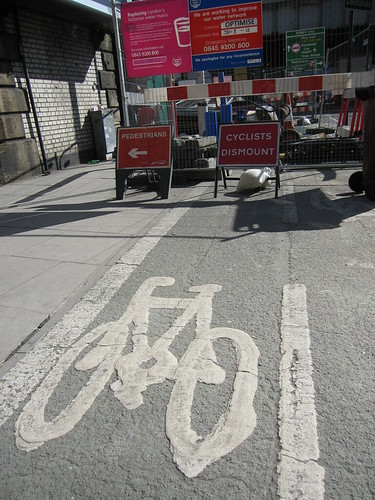
Roadworks in the City: guess which transport mode
everyone decided was dispensable
I smile a similarly wry inward smile when cycling along any
section of pavement (sidewalk, American readers) that’s been divided between
pedestrians and cyclists. The standard UK practice is to mark the separate pedestrians and cyclist sides with ridged tiles (to help vision-impaired people). The ridged tiles on the cyclists’ side are laid parallel to the
bike’s wheels, however. Those on the pedestrian side run acrossways. A
reasonably cautious cyclist consequently has to veer onto
the pedestrian side at the tiles, to avoid the small but real danger the ridges will catch his front wheel. Having
narrowly missed crashing after catching my wheel a few times on such a tile, I’m
unwilling to take more chances.
My main thought as I negotiate these obstacles (or, more
properly, “cycle facilities”) is to wonder whether their designers are even vaguely familiar
with a bicycle and its basic physical properties. I think we can dismiss out of
hand the idea that they might actually regularly ride a velocipede.
However, there’s a second, more serious thought. If this is
the rich world’s idea of cycling infrastructure, why are so many cycling
organisations pressing for more of it?
Such a notion pitches me, of course, into a bitter
intra-cyclist dispute. It echoes, in a way, the divisions everywhere among
oppressed groups seeking greater freedom. Do we seek, like pedalling Malcolm
Xs, the segregation of the separate cycle facility, using mainly lanes free of
our motor-powered oppressors? Or do we pursue peacefully the dream of
integration, winning the right to the respect we deserve on the wider, more
diverse society of the road?
It’s worth saying, of course, that I am as open as the next
person to enjoying a car-free environment. When visiting my parents-in-law, I
cycle to their church in north Wales partly on a tarmac path along an old
railway line. On a Sunday morning, with few runners or other cyclists about, it
can be one of the purest, most uncomplicated bike-riding experiences available.
One of the most enjoyable cycle facilities to use in London is a fully
segregated cycle lane along Cable Street in the East End. The absence on most
of the route of worries about car behaviour is undoubtedly one of its
attractions.
It’s the difference in stress levels using such routes that
leads admirable campaigners in many countries to demand better, separate cycle
provision. In the UK, it’s currently common for such campaigners to say cycling
will remain a niche activity for the eccentric few (such as the Invisible
Visible Man) until the country boasts the same kind of network of segregated
cycle routes as the mass-cycling Netherlands or Denmark. They look at people
like me who think there are chances of forging a basic understanding between
road users and shake their heads. Isn’t it sad how determined we are to restrict cycling to ourselves and a few other members of the privileged
middle classes?
I have, as it happens, a fundamental distrust of the idea of
segregating any groups of people that can’t seem to get along. But I’m worried
about the practicality of cutting cyclists off from other traffic too.
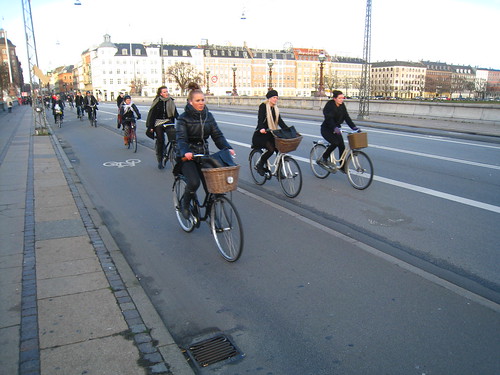
Nørrebrogade: exhibit A in the segregationists' case
It’s certainly hard to feel too sceptical about segregation
standing in the morning on Nørrebrogade, in Copenhagen, the
street that carries traffic from the west of Copenhagen over a string of lakes
into the city centre. I went to look at it in late 2009 and, even towards the
end of the rush hour, there were hundreds of bikes streaming down neat,
segregated cycle lanes. Niels Tørsløv, the head of Copenhagen’s city traffic department,
told me the city timed the traffic lights to fit in with the flow of bikes, rather than cars. One
of the major controversies he was tackling was over the number of cargo
bikes in the city. He was having to widen the cycle lanes to make it easier to
overtake them. Such are the problems of directing traffic in a city where 37
per cent of people get to work, school or college by bike.
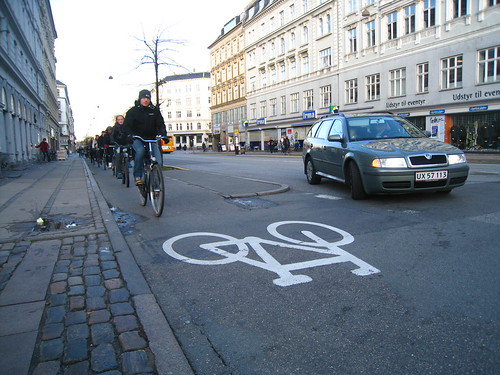
A Copenhagen motorist helpfully illustrates
the Invisible Visible Man's point about side-street conflicts
But, according to Mr Tørsløv, the segregated lanes only
rearranged the accidents, putting them at the intersections between roads and
cycle paths, rather than at even spaces along the roads. Copenhagen put in the cycle
lanes, he said, only because they encouraged people to cycle – cycling numbers
rose 10 per cent when a street gained a cycle lane. I happened later the same
day to see a motorist knock off a cyclist using a segregated cycle lane.
After that visit, I started to notice, as I sped along Cable
Street towards meetings in Canary Wharf, how disproportionately at risk I was from motorists pulling across my path at side streets. I was
out of their eye line and difficult to see.
The Invisible Visible Man's hired cruiser bike.
He's not on it - but obviously
drivers saw it like this all the time
My experiences last week in the US (the reason, dear readers, for the late production of this latest blog post) underlined my worries about segregation. Unable to bear any longer missing my bike languishing across the Atlantic, I hired a cheap cruiser bike
and headed across the causeway from Miami Beach into downtown Miami proper. I
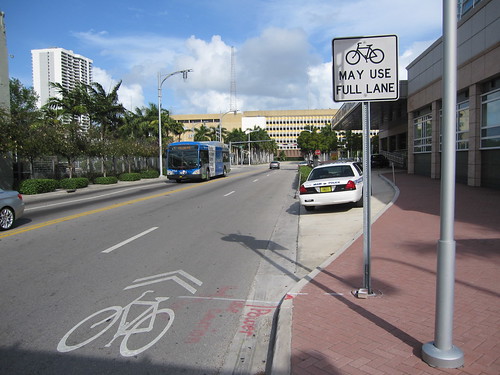
was encouraged at points to see cycle lanes marked on the road. But then I spotted
a sign with a bike picture and the words “may use full lane”. This was a rare
piece of permission, I realised. The painted lanes were less a facility than a
prison, confining me to the fringes of the roads.
Given the number of motorists I’ve already had tell me in
Britain that I shouldn’t be outside some rebranded gutter masquerading as a
cycle lane, it made me worry what kind of message a heavy concentration on
segregated lanes would send. Certain motorists would quickly come to think
of on-road cycling as banned.
A whole lane? The City of Miami, for once, spoils cyclists
I’m consequently positioning myself in the middle of the
lane, staring round at any potentially menacing drivers - and pedalling my way into the camp that says cyclists and motor vehicles broadly
have to coexist in most city streets. This action will, I know, put me, to some advocates, irrevocably in the Not a Good Person
camp. They will look upon me henceforth the way a reactionary newspaper columnist would if he had seen me cycle through a red light and mount a pavement, mouthing
obscenities.
Yet I’m reluctant to side firmly with either camp because bike behaviour doesn’t seem
to me the most important issue on the roads. Watching politicians’ obvious
nervousness when discussing road funding in the UK this week has illustrated
how fear of drivers continues to drive attitudes about how roads are used. The
same fear holds back police forces from tackling speeding, driving while
distracted and the other driver behaviour that puts some cyclists off. After a driver threatened to assault me recently,
the police showed no interest in investigating the driving offence that led to
the confrontation. The driver had deliberately pulled his car across the path
of a cyclist in, I suspect, full view of a CCTV camera. It would have been a “disproportionate
use of police resources” to try to retrieve the film.
There doesn’t even seem to be an appetite for explaining the
law. Many drivers, I suspect, don’t actually understand they’re not meant to
intrude into cycle-only stop areas or that cyclists are allowed to ride outside
cycle lanes. It would take too much courage to embark on a simple public information
campaign.
Motorists’ attitudes are certainly not immutable – I’ve
referred before to the transformation in views about drink driving in many countries as an example. It’s my guess that, if motorists were behaving better,
far fewer people would yearn for the apparent sanctuary of segregated lanes. Meanwhile, if the apathetic planners currently in charge in many
western countries set about building new cycle infrastructure, it’s
a fair bet it would tend more to keep cyclists out of motorists’ way than to help cyclists.
It's unfortunate, too, if the debate polarises advocates into backing two separate approaches. Some places – the busy roads by the Thames in
London, for instance – look perfectly set up for separate cycle lanes. The narrow
streets in the City of London look best suited to assertive, on-the-road
cycling. Many junctions need redesigning. Others would be fine if the current ignored rules were enforced.
But, for the moment, cyclists’ real needs are so far from
policy makers’ minds that they’ve built a “Cycle Superhighway” out of stuff
that makes bikes skid. I’d prioritise changing motorists’ and
officials’ thinking over pressing the same people to build more of their flawed idea of cycling facilities.
At the end of most weekdays during my
first year of higher education, I would cycle to the central quadrangle of St
Andrews University’s ancient buildings, head into a down-at-heel lecture
theatre and ponder some of the biggest questions facing humankind. The most
eagerly-anticipated Moral Philosophy lectures were by Gordon Graham, the
department’s most charismatic lecturer. We teenage students would enter the
room to find Dr Graham grasping the podium and peering keenly up at the rows of
wooden seats. He brought to mind nothing so much as a hawk eager for some
intellectually lazy morsel of first-year thinking to devour.
Praise from Dr Graham for one’s
contribution from the floor would leave one feeling a little elevated for days
– one enconium boosts my fragile ego 24 years later. Dr Graham’s scorn would
leave a discernible chill.
The question is which side Dr Graham, who
gave a particularly memorable lecture series on how to live “the Good Life”,
would have come down on whether to get around a city by bicycle. The Good Life,
Dr Graham eventually concluded, was “the rational life”, where one sought to do
good to others, make the most of one’s abilities but also to be effective and
rational. One should reject mere
gestures in favour of doing things that genuinely improved the human condition.
A cyclist in London rain: cycling feels part of the Good Life
some days more than others
I’ve dwelt in past posts on the irrationality of other road users’ behaviour towards me, as well as cycling’s
capacity to spring sudden, joyful surprises. But are my own actions any more part
of a rational life than those of the road-users I criticise? To put it less
gracefully, would Dr Graham side with the tooth-suckers – the people who see my
high-visibility vest and helmet, suck in their breath through clenched teeth
and say, “I think you have to be mad to cycle in London”?
I should say at the outset that I’m not managing
to live the rational life. A wholly rational person would drink less than I do,
knowing that he was outweighing any health benefits by the damage incurred. A
wholly rational person would eat less, weigh probably 20kg less, get more sleep
and get less stressed about working in a job that, while it feels like one is
writing the first draft of history, is ultimately fairly trivial. That’s even
before tackling the subject of my wider belief systems, which I would stoutly
defend but many people would criticise.
Nevertheless, it strikes me as more worthwhile
to make a stab at living the rational life than merely to do what whim and
hunch suggest. It’s consquently worth examining whether an activity that takes
up at least an hour most days – more on many – and occupies an irrationally large
amount of my waking thinking fits with such an aspiration.
It’s with the tooth-suckers that I most
often discuss cycling’s rationality. The conversation generally starts with
their saying, “I think you’re very brave” or “I love cycling but I wouldn’t
like to try it in London”
or just, “Isn’t it very dangerous?” The most depressing instance was the first
time I met Geoff Hoon, then UK
transport secretary, in his office. “So can you cycle around London?” he asked. I recognised how well
pro-cycling initiatives would do under his leadership.
A big truck: the tooth-suckers think
one of these will get me some time
The tooth-suckers are ultimately claiming
that any benefits I might gain from cycling are outweighed by a substantial
risk that, sooner or later, I’ll find myself beneath the wheels of an articulated
lorry. The hopeless dream that my steel-framed bike and
vulnerable body could co-exist with trucks taking baked goods to Sainsbury’s will have literally been crushed.
My standard answer is to quote research
conducted some years ago by the Cyclists’ Touring Club which showed the average
British cyclist who cycled into middle age enjoyed life expectancy enhanced by
two years, while risking on average losing only two months through cycling
accidents. It’s a 12 to one benefit to cost ratio, I tell people. I even
occasionally mention the subtle message of the obituaries page in the Cyclist
Touring Clubs’ Cyclist magazine. Stories abound of wiry old devotees of the
Sunday club run succumbing eventually only in their 80s or 90s.
Although I might have to hide a receipt
for the latest £100 spent on my transmission while doing so, I could also point
the tooth-suckers towards the financial advantages of cycling. Even with the
amount of damage I seem to do to bike parts, I’m sure I’m spending less than if
I commuted by public transport. I impose virtually no costs on others through
wear and tear on the public roads.
There are also, of course, the
environmental benefits, which many non-cyclists assume are a major factor in
many people’s cycling. It is indubitably one of the few forms of transport –
amid a motley selection including skateboarding and cross-country skiing – to
involve carbon emissions only in the making of the equipment. It’s just
unfortunate that one sounds so insufferably pompous talking about it.
The only time I’ve been tempted to raise
my superior carbon status was when a woman honked loudly at me after I blew my
congested nose’s contents onto a road at traffic lights. It was, I’m sure, not
a pretty sight. But there was an irony in being reprimanded over my
biodegradable mucus as she merrily pumped out long-lasting greenhouse gases.
While some motorists seem to regard me as a vast, insuperable obstacle in their way, it also seems rational to me to use a vehicle that takes up relatively little of the precious urban space devoted to roads. I'm sometimes tempted to ask motorists frustrated with being stuck behind me whether they'd prefer I was sitting in front of them in a car.
There is, meanwhile, scope for me to manage the
safety risks. Although Transport for London
research attributes blame for roughly two-thirds of accidents involving
cyclists to the motor vehicles involved, there’s still substantial scope for me
to cut down my chances of ending up in the road. Failing to look properly, failing
to judge another person’s path or speed and being careless or in a hurry were
the top three reasons for accidents attributed to cyclists. A careful cyclist
can work at avoiding all of those.
Pedestrians: shouldn't they be
wearing helmets?
Yet there remains the objection I heard
from one senior figure in my office. He had, he’d told me, been asked, on
appointment to his present job, to stop cycling to work. He’d become too
important to lose. To my point about cycling’s health benefits, he retorted
that he went regularly to the gym. It is clearly true that the CTC’s averages
for life expectancies mask very different distributions of the benefits and
risks of cycling. Nearly every cyclist gets the extra two years – while the
average lifespan lost through accidents represents an unfortunate few, each of
whom may lose decades each.
Nevertheless, a check through Great Britain’s accident statistics for 2010 backs up a point I’d already deduced looking
around my office. The intersection between colleagues who motorbiked and those
to be seen outside with the smokers was striking. These are the real
risk-takers - there were, I discovered, 36 cyclist deaths per billion vehicle
miles in 2010, against a hair-raising 138 for motorcyclists. Even for
pedestrians, the fatality rate per billion miles walked was 37. The only really
safe group, I realised, was car occupants, wrapped in their steel shell and
suffering only three fatalities for every billion vehicle miles. Each of the 111 cyclist deaths represents a real, avoidable tragedy. There should be far fewer. But I, for one, am
prepared to accept the risks of an activity that, despite the appearances, is
safer than walking.
Of course, it’s reasonable to ask whether
any evidence I could have uncovered would have driven me off my bike. I would
certainly be profoundly reluctant to give up the satisfaction of making my way around under my own power, feeling the wind on my face and hands and catching a
sense of the city living around me.
But the powerful evidence in favour of
cycling does, for me, improve the experience. It feels like the right choice, a
rational choice. Then, occasionally, when the wind is in the right direction,
the drivers polite and the roads clear, I even sense that I am, indeed, living
the Good Life.
Are you making a rational decision to cycle? Are you making an irrational decision not to cycle? Are you making an irrational decision to cycle? You can work out roughly how these questions are working, so please just use the comments box to let us all know your answer.