Showing posts with label Share the Road. Show all posts

Monday, 4 August 2014

A close pass, a misguided campaign - and why I won't just leave it on the road

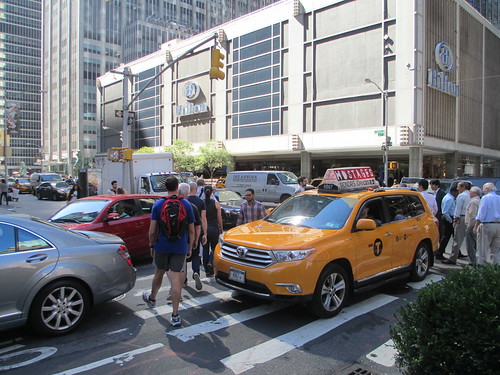
On July 17, as I cycled to work, amid the chaos of rush-hour downtown Brooklyn, I spotted a narrow gap to the right of a line of stationary traffic. I moved into it and rode cautiously towards the next intersection. Then, to my shock, I realised a taxi driver had decided there was room between me and the other traffic for him also to squeeze through. He drove past me, much faster than I was going, leaving at most around six inches to spare. Knowing that any miscalculation would have had me tumbling under the taxi’s wheels, I felt a surge of panic and rage.
 
Close pass: here's how it looks when I try to photograph
a taxi moments after it's come within inches of me
with the lens on zoom and my hands still shaking
Numerous current road safety campaigns – including one by Transport for London, the London Mayor’s transport organisation – would imply that what I did next made me just as bad as the negligent driver. Catching up with him and still feeling the shock of his pointless, dangerous behaviour, I yelled at him: “You could have killed me. You’re a dangerous driver.” Looking at me with stone dead eyes, he languidly rolled up the passenger-side window and drove off as fast as the traffic jam would allow.

The Transport for London campaign – which inevitably uses the shopworn “share the road” slogan – would have enjoined me to ignore the driver’s actions, take a deep breath and head on my way as if nothing had happened. “Leave it on the road,” it advises road users. It isn’t, I think, advice about what one should do with the body fluids and teeth of people that rile one.

My example highlights the insane irrationality of such campaigns. A “leave it on the road” approach to road safety suggests that the real problem is people’s malice towards each other or negative perceptions. It ignores the evidence that negligence, inattention and poor risk assessment are significant causes of car crashes. It puts the focus on vulnerable road users’ reaction to negligent driving. It suggests that all cyclists and pedestrians are somehow collectively responsible for each others’ behaviour. Motorists are helpless vessels full of potential rage that cyclists or pedestrians can make explode or safely depressurise. The approach serves no conceivable purpose other than to comfort people like the taxi driver who put me at risk. “Yes,” is the hidden message. “The real problem is those nasty, lippy cyclists.”

Such campaigns nevertheless enjoy such continued credibility that I found myself arguing vigorously recently with a cyclist who trenchantly defended a campaign by the state government of Utah under the title “Respect is a Two-Way Street”. Most problems cyclists encountered on the road were a result of motorists’ past experience of bad cyclist behaviour, my interlocutor assured me.

I came upon this two-car shunt on Saturday on the Upper
East Side, an eminently respectable neighbourhood.
But was a lack of respect between drivers the real problem?
Utah’s campaign isn’t alone. David Zabriskie, the professional cyclist, has organised a similar (if more nuanced) campaign under the title “Yield to Life” that seeks to build “understanding, respect and appreciation for all life” between cyclists and motorists. British Cycling has called for “mutual respect” between cyclists and motorists.

Yet it’s self-evidently bizarre to argue that the solution to drivers’ killing people is to ask everyone to be nice. There is a quality-of-life argument for asking people to be calmer and more tolerant. I try when I haven’t been put in fear of my life to act considerately. But it’s hard to see that “share the road” campaigns are a better route to that destination than making the roads safe. The question is why “share the road” campaigns continue to consume energy that could be better directed elsewhere.

I suspect the answer is that transport authorities face a choice between conveying messages that are broadly popular and bringing about changes that are likely severely to annoy many. It’s not a surprise – though it’s certainly a disappointment – that the former so consistently wins.
 
Cyclists respectfully wait when asked to stop at this year's
Summer Streets event. What is it about this motor
vehicle-free environment that suddenly makes cyclists
show people more respect?
It’s not hard, after all, to guess such campaigns’ genesis. Many cities worldwide, in gestures towards environmental concern, congestion relief or obesity prevention, have sought to encourage cycling, many with more success than they expected. Surges in cyclist numbers on roads designed to facilitate smooth car movements have often led to spikes in cyclist deaths, even if the death rate per mile cycled has usually fallen. “Share the road,” “mutual respect” and other similar campaigns are all manifestations of public officials’ dilemma. They don’t want to stop the growth of cycling but lack the political capital or courage to upset vocal motorist groups, local shopkeepers, the local newspaper or the many other noisy defenders of the status quo. It must seem a beguilingly simple solution to tell everyone to up their game and hope the problem goes away.

The laws of physics, human nature and psychology keep getting in the way, however.

The taxi driver who brushed by me was driving a Toyota Highlander – a vehicle that weighs 2.5 tonnes – and moving considerably faster than I. That would have made a critical difference if he had actually hit me. His vehicle’s momentum, mass and size surely meant he had a far greater duty to be careful than I had. The emotional stakes were also entirely different. I seek to keep myself safe precisely because I know the odds if I’m hit. The driver could afford to keep his sang froid precisely because, as the driver of a large SUV, he was effectively invulnerable. I was acutely aware of how close he’d come to me because I was out in the open and constantly watching for danger. Sitting on the far side of a 6’ 4” (nearly 2m) wide vehicle, the driver probably had little conception of quite how much he was endangering me.
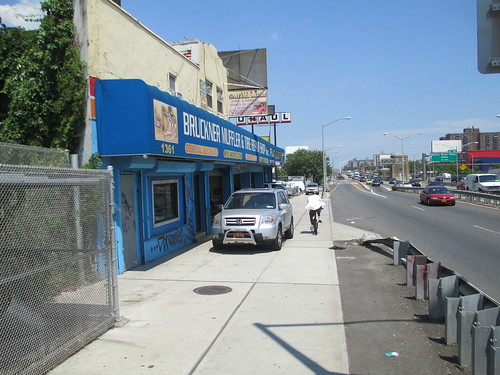
A car parked on a Bronx sidewalk-cum-cycleway. If only
that cyclist had shown more respect, perhaps the driver
wouldn't have felt forced to act this way.
New York City has not actually run a “mutual respect” campaign in the time I’ve been here but I’ve heard all the most senior road safety figures in the city – the transport commissioner, head of the police’s traffic squad and the head of the state department of motor vehicles – back the approach in speeches. The police commissioner erroneously claimed earlier this year that fatally-struck pedestrians tended to cause their own deaths – an entirely untrue assertion that, if it were true, would make some sense of “share the road” campaigns. The tenor of many of the police’s actions – the determination to hand out traffic tickets to pedestrians and, disproportionately, cyclists as well as motorists – seems to reflect the same thinking.

This “even-handed” approach isn’t making people safer, however. According to figures from WNYC, the radio station, 141 people had died in traffic in the city up to August 1, which makes it seem likely there will be almost as many traffic fatalities this year as the 274 in 2013. I can’t find any statistics for road deaths so far in London this year but there’s little indication its record – while far better, per capita, than New York’s – is improving much.
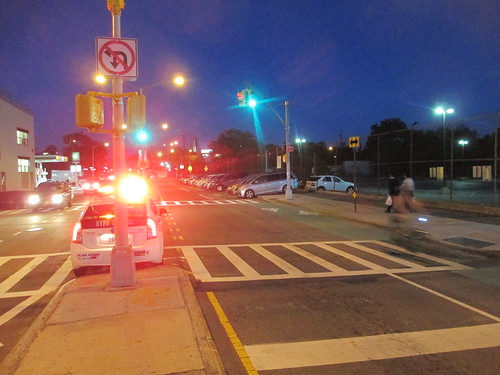
Parked cars block the new two-way bike lane on
Kent Avenue, South Williamsburg: it's absolutely clear
how much extra mutual respect would help alleviate
this problem.
There isn’t any great mystery which approach would make the big cities of the English-speaking world genuinely safer. London has a better record than New York partly because London has far more automated speed and red light enforcement via cameras. It’s also pretty obvious to anyone with experience of British cities’ side streets that there are far more speed humps, road narrowing, raised crossings and other measures to slow traffic down and make pedestrians more visible. The cities with the best cycling safety records tend to give over substantial, well-designed space to cyclists on their streets. Anyone who’s looked at the situation rationally will find these points unsurprising. There’s overwhelming evidence, from repeated studies in multiple places, that drivers’ inattention, excessive speed and other mistakes cause the vast bulk of crashes. Measures that constrain their speed or force them to pay attention unsurprisingly tend to make everyone safer.

But such measures seem to give rise in many people to a kind of existential panic. Powerful groups – men, privileged races, imperial powers – tend to think that they have their jobs, their access to better schools, their political power or their access to road space by right and by merit rather than as a result of rigged power structures. The howls of protest have the same tone of injured innocence I’ve heard in the past from Northern Irish Protestants, Kosovo Serbs and others who see privileges taken for granted being eroded.

I don’t pretend that it’s an easy political choice to take on those vested interests. There would be bitter, angry complaints if New York City’s Department of Transportation decided to put in a well-designed protected bike lane for the many cyclists riding down Smith and Jay streets every morning. It’s my own choice to take – and try to manage – the risks inherent in cycling while those arrangements aren’t in place. But, until something effective is done, I’d rather the authorities not add insult to the threat of injury. I don’t respect drivers who think their desire for convenience trumps my right to life.

Sunday, 8 December 2013

A Jersey City leaflet, an East New York death - and why police are bothering the wrong people

It was near a Path subway station in Jersey City that I encountered a ripple from a wave of sloppy thinking currently sweeping the English-speaking world. On a corner on Grove St, one of the city’s main thoroughfares, a woman wearing a high-visibility vest approached me and thrust a leaflet into my hand.

The pamphlet contained a series of safety rules for pedestrians – among them “Cross at corners and intersections” and “Before crossing look left, right,then left again”– and threats of fines for pedestrians who broke the rules. There were also instructions to drivers. But, even as motorists barged past people crossing right by her, the woman kept thrusting the leaflets solely on people walking.
 
Hey, pedestrians: you can't say
New Jersey hasn't warned you
New Jersey’s safety drive is one of many currently under way on both sides of the Atlantic aimed at improving vulnerable road users’ safety by getting them to take more care. In London, a big part of the response to a spate of cyclist deaths has been to station police officers at key intersections to harass cyclists not wearing high-visibility clothing or helmets. In Park Slope, near where I live in Brooklyn, the New York Police Department’s 78th precinct reacted to a series of recent pedestrian fatalities by posting a list of pedestrian safety tips. They included advice that pedestrians should carry flashlights (torches, British readers) at night. People shouldn’t walk in snow or rain, it added.

The implicit assumption is clear. Vulnerable road users are vulnerable not primarily because they lack protection from the behaviour of motor vehicles but through their own irrational actions. Pedestrians wander heedless, according to this analysis, into the path of cars, whose drivers can scarcely be expected to miss them. Cars hit cyclists primarily because cyclists ignore red lights. It’s a view one can find repeated online in the comments under pretty much any news article about road safety – especially if it concerns bikes.
 
Hey, be fair. The card mentions motorists.
It's just that they don't give it to them.
Yet the worry should be precisely that crashes occur despite the best efforts of vulnerable road users to behave rationally – and because motorists correctly feel themselves largely invulnerable. A study  by researchers at Melbourne University, in Australia, found that 88.9 per cent of cyclists in a study were behaving safely and legally before collisions, near-collisions or “incidents” recorded on their helmet cameras. The figures tally with those in a Transport for London study of all the recorded injuries and deaths of cyclists from collisions with cars during 2010. The London study suggests around 74 per cent were the motorist’s fault, while the Australian researchers blamed the motorists for 87 per cent of the incidents. Studies from around the world regularly seem to find motorists to blame in around 75 per cent of bike/car crashes.

For pedestrians, a study in New York found that 44 per cent of those injured by cars were hit when in a marked crosswalk while crossing with the light, while another 6 per cent were hit on the sidewalk. Given that many of the other crashes will also be a result of motorist negligence, a clear majority of crashes involving pedestrians also appear to be the fault of the motorist concerned.

Pedestrians and cyclists appear, in other words, to behave like people who have a lot at stake on the roads and to take their own safety seriously. The crash on November 25 in East New York that killed Maude Savage seems, according to these studies, to be fairly typical. A surveillance video shows Ms Savage, a 72-year-old pedestrian, waiting and looking carefully before crossing, with the lights in her favour. A van then speeds around the corner and through the crosswalk, hitting her at speed. Robert Brown, the van driver, seems, to judge by the video, to have been driving like someone who recognised that, for him, the consequences of hitting a pedestrian wouldn’t be that serious. As things stand, it probably makes more sense for a busy technician like him – he was working for a cable TV company - to prioritise speed over avoiding a crash.
Cars on a crosswalk in midtown Manhattan.
The cars realise it's vital not to impede uptown progress
on 6th Avenue. So they block the crosswalk.

As with many road safety issues, however, many politicians and police officers seem to base their reaction to vulnerable road users’ deaths mainly on gut instinct and intuition. It’s often easy to sense frustration – “Why won’t these cyclists just get in a car or ride on the subway like everyone else?” Lord James of Blackheath, a Conservative peer, took such thinking to its logical – and absurd – extreme on November 22 when he claimed in a House of Lords debate that cyclists longed to be knocked down – to get motorists into trouble.

Even among people trying to make ostensibly saner points than Lord James, there’s considerable misunderstanding about where the risks lie. Politicians and police officers regularly whine about how cyclists allegedly cause crashes by ignoring red lights – but the Transport for London study found cyclists’ failure to obey a light was a contributory factor in only 61 crashes – against 2,650 involving motorists’ failure to look properly. It wasn’t significantly more common for cyclists to cause crashes by running lights than motorists – a motorist’s failure to obey a light was a contributory factor in 36 crashes. There’s a powerful tendency for policymakers to connect behaviour they observe – “some cyclists run red lights!” – to the death toll, without any further examination.
 
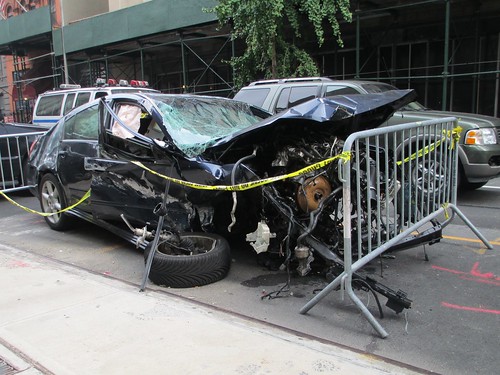
This car crashed at 100mph on West St in Manhattan.
How the NYPD thinks pedestrians can protect themselves
against such risks isn't clear.
There are certainly things that cyclists and pedestrians can do to protect themselves. In the Transport for London safety study, the top cause of crashes caused by cyclists was “failed to look properly,” just as it was for cars. “Failed to judge other person’s path or speed” was the second most common cause of crashes for both cyclists and drivers, while “careless/reckless/in a hurry” was number three for both. The Melbourne study of cycle crashes found that cyclists who looked over their shoulders a lot were least likely to be involved in crashes. There is clearly a great deal to be gained for any vulnerable road user through keeping keenly alert and watching out for the negligent behaviour of others.

Most people certainly make some trade-off in their road behaviour between convenience and safety. It’s surely worthwhile for the people with most to lose through a crash to let safety rule their judgement all the time – if only because it’s clear that people protected by metal shells feel free to prioritise their own convenience over other people’s lives. Last Sunday, riding down Garfield Place in Park Slope, I heard a woman in a car behind honking at me so violently that I, unusually, pulled over into the parked cars’ door zone so that she could squeeze past. “You should be over to one side!” she screamed at me as she zipped past too close, her face contorted with rage. The mismatch of concerns was precisely the one the TfL and Melbourne studies would suggest it might be. She was anxious I might hold her up by a few seconds. I was concerned her car might crush me to death.

Yet the fact remains that New Jersey’s police forces, the New York Police Department and Metropolitan Police are all placing a lot of the emphasis in their road policing efforts on berating the victims rather than the perpetrators of crashes. The tactic is reminiscent of the times – sadly, not too long ago in some places – where the answer to preventing sexual assault was meant to be to stop women walking alone at night or wearing “provocative” clothing. It’s a tactic that, by the nature of what causes the crashes, can never work. It’s patronising and demeaning.
 
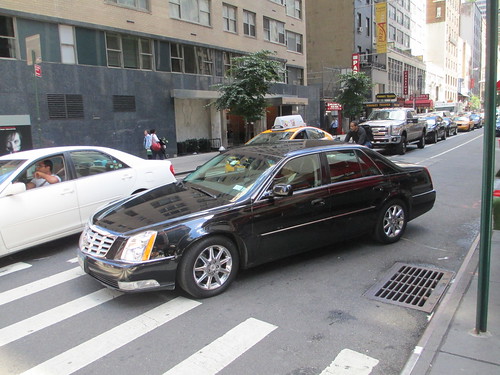
The true effectiveness of years of "Share the Road" efforts
is clear from this picture of a midtown Manhattan Street.
Note the Cadillac blocking the route of the cyclist
using the bike lane.
The correct solution is hiding in the plain sight of that TfL report and Melbourne University study. There simply aren’t enough incentives for motorists to care as much about vulnerable people’s safety as they care about, say, making that important ‘phone call. The driver who ran into Maude Savage appears, according to Streetsblog, the campaigning site, to face no more than a $500 fine or 30 days’ jail, for example.  He faces that only because he turned out not to have a driving licence. It will be only when drivers face a good chance of heavy fines, losing their licences or imprisonment for negligent driving that the convenience/safety trade-off will start favouring safety more often.

Yet the chances of a big change in attitude soon seem remote. Appeals for everyone to “share the road” have the advantage of seeming even-handed and fair. Pleas for vulnerable road users to look after themselves better have the advantage of addressing those with most interest in improving road safety, even if they miss those best placed to improve the position. The alternative is to start acting on the reality of the picture that the research paints. That is that private motor vehicles – the dominant form of transport in most developed countries – pose big risks to those around them, and most drivers drive as if they didn’t. That seems like the kind of truth that politicians will put off addressing for as long as they possibly can.