The young man looked at me distrustfully. I gestured to him
to head across the pedestrian crossing where I’d stopped my bike for him. He
again looked warily to his left, in the direction from which cars tear at high
speed down Hoyt Street ,
in Cobble Hill, in defiance of the area’s 20mph speed limit. Having finally
decided that it was safe, he crossed and I was able to resume my journey.
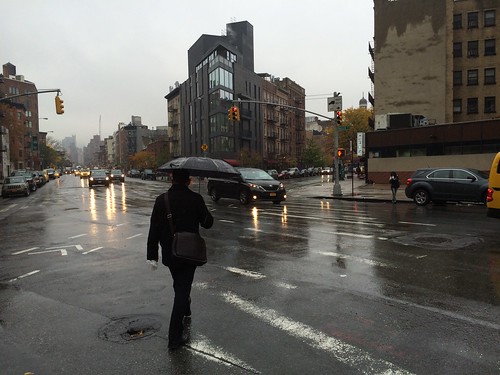 |
| A New York City pedestrian: understandably wary. |
The incident on Friday night was one of the clearest illustrations I’ve encountered recently of the difficulty of communicating with other
road users. Such communications are often obstructed by noise, by the challenges
of communicating with people inside a metal box and by people’s varying
expectations about how other road users will behave. The young man I
encountered was fearful of my effort to help him cross the road precisely because
no-one else stops for that crosswalk, which links shops on Hoyt St to the
Gowanus Houses public housing on the other side of the road. My stopping was so
out of step with other road users’ behaviour that it must have seemed like some
kind of practical joke.
The communication barrier facing cyclists seems particuarly high in cities like New York and London where cars dominate the streetscape . In such big, industrialised cities with only modest cycling levels, few other road users have the inbuilt sense of how cyclists might or
should behave that they have with motorists and pedestrians. The scope for severe mutual misunderstanding is significant.
Yet roads remain intensely communal places, where the
different users are entirely reliant on each other for safety. Cyclists,
drivers and pedestrians all need to decode a complex series of verbal and
non-verbal signals to work out each others’ intentions and likely future
behaviour. The communication barriers play a big part in ensuring that roads remain such dangerous places. But almost no-one addresses the obstacles that the obvious and growing barriers represent.
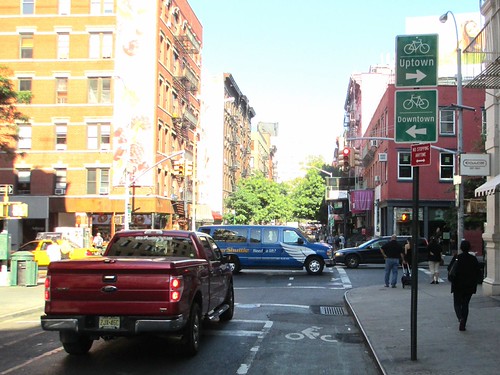 |
| Prince St at W Broadway, Manhattan: a venue where I often have to practise my new communication policy with drivers. |
My sensitivity to the challenges of interacting with other
road users has been heightened, I suspect, by a change in my own communication
policy. In the last few months, I’ve become even more prone than before to
using my loud, powerful voice to try to stop drivers from running me over. I do
this most often by shouting at drivers trying to cut across my path at
intersections, “Stop! Wait there!” While I’m sure that many of those at whom I shout have no
desire to behave legally and respect my right of way, most drivers who hear someone shout, “Stop!” loudly in their direction seem to step at least temporarily on the brake pedal.
But I’ve also been struck by the policy’s shortcomings. It
regularly leads passersby to shout mockingly at me, rather as though vocal
communications in traffic were subject to the same taboos as speaking in a
library or an ancient sacred space. People seem to resent clear, unambiguous
communication across the cyclist-driver divide.
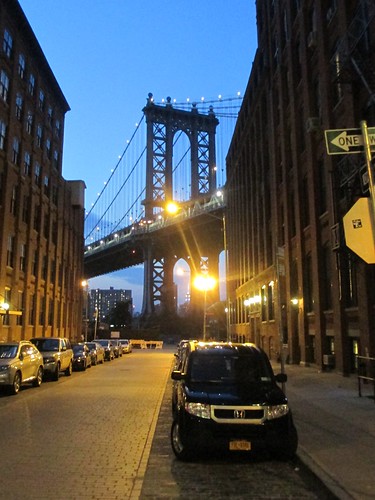 |
| Pearl St, in Dumbo: good luck communicating clearly with the driver if one of those cars starts pulling out in front of your bike. |
My shouts also seem to work far less well with drivers
who are pulling out of parking spaces into my path. There’s a tendency for
drivers creeping slowly into a bike lane while waiting for a suitable gap to
pull out to believe their intentions should be clear to those around them. When
I shout, “Stop!” at such a driver moving slowly into my path, his or her
rejoinder is often to shout, “I saw you!” There’s a failure on the driver’s
part to understand that his or her actions communicate the intention to pull
out but not that he or she has seen me and is taking care not to hit me.
It’s because I recognise that my actions are my clearest
means of communicating with fellow road-users that I seek, by and large, to
obey traffic signals. I hope – and I realise it’s a fairly forlorn hope – that
the example of my self-discipline will communicate itself to the drivers who pose the real danger. I think there’s a usefulness to having an agreed set of standards for
how to act on the roads – albeit a severely flawed one – and to making a point
of obeying it.
For the same reason, I try as I cycle around to make obvious, unambiguous movements.
When passing a car parked in a bike lane, I don’t squeeze by hoping that other
vehicles won’t pass me too close. I swing firmly out into the neighbouring
traffic lane, showing following motorists that they shouldn’t overtake. I try
to make eye contact with drivers when I can. I signal clearly where I’m going.
I use my bell to warn pedestrians when I’m approaching – although, frankly, a
follow-up shout of “Watch out in the crosswalk!” to people crossing against the
light is generally necessary.
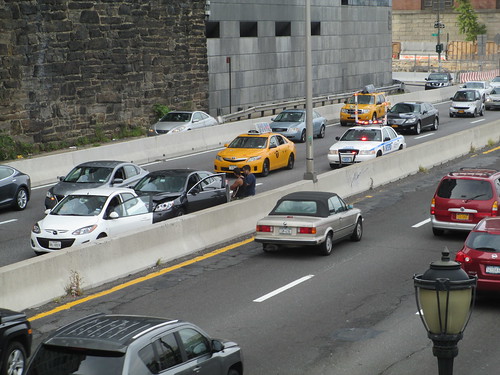 |
| A rear-end shunt on FDR Drive: looked at another way, it's a failure of two drivers to communicate clearly |
Many of these efforts nevertheless run slap-bang into vast barriers. Some of them are cultural. New York drivers seem so used to the idea that they can pass a cyclist in a bike lane with only a tiny space to spare that it barely seems worth trying to communicate with those who do why their behaviour is so dangerous. I ran into similar challenges when I lived in London with drivers who simply didn't seem to realise they shouldn't block advance stop boxes at traffic lights.
The most inescapable fact of on-road communication, meanwhile, is that the modern motor vehicle is designed to shield users from the reality of their being involved in a social interaction. The interior of a motor car looks and feels more like someone’s home than a machine for transporting goods and people. Cadillac last year ran an advertising campaign showing a ring of cymbal-clanging toy monkeys surrounding a Cadillac CTS expressly to boast how the vehicle’s sound-proofing, glass and even noise-cancelling equipment would silence the reality outside the vehicle. It’s no surprise that people riding in such vehicles might struggle to grasp the complexity of what’s going on in the streets surrounding them – or that they might react angrily to my rapping on the window to point out that they’ve nearly, by their negligence, run me off the road.
The most inescapable fact of on-road communication, meanwhile, is that the modern motor vehicle is designed to shield users from the reality of their being involved in a social interaction. The interior of a motor car looks and feels more like someone’s home than a machine for transporting goods and people. Cadillac last year ran an advertising campaign showing a ring of cymbal-clanging toy monkeys surrounding a Cadillac CTS expressly to boast how the vehicle’s sound-proofing, glass and even noise-cancelling equipment would silence the reality outside the vehicle. It’s no surprise that people riding in such vehicles might struggle to grasp the complexity of what’s going on in the streets surrounding them – or that they might react angrily to my rapping on the window to point out that they’ve nearly, by their negligence, run me off the road.
Inside that sensation-deprived space, there must be a heightened sense of frustration at the mismatch between the
calm sounds of the vehicle’s clear stereo or white noise and the more chaotic
pictures coming in through the windows. I’m confident that frustration explains
many of the times I have motorists drive fast at me, blaring their horns. This
silent, frantically pedalling cyclist must seem like a disorderly intrusion
compared with the orderly sound world of the vehicle’s interior.
All of these obstacles play a part in keeping New York's road safety record poor, despite the current mayor's Vision Zero efforts. The position would, needless to say, grow easier if the city built more infrastructure to reduce conflicts, including more of a network of well-designed protected cycle paths.
All of these obstacles play a part in keeping New York's road safety record poor, despite the current mayor's Vision Zero efforts. The position would, needless to say, grow easier if the city built more infrastructure to reduce conflicts, including more of a network of well-designed protected cycle paths.
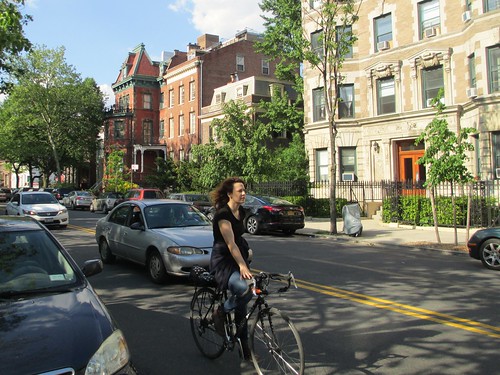 |
| A driver overtakes a cyclist: one of these people is in a box sound-proofed to ensure he can ignore the other. |
As it stands, people find themselves caught up in conflicts fuelled by misunderstanding - and seized of a powerful impulse to reach
through the barriers and explain why they're frustrated. I saw it vividly one recent
morning when a woman, wrapped up in her car’s smooth inner world, pulled out of
a side street in front of a cyclist careering down Smith St on a single speed. The cyclist
jammed on his brakes and landed in a heap. His immediate instinct was to spring
to his feet and aim a defiant one-fingered salute towards the rear-view mirror
of the motorist. I suspect she never had any inkling of the harm she had done.
I was caught up in a more complicated instance last
Thursday when cycling home down Grand St in SoHo .
A man in front of me was pushing a baby buggy (stroller, American readers) down
the narrow bike lane, one child inside the stroller and another riding on the
rear. His only reaction to my bell-ringing was to continue an exaggerated
saunter, taking obvious pleasure in blocking my way.
It wasn't the first time I'd come across people deliberately blocking the lane on Grand St to prevent cyclists' using it. I've long since tired of giving people who deliberately obstruct me the tolerance I generally extend to even inattentive pedestrians. My irritation welled up when he turned to me at an intersection and sneered, “But we’ve got wheels. We’re allowed to use it.”
It wasn't the first time I'd come across people deliberately blocking the lane on Grand St to prevent cyclists' using it. I've long since tired of giving people who deliberately obstruct me the tolerance I generally extend to even inattentive pedestrians. My irritation welled up when he turned to me at an intersection and sneered, “But we’ve got wheels. We’re allowed to use it.”
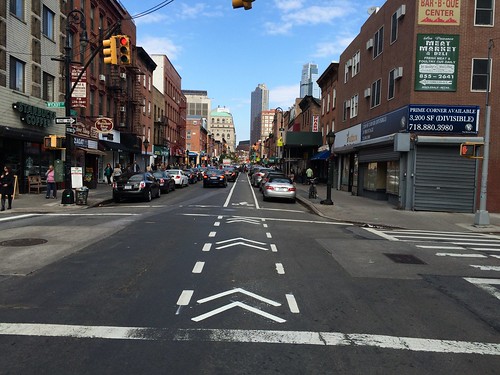 |
| The Smith St bike lane: venue for a memorable failure of communication |
I started calmly, pointing out that it was irresponsible of
him to block a busy bike lane and that someone could have hit him. It would
have been irresponsible of me to hit him, he replied, so I was the
irresponsible one. His deliberate, bullying contempt mixed in with my
tiredness after a red-eye flight the night before and my dismay at the emerging
British general election results. I felt the urge to communicate quite how
deeply he had offended me.
I pointed out – accurately, I think – that he was setting a poor example to his children. I pointed out – again accurately – that his
behaviour was making his wife slink away in embarrassment. I finished with a piece of more metaphysical speculation.
“Your soul’s shrivelling inside you because you’re so petty,” I shouted as I rode away.
“Your soul’s shrivelling inside you because you’re so petty,” I shouted as I rode away.
I should not, clearly, have allowed myself to be provoked. But humans feel the need to connect and communicate with those around them. Far too many street and vehicle designs hinder, rather
than work with, humans’ need to talk to each other. It feels like no exaggeration to say that's drying up many cities' souls.
