It was a rare moment when I felt sorry for a New York motorist. The
elderly man, clearly confused about where to go, had got out of his car to
assess where he was meant to turn at the Manhattan
end of the Manhattan
Bridge Canal St
in Chinatown . “Honk!” “Hoooonk!” “Haaawnk!”
His face expressed an emotion that’s all too familiar to me – fear of
aggressively-driven cars. “What if one of these cars just slams into me?” he
seemed to be thinking. “How can I most easily escape all this honking?”
 |
| New York City traffic: it certainly looks intimidating |
The scene resonated with me. I’d not long before had an
online conversation with someone who’d expressed regret that, although there
was a new Citibike bikeshare station outside her house, she was too fearful to
cycle in New York City .
It just felt like far too great a risk, far too great a worry, she told me.
The exchange had heightened my awareness of the fundamental scariness of New York ’s
fast-moving traffic – and my own reaction to it. I feel concern when I hear a
car speeding down a narrow, one-way street behind me. “Is it going to slow down
when it reaches me?” I ask myself. “Will it tailgate me to intimidate me?” I
worry when I ride through downtown Brooklyn in
the mornings about anticipating the unpredictable behaviour of the drivers. The
click in a car door that someone’s about to open sets off a spike of panic. People in other circumstances must feel something similar at hearing the cocking
of an unseen gun. I used to feel similar alarm about cutting across the lanes
of traffic around the Oval cricket ground in London during my commute to work there. “Get
me out of here,” I’d think. “Any moment now, some idiot will come speeding
round the blind corner.”
But my awareness of fear has also made me realise how year
after year of daily cycle commuting in multiple different cities has changed my
experience of the emotion. I’ve learned, I think, to manage my fear, to train
it to push me towards the right decisions. I wish cycle commuting weren’t as
stressful as it sometimes is and I know that riding a bike in a city isn’t
nearly as dangerous as it sometimes feels. I also recognise that the health
benefits from cycling on average outweigh the risks.
For the moment, however, I’m embracing the way my worries
set off ancient fight-or-flight responses. I treasure how they keep me focused
on riding as safely as I can amid what sometimes seems an almost unmanageably
chaotic environment.
 |
| Smith St: challenging even on days without freezing rain. |
That doesn't mean I wouldn't like a better cycling route to work, just as I yearned for improvements when I lived in South London. I head off each morning down Smith St in Brooklyn
navigating round long lines of vehicles whose drivers clearly aren’t paying enough
attention. They’ll lurch suddenly in or out of parking spaces. They’ll open doors
unexpectedly. Drivers spot the side street they want and turn into it,
oblivious to the idea they might be crossing someone else’s path.
The short – and generally less busy - section in Cobble Hill
is still worse. Drivers floor their accelerators, speeding up like greyhounds
released from traps. There, I look warily over my shoulder, knowing that, if I
have to pull out of the narrow bike lane to avoid a car door, a pothole or a
delivery truck, the cars could be moving too fast to avoid me. Then it’s back
to a chaos of illegally double-parked cars, stray pedestrians and inattentive
drivers. My stress levels
and emotions swing wildly between the sections where I’m cut off from cars and
can concentrate on riding – the Manhattan
Bridge bike lane and Allen St in Manhattan – and the rest.
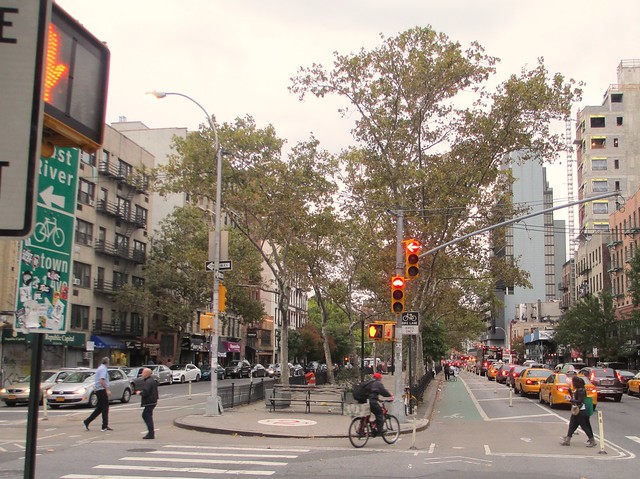 |
| Allen St, Manhattan: believe it or not, this is one of the least stressful spots on my daily commute |
When I’m riding among motor vehicles, I enter a state that sometimes
feels like hyper-consciousness. My attention has to dart from checking a set of
traffic lights and the openness of the road ahead to focusing suddenly on the
state of an individual car’s wheels. It’s badly parked and the driver’s just
got in. Is it about to pull out in front of me? Oh, and just how deep is that
new pothole? There’s no denying it’s so intense as sometimes to be
invigorating.
I can't remember when the fear started pushing me towards safer, more sensible riding options. Once upon a time, I’d have let drivers scare me into riding right by
the roadside even in the narrowest sections, where a passing car posed a
serious danger. I’d let a car on my tail harass me into being uncertain about
my line on the road, exasperating the impatient motorist more. I’d move back to
the side of the road after swinging round a parked car as quickly as possible,
without checking for obstacles in the bike lane or other riders. I’d ride in
the door zone – the area where opening car doors are the biggest risk.
My anxiousness, I find now, makes me more resistant to
shifting over to the side with a car on my tail, keeps me firmer in my line and
makes me more cautious about making sudden changes of direction. My fear has
become far better trained. It impels me constantly towards behaviour that every
manual suggests is more likely to keep me safe than my former nervous, scared
responses.
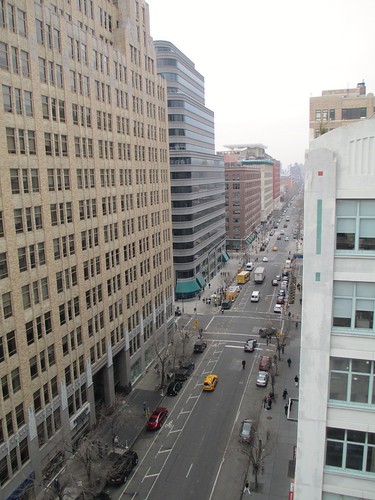 |
| Hudson St, lower Manhattan: sure, you see a magnificent urban thoroughfare. I see a cycle lane I know is constantly blocked by deliveries, food trucks and taxi drivers |
So far from being a regrettable instinct
in an urban cyclist, it strikes me, a well-trained fear is actually vital. It pushes me to go
faster when the best way to avoid a motorist behind is to outrun him or her. It
prompts me to go more slowly – with a better chance of stopping safely in an emergency –
when in close proximity to seriously dangerous behaviour. It sometimes prompts me to pull over and let an aggressive motorist past on a narrow road – but only
when I can safely do so.
My well-trained fear may even, it’s no exaggeration to say,
have saved my life one morning in February. I was riding fast down Smith St’s
cycle lane but scanning the cars. My gut instinct for when stupid behaviour is most likely had warned me of potential trouble. Sure enough, as I
was almost upon it, the driver of a Ford Ranger pick-up truck pulled into my
path, fast, without looking. Thanks to my inherent suspicion, I was already on
my guard, aware of my surroundings and prepared to swerve left to get out of
the way. I screamed “Stooooop!” at the top of my very loud voice. But I still
felt a moment of certainty that I would land in the road. A mixture of my
brakes, my screams and the driver’s belated response brought both of us to a
halt only inches apart.
This well-trained fear, of course, isn’t going to keep me
safe indefinitely. I already had it in 2009, when a car came from behind me in London , turned across my
path and knocked me off. Most bike/car crashes are the motorist’s fault and
there will be many circumstances where the cyclist can do nothing to avoid a
motorist’s stupid behaviour.
Nor is there going to be mass cycling in rich world cities
as long as things remain this intimidating. I’ve learnt how to train my fear because
I have an itch to cycle. I might not have developed the itch to cycle if I’d
known how scary it might sometimes feel.
But the most immediate downside to being hyper-aware of the
risks one’s running is that it can produce a rather obsessive focus. That led
me last Thursday into a position almost as dangerous as the ones I spend so
much time avoiding.
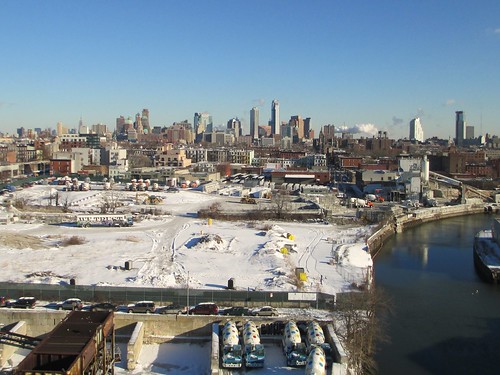 |
| Downtown Brooklyn, from afar. Not pictured: homicidally negligent double parkers, furious limo drivers |
Tired and frustrated as I rode home, I spotted a limousine
parked blocking the bike lane at the corner of Smith and Fulton Streets. Since
the driver was lounging on the vehicle, which he could easily have parked
somewhere less dangerous, and since I was tired of pulling out round
illegally-parked cars into traffic, I pulled up behind him and asked him to
move.
Meeting a volley of abuse, including assertions that the
United States was a “free country” and that I should “back the f*** off,” I
decided to take a picture of the driver and licence plate, send it to the Taxi
and Limousine Commission and leave it at that. I quickly found myself
confronting a still angrier driver, who made grabs for both my camera and my
bike.
Aware now of my misjudgement, I rode off to collect my
thoughts. “You’re a white devil!” I could hear him shouting as I pulled out my
phone to email myself his registration number. I was no longer feeling the
constructive, focused, well-trained fear I experience when navigating the
streets. I was undergoing the humiliating fear of someone who’s run away from a
fight. My hands were shaking.
It was partly because of that experience I felt such
fellow-feeling the following evening at seeing the frightened motorist. I wish big, western cities' traffic conditions weren't so apt to frighten people.
But somehow I still feel more dread in the pit of my stomach
at the idea of a day when snow will stop me riding than at a repetition of the
row with the Angry Limo Driver of Downtown Brooklyn. I even accept with some
kind of resignation that I might, in future, not avoid a badly-driven car and
might suffer another injury.
I shrink from some of the individual battles, it seems.
But in the long run, in the war to keep riding, I don’t want to surrender.
