Showing posts with label Manhattan. Show all posts

Sunday, 20 October 2013

A Film Set, a New Route - and the Joy of Rediscovering Urban Cycling

It’s the kind of intervention in one’s journey home that’s never normally welcome. As I rode my way down Grand St in lower Manhattan around 10.30 in the evening, I found a skinny young man wearing a headset blocking my way. No-one was allowed onto the next block, he said, until the film crew had finished this take. It took only a couple of minutes – although the time felt longer, given that I’d rashly for the time of year put on only a t-shirt on my top half.
 
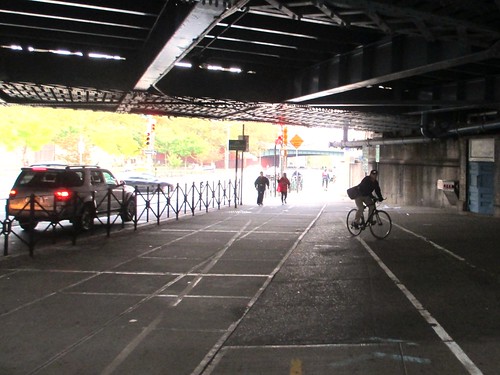
Grand St in Chinatown: city street, film set or cyclocross
track - it can't settle on a single role
But, despite the inconvenience, I felt a little thrill at being stopped on my way home on Friday. That a film crew was filming on a road on my way home was confirmation that I was, once again, the kind of cyclist whose routes lay along grittily interesting urban streets. For more than a year since moving to New York, I’ve done the majority of my Manhattan cycling on the waterfront greenways, riding often at speed but grappling only in little bites with the serious urban cycling of riding on a street with traffic. Following a move in my employer’s office, I now ride across lower Manhattan from the Manhattan Bridge to Hudson St in SoHo, on city streets for nearly all the distance.

The change has reminded me of some of the sheer pleasures of being an urban cyclist. My riding patterns far more closely resemble those I had in London, where I’d ride mostly along the London Cycle Network of routes along quiet back streets. I’m catching once again little vignettes of city life – I notice, for example, how oddly resigned and depressed the faces of the people waiting each morning for the opening of the Prince Street Apple store are. Pushing a hot dog cart to its place in the morning looks like really hard work.

The contrast between midtown and the relatively relaxed cycling environment in lower Manhattan – where there’s motor traffic, but not on the same scale as further uptown - has also highlighted another truth. Cycling in any place where cars dominate the public space can be pretty dispiriting. I’m missing the last mile of my old work route – where I’d battle my way up 54th street from the Hudson River to my office – not at all. If big cities want to encourage cycling, conditions in such forbidding areas need to be addressed.

The USS Intrepid: just one of the Hudson River landmarks
no longer on the Invisible Visible Man's daily route.
Yet these aren't the reactions I'd expected. For months before the move, I’d been telling anyone who’d listen – and a fair few that wouldn’t – how I was dreading the move. I’d grown used to commuting nine miles each way to and from work, including a four-mile sprint up the Hudson River Greenway along the west side of Manhattan. I was particularly concerned about my waistline. Within a few months of undertaking a daily 18-mile round-trip commute, I was noticing the difference when I stood on the bathroom scales in the morning. I’d dropped a good five or six kilos compared with when I moved in August 2012 from London.

There are certainly sad points about no longer having a daily ride by the Hudson. On my last morning on my old route, I was looking wistfully across at the buildings in New Jersey, glittering in the autumn sun on the river's far bank. I cast a sentimental glance to my right up at the Empire State Building, which I now see only in the distance. I took a picture of the USS Intrepid as I passed it for the last time as a commuter. I was dreading not only the new route’s reduced riding but also the stresses of the new route I’d planned. To the west of the new office – the angle from which I planned to approach – streets buzz with high traffic volumes, pouring into and spewing out of the cross-river Holland Tunnel.
 
The bike route onto the Manhattan Bridge: a quick route
to lower Manhattan streets - and romantically urban to a fault.
But, on my second morning in the new office, it occurred to me that it was worth trying the simplest, straightest route across town to the new site. I sped over the Manhattan Bridge, instead of the Brooklyn Bridge, dropped down into Chinatown and navigated my way across to Prince St. I discovered how the old, muddled-up street plan meant no-one expected to speed across SoHo. More to the point, I arrived with a smile on my face. The route had been chaotic, grimy and a little bit noisy – far more unmistakeably a ride through New York than my former ride on a calm, orderly path up by the Hudson.

I also, I’ll admit, felt a little bit cooler than before. For the last 14 months as I’ve fulminated about this or that aspect of New York’s road culture, I’ve had a sneaking feeling that maybe I wasn’t quite getting it. Nearly two-thirds of my ride to work was car-free and I’d found some of my efforts at on-street riding pretty terrifying. I’d watched on Twitter the discussions between more seasoned New York cyclists of their experience in the lower east side, SoHo, Chelsea and elsewhere in the island’s lower reaches and suspected they were simply cooler, more sophisticated, bolder people than I. Most of them remain, no doubt, cooler and more sophisticated than I – but I have less awe of their willingness to ride on these areas’ streets.
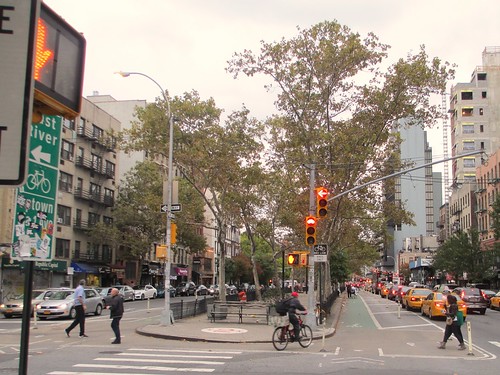
Bike lanes on Allen St at the Rivington St intersection:
a small-time entrepreneur wheeling goods down the bike
lane adds an authentic detail.
It’s certainly not a perfect experience. The journey would be more fun still if more New Yorkers had a better understanding of where the stress in the phrase “bike lanes” is meant to lie. Many seem to hear the term “lanes” and adopt them as the ideal spot to wheel their food truck, haul their suitcase or park their police car. Better protection for many bike lanes would be welcome, as would a reining-in of many vehicles’ speed. I’ve also yet to find an ideal route home. One of those cooler, more experienced cyclists, Joanna Oltman Smith, warned me before the move to avoid Grand St, the most direct route, which extensive sewer works have turned into a cross between a slalom course and a rutted country track. I’ve not yet found a better alternative – and, truth to tell, am enjoying the sense that I might be quietly training for unexpected stardom on the seniors cyclocross circuit.

On the other hand, I now look almost fondly on the elderly Chinese woman I see each morning blocking the Rivington Street bike lane stuffing her bags full of recycling. I marvel at the Beaux Arts magnificence of the Little Singer Building as I cross Broadway. I note how adept the city – like London, my former home – has been at reinventing itself. I see neglected-looking synagogues built for a Jewish community now mainly departed from Chinatown. Factories that once made clothing have been transformed into trendy offices for those of us in the media set. I hear even more of the city's sounds. Next summer, I expect to be still more aware of its smells. I was cycling round New York City on my old route. Now I arrive at the office, a smile on my face, excited at how I've been riding in it.

Sunday, 4 November 2012

Whatever the weather, cycling's proved a post-Sandy surprise

Most mornings, as I cycle to work, I smile to myself as it occurs to me that my children and I both start the day by looking at the American flag. But, while the Invisible Visible Children are taking the Pledge of Allegiance at the start of their school day, I’m looking to the flag for a more practical reason. The stars and stripes that fly from the top of the Brooklyn Bridge tell me which way and how strongly the wind is blowing. Since I moved to New York in the summer, it’s been the direction and strength of the wind on the main section of my morning cycle commute – north up the Hudson River Greenway – that’s been the biggest single determinant of how quickly I can make the journey. A following wind can get me there as much as five minutes faster than the prevailing headwind, I estimate.
The Hudson River Greenway: wind challenge

It’s one of countless ways that moving to New York has reminded me of how cycling makes me far more aware than any other way I might travel of nature’s forces. The summer heat is hotter here than in London, where I lived before, and the humidity higher. The rain is less frequent but the cloudbursts more intense. The winter, when it comes, will be more likely to bring very low temperatures and heavy snowfall. But the last week has made me realise that it’s only my constant awareness of the conditions around me that sets me apart from my fellow New Yorkers. Living for the most part on islands on the edge of a bay vulnerable to storm surges, we’re all to some extent going about our business at the pleasure of the elements. And it’s turning out that when nature really pays us back for the presumption of living in such an exposed position bicycles have a rather important role to play.

It was when I saw the mixture of embarrassment and pity on the CEO’s face that I realised I would need to change some of my cycling routines to fit New York’s weather. It was late June, I had just cycled briskly to my office in nearly 40 centigrade heat amid high humidity to encounter a colleague unexpectedly asking me to join his meeting with an important visiting chief executive. I had ridden – as I used to do in London – in my work shirt with the sleeves rolled up. In the greater New York heat, I was dripping with perspiration. My shirt was damp enough that my chest hairs were visible. I did my best to make myself look respectable. But, when I entered the meeting, it was clear I was still looking rather freakish. “Looks like you’ve done a hard day’s work already,” the CEO said. The next day, I started cycling in a T-Shirt and changing on reaching the office.

The heat and humidity, however, are nothing compared with getting caught in a proper New York downpour. Having cycled regularly in rain in London, I thought myself ready to face the worst a temperate-climate city could produce in the way of rain. Then I set out for home one evening in mid-September amid a deluge that would not have disgraced monsoon-season Chennai. A gutter running downhill on Ninth Avenue had turned into a respectable-sized, fast-flowing, deep river. Every surface was slick with water. The mixture of high humidity, torrential rain and darkness left me struggling to see where I was going. My waterproof jacket became so thoroughly soaked that my BlackBerry, tucked inside a pocket, got fatally wet. It was one of the rare occasions when I regretted the folly of my determination to get about by bike.

9th Street, Brooklyn during Sandy:
the Invisible Visible Man is invisible in this picture for a simple reason
- he wasn't riding when it got like this
As a result of that experience, I resigned myself, when I heard that a tropical storm was approaching New York, to weather that would stop me cycling for a few days. On the Saturday evening before superstorm Sandy hit, I took the Invisible Visible Girl by bike to a friend’s house for a Halloween sleepover. By the time I went to pick her up the next morning, the wind was up enough to send leaf debris stinging into our eyes. By late in the afternoon, as I ferried the Invisible Visible Boy on his trailerbike to a playdate with a friend, I was beginning to doubt the wisdom of being out. Every other means of transport gradually came to a halt too. The Monday was a rare day when I dared not cycle anywhere. I monitored the storm’s progress by walking cautiously down to the canal near our apartment. By the evening, I could see water up to the rooves of nearby buildings where we’d walked around earlier in the day.

But the same surge of water I could see in the canal was devastating many areas I couldn’t see. Water was pouring into subway, commuter rail and road tunnels all round the city. It was pouring through the Staten Island ferry terminal in Manhattan and carrying onto the shore the large ship I would see later in the week beached in Staten Island. It was, in other words, knocking out pretty much every means of transport that depends on any complex electrical or electronic control system. It was even shutting down the pipeline that supplied fuel to the city, laying the groundwork for queues hundreds of yards long to appear by gas stations later in the week.

As a result, I found myself in an unusual position among my colleagues over the next few days, possessed of the one means of transport that enabled me to consider a lengthy commute into Manhattan. I abandoned an initial attempt to reach the office on Tuesday, discovering in still-powerless lower Manhattan the value of the traffic lights whose numbers in New York City I’ve previously decried. But, skirting round the powerless section via Greenpoint and Queens, I found myself back in the office on Wednesday, able to slip past traffic jams and wheel my bike round downed trees. By Friday, I was volunteering to report from Staten Island, putting my bike on the first ferry after the service resumed. I pedalled my way down to bits of the island where the surge had come up to the ceilings of residents’ ground floors. My main thought was that I was fortunate to live in a part of the city where our main moan was a brief Internet outage and a shortage of bread in the shops. While a man had died in his basement in one street I visited in Staten Island, we had never been in serious danger.

But, as I cycled past queues for fuel so long that different gas stations’ lines met each other in the middle and heard anguished stories of islanders’ four-hour journeys to work, I also felt a new appreciation of my bike. New York largely depends on transport systems so overstretched that every extra journey puts a strain on them. I needed little more than a solid surface under my wheels and made few demands on anyone else as I used it.

I don’t know how long my bravado in the face of bad weather will continue into the coming, probably harsh winter. The weather is already making it feel more comfortable to be inside than out. But the past week has made me appreciate afresh the flipside of a cyclist’s vulnerability to the elements. I might have felt dangerously exposed at points on Sunday – more exposed than someone using other means of transport. Yet that also reflects cycling’s simplicity – the thing that’s allowed me to keep skipping round the city in a week when others have spent hours in traffic jams or waiting for shuttle buses.
The Manhattan Bridge bike lane:
this climb's a Mont Ventoux to a novice

New York’s most pressing problem is that thousands of my fellow New Yorkers remain without heat, light and, in many cases, shelter as the weather gets colder. But some hopeful signs are emerging from the post-Sandy gloom. The most impressive is undoubtedly New Yorkers’ willingness to help each other – the pile of donations I saw in church this evening, ready to go from well-off Brooklyn Heights a couple of miles down the road to inundated Red Hook. But there was also something stirring about watching the inexperienced cyclists on the Manhattan Bridge on Friday. One knew so little about his cruiser bike he was riding with the kickstand down. Others felt the need for a breather only a third of the way across the bridge. All seemed possessed of a sense that their work or some other business was so important that their physical limitations or experience of cycling shouldn’t stand in the way.

As the city rebuilds, one can only hope that at least some of those forced converts experienced at least a little of the satisfaction of experiencing and overcoming the power of nature while cycling. Having seen the vulnerability of the city’s overstretched transport systems to disaster, I harbour at least a hope that some of them might choose to stay on their bikes and keep battling the elements with me.

Saturday, 6 October 2012

Do as you like, motorists - and don't blame us for the deaths


It’s a disturbing scene to encounter on the way to work. Every morning recently that I’ve cycled to the office, I’ve come part way down West 54th Street on a badly-damaged airport shuttle minibus. The passenger doors on one side are mangled; the right-hand front wheelarch obviously took a heavy blow and the front radiator grille is nowhere to be seen. It was, I instantly recognised, the result of a crash with a large vehicle, travelling at high speed, hitting the bus then spinning round to hit it a second time. Some research suggests a Mercedes Benz sped up Sixth Avenue early on September 16 and hit the minibus as it crossed at 50th street. Some witnesses said the driver had been racing another vehicle. He was arrested on suspicion of drunken driving. Not surprisingly, given the vehicle’s condition, four passengers and the bus driver were badly hurt - one had a fractured skull, while others suffered head and neck injuries.
The crushed minibus of W54th street: yet more evidence
that cyclists are the true menace to New Yorkers

Injuries and deaths from traffic accidents like the one involving the minibus are growing more common after years of declines in New York. In the year to June, 291 people died in traffic accidents of various kinds in New York City, up 23 per cent from the previous year. The numbers of pedestrians and cyclists killed rose 11 per cent to 176. The same goes for the UK, from which I've just moved. Statistics released in the last week show 3 per cent more people died in road traffic accidents in the UK in 2011 than in 2010, well above the increase in traffic volumes. Civil servants and politicians in both places profess bemusement at the reversal of fortunes.

But it’s hard to believe the puzzlement is sincere. From a crime point of view, New York City has become a far, far safer place than a couple of decades ago – it's just the city won't use the policies it applied to crime to stamp out bad driving. In the UK, transport officials know that speed and traffic light cameras can sharply reduce road deaths – and have encouraged their removal because drivers don’t like them. The question is how many more minibus passengers and drivers have to be rushed to hospital on both sides of the Atlantic before the various authorities start to do something.

I’m lucky that both my encounters so far with officers of the New York Police Department have been fairly benign. On September 29, when I was riding across the Brooklyn Bridge towards Manhattan, I met a police officer leading thousands of people marching towards Brooklyn for a charity event. It wasn’t safe to cycle, he said, because of the numbers of people. I huffily dismounted and pushed my bike towards City Hall. A few weeks earlier, I’d passed a mounted policeman during my morning ride to work along the Hudson River Greenway. I then dutifully stopped at red traffic lights where a road crosses the path – only for the officer impatiently to tell me to get on with it and keep riding.

A typical Manhattan intersection, making it clear why the police
should prioritise cracking down on cyclists
Other cyclists' experience of the NYPD is very different. Last year, the NYPD issued 50,000 tickets of various kinds – for running red lights and so on – to cyclists, compared with only 25,000 for trucks. The division set up to get trucks to follow the law issued more tickets to cyclists than to trucks. Cyclists – who account for maybe 1 per cent of New York traffic and barely ever kill another road user – received around 5 per cent of all traffic tickets. Cyclists should follow the rules of the road, as should every other road user type. But the NYPD is so keen on ticketing cyclists that even perfectly legal cycling gets the treatment. At the height of the NYPD’s effort to intimidate cyclists last year, the filmmaker Casey Neistat received a ticket for cycling outside the cycle lane – which is simply not an offence.

The NYPD no doubt feels that its crackdown on poor cycling is simply bringing to road safety of the “broken windows” approach that’s generally thought to have helped to bring down other kinds of crime in New York. In the 1990s, Bill Bratton, then the police commissioner, and Rudy Giuliani, then New York’s mayor, told the police to tackle petty, “quality-of-life” pieces of anti-social behaviour, which they'd largely ignored before. Police started arresting vandals and the men who extorted money from motorists by cleaning their car windows at intersections. The approach is generally thought to have played at least some part in making the sitting a significantly less scary place to live. Cyclists certainly seem to be feeling the heat for some of the same reasons vandals and squeegee men started getting arrested. There are stories of community meetings with police where residents' top demand is a crackdown on allegedly scofflaw cyclists.

But it’s hard to imagine that broken windows would have been judged a success if the NYPD had concentrated on the squeegee men at the expense of going after murderers. It’s well documented that NYPD’s current policy for accidents involving cyclists is to investigate only if the cyclist has died or looks like doing so. Even then, the investigations seem to be perfunctory at best. While the fatality figures for the last year don’t give much detail on the nature of the fatal accidents, it’s clear that deaths of car occupants are the ones that are going up sharpest – and it’s essentially impossible that cyclists caused any of them. The city is determinedly not prosecuting motor vehicle crime.

A food delivery cyclist on 6th Avenue:
spreading fear, no doubt, among those he may imminently crush
That view seems in no danger of changing. Amid the alarming reversal in the safety statistics, New York’s latest transport safety crackdown is not on the trucks that I see careering at 50 mph up Sixth Avenue but on food delivery cyclists. I bow to no man in my irritation when I find a vacant-looking man on an electric-assist bike carrying chop suey the wrong way up a bike lane towards me. But, given the numbers of families losing fathers, mothers and children to bad driving, it’s mildly obscene that the focus is on a minor irritant of city life. I would feel even stronger, I imagine, were I, say, a relative of the woman killed in a particularly disturbing incident in late August in the West Village where the truck driver was so oblivious to the woman he hit that he dragged her body in his wheels for two blocks before stopping. The same must hold for the family of the young cyclist killed in an incident on Queens Boulevard on September 25, where the truck seems to have gone straight through a stop line. These are clearly incidents for which no food delivery bike, no matter how poorly ridden, could ever be responsible.

A well worked-out effort to tackle quality of life crime on roads in New York City  - or pretty much any big settlement - would concentrate on prosecuting motorists’ red-light jumping at the most dangerous intersections, failure to yield to pedestrians when required, illegal turning across other vehicles’ paths and excessive speed, especially at the most deadly junctions. Perhaps most importantly, it would try to stop people driving while distracted by their telephones or iPads - an area where prosecutions have fallen sharply even as the habit has become more and more widespread. The strategy, in other words, would seek to catch the kind of person who thinks it’s appropriate to race a Mercedes up Sixth Avenue - and address his behaviour before he ploughs into a minibus. The problem, of course, is that speeding motorists are, by their nature, hard to catch. It can be tough to gather the evidence to prosecute a car driver for dangerous but non-fatal behaviour such as deliberately driving intimidatingly close to a cyclist (a regular event in New York). Police forces everywhere have a predeliction for detecting offences that have a 100 per cent clear-up rate, of which cyclists’ light-jumping is a perfect example. The offence will almost never be reported except by a watching policeman. The offender is easy to catch and unlikely to argue his or her innocence successfully.

The change in tone in the 1990s in policing in New York City – and many other large cities worldwide that followed its lead – resulted from a revolution in thinking. City bosses realised it was no longer acceptable to let crime make parts of the city uninhabitable. The puzzle is why such thinking goes only as far as the kerb, and not onto the roads.

A van yields to pedestrians in mid-town Manhattan:
life would be better if this always happened
The British statistics, meanwhile, take me in my mind back to May 2010 and the day when I and other reporters were ushered into a room in the UK’s Department for Transport to meet Philip Hammond, the then-new UK transport secretary. “We will end the war on motorists,” Hammond told us, a keen glint in his eye no doubt reflecting his personal excitement at gaining greater freedom to drive his sport cars. One peace dividend for the motorists was a cut in funding for speed and traffic light cameras. Local authorities weren’t exactly told to take the things down – but the government did the next best thing. It stopped telling them they had to use some of their central government money for cameras - and cut the funding for road safety spending greatly.

The ensuing changes took me a little under a year later to the village of Nuneham Courtenay, on a stretch of the busy A4047 road just out side Oxford. Residents there had grown desperate enough to offer to pay to have their speed camera restarted. Cars that had been slowing down sharply through the village when there as a speed camera now swept through at 60mph. The same day I visited, Oxfordshire police were reintroducing speed cameras throughout the county after scraping together the money to pay for their operation. Because I knew plenty of places were simply abandoning speed cameras and I'd read research saying they saved 80 lives annually in the UK, I'd known for a long time that the UK's record of improving road safety was likely to be spoilt as it was by the recent statistics.

None of this is to say it's easy to stop future Mercedes bashing into minibuses. There's an urgent need to revise deep-seated attitudes about the priority given to cars and drivers’ rights. The driver who smashed into the minibus might, I suppose, have been a first-time offender whom an effort to target the riskiest drivers would have missed. But there’s a steady, demoralising stream of news at the moment on both sides of the Atlantic – a young musician killed on his bike in Queens, an elderly woman hit on a pedestrian crossings in London, a man hit on a crosswalk in Manhattan. As long as officials put off using speed cameras more and targetting the riskiest motorist behaviour, they're throwing away the chance to slow the flow at least a little.

Saturday, 14 July 2012

Grids, lights and why New York's traffic should be less metronomic

All day long, as I look from the 14th floor window of my new office in midtown Manhattan, a hypnotic scene plays out in the streets below. As one set of traffic lights turns green, vehicles – sometimes swarmed four or five deep across the street – resume their journey, like so many multi-coloured woodlice, north up sixth avenue towards Central Park. Then the lights change and two ant-like swarms of pedestrians march out from either side of Sixth Avenue and merge in the middle. One swarm of woodlouse-cars meanwhile makes its way west along 51st street and a second heads east along 50th. Then, at a regular tempo, the pattern starts again, changing only when some oddity comes along. I watched one day as a food vendor pushing his cart across the intersection was marooned mid-crossing by a change of lights. Cars nudged up against the unexpected obstruction and pedestrians marched round it, like water finding its way around a rock newly fallen into a stream.

Then, every now and again, between the woodlice and the ants appears a gnat – a bicycle picking its way around the parked cars and zig-zagging between the pedestrians. Both the pedestrian-ants and the woodlouse-cars seem impatient with them. It is, after all, especially clear from my vantage point that the bicycles – dodging out behind stopped cars, darting between the ranks of cars stopped at lights – travel in very different lines from the straight up-and-down or across-town of most other Manhattan traffic. Every now and again, some sudden lurch by a taxi or truck has me fearing I’ll need to run to the elevator, head down to the street and act as a witness on some prone cyclist’s behalf.

West 15th Street: Orderly, but not in a very human way
The view from my window has sprinkled yeast on an idea that’s been fermenting in my mind all the three weeks I’ve so far been cycling around New York. It’s that the shape of a city’s infrastructure does more than anything else to forge the culture of its roads. New York’s infrastructure, moreover, seeks a lot of the time to force human beings into the neat patterns that sprang from the minds of its 19th century planners. It was a bold idea, a refreshing change from the haphazard patterns of a city like London, whose street plan in parts dates back as far as Roman times. But it’s hardly suprising that the less-than-straight lines of most humans’ attitudes and behaviour sometimes lead them to burst out of the grid’s constraints.

When I tell people I’m cycling in New York, it conjures up a mental picture for most of my pedalling down some vast Manhattan avenue, skyscrapers towering over me and threatening streams of cars, trucks and buses roaring past. In fact, most of my Manhattan cycling has involved my making my way to the car-free Hudson River Greenway, cycling to the appropriate cross street then cutting across the island to my destination. A brief ride this week was a rare exception. Keen to pick up a train ticket quickly from Pennsylvania station, I headed down Broadway, through Times Square and on down 7th Avenue.

I was suddenly after leaving the Broadway bike lane one of the gnats I could see from my office window, navigating along the line of parked cars to the side of four roaring streams of traffic. At cross streets where the lights were in my favour, I would still frequently face obstruction from a turning car, trying to nose its way through the cross-street pedestrians but stuck in my path. I had to maneouvre out round each, trusting that I wouldn’t find myself, if one of the vehicles made a sudden change of course, heading for a collision.

The 7th avenue experience was almost wholly a product of the city’s decisions about how to use its space. Seventh Avenue could have been a perfectly adequate – and probably far less intimidating – two-way street, with traffic forced into the relatively narrow confines of most London thoroughfares. Cars would then have been far less inclined to swing wildly across the lanes, ignoring general traffic law and the speed limit. Someone preferred, many years ago, to prioritise the swift passage of cars on the avenues over making them feel more human-scale. It created vast tarmac tracts that, when empty, must feel to a driver like some huge auto playground.

The West Side highway, with the Hudson River Greenway:
a chance to watch nearly every road user type breaking rules.
I face a different set of challenges using the Hudson River Greenway. The Greenway may, as I’ve noted before, be the finest piece of cycling infrastructure in the English-speaking world. It’s spacious, largely unaffected by traffic and offers fine vistas across the river to New Jersey. It even afforded me, one recent morning, the chance to race a ship. The general cargo vessel was heading up the Hudson at, I think, a speed of around 15 knots – more or less the perfect pacer for a cyclist heading into the wind on an old hybrid. I was able to catch up at points but held back now and again by traffic lights.

Yet, despite the numerous signs telling them to follow their own path, the cycle track is thick with runners, often pushing strollers (baby buggies, for British readers). Overtaking them safely requires a swing into the opposite lane, often into the face of an oncoming cyclist intent on maintaining the appropriate tempo for his triathlon training. The Greenway is also, while less stop-and-start than a Manhattan Avenue, dotted with traffic lights, protecting turnings across the path into the police department’s pound for towed vehicles, the city’s cruise terminal, the 30th street heliport and others.  A number of these lights spend much of their time showing red for cyclists and green for cars, even though motor vehicles are rare. The pattern at the cruise terminal remains unchanged, for example, whether a ship is disembarking or the terminal’s gates are locked. Even a cyclist as rules-obsessed as I finds it impossible to stop at these junctions, sticking pointlessly to the letter of the law while around motorists zip at 50mph down the 35mph westside highway, cyclists buzz pedestrians and runners jog, talking on their iPhones, down a path meant only for cyclists and skaters.

The traditional response to all these different forms of chaos is to bemoan road users’ failure to obey the rules. The still-more traditional response is to berate cyclists as if they were the only ones breaking them. There is obviously some merit in wishing road users were generally more careful of others’ needs. I was certainly embarrassed on behalf of cyclists generally when, one Sunday morning, I watched a string of speeding cyclists yell out of the way cruise passengers trying entirely legitimately to use a crossing on the Greenway.

But it’s more interesting, I think, to examine why New York’s traffic system seems to encourage possibly even more widespread rule-flouting than London’s more chaotic sprawl.

Police horses on Sixth Avenue:
not every animal in the traffic is metaphorical
The answer, I’d suggest, lies in the similarities between renting a New York apartment and riding in the city. Both exhibit America’s tendency to make every rule clear and unambiguous – for the avoidance of doubt, as a very American phrase puts it. Large British corporations may, I suspect, have been bought and sold with less paperwork than was required for me to rent a Brooklyn loft for my family. Everything from whether the building had ever had a bed bug infestation to whether we needed guards on the windows to protect the children was carefully and methodically spelt out. On the roads, a far higher proportion of intersections in New York are traffic light controlled than in London. There’s far less reliance than in London on allowing road users’ good sense and public spirit work out the best traffic flows at less busy junctions.

That stems in part from an admirable instinct. The United States, a country founded by dissidents and populated by immigrants, recognises that not everyone implicitly shares the same approach to problems. It codifies nearly everything. That has many undoubted strengths over the British assumption that good chaps will have the common sense to understand how things should be done. One country has a hallowed constitution whose workings are overseen by nine learned justices. The other has never even written its constitution down. The American principle, as laid down by John Adams, the second president, is “the rule of laws, not the rule of men”.

Yet there’s a risk, as with any regulation, that it becomes like the Russian tax system – so onerous that, because no-one can fully follow it, it hands arbitrary power to the rule-enforcers. With the apartment, the bureaucratic problems seemed insurmountable until I threatened to take my business elsewhere and the formalities concluded suspiciously speedily. As a cyclist, it is surprisingly difficult heading along a Manhattan avenue not at least to rush through traffic lights as they’re changing. The blocks’ shape – shorter north-south than they are east-west – and the lights’ timing to suit motor vehicle, rather than cyclist, speed mean one can face a red light close to every 100 yards. With the short time pedestrians have to cross, it’s small wonder so many start crossing streets with lights on red, neglecting to look out for cyclists following behind the mass of traffic. The police effectively have free rein to issue violation notices to pretty much any road user they choose – and cyclists, who are far less likely to cause fatalities than motorists, are often the target.

Greeley Square, in midtown: tailored to motorists' speed,
rather than cyclists' comfort
Even more corrosively, the burden of rules can send a message to road users to abandon judgement and good sense. The red lights protecting roads on the Greenway seem to me a subtle message that the rules are arbitrary and weighted against cyclists. While it’s unfortunate, it’s small wonder that so many then go on to ignore the rules designed to protect pedestrians at crossings.

None of this is to say that New York doesn’t work for cyclists. I’ve encountered, I think, less straightforward aggression from motorists than in London. With the competition for road space less frantic, fewer drivers seem to feel quite as embattled as the worst in London. I’ve had no-one deliberately try to intimidate me with his or her driving yet – a fairly regular occurrence in London. Many of the cycle facilities are excellent.

But I can’t help thinking a slight change in New York’s approach might produce some surprising results. A few less traffic lights and I would certainly be looking down from my window at a less metronomically regular scene. I might even be observing one where the woodlice and gnats were willing to let the ants cross - and the woodlice less prone to cutting across the zig-zagging gnats’ paths.