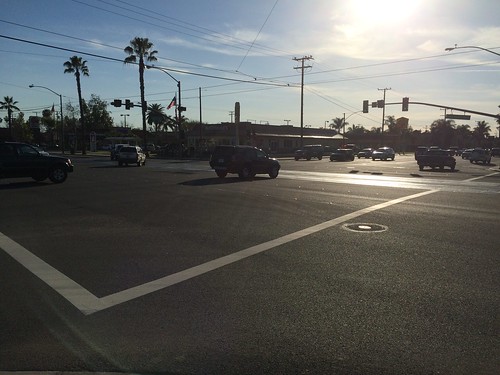
As I ride home from work in the evenings, an intersection in
downtown Brooklyn often prompts me to ponder New York City ’s attitude to cycling. The
southbound bike lane on Smith St at Fulton
St used to move out gracefully round a waiting
area for taxis and car-service vehicles. Then, recognising that the lane was
constantly blocked by parked vehicles, the city decided to repaint the lane so
that the parked taxis would no longer block it – though cyclists would have to
perform a dangerous swerve out into traffic to round the parked vehicles. More
recently, it’s been repainted yet again – and the lane’s now back to guiding
cyclists smoothly through the junction – and once again perpetually blocked.
 |
| Smith St at Fulton: as it was before it became a symbol of the city's vacillation about cyclists. |
The intersection is a beautiful concrete – or asphalt – illustration of New York
City ’s equivocal attitude towards encouraging cycling.
The city has been prepared to paint bicycle lanes on streets – although it’s
now retreating even from that in favour of the dreadful “extra-wide parking
lane”. But the city has been far less ready – particularly since Janette
Sadik-Khan left as transport commissioner at the end of 2013 – to recognise
that to accommodate cyclists well in a given road space it is also often
necessary to inconvenience motorists. There has lately seemed to be a waning of
the confidence under Michael Bloomberg, the previous mayor, that by promoting
cycling the city was making progress towards being a better city.
A bike ride last Thursday prompted me to ponder further the
politics of this change. I rode with members of New York
city council’s progressive caucus from Brooklyn Borough Hall across the Brooklyn Bridge Manhattan
delegation, having ridden from Union
Square , met us at City Hall. As I rode with Brad
Lander, Carlos Menchaca and other left-leaning individuals, I got into
discussion about the “progressive” agenda for transport in the city and how
intimately cycling is linked to making the city better for all its inhabitants.
 |
| Brad Lander addresses the bike-to-work ride outside Borough Hall: a reliable progressive enthusiast for cycling. |
I came away convinced that there are many progressive
politicians in the city who recognise that the way people get about significantly
affects how equitable and safe a city is for all its inhabitants. But I also left worried that some other progressive politicians fail to grasp what a big role changes to those patterns of mobility could play in achieving their wider goals.
Even the term progress is a pretty significant
stumbling-block when thinking about these issues. The term implies that humans
are learning from previous generations’ mistakes to make the world a steadily
better place. It’s a view of the world that sits uncomfortably with the
multiple areas where the world appears to be going into reverse. Among those
are the rise of vicious Islamist radicals like the Islamic State and the
takeover of the US ’s
Republican Party by groups that appear to reject the reliability of the scientific
method for deducing facts about the world. The term also calls into question
what “progress” is. Does it entail everyone’s growing steadily richer and
buying ever more cars and consumer goods? At its worst, the goal of pushing
towards “progress” has justified appalling acts of political repression.
Nevertheless, I’m confident that in most industrialised
societies people’s political instincts divide fairly neatly into conservative
and progressive camps. Conservatives tend to believe the past was better than
the present and that society’s existing power structures are there for fairly
good reasons. Progressives tend to think the future can be better than the
present and question the power structures currently in place.
 |
| I don't know the politics of these people waiting to participate in last week's ride with progressive city council members - but it's a fair guess many would call themselves progressives. |
It’s no surprise that many cycling activists, as I do, place
themselves broadly in the progressive political camp. Since cycling currently
accounts for only a small proportion of journeys in many rich countries, arguments
for cycling are by their nature arguments for building a future that’s better
than the present. Conservatives such as Boris Johnson, London ’s elected mayor, are rarer – but often
seem to value the bicycle as a symbol of how things were done in the past. Far
more conservatives - including Jeremy Clarkson, formerly of the BBC’s Top Gear
franchise – seem to identify with car culture.
But that point doesn’t fit with recent shifts in attitudes
towards cycling in New York .
Following the election in late 2013 of Bill de Blasio – a Democratic mayor
about as far left as any conceivable mayor of the US ’s main financial centre – it’s
clear that cycling has moved well down the city’s list of political priorities.
Compared with Michael Bloomberg, his far more conservative predecessor, the
current mayor seems to see little reason to encourage cycling to work or the
completion of the city’s cycling network. In fact, the fading paint on many of
the city’s cycle lanes is a neat illustration of how fragile progress in such
an area can be. With less active support for cycling promotion, the previous
gains are almost literally fading away.
It wouldn’t be surprising, in fact, if the mayor were a
little distrustful of those of us who lobby for cycling. The mayor fought the
election on the basis that he would campaign for the second New York that had been neglected during the
Bloomberg years. From the perspective of poor neighbourhoods far out in
Brooklyn, Queens and The Bronx, those of us from brownstone Brooklyn and nice
parts of Manhattan who lobby for better cycling provision must seem like
representatives of the elements in the city that are already well catered-to.
 |
| Poverty-stricken Coney Island after Superstorm Sandy: cycling promotion probably wasn't on many locals' minds after this catastrophe. |
It must also make a great deal of sense looked at from
poorer neighbourhoods for the mayor to focus much of his transport energy on
the Vision Zero programme of reducing road deaths. A disproportionate number of
those who die on the roads are people like Noshat Nahian, an eight-year-old
child of Bangladeshi immigrants killed by a turning semi-trailer truck on Northern Boulevard
in Queens, or Amar Diarrassouba, the six-year-old son of immigrants from Cote d’Ivoire killed by a truck in February 2013
as he walked to school in East Harlem . There’s
no doubt that trucks and cars – which predominantly support the lifestyles
of New York ’s
richer people – exact a disproportionate toll in death and injury on poorer New
Yorkers. The mayor is quite right to try to address that.
Yet it’s a significant failure of imagination not to try to
do more than that. Because New York state’s gas tax and other fees for driving
cover only 56.1 per cent of the cost of providing the state’s road system, poor
state taxpayers without cars are forced to pay much of the cost of maintaining
the road system. That’s even before considering all the other costs that the
road system imposes – the costs of crashes, congestion, atmospheric pollution
and noise, all of which are shouldered by ordinary taxpayers. Any effort to
make New York City
less car-dependent is inevitably a progressive step away from the regressive
effects of the current system of funding for roads. It would also make perfect
sense for a progressive mayor to support Move New York’s sensible plans to charge all vehicles entering lower Manhattan a fee that would be used to support
the city’s subways and other alternative means of transport. The higher charges
would fall predominantly on the city’s wealthiest people, while a great many of
the benefits would flow to the city’s poor.
 |
| The Manhattan Bridge bike lane on bike-to-work day: I don't want to see more bike traffic jams like this - but there's a clear progressive case for encouraging these people to keep riding their bikes. |
An increase in the number of people cycling would serve many
of the political goals for which the mayor and many other progressives purport
to be aiming. It would reduce the cost burden of maintaining the road system,
reduce pollution – another ill that disproportionately harms the poor living by
arterial roads – and improve New Yorkers’ overall health. Despite some high-profile incidents, it's also far safer for pedestrians to be around people using bicycles than people using cars.
There is no good reason either why, with better cycle provision, people in some ofNew York ’s more central public housing
projects should not take to cycling far more than at present.
There is no good reason either why, with better cycle provision, people in some of
Yet the scene at the corner of Smith and Fulton illustrates
the challenge. The Department of Transportation was prevailed upon to change
the bike lane arrangement at the corner in the interests of preserving a single
parking space. The city’s willingness to get people cycling has melted in the
face of a backlash by those who see parking spaces as their own private
property. There could scarcely be a more reactionary force than groups
determined to preserve the right to store their private luxury items on-street
for free, but their indignation seems for now to have intimidated many
progressive forces into leaving parking spaces well alone. Vested interests can also push the apparently progressive side towards reactionary stances. Both Ben Kallos and Robert
Cornegy, council members who turned up at last weeks’ cycling event, have
backed a bill supported by transport workers exempting them from legal penalties if they hit pedestrians and cyclists who have the right of way.
 |
| Whatever the precise politics of Jay St's cycle lanes, they certainly feel regressive |
Such equivocation about improving conditions for cycling
explains a great deal of what the ride from Brooklyn Borough Hall experienced
on the first section of our ride to the Brooklyn Bridge Jay
St and found ourselves jostling among heavy
traffic, including at least one double-parked car in the bicycle lane. It wasn’t
hard to see, taking in the scene, why only 1 per cent of New Yorkers’ commuting
trips are currently by bicycle.
New York and many other cities would be a better, fairer place if more of its citizens were getting about by bicycle. Increasing the share of journeys made by bicycle should, consequently, be part of the progressive agenda alongside more obvious causes such as improving urban education and housing. But, if progressives continue to lack political courage when tackling car-dependency or conservatives stay entrenched in power, it’s hard to imagine conditions improving dramatically in the immediate future.
New York and many other cities would be a better, fairer place if more of its citizens were getting about by bicycle. Increasing the share of journeys made by bicycle should, consequently, be part of the progressive agenda alongside more obvious causes such as improving urban education and housing. But, if progressives continue to lack political courage when tackling car-dependency or conservatives stay entrenched in power, it’s hard to imagine conditions improving dramatically in the immediate future.