It was one morning at the end of January in TriBeCa that I
encountered the very personification of motorist arrogance. As I rode down a
single block of Reade St
that was still mostly clogged with snow, I used the middle of the lane to
signal that there was no room to pass me safely. But a block of driving more
slowly was unthinkable for a driver who was approaching me from behind in his
Lexus SUV. He first leant on his horn to try to bully me out of the way then
swerved into the parking lane and passed me close and fast on my right.
“What the hell is wrong with you?” I screamed at him as I,
inevitably, caught up with him at the next traffic lights. “There was a bike
lane!” he yelled back as though that were some kind of explanation. “It was
full of snow,” I screamed back.
 |
| A Brooklyn bike lane after one recent snowfall. The angry Lexus driver of TriBeCa wants me to ride in such lanes and get myself out of his way. |
The driver was one of the scores, possibly hundreds, I’ve
encountered over more than two decades of urban cycling whose anger at my presence
on the road went far beyond what any actual hold-up or inconvenience at my
being on the road might justify. My making a different transport choice seemed
to present an existential affront.
The tendency would exist, I’m sure, without Top Gear, the BBC-made show that
presents such motorist arrogance as entertaining, clever and part of the
natural order of things. But the show, which is syndicated or remade in nearly
every country around the world, gives such views far more legitimacy than they
would otherwise enjoy. Any number of mind-numbing cable shows and irresponsible
adverts feed similar thinking among many US motorists.
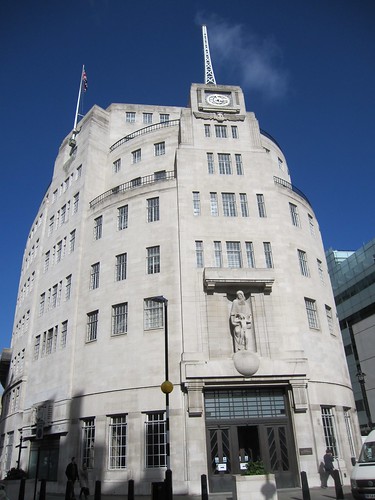 |
| Broadcasting House: who wouldn't make their point by driving an armoured vehicle here? |
I’ve consequently found it depressing how much support
Jeremy Clarkson, Top Gear’s star and
chief boor, has attracted since he was suspended on March 10 from work on the
show after a “fracas” – a British way of saying he apparently punched a
producer. A petition demanding his reinstatement – started by Guido Fawkes, a
political blog – attracted nearly 1m signatures. It was, tastefully, delivered
to the BBC’s Broadcasting House in a tracked armoured vehicle. Clarkson’s suspension
seems as much of a threat to some people’s sense of themselves as my cycling in
the middle of the road was to the driver of the Lexus SUV.
But a row I had on Facebook with a friend of an old school friend
has crystallised in my mind the nature of what’s going on. The role of the
motor car appears, for better or worse, to be part of a cultural battle in many
industrialised societies.
The Top Gear
tendency among motorists is, it seems to me, part of a wider conservative predilection
for accepting certain established social facts – including the motor car’s
dominant role - as so inevitable that it’s eccentric even to question them. Top Gear seeks to celebrate the joys for
those who already have power of exercising it.
From such a
worldview, naturally, people who question the established way of doing things
are apt to look like joyless worrywarts. If one can’t see why it’s worth
questioning the promotion of high-speed motor vehicles for use in urban
environments, it must be frustrating to see people like me poring over
statistics and presenting philosophical arguments for change.
The division looks a lot like the classic one that has run
through much British politics for centuries and is replicated in many other
English-speaking societies. On one side stand care-free
conservative bon-vivants, the Cavaliers. On the other are puritanical, uptight
progressives, the Roundheads. Society’s overall view of the two sides probably
remains much as the two sides in the English Civil War are described in the
satirical history 1066 and All That. The Cavaliers are “Wrong but Wromantic,”
while the Roundheads are “Right but Repulsive.”
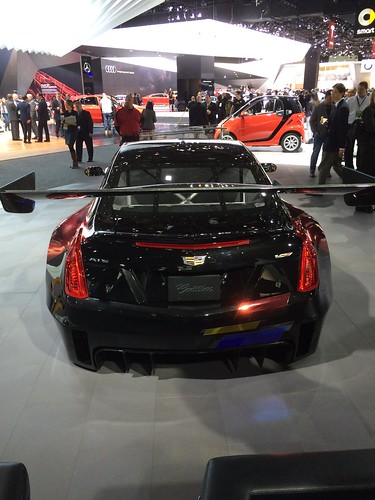 |
| A Cadillac ATS at the Detroit Auto Show: people like me seem like joyless prudes if we suggest this maybe isn't an ideal urban car. |
I stumbled into the Clarkson discussion by agreeing with an
old friend who had commented that Clarkson was “beyond ghastly” in another friend’s post about his suspension. I expressed the hope that the producer –
whom Clarkson appears to have hit because a hotel wouldn’t provide him with hot
food late at night – had excellent legal representation. I would have left it
there had not a third person – whom I don’t personally know – chimed in with a
rebuke.
“He is a legend...someone who can laugh at himself and
others,” the poster wrote of Clarkson. “Some people have had humour bypass
surgery.”
An ironic, amused detachment from events is such a critical
attribute for a British man that this was, of course, a serious charge.
So I went on to list some of the many recent controversies
surrounding Clarkson and inquire where the joke in them was. Last year, for example, he was recorded using the word “nigger” – a profoundly offensive racial slur – during taping of Top
Gear. In 2011, he denigrated Mexicans as “lazy, feckless, flatulent [and] overweight.” In 2009 he described Gordon Brown, the then UK prime
minister who lost an eye in childhood, as a “one-eyed Scottish idiot”.
The jokes are funny only if one presupposes that people’s
being different from oneself is inherently funny. They assume, variously, that
it’s intrinsically funny to use a racial slur; that some people belong to a
different culture from one’s own; that some people have a disability; or that some
people are from a less powerful bit of one’s own country. I suggested that
Clarkson was indulging in the lazy humour of the school bully, mocking weakness
and difference to denigrate them.
My reaction then became part of the joke.
“It is funny, isn’t it – especially the reaction,” the
poster replied, with problematic punctuation.
It’s probably easier, however, to recognise the problems
with Clarkson’s attitudes if one’s dealing daily with the boorish driving that
he and like-minded people, like the worst Daily News and New York Post columnists, endorse. An encomium to the joy of a high-powered vehicle seems less
entertaining if one’s just been buzzed by a muscle car with tinted
windows on an urban street. Top Gear’s admonishment to cyclists to learn the
difference between red and green traffic lights looks less self-evidently
side-splitting if one regularly sees motorists speeding at 40mph down residential
streets.
The Cavalier driver speeding and jumping lights probably feels free to do so because driving feels to him or her like a private matter. We Roundheads on the
outside tend to suck our teeth and worry about how driving on a street means
taking part in a complex social transaction. At high speeds one has
far less scope to adjust to how other people act - and a far greater chance of
harming them.
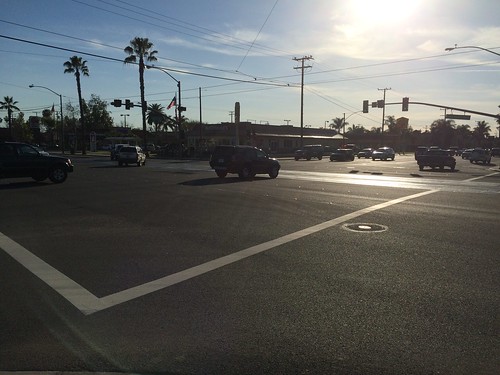 |
| A crossroads in Long Beach, California, suggests to me that car-dominated spaces can have drawbacks - which probably makes me a joyless worrywart. |
The heavy use of cars in cities presents real moral dilemmas. It’s vital that people who want to think seriously about that aren’t
mocked into silence by boors.
Yet I’ve concluded from the Clarkson episode, my Facebook
argument about it and countless other expressions of support for inconsiderate
driving that there’s an asymmetric battle under way. Advocates for change often
earnestly wheel out studies and campaigns as if it were enough to have a better
case and better arguments. There are, however, millions of people for whom even
the notion of a serious discussion about such matters seems to be beside the
point. The first battle has to be against the very assumption that any effort
to change or examine the current state of affairs is absurd in itself.
The Clarkson episode is also further proof that what people
think and say are closely linked to how they actually act. While Clarkson is
often defended as a harmless japester, there has long been a singularly nasty
whiff around his behaviour. In January 2014, for
example, he tweeted a picture of a cyclist on the narrow backstreets of Chelsea , West London ,
taking the lane and commented how it was “middle-of-the-road pointmakers like
this” who made drivers so angry with cyclists. A person claiming to be the cyclist
– who was riding absolutely correctly given the nature of the streets – later claimed
that Clarkson forced him off the road by passing when there was insufficient
room.
The incident that provoked the latest controversy,
meanwhile, apparently involved an angry confrontation. Many accounts suggest
that Clarkson called Oisin Tymon, the producer, a “lazy Irish c***” and punched him, splitting his lip. That would suggest a still darker side to Clarkson’s
enthusiasm for xenophobic slurs, although he seems to deny either speaking
xenophobically or punching the producer.
The most important lesson, finally, may be that large
numbers of people are nasty, callous and lack a moral compass. Oisin Tymon
appears at the very least to have been badly bullied at work by a far more powerful
individual. He may also have been subject to slurs on his ethnicity and an
assault that resulted in his going to hospital for his injuries. The response
of nearly a million people in the UK to this has been to demand that
the perpetrator be allowed unconditionally to return to his job. A significant minority
has added to the victim’s suffering by abusing him online. A glance at any
online US media report about
the death of a cyclist will confirm there’s no shortage of similar scorn for
weaker road users on the Atlantic ’s western shore.
If that’s what it looks like to be wrong but wromantic in
2015, I’m more willing than ever to accept being repulsive but right.
Update, March 25:
The BBC has decided - using unfortunately mealy-mouthed language - not to renew Jeremy Clarkson's contract. An internal investigation found that he harangued Oisin Tymon for a prolonged period and assaulted him for 30 seconds. Thinking he had lost his job as a result of Clarkson's anger, he drove himself to hospital. The BBC's report and the decision to suspend Clarkson's contract has had the predictable - but depressing - effect of making many of Clarkson's fans furious with Clarkson's victim.
Update, March 25:
The BBC has decided - using unfortunately mealy-mouthed language - not to renew Jeremy Clarkson's contract. An internal investigation found that he harangued Oisin Tymon for a prolonged period and assaulted him for 30 seconds. Thinking he had lost his job as a result of Clarkson's anger, he drove himself to hospital. The BBC's report and the decision to suspend Clarkson's contract has had the predictable - but depressing - effect of making many of Clarkson's fans furious with Clarkson's victim.
