It was near a Path subway station in Jersey City that I encountered a ripple from
a wave of sloppy thinking currently sweeping the English-speaking world. On a
corner on Grove St ,
one of the city’s main thoroughfares, a woman wearing a high-visibility vest
approached me and thrust a leaflet into my hand.
The pamphlet contained a series of safety rules for
pedestrians – among them “Cross at corners and intersections” and “Before
crossing look left, right,then left again”– and threats of fines for pedestrians who
broke the rules. There were also instructions to drivers. But, even as
motorists barged past people crossing right by her, the woman kept thrusting
the leaflets solely on people walking.
 |
| Hey, pedestrians: you can't say New Jersey hasn't warned you |
The implicit assumption is clear. Vulnerable road users are
vulnerable not primarily because they lack protection from the behaviour of
motor vehicles but through their own irrational actions. Pedestrians wander
heedless, according to this analysis, into the path of cars, whose drivers can
scarcely be expected to miss them. Cars hit cyclists primarily because cyclists
ignore red lights. It’s a view one can find repeated online in the comments
under pretty much any news article about road safety – especially if it concerns bikes.
 |
| Hey, be fair. The card mentions motorists. It's just that they don't give it to them. |
Yet the worry should be precisely that crashes occur despite
the best efforts of vulnerable road users to behave rationally – and because
motorists correctly feel themselves largely invulnerable. A study by researchers at Melbourne University , in Australia , found that 88.9 per cent of cyclists in a study were behaving safely and legally before collisions,
near-collisions or “incidents” recorded on their helmet cameras. The figures
tally with those in a Transport for London
study of all the recorded injuries and deaths of cyclists from collisions with cars during 2010. The London
study suggests around 74 per cent were the motorist’s fault, while the Australian
researchers blamed the motorists for 87 per cent of the incidents. Studies from
around the world regularly seem to find motorists to blame in around 75 per
cent of bike/car crashes.
For pedestrians, a study in New York found that 44 per cent of those injured by cars were hit when in a marked crosswalk while crossing with the light, while another 6 per cent were hit on the sidewalk. Given that many of
the other crashes will also be a result of motorist negligence, a clear
majority of crashes involving pedestrians also appear to be the fault of the
motorist concerned.
Pedestrians and cyclists appear, in other words, to behave
like people who have a lot at stake on the roads and to take their own safety
seriously. The crash on November 25 in East New York
that killed Maude Savage seems, according to these studies, to be fairly
typical. A surveillance video shows Ms Savage, a 72-year-old pedestrian,
waiting and looking carefully before crossing, with the lights in her favour. A
van then speeds around the corner and through the crosswalk, hitting her at
speed. Robert Brown, the van driver, seems, to judge by the video, to have been
driving like someone who recognised that, for him, the consequences of hitting
a pedestrian wouldn’t be that serious. As things stand, it probably makes more
sense for a busy technician like him – he was working for a cable TV company - to
prioritise speed over avoiding a crash.
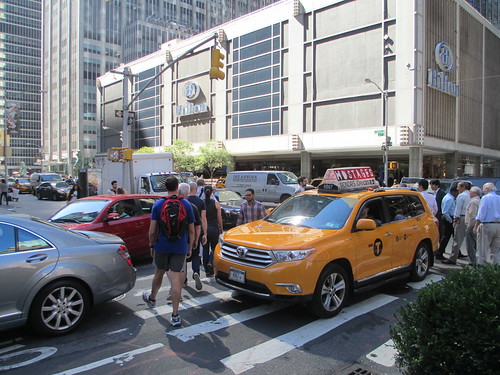 |
| Cars on a crosswalk in midtown Manhattan. The cars realise it's vital not to impede uptown progress on 6th Avenue. So they block the crosswalk. |
As with many road safety issues, however, many politicians
and police officers seem to base their reaction to vulnerable road users’
deaths mainly on gut instinct and intuition. It’s often easy to sense
frustration – “Why won’t these cyclists just get in a car or ride on the subway
like everyone else?” Lord James of Blackheath, a Conservative peer, took such
thinking to its logical – and absurd – extreme on November 22 when he claimed
in a House of Lords debate that cyclists longed to be knocked down – to get
motorists into trouble.
Even among people trying to make ostensibly saner points
than Lord James, there’s considerable misunderstanding about where the risks
lie. Politicians and police officers regularly whine about how cyclists
allegedly cause crashes by ignoring red lights – but the Transport for London study found
cyclists’ failure to obey a light was a contributory factor in only 61 crashes –
against 2,650 involving motorists’ failure to look properly. It wasn’t
significantly more common for cyclists to cause crashes by running lights than
motorists – a motorist’s failure to obey a light was a contributory factor in
36 crashes. There’s a powerful tendency for policymakers to connect behaviour
they observe – “some cyclists run red lights!” – to the
death toll, without any further examination.
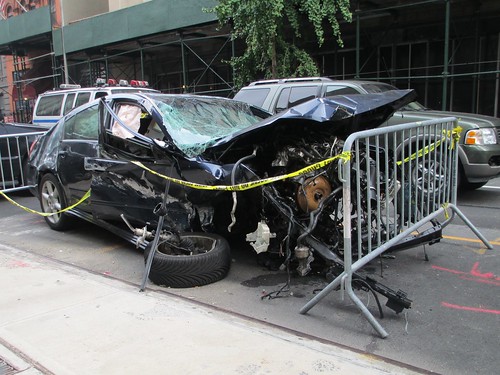 |
| This car crashed at 100mph on West St in Manhattan. How the NYPD thinks pedestrians can protect themselves against such risks isn't clear. |
There are certainly things that cyclists and pedestrians can
do to protect themselves. In the Transport for London
safety study, the top cause of crashes caused by cyclists was “failed to look
properly,” just as it was for cars. “Failed to judge other person’s path or
speed” was the second most common cause of crashes for both cyclists and
drivers, while “careless/reckless/in a hurry” was number three for both. The Melbourne study of cycle
crashes found that cyclists who looked over their shoulders a lot were least
likely to be involved in crashes. There is clearly a great deal to be gained
for any vulnerable road user through keeping keenly alert and watching out for
the negligent behaviour of others.
Most people certainly make some trade-off in their road behaviour
between convenience and safety. It’s surely worthwhile for the people with most
to lose through a crash to let safety rule their judgement all the time – if only
because it’s clear that people protected by metal shells feel free to
prioritise their own convenience over other people’s lives. Last Sunday, riding
down Garfield Place in Park Slope, I heard a woman in a car behind honking at
me so violently that I, unusually, pulled over into the parked cars’ door zone
so that she could squeeze past. “You should be over to one side!” she screamed
at me as she zipped past too close, her face contorted with rage. The mismatch
of concerns was precisely the one the TfL and Melbourne studies would suggest
it might be. She was anxious I might hold her up by a few seconds. I was
concerned her car might crush me to death.
Yet the fact remains that New Jersey ’s police forces, the New York
Police Department and Metropolitan Police are all placing a lot of the emphasis in their road policing efforts on berating the victims rather than the perpetrators of crashes. The tactic is
reminiscent of the times – sadly, not too long ago in some places – where the
answer to preventing sexual assault was meant to be to stop women walking alone
at night or wearing “provocative” clothing. It’s a tactic that, by the nature
of what causes the crashes, can never work. It’s patronising and demeaning.
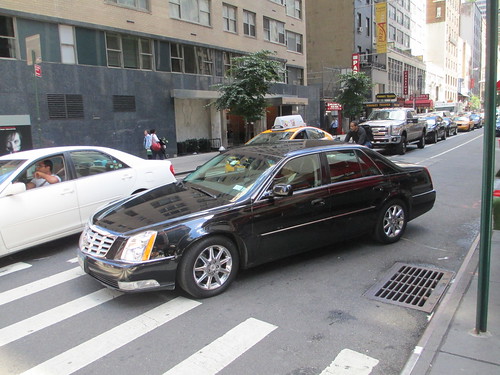 |
| The true effectiveness of years of "Share the Road" efforts is clear from this picture of a midtown Manhattan Street. Note the Cadillac blocking the route of the cyclist using the bike lane. |
The correct solution is hiding in the plain sight of that
TfL report and Melbourne
University
Yet the chances of a big change in attitude soon seem
remote. Appeals for everyone to “share the road” have the advantage of seeming
even-handed and fair. Pleas for vulnerable road users to look after themselves
better have the advantage of addressing those with most interest in improving
road safety, even if they miss those best placed to improve the position. The
alternative is to start acting on the reality of the picture that the research
paints. That is that private motor vehicles – the dominant form of transport in
most developed countries – pose big risks to those around them, and most
drivers drive as if they didn’t. That seems like the kind of truth that politicians
will put off addressing for as long as they possibly can.
