Showing posts with label cycling in New York. Show all posts

Sunday, 20 November 2016

Obstructive pedestrians, a crass video - and why your city's cyclists are the kind you don't like

If I’d gone out looking for evidence of how differently people regard cyclists from how I regard myself, I could scarcely have done better than my experience this Saturday. In the afternoon, as I rode with my wife and my son along the Embankment in Central London, we encountered a crowd of pedestrians crossing the cycle track against the signal. “Watch out in the cycle track, please!” I shouted.

The East-West Cycle Superhighway near Parliament Square:
site of the Invisible Visible Man's contretemps with
a group of pedestrians
Then, in the evening, I came across a trailer for Trigger Happy, a new series of Channel 4 comedy shorts. The first - Angry Cyclist - features helmet camera footage of the eponymous cyclist riding around streets. “Cycle lane!” he shouts at pedestrians, in imitation of precisely the tone I’d taken than afternoon. He then rides onto a section of pavement that is not, in fact, a cycle lane.

The video was only the latest evidence I’ve seen in recent weeks of how cyclists continue to be regarded in the UK - and possibly even more in the US - as a strange, fringe out-group whose behaviour is baffling and infuriating to others. Earlier in the week, I’d felt a similar sinking feeling when I saw Tweets by Mark Dennison, a presenter on BBC Nottingham, a local radio station, encouraging people to call his show. “Cyclists… what do they do that winds you up?” he asked. He later defended the transparently tendentious tweet as merely a way of encouraging a “balanced” debate.

The comedy short and Mark Dennison’s tweet both came across as belittling a group of people who, at least when sharing the roads with motor vehicles, are vulnerable and relatively powerless. They showed the depth of the chasm of misunderstanding between cyclists and others. While my request to the pedestrians on the Embankment would have seemed self-righteous or priggish to the makers of Trigger Happy, it was in fact motivated by fear. I was worried that, unless they got out of the way, my nine-year-old would be marooned in the roadway when motor vehicles restarted.
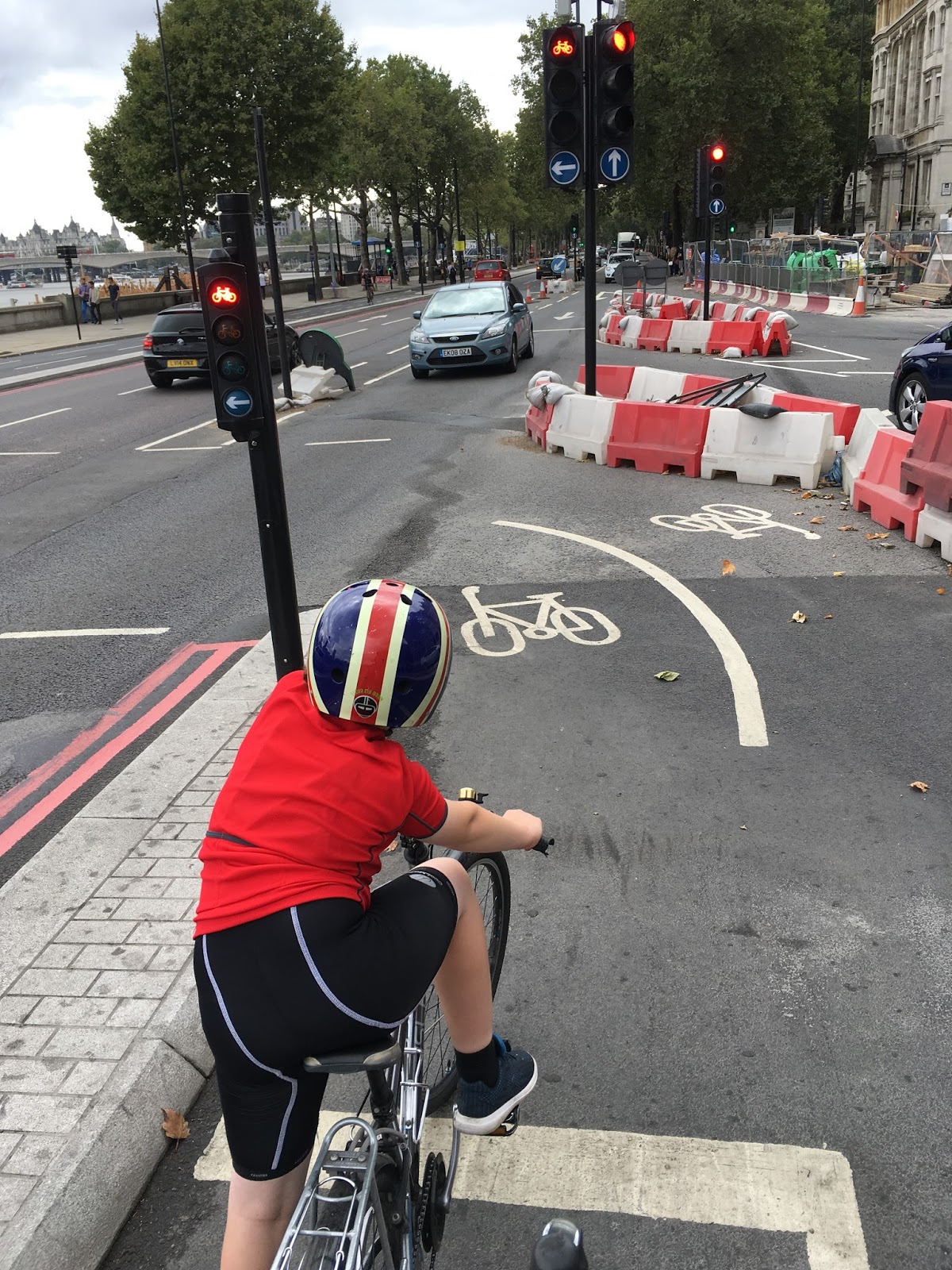
The Invisible Visible Boy on his bike
in central London: a reason for concern I hope
even the haters can understand

The incidents have led me to query why so many people continue to find me and other cyclists so bafflingly alienating. It strikes me as an especially important question given that many cyclists, like me, believe their countries’ transport systems would work better if more people joined them by starting cycling. Current attitudes appear to be both a symptom and a cause of cycling’s remaining a niche activity, practised by a relatively small group of people.

I should say, first of all, that I understand at least a little bit of why Trigger Happy finds some cyclist behaviour funny. There is an underlying similarity to a lot of helmet camera video footage that cyclists post on YouTube. The cyclist is riding along a road - often at some speed - when a motorist does something stupid, dangerous and possibly malevolent. The driver’s behaviour is then held up for general condemnation in a tone that generally suggests the poster is standing, hands-on-hips shaking his head in shocked but unsurprised disbelief. I am sure that, while I don’t use a camera, my complaints about bad driver behaviour have a similar, rather priggish tone. I can see how someone might find it so predictable that it starts to seem a little ridiculous.

But the jokes become far less funny, it seems to me, the moment one starts to think about what shapes the culture that Trigger Happy and others hold up to ridicule. I’m surrounded by fast, aggressive cyclists on my morning commute down Clapham Road not because Londoners are by nature fast and aggressive when cycling but because the conditions have selected both who rides and how they do it. People who don’t feel capable of maintaining a steady 20mph are unlikely to feel comfortable riding down a wide, straight road in close proximity to drivers driving at 30mph and faster.

Cyclists at the Oval on my route to work:
some clichés about London cyclists persist
because they're partly true.
The cyclists I see around me have been as surely shaped by their environment as giraffes have been by conditions on the savanna or the American bison by the high plains. People wear bright clothing and helmets because they hope they’ll help to prevent or ameliorate collisions with fast-moving motor vehicles. It takes both the skills of racing cycling and a road-racer’s appetite for risk truly to embrace this style of commuting. That point came home to me forcibly on Friday when a fellow cyclist, to my astonishment, slipped through the gap - of barely a metre - that I’d allowed myself when overtaking a bus. One especially stressful recent morning, I witnessed a blazing row between two fellow cyclists over an apparent near-collision caused, as far as I could tell, by excessive risk-taking by one of them. The argument continued over a considerable distance, being resumed as both stopped at successive junctions.

This environment explains one of the most frequently remarked upon issues about the demographics of London cycling - that cyclists disproportionately tend to be better off, whiter and more male than the city as a whole. In a car-centric city where people feel skill, knowledge and equipment are necessary to cycle commuting, it's hardly surprising that cycle commuters often come from the class of people who have the leisure and finance to develop the requisite cycling skills recreationally.

A fairly typical bike path in London's
Docklands: experts can't work out why
cycling hasn't taken off here.
I’ve been struck recently by how even I, someone who’s cycled an average of nearly 4,000 miles a year for the last 13 years, feel a little spooked by conditions on much of my commute. I’ve had so many close passes from drivers after pulling out round stopped buses that I find myself increasingly stopping to let buses pull away. On Friday morning, a beautiful morning with nearly ideal conditions, I remembered well over half-way into my commute that I’d forgotten my security pass. I felt a frisson of fear as well as excitement when I realised I’d have to turn around and head home for it, even though I’d normally welcome the excuse to put in some extra miles.

There have, undoubtedly, been efforts to widen cycling’s appeal, both in London and New York, where I lived for four years until July. But Trigger Happy’s scoffing at cyclists’ tendency to shout at other road users about their rights highlights the big problem with many of them. Inadequate on-road cycle lanes, areas where cyclists and pedestrians share space and some quiet routes down parking-clogged back streets build in a significant level of conflict between cyclists and others. It might seem irritating to pedestrians to be asked please not to walk in a bike lane. But it is profoundly frustrating regularly to have to use spaces whose use is so unclear that other users obstruct cyclists unless specifically asked not to do so.

It should certainly surprise no-one that, in existing conditions, some cyclists are apt to break the road rules. If one knows, after all, that the traffic lights on a certain road are timed to suit drivers, not cyclists, and that a phalanx of drivers will chase after one the moment the lights change, the temptation to ride off through a red light and get away in peace can be very strong.

Helmetless, relaxed tourists on the east-west cycle
superhighway: evidence of how conditions dictate who rides.
The way to shape this culture is not, it seems to me, to berate existing cyclists for being as they are but to create conditions that will encourage a different kind of cycling. I certainly feel very different during the brief period each day when I cycle on the protected north-south cycle superhighway from when I’m in a 20mph pack racing down a bus lane. Even small changes can have a big effect. While I still jostle drivers for most of my commute, there are now segregated bike lanes through Stockwell Cross and past Kennington Park, previously the riskiest parts of the route I take. It’s no coincidence, I think, that, since those improvements, I see the occasional couple cycling to work and holding hands at traffic lights. While lycra-clad men still predominate, I find my heart lifting over such normal, human moments.

Better conditions are even, I think, starting to generate different types of cyclists. For four weeks in July and August, when we first returned from New York, I rode each day from our temporary apartment down the Cable Street protected bike path in the East End and onto the east-west cycle superhighway. I couldn’t help noticing that, in a deprived area with such good facilities, I’d see some families of eastern European immigrants out getting about by bike. On Prudential Ride London weekend, when many streets in the capital were closed to motor vehicles, I vividly recall the sight that most raised my hopes for the future. Near Blackfriars Bridge, a Bangladeshi woman in Salwar Kameez clothes paused on her hire bike as she waited for her son to make his way up the hill from the Blackfriars underpass.

The East-West Cycle Superhighway in
Parliament Square: politicians will be slow
to build more such facilities while
cyclists remain alien
Yet the challenge remains that, for the moment, many existing cyclists fit into the kind of stereotypical pattern that can prompt others to label us as “them”. That makes politicians reluctant to provide the kinds of facilities that would produce more obviously non-alien cyclists. It is certainly not surprising that London’s new, left-wing mayor is back-pedalling on his predecessor’s plans to encourage cycling. It is easy to understand his concern that his natural constituency of poorer voters will find themselves stuck on the bus while middle-class cyclists such as I zip by on new facilities and vote for his rivals.

Until that impasse is broken, however, London and other big cities will find that most of its cyclists are people prepared to face down sometimes naked aggression from motorists and even, sometimes, from frustrated pedestrians.

The challenge was made brutally clear to me as I completed my lengthy commute on Friday. As I neared Elephant & Castle, a van driver deliberately pulled into my path. Then, apparently eager to ensure he cleared the junction before the traffic light changed, he tried, despite my clear signals to him, to turn across my path and force me to stop. It was hard not to be reminded of the most succinct answer to Mark Dennison’s question about what cyclists did that wound people up. “Breathe” was one of the very first responses.

Sunday, 16 October 2016

A British Stand-off, an Unbridged Divide - and Why it's Time for Cycle Campaigners to Change the Conversation

There was something almost endearingly British about the standoff. In a typical autumnal light drizzle last Saturday in Swiss Cottage, North London, a group of other cyclists and I stood listening to speeches in support of the building of Cycle Superhighway 11, a planned segregated bike route from London’s West End, through Regent’s Park and up to the point where we were standing. Then, a demonstration against the plan arrived. Participants in the two demonstrations did some mild chanting at each other. Afterwards, we went our separate ways.
Protesters against CS11 meet its supporters, in Swiss Cottage:
a very British stand-off


But, however mild-mannered the two demonstrations at Swiss Cottage might have been, there has been no disguising in the past weeks that demonstrators like those opposing CS11 are growing increasingly vocal in many parts of the developed world. From Community Board meetings in Brooklyn to the pages of daily newspapers in the UK, there have been noisy complaints that newly-introduced or planned cycling facilities are a tyrannical imposition by unfeeling authorities out of touch with the feelings of ordinary people.

The UK’s Daily Mail two weeks ago produced the most eye-catching manifestation of the phenomenon, devoting a double-page spread to what it called “cycle lane lunacy,” which it said was “paralysing Britain”. However, there have been plenty of other examples. The Community Board that oversees planning issues in Park Slope, Brooklyn, and surrounding areas is preparing for a meeting where some locals are expected to vent their near-apoplexy over the Citibike bikeshare system’s arrival in their neighbourhood. Local councillors in Ayr, in the West of Scotland, have voted, under pressure from drivers, to remove the town’s only significant protected bike lane.
A cyclist and motorists in Regent's Park: a powerful
illustration of the arrangements the anti-CS11 campaigners
are fighting to preserve


Yet the cycling sceptics and supporters seem as incapable of meaningful communication as the two groups shouting at each other last Saturday morning. The motorists’ side complains that bike lanes often look empty. Cyclists argue that just shows cycling’s efficiency. Motorists complain that cyclists don’t pay “road tax,” as they do. Cyclists reply that vehicle excise duty in the UK has not been a hypothecated tax for many decades. Motorists complain that congestion is growing worse. Cyclists retort that the people complaining are themselves the traffic. My mind turned, as I rode home from Swiss Cottage, to whether there is some way to narrow this currently apparently unbridgeable divide.

A couple of incidents have highlighted to me the width of the communication gap. The first was on September 23 when, after I published in my day job a piece about the future of London’s roads, a former colleague wrote to me. He questioned whether it could possibly be true, as I had written in the piece, that some London roads with cycle superhighways were carrying more people per hour in rush hours than they were before the superhighways were put in place. He also asserted that cycling was, in fact, far more dangerous than people admitted and that, anyway, only the young and fit could do it.
Morning rush-hour traffic on the north-south superhighway:
no, there's no way this street's carried more people since the
segregated bike path went in


Then, two weeks ago, a fellow guest at a dinner party asked me how I’d found my just-finished four years in New York. Struggling to sum up the wealth of experience, I said that New York drivers weren’t terribly nice to cyclists. “But isn’t that how everyone feels?” he blurted out, before looking mortified as it dawned on him that I was, in fact, a cyclist.

The two incidents reminded me that cyclists, for most people, seem like a strange, alien species, taking unfathomable risks yet somehow eager to suck other, new people into participating in their strange mode of transport. The reminder was all the more stark because it was clear that neither of my interlocutors were people of ill will. They thought their frustration over growing cyclist numbers and efforts to facilitate cycling was simple common sense.

It is unsurprising to me that the many people who hold such views see dedicating road space that was previously mainly used by motor vehicles to cycling as a strange, ideologically extreme act. The Swiss Cottage demonstrators were portraying Transport for London’s determination to put in more facilities to encourage cycling as a bizarre, politically-driven effort to punish ordinary people. For many New Yorkers, the notion that a person might ride a bike to work is entirely crazy. That bikes to allow people to do so are now taking up what used to be their normal parking space must seem like a personal insult.
Drivers in a traffic jam by an empty bit of superhighway:
all, I'm sure, would be calmed to learn they're not paying
road tax.


Yet the response from many cycling advocates could be calculated to heighten the irritation, rather than calming it. For example, cycling activists often retort when drivers complain that cyclists pay no “road tax” that the UK abolished its hypothecated road tax - whose proceeds all went to road building and maintenance - in 1937. While the point is accurate, It is also a prissy, know-it-all one. Like many such responses, it deliberately misses the thrust of what cycling’s critics are trying to say - in this case, that they feel their transport choices are heavily taxed and they cannot see why others should use the same space for free.

It would make far more sense to point out that, while motoring is indeed heavily taxed in the UK, the taxes still fall short of covering the full external costs of the pollution, congestion, crashes and other side-effects. The argument is still clearer in the United States, where no state’s taxes on motoring cover even the annual cost of road maintenance. A tax-paying cyclist is, consequently, both saving the neighbouring drivers money and, if he or she previously drove a car, reducing the burden on taxpayers.

Cycling campaigners end up deploying plenty of other similar “well, actually” arguments about the terms of the debate, rather than the substance. There was a striking example in the last week when Quentin Wilson, a campaigner to shift even more of the burden for motoring onto ordinary taxpayers, tweeted a picture of the most westerly current section of London’s east-west cycle superhighway, just off Parliament Square. “Great new cycle lane but where are the cyclists?” he wrote above a picture of the empty lane.
A group of tourists refutes Quentin Wilson's contention this
bike lane goes unused - but also my fellow cyclists' claim
it's not open


Many cycling advocates accused Wilson of bad faith, responding with pictures facing in the other direction, showing a barrier that marks the end of the superhighway. I saw several people tweet with an excited, “gotcha” tone that the lane wasn’t (actually) even open yet.

I’d far rather that activists had pointed out the facts about the section of cycle track in question - and addressed the underlying issue. The section is lightly used because it’s short and doesn’t yet link to any other part of the cycle network. While I’ve used it several times myself, I have also bypassed it sometimes as inconvenient. It would, in addition, be worthwhile pointing out that the superhighways are new, incomplete and that people’s travel patterns always take a while to change after changes to infrastructure.

The Wilson case was one of a worrying number where I’ve seen cycling advocates on Twitter and Facebook accusing opponents of something close to false consciousness. Many seem reluctant to accept, for example, that the new cycle superhighways are currently lightly used outside rush hours or that, yes, motor traffic congestion really is growing worse. Yet I ride frequently on the superhighways outside rush hours and encounter few other cyclists. Arguments that accepted these points, explained what was going on and explained why cycling facilities can help to resolve the problems would be far more compelling.
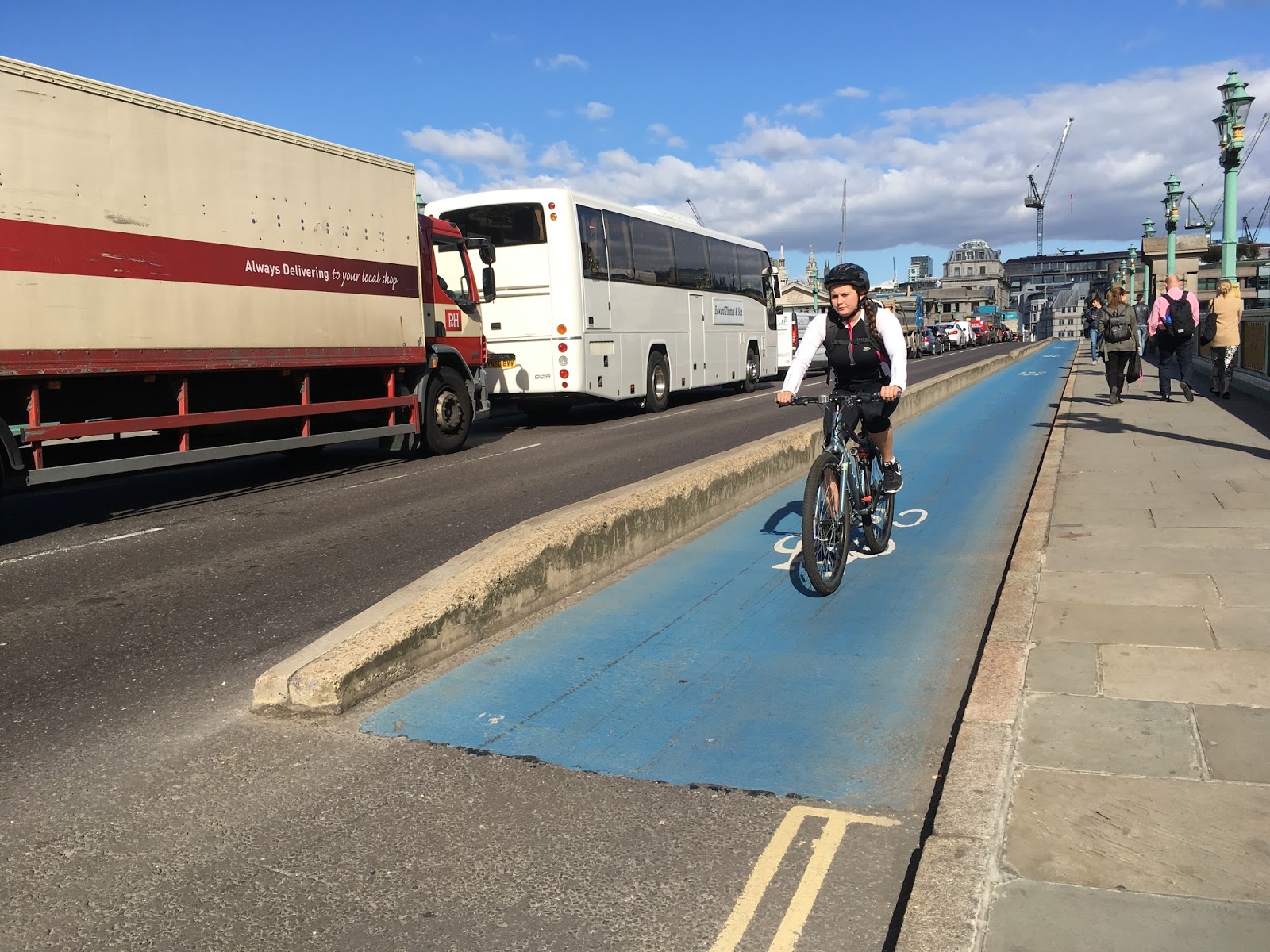
A rider uses the Southwark Bridge bike lane, one of those
singled out in the Daily Mail for paralysing Britain
The problem mirrors developments in the contemporary, polarised political scenes on both sides of the Atlantic. The echo chamber of Twitter feeds and Facebook pages full of like-minded people is gradually alienating many people from the idea that any sincere person could disagree with his or her point of view.

Such echo chambers encourage their inhabitants to feel particularly enraged at my fellow journalists. One Facebook thread I saw recently discussed how users might punish a reporter who had, the thread’s originator claimed, lied through the heinous act of reporting on the anti-cycling views of the London Chamber of Commerce and Industry. Yesterday, I saw two normally sensible Twitter users discussing how a well-regarded reporter who happens to write critically about cycling must be secretly in some sinister anti-cycling group’s pay. This afternoon, I’ve seen on Twitter a suggestion that an anti-cycling editorial in the Sunday Times might be a sign of a “concerted media campaign building”.

Sure, this space in Vauxhall is being very
well used: but how interesting is it to point
that out?
This imagining of sinister, hidden agendas behind newspaper articles betrays a frustrating lack of understanding of how actual journalists work. While I understand the London Taxi Drivers’ Association may have undertaken some lobbying and I know that some business groups oppose new cycling provision, it is naive and silly to imagine that reporters automatically bend to obvious efforts to influence them.

Nearly every reporter I know is driven by a desire to spot developing trends and to paint a picture of the world that will strike his or her readers as true and illuminating. Cycling campaigners should be far more concerned that large numbers of journalists are independently detecting a mood to dismantle or halt progress on cycling and far less concerned with finding a hidden force behind it.The truth, after all, is that progress on both sides of the Atlantic is fragile. There are strong reactionary movements in parts of Europe and North America. 

Many people see provision for cycling as part of a suspect, politically-correct effort to take away their cars. Governments and local authorities have often seemed sheepish about promoting their efforts to support cycling. The arguments for cycling - that it is more space-efficient than motor vehicles, that it causes no pollution, that it costs little to provide for and promotes health - are so obvious as to seem trite. Cycle campaigners would be better, it seems to me, to admit they have a vision for the future that’s different from that of their opponents and argue for their vision’s superiority.
Slow progress in Hyde Park: tangible evidence of the
fragile nature of recent gains
My ride home from Swiss Cottage made clear the costs of failing to get across the case for cycling. Wanting to see progress on the next sections of the east-west superhighway, I took a route through Hyde Park. I at first enjoyed riding down a completed superhighway section down the park’s western end. But then, abruptly, I not only came to the end of the open superhighway but encountered an unannounced closure of the whole southern road through the park.

After my queries about a route for cyclists round the closure drew blank looks from park staff, I instead headed reluctantly out onto the streets of Kensington, one of London’s least cycle-friendly areas. As I did so, the driver of a large Range Rover edged threateningly close to me. When that failed to elicit whatever panicked response the driver was seeking, he leaned long and hard on the vehicle’s horn, issuing a depressing reminder of where real power on the UK’s roads currently lies.

Monday, 25 July 2016

A ride on autopilot, a famous cricket ground - and why I feel more optimistic when I'm on my bike

It was a curious feeling to ride my bike home from church this Sunday along the back-street cycle route that used to be my regular route between home and work. I felt a superficial unfamiliarity - it was my first time back in the area since spending four years living in New York. But at the same time so little had changed on many of the roads that a kind of auto-pilot took hold of me. I followed a complex, twisting and turning route with the instinctiveness that comes from having gone the same way literally thousands of times before.

Canary Wharf's towers loom over the neo-classical
splendour of maritime Greenwich: symbols of London's
endurance and its adaptability
The feeling reflects much of my wider experience of returning to living and cycling in London. There are some big, welcome changes - the new, segregated cycle superhighways being the most obvious. But I’ve been surprised in the last week to find that routes I’ve been using since 1997 - many using facilities designed to encourage cycling by the outmoded method of pushing cyclists towards back streets - still work surprisingly well. I’ve been navigating byways in Covent Garden and quaintly-named alleys in the City of London financial district with almost the same ease as if I’d never been away.

My experience doesn’t feel like a merely practical lesson in getting around London. I’ve come to feel that it’s telling me something wider about the metropolis as a place. London is in some ways peculiarly resistant to change - or at least has a great propensity to preserve the past. While St Paul’s Chapel in lower Manhattan feels almost miraculously old for dating from before 1776, I rode my bike to church partly down a road first laid down by the Romans nearly 2,000 years ago. I currently cycle daily past the Tower of London, whose construction started after the Norman Conquest 950 years ago, in the same year that the last Viking kingdom in England was defeated.

The Walkie Talkie, Cheesegrater and Gherkin:
what London's new towers' names lack in grace
they make up for in memorability
Yet the city also feels peculiarly adaptable. While the Tower has changed little in parts since the 11th century, several of the most prominent skyscrapers - including the Cheesegrater and Walkie Talkie - have sprouted just in the four years I’ve been away. While I didn’t want to leave New York, London’s mixture of stability and flexibility makes it a peculiarly comforting place to be living at a time when the world is descending into turmoil. I cycle daily past reminders that the city has withstood the Black Death, the Bubonic Plague, levelling by fire, the horrors of The Blitz and the vast IRA bombs of the early 1990s. If London spoke like a New Yorker, it might be asking fate, “Is that all you got?”

I encountered an excellent example of the city’s spirit during my ride back from church. I emerged from a back street onto a stretch of Harleyford Road in Kennington in the shadow of the Oval cricket ground. Surrey County Cricket Club’s ground hosted the first ever international cricket test match in 1880. Traditionally home of the last test of each English season, it is steeped in the history of acts of late summer sporting daring. Yet Harleyford Road - once the highest-stress part of my daily commute - has been enhanced with a new, two-way protected bike lane that carries cyclists all the way over the once-terrifying Vauxhall Bridge into Pimlico. The juxtaposition of the cricket ground’s Victorian grandeur and the bold new transport experiment was striking.

The glory days of Jack Hobbs, Surrey's master batsman,
are a thing of the past at the Oval, over the brick wall in this
picture. But so, thankfully, are the days of death-defying
cycling manoeuvres over multiple lanes of traffic
on Harleyford Road

The relative mildness of London’s response to change, of course, reflects partly the city’s being a less bracing place than New York. The crowding of the key bits of New York onto small areas of two islands in New York Harbour produces greater density and a greater propensity to eradicate the past. But it also propagates an impatience with anything that’s not immediately useful or profitable. That certainly helps to encourage some negatives - the dreadful driving standards, for example, or the peculiar anger over any effort to reallocate street space away from car parking. But it also produces an energy and buzz that aren’t quite there in lower-rise, lower-stress London.

I don’t mean, either, to sentimentalise London. I’ve noticed since I returned that my younger colleagues are living further and further from central London, pushed into more and more obscure outer suburbs by crazily spiralling housing costs. I’m protected from them only by the good fortune of having bought a house 12 years ago.

A graffiti mural in Park Slope, Brooklyn: a reminder of
New York's more frenetic street life
The riots in many parts of the city in 2011 suggest many members of poor minority groups feel little stake in London’s wellbeing. Some of the UK’s poorest people continue to live in such jarring proximity to members of the global super-rich that it seems remarkable the city has maintained such relative social peace.

The city’s tolerance of change and incomers is perhaps the flipside of a rather English reserve about them. In the serviced apartment complex where my family, my bike and I are currently living, no-one seems perturbed that the staff all speak Romanian to each other. But most people barely seem to notice the staff at all.

The Brick Lane Jamme Masjid - formerly the Spitalfields
Great Synagogue, formerly London's Huguenots' Neuve
Eglise: symbol of London's flexibility
Nevertheless, I am reconnecting with the city’s distinctive spirit. I rode down on Saturday, for example, to Greenwich through the Isle of Dogs. I cycled part of the way with a group of boys whose accents were a strange mixture of Caribbean, South Asian and traditional cockney. Given the mixture of the language and their own ethnicites, their term for each other - “bruv” - sounded like a strangely universal embrace.

Our temporary accommodation, meanwhile, is near the Brick Lane Mosque - a building famously built by Huguenot refugees, subsequently taken over by Jewish refugees and now a place of worship for east London’s Bangladeshis. Its history seems mainly to be a source of some pride, rather than anguish over what has been lost.

Striking juxtaposition: a man rides down a few months old
cycle track, past a tower whose origins go back 950 years
These positive feelings, of course, could prove fragile. As the UK’s wealthiest, most international city, London has far more to lose from the economic pain of leaving the European Union than some other parts of the UK that, unlike London, voted in favour of leaving. Having experienced the trauma of the July 2005 terror attacks on London, I know that the city’s relative calm could be tested if the successor to the Nice or Munich terror attacks takes place on London streets.

But I ride daily amid a city that feels as if it’s flourishing, despite the abundant evidence of past catastrophes. The ground below Upper Thames Street where I ride each morning contains piers abandoned by the Romans when they left the city in ruins. To my right as I ride to work is the monument to the dead of the city’s 1666 Great Fire. A mere recitation of the grim facts of London's current situation makes it feel as if it's undergoing another historic disaster. But, riding a bike amid the ghosts of past horrors overcome, it's far easier to feel optimistic.

Monday, 9 May 2016

A sobering email, writing about cycling - and why my rational choice brings me joy

It wasn’t the most depressing email I’ve ever received. But it was one of the more disheartening related to this blog. A couple of weeks ago, an old, London-based contact emailed to let me know he was moving to New York. But, while I eagerly agreed to his suggestion we meet up, his second paragraph gave me pause for some gloomy thought.

“I shall not be cycling,” my contact wrote. “I have read enough of your blogs not to tempt fate.”
 
Cyclists literally queue up at the Manhattan Bridge
to tempt fate
The line made me realise my fundamental failure to strike a balance in how I’ve written about cycling. While I would like New York conditions for riding to be far better, I haven’t, I recognise, given nearly enough space to why, amid all my complaining, I continue to ride a bicycle.

My dismay has grown all the greater subsequently as I’ve received repeated reminders that large numbers of people either think it wholly irrational to ride a bicycle in a city or misunderstand the rationale for doing so. Two days after I received the email, Lucy Kellaway, my colleague at the Financial Times, published a column saying she longed to return to cycling after a recent crash while cycle commuting. But she said many readers had assured her the crash should have served as a warning to her to give up. The day before Lucy’s piece, the New York Times published an article of advice for would-be urban cyclists. The Times’ piece dwelt at length on the need to wear a helmet and follow all the road rules but suggested one simply had to trust drivers not to pass one too closely. Most despicably, AMNewYork, a New York news site, on Monday published a piece of unpleasant clickbait listing the "Worst Things about Bicyclists in New York City".

Such criticism of the choice to cycle often seems to me to miss a core point about cycling as an activity. Cyclists, to read many people’s writing about the subject, are helpless subjects of the dangers of the roads, who can do no more to mitigate the risks than wear a plastic helmet. This is essentially the way a cyclist must look to an onlooker driving a motor vehicle.

Yet the arguments in favour of cycling all focus on its nature as an active form of transport. There are significant health benefits to be derived from cycling as a physical activity. It’s also possible to act in ways that, to a limited extent, mitigate the dangers. I’m convinced that, when these points are thrown into the balance, the cost/benefit ratio swings overwhelmingly in favour of cycling. I regret having given a different impression.
 
The Broadway bike lane: not a clear signal of cycling's
rationality
It’s perhaps worth asking, however, why it even matters to me that my choice is rational. It’s irrational, after all, to eat and drink as much as I do. It’s almost certainly not sensible to work as hard as I do at a job that’s far less significant than it feels when I’m wrapped up in it. I could simply say – as Lucy’s piece concluded – that a cold-headed assessment of risk doesn’t capture why I cycle. I could say that I ride my bike because of the joy of feeling in step with the city, of the extraordinary things one sees late at night, or because I feel when I'm cycling as if I have a superpower.

I’m not quite prepared to do that, however. It would feel, partly, like a betrayal if, having criticised the irrationality of so many other people’s thinking about transport, I decided it was a matter of personal taste. I’d also risk sounding like the archetypal annoying hipster explaining how he likes a band you “probably won’t have heard of” – “I like cycling in New York – but it’s probably a bit too hardcore for you”.

I want, as I wrote four years ago, to live what Gordon Graham, one of my moral philosophy lecturers at university, called “the rational life”. Someone living a rational life seeks to use reason to decide how to behave. If I didn't think the way I got about was rational, I'd find another way to travel.

Yet there is no doubt that there is at least a superficial case that I'm taking on an unnecessary risk when I cycle. I have, over the course of more than two decades' urban cycling, been twice knocked off by motor vehicles and once by another cyclist. It was only good fortune that none of these crashes involved a serious, long-term injury. There is a small - but not entirely negligible - risk that some day I too will end up, through no fault of my own, crushed under the wheels of a badly-driven truck or sent flying into the air through a taxi driver's inattention.

Make a wise choice, folks: drive a car instead. Oh.
But that fails to capture anything like the whole, complex picture of the risks I'm managing. Heart disease, cancer, stroke and my tendency to put on weight all pose far more serious risks to my life expectancy than the small risk of a fatal crash. Figures years ago from Cycling UK suggested that someone who cycled regularly into middle age – that’s I now, folks – increased his or her life expectancy by an average 24 months. The reduction from crashes was, on average, two months. While the figures for deaths per mile in the US are hard to find, the risk per mile of cycling looks to be just short of twice as high, leaving the benefit: cost ratio still a healthy 7:1.

I am not, either, a helpless victim of those averages. It is certainly true that the vast bulk of crashes between drivers and cyclists are mainly the driver’s fault. But I have, I think, learnt over the years a “well-managed fear”. I let my nervousness about the vehicles around me prompt me towards holding the road when drivers try to bully me out of the way, making clear, understandable movements, rather than sudden, darting ones. I try to communicate clearly with drivers. Such behaviour can guard against the negligence of people who have far less at stake than I. A good knowledge of safe routes and the skills to take up the necessary road space to discourage dangerous passing are far more useful than most of the “safety tips” that the New York Times’ piece gave.
 
Should New York's cycling facilities make it clearer
cycling's a good idea? Guess what I think, based on this picture.
It’s because cycling is a rational choice, meanwhile, that it’s folly for cities to seek to cater to cyclists merely as part of a policy of offering a choice of travel modes. Given that cycling makes personal sense for vast numbers of people, makes excellent use of road space and reduces pollution, it should be incumbent on cities actively to promote cycling. City departments of transportation should ask themselves if few people choose to cycle why their road designs are instead promoting less rational options. The risks of cycling should undoubtedly be less than they are. But better-designed roads would not only reduce those risks but make it far clearer how rational a choice it is to cycle.

Better facilities would make it far easier for citizens to appreciate the true balance of risks they face. All forms of transport entail some form of risk. I was knocked down as a child while crossing a street. I crashed my dad's car off the road during my first driving lesson. I've been caught underground in a subway train during a track fire. Riding a bicycle represents, even under current sub-optimal conditions, a good trade-off between risks and rewards.
The USS Intrepid: a sight I'd have missed in the subway.

Yet I can’t deny that I’m happy to find cycling rational because it’s also a joy. I was acutely aware of that on Friday when I finally met up with my old contact. Leaving the office, I pedalled up Hudson St then out onto the Hudson River Greenway towards midtown. It was a journey my colleagues assumed I wouldn’t do by bike because of the looming threat of rain. My contact assumed I wouldn’t have enjoyed because I’d be battling through traffic. It nevertheless lifted my spirits in a way that a subway trip could never have done and got me there promptly and cheaply in a way a taxi ride could not have. As I zipped along by the water under leaden skies, looking up at the Empire State Building, marvelling at the USS Intrepid and hearing the splash of the water, I reflected on the straightforward pleasure the ride was bringing me. There are few satisfactions greater, I realised, than indulging in an activity that's both rational and brings one immense joy.

Sunday, 26 April 2015

A midtown mechanical, a Hudson River puncture - and how my bike gives me a superpower

As I wheeled my bike along 58th Street in midtown Manhattan in a heavy rain shower last Wednesday, I noticed a periodic scraping sound from the vicinity of my rear brakes. Realising that one of the brake pads was rubbing a slight bump in the wheel, I delved into one of my pannier bags, pulled out a multi-tool and set to work. I marginally tightened the left-hand brake calliper and loosened the right-hand one about the same. I was pleasantly surprised to hear the sound had stopped and that, when I started riding down Lexington Avenue, the brakes were working as well as they ever do in the slitheriness of a spring downpour.
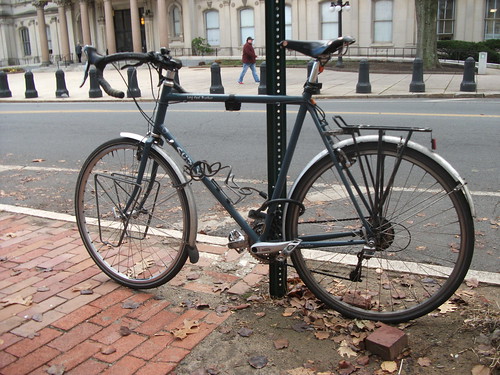
Shaped by 30,000 miles' riding: my Surly Long Haul Trucker
mediates many of my interactions with the world.

The incident made me realise how, even though I still regularly make comically silly mistakes when trying to maintain my bike, I’ve come to know its ways. My attempts to fix faults are growing steadily less disastrous. It also made me think, harder than I have for a while, about quite how intense and symbiotic the relationship between a regular cyclist and his or her main bike can be. My body has gradually shaped this bike – on which I’ve ridden about 30,000 miles over seven years – to fit its needs. I’ve steadily fitted tougher and tougher rear hubs after cheaper ones collapsed under the strain of hauling my tall, heavy body away from traffic lights. The bike, meanwhile, has shaped my body. My bulging leg muscles testify to hundreds of twice-daily climbs over the Brooklyn and Manhattan Bridges. If something on the bike changes - the brakes, say, are tightened - I find myself so used to how they used to be that it takes me some time to adjust my reactions.

My Phil Wood rear hub: a component so expensive one buys it
only after breaking every other brand available.
It’s because of this intense symbiosis, I think, that for many cyclists their main bike excites far greater passion than its status as a possession should suggest. A bike becomes one’s own more and more over time, much as a pair of shoes does. My Surly Long Haul Trucker probably shapes how I interact with the world more than any possession except my spectacles. It’s hardly surprising that, even more than dogs, bikes seem to start taking on an appearance similar to their owners’.

My midtown incident also, however, threw my mind back to the Thursday before Easter, when I encountered a High School student struggling with his bike on the Hudson River Greenway. He asked me to lend him a pump to inflate his obviously punctured rear tyre. Recognising that mere extra pumping wouldn’t get the young man all the way home to Williamsburg, I fixed the puncture for him. But I also felt grateful for the years of advice and training from my father, bike shop staff and fellow cyclists that ensure I’m never similarly forced to rely on the kindness of cycling strangers.

The downside, after all, of the elegant simplicity of a bicycle’s workings is that simple often isn’t self-explanatory. In an era when carmakers are warning customers that they shouldn’t on any account try to repair their vehicles because of the sophistication of their software and electronics, most bikes remain resolutely mechanical. They are still controlled by systems of levers and springs, actions balanced against equal and opposite reactions.
 
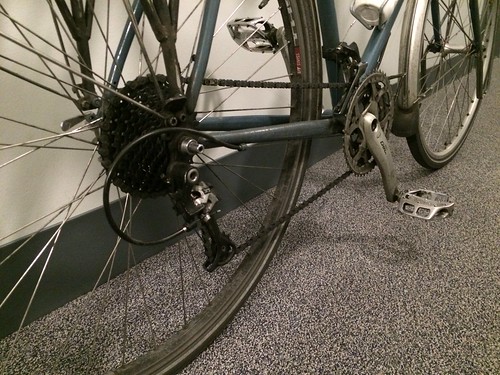
My bike's rear mechanism: action and reaction exemplified.
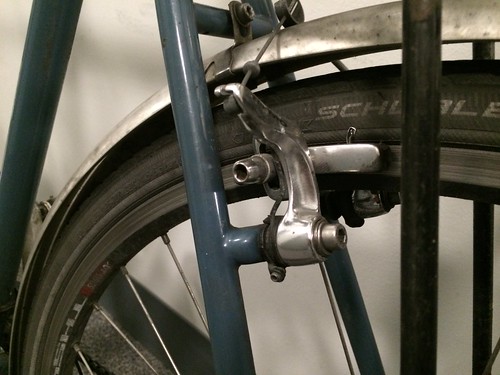
It requires some understanding of derailleur gears to grasp, however, that the cable for the rear sprockets needs to be tighter if the bike isn’t shifting easily onto the easiest gears. When I undertook my roadside repair last Wednesday, I was tensioning the spring in the left calliper and loosening the spring in the right one. I was using my knowledge and experience of how the two sides of the brakes push against each other.

It’s not only worth understanding these systems for purely practical reasons. There’s a poetry to the way a rear mechanism pushes a chain between the sprockets of a derailleur gear that is a powerful testimony to human ingenuity. It’s compelling evidence of how humans learn from their predecessors and make progress that I can now so easily adjust my brakes thanks to simple adjustment mechanisms. That was impossible with the bikes I owned 20 years ago.
 
My once-troublesome rear brakes: a delicate counterpoise
of springs
The sheer range of different ways of making a bike work also testifies to the dazzling range of different things people seek to do with bikes. I ride a bike with plenty of gears and a solid frame because it fits with the relationship I want between my body and the bike. When I had bikes with harder-to-change gears, I used to get sore knees from pushing on the pedals in a less-than-efficient gear. I shift gears hundreds of times every journey now and my knees suffer no longer. The frame of one old, alloy bike broke under me. My steel frame has withstood the stresses of one crash with a car, another with another bike, huge loads of weekly shopping and transporting, at different times, both my children. I marvel at how smoothly the steel frame copes with corners, removing the sense that I’m wrestling with the bike to get it to turn.

The range of different balances between body and bike came home to me on Saturday night when the Invisible Visible family and I headed the short distance from our apartment to the Red Hook Criterium, a cycling road race near our apartment. The race compels riders to use track bikes – light, brakeless and with fixed wheels – rather than more conventional, multi-geared road bikes. The trade-off was plain. The event teemed with cyclists with leaner, stronger, more efficient bodies than mine, honed to handle the rigours of a far less forgiving bike. We watched awestruck as these hyper-fit riders and their stripped-down machines negotiated the 1.25km circuit, ticking off some laps in less than 90 seconds and swishing by us at well over 60kph.
 
Crit riders warm up: a subtly different balance between body
and bicycle from mine
I’ll never zip round a track like these fit young men. Nor will I ever dance up Alpe d’Huez like Chris Froome, except in my imagination. But there is a similar satisfaction in the relationship between our bodies and the machines. For the Criterium riders, Tour de France participants and me, the bicycle magnifies our bodies’ efforts. For the Criterium riders, it was a question of a carbon frame's coping with the strain both of rapid acceleration and of being slowed down for a corner only through the rider’s resistance against the pedals’ spinning. My bike has to absorb the shock of a hidden pothole then let me skip swiftly away from the next traffic lights while the drivers are still looking at their smartphones.
Riders fly by at the Red Hook Crit: yes, it's entirely different
from my cycling but, yes, their bikes offer similar joys.

Even for me, being on a bike can resemble being in possession of a superpower. On an empty, flat road, it can feel when I slip the chain onto the biggest, fastest chainring as if I’m Mr Scott pushing the button to send the Starship Enterprise into warp drive. A range of new, higher speeds is suddenly at my command and my speed surges. As I labour up steep hills, meanwhile, I reach the lower limits of the lowest gears on my middle chainring. Then I feel a little surge of joy as I switch down to my smallest chainring, pedalling grows easier and nearly any slope is within my reach.

It’s on the offchance that I’ll enjoy such a feeling that I ride to work when I can even on days when the water in my bottle freezes on the way to work – and on days so hot the whole city stinks. Maybe in time the same feeling will inspire the young man I helped to persevere with cycling rather than giving up in frustration. I'd love to think that one day he'd join me among a fairly small minority of New Yorkers - the ones who, faced with rain and a faulty bike, say not, “Let’s take the subway,” but, “Where in my bag is that multi-tool?”

Wednesday, 9 July 2014

A Chinatown honker, an interborough trip - and how city cycling betrays my kids' innocence

It wasn’t, in most respects, a particularly exceptional piece of abuse. The man leaned loudly on his horn, squeezed his vehicle through a narrow gap to my right, leant out his window and gestured towards the kerb. “You should be over to the side!” he shouted.
 
A clear incitement to driver rage
But the abuse felt different for one reason. I wasn’t riding last Saturday on my own, as I usually do, but with my wife, the Invisible Visible Girl, 12, and the Invisible Visible Boy, six. The driver was harassing two children who’d been given limited choice about whether to come with us. He threatened them, effectively, with being run over for turning left. It was one of several incidents of low-level harassment we suffered as we rode from home to a Hudson River playpark and back, more slowly and cautiously than I would on my own.

It felt – not for the first time – as if I was giving the children a harsh introduction to the hypocrisies of the adult world. They’ve heard at school and on television about how they should look after the environment and how cycling is a good way to do so. I’ve stressed to them the importance of responsible behaviour on the road. They’re led to believe that most adults want to protect children.

Instead, we faced some motorists who felt entitled to scare us off the roads by brute force. While we tried to keep to the rules of the road and respect others, we found motorists turning across our path, driving dangerously fast and generally treating their legal and moral obligations to other road users with contempt.
 
The Invisible Visible Boy and trailer bike:
it's OK; you're allowed to smile at us
The overall atmosphere even made me feel irritated about one of the positives of riding with children. After they’d done a double-take at my son’s trailer bike, many passersby would smile or even give us a thumbs-up, responding to the sense of joy and freedom that children seem to feel when cycling. In light of the other behaviour, the friendly gestures felt somehow irritatingly superficial.

It speaks volumes about quite how superb an experience cycling in a city with children can be that we still thoroughly enjoyed ourselves.

Part of the problem is that few parents in New York or many other big cities – including London, where we used to live – would even countenance undertaking a 12-mile, cross-city round-trip with two children by bike. I’ve read suggestions that parents who cycle with children in London should be prosecuted for child abuse. I remember one disapproving woman in London who saw me negotiating a junction in London (on foot, to reduce the danger) with my son and his trailer bike. “That’s so dangerous!” she said in a stage whisper.

The thought’s the logical extension of the common, mistaken notion that cyclist and pedestrian negligence causes crashes, while speeding, telephone-using motorists are the hapless agents of fate. Parents who cycle with their children are somehow meant to be the only living creatures on earth who don’t care if their progeny survive. The disapproving woman in London presumed she cared more about my son’s welfare than I did. Drivers’ behaviour around cycling families is unlikely to improve until they’ve had more practice encountering them.
The view from Pier 25: worth a few hassles to cycle there.

I'm carefully balancing the risks and rewards when I ride around with the children, however. I’m partly looking to the long term, when the likelihood is that a cycling habit will extend their life expectancy by far more than the risk of a crash will curtail it. I also undertake careful risk analyses. I thought carefully on Saturday about whether the roads would be quiet enough over a holiday weekend for the whole family to follow the route I take to work each day. We then headed a little further to Pier 25 on the Hudson.

The trip brought immediate benefits. As soon as we set off, I was being treated to a burbling stream of the boy’s observations on life and the passing city. When might he fit his older sister’s old bike? Were we in Chinatown yet? Were we out of Chinatown? Why was it called Chinatown? Which floor in that building was my office? My wife, following behind, had the pleasure of hearing the Invisible Visible Girl, riding her own bike, reflect on the shops along Prince St in SoHo.
 
I'm still a hero when I can fix the Invisible Visible Girl's
bike, if at no other time
It was as if the simple act of getting on our bicycles had wiped away the generation gap in perceptions and enthusiasms within the family. Cycling’s an activity for which many children feel an infectious enthusiasm. It lets adults – myself included – give free rein to their inner child. It’s one of the first activities where children exercise the adult responsibilities of getting about independently. It’s an activity where my modest mechanical expertise continues to give me hero status with my daughter, even as she draws close to becoming a teenager. I’m handing on to my children knowledge about bikes that I learnt from my father and that he learnt from his father before him.

Because of how the experience bonded and relaxed us, I felt guilty when I lapsed into my stressed adult self at a few points in the journey. I found myself gesticulating, exasperated hands aloft, as a truck overtook us then swung right across our path at Spring St and Broadway. I gestured frantically at motorists lining up at the scary intersection of W Houston and West St not to try dangerous overtaking moves. It always feels unfair when I let the children see the more anxious, stressed me of points in my workaday life, rather than the in-control daddy I try to give them.
 
The Invisible Visible Boy absorbs another family interest
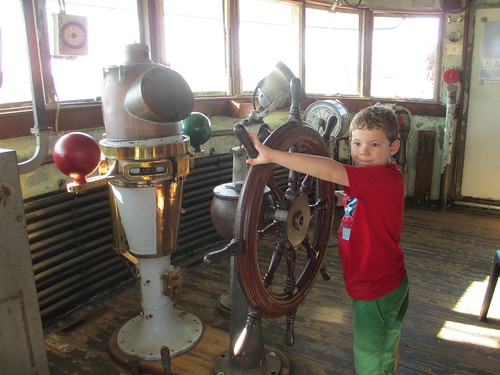
Yet, after 45 minutes or so, we had reached the calm of the bike-only Hudson River Greenway for the short ride down to Pier 25. The boy splashed in the water to cool off from the 90F heat and humidity. The girl, who normally has her head in a book or her iPad, briefly tried out a climbing wall. We visited an old lighthouse tender moored by the pier, where the boy made my heart sing by taking a close interest in the triple-expansion steam engine. Looking up at the lower Manhattan skyscrapers, it felt a privilege to be on bikes in this spectacular city.

The incident with the honking driver – in Chinatown, as we returned to the Manhattan Bridge – detracted only a little from the day.

It was hard, nevertheless, not to feel wistful as we returned home that the experience could not be easier and more straightforward. While I’m prepared to take the boy most places in the city on a trailer bike behind mine, I’ve so far turned down his requests to be allowed to ride alongside us on the sidewalk on his own bike on short, local trips. The girl, older and more attuned to the risks of the roads, never much likes riding into Manhattan because of the challenges of the traffic and impatient drivers.

It would take relatively little improvement, I’m sure, to coax far more parents to get out their children’s bikes for family trips, rather than resort to the subway or a car. Even on Saturday, there were parts of the journey – on the Allen St protected bike lanes, on the Hudson Greenway, on the Manhattan Bridge – where I had no worries about the children’s safety. With further work, I might start feeling more confident about letting the boy ride on his own. With only minor improvements, I might start acknowledging on their own, friendly terms the thumbs up and smiles of well-meaning passersby.