Showing posts with label London. Show all posts

Sunday, 22 January 2017

A past mayor, a miserable blogiversary - and why I still think Roundheads must come to the rescue

It used to be frustrating asking Boris Johnson, London’s mayor until May last year, about transport policy issues. During my first stint as a transport correspondent, from 2003 until 2011, I recall asking him about his determination to remove the western extension of London’s congestion charging zone, to introduce new cycling facilities as mere blue-painted lanes down busy main roads and replace London’s efficient, articulated buses with a lower-capacity, double-deck vehicle loosely based on a much older vehicle. All the concerns were shrugged off, with Johnson’s trademark insouciance.

All those ideas are now recognised, to a greater or lesser degree, as bad ones that either should have been better thought through or not implemented at all. Congestion in west London rose; the painted “superhighways” proved tragically dangerous and the new bus has become an expensive joke that has helped to damage the performance of London’s bus networks. The mayor, meanwhile, went on to be a leading figurehead of the movement calling for the UK to make one of its biggest, most poorly thought-out policy decisions since the second world war when it voted to leave the European Union.
A Routemaster at the London Transport
Museum: nostalgia for the design classic
inspired Boris Johnson to commission
the New Bus for London, the opposite of
a design classic

This past week, however, has left me with the impression that far more people approve of the former mayor’s style of policy-making than I had suspected. Since I posted on Monday a blogpost calling for cyclists to face the reality that London’s roads are growing steadily more congested, I’ve faced a series of criticisms. Many of them have focused on my argument that cyclists have to recognise that our aspirations to get further dedicated space for cycling facilities mean we are in competition for scarce road space with other road users, who face growing congestion. Cyclists ought, I argued, to take an interest in the problem and in measures to rein it in. In particular, I was the subject of a blogpost by Andrew Gilligan, who worked as Boris Johnson’s cycling commissioner. He accused me, essentially, of cherry-picking evidence to suit my position and asserted, based on Transport for London’s Journey Time Reliability figures, that congestion wasn’t really getting worse at all.

The various criticisms I’ve faced have fallen into a series of broad groups. Several people argued that there was no real trade-off between cycling and other modes. Others contended that other road-based modes were so much less worthwhile that any trade-off was worth it even if it, say, caused serious inconvenience to people making the 6.5m daily trips by bus in London. Finally, there was a strain of thought that I was mistaken in even my attempt to put cycling in a broader policy context. Cyclists should make the argument for cycling provision and forget about anything else. I’d class all of these criticisms as falling, like Johnson himself, within the Cavalier tradition in British public life - that the depth of one’s convictions and the elan with which one states them are more important than the pettifogging details of the statistics.

A mid-morning traffic queue on Blackfriars Road: road-pricing
might fix this.

However, a report on Thursday from the London Assembly’s transport committee has reinforced my conviction that my cautious approach to public policy - which I’d class as being in the Roundhead tradition - is in the ascendant, in London at least. The report acknowledged the growing congestion crisis and that the recent worsening in conditions reflected a shrinking of the road network’s capacity for multiple reasons. It advocated - as I do - pressing ahead with new, high-quality cycle provision such as the segregated cycle superhighways. However, it also said it was vital to introduce road-pricing - as opposed to a simple congestion charge for entering central London - to relieve the pressure on the roads. I very much hope - although I doubt that the current mayor has the political courage for it - that the assembly members’ recommendation will be followed. I also hope that the debate over the issues can become more constructive than it feels to me after a week that’s marked a fairly miserable fifth anniversary for this blog.

The focus of much of the criticism, however, has been my reference in the last blogpost to a point that ought, in a rational world, to be uncontroversial. This was to point out that central London’s congestion is worsening and that it is likely that the building of wide cycle tracks along some of central London’s key arterial roads - and the addition of some cyclist-only phases at junctions - contributed to this. I made the point not because I disapprove of the cycle tracks’ building - I enthusiastically endorse them - but because of the implications for the future.

Anyone who wants an extension of the existing tracks needs to gain the approval of planning authorities and a mayor’s office already facing substantial pressure because of the road network’s deteriorating performance. There seems to me to be little likelihood that a mere restatement of the now-conventional wisdom that the cycle superhighways are unrelated to traffic delays is going to win over many of the people that need to be persuaded.
Cyclists last week on the north-south
Cycle Superhighway: a stirring and encouraging
sight - but still, I contend, one that must be
affecting the neighbouring motor traffic.


As I pointed out in the original post, the average speed of traffic in central London has fallen in the most recently-published figures despite a substantial fall in the volume of traffic on the roads, a phenomenon that most observers attribute to a shrinking of the network’s capacity. While it’s true that the network’s capacity started to fall well before the cycle superhighways were built, there’s little serious doubt that the superhighways are contributing to delays for motor vehicles. An update in November on implementation of the schemes said that journey times for motor vehicles southbound alongside the north-south cycle superhighway had returned to pre-construction levels since completion of the project. All other traffic flows alongside the superhighways were longer, however.

The added delays included eastbound journey times alongside the east-west cycle superhighway that were 10 to 15 minutes longer in the evening peak than before the facility was put in. The roads concerned will undoubtedly have been affected by the wider worsening of congestion in the period in question and the changes will no doubt, like all changes to road networks, bed down as drivers adapt their behaviour to cope. But it seems profoundly improbable that the big changes to traffic flows have not contributed to this slowing and it is impossible that this substantial slowing of some journeys has not played a part in the declining average speeds reflected in the statistics.

It was my reference to the superhighways’ effects that prompted Andrew Gilligan’s response. Referring to me by my title in my day job - something I’ve tried to keep scrupulously separate from my free-time blog - he accused me of using figures that were “selective” and that the true indicator of congestion was quite different. At least one person treated this post as definitive proof that I was wrong. “Watch @mragilligan use knowledge and stats to destroy @RKWinvisibleman 's recent argument that cycle lanes are causing London congestion,” wrote @BrixtonHatter on Twitter, linking to Gilligan’s post.

Yet Gilligan’s arguments seem at odds with nearly everyone's experience. His argument that congestion isn’t getting much worse pre-supposes that the ever-slowing movement of London buses and logistics companies’ dwindling productivity are mere fever dreams. Any anecdotal evidence - the fact, for example, that I often now have to pick my way between halted vehicles to buy my lunchtime sandwich, whereas the danger used to be moving ones - is also to be disregarded.

In fact, the reason why I didn’t quote Gilligan’s favoured measure of congestion - journey time reliability - is that the average speed figure that I used more accurately captures the nature of this problem. The reliability figure tracks the proportion of vehicles that complete trips in more than five minutes longer than the average time over the previous year. It consequently measures the frequency of severe, one-off disruption. Its use of previous average speeds means it is designed to screen out the kind of gradual, strangling congestion that is steadily choking London.

A typical weekday lunchtime on Southwark Bridge:
anecdotal evidence that it seems I must disregard.
My central point remains. It must, in my view, be a serious problem if average daytime traffic speeds in the centre of London - a place where motor vehicles are needed to serve a big upsurge in building and infrastructure work, to carry people in buses and to make deliveries - have dropped as low as 7.8 mph.

Members of the London Assembly’s transport committee seem to share many of my concerns. In the foreword to their London Stalling report on congestion in the capital, Caroline Pidgeon, the committee’s chairwoman, wrote that congestion had begun to rise sharply.

“Traffic has slowed down and road users are spending longer stuck in delays,” she wrote. “Buses have become so unreliable that usage has begun to fall, after many years of growth.”

The report went on to list a very Roundhead set of recommendations - ideas based on careful attention to the statistics, rather than the kind of sweeping, grand gesture that used to be the rule under the previous mayor. While I am delighted that the existing superhighways have been built and grateful to Andrew Gilligan for his central role in that achievement, it seems vanishingly unlikely that either Sadiq Khan or the assembly’s transport committee will sign off on a significant extension if it will produce a further worsening of congestion.
Ultimate motivation: my son enjoys the east-
west cycle superhighway by the Embankment

It is hard to imagine some of the arguments I’ve heard this week will succeed in swaying the current mayor. It is inherently implausible, for example, that the mayor will allow measures that significantly delay bus passengers to benefit cycling, which currently accounts for just 700,000 daily journeys across the capital. As with nearly every other public policy question, measures to favour cycling are subject to trade-offs with other choices in which policymakers have to balance competing interests in as equitable a way as possible.

But the ultimate question for me doesn’t involve politics, policy arguments or the different personality types of the people involved. It’s that my children since we returned to London from New York in July have become much keener on cycling in central London, thanks to the cycle superhighways. I want to see them extended so that we need do far less jostling with aggressive drivers to reach them.

The Cavaliers had the chutzpah to get the existing facilities built. Perhaps their current strategy - berating the uselessness of everyone concerned, questioning their motives and insisting that no trade-offs are necessary - will succeed again, despite my concerns. But my guess is that the next push will require more of a Roundhead’s recognition of the complexity of the policy challenges and readiness to get to grips with them. I hope that such sober thinking will grow far more widespread than it seems to be at present.

Sunday, 4 December 2016

A peeved pedestrian, a rider's broken shoulder and why it's time to stop designing for conflict

It’s the kind of incident that a London cyclist experiences pretty regularly and that I’d normally put straight out of my mind. As I rode home from work a few weeks ago, down Lambeth Road past the Imperial War Museum, a pedestrian yelled at me as I rode through a zebra crossing: “You’re supposed to stop!” Since I’d ridden through as he was on the other side of a central pedestrian refuge from me, on a wide, four-lane road, I found the shout irritating, rather than guilt-inducing. He wanted to make a point, I sensed, rather than to express any plausible serious concern. At the closest point, we were at least four or five metres apart.

The incident has stayed with me because the Peeved Pedestrian of Lambeth Road seems to represent a significant current tendency in anti-cycling thinking. Again and again recently, people have responded to my writing about the dangers facing cyclists by complaining about cyclists’ behaviour in pedestrian areas. “A cyclist whizzed right past me on the pavement the other day,” the rejoinder to some tale of death-narrowly-escaped often runs. “What do you say about that?” People often use cyclists’ alleged misdeeds towards pedestrians as grounds to withhold their sympathy for people trying to improve conditions for cyclists to make riding safer.
"Shared space" near Clapham Common,
South London: evidence, I think, of how
many cyclist-pedestrian conflicts arise.

This train of thought describes a world entirely at odds with the one I inhabit, where I feel vulnerable in encounters with pedestrians - far more than I conceivably would as a driver. It’s far from uncommon for people to rush into the road to try to knock cyclists off. I’m frequently forced when riding perfectly properly to swerve round pedestrians who see me but insist on not breaking their stride, apparently to express some irritation or anger. While I certainly bring more kinetic energy to most foreseeable collisions than a pedestrian would, the mismatch in power is very different from that between me and someone encased in a steel cage equipped with a powerful engine.

It makes far more sense, it seems to me, to see the undoubted friction between cyclists and pedestrians as a symptom of how poorly many streets have been designed to work for both groups. Cyclists and pedestrians are tussling like two hungry vultures over the scraps of public space left over after the lion-kings of the space - the motor vehicles - have eaten their fill. The two groups would be far better off cooperating to seize some juicy prime cuts. The challenge is to recast people’s thinking to make that obvious.

I am not, I must make it clear, condoning or encouraging the types of behaviour that help to fuel the mistrust. I can understand that people find it irritating when a fast-moving cyclist swishes past at speed in an area that’s meant to be devoted to pedestrians. I’m never impressed on the rare occasions that I see cyclists riding through red lights and causing genuine inconvenience to people trying to cross the road safely. I think all classes of London road user leave too little room for error around others, including cyclists around pedestrians.
The City of London Corporation blocks a new bike path
over the theoretical risk it might pose to a pedestrian crossing:
astonishing given the tiny risk.

But it’s important to put the risk in context. Only two of the 408 pedestrians killed on the UK’s roads last year died after collisions with cyclists. Only 89 of the 4,584 pedestrians seriously injured on the roads received their injuries in collisions with people riding bikes. While it would clearly be preferable for all these figures to be zero, cyclists account for 1.8 per cent of traffic on the UK’s urban roads and far more in the busy, inner-urban locations where most conflict between cyclists and pedestrians takes place. Since collisions with cyclists accounted for only 0.5 per cent of pedestrian fatalities and 1.9 per cent of serious injuries, it’s clear that being around people riding bicycles is markedly safer for people walking than being around people driving. Some 99.9 per cent of Great Britain’s 1,730 road deaths in 2015 were in incidents involving at least one motor vehicle.

I nevertheless regularly hear rationalisations arguing that these statistics obscure the nature of the risk, rather than illuminating it. People have told me that drivers are somehow more predictable than people on bikes - and that drivers at least don’t endanger pedestrians in their space - the pavement (or sidewalk, American readers). Yet around 6 per cent of pedestrian fatalities in London are people who were on a footway when struck. Overall, last year in the UK, there were more reported collisions on pavements between motor vehicles and people on foot than between cyclists and people walking.
Drivers speed past the spot where Joanna Reyes died:
a reminder of the real source of danger.

The illusion that drivers are safe and predictable only adds to the danger. The death last month of Joanna Reyes, an actress, on Commercial Road, East London, demonstrates the risks. Huge numbers of drivers drive at excessive speed down the stretch of Commercial Road, which I know well because we stayed there in July and August immediately after returning to London from New York. Reyes appears to have been hit while standing on a pedestrian refuge in the middle of the road, an area most people would assume themselves to be safe. A driver was arrested on suspicion of causing death by dangerous driving. Even as he shouted at me, the greatest danger facing the Peeved Pedestrian of Lambeth Road was that a motor vehicle would come speeding along the road and hit him.

Yet I suspect that pedestrians’ fears about people cycling aren’t much related to rationality. People who are habituated to regarding the only risk on the road as being large, noisy motorised machines are apt to be scared when they suddenly - and often too late - notice an approaching small, silent machine. The instinctive, angry reaction is so deep that I sometimes imagine it stems from some of humans’ oldest impulses. People seem instinctively to grow more alarmed at suddenly noticing something moving fast but silently in their peripheral vision than by something large, obvious and noisy that announced itself far further off.

It’s also far easier for a pedestrian to experience a run-in with a cyclist as an interaction with another human being. Drivers in cars are not necessarily visible and the vehicles can seem like a faceless force, a fact of street life. Because cyclists are very visibly people, it’s easier, I think, for people to feel rage at them.
A shared-use path across Clapham Common: designed to
produce confrontation

On top of all that, a confrontation between a cyclist and a pedestrian is far more evenly-matched than many people’s complaints would allow. There was considerable controversy in September over a video that showed a cyclist on Millbank in Westminster passing uncomfortably close behind a pedestrian on a zebra crossing. While I thought that the cyclist left too little margin for error, the striking point for me was that the pedestrian deliberately reversed course to obstruct the cyclist’s path in retribution. Most people on foot know, I think, instinctively that they can do a fair amount of harm to a person riding a bike if they want, judging by the number of times I’ve had pedestrians deliberately block my path or try to knock me off my bike. If people truly lived in the mortal terror of people on bikes that some critics contend, such deliberate actions by pedestrians against cyclists would be as rare as attacks of that kind on people driving cars..

Much of the road design I encounter, meanwhile, only serves to ratchet up the risks of such cyclist-pedestrian confrontations, rather than to dissipate it. The standard response of many local councils in the UK - and the US, where I lived for four years - is to regard cyclists’ demands as part of an amorphous “active travel” agenda and to force the two different groups into a redesigned but no larger space, which both sides are meant to share. The obvious dangers of such an approach are mitigated by erecting multiple signs telling cyclists to slow down. It is hardly surprising that many people on foot find themselves feeling irritated at being buzzed by fast-moving cyclists in such circumstances, while it’s entirely predictable that people on bikes - which people use to get fast to places they need to go - find themselves frustrated by designs that envisage their going at a walking pace.
Congratulations, you've built an interurban
bike path that's well-suited for high speeds.
What finishing touch does it require?

Even illegal on-pavement cycling - a regular bugbear of many pedestrians - reflects far more than many people appreciate the muddled design of many roads. I most often see fellow cycle commuters mounting the pavement near junctions when the lanes meant to be filtering them to the more visible, safe head of the traffic queue are blocked by motor vehicles. While I am sure that such behaviour infuriates people walking, I also know there’s a powerful impetus not to let oneself get stuck in a stream of motor vehicles - especially when the road designer has signalled it would be safer to be at the front.

The answer to many of the frustrations is for road planners to start recognising a point that should be self-evident: that motor vehicles, cyclists and pedestrians all have distinct and different needs and that far more clarity is needed to help all to share public spaces. It’s far less common for me to find texting pedestrians wandering heedlessly into my path when I’m using the clearly-demarcated north-south cycle superhighway on Blackfriars Road than when I’m riding on the short, confusing shared-use section of Sumner St, behind the Tate Modern. It’s also clear that cyclists using the new superhighways are far less prone to running red lights through pedestrian crossings than when on main roads and seeking to escape the road-wide charge of accelerating motor vehicles that a change of lights produces. In interfaces between people on bikes and those on foot, as in many other areas of life, it strikes me that strong fences have a tendency to create good neighbours.
Cyclists wait patiently for the light on
the north-south Cycle Superhighway:
a striking sign of design's effect on behaviour.

I recognise, nevertheless, that until such designs are widespread, I will find myself interacting with people on foot in spaces that are poorly designed for the purpose. I will seek, as I was doing even on the night of my run-in on Lambeth Road, to ride cautiously and respectfully around people on foot. I think it’s important that all road users try to avoid, where possible, causing other people on the road unnecessary stress.

I hope, however, that people on foot will return the favour a little too. While we both face the common enemy of the motor car, after all, I know that we both face some dangers if we collide and I’m knocked off my bike.

When pondering that point, I remember an incident from the summer of 2013 as I rode home down the Hudson River Greenway on the west side of Manhattan. Near a narrow section where runners and pedestrians were forced together, I came upon a middle-aged Dutch man slumped on the ground and grasping at his shoulder. He had hurt himself, I later discovered, after a runner had stepped off the walkway and into his path, knocking him off.

There could scarcely have been a starker illustration of the real, albeit small, risk that cyclists face in such situations. I waited for 20 minutes with the man until an ambulance arrived to take him for treatment for what seemed to be a badly-broken shoulder. A few miles after I restarted my ride home, I came upon the runner again. She had not only been able to continue her run uninjured but was apparently untroubled by the damage her actions had caused.

Sunday, 30 October 2016

A clichéd advert, cycling in the mist - and what a foggy London reveals about the city's identity

When La Défense, Paris’ equivalent of London’s Canary Wharf, launched a campaign to woo financial services firms from London earlier this month, they used a slogan to make long-term London residents sigh. “Tired of the fog?” it asked. “Try the frogs!” It was an irritating illustration of how comprehensively people’s ideas of London continue to be shaped by Charles Dickens and Arthur Conan Doyle. Especially since the advent of clean air legislation, it’s really not a typical London experience to find a man in a deerstalker emerge into view from only a few feet away, by the light of a conveniently-placed gaslamp.

Foggy London might be as much of a cliché as 
parliament's clock tower. But, as this picture
taken in this week's misty weather shows,
both still exist. 
Yet clichés survive when there’s a little bit of truth in them. The last few days in London have been a powerful reminder for me, after four years in New York’s very different climate, about the distinctiveness of London’s weather. Day after day has dawned with anything ranging from a slight mist to a definite fog. As I’ve cycled to work or to meetings, the air’s felt an odd mixture of warm from the enveloping blanket of mist and cold from the pervasive dampness. Each day has felt slightly different, in a way that’s obvious only to someone travelling about by bike. The experience has stood in sharp contrast to the switchback ride between hot high summer and chilly late fall that my friends still in New York seem to have been experiencing.

The relative mildness of London’s climate fits with a general atmosphere that’s more subdued than in some other metropolises. More intense, denser, in-your-face New York bakes its residents - and especially cyclists - in summer, only to freeze them in winter. Even its fog is more intense. While the city’s less prone to the generalised, damp mist that’s settled over London the last few days, such dense, impenetrable fog sometimes settles over the East River that I sometimes rode to work over the Manhattan Bridge unable to see the water below.

Even its fog is more intense: cyclists head into dense,
East River fog on the Manhattan Bridge bike lane.

My feelings about the weather have made me realise how puzzlingly rural much of London continues to feel. Generation after generation has sought to erect a very English calm facade for a metropolis of nearly 9m people. I’m always a little surprised here when I encounter the same dense crowds of people I’d expect to see at every corner in Manhattan. In Manhattan, by contrast, if workmen were digging a hole and I saw soil underneath, I always felt a little incredulous. The city felt like a mass made solely of concrete and steel that should properly be bolted straight into the bedrock.

The issue has serious implications. In dense New York, far more people live within what should, theoretically, be easy cycling distance of their places of work and education. London’s lower density makes many trips longer and the rationale for getting about by motor vehicle stronger.
The Wimbledon Common windmill: a bucolic scene
a short bike ride from a town centre wrecked by excess traffic

But it’s also striking how London’s current dependence on cars is strangling much of what’s worth preserving. London is formed of a collection of villages that happened to be swallowed by a city. Yet town centres, such as Wimbledon’s, that could be the hearts of communities are instead noisy, polluted and divided rather than held together by roads that should be their main public spaces.

My main insight from the last few days, nevertheless, is simply that fog simply sits well on London, like a comfortable sweater on a middle-aged man. It is almost by definition a form of mild, still, temperate weather. In the streets around where I live in genteel Brixton Hill, that’s of a piece with the rows upon rows of Victorian houses. Instead of being built to impress with their opulence, these represent an ideal of restraint, moderation and good taste. The fog heightens that sense still further because it obscures a skyline cluttered with the towers that are increasingly making the City and the banks of the Thames resemble Dubai.
A City of London back alley in last week's mist:
an oasis thanks to two millennia of haphazard
development.

The effect is thanks partly to fog’s muting effect on the city’s sounds. It may be partly because it so disrupts flights into Heathrow Airport but there has been an eerie calm around my area today thanks to the fog. It’s a very different feeling from our Brooklyn apartment, where we were treated nearly 24 hours a day to a cacophony of emergency vehicles, squealing subway trains and building work. The effect has been all the more striking because I can, if I want, ride down urban streets that feel, in the fog’s limited visibility, as deserted as a country lane. London’s haphazard growth has left it with a wealth of such meandering back streets. The metronomic grid of a more planned metropolis tends to distribute cars more evenly.

I find my horizons closing in metaphorically as well as literally. A foggy day prods one to feel one’s way gently to the local shops, rather than to venture farther afield. Where one’s local town centre is feels mostly like a better-defined question in London than in many other cities. When an improvised bomb exploded at W23rd Street & 6th Avenue in Manhattan in September, for example, there was considerable confusion about how to describe the area (Chelsea? Flatiron?). In London, where some streets were laid out as long ago as the Roman occupation, the delineations mostly seem clearer.

Fog-induced myopia could on such a day trick one into sentimentality about London’s clear, organic links with its past. As I rode my bike back from church in this morning’s fog, I even passed an older spinster lady I know heading by bike towards a later service. She was a living embodiment of one of George Orwell’s archetypal pictures of England - “old maids biking to Holy Communion through the mists of the autumn morning”.

An unfinished part of the east-west cycle superhighway
in Hyde Park: vested interest at work
Yet one of the most striking factors behind the city’s current atmosphere is the prevalence of vested interests among those who control its territory. I was able to cycle across Clapham Common, for example, because the ancient right of Clapham’s people to graze their livestock on a patch of land by the village. Such commons are dotted all across London, often taking up several square miles of empty space. The influence of royalty is still more pervasive. St James’ Park, Hyde Park, Regent’s Park and others occupy vast swathes of Central London thanks to their ownership by the crown. The City of London Corporation, the unelected government of the square mile where the financial industry is concentrated, also owns some big tracts of land, including Hampstead Heath.

These big, conservative landowners are often fixated on their narrow ideas of how their open spaces should be used and hard to pressure to change. Foot-dragging by Royal Parks currently appears to be holding up further development at the west end of London’s east-west cycle superhighway, yet the body’s very unaccountability makes it impossible to force it to obey the will of the people who ultimately fund it.
London's new towers might be as unloveable as Dubai's,
but a denser, more urban London is probably necessary.

The generally suburban feeling in even large parts of Central London, meanwhile, represents a tendency that’s no less insidious. The UK has for centuries nurtured a cultural bias towards the idea that the countryside is more wholesome and honest than the city. Much of London was built with houses surrounded by gardens big enough to persuade their inhabitants that they were not really in an urban setting. Its housing shortages, congestion and car dependency could all be more easily resolved if the city had embraced the need for density far earlier, as constrained New York has all along been forced to do. While London’s distinctive atmosphere will suffer if more high-rise housing is built, the underground, surface trains, buses and cycling will all gain.

Yet it’s easy on a foggy morning to let those big worries go, at least for a while. Instead, this morning I slipped out of the house with my son and headed off along the deserted, early morning streets towards church. The dampness in the air hung so heavy that we felt big droplets kissing our cheeks as our breath filled the air in front of us. Only the leaves stood out, as if they’d painted themselves red and gold expressly to stand out against the fuzzy-white background.
Fog on Clapham Common: scene for an Orwellian idyll.

The mystery only increased as we rode out onto the common. Trees looked like grease stains on a bag from a bakery, the mist rolling more densely round the bases of their trunks than round their branches. Other cyclists and runners emerged from the mist then faded back into it.

The most remarkable point, however, was that this scene was unfolding not in some old, idealised landscape painting but a mere five miles from central London. I was, once again, reminded of the remarkable privileges I can enjoy by simply riding a bicycle to get around this big, infuriating but ultimately endlessly beguiling city.

Monday, 25 July 2016

A ride on autopilot, a famous cricket ground - and why I feel more optimistic when I'm on my bike

It was a curious feeling to ride my bike home from church this Sunday along the back-street cycle route that used to be my regular route between home and work. I felt a superficial unfamiliarity - it was my first time back in the area since spending four years living in New York. But at the same time so little had changed on many of the roads that a kind of auto-pilot took hold of me. I followed a complex, twisting and turning route with the instinctiveness that comes from having gone the same way literally thousands of times before.

Canary Wharf's towers loom over the neo-classical
splendour of maritime Greenwich: symbols of London's
endurance and its adaptability
The feeling reflects much of my wider experience of returning to living and cycling in London. There are some big, welcome changes - the new, segregated cycle superhighways being the most obvious. But I’ve been surprised in the last week to find that routes I’ve been using since 1997 - many using facilities designed to encourage cycling by the outmoded method of pushing cyclists towards back streets - still work surprisingly well. I’ve been navigating byways in Covent Garden and quaintly-named alleys in the City of London financial district with almost the same ease as if I’d never been away.

My experience doesn’t feel like a merely practical lesson in getting around London. I’ve come to feel that it’s telling me something wider about the metropolis as a place. London is in some ways peculiarly resistant to change - or at least has a great propensity to preserve the past. While St Paul’s Chapel in lower Manhattan feels almost miraculously old for dating from before 1776, I rode my bike to church partly down a road first laid down by the Romans nearly 2,000 years ago. I currently cycle daily past the Tower of London, whose construction started after the Norman Conquest 950 years ago, in the same year that the last Viking kingdom in England was defeated.

The Walkie Talkie, Cheesegrater and Gherkin:
what London's new towers' names lack in grace
they make up for in memorability
Yet the city also feels peculiarly adaptable. While the Tower has changed little in parts since the 11th century, several of the most prominent skyscrapers - including the Cheesegrater and Walkie Talkie - have sprouted just in the four years I’ve been away. While I didn’t want to leave New York, London’s mixture of stability and flexibility makes it a peculiarly comforting place to be living at a time when the world is descending into turmoil. I cycle daily past reminders that the city has withstood the Black Death, the Bubonic Plague, levelling by fire, the horrors of The Blitz and the vast IRA bombs of the early 1990s. If London spoke like a New Yorker, it might be asking fate, “Is that all you got?”

I encountered an excellent example of the city’s spirit during my ride back from church. I emerged from a back street onto a stretch of Harleyford Road in Kennington in the shadow of the Oval cricket ground. Surrey County Cricket Club’s ground hosted the first ever international cricket test match in 1880. Traditionally home of the last test of each English season, it is steeped in the history of acts of late summer sporting daring. Yet Harleyford Road - once the highest-stress part of my daily commute - has been enhanced with a new, two-way protected bike lane that carries cyclists all the way over the once-terrifying Vauxhall Bridge into Pimlico. The juxtaposition of the cricket ground’s Victorian grandeur and the bold new transport experiment was striking.

The glory days of Jack Hobbs, Surrey's master batsman,
are a thing of the past at the Oval, over the brick wall in this
picture. But so, thankfully, are the days of death-defying
cycling manoeuvres over multiple lanes of traffic
on Harleyford Road

The relative mildness of London’s response to change, of course, reflects partly the city’s being a less bracing place than New York. The crowding of the key bits of New York onto small areas of two islands in New York Harbour produces greater density and a greater propensity to eradicate the past. But it also propagates an impatience with anything that’s not immediately useful or profitable. That certainly helps to encourage some negatives - the dreadful driving standards, for example, or the peculiar anger over any effort to reallocate street space away from car parking. But it also produces an energy and buzz that aren’t quite there in lower-rise, lower-stress London.

I don’t mean, either, to sentimentalise London. I’ve noticed since I returned that my younger colleagues are living further and further from central London, pushed into more and more obscure outer suburbs by crazily spiralling housing costs. I’m protected from them only by the good fortune of having bought a house 12 years ago.

A graffiti mural in Park Slope, Brooklyn: a reminder of
New York's more frenetic street life
The riots in many parts of the city in 2011 suggest many members of poor minority groups feel little stake in London’s wellbeing. Some of the UK’s poorest people continue to live in such jarring proximity to members of the global super-rich that it seems remarkable the city has maintained such relative social peace.

The city’s tolerance of change and incomers is perhaps the flipside of a rather English reserve about them. In the serviced apartment complex where my family, my bike and I are currently living, no-one seems perturbed that the staff all speak Romanian to each other. But most people barely seem to notice the staff at all.

The Brick Lane Jamme Masjid - formerly the Spitalfields
Great Synagogue, formerly London's Huguenots' Neuve
Eglise: symbol of London's flexibility
Nevertheless, I am reconnecting with the city’s distinctive spirit. I rode down on Saturday, for example, to Greenwich through the Isle of Dogs. I cycled part of the way with a group of boys whose accents were a strange mixture of Caribbean, South Asian and traditional cockney. Given the mixture of the language and their own ethnicites, their term for each other - “bruv” - sounded like a strangely universal embrace.

Our temporary accommodation, meanwhile, is near the Brick Lane Mosque - a building famously built by Huguenot refugees, subsequently taken over by Jewish refugees and now a place of worship for east London’s Bangladeshis. Its history seems mainly to be a source of some pride, rather than anguish over what has been lost.

Striking juxtaposition: a man rides down a few months old
cycle track, past a tower whose origins go back 950 years
These positive feelings, of course, could prove fragile. As the UK’s wealthiest, most international city, London has far more to lose from the economic pain of leaving the European Union than some other parts of the UK that, unlike London, voted in favour of leaving. Having experienced the trauma of the July 2005 terror attacks on London, I know that the city’s relative calm could be tested if the successor to the Nice or Munich terror attacks takes place on London streets.

But I ride daily amid a city that feels as if it’s flourishing, despite the abundant evidence of past catastrophes. The ground below Upper Thames Street where I ride each morning contains piers abandoned by the Romans when they left the city in ruins. To my right as I ride to work is the monument to the dead of the city’s 1666 Great Fire. A mere recitation of the grim facts of London's current situation makes it feel as if it's undergoing another historic disaster. But, riding a bike amid the ghosts of past horrors overcome, it's far easier to feel optimistic.

Monday, 17 February 2014

The C Train, my childhood - and why the subway still gets me excited

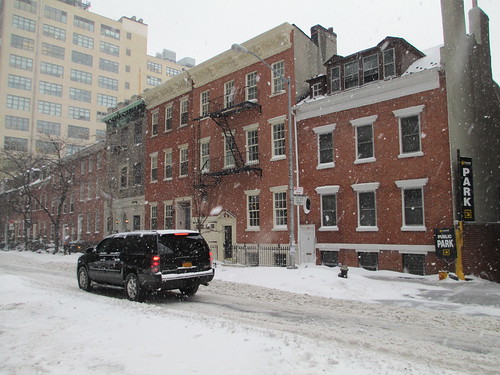
It’s not a term that many people would associate with a journey on the New York City subway. But, as I trudged up the steps on Thursday from the C Train station at Spring St, I felt a warm glow of admiration. I emerged onto Vandam St to find that day’s blizzard – which would eventually drop 14 inches (36cm) of snow on parts of the city – still in nearly full flow. The transit system had nevertheless transported me with what seemed to be insolent ease from an above-ground station in Carroll Gardens down into the tunnels to downtown Brooklyn then, on another train, across the east river to the west side of lower Manhattan.

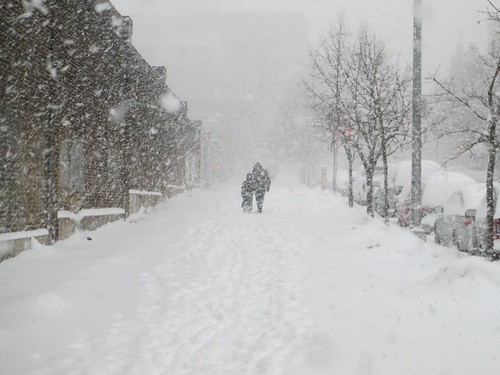
Vandam St in a snowstorm: a contrast to the order
beneath the streets
The journey’s smoothness was a tribute to the virtues of forward planning, teamwork and operational excellence that make for a smoothly-running transit system. At street level, by contrast, a rental truck whose driver had got it stuck on a pile of snow was blocking the street, holding up a snow plough.

Yet, just the day before, it occurred to me, I’d been raving about how magnificently satisfying my cycle ride to work had been. I’d braved well-below-freezing temperatures and persisting patches of ice and snow to ride to work on both Tuesday and Wednesday, enjoying the challenge of the unpredictable conditions and taking in magnificent views of the city spread out before me.

Wasn’t there a contradiction, I thought to myself, about my two positions? If I enjoyed using perhaps the most individualistic of mechanised transport methods – the bicycle – wasn’t it odd I also admired such an obviously shared form of transport as the subway? Moreover, it occurred to me, why wasn’t I alone in my shared enthusiasm? Why did so many of the cyclists and cycling advocates I knew have a decided preference for subways and buses over cars in conditions when they couldn’t get about by bike?

Trying to leave an F Train when the track ahead is on fire.
I can tell you what it felt like - just be grateful I can't
make you smell the acrid smoke.
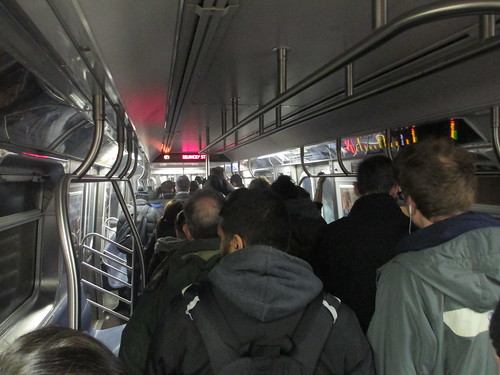
I should start answering those questions by making it clear that not all – possibly not even most – of the subway journeys I’ve been forced to take for weather reasons in recent weeks have evoked the warm feelings that my trip on Thursday did. I’ve had plenty of long waits for trains and other disruptions, including the two-hour journey home I mentioned in a previous post. Worst of all was my experience on the morning of February 3. After unwisely guessing that the F Train to West 4th St would be my quickest route to SoHo, I found myself trapped underground for 40 minutes. The live rail in the station ahead was on fire and power to our train was cut while the fire department tackled it. I don’t especially recommend the experience of standing in a confined space with emergency lighting, no air-conditioning and a growing smell of acrid smoke in the air.
 
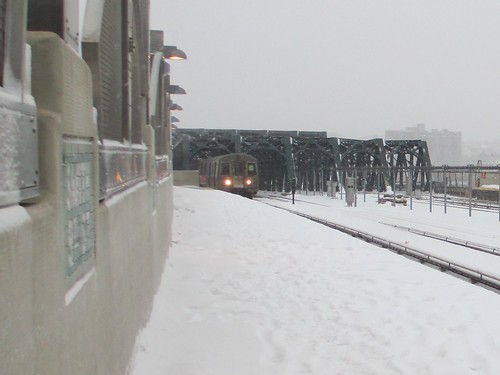
A G Train on a snowy day. My background tells me
it took teamwork and organisation to get this train running.
I should also confess that part of my feeling for subway systems stems from my background. My late father, who taught me to ride a bike, devoted his whole working life to subways – first in London, then in Glasgow. While my journey to work last Thursday might have seemed easy to me, I know that subways do anything but run themselves. My dad, I recall, diverted the taxi taking him and my mother to their 20th wedding anniversary dinner to the subway depot. A train had derailed at a critical point and he wasn’t going to relax until he was sure it was on its way to being put back.

I associate the New York subway also with my grandfather, who visited New York as a seafarer in the 1920s and told us wide-eyed children decades later about the marvels of express and local trains and the other complexities of the subway system.

As I spot some complicated bit of lineside equipment or work out some intricacy of the New York City subway system’s workings, I often feel a sharp pang at not being able to share it with my father, who died in 2002. “My train was diverted over the disused express tracks, dad!” “I got a good look at the snowblowing train!”

But there are also plenty of things about transit systems that cyclists can appreciate even if they haven't got my back story, I think. While many motorists seem to view their car as an extension of private space, I recognise clearly when I’m on my bike that I’m involved in a complex social interaction. The difficulty of communicating with other drivers is one of the things I least like about driving. It’s less of a stretch for me than for a driver or habitual taxi user to have to negotiate the scores of interpersonal transactions involved in using busy subway trains.
Copenhagen's cycle rush hour: they could have got
a nice train instead, lucky people.

It’s certainly no coincidence that cities that are good for cycling also tend to have good public transport. Copenhagen has a magnificent driverless metro system as well as good suburban S-Trains. Amsterdam has a formidable tram and suburban rail network. In the US, Portland, Oregon, has both some of the highest cycling and some of the highest transit ridership figures. Washington, DC, also enjoys a combination of relatively good cycling conditions and good public transit (even if the Washington metro’s train frequency and reliability could do with improvement). The careful planning and forward thinking required to build a good public transit network also tend to produce the kind of civic-minded thinking that prompts cities to curb car traffic, police streets well and put in good cycling facilties.

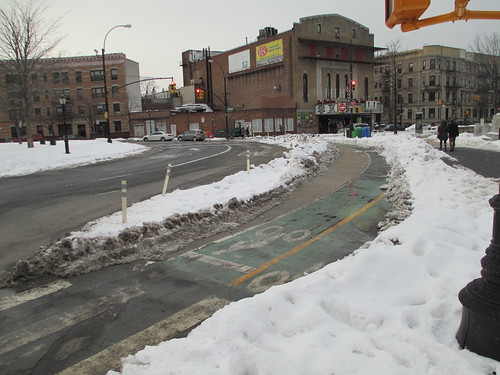
A partly-cleared bike lane: cyclists and transit users
have both been getting spotty service
New York and London, the two cities where I’ve most recently lived, fall in slightly odd places on the cycling-public transport continuum. Both suffered years of underinvestment. The 1930s-vintage lines that I use most heavily in New York are some of the city’s newest; London's underground steadily deteriorated between the 1960s and 1990s. Both cities veered off for decades in the direction of encouraging motor car use – under Robert Moses’ leadership in New York, inspired by his example in London. Moses fought to ensure badly-needed new transit lines were never included in his vast road-building projects.

There are days when, sorry, even I can't cycle
The spotty service I’ve experienced in recent weeks in New York is consequently an excellent summary of how the city is faring in both cycling and public transport. There are moments when the smoothness and progress from the worst times seems like a miracle. There are others when the main improvements from the city’s darkest days seem to be that the ageing trains are no longer covered with graffiti. The fire that kept me stuck underground isn't the only one I've encountered lately.

The subway's challenges regularly remind me that I prefer to cycle when I can. I also enjoy the exercise, the fresh air, the views from the Manhattan Bridge and cycling's relative reliability. Cyclists also avoid some of the hassles that come in winter as the homeless and disturbed crowd onto subway trains for warmth.

But, on days when the weather gives me no choice, the subway reminds me of the excitement I still feel at living in this mad experiment of a city, scattered on the islands and peninsulas around New York Harbour.

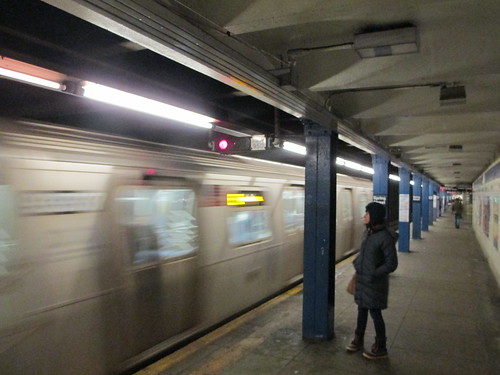
"This is a World Trade Center-bound E local train!" -
words that still sound oddly exciting to me.
Even the littlest detail of the journey can send that welling up in me. There’s the rattling of an express train through a local station, its lights flashing as they pass the support pillars. There are the names that evoke a thousand novels, songs and films. There’s the bizarre mixture of all kinds of cultures and classes one finds crammed onto many subway cars.

All are summed up sometimes in the announcements that squawk out over the public address as I step onto the train.

“This is a Manhattan-bound A train,” I hear with childish excitement. “Next stop: High St-Brooklyn Bridge. Stand. Clear. Of the closing-doors!”

Sunday, 19 January 2014

A new police commissioner, some dodgy statistics - and an open letter from me

William Bratton,
Commissioner,
New York Police Department,
1 Police Plaza,
New York,
NY 10038
January 19, 2014

Dear Commissioner Bratton,
Vision Zero and Statistics
            Congratulations on your appointment as NYPD commissioner. Like many New Yorkers, I feel optimistic based on most of your public statements that you’re determined to build on the progress made on public safety in your previous term at the department. I am particularly optimistic that you are determined, at last, to set about reducing the appalling toll of death and injury that motor vehicles exact from New Yorkers every year.
          I wanted to pick you up, however, on a puzzling statement on January 15 at the launch press conference for the mayor’s Vision Zero initiative. You said pedestrians contributed to causing 73 per cent of pedestrian-motor vehicle collisions last year and that pedestrian actions were directly responsible for 66 per cent of those collisions. It’s a figure that on my reading of the figures is demonstrably incorrect. I fear that, if the NYPD genuinely thinks this figure reflects reality, it could seriously distort the department’s efforts to reduce the grim toll of unnecessary suffering on our city’s streets.
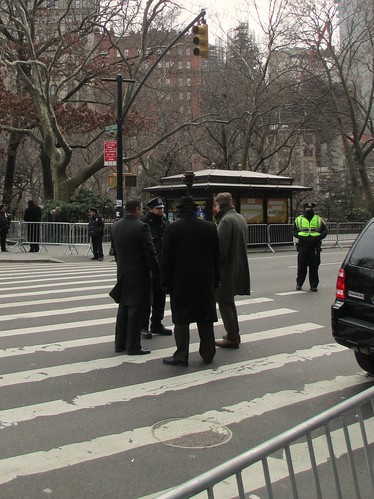
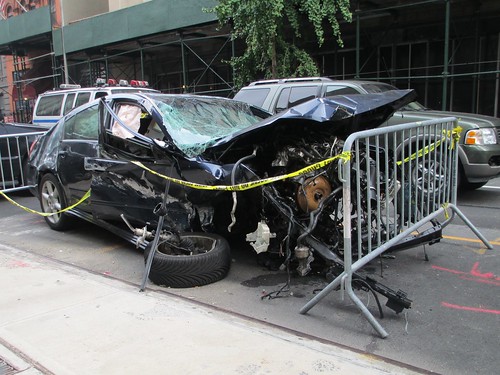
Waiting for a new boss: NYPD officers
outside the new mayor's inauguration
I would be interested to know the basis for your assertion – and grateful if you could put the figure right if, as I am sure it is, it is mistaken.
            Your figure is implausible to start with. It implies that motorists - who stand almost no chance of injury in a collision with a pedestrian, often drive at high speed and are easily distracted – are more solicitous of pedestrians’ safety than the pedestrians themselves. That seems at variance with my experience of human nature as well as with my observation that pedestrians are generally watchful when crossing city streets and motorists often cavalier when driving on them.
            The statistic is also starkly at odds with all the research I’ve read either in New York or elsewhere on the causes of crashes between motor vehicles and vulnerable road users – pedestrians and bicyclists. For example, a study published in 2013 by NYU Langone Medical Center found that 44 per cent of pedestrians treated for injuries after collisions had been hit in a crosswalk while crossing with the light. Another 6 per cent were hit on the sidewalk. Given that some of the other victims will also have been the victims of driver negligence – hit in unsignalised crosswalks, for example – it is clear the majority of studied crashes were mainly drivers’ fault.
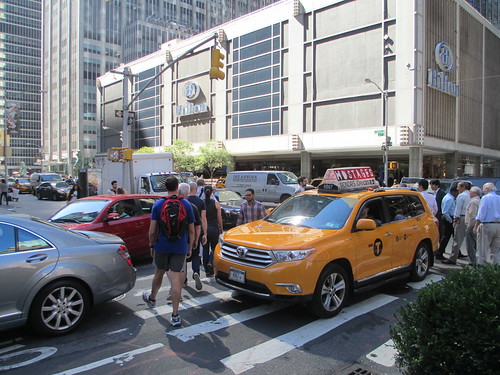
Typically dangerous pedestrian behaviour:
midtown Manhattan
            A more comprehensive study, published in 2010 by the city’s own Department of Transportation, attributed blame for 36 per cent of crashes that killed or seriously injured pedestrians to driver inattention. It attributed another 27 per cent to motorists’ failure to yield and said vehicle speed was a major contributor to 21 per cent of crashes. The DoT study reinforces the impression that, while pedestrians undoubtedly cause some crashes, they are probably mainly to blame for only a quarter or so of incidents.
            Around the world, a number of research studies have reached strikingly similar conclusions. Many have attributed blame for crashes involving pedestrians and cyclists to motorists in around 75 per cent of cases. For example, in London, where I lived and cycled for nine years until August 2012, a Transport for London study of every reported motorist-cyclist collision in 2010 attributed blame for around 74 per cent of the crashes to motorists. Motorists’ inattentiveness, excessive speed and impatience are the main killers in every industrialised country of which I’m aware. It's unlikely New York City is a freakish exception.
It might look to you like the outcome of negligent speed:
but there's an NYPD statistician who probably thinks
some pedestrian caused this.
            Your assertion also seems at odds with the evidence of the fatal crashes involving pedestrians so far this year. I’ve been able to glean enough information about four of the fatal pedestrian crashes up until Friday 17 to guess how blame might be allocated. In only one – the death of Xiaoci Hu, killed on January 2 when a car ran into the back of another car that had slowed down to let him cross mid-block – does the pedestrian appear to have carried even a portion of the blame. The driver who struck Mosa Khatun on January 5 in Jamaica was charged with failure to yield; the driver who hit Nydja Herring on January 11 in Parkchester has reportedly been charged with aggravated driving while intoxicated; numerous witnesses attest that the driver who killed Cooper Stock on January 11 hit him and his father in a crosswalk as they crossed with the light.
            Streetsblog, the campaigning website, calculates your department coded only between 7 and 8 per cent of crashes involving pedestrians or cyclists in the first 11 months last year as having resulted from pedestrian or cyclist confusion or error.
            My concern is that a mistaken understanding of the present crisis’ causes could lead the NYPD to pursue mistaken or counterproductive measures to halt it. If pedestrian behaviour were indeed the cause of most pedestrian/car crashes, it would be worthwhile and effective to work harder at changing pedestrian behaviour. I note there are already reports of a police crackdown on “jaywalking” around the area on 96th street in Manhattan where there has been a cluster of casualties this year. I can imagine it will be tempting for local police precincts to seek in any crackdown to tackle pedestrians and cyclists since they are, by their nature, easier to catch and prosecute than drivers of fast-moving cars.
            If, however, cars cause the majority of crashes involving pedestrians and cyclists, it will make far more sense to work at controlling drivers’ speed and ensuring they yield when required to do so. I am worried that, with the crackdown on the Upper West Side, you are beginning to pursue a pedestrian-focused strategy – one that targets the victims and not the perpetrators.
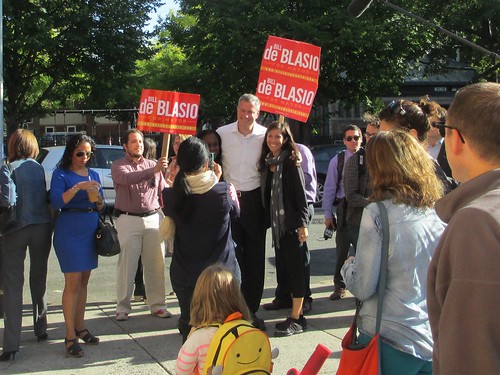
The new mayor during his campaign: before he had a police
commissioner to explain how pedestrians were
killing themselves
            My personal conviction is that a concerted effort to tackle the traffic crisis’ real causes could yield dramatic results quickly. During my nine years in London, I covered transport issues in the UK and elsewhere for the Financial Times, winning several awards. London, which has a similar population to New York’s and similar traffic volumes, suffers only half the annual traffic fatalities that New York does. Motorists’ adherence to speed limits and other road rules is noticeably more lax in New York City than in London. I see no reason why the introduction to New York of systematic speed enforcement and a general culture of respect for road rules should not quickly bring New York’s fatality levels closer to London’s.
            I look forward to hearing from you about your figure’s origin and how it is affecting your policies. I would of course be delighted to speak with you or your officials about my concerns.
The NYPD and other city agencies have it within their grasp to save hundreds of New Yorkers’ lives every year. It would be a tragedy if apparently mistaken data led you to pass that opportunity up,
Yours Sincerely,

 Invisible