William Bratton,
Commissioner,
New York Police
Department,
1 Police Plaza,
NY 10038
January 19, 2014
Dear Commissioner Bratton,
Vision
Zero and Statistics
Congratulations
on your appointment as NYPD commissioner. Like many New Yorkers, I feel optimistic
based on most of your public statements that you’re determined to build on the
progress made on public safety in your previous term at the department. I am
particularly optimistic that you are determined, at last, to set about reducing
the appalling toll of death and injury that motor vehicles exact from New
Yorkers every year.
I wanted to pick you up, however, on a puzzling
statement on January 15 at the launch press conference for the mayor’s Vision Zero initiative. You said
pedestrians contributed to causing 73 per cent of pedestrian-motor
vehicle collisions last year and that pedestrian actions were directly
responsible for 66 per cent of those collisions. It’s a figure that on my
reading of the figures is demonstrably incorrect. I fear that, if the NYPD genuinely thinks this
figure reflects reality, it could seriously distort the department’s efforts to
reduce the grim toll of unnecessary suffering on our city’s streets.
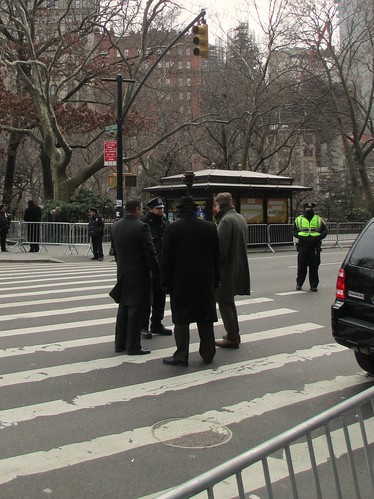 |
| Waiting for a new boss: NYPD officers outside the new mayor's inauguration |
I would be
interested to know the basis for your assertion – and grateful if you could put
the figure right if, as I am sure it is, it is mistaken.
Your
figure is implausible to start with. It implies that motorists - who stand
almost no chance of injury in a collision with a pedestrian, often drive at
high speed and are easily distracted – are more solicitous of pedestrians’
safety than the pedestrians themselves. That seems at variance with my experience of human nature as well as with my observation that pedestrians are
generally watchful when crossing city streets and motorists often cavalier when
driving on them.
The
statistic is also starkly at odds with all the research I’ve read either in New York or elsewhere on
the causes of crashes between motor vehicles and vulnerable road users –
pedestrians and bicyclists. For example, a study published in 2013 by NYU Langone Medical Center found that 44 per cent of pedestrians treated for injuries after collisions had
been hit in a crosswalk while crossing with the light. Another 6 per cent were
hit on the sidewalk. Given that some of the other victims will also have been
the victims of driver negligence – hit in unsignalised crosswalks, for example –
it is clear the majority of studied crashes were mainly drivers’ fault.
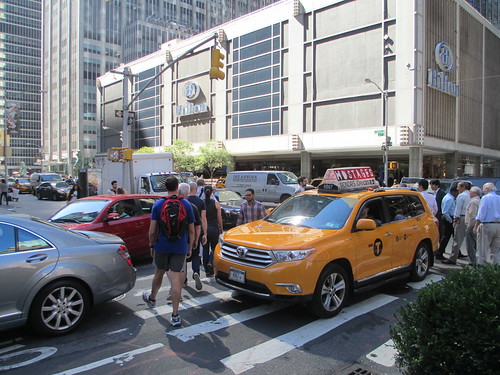 |
| Typically dangerous pedestrian behaviour: midtown Manhattan |
A
more comprehensive study, published in 2010 by the city’s own Department of Transportation, attributed blame for 36 per cent of crashes that killed or seriously injured
pedestrians to driver inattention. It attributed another 27 per cent to
motorists’ failure to yield and said vehicle speed was a major contributor to
21 per cent of crashes. The DoT study reinforces the impression that, while
pedestrians undoubtedly cause some crashes, they are probably mainly to blame
for only a quarter or so of incidents.
Around
the world, a number of research studies have reached strikingly similar
conclusions. Many have attributed blame for crashes involving pedestrians and
cyclists to motorists in around 75 per cent of cases. For example, in London , where I lived and cycled for nine years until
August 2012, a Transport for London
study of every reported motorist-cyclist collision in 2010 attributed blame for around 74 per cent of the crashes to motorists. Motorists’
inattentiveness, excessive speed and impatience are the main killers in every
industrialised country of which I’m aware. It's unlikely New York City is a freakish exception.
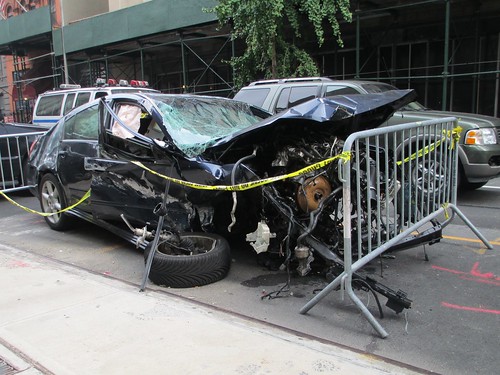 |
| It might look to you like the outcome of negligent speed: but there's an NYPD statistician who probably thinks some pedestrian caused this. |
Your
assertion also seems at odds with the evidence of the fatal crashes involving
pedestrians so far this year. I’ve been able to glean enough information about
four of the fatal pedestrian crashes up until Friday 17 to guess how blame
might be allocated. In only one – the death of Xiaoci Hu, killed on January 2
when a car ran into the back of another car that had slowed down to let him
cross mid-block – does the pedestrian appear to have carried even a portion of
the blame. The driver who struck Mosa Khatun on January 5 in Jamaica was
charged with failure to yield; the driver who hit Nydja Herring on January 11
in Parkchester has reportedly been charged with aggravated driving while
intoxicated; numerous witnesses attest that the driver who killed Cooper Stock
on January 11 hit him and his father in a crosswalk as they crossed with the
light.
Streetsblog,
the campaigning website, calculates your department coded only between 7 and 8 per cent of crashes involving pedestrians or cyclists in the first 11 months last year as having resulted from pedestrian or cyclist confusion or error.
My
concern is that a mistaken understanding of the present crisis’ causes could
lead the NYPD to pursue mistaken or counterproductive measures to halt it. If
pedestrian behaviour were indeed the cause of most pedestrian/car crashes, it
would be worthwhile and effective to work harder at changing pedestrian
behaviour. I note there are already reports of a police crackdown on
“jaywalking” around the area on 96th
street in Manhattan
where there has been a cluster of casualties this year. I can imagine it will
be tempting for local police precincts to seek in any crackdown to tackle
pedestrians and cyclists since they are, by their nature, easier to catch and
prosecute than drivers of fast-moving cars.
If,
however, cars cause the majority of crashes involving pedestrians and cyclists,
it will make far more sense to work at controlling drivers’ speed and ensuring
they yield when required to do so. I am worried that, with the crackdown on the
Upper West Side , you are beginning to pursue a
pedestrian-focused strategy – one that targets the victims and not the perpetrators.
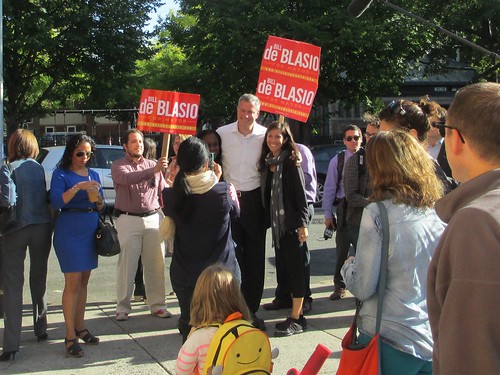 |
| The new mayor during his campaign: before he had a police commissioner to explain how pedestrians were killing themselves |
My
personal conviction is that a concerted effort to tackle the traffic crisis’
real causes could yield dramatic results quickly. During my nine years in London , I covered transport issues in the UK and
elsewhere for the Financial Times, winning several awards. London ,
which has a similar population to New York ’s
and similar traffic volumes, suffers only half the annual traffic fatalities that New York does. Motorists’ adherence to speed limits and other road rules is noticeably
more lax in New York City than in London . I see no reason
why the introduction to New York of systematic
speed enforcement and a general culture of respect for road rules should not
quickly bring New York ’s fatality levels
closer to London ’s.
I
look forward to hearing from you about your figure’s origin and how it is affecting
your policies. I would of course be delighted to speak with you or your
officials about my concerns.
The NYPD and
other city agencies have it within their grasp to save hundreds of New Yorkers’
lives every year. It would be a tragedy if apparently mistaken data led you to
pass that opportunity up,
Yours
Sincerely,
