Showing posts with label NYPD. Show all posts

Monday, 10 August 2015

A Precinct House, a String of Deaths - and How to Stop Traffic Stops from Gambling with People's Lives

One day in mid-June, having taken a rare week off work, I was walking my son to school when we spotted two curled-up $20 bills on the sidewalk. It was the kind of sum that, to many people in our area, might be entirely inconsequential. But, to, say, a struggling food delivery cyclist or cleaner, those two bills might, I thought, represent a substantial loss. With that thought in mind and being temperamentally unsuited to pocketing something I hadn’t earned, I headed after I’d dropped the Invisible Visible Boy at school to report the cash as lost property at the New York Police Department’s 76th Precinct House.
Unlikely site for an epiphany: the NYPD's 76th precinct house.

As I sat waiting for someone to talk to me about my discovery, however, I noticed something significant about the layout of the area around the station house’s main entrance. Behind the public counter, by the door – in a position where they would be the last thing many officers would see before heading out on patrol – stood three memorials to officers from the precinct who’d died in the line of duty. Among them was Maitland Mercer, a patrolman shot dead in 1965 while off duty and trying to arrest a suspect.

The plaques excited mixed emotions in me. Each of the deaths – although each occurred decades apart – must have shocked and appalled the dead men’s fellow officers and devastated their families. I was horrified by the killing of two New York police officers just before Christmas. But the memorials were also, it seemed to me, manifestations of a culture around US law enforcement that celebrates the profession’s dangers and focuses on violent confrontations, at the expense of a more collaborative philosophy. The near cult-like celebration of fallen police officers encourages, I suspect, the dangerous idea that virtuous officers are engaged in a Manichean struggle against dark forces every time they leave the precinct house.

I quickly moved on to worrying about something else. If I felt so uneasy about the culture surrounding US policing, it occurred to me, wasn’t it strange that I instinctively wanted police officers to be tougher on traffic violations? It’s a striking feature of the many of the highest-profile killings of black people by police that the incidents in question start with traffic stops. The killing in April of Walter Scott in North Charleston, South Carolina, by a police officer followed a stop for a broken brake light. Samuel DuBose died on July 19 in Cincinnati after being stopped by a University of Cincinnati police officer who thought (wrongly, given the local law) he was missing a vehicle licence plate. Sandra Bland, who was found dead in a Texas jail cell on July 13, had been stopped three days earlier for not using her indicators to pull her car over as a police officer followed her.
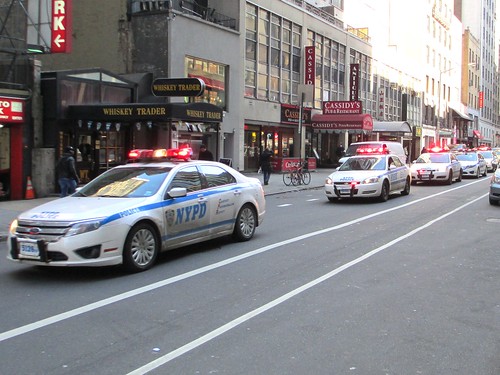
 
NYPD cruisers in midtown: a force for road safety?
I’ve had regular cause since that moment in the 76th precinct house to ask myself: is it possible to reconcile an effort to tighten up traffic policing on the US’s roads with a desire to cut the dreadful annual toll of deaths at the hands of police officers?

The starting point in the search for an answer is to unpick what’s actually going on in the traffic stops that end in an officer’s standing over some black person’s prone body – which is that few of them seem to involve serious safety violations. It’s important that vehicles have working brake lights, that drivers use their indicators and that vehicles bear appropriate licence plates. But it’s significant, it seems to me, that neither Sandra Bland nor Samuel DuBose nor Walter Scott was stopped, say, for speeding or using a mobile phone while driving or refusing to yield to pedestrians in a crosswalk – all offences that lead to thousands of deaths annually in the US.

These traffic stops seem, instead, to have had far more in common with the kind of policing-as-harassment tactics that are familiar in many parts of the world but for which the US has a particular predilection. The broken tail-light, the apparently missing licence plate, the momentary failure to signal aren’t of much interest to the officer. The point – as it was with the New York Police Department’s now-abandoned Stop and Frisk policy of searching people on the flimsiest of pretexts – seems far more to have been to exert control.

The motivation often appears to be for officers to mark their territory and stamp their authority on anyone who seems suspicious to them – a group that seems inevitably disproportionately to include African-Americans. The simplest act of defiance – such as Sandra Bland’s continuing to smoke a cigarette while a police officer addressed her – seems in such a context to be an act of infuriating insolence that demands a response.
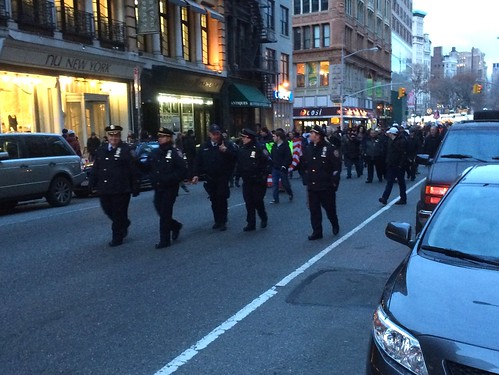
 
These NYPD officers may be fine, upstanding people -
but it's easier to understand the system where they work
if one understands it's racist.
It’s easier to understand why such a high proportion of the New York Police Department’s traffic stops are for the apparently minor offence of having excessively tinted windows when one sees traffic stops as part of a racist system. It’s a modification that officers associate with the desire of members of minority groups to hide from onlookers, especially the police. It’s a relatively minor safety issue but a significant affront to police officers who experience traffic policing as a kind of primal marking of their territory.

Still more reprehensibly, it’s clear that many municipalities – notably Ferguson, Missouri, where the killing a year ago of Michael Brown, a young black man, by a white police officer started the current agitation over policing violence – use traffic stops as an important source of revenue. The US justice department’s report on the municipality in March recorded pressure from the town authorities on the police to ramp up ticketing to raise money for the budget. It also noted that 85 per cent of vehicle stops in Ferguson were of black people, although they made up only 67 per cent of the population.

Ta-Nehisi Coates, the US writer criticises the arbitrary, racist thinking behind such policing in Between the World and Me, his superb new book about growing up as an African-American man. The book talks at length about how Prince Jones, a black college friend of Coates’, was killed by police in an apparently unjustified traffic stop in Virginia in 2000.

“You know now, if you did not before, that the police departments of your country have been endowed with the authority to destroy your body,” Coates writes to his 15-year-old son. “It does not matter if the destruction is the result of an unfortunate overreaction. It does not matter if it originates in a misunderstanding… The destroyers will rarely be held accountable.”

Yet, while it’s impossible to defend contemporary traffic policing in the US, I’m also deeply resistant to the idea – which seems to be gaining ground amid the discrediting of current behaviour – that traffic policing is a trivial matter that could reasonably be put aside as part of the police’s responsibilities. A better-focused system of traffic policing could surely improve on the US’s current dismal record on road safety. In 2013, the most recent year for which data are available, 32,719 people died on the US’s roads. The US’s minorities – who disproportionately live in areas poorly served with crosswalks and public transport – must suffer a disproportionate share of these deaths too.

Nuneham Courtenay: a rural idyll, protected by speed camera
As a result, I’ve found my mind turning increasingly to the village of Nuneham Courtenay,in Oxfordshire, in England, which I visited in 2011. I visited the village the day after residents achieved their aim of having reactivated a speed camera that had significantly slowed traffic on the 30mph road that divides the village. The camera had been deactivated as part of a populist backlash against cameras under the coalition government after the UK’s 2010 general election. Villagers had looked on in horror as, without the threat of a speeding fine, drivers increasingly ignored signs telling them to slow down from the 70mph speed limit on the roads outside to the far slower speed required when passing right by villagers’ front doors.

It’s an obvious virtue of mechanising the process of policing bad driving that the policing is no longer subject to arbitrary considerations such as whether policing staffing is down because of school holidays. It’s also helpful that cameras are generally places where there’s general agreement they’re serving a real safety, not fund-raising purpose. In the UK, the main criterion has been that four people should have been killed or seriously injured at a site in the past four years. It’s also, however, a great virtue of cameras that they won’t display racist bias. Policing should be far more closely linked to drivers’ behaviour and far less linked to their race.
 
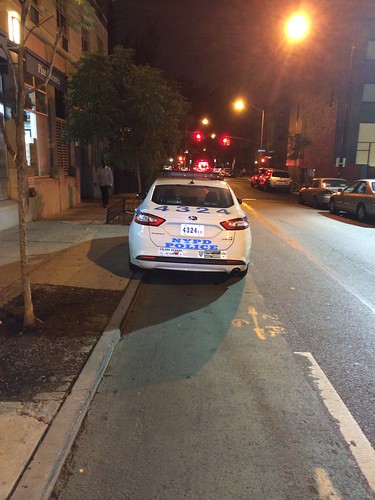
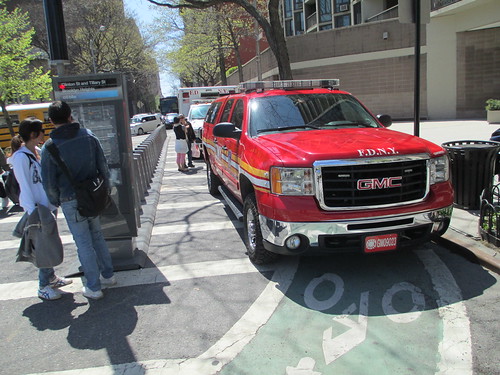
Officers from the NYPD's 28th precinct demonstrate
how seriously they take road safety, by parking blocking
a bike lane in Harlem
A nationwide programme of speed and red light camera installation across the US could, if wisely implemented, be part of a wholesale rethinking of policing in the area. It’s clear that there are some violations – such as the use of phones while driving – that it will always be hard to hand over to cameras. But it would be transformative, as I’ve argued before, to start linking the promotion prospects of officers charged with traffic policing to the number of crashes, injuries and deaths on their roads, rather than to the number of tickets issued. Such a policy would immediately, I’d guess, eliminate many NYPD precincts’ enthusiasm for ticketing cyclists – a form of harassment that’s far less grave than that against black people and other minorities but stems, I think, from a similar desire to exert control over a group seen as troublesome outsiders.

Not that I sensed any mood for revolutionary change at the 76th precinct. Before I could even finish my explanation about finding the money, an officer interrupted, shouting across the room, to demand what identification I’d found with the money. None, I replied.

“We will never find the owner of that money,” the officer replied, sending me burdened with the Protestant guilt of an unearned $40, back into the street.

His last words rang in my ears as I trudged back towards the apartment.

“Sometimes it’s just your lucky day,” he said.

It wasn’t, a voice in my head objected, a lucky day for the person who’d lost $40 on the way to the subway, though, was it?

The idea fed into concerns far more significant than a mere $40. There is no element of luck attached to whether a driver gets a speeding ticket in Nuneham Courtenay. Luck plays far too large an element both in whether US police forces catch dangerous traffic violations – and in whether people stopped by US traffic patrols survive the encounter. It’s an obscene gambling with lives that can be and should be stopped.

Sunday, 14 December 2014

A protest march, a German thinker - and how injustice for some is injustice for all

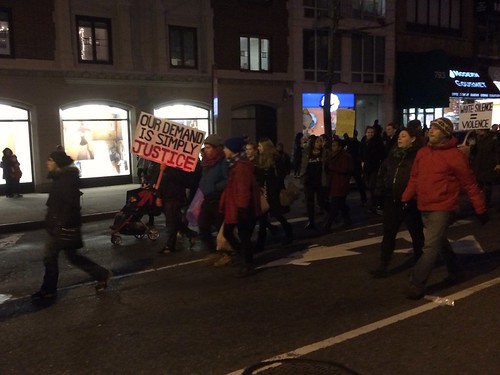
The chanting on the night of December 4 sounded muted heard from my eighth-floor office. But there was no mistaking what was going on. Rushing over to the window, I peered down into Hudson Street and saw the front of a line of hundreds of protesters. The leaders were carrying black placards with slogans picked out in LED lights. “Justice 4 All” and “Black Lives Matter,” they read.

I felt admiration and fellow-feeling for the demonstrators, protesting against the decision of a grand jury in Staten Island, just across New York Harbor from where I was, to bring no charges against the police officer who killed Eric Garner. The officer placed Mr Garner, a black man, in an illegal chokehold in July as he sought to arrest him for selling untaxed cigarettes. The protesters were shouting “I can’t breathe” – the last words that a video of the event captured Mr Garner gasping out 11 times.

Drivers held up by protests over police brutality:
far from determined to uphold the rules themselves.
But I faced an immediate problem - how, with protests swarming over much of lower Manhattan, I would get myself and my bicycle home to Brooklyn. I opted for a route somewhat to the north of my normal one and successfully reached the Manhattan Bridge. Yet my biggest challenge turned out not to be the protests but the behaviour they encouraged in drivers. Many expressed their frustration at being delayed by driving into cycle lanes, executing illegal u-turns, honking loudly and otherwise behaving irresponsibly and illegally.

The experience was, it subsequently occurred to me, an excellent encapsulation of the crisis in policing of both the US’s roads and minority – especially black – communities. Far from looking down on the law, the most vulnerable people – the protesters, people who don’t own cars – have high expectations of law enforcement. Fair, undiscriminatory enforcement of society’s agreed rules is their main protection against those who have more power than they - or operate vehicles with greater momentum.

Meanwhile, it’s the people commonly regarded as upholders of society’s order – police officers and those who have taken driving tests and invested in cars – who often seem, consciously or otherwise, to hold those rules in most contempt. Many seem to think themselves responsible or respectable enough not to need to follow the pettifogging details of the rules.
An emblem of the NYPD's style: some officers are prone
to brutality and the department cites shortages of resources
as a reason not to investigate traffic deaths. But even on a cold
winter's evening at present there are four police interceptors
parked on the Brooklyn Bridge to guard against tampering
with the Stars and Stripes on the towers.

The episode brought to mind a famous passage in which Immanuel Kant, the 18th century German philosopher, wrote about how justice’s significance went far beyond any practical effect its execution might have.

Kant expressed his views in relation to the death penalty – and took a position about the morality of capital punishment with which I profoundly disagree. But his take on justice’s significance captures something of why the families of Eric Garner in Staten Island and Michael Brown in Ferguson, Missouri – as well as those of Allison Liao, killed by a driver in Queens, and Cooper Stock, killed by a driver on the Upper West Side – protest so loudly over the system’s failing them.

“Even if a civil society resolved to dissolve itself with the consent of all its members… the last murderer lying in prison ought to be executed before the resolution was carried out,” Kant wrote. “This ought to be done in order that every one may realise the desert of his deeds, and that blood-guiltiness may not remain upon the people.”

The acute problem, however, is not so much that the US – and some other societies worldwide – is failing to prosecute some brutal police officers and many, many negligent or even deliberately violent drivers. It’s that by doing so the authorities send a message to those who follow the rules that they’re mugs. Refraining from violence at risk to yourself, police officer? Why not just grab the suspect round the neck? Ignoring that cellphone call so you don’t endanger other road users, taxi driver? Why? It might be a customer calling to book a long, profitable ride.

Minor lawlessness, certainly - but evidence of a corrosive
contempt for the rules: a private garbage truck blocks the bike
lane, while a delivery truck double parks outside
The challenge is less that the guilty are going unpunished and more that virtue is punished by default.

These ideas started forming in my mind nine days before the December 4 protests, as I took a bike ride on a rare day off work the Tuesday before Thanksgiving. I rode from home in Brooklyn all the way up Manhattan’s 1st Avenue towards The Bronx. Yet it was soon apparent that the relatively new protected bike lane north of 60th Street wasn’t going to live up to its promise. I had to leave the lane repeatedly and pull into fast-moving traffic. Some of the obstructions were because of building work – but most were because cars were illegally parked in the bike lane or improperly turning across my path. More than once, on pulling out of the lane and round the legally-parked cars, I found a third barrier in the form of an illegally double-parked truck.

At one point, I found a huge semi-trailer truck (articulated lorry, British readers) had blocked the bike lane to deliver to a store. I appealed to a nearby traffic police officer to ticket the driver. The driver treated her with contempt and berated me, as a proxy for all other cyclists, for having forced him to park there. A previous cyclist had, apparently, sued after the driver struck him with a trolley while moving goods across the cycle lane from a legal parking place.
It's no illegal chokehold - but the parking outside the 52nd
precinct in The Bronx police station suggested to me something
about its officers' conception of enforcing the law.

It was no surprise when, later in the ride, I had to manoeuvre delicately around police cars parked illegally on the shared sidewalk and bike path outside the NYPD's 52nd precinct in The Bronx.

None of what I experienced went beyond inconvenience and I suffered no real harm. But I was soon feeling humiliated and powerless in the face of the bullying of those who were refusing to follow the rules. I felt angry that so little was being done to ensure a more equitable, fairer outcome.

Given my feelings over this minor injustice, I can only imagine the blind rage that Michael Cheung must feel over the failure to take any serious action against the driver who killed his 90-year-old mother as she crossed a street with the light in New York’s Chinatown in October. It must be indescribably painful for a mother such as Dana Lerner to hear that district attorneys are declining to bring criminal charges against the cab driver who killed her nine-year-old son, Cooper Stock, on the grounds the weather was bad when it happened.

I spoke recently to the daughter of someone killed by a negligent driver while he cycled in Central London. She expressed her rage at the failure of the police there to investigate the crime thoroughly and of prosecutors to bring a prosecution over the case.

It can only be worse still to learn that a relative has died because of illegal behaviour by those meant to uphold the law – and that those responsible will not be held to account. The killings of Eric Garner on Staten Island, Akai Gurley in East New York, Tamir Rice in Cleveland in countless other cases are shocking because they contradict so many of the theoretical principles of life in the US – and anywhere that human rights are held in any regard. A mixture of rage, impotence and grief that must boil inside the victims' relatives at the thought that many of these incidents happened mainly because of their family's skin colour and others' assumptions about people of their race.
 
He agrees with Kant: a demonstrator voices humans' shared
yearning for justice.
Police officers and district attorneys who flout the law or ignore rule-breaking not only disgrace their offices - and sometimes break the law themselves – but breach a fundamental clause in western societies’ social contract. Civil legal authorities centuries ago largely removed from individuals the burden of pursuing those who had criminally wronged them. The promise was that justice would be more fairly, impartially and efficiently dispensed when its pursuit was no longer clouded by issues to do with victims’ personal power, prestige, feelings or wealth.

That principle has been abandoned, it seems, when it comes to many of those killed or injured on the roads or minority community members harmed by police officers. Many prosecutors in the US – and in the UK, I increasingly fear – are ready to pursue only cases where either overwhelming evidence or a plea-bargained guilty plea make a conviction nearly certain. On the rare occasions I cycle through New York’s Foley Square, past the steps that featured at the end of the classic legal drama Twelve Angry Men, I give a rueful smile at how such finely-balanced court cases increasingly seldom come to court.

Despite my misgiving about Kant’s support for the death penalty, it’s hard to escape the conclusion that his feeling about a wider society’s guilt for unpunished crimes captures something about the deep wrong of the Eric Garner and other cases. If this behaviour isn’t regarded as wrong, if wider society imposes no consequences for these kinds of actions, what does it say about the wider society? How far into lawlessness is society prepared to let its roads or its police officers descend?

While the problems of unaccountability spread across the United States and some other developed countries, there are also very specific New York issues. Bill de Blasio stood as mayor on prominent pledges to improve police treatment of black people and to tackle the city’s epidemic of traffic deaths. It’s dispiriting that he appears so weak in face of his police commissioner’s apparent reluctance to act decisively on either.

Yet the outrage I witnessed from my 8th floor window and the growing disquiet over traffic deaths give me at least some hope. The United States might finally be preparing, as Winston Churchill would say, to do the right thing, having exhausted all other options.

Santa-conners in the 2nd Avenue bike lane: our trip would
have been depressing if we'd seen only sights like these.
That hope was boosted this Saturday, December 13, when I took my son Christmas shopping by bicycle in Greenwich Village.

We rode first up 1st Avenue and encountered drunk participants in the gruesome, annual Santacon bar crawl by young fraternity boy-types and like-minded women around the Lower East Side. The partygoers – who had noisily asserted their “right” to pursue their drunken binge in the preceding days – were the epitome, it seemed to me, of privileged refusal to follow generally accepted rules. They wandered over sidewalks, shouted across streets at each other and behaved self-indulgently and short-sightedly.

But, even as I mentally shook my head over them, I heard the first protest chants.

“I can’t breathe!” “Hands up – don’t shoot!”

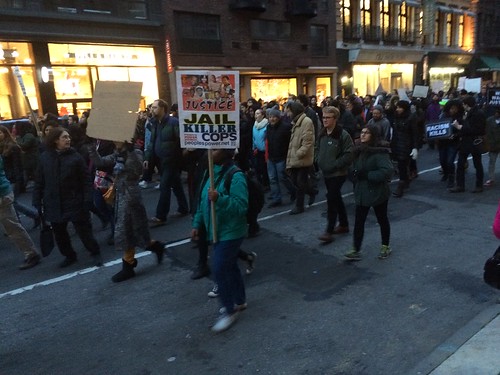
We arrived at the Strand Bookstore on Broadway just as the front of the Millions March NYC protest headed by. Many of the participants were of the same twenty-ish age group as the Santacon participants. But there was an impressive earnestness about them that was entirely absent amid the Santacon foolishness.

There were also far more of them than of the Santacon-ners. We emerged after 20 minutes in the bookshop to find the march still in progress down Broadway. We joined them for a symbolic two blocks, wheeling my bike and the Invisible Visible Boy’s trailer bike.

“How do you spell racist? NYPD!”

A brief spasm or the start of real change? The Millions March
NYC protest just before I and the Invisible Visible Boy joined.
For those two blocks, it was possible to get caught up in the earnest passion of the crowd, the frustration that so little has changed. My heart sang to see several bicycles among the protesters, symbols of the union of my various political and policy positions.

But I’d have come away less optimistic had I not come away with the sense that others better equipped than I to understand the crisis also thought that, just maybe, these protests might be the harbinger of real change.

As my son and I walked those two blocks, I noticed a tall black man grab the hand of his young son – maybe three or four – and lead him across Broadway through the crowd. He was determined to get him a better view of the event.

“Come on,” he said impatiently, looking down at him. “I want you to see this.”

Monday, 24 November 2014

A 1980 crash, a rushed hearing - and why paradigms keep trumping facts

It was an experience in April 1980 – when I was ten years old – that first forced me to confront people’s thinking and expectations about road safety. I’d left my primary school in Glasgow without my homework and, on arrival at the flat across the road where I went after school, remembered and turned around. But, as I crossed back, a car that had come round a bend in the road hit me, and threw me up in the air. I wasn’t badly hurt when I landed but the impact must have been significant. One of my shoes landed in the back garden of the substantial house on the other side of the street.

Over the next few days, I encountered the complexities of people’s reactions. There was, of course, sympathy, as one would hope a 10-year-old would receive under such circumstances. But there was also a pursed-lip terseness to some adults’ solicitousness. They clearly regarded the whole thing as the inevitable outcome of my careless crossing of the street. Their view wasn’t, I think, based on the crash’s circumstances but on their expectations of how such things worked. Something in their head – a paradigm – told them that if I’d been hit it must have been my own silly fault.
The street where the Invisible Visible Man - then the Invisible
Visible Boy - was hit by a car 34 years ago. Adults sucked their
teeth at his negligence. But the streetscape changes hint
at the wider cause. (c) Google Streetview

My mind’s returned to that childhood experience this week as I’ve been pondering how ordinary people, the police and news reporters respond to road crashes far more serious than mine. Many of these events, it seems to me, are filed just as quickly as my crash was into convenient, easy-to-understand categories. Police officers, I suspect, start off with a similar paradigm to the one I faced 34 years ago – that pedestrians’ and cyclists’ mistakes, not cautious, respectable motorists, tend to cause crashes. Reporters overseen by under-pressure news editors all too easily fit events for their readers into even simpler, more misleading constructs.

One recently-publicised case shows such paradigms’ ability to overpower the truth. New York news outlets in October last year cited police sources as saying Allison Liao, a three-year-old, had “broken away” from her grandmother in a crosswalk in Flushing, Queens, before Ahmad Abu-Zayedeha drove over her in his SUV. The phrase “broke away” conjures up images from road-safety films of a child’s heedless breaking away from a parent’s grasp. It suggests a freak event – or negligence on the part of the grandmother or little girl – that Abu-Zayedeha could not have been expected to anticipate. The phrase is such a cliché that it ought, in retrospect, to have alerted readers that it was based on false assumptions.

Footage from another vehicle’s dashboard camera showed Abu-Zayedeha in fact simply drove his vehicle through the crosswalk oblivious to the presence of Allison and her grandmother, who had right of way and were holding each other’s hands. The truth, however, contains none of the satisfying closure of the “broke away” version, which suggests the event is simply a sad, unavoidable tragedy. There’s nothing to satisfy the reader’s curiosity about why such a horror should happen – no obvious sign of the driver’s using his telephone or acting deliberately. There isn’t an easy narrative to fit the many pointless, avoidable crashes that arise from drivers’ impatience and inattention while carrying out simple manoeuvres.

It's a long shot - but this NYPD driver
may not spend a lot of time questioning
the paradigms behind his thinking
about street safety.
Yet the recognition that the minds of all involved – the police, reporters and drivers – are falling in line with paradigms suggests a route towards achieving better understanding of such events. It’s vital, it seems to me, that road safety advocates start countering misleading stories about crashes’ causes still more quickly and aggressively than they do at present. Only when unspoken assumptions are spoken and revealed for myths will new, more accurate paradigms emerge. It’s imperative to recognise that narratives about crashes are built around pre-existing templates, rather than constructed afresh for the facts of each incident.

A change in the narratives might encourage police and prosecutors to act – and discourage future poor behaviour. Abu-Zayedeha has faced no criminal charges for his extreme negligence. Even the two traffic violations he faced were dismissed, after a hearing before a Department of Motor Vehicles hearing that Radio WNYC last week revealed lasted just 47 seconds.

In my own crash, I remember for sure that the school crossing guard – “lollipop lady,” in British parlance – had left by the time I arrived. I also recall letting pass a car heading in the other direction from the one that hit me. I’ve little idea why I then missed the one coming from my right – but there was a slight bend in the road and cars on either side. I used to tell myself that the driver – a driving instructor, on his way to a lesson – was speeding.  But I think I’d have been more seriously injured if the vehicle had been going faster than the 30mph speed limit.

The truth of the crash is probably that the road, with its 30mph speed limit, no permanent crossing and parked cars obscuring the view, was simply a hostile environment that was intolerant of an incautious driver and my momentary lapse. A check on Google Streetview reveals that the site now has a raised pedestrian crossing. Many of the parking spaces that obscured mine and the driver’s view of each other have been taken out. There’s a 20mph speed limit around school times. Those all seem to me like retrospective recognition that the tooth-sucking adults 34 years ago were putting too simplistic a construction on events.

But humans take minutes or hours, rather than decades, to reach their conclusions on many crashes’ causes. The simple paradigms in many people’s heads keep pushing them, it seems to me, towards some strikingly misleading conclusions in that period.
 
The foot of the Manhattan Bridge bike lane, near where
Matthew Brenner was hit: a confusing place, but not one
where people deliberately take suicidal risks.
In one recent case, for example, the New York Police Department announced shortly after Matthew Brenner, a cyclist, was fatally injured in a crash near the Manhattan Bridge that he had been cycling against the traffic down Sands St – a street supplied with one of the city’s best segregated bike lanes – when hit. The explanation made sense only if one always frames such incidents in a mental construct that says cyclists regularly take suicidal risks with their own safety.

I expressed scepticism in the comments below an online story about the narrative, only to be criticised by other commenters to the point of abuse. Further investigation and video have nevertheless suggested Brenner – who had previously worked as a cycle courier in Washington, DC - appeared confused about how to reach one of the area’s bike lanes and was hit by two separate vehicles. The simplistic early version was indeed based on invalid, improbable assumptions.

Another more recent tragedy shows how the neat paradigms in police officers’ heads distort their efforts to assign culpability for crashes. On November 15, a man driving an F150 pick-up truck with a raised chassis and illegally tinted windows killed Jenna Daniels, a 15-year-old jogger, in a crosswalk on Staten Island. The police almost immediately told reporters that they were blaming the crash on Daniels’ crossing the street outside the marked crosswalk at the site. They had ticketed the driver for having illegally tinted windows, they said, but these played no role in the crash.
An F150 at the Detroit auto show: imagine a raised chassis
and tinted windows - and ask yourself if you'd assume such
a vehicle's design played no role in a fatal crash.

It takes extraordinarily powerful mental biases to reach those conclusions based on the available facts. The poor young woman, after all, was hit at least close to a crosswalk, by a driver whose vision must have been impaired not only by his vehicle’s height and size but by an illegal window tint. Only a very strong urge to blame pedestrians for crashes and exonerate drivers could immediately exculpate the windows and the driver.

Yet, as a newspaper reporter with more than two decades’ experience, my concern about the paradigms at work doesn’t stop with the police. I note their effect just as strongly in the work of journalists. The failure of reporters to interrogate their police sources about their improbable versions of events has certainly made life easier for the district attorneys, police officers and others who want to go with the easy version of events.

It’s perhaps less obvious to a non-reporter how those stories must reflect priorities coming from elsewhere in the news organisation. It’s clear to me, for example, that news editors regard many stories about traffic crashes as a minor matter, worthy of only a brief story. It’s hardly surprising that the stories often feel rushed and only partially researched. Reporters are inevitably under pressure to write such stories quickly and move on to the next. It’s impossible by its nature to contact a dead victim or one who’s in a coma to see if he or she agrees with a biased police investigator’s account.

A pedestrian tries to cross Varick Street, in Manhattan's
West Village. The intersection's badly designed and cars
behave badly around it. But, if something happens to him,
you can be fairly sure what the paradigm in the police's heads
will be telling them about whose fault it was.
It will be even less apparent to anyone who’s never worked in news how hard it can be to write a story that doesn’t fit a readily-understood paradigm. Even the shortest story needs some kind of narrative if it is to satisfy readers’ curiosity. It’s far easier from a news editor’s point of view to frame a story like Allison’s death as an inexplicable, unpreventable tragedy than to try to tie up the loose ends of the events in question.

The “inexplicable tragedy” version of road crashes also has the significant advantage – especially in England and Wales, which have appallingly restrictive defamation laws – that it tends to blame a dead or unconscious victim. A dead person can’t sue a newspaper. A driver accused of negligence certainly can.

That tendency to pick conveniently on the dead to simplify the consequences of their deaths for those still alive is, incidentally, one of the coldest, most cynical parts of the whole process.

It's far harder, however, to kill off a misleading paradigm than it is to kill a vulnerable road user. The paradigms in news editors’ heads were some of the last holdouts of last century’s outmoded ideas on sexual identify, domestic violence and a host of other issues. The paradigms about how to write about race, crime, immigration and a swathe of other issues continue to distort reporting. It is hardly surprising that few reporters currently care enough or are well-informed enough to counter their editors’ entrenched views of “common sense” views of traffic issues.

The paradigms in police officers' heads, meanwhile, can literally kill people. It's hard to imagine that, if Darren Wilson, the Ferguson, Missouri, police officer, hadn't had fixed views about the behaviour of his town's black people, he wouldn't have felt it necessary to kill unarmed Michael Brown in August. It's hard to imagine that police views about the likely behaviour of people in Brooklyn's Pink Houses didn't contribute to a police officer's shooting of Akai Gurley, an entirely innocent young man, last week in East New York.

54th St & 8th Avenue, Midtown Manhattan:
it's a chaotic environment - yet I never doubted
when I rode it daily I'd get no sympathy from
the police if a driver ran into me
Yet none of this is intended as a counsel of despair. Campaigners against domestic violence, drunk driving and countless other social scourges have changed the media narrative through sheer persistence. Street safety activist groups can adopt similar tactics, raising quickly after every crash the legitimate questions that police and news organisations currently fail to raise. The questions need not even be very specific to the individual incidents. The stories about Matthew Brenner’s fate and Jenna Daniels’ death would both have been improved by a simple reminder that research shows motorists - not the victims - cause most crashes involving cyclists and pedestrians in New York.

It is likely, no doubt, to be an uncomfortable business for activists used to running positive, non-confrontational campaigns to start taking such a stance. The resources to find people willing to put in the hard work will be hard to find. There could easily be resistance from police, media organisations and those responsible for causing crashes.

But substantial changes can take place. After all, as I sat on the kerb of that road in Glasgow waiting for an ambulance and wondering where my shoe was, nobody queried why a road past a school lacked a crossing, good sightlines or a lower speed limit. No-one now, I fancy, would tolerate the then-conditions on that road. If, heaven forbid, there are still crashes as horrendous as the one that devastated Allison Liao’s family three decades hence, the reporting should be just as different.

There are, goodness knows, multiple problems with rich-world countries' justice systems, societies and the way people write about them. But the conditions that led first to Allison’s death, then its misreporting then its mishandling by the legal system are undoubtedly among them. They must be recognised as lazy, complacent, obscene assumptions that obscure the truth of appalling tragedies.

Monday, 1 September 2014

A street drug arrest, a crackdown on cyclists - and why Broken Windows is a bust

It was as I walked down San Francisco’s Market St with my family on August 10 that I spotted a scene I’d previously witnessed only in TV shows such as The Wire. Two policemen were running towards us, guns drawn. As I started shepherding the family out of the potential line of fire, I spotted the reason for the fracas. A young-ish black man was sprinting towards us. He threw a large, plastic wrapped parcel over a wooden hoarding then, having ditched the evidence, surrendered himself. We continued our stroll as he knelt on the sidewalk, face towards a building, with the police officers handcuffing his hands behind his back.
 
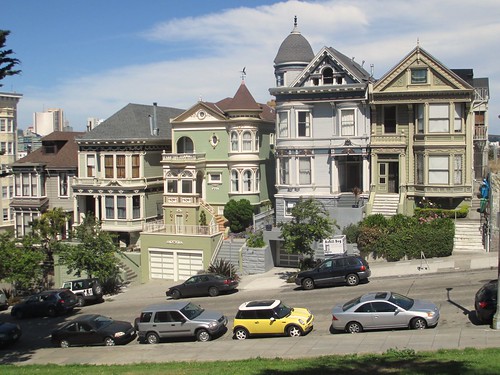
San Francisco's Painted Ladies: the epitome of Victorian
respectability - and only a short walk from where our family
encountered a street drugs bust.
I didn’t know it at the time but, the previous evening, half a continent away, a confrontation between a young black man and white police officers had ended tragically differently. In Ferguson, Missouri, a police officer had pumped six bullets into Michael Brown, a black 18-year-old, who was apparently holding up his hands in surrender and saying, “Don’t shoot!” One shot – to the head – killed him. The source of the confrontation appears to have been a demand by the officer than Michael and his friends walk on the sidewalk, rather than the road.

The scene in San Francisco ran through my head over the next few days as we saw, despite our holiday isolation, pictures of police in Ferguson equipped for war but facing mainly peaceful protesters. I also found myself making mental links between the scene we’d encountered and a far less grave injustice that was closer to home for me – the New York Police Department’s disproportionately harsh Operation Cyclesafe crackdown on cyclists’ rule-breaking.

The street drugs bust, the events in Ferguson and the NYPD’s harassment of cyclists all look to me to be the work of police forces more concerned about asserting their own authority than actually making the places they police safer. It’s hard in light of these and other incidents to avoid the conclusion that many US police forces are currently bereft of ideas and moral sense. While UK police forces rethought some aspects of their policing 30 years ago after urban rioting, the Metropolitan Police’s recent purchase of a water cannon hints that such thinking is creeping back in the UK too.

NYPD cruisers: sensitive, intelligence-led policing
The priority is to end appalling injustices such as the killings of Michael Brown and, closer to my home in New York, of Eric Garner, choked in Staten Island as New York police officers arrested him for a minor alleged offence. But better police forces would also surely reassess which offences demanded most of their attention. They would surely take more seriously the dreadful toll of death and injury on the US’s streets and give that national – but largely unacknowledged – tragedy a far higher priority.

I wouldn’t say I was precisely naïve about the potential misuse of police power, even before recent events. In one obviously conflict-ridden society, Bosnia, I remember seeing Bosnian Croat police harassing the mainly Bosniak – Bosnian Muslim – passengers on a bus where I was travelling in 1995 during the Bosnian war. Hungary’s police seldom impressed me when I lived there.
 
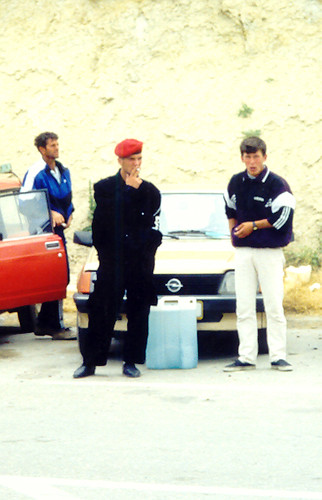
A Kosovo Liberation Army "policeman"
smokes while supervising sales of
smuggled fuel: just one of many
less-than-impressive officers I've
encountered during more than two
decades' reporting.
I have a particularly vivid memory from my home country of watching the reaction of Northern Ireland’s Royal Ulster Constabulary in July 1996 to rioting by members of the mainly Irish Nationalist Catholic community on the outskirts of Portadown, in the centre of the province. For five days previously, the police – mainly pro-British Protestants – had reacted with remarkable restraint as Protestants rioted over the routing of a march by the Protestant Orange Order in Portadown. After the police finally forced the march down Garvaghy Road, against the mainly Catholic residents’ wishes, I watched the police fire rubber bullets freely. At one point, I saw people of all ages, violent and non-violent alike, flee into a narrow passageway between shops. The police pumped plastic bullets indiscriminately into the passageway, knowing they would hit rioters and non-rioters.

My personal experiences as a cyclist have made me realise that bad policing affects places other than obviously conflict-ridden societies and people other than clearly discriminated-against minority groups. I’ve been lectured by City of London Police officers who were themselves breaking the road rules about my allegedly irresponsible behaviour. In May, I encountered a man who claimed – to my satisfaction – to be an off-duty cop. He grew verbally abusive when I asked him to move his car out of a busy, two-way cycle lane. There are stretches of road in New York where I know I’m likely to encounter police cars or vans illegally parked in the cycle lane and to have to dodge around them.

Yet I had retained, I now recognise, a residue of rather British innocence about democratic countries’ police forces, a feeling that they must somehow be on the side of the law-abiding, no matter their colour or background, against those who would harm them. I remember the times my parents had to call on the police when I was young and their polite attitude when they visited our large, respectable house.
 
Broken windows might have helped to make it safe for me
to walk nearly anywhere in this picture - it hasn't necessarily
done the same for people with darker skin.
Recent events have washed that residue out of me. I increasingly recognise how it was my family’s whiteness and respectability that won the police’s politeness. If I were black or belonged to some other obviously marginalised group, I would have far more – and probably far worse – stories about police behaviour. I’m more and more sceptical of the policing philosophy that’s come to dominate much of the western world in recent years – the idea that police intolerance of minor misdemeanours is critical to tackling crime overall. Bill Bratton, the police commissioner who returned to the top post in the NYPD earlier this year, pioneered this “broken windows” approach in New York City. Its apparent success in making the city safe again in the 1990s has led to its widespread acceptance as a policing approach elsewhere.

It’s to some extent because of broken windows that officers felt justified, I suspect, in violently restraining Eric Garner while arresting him for the minor crime of selling untaxed cigarettes. It’s because police officers are encouraged to create an orderly atmosphere on the streets, I suspect, that officer Darren Wilson thought it important to confront Michael Brown and his friends about where they walked. It’s a sense that street drug-dealing is worse than more discreet drug-dealing that leads to scenes like the one we encountered in San Francisco. I’ve long had a strong sense that the broken windows approach explained the NYPD’s tendency to give disproportionate numbers of traffic tickets to cyclists. If one believes that a police force’s main goal is to tackle the problems that create most noise at public meetings, it might well make sense to run a two-week crackdown on dangerous cycling.
 
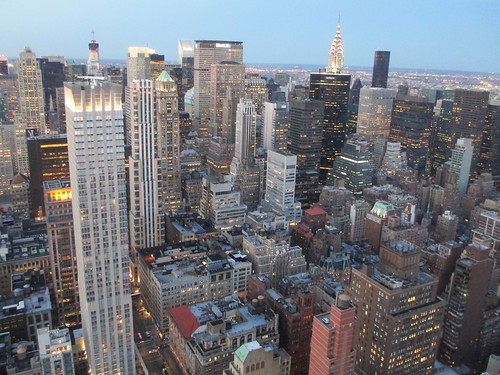
Midtown Manhattan: a bad place to break a window,
thanks to Bill Bratton, but not a bad place, necessarily,
to commit a serious fraud
The approach’s limitations are clear as soon as one starts examining them. Any strategy that deliberately devotes disproportionate resources to small, “quality-of-life” offences by its nature takes resources away from investigating the crimes – racketeering, murder, rape, fraud – for which society imposes the harshest penalties. The approach quickly degenerates into an anti-intellectual tendency to go after the crimes whose victims make the loudest noise, rather than those that are the biggest problem. It’s obvious that the arrest of one street-level dealer is unlikely to do anything to eradicate demand for illegal drugs in San Francisco or the business of supplying them.

Some good might yet come out of the grim events in Ferguson and elsewhere in the US this summer if they prompt a thorough re-examination of how the US is policed – a change that would surely have repercussions in other countries too. It would be heartening to see police forces question whether the constant harassment of the poorest groups under broken windows makes sense. There is surely scope to ponder which offences cause the most overall harm and start to tackle them.

I’ve argued before that traffic policing would be far better if commanding officers’ pay depended partly on the numbers of people injured on their areas’ streets, rather than the numbers of tickets handed out. A police force focused on preventing crime rather than enforcing order would surely not have thought a confrontation over where a group of young men walked worth provoking. Intelligent traffic policing might even seek to encourage cycling, recognising that cyclists are far less likely to kill other road users than motorists are.

It’s hard to be optimistic that such changes are coming soon, however. Reaction to the events in Ferguson has followed a pattern all too familiar in the contemporary US – right-wingers have defended the police, while the left have criticised them. On Twitter last week, Bill Bratton wrote that he was “gratified but not surprised” that New Yorkers appreciated “quality of life enforcement measures”. I’ve seen even cyclists welcome Operation Cyclesafe’s misdirection of resources, saying that, since they never break the rules, they have nothing to fear from it. Few people seem to recognise how crackdowns on minor crime misdirect resources.
 
Operation Cyclesafe made this cycle lane on my route to work
no safer for me to use
Two experiences on our return from California crystallised the nature of the problem. I returned to my regular cycle commute in the last days of Operation Cyclesafe to find that the crackdown had unsurprisingly done nothing to make the streets safer for cyclists. The cycle lanes appeared still more regularly blocked than normal and drivers’ behaviour still worse than normal.

The Invisible Visible Woman, meanwhile, heard two women discussing Eric Garner’s death on the street. It’s hard to avoid the conclusion that broken windows policing has turned some police forces into vehicles for the kinds of prejudice our neighbours were expressing.

“People say they heard him say, ‘I can’t breathe’,” one of them commented to the other, who nodded sagely. “But you have to remember – this was a man who’d been to prison ten times.”

An uncritical readiness to go after the offences that most annoy people quickly degenerates into a readiness to go after the people that most annoy the majority. That will sometimes be cyclists. It will far more often – and with far more deadly outcomes – be poor people like Eric Garner, condemned by prejudice to miserable and public deaths.

Sunday, 25 May 2014

An angry off-duty policeman, a rainy night - and why the suburbs are coming for your bike lane

It was 8.30pm on Friday and I was battling my way home from Greenpoint, at Brooklyn’s northern tip, through a thunderstorm of the kind that reminds one New York’s weather arrives partly from the tropics. I’d just got south of the Williamsburg Bridge on Kent Avenue when, looking ahead, I could see there was a car parked blocking most of the bike lane.

I naively assumed for a moment that perhaps the driver had made a mistake. Perhaps, despite the clear markings, in the torrential rain the driver just hadn’t spotted the bike lane.
The Kent Avenue bike lanes: a great place to park,
if you're entitled and unpleasant.

Instead, I was about to discover an almost beautifully distilled summary of what remains wrong with attitudes to cycling and road law enforcement in New York City. Some of those attitudes are peculiar to this big, crazy malfunction of a metropolis, while others are frustratingly widespread across the industrialised world. Cyclists, according to this attitude, are an odd, fringe group whose concerns needn’t be taken seriously.

But that’s putting the cart of theorising before the horse of anecdotal evidence.

The car stood out because it was so obviously in the wrong place. The parking spaces along Kent Avenue are all in the road, while a two-way bike lane runs along the kerb. The car’s headlights were glaring back at me, through the rain, more or less right in my path. Every other car for blocks was neatly parked outside the bike lane. As I approached, I expressed my irritation by waving to the motorist to move. It was a waste of effort. Even so, I might have said nothing if the motorist had not, as I rode slowly past in the remaining portion of the southbound bike lane, rolled down his window and said something, which I didn’t catch, but sounded abusive.

The insolence of the gesture switched me into “Invisible Visible Avenger” mode. I rapped sharply on the now-closed window and told the driver, “Shift! You’re in the bike lane.”

When the window rolled down again, the face looking back at me was a man, probably in his thirties, solidly built and wearing a baseball cap. He looked unimpressed with being asked to move.

“I’ll park wherever I want,” he replied.

“It’s illegal,” I said. “You’re blocking the bike lane.”

His reply alone would make a fascinating blogpost on its own – and certainly a fascinating contribution to Sarah Goodyear’s recent piece for the Atlantic Cities about cycling and masculinity.

“I’m picking up my baby,” he said. There was a child in a car seat in the back.

“What’s more important – my baby or your faggot-assed bike?”

The weight of his cultural assumptions was suddenly crashing and swirling around inside my head as frantically as the rain was lashing down outside it. There was the tone of injured innocence, so typical of a certain kind of self-righteous motorist. “I’m trying to go about my life the way normal, respectable people do,” he seemed to be telling me. “Yet here you, cyclist, are trying to intrude and ruin it.”

The assumptions behind the “faggot-assed bike” comment are even more breathtaking. He was driving a Dodge Avenger – a mid-size sedan with a more powerful than normal engine and an aggressive look. The car was an embodiment of his assumption that real men drive fast, aggressive cars. I, in my human-powered earnestness, represented weakness so transgressive as not to be fully male. My behaviour was so strange that even my bicycle suddenly assumed a sexual orientation.

And, of course, his attitude was turning this into a battle of wills, which I wasn’t prepared to lose.

“What’s important is that you’re blocking the bike lane,” I told him. “Look. I can call the police if you like.”
 
I use this photo for balance. The NYPD isn't the only
emergency service that ignores bike lanes
It was a bluff, based on my knowledge that no NYPD officer would deal with a call about a driver's obstructing a bike lane, particularly in a thunderstorm. But it opened up a whole new front in the battle.

“Call the police if you like,” he said, grabbing a sheaf of papers from his dashboard and shoving them towards me. They bore the logo of the New York Police Department and looked like some internal police directory. “This is the police right here.”

It would be reasonable to ask at this point why I believed him to be a police officer. Suffice it to say that I had a run-in once in London with someone who claimed to be a Metropolitan Police community support officer. His claim never rang true and, sure enough, when I complained to the police they said he was nothing to do with them.

The arrogance, self-confidence and sense of entitlement of the Angry Avenger Driver of Kent Avenue struck me as far more convincing.

It would be still more sensible to ask why, faced with a homophobic, cyclist-hating police officer who thinks his role entitles him to break the law, I didn’t cut my losses and leave. That, I imagine, is how a more balanced, contented person might have behaved.

Yet by now the Invisible Visible Avenger was in sole charge.

“What’s your badge number?” I asked.

“You got room to pass, don’t you?” he asked. “I ain’t stoppin’ you.”

“Are you a police officer?”

“Yes, I am. You shouldn’t be riding in the rain.”
 
There are two ways to read the NYPD's decision to put
"Courtesy, Professionalism, Respect" on the side of their
vehicles. They're either wholly out of touch or - which I
prefer - have a brilliant satirist in their image department
“Tell me your badge number.”

“Stop ridin’ in the rain.”

“What’s your badge number?”

“I don’t have to tell you shit.”

It was the last I heard from him. Silently, recognising reason wouldn’t work, I strode over to a nearby wall, leaned my bike against it and started to get my camera out of my pannier bag. Recognising, I suppose, that his bosses might take a dim view of discovering his views on a whole range of matters, the officer made off into the dark, rainy night. My sole sliver of victory was that I’d got him out of the bike lane. I felt far less fearful than after some previous confrontations with recalcitrant motorists.

But, as I headed on homeward, water squelching in my waterlogged shoes, I felt depressed. The previous morning, I’d been delighted as I rode to work to see a police officer ticketing a driver parked in the bike lane on Jay St in downtown Brooklyn and had shouted my thanks to him. The Kent Avenue encounter made me think that other reports I heard last week – of the police ticketing cyclists for relatively harmless breaches of Prospect Park’s one-way rules, for example – were more representative of current police attitudes.

The officer’s self-righteousness bothered me most. The comment about how I shouldn’t be riding in the rain suggested a strong underlying assumption that cycling was a trivial, leisure activity while driving a car was the serious act of a responsible person. Illegal driving consequently trumped perfectly legal cycling.

My mind went back to when two City of London police officers stopped me in London, accusing me of cycling dangerously by squeezing past their vehicle. They and other motorists had been illegally blocking an intersection where I had the light. In both that and Friday’s incident, there was the sense that the police officers, in their car, were implicitly the responsible grown-ups.

The officer’s arrogant assertion of his right to park wherever he liked spoke to something similar to the previous day’s ticket blitz in Prospect Park. The traffic rules for some police officers seem unimportant on their own terms – as a means to prevent people’s being harmed – but a series of traps, like the Russian tax code. They’re there to use as a stick to beat whatever group one wants to beat today or to fill up an unfilled quota of tickets.
 
NYPD cruisers in midtown: five carloads of suburban
assumptions, coming your way
The proliferation on New York City cars of stickers showing the driver’s allegiance to this or that police benevolent association – lucky charms to ward off the evil eye of an arbitrary traffic stop – suggests others share my perception of police attitudes.

Not that, for me, the consequences were ultimately important. As a middle-aged white professional, I’m self-evidently a poor target for a harassment arrest. Had I been a younger black or Hispanic man, I would probably have made off the moment I realised I was dealing with the police.

Blacks, Hispanics, gays and many other minority groups face far worse than cyclists generally do at the hands of the NYPD. I’m certainly in a far better position than the 28-year-old mentally ill man who used to live round the corner from me. After he stabbed – but only lightly wounded – his uncle, the police pumped seven bullets into him, killing him.
 
Williamsburg, near the scene of my encounter: no vision
of suburban respectability
Yet I don’t think it’s a stretch to see in the dismissive attitude of police in London and New York to cyclists’ complaints a symptom of the disconnect between police and policed. In both cities, officers live in outlying, suburban areas where car use is a symbol of a certain kind of conventional respectability. It’s not hard to imagine such officers are fundamentally at odds with much of the reality of the urban life they’re policing, from casual, harmless use of illegal drugs to rising levels of cycling.

Both cities’ residents have fought long battles with their police forces – over their racism, their homophobia, their sense they’re above the law. Yawning gaps persist between police and public attitudes. This year in New York started with bold declarations about eradicating road deaths. I arrived home on Friday discouraged, feeling that some of the police who should be helping towards that goal are part of the problem rather than the solution.

Sunday, 19 January 2014

A new police commissioner, some dodgy statistics - and an open letter from me

William Bratton,
Commissioner,
New York Police Department,
1 Police Plaza,
New York,
NY 10038
January 19, 2014

Dear Commissioner Bratton,
Vision Zero and Statistics
            Congratulations on your appointment as NYPD commissioner. Like many New Yorkers, I feel optimistic based on most of your public statements that you’re determined to build on the progress made on public safety in your previous term at the department. I am particularly optimistic that you are determined, at last, to set about reducing the appalling toll of death and injury that motor vehicles exact from New Yorkers every year.
          I wanted to pick you up, however, on a puzzling statement on January 15 at the launch press conference for the mayor’s Vision Zero initiative. You said pedestrians contributed to causing 73 per cent of pedestrian-motor vehicle collisions last year and that pedestrian actions were directly responsible for 66 per cent of those collisions. It’s a figure that on my reading of the figures is demonstrably incorrect. I fear that, if the NYPD genuinely thinks this figure reflects reality, it could seriously distort the department’s efforts to reduce the grim toll of unnecessary suffering on our city’s streets.
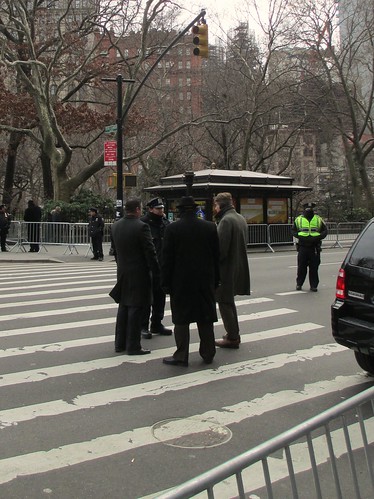
Waiting for a new boss: NYPD officers
outside the new mayor's inauguration
I would be interested to know the basis for your assertion – and grateful if you could put the figure right if, as I am sure it is, it is mistaken.
            Your figure is implausible to start with. It implies that motorists - who stand almost no chance of injury in a collision with a pedestrian, often drive at high speed and are easily distracted – are more solicitous of pedestrians’ safety than the pedestrians themselves. That seems at variance with my experience of human nature as well as with my observation that pedestrians are generally watchful when crossing city streets and motorists often cavalier when driving on them.
            The statistic is also starkly at odds with all the research I’ve read either in New York or elsewhere on the causes of crashes between motor vehicles and vulnerable road users – pedestrians and bicyclists. For example, a study published in 2013 by NYU Langone Medical Center found that 44 per cent of pedestrians treated for injuries after collisions had been hit in a crosswalk while crossing with the light. Another 6 per cent were hit on the sidewalk. Given that some of the other victims will also have been the victims of driver negligence – hit in unsignalised crosswalks, for example – it is clear the majority of studied crashes were mainly drivers’ fault.
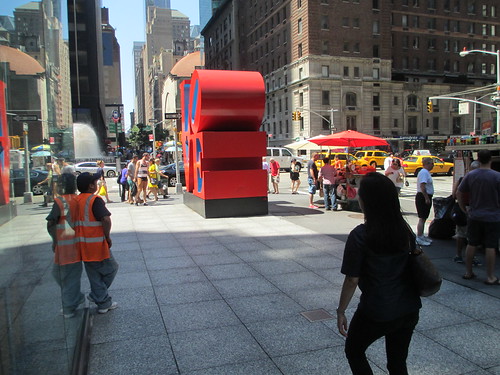
Typically dangerous pedestrian behaviour:
midtown Manhattan
            A more comprehensive study, published in 2010 by the city’s own Department of Transportation, attributed blame for 36 per cent of crashes that killed or seriously injured pedestrians to driver inattention. It attributed another 27 per cent to motorists’ failure to yield and said vehicle speed was a major contributor to 21 per cent of crashes. The DoT study reinforces the impression that, while pedestrians undoubtedly cause some crashes, they are probably mainly to blame for only a quarter or so of incidents.
            Around the world, a number of research studies have reached strikingly similar conclusions. Many have attributed blame for crashes involving pedestrians and cyclists to motorists in around 75 per cent of cases. For example, in London, where I lived and cycled for nine years until August 2012, a Transport for London study of every reported motorist-cyclist collision in 2010 attributed blame for around 74 per cent of the crashes to motorists. Motorists’ inattentiveness, excessive speed and impatience are the main killers in every industrialised country of which I’m aware. It's unlikely New York City is a freakish exception.
It might look to you like the outcome of negligent speed:
but there's an NYPD statistician who probably thinks
some pedestrian caused this.
            Your assertion also seems at odds with the evidence of the fatal crashes involving pedestrians so far this year. I’ve been able to glean enough information about four of the fatal pedestrian crashes up until Friday 17 to guess how blame might be allocated. In only one – the death of Xiaoci Hu, killed on January 2 when a car ran into the back of another car that had slowed down to let him cross mid-block – does the pedestrian appear to have carried even a portion of the blame. The driver who struck Mosa Khatun on January 5 in Jamaica was charged with failure to yield; the driver who hit Nydja Herring on January 11 in Parkchester has reportedly been charged with aggravated driving while intoxicated; numerous witnesses attest that the driver who killed Cooper Stock on January 11 hit him and his father in a crosswalk as they crossed with the light.
            Streetsblog, the campaigning website, calculates your department coded only between 7 and 8 per cent of crashes involving pedestrians or cyclists in the first 11 months last year as having resulted from pedestrian or cyclist confusion or error.
            My concern is that a mistaken understanding of the present crisis’ causes could lead the NYPD to pursue mistaken or counterproductive measures to halt it. If pedestrian behaviour were indeed the cause of most pedestrian/car crashes, it would be worthwhile and effective to work harder at changing pedestrian behaviour. I note there are already reports of a police crackdown on “jaywalking” around the area on 96th street in Manhattan where there has been a cluster of casualties this year. I can imagine it will be tempting for local police precincts to seek in any crackdown to tackle pedestrians and cyclists since they are, by their nature, easier to catch and prosecute than drivers of fast-moving cars.
            If, however, cars cause the majority of crashes involving pedestrians and cyclists, it will make far more sense to work at controlling drivers’ speed and ensuring they yield when required to do so. I am worried that, with the crackdown on the Upper West Side, you are beginning to pursue a pedestrian-focused strategy – one that targets the victims and not the perpetrators.
The new mayor during his campaign: before he had a police
commissioner to explain how pedestrians were
killing themselves
            My personal conviction is that a concerted effort to tackle the traffic crisis’ real causes could yield dramatic results quickly. During my nine years in London, I covered transport issues in the UK and elsewhere for the Financial Times, winning several awards. London, which has a similar population to New York’s and similar traffic volumes, suffers only half the annual traffic fatalities that New York does. Motorists’ adherence to speed limits and other road rules is noticeably more lax in New York City than in London. I see no reason why the introduction to New York of systematic speed enforcement and a general culture of respect for road rules should not quickly bring New York’s fatality levels closer to London’s.
            I look forward to hearing from you about your figure’s origin and how it is affecting your policies. I would of course be delighted to speak with you or your officials about my concerns.
The NYPD and other city agencies have it within their grasp to save hundreds of New Yorkers’ lives every year. It would be a tragedy if apparently mistaken data led you to pass that opportunity up,
Yours Sincerely,

 Invisible