Showing posts with label road safety. Show all posts

Sunday, 7 June 2015

A Twitter row, a gospel passage - and why victim-blaming keeps coming back

It’s not, I accept, a common outcome to a row on social media. But, as I was cycling home on May 20 past downtown Brooklyn’s Roman Catholic Cathedral, my mind turned from a row I’d been having on Twitter with Rory Lancman, a New York city council member, to the New Testament. Specifically, I thought about an incident in the 9th chapter of the Gospel ofJohn.
 
Jay St: not an obvious place, I accept, to start pondering
the Gospel of John
The passage came to mind because Councilman Lancman wants to amend key provisions of the council’s Right of Way law, passed last year. The amendments would shift from the driver to police and prosecutors the burden for proving violations of the law were avoidable. That would make it far harder to use the law for its intended purpose of charging drivers who hit pedestrians and cyclists who have the right of way. The councilman’s arguments to my mind suggest he thinks there are cases where motorists strike vulnerable road users acting legally and the crash is still ultimately somehow the vulnerable road user’s fault.

John Chapter 9 is a reminder of how long human beings have been battling that same instinct to assume people nearly always bring their misfortune on themselves. It details an encounter between Jesus and his disciples and a man born blind. The disciples assume the man must be suffering because of some wrongdoing either on his own or his parents’ part.

The efforts by Councilman Lancman and many others to shift the blame for crashes make far more sense, it seems to me, looked at in the context of millennia of instinctive victim-blaming than as a rational piece of public policy-making. The belief that victims deserve their fate continues to underlie thinking in a huge range of areas. While it clouds a huge amount of people’s thinking about road safety, it has still more invidious effects in thinking about class, race and, most obviously in the contemporary US, violence by the police. It is particularly invidious because it tends to be applied disproportionately to the powerless – the pedestrian or cyclist more than the motorist; the poor, unarmed black person killed by police more than the police officer.

“As Jesus went along, he saw a man blind from birth,” John Chapter 9 reads. “ His disciples asked him, ‘Rabbi, who sinned - this man or his parents - that he was born blind?’”

A crash I encountered on Friday: since it involved two
motor vehicles, Councilman Lancman is spared
the task of working out how to exonerate one party.
Councilman Lancman, of course, doesn’t accept my interpretation of his proposed amendments. He insists that his concern is a purely technical one – that the law passed last year is wrongly being interpreted as a “strict liability” law: that drivers are charged irrespective of the circumstances and their culpability in striking the victim of the crash. The police are wrongly failing before making arrests to analyse whether the crash was somehow unavoidable.

An email he sent to fellow council members explaining his proposed amendments, however, suggests he simply doesn't think drivers are truly to blame for many crashes.

“Adding a provision to the bill to require an analysis of due care will penalise drivers who hit pedestrians out of recklessness and gross negligence, while sparing drivers when accidents are caused by poor road conditions, bad weather and scofflaw pedestrians,” he wrote.

The email suggests strongly that many motorists who strike pedestrians and cyclists moving legally and with the right of way are somehow helpless victims either of circumstances on the roads or of the negligence of those they hit. Since it’s impossible that a pedestrian crossing the street with a walk signal can be crossing the street illegally, Councilman Lancman seems to be suggesting that, for example, a motorist might be let off charges for striking him or her if, say, the victim was talking on a mobile telephone.
Two pedestrians in this Meatpacking District crosswalk
are on their phones. That makes them fair game, right?

The email also suggests an entirely mistaken conception of a driver’s duty to exercise due care. In poor road conditions and bad weather, it’s a driver’s responsibility to drive more carefully. If a driver has blindspots, he has to compensate for them by looking more carefully. To assume that the vulnerable have to assume all the blame is to make a crude assumption that might is generally right.

The true obscenity of the councilman’s proposed amendment, meanwhile, is that it’s seeking to stamp out a “problem” that barely exists. According to Streetsblog, between the introduction of the Right of Way Law last August and the end of April, only 22 drivers had been charged under it, out of 8,000 collisions between motorists and pedestrians or cyclists. His proposed amendment would usher in a system where even that minuscule number of prosecutions would inevitably fall to nearly zero. It is no comfort at all that the councilman's proposed amendment and some other recent legislation aimed at gutting the Right of Way Law seem to be aimed at ensuring that more members of Transport Workers' Union Local 100, which represents New York bus drivers, escape arrest when they hit pedestrians.

It’s hardly as if, after all, there isn’t already a firmly-established paradigm in the heads of police officers and district attorneys that pedestrians and cyclists bring their fates on themselves. On May 18, for example, a driver struck and killed John Torson, 89, at the corner of 1st Avenue and 61st Street on Manhattan’s Upper East Side and claimed that, while she had done her best to stop, he had “just hobbled into the middle of the street”. Extraordinarily, the New York Police Department appears to have accepted this improbable excuse for hitting a man of 89 who was crossing with the right of way. The NYPD let it be known that Mr Torson had been “crossing outside the marked crosswalk”. Pictures of the scene showed the car stopped only just beyond the crosswalk, suggesting that he must at least have been very close to the marked lines.

Mr Torson was killed only a few blocks from where a turning cab driver killed Amelia Sterental, 76, on May 9 at 60th Street and Madison Avenue. That crash – which also involved a turning driver and someone crossing the street with the walk signal - has yet to produce any charges either, suggesting that the police in that case have also found some improbable excuse for the driver’s negligence.

A van driver swings through a crosswalk
on Sixth Avenue. If he hits a pedestrian,
in many circumstances, Rory Lancman
will have his back
New means of suggesting pedestrians and cyclists bring their fate on themselves are constantly emerging and need to be slapped down, like some strange game of cultural whack-a-mole. One snowy morning in early 2014, I shouted at a cab driver who honked at me to try to get me out of a crosswalk. When he got out to confront me, I told him impatient driving like his explained the city’s poor road safety record. He asserted – even though I had not been using a phone – that pedestrians’ mobile phone use that explained the spike in crashes. I have seen abundant commentary recently on the risks of pedestrians' mobile phone use - and far less on the far greater danger posed by distracted drivers.

In the UK, Bradley Wiggins - for whose sporting achievements I feel the greatest respect - recently made the latest of a series of poorly-judged interventions on cycling safety to say cyclists "have to help themselves" by wearing "helmets and things". The Metropolitan Police shamefully failed to charge the driver who fatally hit Michael Mason on Regent’s Street because, although his bike was well lit, he was wearing neither a helmet nor high-visibility clothing. Most dispiritingly, I once had a lunch with a UK road safety minister who, when asked about cyclist safety, said cyclists were "their own worst enemies".

The persistence of such thinking is all the more extraordinary given the mental leaps that should be required to accept this narrative. Research regularly places the main blame for between two-thirds and 80 per cent of crashes involving vulnerable road users on the driver involved. Yet the victim-blaming narrative suggests cyclists and pedestrians either don’t know themselves to be vulnerable or consistently throw themselves in front of deadly, speeding vehicles heedless of the dangers.

The desperation to exonerate motorists reflects not only a desire to blame victims but to exculpate the powerful of wrongdoing. Last week, for example, after a driver mounted a sidewalk in Sunset Park, Brooklyn, and mowed down Oscar Chen, four, the police were quick to dismiss this appalling piece of driving as “just an accident”. The four-year-old was saved, to judge by videos, only by being by a tree – which fell over and protected him – when the vehicle hit him. The distasteful rush to exonerate contrasts sharply with the police’s desperation to accept the false account of Ahmad Abu-Zayedeha, the driver who killed three-year-old Allison Liao in a crosswalk in Queens in 2013. The driver said Allison had “broken away” from her grandmother while crossing the street – a version of events that subsequent evidence has shown to be entirely misleading. Allison's family are constituents of Rory Lancman's.

There are similar forces at work in the effort to vilify Tamir Rice, the 12-year-old killed last year by Cleveland Police, and make excuses for the police officers who killed him. It’s not too much of a stretch, I think, to see the victim-blaming, power-exonerating dynamic at work in much of recent decades’ US economic policy. The rich need the carrot of lower taxes if they’re to be persuaded to work harder. The poor need the stick of withdrawn benefits.

The victim-blaming narrative, after all, has huge implications. If we all primarily determine our own fate on the roads, there should be a presumption of minimal intervention by the police, prosecutors and licensing authorities in drivers’ freedom to do as they please. If, however, people’s fates depend predominantly on the behaviour of others, the presumption in favour of freedom should be significantly eroded.

It’s striking for how long these moral and intellectual battles have been fought and refought, however. In the Jewish scriptures, the book of Job recounts a man suffering a series of afflictions whose friends falsely assume his own wrongdoing has somehow brought them on him. In John Chapter 9, meanwhile, Jesus firmly rebukes his disciples.
 
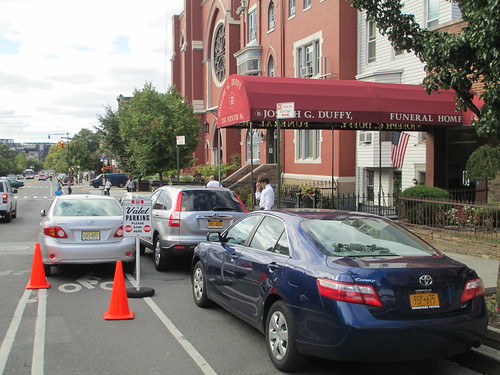
Parking outside Brooklyn Basilica: how would Jesus park,
do you think?
“Neither this man nor his parents sinned,” he says.

The story in John has a far happier ending than many collisions on New York’s or London’s streets or between angry police officers and vulnerable African-Americans. Jesus says that the blind man is blind "so that the works of God might be displayed in him". That is, I accept, a problematical idea. But Jesus goes on to put mud on the man’s eyes and have him wash it off. Afterwards, he can see.

Such a moment of eye-opening doesn’t yet seem to have come to Councilman Lancman or many other policy-makers or law enforcement officials worldwide. It hasn’t, sadly, even come to some of my fellow contemporary followers of Christ. As I cycled home on May 31, a little over a fortnight after my row with Councilman Lancman, I headed as usual down Jay St past St James’s Cathedral. I came up short when I found the bike lane was blocked. People attending an event at the cathedral had arrived by car in large numbers and decided, entirely illegally, to park diagonally to the kerb, blocking the bike lane in both directions. Cyclists were forced out into a busy stream of rush-hour traffic, endangered to provide more convenient parking for the congregation.

It’s a casual example of the arrogance of the powerful against the weak. Were Jesus present on earth in the same sense as 2,000 years ago, there would, I’m sure, be issues that would cause him still more concern. But there's a moral responsibility to park a car - just as there is to move it - in a way that poses the least possible risk to others. When people undertake even such minor acts in a fashion so casually contemptuous of the interests of others, it strikes me as deeply at odds with the solicitude for others that Christian faith – or the true practice of Judaism, humanism or any truly ethical belief system – should inspire.

Sunday, 8 June 2014

An uptown ride, a Hudson incident - and why some safety messages spell danger

On April 25, instead of heading straight to the office, I cycled up the Hudson River Greenway to the ghastly Javits Convention Center, for an event grandly titled the World Traffic Safety Symposium. The centrepiece turned out to be a much-hyped announcement about improving pedestrian safety by David Friedman, acting administrator of the federal government’s National Highway Traffic Safety Administration.
The Hudson River Greenway: a ride up here put me
in a sombre mood

A scene I encountered as I cycled there shaped my experience of the event, however. Around Pier 59 in Chelsea, I found a swarm of emergency vehicles blocking most of the cycle path, busy working at something in the river. It wasn’t hard to work out that they were retrieving something significant – probably a dead person – from the water.

The sense that I’d brushed someone’s tragedy on the way put me in no mood to listen to the convenient messages that their public relations departments had given the speakers to parrot about improving road safety. It fuelled my conviction that their approach to road safety had been infected by one of the signature thinking failures of the contemporary age. Faced with a big problem with complex roots, they had decided – by stressing everyone’s collective responsibility for safety - to blame everyone involved, rather than the people most responsible.

The indignation that overtook me was similar to what I feel when I hear or read, for example, that it’s impossible to tell whether Russia or Ukraine is more to blame for Russia’s invasion of Ukraine. In the wake of the revelations about the US National Security Agency’s excessive spying, I’ve read suggestions that, since America is less free than was previously supposed, it’s really no different from China or North Korea. Other cynics say that, since it’s hard to tell which of the various UK political parties at present is least bad, one might as well regard them as all the same.

Such ideas invariably serve to help the powerful and ill-intentioned – an authoritarian Russia against a democratic if flawed Ukraine; China’s repressive government against its own people and the UK independence party against less nasty groups.

Pedestrians in midtown Manhattan: crossing the street
almost as if it weren't their personal responsibility
to keep themselves safe from the poor cars.
But this act of intellectual surrender was all the more invidious because none of the speakers – who included the commissioner of New York State’s department of motor vehicles, New York City’s traffic commissioner and the New York police’s head traffic cop - seemed to recognise it as such. In fact, they presented their message – that everyone shares responsibility for making the roads safer – as if it were the plainest common sense.

“It begins with personal responsibility,” Friedman said, before going on to say how indispensable it was that everyone take ownership of his or her own safety.

“In a rush, we might cross against the light,” he said. “On our bikes, we might not stop at every stop sign. As drivers, being late for work can mean the temptation to rush into a crosswalk before the pedestrian does to get across and save a bit of time instead of waiting for them to walk safely by.”

Friedman invited us, in other words, to equate in blameworthiness nipping across a pedestrian crossing against the light when no vehicles are around, jumping a red light on a bike when one can see a phalanx of charging cars behind one and barging one’s car through a crosswalk of children walking to school.

Riding down the 9th St bike lane in Park Slope, Brooklyn?
Don't forget to exercise your personal responsibility
to keep yourself safe there.
Research into road crashes highlights such a suggestion’s preposterousness. Every bit of research I’ve read on crashes between motorists and pedestrians or cyclists attributes blame for between two-thirds and 80 per cent of crashes to the motorist. People’s gut instinct about where the power lies between a half-tonne speeding vehicle and a vulnerable cyclist or pedestrian already appears to be making them risk-averse around cars. In New York City, more serious pedestrian injuries seem to occur to people crossing with the light in the crosswalk than crossing against the light. People who cross when traffic’s clear but the light’s not in their favour seem to do better than those who rely on turning drivers to yield to them.

The effects of this misallocation of blame are real. Since New York embarked on its effort to eliminate road crash deaths in January, police in many precincts have stepped up harassment of cyclists and pedestrians but not policing of refusal to yield or speeding. When a driver hit and killed Nicholas Soto, a 14-year-old boy, crossing the street in Red Hook, a few blocks from my house, last Monday, the instant reaction was to blame the boy’s sweatshirt for obstructing his view. But the car involved seems to have been going far too fast and the boy was in a crosswalk. The implicit assumption that responsibility for road safety lies equally with the driver of a speeding performance car and a schoolboy running for the bus has led police to blame the victim, rather than the perpetrator.
Remember, folks: exercise your personal responsibility
in getting around the cars the police have allowed
to block the sidewalk and bike lane.

On a wider scale, both in New York and other parts of the world, failure to understand crashes’ causes leads police to harass groups that don’t cause crashes and leave alone others that do. In my native Scotland, the Scottish government last year embarked on an especially bizarre "mutual respect" campaign called "the Niceway Code". The evening before Nicholas' death, I'd even come across police supervising minivan drivers who were parking blocking a sidewalk and most of a two-way bike lane. It was as if they were trying to demonstrate unequivocally whose interests they represented.

Nor is it adequate to claim that, somehow, the misleading message about safety is effective because it overcomes drivers’ resistance to being told it’s all their fault. After a taxi driver honked at me to hurry me out of a crosswalk earlier this year, he told me that, no, it wasn’t the fault of drivers like him that pedestrian deaths in the city remained high. It was the fault of pedestrians distracted by their telephones. I wasn’t using a mobile device as I crossed the street. I am confident that he is one of many drivers who, when hearing that road safety is a shared responsibility, concludes it isn’t really his at all. It’s hard not to be reminded of the way some police forces used to combat sexual assault. Yes, men, you shouldn’t rape women. But, come on women, watch how you dress and where you go. Any message that disperses blame for a problem takes pressure off the most blameworthy party.
Cycle or walk responsibly through the intersection
of 54th Street and Broadway. Otherwise you
might not be safe.

The only comfort I could draw was that the sums being put into this new initiative are so small they’re unlikely to do much harm. Friedman had come to New York to announce awards of $1.6m – the price of a few rooms of a Brooklyn brownstone – for pedestrian safety, split between three cities. New York was to receive $800,000 while the remainder would be split between Philadelphia and Louisville, Kentucky. I had no time to follow the group to a nearby celebratory press conference. So, robbed of the chance to ask awkward questions, I headed back to the office.

It was to be a memorable ride downtown. I reached Pier 59 to find the emergency vehicles gone. Only two policemen remained, seated at a picnic table playing cards. At their feet was a sheet, hiding the unmistakeable outline of the body they’d hauled out of the river.

It was hard not to see the little tableau as a metaphor for how New York and many other cities treat deaths. We’re constantly surrounded by fatal tragedies – a young man who’s jumped off a bridge, or another who’s been hit by a car. Yet we seem all too often to be so distracted, impatient and easily bored that we don’t give their deaths the respect and reflection they deserve.

There are no easy solutions. A patrol cop in the precincts by the Hudson probably sees enough bodies fished out of the river that he can be forgiven his sense of ennui. It’s hard when driving to hold onto a full sense of one’s responsibility to those around.

But, at the moment, the rush after a fatal crash is all too often to assure the survivor that, no, he couldn't have done anything to avoid it, to heap the blame on the person whose life has just been taken away. As long as that's the instinct, there won't be much reduction in the numbers of the recently-deceased left lying in the street, hidden by only a sheet, for the medical examiner to take away.

Sunday, 19 January 2014

A new police commissioner, some dodgy statistics - and an open letter from me

William Bratton,
Commissioner,
New York Police Department,
1 Police Plaza,
New York,
NY 10038
January 19, 2014

Dear Commissioner Bratton,
Vision Zero and Statistics
            Congratulations on your appointment as NYPD commissioner. Like many New Yorkers, I feel optimistic based on most of your public statements that you’re determined to build on the progress made on public safety in your previous term at the department. I am particularly optimistic that you are determined, at last, to set about reducing the appalling toll of death and injury that motor vehicles exact from New Yorkers every year.
          I wanted to pick you up, however, on a puzzling statement on January 15 at the launch press conference for the mayor’s Vision Zero initiative. You said pedestrians contributed to causing 73 per cent of pedestrian-motor vehicle collisions last year and that pedestrian actions were directly responsible for 66 per cent of those collisions. It’s a figure that on my reading of the figures is demonstrably incorrect. I fear that, if the NYPD genuinely thinks this figure reflects reality, it could seriously distort the department’s efforts to reduce the grim toll of unnecessary suffering on our city’s streets.
Waiting for a new boss: NYPD officers
outside the new mayor's inauguration
I would be interested to know the basis for your assertion – and grateful if you could put the figure right if, as I am sure it is, it is mistaken.
            Your figure is implausible to start with. It implies that motorists - who stand almost no chance of injury in a collision with a pedestrian, often drive at high speed and are easily distracted – are more solicitous of pedestrians’ safety than the pedestrians themselves. That seems at variance with my experience of human nature as well as with my observation that pedestrians are generally watchful when crossing city streets and motorists often cavalier when driving on them.
            The statistic is also starkly at odds with all the research I’ve read either in New York or elsewhere on the causes of crashes between motor vehicles and vulnerable road users – pedestrians and bicyclists. For example, a study published in 2013 by NYU Langone Medical Center found that 44 per cent of pedestrians treated for injuries after collisions had been hit in a crosswalk while crossing with the light. Another 6 per cent were hit on the sidewalk. Given that some of the other victims will also have been the victims of driver negligence – hit in unsignalised crosswalks, for example – it is clear the majority of studied crashes were mainly drivers’ fault.
Typically dangerous pedestrian behaviour:
midtown Manhattan
            A more comprehensive study, published in 2010 by the city’s own Department of Transportation, attributed blame for 36 per cent of crashes that killed or seriously injured pedestrians to driver inattention. It attributed another 27 per cent to motorists’ failure to yield and said vehicle speed was a major contributor to 21 per cent of crashes. The DoT study reinforces the impression that, while pedestrians undoubtedly cause some crashes, they are probably mainly to blame for only a quarter or so of incidents.
            Around the world, a number of research studies have reached strikingly similar conclusions. Many have attributed blame for crashes involving pedestrians and cyclists to motorists in around 75 per cent of cases. For example, in London, where I lived and cycled for nine years until August 2012, a Transport for London study of every reported motorist-cyclist collision in 2010 attributed blame for around 74 per cent of the crashes to motorists. Motorists’ inattentiveness, excessive speed and impatience are the main killers in every industrialised country of which I’m aware. It's unlikely New York City is a freakish exception.
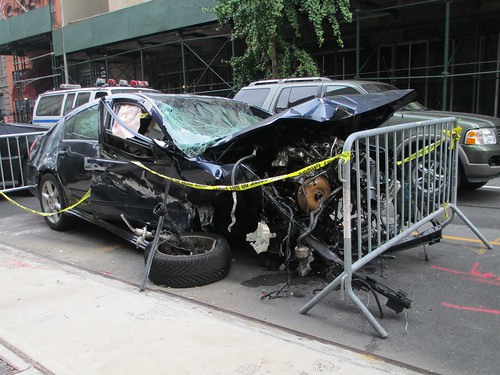
It might look to you like the outcome of negligent speed:
but there's an NYPD statistician who probably thinks
some pedestrian caused this.
            Your assertion also seems at odds with the evidence of the fatal crashes involving pedestrians so far this year. I’ve been able to glean enough information about four of the fatal pedestrian crashes up until Friday 17 to guess how blame might be allocated. In only one – the death of Xiaoci Hu, killed on January 2 when a car ran into the back of another car that had slowed down to let him cross mid-block – does the pedestrian appear to have carried even a portion of the blame. The driver who struck Mosa Khatun on January 5 in Jamaica was charged with failure to yield; the driver who hit Nydja Herring on January 11 in Parkchester has reportedly been charged with aggravated driving while intoxicated; numerous witnesses attest that the driver who killed Cooper Stock on January 11 hit him and his father in a crosswalk as they crossed with the light.
            Streetsblog, the campaigning website, calculates your department coded only between 7 and 8 per cent of crashes involving pedestrians or cyclists in the first 11 months last year as having resulted from pedestrian or cyclist confusion or error.
            My concern is that a mistaken understanding of the present crisis’ causes could lead the NYPD to pursue mistaken or counterproductive measures to halt it. If pedestrian behaviour were indeed the cause of most pedestrian/car crashes, it would be worthwhile and effective to work harder at changing pedestrian behaviour. I note there are already reports of a police crackdown on “jaywalking” around the area on 96th street in Manhattan where there has been a cluster of casualties this year. I can imagine it will be tempting for local police precincts to seek in any crackdown to tackle pedestrians and cyclists since they are, by their nature, easier to catch and prosecute than drivers of fast-moving cars.
            If, however, cars cause the majority of crashes involving pedestrians and cyclists, it will make far more sense to work at controlling drivers’ speed and ensuring they yield when required to do so. I am worried that, with the crackdown on the Upper West Side, you are beginning to pursue a pedestrian-focused strategy – one that targets the victims and not the perpetrators.
The new mayor during his campaign: before he had a police
commissioner to explain how pedestrians were
killing themselves
            My personal conviction is that a concerted effort to tackle the traffic crisis’ real causes could yield dramatic results quickly. During my nine years in London, I covered transport issues in the UK and elsewhere for the Financial Times, winning several awards. London, which has a similar population to New York’s and similar traffic volumes, suffers only half the annual traffic fatalities that New York does. Motorists’ adherence to speed limits and other road rules is noticeably more lax in New York City than in London. I see no reason why the introduction to New York of systematic speed enforcement and a general culture of respect for road rules should not quickly bring New York’s fatality levels closer to London’s.
            I look forward to hearing from you about your figure’s origin and how it is affecting your policies. I would of course be delighted to speak with you or your officials about my concerns.
The NYPD and other city agencies have it within their grasp to save hundreds of New Yorkers’ lives every year. It would be a tragedy if apparently mistaken data led you to pass that opportunity up,
Yours Sincerely,

 Invisible

Monday, 23 December 2013

A Brooklyn Heights commuter, an untimely Queens death - and how attitudes to roads might be the least of our problems

I’ve come across few sights on New York City streets that excited such mixed feelings in me as the one I encountered one morning last month on Clinton Street in Brooklyn Heights. Just in front of me in the cycle lane on the street, which fills up with cars and taxis every morning, was the only child – he was probably ten or 11 – I’ve ever encountered riding on his own to school in New York City on the road.

I was, on one level, hugely excited. It would be an enormous improvement for every city in the industrialised world if the queues outside schools in the morning were of children waiting to park their bikes, not sports utility vehicles waiting to double-park. The boy had clearly been thoroughly trained and looked attentively from side to side at every junction.
 
Clinton St at Atlantic Avenue: I was excited to see a child
cycling here - but also apprehensive
But I also, I’ll confess, felt fearful. Motorists are apt to turn left or right suddenly on Clinton St or lurch into the cycle lane to avoid a suddenly-stopped taxi.  Drivers are prone to driving through the slow-moving traffic texting or sending emails. Car doors are apt to spring open or pedestrians to step into the street without looking. Knowing my own concerns about using the street, I willed the young man to make it to school safely. He eventually did.

That young boy’s been back in my mind since I heard on Friday about another boy going to school elsewhere in New York who didn’t make it safely.

On Friday morning, Mauricio Osorio-Palaminos, a truck driver, drove his truck out of 61st street in Queens left onto Northern Boulevard, cut well onto the side of the street for oncoming traffic and caught Noshat Nahian, eight, with the trailer’s rear wheels. Noshat, who was hurrying to school with his 11-year-old sister, died shortly afterwards in hospital.

The street Osorio-Palaminos was leaving was not, as far as I can tell, a designated truck route. Pictures showed his truck far over to the wrong side of the road. The driver was also the second in recent weeks to kill a pedestrian in New York City while driving commercially with a suspended licence.
 
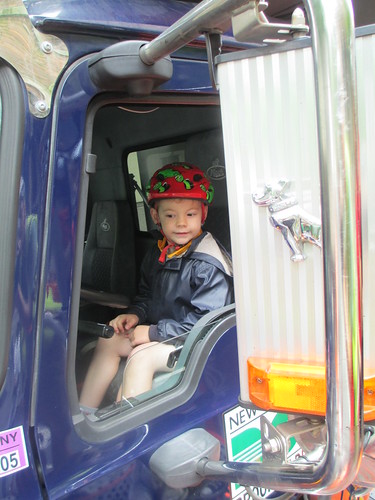
The Invisible Visible Boy on a truck
meant to show cyclists how hard they are
to see. Let's hope New York's DoT trains
its drivers in spotting cyclists too.
Yet commenters on online news reports about the death homed in instead on police reports that Noshat had his hood up and was looking down when hit. There was abuse for his parents. One commenter said Noshat must have been looking for “suicide by truck”.

Noshat’s death is at least the 11th of a pedestrian under 13 so far this year in New York. Many people’s instinctive reaction has been to blame the victims.

In November, I attended a rally in Fort Greene, Brooklyn, calling for enforcement of traffic laws after a speeding driver killed Lucian Merryweather, nine, on a sidewalk. The rally heard a brave and heartbreaking speech from the mother of Samuel Cohen Eckstein, 12, who died in October when a car hit him on a crosswalk on Prospect Park West in Brooklyn. She was speaking a few days after what should have been Samuel’s bar mitvah.

Many internet commenters on Samuel’s death focused on how he was hit after going after a ball that had bounced into the street. They ignored how he had the light when he entered the crosswalk. Several cars stopped for him before a speeding van hit him.
 
A memorial where Lucian Merryweather died. I'd love
to take half the internet commenters on road safety
to this unspeakably sad spot.
The father of Allison Liao, three, who was killed in October crossing the street in Flushing, Queens, looked on, weeping, as Samuel’s mother spoke. Initial reports on Allison’s death focused on how she had allegedly broken away while crossing the road from her grandmother, who was holding her hand. Yet Allison’s family insist she was holding her grandmother’s hand – and the driver who hit her barged through the crosswalk when he should have yielded.

The circumstances of Noshat’s death are very similar to those surrounding the death in East Harlem in February of Amar Diarassouba, a seven-year-old. He also died under a truck’s rear wheels as he headed to school. Erik Mayor, a restaurateur whose business is near the crash site, despicably tried to blame that crash on Amar’s older brother, saying he “wasn’t paying attention.” The driver involved had, as in other cases, driven through a crosswalk when he should have yielded.

They’re stories that won’t surprise many adults who walk or cycle around New York City – or any other big city in the United States. When I cross streets on foot, vehicles constantly barge through crosswalks when I have the light in my favour. I have found myself caught unawares by the line a truck’s rear wheels have taken through a crosswalk and been forced to jump backwards out of the way.

On my bike, on the 1st Avenue bike lane in Manhattan, I need constantly to look over my shoulder at westbound cross-streets, knowing that cars will try to turn across my path. I have to signal forcefully to drivers to stop if they’re behaving dangerously. I need the sixth sense of the experienced urban cyclist to spot the vehicles that are about to pull out without looking from a parking space.

There’s an invidious assumption that, if children can’t at least match my skills at navigating streets, they shouldn’t be on the streets at all. The attitude is sometimes reminiscent of the sexual harassment that faces single women in some places in southern Europe. Anyone silly enough to enter the environment, it seems to be assumed, is fair game for any untoward consequences. A responsible parent, it’s  assumed, transports his or her children by car, prioritising their safety over that of others.
A cyclist on 55th Street in Manhattan. Remember: if
anything bad happens to a kid in this traffic,
it's probably the kid's fault.

Looked at dispassionately, however, the adults are behaving like stereotypical children. Many of my closest calls are with drivers who simply lose patience with waiting and pull out without looking from a traffic line. Most parents try to teach their children the kind of patience that drivers who drive while using their mobile telephones haven’t learned. Children are encouraged to face up to their responsibilities – yet many commercial trucking companies seem to employ unlicensed drivers. The police seem to shirk their duty to hold the worst drivers accountable.

I’ve come across plenty of children taking road rules far more seriously than many adults. The boy pedalling down Clinton St was paying far more attention to road conditions than most of the motorists. Esme Bauer, a young woman from Fort Greene, was one of the most powerful speakers at the rally I attended in November.

Many of the adults seem to be products of recent decades when parents feared to teach their children to navigate the streets. Having grown up with parents scared to let them out on the streets, they now sit, sucking their teeth, in their cars. Why, they wonder, are these children wandering about on the streets? What are their parents thinking?
 
New York needs more children commuting like this -
but will it take the steps to get them?
It’s a cycle that it’s obvious needs to be broken. Enforcement, road layout and general attitudes all need to improve to rebalance streets policy in favour of the pedalling boy commuter of Clinton St and away from the bad drivers around him.

It’s a question that goes far beyond transport policy, however. The disdain with which I saw some internet commenters react to Noshat’s death toppled over, it seemed to me, into expressing a generalised contempt for the weak and powerless. It’s an ugly attitude at the best of times. In this case, it was being expressed the week before Christmas about a young Bangladeshi immigrant crushed by a truck as he headed to take part in his public school’s holiday play.

In a city where someone can accuse such a young man of wanting “suicide by truck,” I’m tempted to conclude that New York’s transport problems are, perhaps, only a symptom – albeit a serious one – of a wider social malaise.

Tuesday, 5 November 2013

A Fort Greene tragedy, London's missing road dead - and why New York's mayoral election matters

The Saturday before last, facing a day of boring but necessary chores, I persuaded my family that we could alleviate the tedium by going for lunch in Fort Greene, one of my favourite bits of Brooklyn. After I’d cycled there and everyone else had taken the G Train, we settled on eating in Black Iris, a middle eastern restaurant at the corner of DeKalb and Clermont Avenues. We ate looking out on the mixture of brownstone houses and fashionable businesses that makes Fort Greene such a likeable part of the city.
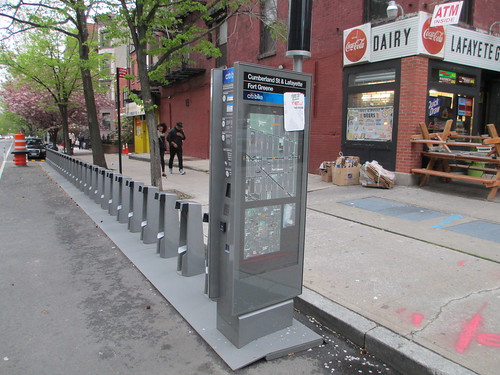
A bikeshare station near the site of Saturday's tragedy:
shamefully, where to position these stations has generated
far more debate in Fort Greene than the threat posed
by deadly drivers

I found myself looking at some of the same scenes again this past Saturday, in far less happy circumstances. Returning home from a bike ride with the children, I spotted on Twitter pictures of a pharmacy that I realised was diagonally opposite Black Iris. Next to it was a Ford sports utility vehicle on the sidewalk, with sheets covering a body and police tape cordoning off the scene.

Some poking around revealed that, around 12.45pm, a driver had crashed his SUV through the front of Black Iris – no doubt as diners like us tucked into the grilled meats and Mediterranean pizzas that our family had enjoyed a week before. After hitting the restaurant, the driver, Anthony Byrd, reversed at speed, made a U-Turn, swerved, hit some cars on the other side of the street by the pharmacy, mounted the sidewalk and hit a mother and her two boys. The sheet was covering the body of Lucian Merryweather, a nine-year-old, crushed on the sidewalk by the pharmacy. His five-year-old brother is in hospital. Byrd also hit a pedestrian in a crosswalk.
 
The Invisible Visible Family's bikes visit the Brooklyn
Academy of Music on a previous Fort Greene trip
It’s the kind of incident that ought – as multiple-victim public shootings once were – to be shocking, garner exceptional media attention and be fully investigated for lessons. But it’s actually depressingly routine. A Streetsblog post from September suggests that cars mounting sidewalks have already killed at least nine pedestrians so far this year in the city. Those figures don’t include Sian Green, the British tourist whose leg was severed in August when a taxi driver mounted the sidewalk while trying to ram a cyclist. Nor do they include Michael Gomez, who died of an asthma attack a few days after he was one of several children hit in Queens when a driver mounted a sidewalk.

Much coverage of these events has focused on their individual, exceptional circumstances and the culpability or otherwise of the drivers – and sometimes even the victims – involved. The attitude of New York's police has been reminiscent of the fatalism of some Hungarians when I lived in Budapest about the country's shortcomings. “Hat, mindenhol a vilagban (Well, everywhere in the world)” they would say over problems that were objectively, verifiably much worse in Hungary than elsewhere.

The folly of that complacency was exposed on Friday from the other side of the Atlantic when Transport for London published its annual health, safety and the environment report. The report – which was given a rough reception because it suggested safety for some categories of road user was falling - showed that 134 people died on London’s roads in 2012. That’s less than half the 271 who died on New York’s streets the same year, in a city with roughly the same population and traffic flows. New York killed more pedestrians in 2012 – 135 – than died on all modes of transport on London’s streets.
 
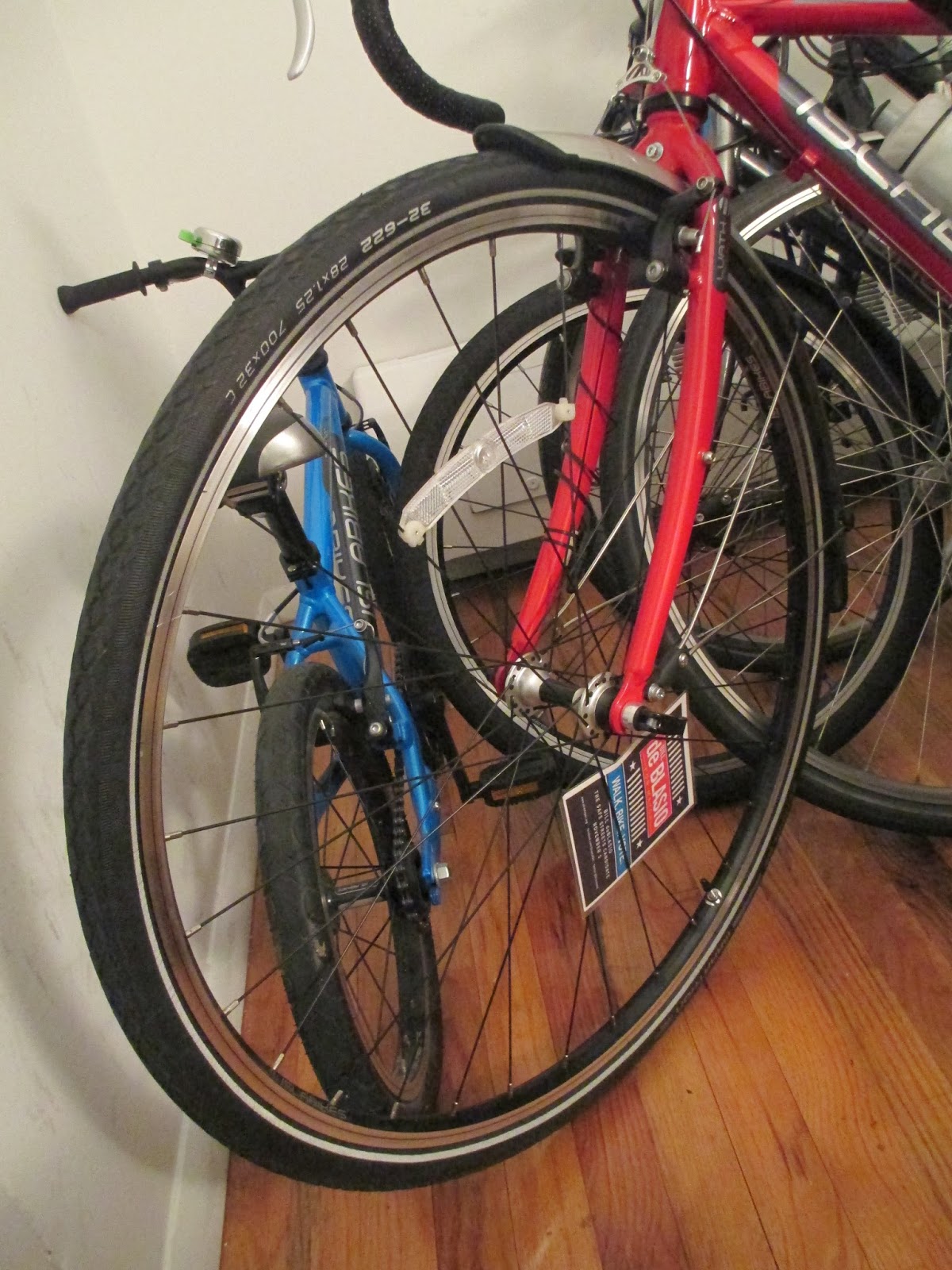
The Invisible Visible Girl's bike with its
Vote deBlasio spoke card. If any of us had
a US vote, we'd choose him, we promise.
Although it’s tragically too late for Lucian, New York this week has a chance of making a new start on road safety issues. The day after our visit to Fort Greene, our family emerged from church to find our bikes had been festooned with spoke cards suggesting we vote in the mayoral election – this Tuesday, November 5 – for Bill de Blasio, the Democratic candidate. During the Democratic primary, de Blasio loudly proclaimed his support for Vision Zero, a policy that targets eliminating city road deaths entirely.

If deBlasio does go for the systematic casualty-reduction technique of Vision Zero, it should, I think, prove far easier than anyone expects to bring down New York’s deaths to levels far closer to London’s. London’s figures, after all, are achieved in a city where some vehicles still speed, where the police response to many road incidents is grossly inadequate and where the poor design of parts of the mayor’s hurriedly-introduced cycling network has led to a series of appalling deaths. On the most basic levels in London, I suspect the superiority of its road safety record is down to drivers’ reasonable expectation that a speed camera will catch them if they speed, to the calming effect on traffic of the central London congestion charge and a total ban on vehicles’ turning through crosswalks when pedestrians have a green light.

There is also, I suspect, an effect of the reduced politicisation of policy-making compared with the US. The UK’s independent civil service tradition ensures that many of the senior officials grappling with road safety issues in London are the same people who have dealt with them for many years. There is less need to make the big policy splash that mayors in big North American cities crave when introducing an initiative. That civil service’s tradition is to work by producing dull, practical reports and recommending policy solutions mainly on a practical basis, often by formal cost-benefit analyses. A small group of officials, I suspect, will have had charge of producing TfL’s health, safety and the environment report. Their job prospects, I suspect, are closely tied to the health of the city’s road culture. It’s probably no coincidence that introduction of the poorly-designed Cycle Superhighways - one of London's worst-designed policies - is among those most closely associated with an individual politician.

In New York's case, it’s hard to imagine a man capable of running a slick election campaign can’t – if he’s willing – introduce fairly quickly policies to bring the city's road safety practices closer to London’s. Ideally, he'll choose somewhere still more safe.

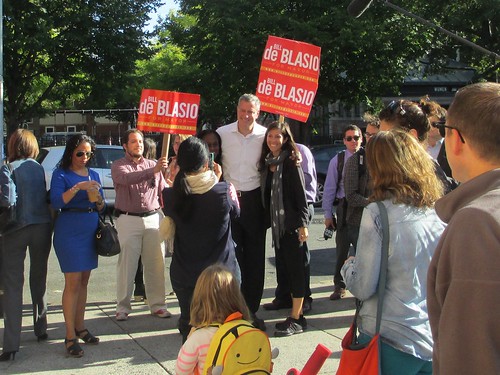
It's a comparison of which I know the presumed mayor is aware. I saw him one morning campaigning outside my son’s school and forcefully told him about it. “I moved in August last year from London,” I said. “It has 100 fewer road deaths annually, with around the same population.”
Me and Bill deBlasio: I hope he remembers what I said
and wasn't too busy thinking, "Why is this strange man
shouting at me and gesticulating so hard?"

A picture that another parent took shows the candidate and his staff looking a little taken aback at the vehemence of my point-making. De Blasio’s body language looks a little defensive. There have been signs – including some remarks about pedestrian plazas in a debate that suggest an only partially-digested sense of his policy’s implications. The candidate nevertheless mentioned his support for Vision Zero when I spoke to him and trumpeted his Streetspac endorsement.

I remain nervous, nevertheless. I can only hope in light of the Merryweather family's appalling grief over a young life wasted that my parting shot to the future mayor will prove prophetic.

“You can fix this,” I said, jabbing my hand towards his chest. “You can do it.”

Tuesday, 24 September 2013

Falling scaffolding, a sidewalk driver and how safe it's your job to be

Unusually early for a Saturday, I cycled off September 14 towards Sheepshead Bay, a distant corner of Brooklyn, to help out with a relief project dealing with the continuing unrepaired damage from last year’s Superstorm Sandy. Running late as ever, I started off at a sprint over a lift bridge near our apartment that takes Brooklyn’s 9th street over the Gowanus Canal and under Smith and 9th street subway station. The subway sits high on a viaduct above.
 
The great 9th Street scaffolding collapse: I can't think how
anyone would have blamed me if I'd got caught up in this.
But I'm sure they'd have found a way.
A couple of hours later, a large truck carrying building materials made the same journey over the bridge as I - but with a crane on its back sitting a little higher than it should have done. The crane caught a piece of corrugated iron on a vast network of scaffolding erected for a renovation project on the subway station. I returned from Sheepshead Bay to find 9th street barred to me and police and fire officers milling around a tangled mess of truck, corrugated iron and other bits of the scaffolding. Had I been riding over the bridge at the same time as the truck, I would have been helpless. Sheets of metal and steel poles would have tumbled on top of me, while the driver, protected by his cab, was unhurt.

Yet, had I found myself crushed under the scaffolding, at least some people, I’ve come to realise, would have blamed me for not looking after myself better. That’s the implication of the response to an appalling incident on September 12 when a motorist in Maspeth, part of the New York borough of Queens, drove onto a sidewalk and hit five children, three of whom are seriously injured. One child, although initially regarded as only slightly hurt, has since died of an asthma flare-up which, the laws of probability suggest, was probably related to the crash.

In the wake of the incident - captured on the disturbing video below - the school’s principal wrote to parents asking them to ensure their children avoided wearing earphones or using mobile devices when walking to school. The suggestion – not borne out by the horrific, disturbing video of the incident – was that the hospitalised children should somehow have avoided the speeding vehicle by paying greater attention.

The letter – which education officials seem to have insisted the principal sent, over his objections – is all the more astounding since it makes no suggestion that parents drive more carefully – and the driver responsible seems to have been dropping his own child at the school.

The education system’s reaction was far from unique. I recently read with dismay the comments under an old news article about the death in 2011 of Johannah Bailey, a cyclist hit by a van driver on Cavendish Road, part of London’s South Circular in Clapham, that I’ve often ridden myself. The van driver, Andrei Dulgher, rounded a bend in the road so fast that he drove over a traffic island before hitting Ms Bailey – on a turning lane in the centre of the road - and sending her body flying high into the air.

One ostensibly sympathetic comment from someone who’d witnessed the horrific incident – which came to my attention when Dulgher was cleared of causing death by dangerous driving – expressed horror at what happened and appealed to all cyclists to “take care” when riding. How cyclists were meant to “take care” around vehicles coming round blind bends at speed in the wrong part of the road was not made clear.

The scaffolding incident and the strange comment on Ms Bailey’s death have prompted me to think hard not only about how other people think vulnerable road users should behave but how I myself think. Where is the line between a crash that the victims clearly couldn’t have avoided – such as that in Maspeth or Johanna Bailey’s killing – and an incident where the victim’s negligence clearly contributed to what happened? Why do so many people place the blame so firmly on the vulnerable? How does that affect my own road behaviour?

The Invisible Visible Man is comfortable with fewer risks
than this helmetless, dark-clothed midtown Manhattan
cyclist. But he still recognises it's the cars that pose the
main risk
I don’t, unfortunately, need to think too hard to imagine the circumstances of a crash for which I’d blame a cyclist. It happened at 1.30am one Saturday a few months ago as I cycled home from a very late night at work. Tired and feeling stressed by the speed and volume of traffic in downtown Brooklyn, I took a rare opportunity when no traffic was on my tail to make a rapid left turn across Boerum Place’s six lanes, into quiet State Street. I’d forgotten that traffic heading the other way along Boerum Place wouldn’t have a red light. Suddenly, an SUV came tearing around the corner from Atlantic Avenue, the next intersection along, and hurtling towards me. I jammed on my brakes and the SUV swerved and also braked. Catastrophe was averted – but I could have had little complaint, despite the road’s confusing layout and the driver’s speed, if the car had hit me. I’d made a stupid – negligent – mistake.

Yet, if the SUV had hit me, it would have been a relatively unusual type of crash. Every survey I’ve read, including a very detailed one from Transport for London, attributes most crashes involving cyclists to a relatively small number of causes – motorists’ failure to look properly, motorists’ failure to judge cyclists’ speed or direction and motorists’ passing cyclists too fast and/or too close. It’s not, in other words, that common for cyclists or other vulnerable road users to take suicidally silly risks or make utterly inept mistakes. The people who are hidden inside steel shells so have least to risk tend to be the biggest risk takers.
 
I ride in such a way as to reduce my risks. I wear – unlike many of my fellow New York cyclists – a high-visibility vest and even a reflective snap bracelet, intended to help drivers to see when I’m signalling left. Convinced that protection for my body’s densest, most sensitive part must do some good, I use a helmet. I also – again, unlike a puzzlingly high proportion of New York cyclists – use lights at night, two at the rear and one at the front. When riding on a cycle lane between a line of halted or slow-moving cars and parked vehicles, I ride slowly, aware that a door could suddenly fly open or a car lurch suddenly into my lane.

Possibly most importantly of all, I try to communicate with drivers. “I’ll be going straight ahead here, OK?” I occasionally say through an open window. “Stop! Wait there!” I’ll tell one who’s turning illegally across my path. “Please stop using your phone,” I’ll tell another. “It’s making you drive badly.”

It’s no coincidence, however, that my efforts are designed either to help me to react in circumstances where I know drivers are likely to be negligent or actually to influence drivers’ behaviour. I concentrate on taking reasonable steps to mitigate the most serious risks. I don’t pretend that, walking on a sidewalk, I could protect myself against an out-of-control SUV hurtling towards me. I don’t believe I – or the poor children so horribly hurt in Maspeth – bear responsibility for crashes where the driver has been negligent and the victim wasn't.

These drivers blocking a crosswalk on W54th street know
who's boss: and it ain't the pesky people on foot
But the reaction to Johannah Bailey’s death perhaps explains why so much thinking on this subject is so woolly. Both the commenter and, perhaps, the jury that acquitted Andrei Dulgher probably thought of themselves mainly as drivers. That seems to create a barrier as impermeable as a car’s body shell between the driver and the complex reality of life outside the car, including its destructive potential. When that destructive power crushes a pedestrian or throws a cyclist 30ft into the air, it can be hard for motorists not to put themselves mainly in the place of the driver, rather than the cyclist or pedestrian. No matter the circumstances, there seems to be a thought that motorists drive of necessity and are a fact of life. Others have made a conscious, eccentric decision to walk or cycle – and can’t complain too much when a motorist’s negligence makes it go wrong.
 
That thinking, it seems to me, lies behind responses like that of the New York Department of Education to the Maspeth tragedy. Many people seem to see cars as the natural, inalienable rights-holders in public places. Cyclists and pedestrians are the parent-in-law house guests – just about tolerated, but only with the poorest of graces. The streets would surely be safer if more people thought of roads as places where multiple types of road users mixed, rather than places where cars drive and others fit around them.

It will, ironically, be when most people think automatically on hearing of incidents like the Maspeth crash, “How negligent of the careless driver” rather than, “How negligent of the walking teenagers” that people will start to hear of far fewer happening.

Tuesday, 27 August 2013

A midtown tragedy, a TriBeCa run-in - and taxi drivers' economic incentives

It’s a key survival skill for a New York city cyclist to learn to spot the looming lurch-out-of-the-lane – the manoeuvre whereby a frustrated motorist, tired of waiting for an obstruction to clear, pulls out of the line of cars into the bike lane without checking his mirrors. But, even by such moves’ poor standards, the sudden turn into my path late last year by a yellow taxi cab one evening in TriBeCa was a close-run thing. I managed to swerve round the cab into a delivery bay before getting back into the bike lane and catching up with the offending driver.

When I told the driver that he’d nearly knocked me off, however, he was not only indifferent but chased after me for a block, driving deliberately close to me and taunting me. So, at the next traffic lights, I took a different tack. I knocked on the passenger door. When the occupants – who turned out to be a group of fairly terrified-looking tourists – wound down the window, I told them: “Please don’t tip this man. He’s a dangerous driver. He needs to learn a lesson.”

A taxi blocks a cycle route on W54th street.
Who knows whether he'd do this if his fares
kept withholding tips when he did?
The incident in TriBeCa has been in my mind this week because of the grim series of events  last Tuesday in midtown Manhattan that led a taxi driver to drive his vehicle onto a 6th Avenue sidewalk with a cyclist on the hood. He then slammed into a couple of British tourists, severing the leg of one of them, Sian Green, a 23-year-old woman.

My experience has made me look at the horrible, apparently deliberate crash a little differently from some other commentators, however. It is entirely true, as many commentators have said, that Tuesday’s crash would probably have been avoided if either the New York Police Department or the city’s Taxi and Limousine Commission had taken seriously their duties to police motorist behaviour in New York City. It’s also true that, were it not for the widespread demonisation of cyclists and the poor understanding of their rights, the taxi driver - Mohammed Himon – probably wouldn’t have felt the same outrage at Kenneth Olivo, the cycle courier whom he knocked onto his vehicle’s hood. It’s certainly deplorable that some sections of the media have used the incident’s circumstances as yet another opportunity to vilify cyclists, claiming that Olivo, who was arguing with Himon about his efforts to pass him near a busy crosswalk, played a “big part” in causing the crash.

Yet that incident in TriBeCa - along with others where I’ve taken a similar approach – has also made me realise that it’s far easier to reach across the steel barrier separating taxi drivers and other paid drivers from those around them than it is with other drivers. All over the world, such drivers are open to price signals that anyone who cares about road safety can send or ask other people to send. The weak official response to Sian Green’s maiming – the taxi and limousine commission has so far suspended Himon’s licence for only 30 days – underlines how urgent it is that people in New York in particular start using such signals more regularly and concertedly.
 
A cab on Sixth Avenue illustrates the high driving standards
for which the profession is known in New York. Thankfully,
everyone in this incident seems to have kept their limbs.

It’s unfair, of course, as I’ve argued in the past when cyclists have done bad things, to extrapolate from a single incident to the behaviour of a whole wider class of people. There are many charming, considerate taxi drivers. Shortly after my run-in with the terrible turning taxi-driver of TriBeCa, I found myself riding one evening down W55th street with a taxi behind me. The driver not only let me pull over to take the lane at a point where the road narrowed but told me at the next traffic lights to “take it easy” after I’d visibly hurried up to avoid slowing him down.

It’s also worth pointing out that, just as minicab drivers in London appear to be on a collective mission to make black cab drivers seem courteous and sensible, New York’s limousine services make yellow cab drivers seem like airline pilots in their regard for safety. There’s a particular limo service operating near where I live in Brooklyn whose drivers I’ve given an especially wide berth ever since I saw one of their drivers dump a package out of the vehicle one Saturday lunchtime. It turned out to contain an empty spirits bottle. Shortly before my TriBeCa run-in with the cabbie, a limo driver had squeezed past me one morning on a wet, slippery W54th street when it clearly wasn’t safe to do so. When I told him he could have killed me, he answered laconically, “I still can.”

Nevertheless, in cities where roads policing and taxi regulation have been made lower priorities than they should have been it’s not unreasonable to expect the drivers putting in the longest hours in the most congested places to pick up bad habits. Serious crashes involving yellow cabs – many of them fatal – are a regular, depressing feature of New York life. Himon’s cab wasn’t even the only one to end up on a sidewalk on Sixth Avenue last week. Two days after Sian Green was maimed, two taxi drivers racing to get to the same fare collided with each other at 37th street, sending one cab onto the sidewalk.
 
Taxis on Sixth Avenue, not far from where Sian Green was hit:
sheer numbers make regulation both difficult and vital.
The sheer volume of yellow cabs in New York makes its challenges particularly acute. There are serious issues with cab driver behaviour nearly everywhere, however. The strict licensing requirements for black cabs in London - where drivers have to pass such a rigorous test that it changes their brain structure - make serious crashes less common than in New York. But I still had some seriously frightening run-ins with black cab drivers when I lived and cycled in London. The occasional helpful response to complaints from London’s Public Carriage Office only made its other complacent efforts to shrug off responsibility more frustrating.

Which brings me back to my experience in TriBeCa.

I have no idea whether the tourists I accosted withheld the driver’s tip, as I requested. The chances are that they didn’t. Even I when in a motor vehicle with a taxi driver tend to feel a certain fellow feeling with him or her that makes it awkward to criticise the driver’s conduct. The emotional cost of the conflict with an unhappy driver refused a tip can certainly seem higher than the few bucks’ cost of peace.

But the fate of poor Sian Green and the crash later the same week on Sixth Avenue are both reminders of where the economic incentives for drivers currently point. Under current circumstances, higher speeds and refusal to yield when required to pedestrians merely get taxi drivers faster through their current fare or to the next fare more quickly. Only a change in the value of the tip – a higher tip for good driving, a lower one for poor behaviour – can shift the balance in the other direction.

All that would change, of course, if city authorities were to start enforcing traffic rules in a systematic, sensible way. Speeding would become a costly activity for taxis. The price of blowing through a crowded crosswalk might be permanent loss of a licence.
 
The taxi driver who nearly doored me. His intense interest
in my comments on his conduct is evident
But two scenes I encountered in the week before Sian Green was maimed illustrate how far New York City at least is from such a logical system. On Wednesday, August 14, as I cycled to work, Sebastian Delmont, a safer streets activist who was commuting south on the Hudson Greenway, warned me that police were stopping cyclists further up. Sure enough, at 39th street police were stopping cyclists who failed to stop for the red light by an exit from a ferry terminal where most of the time barely any traffic crosses. They were ignoring the next intersection, at 40th street, where taxis and buses regularly refuse to yield to bikes and pedestrians.

The following morning, meanwhile, I was forced to brake hard as I rode to work when a taxi driver opened his door into the bike lane on Clinton Street in Brooklyn Heights. His response when I asked him what was wrong with him was to reply, “I saw you.”

As long as traffic police in big cities worldwide think cyclist harassment a better use of their time than policing speeding and taxi drivers have no fear of the consequences of bad behaviour, it’s incumbent on everyone else to act. I plan to step up my efforts to make professional drivers’ tips reflect how they respect other road users. I hope other readers of this blog will do the same.