It’s a key
survival skill for a New York city
When I told the
driver that he’d nearly knocked me off, however, he was not only indifferent
but chased after me for a block, driving deliberately close to me and taunting
me. So, at the next traffic lights, I took a different tack. I knocked on the
passenger door. When the occupants – who turned out to be a group of fairly
terrified-looking tourists – wound down the window, I told them: “Please don’t
tip this man. He’s a dangerous driver. He needs to learn a lesson.”
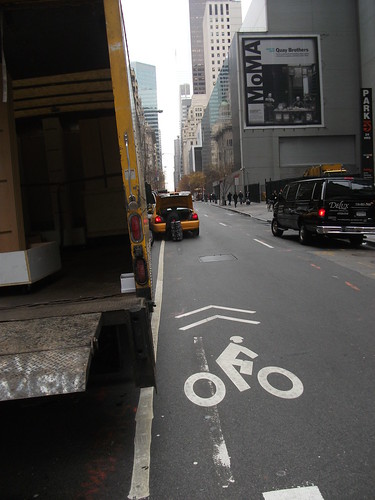 |
| A taxi blocks a cycle route on W54th street. Who knows whether he'd do this if his fares kept withholding tips when he did? |
The incident in
TriBeCa has been in my mind this week because of the grim series of events last Tuesday in midtown Manhattan that led a
taxi driver to drive his vehicle onto a 6th Avenue sidewalk with a
cyclist on the hood. He then slammed into a couple of British tourists,
severing the leg of one of them, Sian Green, a 23-year-old woman.
My experience has
made me look at the horrible, apparently deliberate crash a little differently
from some other commentators, however. It is entirely true, as many
commentators have said, that Tuesday’s crash would probably have been avoided
if either the New York Police Department or the city’s Taxi and Limousine
Commission had taken seriously their duties to police motorist behaviour in New York City
Yet
that incident in TriBeCa - along with others where I’ve taken a similar
approach – has also made me realise that it’s far easier to reach across the
steel barrier separating taxi drivers and other paid drivers from those around
them than it is with other drivers. All over the world, such drivers are open to price signals that anyone
who cares about road safety can send or ask other people to send. The weak
official response to Sian Green’s maiming – the taxi and limousine commission
has so far suspended Himon’s licence for only 30 days – underlines how urgent
it is that people in New York in particular start using such signals more regularly and concertedly.
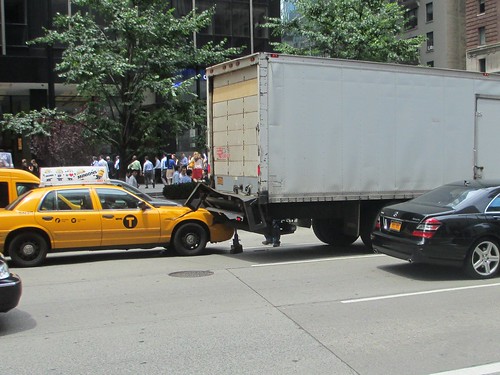 |
| A cab on Sixth Avenue illustrates the high driving standards for which the profession is known in New York. Thankfully, everyone in this incident seems to have kept their limbs. |
It’s
unfair, of course, as I’ve argued in the past when cyclists have done bad things, to extrapolate from a single incident to the behaviour of a whole wider
class of people. There are many charming, considerate taxi drivers. Shortly
after my run-in with the terrible turning taxi-driver of TriBeCa, I found
myself riding one evening down W55th
street
It’s
also worth pointing out that, just as minicab drivers in London
appear to be on a collective mission to make black cab drivers seem courteous
and sensible, New York Brooklyn whose drivers I’ve given an especially wide berth ever since I saw one of their drivers dump a package
out of the vehicle one Saturday lunchtime. It turned out to contain an empty
spirits bottle. Shortly before my TriBeCa run-in with the cabbie, a limo driver
had squeezed past me one morning on a wet, slippery W54th street when it
clearly wasn’t safe to do so. When I told him he could have killed me, he
answered laconically, “I still can.”
Nevertheless,
in cities where roads policing and taxi regulation have been made lower priorities than they should have been it’s not unreasonable to expect the drivers
putting in the longest hours in the most congested places to pick up bad
habits. Serious crashes involving yellow cabs – many of them fatal – are a
regular, depressing feature of New
York Sixth
Avenue
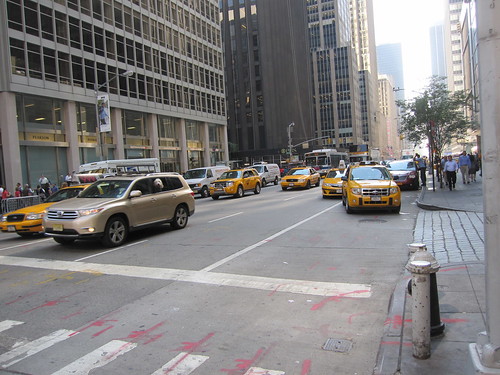 |
| Taxis on Sixth Avenue, not far from where Sian Green was hit: sheer numbers make regulation both difficult and vital. |
The sheer volume of yellow cabs in New York makes its challenges particularly acute. There are serious issues with cab driver behaviour nearly everywhere,
however. The strict licensing requirements for black cabs in London - where drivers have to pass such a rigorous test that it changes their brain structure - make serious crashes less common than in New York London London
Which
brings me back to my experience in TriBeCa.
I
have no idea whether the tourists I accosted withheld the driver’s tip, as I
requested. The chances are that they didn’t. Even I when in a motor
vehicle with a taxi driver tend to feel a certain fellow feeling with him or
her that makes it awkward to criticise the driver’s conduct. The emotional cost
of the conflict with an unhappy driver refused a tip can certainly seem higher than
the few bucks’ cost of peace.
But
the fate of poor Sian Green and the crash later the same week on Sixth Avenue
All
that would change, of course, if city authorities were to start enforcing
traffic rules in a systematic, sensible way. Speeding would become a costly
activity for taxis. The price of blowing through a crowded crosswalk might be
permanent loss of a licence.
 |
| The taxi driver who nearly doored me. His intense interest in my comments on his conduct is evident |
But
two scenes I encountered in the week before Sian Green was maimed illustrate
how far New York City 39th street 40th street
The
following morning, meanwhile, I was forced to brake hard as I rode to work when
a taxi driver opened his door into the bike lane on Clinton Street Brooklyn Heights
As
long as traffic police in big cities worldwide think cyclist harassment a
better use of their time than policing speeding and taxi drivers have no fear
of the consequences of bad behaviour, it’s incumbent on everyone else to act. I
plan to step up my efforts to make professional drivers’ tips reflect how they
respect other road users. I hope other readers of this blog will do the same.
