Showing posts with label cyclists. Show all posts

Sunday, 4 December 2016

A peeved pedestrian, a rider's broken shoulder and why it's time to stop designing for conflict

It’s the kind of incident that a London cyclist experiences pretty regularly and that I’d normally put straight out of my mind. As I rode home from work a few weeks ago, down Lambeth Road past the Imperial War Museum, a pedestrian yelled at me as I rode through a zebra crossing: “You’re supposed to stop!” Since I’d ridden through as he was on the other side of a central pedestrian refuge from me, on a wide, four-lane road, I found the shout irritating, rather than guilt-inducing. He wanted to make a point, I sensed, rather than to express any plausible serious concern. At the closest point, we were at least four or five metres apart.

The incident has stayed with me because the Peeved Pedestrian of Lambeth Road seems to represent a significant current tendency in anti-cycling thinking. Again and again recently, people have responded to my writing about the dangers facing cyclists by complaining about cyclists’ behaviour in pedestrian areas. “A cyclist whizzed right past me on the pavement the other day,” the rejoinder to some tale of death-narrowly-escaped often runs. “What do you say about that?” People often use cyclists’ alleged misdeeds towards pedestrians as grounds to withhold their sympathy for people trying to improve conditions for cyclists to make riding safer.
"Shared space" near Clapham Common,
South London: evidence, I think, of how
many cyclist-pedestrian conflicts arise.

This train of thought describes a world entirely at odds with the one I inhabit, where I feel vulnerable in encounters with pedestrians - far more than I conceivably would as a driver. It’s far from uncommon for people to rush into the road to try to knock cyclists off. I’m frequently forced when riding perfectly properly to swerve round pedestrians who see me but insist on not breaking their stride, apparently to express some irritation or anger. While I certainly bring more kinetic energy to most foreseeable collisions than a pedestrian would, the mismatch in power is very different from that between me and someone encased in a steel cage equipped with a powerful engine.

It makes far more sense, it seems to me, to see the undoubted friction between cyclists and pedestrians as a symptom of how poorly many streets have been designed to work for both groups. Cyclists and pedestrians are tussling like two hungry vultures over the scraps of public space left over after the lion-kings of the space - the motor vehicles - have eaten their fill. The two groups would be far better off cooperating to seize some juicy prime cuts. The challenge is to recast people’s thinking to make that obvious.

I am not, I must make it clear, condoning or encouraging the types of behaviour that help to fuel the mistrust. I can understand that people find it irritating when a fast-moving cyclist swishes past at speed in an area that’s meant to be devoted to pedestrians. I’m never impressed on the rare occasions that I see cyclists riding through red lights and causing genuine inconvenience to people trying to cross the road safely. I think all classes of London road user leave too little room for error around others, including cyclists around pedestrians.
The City of London Corporation blocks a new bike path
over the theoretical risk it might pose to a pedestrian crossing:
astonishing given the tiny risk.

But it’s important to put the risk in context. Only two of the 408 pedestrians killed on the UK’s roads last year died after collisions with cyclists. Only 89 of the 4,584 pedestrians seriously injured on the roads received their injuries in collisions with people riding bikes. While it would clearly be preferable for all these figures to be zero, cyclists account for 1.8 per cent of traffic on the UK’s urban roads and far more in the busy, inner-urban locations where most conflict between cyclists and pedestrians takes place. Since collisions with cyclists accounted for only 0.5 per cent of pedestrian fatalities and 1.9 per cent of serious injuries, it’s clear that being around people riding bicycles is markedly safer for people walking than being around people driving. Some 99.9 per cent of Great Britain’s 1,730 road deaths in 2015 were in incidents involving at least one motor vehicle.

I nevertheless regularly hear rationalisations arguing that these statistics obscure the nature of the risk, rather than illuminating it. People have told me that drivers are somehow more predictable than people on bikes - and that drivers at least don’t endanger pedestrians in their space - the pavement (or sidewalk, American readers). Yet around 6 per cent of pedestrian fatalities in London are people who were on a footway when struck. Overall, last year in the UK, there were more reported collisions on pavements between motor vehicles and people on foot than between cyclists and people walking.
Drivers speed past the spot where Joanna Reyes died:
a reminder of the real source of danger.

The illusion that drivers are safe and predictable only adds to the danger. The death last month of Joanna Reyes, an actress, on Commercial Road, East London, demonstrates the risks. Huge numbers of drivers drive at excessive speed down the stretch of Commercial Road, which I know well because we stayed there in July and August immediately after returning to London from New York. Reyes appears to have been hit while standing on a pedestrian refuge in the middle of the road, an area most people would assume themselves to be safe. A driver was arrested on suspicion of causing death by dangerous driving. Even as he shouted at me, the greatest danger facing the Peeved Pedestrian of Lambeth Road was that a motor vehicle would come speeding along the road and hit him.

Yet I suspect that pedestrians’ fears about people cycling aren’t much related to rationality. People who are habituated to regarding the only risk on the road as being large, noisy motorised machines are apt to be scared when they suddenly - and often too late - notice an approaching small, silent machine. The instinctive, angry reaction is so deep that I sometimes imagine it stems from some of humans’ oldest impulses. People seem instinctively to grow more alarmed at suddenly noticing something moving fast but silently in their peripheral vision than by something large, obvious and noisy that announced itself far further off.

It’s also far easier for a pedestrian to experience a run-in with a cyclist as an interaction with another human being. Drivers in cars are not necessarily visible and the vehicles can seem like a faceless force, a fact of street life. Because cyclists are very visibly people, it’s easier, I think, for people to feel rage at them.
A shared-use path across Clapham Common: designed to
produce confrontation

On top of all that, a confrontation between a cyclist and a pedestrian is far more evenly-matched than many people’s complaints would allow. There was considerable controversy in September over a video that showed a cyclist on Millbank in Westminster passing uncomfortably close behind a pedestrian on a zebra crossing. While I thought that the cyclist left too little margin for error, the striking point for me was that the pedestrian deliberately reversed course to obstruct the cyclist’s path in retribution. Most people on foot know, I think, instinctively that they can do a fair amount of harm to a person riding a bike if they want, judging by the number of times I’ve had pedestrians deliberately block my path or try to knock me off my bike. If people truly lived in the mortal terror of people on bikes that some critics contend, such deliberate actions by pedestrians against cyclists would be as rare as attacks of that kind on people driving cars..

Much of the road design I encounter, meanwhile, only serves to ratchet up the risks of such cyclist-pedestrian confrontations, rather than to dissipate it. The standard response of many local councils in the UK - and the US, where I lived for four years - is to regard cyclists’ demands as part of an amorphous “active travel” agenda and to force the two different groups into a redesigned but no larger space, which both sides are meant to share. The obvious dangers of such an approach are mitigated by erecting multiple signs telling cyclists to slow down. It is hardly surprising that many people on foot find themselves feeling irritated at being buzzed by fast-moving cyclists in such circumstances, while it’s entirely predictable that people on bikes - which people use to get fast to places they need to go - find themselves frustrated by designs that envisage their going at a walking pace.
Congratulations, you've built an interurban
bike path that's well-suited for high speeds.
What finishing touch does it require?

Even illegal on-pavement cycling - a regular bugbear of many pedestrians - reflects far more than many people appreciate the muddled design of many roads. I most often see fellow cycle commuters mounting the pavement near junctions when the lanes meant to be filtering them to the more visible, safe head of the traffic queue are blocked by motor vehicles. While I am sure that such behaviour infuriates people walking, I also know there’s a powerful impetus not to let oneself get stuck in a stream of motor vehicles - especially when the road designer has signalled it would be safer to be at the front.

The answer to many of the frustrations is for road planners to start recognising a point that should be self-evident: that motor vehicles, cyclists and pedestrians all have distinct and different needs and that far more clarity is needed to help all to share public spaces. It’s far less common for me to find texting pedestrians wandering heedlessly into my path when I’m using the clearly-demarcated north-south cycle superhighway on Blackfriars Road than when I’m riding on the short, confusing shared-use section of Sumner St, behind the Tate Modern. It’s also clear that cyclists using the new superhighways are far less prone to running red lights through pedestrian crossings than when on main roads and seeking to escape the road-wide charge of accelerating motor vehicles that a change of lights produces. In interfaces between people on bikes and those on foot, as in many other areas of life, it strikes me that strong fences have a tendency to create good neighbours.
Cyclists wait patiently for the light on
the north-south Cycle Superhighway:
a striking sign of design's effect on behaviour.

I recognise, nevertheless, that until such designs are widespread, I will find myself interacting with people on foot in spaces that are poorly designed for the purpose. I will seek, as I was doing even on the night of my run-in on Lambeth Road, to ride cautiously and respectfully around people on foot. I think it’s important that all road users try to avoid, where possible, causing other people on the road unnecessary stress.

I hope, however, that people on foot will return the favour a little too. While we both face the common enemy of the motor car, after all, I know that we both face some dangers if we collide and I’m knocked off my bike.

When pondering that point, I remember an incident from the summer of 2013 as I rode home down the Hudson River Greenway on the west side of Manhattan. Near a narrow section where runners and pedestrians were forced together, I came upon a middle-aged Dutch man slumped on the ground and grasping at his shoulder. He had hurt himself, I later discovered, after a runner had stepped off the walkway and into his path, knocking him off.

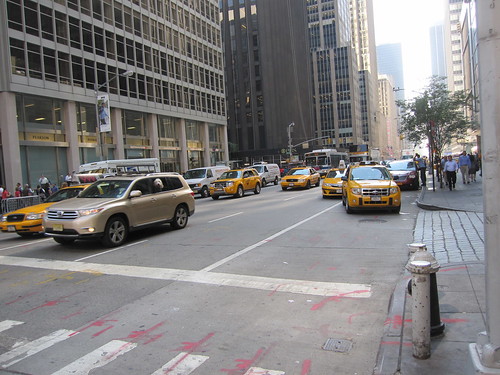
There could scarcely have been a starker illustration of the real, albeit small, risk that cyclists face in such situations. I waited for 20 minutes with the man until an ambulance arrived to take him for treatment for what seemed to be a badly-broken shoulder. A few miles after I restarted my ride home, I came upon the runner again. She had not only been able to continue her run uninjured but was apparently untroubled by the damage her actions had caused.

Monday, 2 June 2014

An idle hour, worried taxi drivers - and why only the dumbest don't plea bargain

The man looked me up and down and, mistaking my light grey, Brooks Brothers suit for a sign I had an official role at the Taxi and Limousine Commission tribunal, asked me, “Are you the lawyer?”

“No, I’m a witness,” I replied.

A brief, awkward silence ensued.

“You are in favour of the driver?” he asked, in the accent of somewhere in South Asia.

“No,” I said. “The driver tried to assault me, so I’m very much not in favour of the driver.”
 
New York City taxi drivers, before humanisation
The man’s error, I realised during the 90 minutes I spent this past Thursday at the New York Taxi and Limousine Commission, was an understandable one. We were all at the TLC’s Office of Administrative Trials and Hearings because of things that had happened somewhere on New York City’s streets. The steady stream of mainly South Asian men that trooped out of the elevators on the 19th floor of the TLC’s building in the Financial District had all, presumably, done something negligent or dangerous that would have infuriated or horrified me if I’d witnessed it. There’s an equally strong chance that, had we encountered each other on the street, we'd have been yelling at each other.

But, as I waited for my moment of courtroom drama, I found myself viewing the drivers, shorn of their yellow cabs or Town Car limousines, differently. They were hard-working immigrants worried about what their day at the tribunal would mean for their livelihoods. Once there was no obvious sign (apart from the pair of pannier bags at my seat) that I was a cyclist, I suddenly turned into someone who might make this bad day better for them. Off the roads, our shared humanity came to the surface.
 
The scene of, if not the crime, at least the breach
of Taxi and Limousine Commission regulations
Not that the reason I was there was touching or reassuring. I was due to attend a hearing over my complaint against a car service driver that I found one night in March blocking a cycle lane at a particularly dangerous junction in downtown Brooklyn. Since he was leaning against the car and there were plenty of legal alternative places to park, I asked him to move. After he angrily refused to do so, I tried to take a picture as evidence for the TLC. That sent him spiralling into a far more intense fury and he not only swore at me and called me a “white devil” but made grabs for both my camera and bike.

When I arrived at the office at 8.50am on Thursday, however, I recognised none of the drivers waiting anxiously for hearings. A short while later, a TLC prosecuting attorney emerged to tell me my driver had so far not turned up. If he hadn’t arrived by 10am, he would be in default and found guilty of all the charges. He apologised for making me wait.
A New York taxi cab in action: quiet professionalism

But I was already growing interested in the transactions I could hear taking place around me.

“OK, so the complaint’s withdrawn,” I heard a TLC official telling a woman I took to be a driver’s lawyer. “So he doesn’t have the points. You just have to make sure he doesn’t get two more points or he’ll get another summons.”

Another driver was standing, head cocked, listening carefully to a TLC attorney.

“This is the offer,” he was being told. “We give you a $300 fine and no points.”
 
There was then some discussion about whether the driver had been given a previous chance to consider the offer, before it became clear that he would accept it.

“If that’s what you want to do, we’ll go in front of the judge and withdraw everything else,” the official told him.

Would you feel like veering left round a limo parked
at this intersection? One evening back in March, I didn't.
The tribunal, I started to realise, seldom dealt in courtroom drama of the To Kill a Mocking Bird kind. I’d carefully taken pictures of the intersection involved to show the judge how dangerous it was to park in that bike lane. But I’d never been likely to get my moment in court. The tribunal dealt instead in the kind of mildly unsatisfactory plea-deal compromise that Maurice Levy would persuade a drug gang’s members to accept in The Wire. The transactional nature of the interactions was such that I even heard someone who seemed to work at the TLC shouting cheerily to someone who appeared to be a driver, “Nice to see you here again!”

My mind went back to my most recent journey in a New York City taxi – my first since I moved permanently to the city nearly two years ago. Arriving at nearly midnight at LaGuardia Airport ten days ago, I opted for a taxi over the late-night vagaries of bus and subway. I found myself hurtling at 70mph along the uneven surfaces of the Brooklyn Queens Expressway. The driver hunched over the wheel of his Ford Escape, a hunted look in his eyes.

It was obviously dangerous driving – he tailgated other vehicles, drove too close to the concrete dividing barriers and generally, I eventually told him, drove like someone who would one day kill another road user. He didn’t seem in any way a bad person, however. He was remarkably calm and receptive once I started fully explaining to him why his driving terrified me. I slightly reduced my tip in line with my previous advice on how to shape taxi driver behaviour. I couldn’t help wondering how well the endless transactions at the TLC fulfilled the wider goal of persuading drivers like mine to use their vehicles more safely.

Yeah, sure it looks like a clear rule breach
to you. What will it look like after a
plea bargain?
Yet, as my hour ticked by, it became clear I’d got into a row with one of the few for-hire drivers who didn’t understand how to play this game. My driver had been charged with three counts – a parking violation; harassment; and making threats of, or actual use of, physical violence. He faced points on his licence for the parking, a $200 to $1,000 fine for the harassment and a fine of up to $1,500 for the violence element. He could, in theory, face a suspension or revocation of his licence but the prosecutor made it clear the judges didn’t like using that.

Having listened to the other conversations, I’m confident the prosecutors had foreseen a deal dropping the violent element in exchange for guilty pleas to the two other charges. As it turned out, unless the driver can provide a good reason why he didn’t attend, he’s been found guilty of all the charges and could face the maximum penalties.

It was an outcome that initially pleased me. I headed back outside to find the Financial District bathed in bright, warm sunshine I’d been unable to see inside, unlocked my bike and prepared to head back to the office. I remain grateful to the TLC for taking my complaint seriously and acting on it. It’s better than the only previous time I complained to them, when they insisted they couldn’t identify the driver involved based on his licence plate number.

But Beaver St, outside the offices, was packed with cars, their drivers leaning impatiently on their horns. As I headed north towards the Hudson River Greenway, motorists were cutting inside each other, jostling for minuscule advantages with little regard to the danger or inconvenience their behaviour was creating for other people. As I rode home that evening, I once again had to dodge round a for-hire vehicle parked exactly where the driver I encountered had been. I hadn’t the heart to ask him to move.

I’d won one hollow, easy victory in the campaign for more civilised streets. But I got home far from certain the war was being won.

Update, June 10: I've just heard that the driver was indeed found guilty. He will have to pay a $3,050 fine and have four points on his licence.

Tuesday, 27 August 2013

A midtown tragedy, a TriBeCa run-in - and taxi drivers' economic incentives

It’s a key survival skill for a New York city cyclist to learn to spot the looming lurch-out-of-the-lane – the manoeuvre whereby a frustrated motorist, tired of waiting for an obstruction to clear, pulls out of the line of cars into the bike lane without checking his mirrors. But, even by such moves’ poor standards, the sudden turn into my path late last year by a yellow taxi cab one evening in TriBeCa was a close-run thing. I managed to swerve round the cab into a delivery bay before getting back into the bike lane and catching up with the offending driver.

When I told the driver that he’d nearly knocked me off, however, he was not only indifferent but chased after me for a block, driving deliberately close to me and taunting me. So, at the next traffic lights, I took a different tack. I knocked on the passenger door. When the occupants – who turned out to be a group of fairly terrified-looking tourists – wound down the window, I told them: “Please don’t tip this man. He’s a dangerous driver. He needs to learn a lesson.”

A taxi blocks a cycle route on W54th street.
Who knows whether he'd do this if his fares
kept withholding tips when he did?
The incident in TriBeCa has been in my mind this week because of the grim series of events  last Tuesday in midtown Manhattan that led a taxi driver to drive his vehicle onto a 6th Avenue sidewalk with a cyclist on the hood. He then slammed into a couple of British tourists, severing the leg of one of them, Sian Green, a 23-year-old woman.

My experience has made me look at the horrible, apparently deliberate crash a little differently from some other commentators, however. It is entirely true, as many commentators have said, that Tuesday’s crash would probably have been avoided if either the New York Police Department or the city’s Taxi and Limousine Commission had taken seriously their duties to police motorist behaviour in New York City. It’s also true that, were it not for the widespread demonisation of cyclists and the poor understanding of their rights, the taxi driver - Mohammed Himon – probably wouldn’t have felt the same outrage at Kenneth Olivo, the cycle courier whom he knocked onto his vehicle’s hood. It’s certainly deplorable that some sections of the media have used the incident’s circumstances as yet another opportunity to vilify cyclists, claiming that Olivo, who was arguing with Himon about his efforts to pass him near a busy crosswalk, played a “big part” in causing the crash.

Yet that incident in TriBeCa - along with others where I’ve taken a similar approach – has also made me realise that it’s far easier to reach across the steel barrier separating taxi drivers and other paid drivers from those around them than it is with other drivers. All over the world, such drivers are open to price signals that anyone who cares about road safety can send or ask other people to send. The weak official response to Sian Green’s maiming – the taxi and limousine commission has so far suspended Himon’s licence for only 30 days – underlines how urgent it is that people in New York in particular start using such signals more regularly and concertedly.
 
A cab on Sixth Avenue illustrates the high driving standards
for which the profession is known in New York. Thankfully,
everyone in this incident seems to have kept their limbs.

It’s unfair, of course, as I’ve argued in the past when cyclists have done bad things, to extrapolate from a single incident to the behaviour of a whole wider class of people. There are many charming, considerate taxi drivers. Shortly after my run-in with the terrible turning taxi-driver of TriBeCa, I found myself riding one evening down W55th street with a taxi behind me. The driver not only let me pull over to take the lane at a point where the road narrowed but told me at the next traffic lights to “take it easy” after I’d visibly hurried up to avoid slowing him down.

It’s also worth pointing out that, just as minicab drivers in London appear to be on a collective mission to make black cab drivers seem courteous and sensible, New York’s limousine services make yellow cab drivers seem like airline pilots in their regard for safety. There’s a particular limo service operating near where I live in Brooklyn whose drivers I’ve given an especially wide berth ever since I saw one of their drivers dump a package out of the vehicle one Saturday lunchtime. It turned out to contain an empty spirits bottle. Shortly before my TriBeCa run-in with the cabbie, a limo driver had squeezed past me one morning on a wet, slippery W54th street when it clearly wasn’t safe to do so. When I told him he could have killed me, he answered laconically, “I still can.”

Nevertheless, in cities where roads policing and taxi regulation have been made lower priorities than they should have been it’s not unreasonable to expect the drivers putting in the longest hours in the most congested places to pick up bad habits. Serious crashes involving yellow cabs – many of them fatal – are a regular, depressing feature of New York life. Himon’s cab wasn’t even the only one to end up on a sidewalk on Sixth Avenue last week. Two days after Sian Green was maimed, two taxi drivers racing to get to the same fare collided with each other at 37th street, sending one cab onto the sidewalk.
 
Taxis on Sixth Avenue, not far from where Sian Green was hit:
sheer numbers make regulation both difficult and vital.
The sheer volume of yellow cabs in New York makes its challenges particularly acute. There are serious issues with cab driver behaviour nearly everywhere, however. The strict licensing requirements for black cabs in London - where drivers have to pass such a rigorous test that it changes their brain structure - make serious crashes less common than in New York. But I still had some seriously frightening run-ins with black cab drivers when I lived and cycled in London. The occasional helpful response to complaints from London’s Public Carriage Office only made its other complacent efforts to shrug off responsibility more frustrating.

Which brings me back to my experience in TriBeCa.

I have no idea whether the tourists I accosted withheld the driver’s tip, as I requested. The chances are that they didn’t. Even I when in a motor vehicle with a taxi driver tend to feel a certain fellow feeling with him or her that makes it awkward to criticise the driver’s conduct. The emotional cost of the conflict with an unhappy driver refused a tip can certainly seem higher than the few bucks’ cost of peace.

But the fate of poor Sian Green and the crash later the same week on Sixth Avenue are both reminders of where the economic incentives for drivers currently point. Under current circumstances, higher speeds and refusal to yield when required to pedestrians merely get taxi drivers faster through their current fare or to the next fare more quickly. Only a change in the value of the tip – a higher tip for good driving, a lower one for poor behaviour – can shift the balance in the other direction.

All that would change, of course, if city authorities were to start enforcing traffic rules in a systematic, sensible way. Speeding would become a costly activity for taxis. The price of blowing through a crowded crosswalk might be permanent loss of a licence.
 
The taxi driver who nearly doored me. His intense interest
in my comments on his conduct is evident
But two scenes I encountered in the week before Sian Green was maimed illustrate how far New York City at least is from such a logical system. On Wednesday, August 14, as I cycled to work, Sebastian Delmont, a safer streets activist who was commuting south on the Hudson Greenway, warned me that police were stopping cyclists further up. Sure enough, at 39th street police were stopping cyclists who failed to stop for the red light by an exit from a ferry terminal where most of the time barely any traffic crosses. They were ignoring the next intersection, at 40th street, where taxis and buses regularly refuse to yield to bikes and pedestrians.

The following morning, meanwhile, I was forced to brake hard as I rode to work when a taxi driver opened his door into the bike lane on Clinton Street in Brooklyn Heights. His response when I asked him what was wrong with him was to reply, “I saw you.”

As long as traffic police in big cities worldwide think cyclist harassment a better use of their time than policing speeding and taxi drivers have no fear of the consequences of bad behaviour, it’s incumbent on everyone else to act. I plan to step up my efforts to make professional drivers’ tips reflect how they respect other road users. I hope other readers of this blog will do the same.