Sunday, 17 June 2012

Of Choppers, Long Haul Truckers and why cycling's future looks like its past


When I was growing up in 1970s Glasgow, the more worldly-wise boy three houses down had a far more obviously cool bike than mine. It had a big, chunky back wheel, a cushioned saddle that curved up to provide back support, high handlebars and a tiny front wheel. Anyone of a certain age from the UK will have instantly recognised from the description that my neighbour had a Raleigh Chopper.
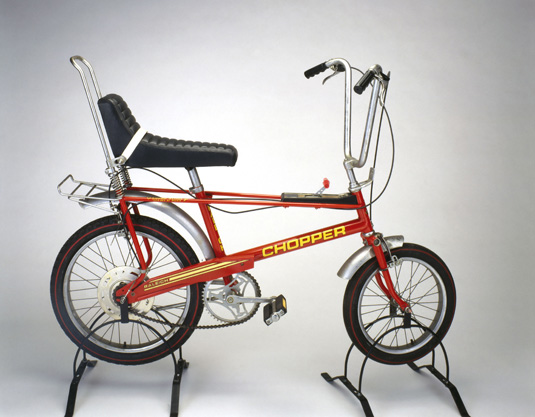
A Raleigh Chopper: it was certainly popular -
but are its riders still on bicycles now?

There has been an outpouring of nostalgia in recent weeks in the UK over the Chopper after Alan Oakley, the man who designed the Chopper for Raleigh in the 1960s, died. Adults now in their 40s or 50s waxed lyrical over how they’d nagged their parents for a Chopper, envied other children who had them or ridden around their street on them.

The conspicuously absent stories, however, were of people riding any great distance on the bike type that, for a while, pretty much every young boy in Britain seemed to want. There were far more stories of people crashing because of the bike’s inherent instability or doing permanent damage to their crotches as they slid off the saddle onto the top tube-mounted gear lever. It could almost have been deliberately positioned, after all, to produce such injuries.

The Chopper looked, to many people at the time, like the wave of the future – but my suspicion is that it planted in many of my generation’s heads the idea that a bike was a toy motor vehicle substitute, rather than a means of transport. It was predicated on the principle that, to succeed, a bike had to look like a motor vehicle – specifically the motorbike that Peter Fonda rode in the film Easy Rider.
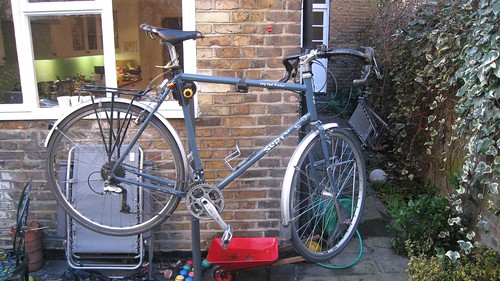
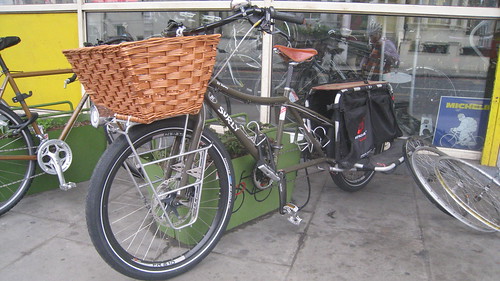
The Invisible Visible Man's Surly Long Haul Trucker.
This picture is making its third appearance on this blog -
but it would be churlish to cheat readers
of another chance to ogle it.
The contrast between a Chopper and the bike I mount every morning could hardly be starker. Despite being designed by the fairly “street” Surly brand, my bike, with its drop handle bars, leather Brooks saddle and conventional profile, looks as resolutely traditional as the Chopper tried  to look radical and modern. But, as a machine to ride, it boasts technology that strikes me as a miracle when I think about it – and works so smoothly I barely ever do. I can flick between gears with barely a thought, stop smartly and haul heavy loads.

Most novices nevertheless look at my bike, ask if they’ve heard correctly what I paid for it, and struggle to work out where the money went. Like the children who preferred the gimmicky Chopper to a bike that would actually take one places, they prefer something cheaper but with the flashy features that suggest the bike concerned is superior. It takes an experienced cyclist to know the value of paying out for a bike that, while as uncomplicated as possible, boasts the best possible components and materials.

But no owner of the superficially attractive but rubbishy bikes of which the Chopper was a forerunner is likely ever to become an experienced cyclist. Thousands of scrapyards’ worth of such bikes lie abandoned in cellars, garden sheds or backyards worldwide. People who thought they’d try cycling bought them because they seemed good value for money – then found the tyres were prone to punctures, the frame was heavy and the poor-quality suspension soaked up much of the effort that should have gone into moving them forward.
Nasty bikes (on the right) on Glasgow's Nithsdale Road.
WARNING: some readers may find the cheap disc brakes
and nasty suspensions in this picture distressing.

I encountered a rare excursion for a flock of such bikes on a recent visit to my family in Glasgow. I noticed some nasty-looking cheap mountain bikes clustered round a bike stand on Nithsdale Road in Pollokshields then spotted their owners – two parents and a daughter of around 10 – eating in the same restaurant we were patronising. Their meal finished, the family strapped on helmets, unlocked the bikes – and headed home up the narrow, obstructed pavement (sidewalk). Their unsatisfactory bikes were clearly barely ever used. They had yet to realise how much greater a danger cycling on the pavement – where each side street would raise the risk of a misunderstanding with a car – posed to them than cycling confidently and visibly on the area’s quiet, safe roads.

The question is what it is about bicycles’ aesthetics that leads to such perverse outcomes.

It would be nice to say it didn’t matter how a bike looked – but then I remember the reading party I attended during my third year at university. There was a discussion one afternoon of aesthetics, where a lecturer raised the question of whether it counted as art to hang a bicycle wheel on a wall. I, already a little besotted with bicycles, launched into a speech on the beauty of the relationship between the different spokes, the wheel’s combination of strength and practicality and so on. The lecturer grudgingly remarked that I might one day make a useful general cultural commentator.

It’s undoubtedly an attraction that many bicycles’ looks – the combination of strength and lightness, clear lines and the delicate meshing of a wheel’s spokes – are an uplifting example of economy and effectiveness in industrial design.

But at  the same time there’s an attraction in seeing a bike that’s been fitted out neatly to do a job. My bike has front and rear luggage racks, mudguards and a couple of different hitches for hauling children. There’s an argument that the paraphenalia represent unattractive clutter around the bike’s neat lines. But I enjoy the feeling they’re there to do a job – that they make the bicycle useful, rather than the kind of machine whose rider has to hang shopping off his handlebars. Extras start looking like clutter to my eye when they stop being useful. I experience an almost visceral aversion when I see a cheap mountain bike with nasty, low-cost springs masquerading as a suspension. Look closely enough and most such bikes feature somewhere a sticker warning the rider that it can’t safely handle jumps or rough terrain. It doesn’t, in other words, function as its form advertises it should.
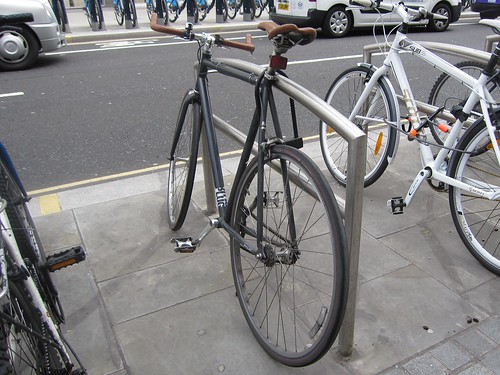
A Charge Plug single-speed in the City of London.
Sure, it's uncluttered. But how will its riders' knees feel in 20 years' time?
I find the current vogue for stripped-down, single-speed or fixed-wheel bikes depressing for similar reasons. The lines may be crisp and clean – but I can’t help feeling they reflect the modern era’s pessimism about progress. People seem to have grown tired of imperfect examples of multi-geared bikes or bikes with suspension and given up on the possibility of ever doing better. Fixed-wheel bikes’ recent popularity among commuters may not represent quite the same kind of retreat from progress as radical Islamism or the US’s Tea Party movement – but I’d argue it shares a general intellectual background.

Yet even my own main bike disguises its modernity with a retro-ish cover. That’s the dominant current aesthetic for pretty much any kind of decent bike not intended for top-level road or mountain bike racing. The ironic result is that the more committed someone is to the idea that cycling has a strong future the more likely his or her bike is to look like it comes from the past. It is extraordinarily rare to see a practical, well-made utilitarian bike whose designers had the confidence to make it look modern.

A Scott sub35 hybrid. It may not be perfect -
but it features mudguards, hub gears, sensible brakes
and looks, miracle of miracles, modern.
Nevertheless, manufacturers like Surly making retro-ish but effective bikes are unlikely to suffer as Raleigh has since it put its faith in gimmicky bikes. Even though I never owned a Chopper, my first three bikes – including a bike I was riding regularly as recently as ten years ago – were all Raleighs. Like many British people, I was barely aware other brands were available. Yet Alan Oakley’s death came less than a month after Raleigh, which once manufactured more bikes annually than any other company, sold itself to Accell, a Dutch cycle manufacturer, for just $100m.

I’ve remarked before on this blog on how magnificently the free market serves cyclists, even if many are reluctant to recognise it. It may mark a sad end for a proud British company. But, in ending the independence of Raleigh Cycle, which sold hundreds of thousands of British youngsters a gimmick for a bicycle, the market may have done cyclists yet another favour.

Saturday, 2 June 2012

Cops, pedallers and why they're picking on me

It was as I started pedalling across Southwark Bridge from Lower Thames Street in the City of London that I spotted the police car chasing after me, lights flashing and sirens blaring. I was about, for the first time in my life, to be pulled over by the police.
Southwark Bridge: the only place the police
have ever pulled me over

I hadn't broken any road rules, however, as the cyclophobes might assume. In fact, the policemen were angry that I’d signalled at them to leave me enough space to negotiate safely the junction I’d just passed. A lively discussion ensued as they told me that I – the innocent party – could have caused a crash by waving at them. They had obstructed the junction, I pointed out. There had been nothing to tell them it was a junction, they replied. “Except for the telltale meeting of two roads,” I retorted.

I would have minded the City of London Police's zeal far less, however, had it not contrasted so sharply with the attitude of the police officers I've asked to help me deal with far more serious wrongdoing by motorists. Having been knocked off once in London by a motorist paying no attention, assaulted once by a bus driver and threatened very frighteningly by another motorist, I’ve yet to see anyone lose so much as a single point on his licence as a result of illegal road behaviour around me. It has always been deemed “not in the public interest” to prosecute. Many British cyclists who’ve suffered far more serious incidents have been even worse served.

The emblematic episode for me was a journey home one summer evening along Brixton Road. A series of motorists obstructed the cyclist-only areas along the route, drove too close to me and generally harrassed me – in full view of a British Transport Police car also caught up in the heavy traffic. I eventually concluded it simply couldn't be the job of BTP officers, who police the UK's mainline railways and the London Underground, to deal with illegal driving. But then a cyclist further up the road lost patience with the delays and rode through a set of traffic lights at red. The police car’s flashing lights came on, its siren started and the officers sped up the road after him. The disparity in attitudes was so stark that I briefly contemplated stopping to ask the officers about it - and then, remembering my Southwark Bridge experience, elected to cycle on past.

The question I would have loved to have asked the officers, however, would have been the key one to any discussion of cycling and policing: why do so many police officers worldwide seem to be so alive to the relatively harmless wrongdoing of cyclists and unaware of motorists' far more often deadly misdemeanours? It would have been no less worth asking, I think, because the police officers' faces would probably have looked back at me with blank incomprehension. The injustice, like many worldwide, is, I strongly suspect, mostly a result of subconscious attitudes rather than conscious prejudice.

At least part of the answer lies in the conversation I had with the detective handling the last complaint I made to the Metropolitan Police about a driver’s behaviour – when I reported earlier this year the case of the driver who had threatened me with assault. I complained not only about the driver’s threats but also about his deliberately driving across the path of another cyclist. That incident – which struck me as far more dangerous than his threats to assualt me – must, I’m sure, have been captured on a closed circuit television camera.

New York City traffic. If one of those cars
hits your bike without killing you, the NYPD's message
is simple: fuggeddaboutit.
Yet the detective replied that it would not be “an appropriate use of police resources” to try to track down the footage. I didn't necessarily agree with his decision in my case. But his answer highlighted how, however much one might like to see the police investigate and report to prosecutors every offence they notice, not every red-light jumper will be tracked down, nor will every speeding motorist. Every police force in the world has to make some calculation about where the balance lies between tackling the crimes that most worry its political masters, the concerns of the community it polices and the resources needed to address them. Many of the outcomes are entirely rational. There aren’t many policemen worldwide happy to let murders go unsolved. There are mercifully many who have made their peace with letting litterbugs go unpunished.
The problem is that so few police forces worldwide seem to allocate resources for dealing with crime against cyclists in the way that natural justice for the victims - and the public interest in boosting cycling - would appear to demand. In New York – a city whose affairs are engaging me particularly closely as I’m about to move there – the police department’s policy is not to investigate crashes that look set merely to leave the victims maimed for life, rather than killing them. There are almost no prosecutions in New York for careless driving. Even in London, where the situation is less serious, it remains tempting to conclude many British police forces have dealt with the problem of prosecuting dangerous driving the way that Bunny Colvin, fictional commander of Baltimore’s western district in the TV series The Wire, dealt with drug dealing. They have, to all intents and purposes, legalised it.

The City policemen’s attitude towards me hinted, I think, at the subconscious attitudes involved. They spoke to me on the assumption that I had deliberately endangered myself and others out of ignorance. It took ten minutes of arguing before they realised I had taken the most reasoned, sensible approach I could to negotiating a junction where cyclists’ way across was perpetually blocked by rule-breaking motorists. The starting point seemed to be that I belonged to an out-group, beyond the civilised community they were protecting and too ignorant to handle themselves properly. Most police officers I've encountered seem, by contrast, very alive to the pressures that might make motorists break speed limits, take ‘phone calls while driving or commit other offences. That was certainly the message of the behaviour of the BTP officers I observed. The motorist rule-breaking that they ignored posed some significant threats to others. The cyclist they pursued was riding against the lights across a junction unoccupied by motorists or pedestrians.

Such attitudes, nevertheless, aren’t immutable, to judge by the history of London's Gay Pride march. When the march was first held in 1969 – at a time when nothing the organisers advocated was illegal – police officers accompanying the parade disgracefully barracked those taking part. A contingent of gay police officers, in uniform, takes part in the march now. Cyclists face far less pervasive discrimination than gay people – but a similarly comprehensive revolution in attitudes is required.

The effects of the current attitudes came home to me only last night as I cycled home. As I rode down a four-lane road, I spotted a white van speeding down the kerbside lane towards me, at high speed, illegally undertaking the vehicle in the offside lane. I swung in towards the kerb and stopped, the van only just missing me. When I saw the vehicle again at the next traffic lights, the driver shouted, “Sorry about that, mate”. When I pointed out that he was driving illegally and dangerously, he retorted that I, riding around a metre from the kerb, was to blame for “riding in the middle of the road”.

The driver involved poses a clear danger to cyclists. A rational system, aimed at reducing road deaths, would seek to discourage such driving. A serious approach to complaints from cyclists would be a step in that direction.

That, however, is utterly at odds with the approach of any police force I’ve encountered. There was no prospect, I realised, that the police would take any action against the driver. I decided against even trying to photograph the offending vehicle for fear of provoking another assault that the police would also ignore.

The driver involved might well one day soon kill a cyclist. An open police approach to tackling driving like his might conceivably have encouraged me to report him and led to his behaviour’s being addressed. For the moment, however, it remains far easier to chase after and catch a handful of slow-moving, vulnerable cyclists than tackle the sheer, overwhelming volume of motor vehicle misbehaviour.

Sunday, 20 May 2012

Why a cyclist must write London's answer to The Wire


It was as I prepared to turn into a side road near my house that I saw the young man tearing the other way on a mountain bike. His eyes were fixed ahead, his head was hunched over the handlebars and he was pedalling with an intensity that instantly struck me as strange. It was as if he was following Lance Armstrong’s famous advice to Floyd Landis on Stage 17 of the 2004 Tour de France: “Run like you stole something”.

Gentrified Fell's Point, Baltimore:
insulated from the ghetto.
This young man, however, had stolen something – or got involved in some other kind of trouble. As he swung round the corner, I noticed the first pursuing policeman, pedalling just as hard on his mountain bike. A second officer came up another road, also on his bike, radioing frantically for support. Before I could see precisely what had happened, they’d cornered him and started making the arrest.

The cycling police chase is one of many incidents I’ve encountered while cycling that I’ve filed mentally for my great writing project – a TV series telling contemporary London’s story as comprehensively as the epic series The Wire told Baltimore’s. I’m constantly straining as I ride around to pick up the little tell-tale snatches of dialogue that reveal the story of the Londoners around me.

"That's all she said to me,” I heard one builder say to another outside a house on my street recently. “If I get arrested again and do jail time, my mum won't have anything more to do with me".

Guildford Road: neo-classical gems on one side,
brutalist social housing on the other - and
a cultural chasm down the middle
Yet one street - Guildford Road, in Stockwell - illustrates perhaps the key thing that makes London - and some other big European cities - different from Baltimore. On the western side of the road – where I sometimes cycle on my way to work – lie the plush houses, most of them worth £1m each, of Landsdowne Gardens. The Landsdowne Gardens estate, centred on a pretty circular garden square, is a celebrated jewel of Victorian neo-classical architecture. On the eastern side lie the brick and sharp angles of the Spurgeon Estate. The Spurgeon, built in the 1960s with undoubtedly good intentions, has become a bleak place, blighted by crime, where few people would freely choose to live.

Four years ago, someone stabbed a young Ghanaian man from the Spurgeon Estate on Guildford Road. Paramedics struggled – ultimately unsuccessfully – to save his life. News accounts quoted residents from the Landsdowne Gardens side who had looked at the scene across the street in horror. Their near-neighbour’s short life was slipping away from him just yards from them physically, but on the other side of a cultural chasm.

The Guildford Road phenomenon is the same one that brings me face-to-face with cycle-borne police chases hard by where I live my respectable, middle-class existence. Inner London has few ghettoes to match Paris’s banlieues or west Baltimore. Instead, we all live, rich and poor, black and white, all but on top of each other. We largely segregate ourselves by using different schools, going to different churches or using different forms of transport. But on the roads we interact with each other, at least a little bit. Cyclists – the only group travelling long distance but not shut off by the shell of a car, a bus or a train – do more of that interacting than most.

A cyclist on Colliers Wood High Street. It shares a postcode
with the all-England lawn tennis club - but this part of SW19
features Tamil curries, not strawberries and cream.
It’s certainly no conventional idyll of peaceful coexistence. There are some roads through rough estates that I no longer use late at night. I’ve had bottles, and some unidentified substance that left a nasty stain on a pannier bag, thrown at me. It wasn’t easy to see the funny side of having a line of aggressive youths, with appropriately mean-looking dogs, block the road, as happened one night on the square in Landsdowne Gardens. Some youths take joy in trying to knock an earnest, middle-class cyclist off his bike by running out into the road, pretending to throw something at him or using some other trick. When hatched, the scheme probably feels like a quick, easy victory over a member of the pompous liberal middle classes. Maybe it even feels like that afterwards.

Cycling's role in the lives of people living on some of the rough estates can be very different from the one it plays in mine. One Sunday after stopping on our ride home from church to buy a newspaper, my wife and I watched a young man ride his mountain bike onto the pavement by some run-down social housing. A youngster was waiting on his BMX bike. A package changed hands and both pedalled off fast in different directions.

The scene made me wonder how many of the pavement cyclists who cause such tooth-sucking and headshaking in some parts of London are actually resupplying drug dealers. I also pondered what would happen if, as some suggest they should, the police were to crack down especially hard on such cyclists. Would the headshakers be happy if the resuppliers started arriving in equally poorly-driven cars?

Mist shrouds south London seen from the City's
St Paul's Cathedral. But the world's leading financial
centre is only a short cycle ride from
some of Europe's worst urban deprivation.
The risk amid this undoubted tension is that one ends up thinking like the colleague I told about a particularly nasty confrontation late one Friday night in Clapham. “Was he black?” he asked me about the car driver who threatened me. He had been – but I said I didn’t think how people drove reflected their race. I don’t think it reflects their religion or social class or membership of any other group either. The incident reflected the attitudes of a “certain type” of African-Carribean man, my colleague retorted. In Paris, no doubt similar theories circulate about north Africans. When I lived in Hungary, there was no shortage of lazy assumptions about gypsies.

The prejudice is, perhaps, understandable. In a city where we know that our neighbours lead very different lives from ours, it’s tempting to jump to conclusions. There is surely some human instinct when confronted with a potentially menacing driver or roadside group of teenage boys to gather as much information fast as possible. We end up fitting people into easy – and meaningless – categories.

Such stereotyping is hardly the kind of behaviour that cyclists appreciate when they’re on the receiving end. I’ve occasionally had drivers tell me when I’ve complained about their rule-breaking that, for example, they “see cyclists run red lights all the time”. Few seem to grasp that I have as little responsibility for other cyclists as the driver has for, say, other delivery van drivers, motorcyclists or white people.

The perpetual struggle of life in a city is to live beside groups that we may find alienating or strange and remember that each member is as much an individual and precisely as real as we ourselves are. It’s also the city’s joy. I remember my excitement on first coming during a ride that took me past Willesden Junction on a cluster of shops serving London’s Brazilian community. How refreshing to live in a city so rich in different ways of doing things.

It's also a personal protection measure to remember that not everybody's book reflects his or her cover. That’s the lesson of an incident one recent morning as I pedalled away from the Invisible Visible Boy’s nursery school in a plush corner of Clapham. The couple in the car's front seat had looked instantly like the kind of people I like – a couple in their sixties looking outwardly kind and driving a smart but sensible Audi estate. Yet my sitting in front of him on a road over a narrow bridge clearly enraged the man. The moment I was over, on a road section far too narrow for the maneouvre, he squeezed past me, far too fast, leaving inches to spare.

I had pictured the couple as resembling my wife’s parents or the other kindly, country-dwelling grandparents to whom my friends introduce me at church. My stereotyping led me to move over, trusting them to drive safely. For a different-looking couple, I might not have. In truth I knew no more about these people than I do when I look over my shoulder to see what I assume to be a menacing-looking African-Caribbean man. The good fortune is that my trust cost me no more than a nasty scare. I could easily have ended up crushed under the car wheels of a man who, no matter what we might seem to have in common, thought his petty irritation justification enough to risk killing me.

Wednesday, 2 May 2012

How should cyclists pedal the electoral cycle?

There is a short stretch on one of my regular cycle routes – from central London down to the Canary Wharf financial district – that always reminds me of Boris Johnson, London’s mayor. I found myself riding there one morning three years ago with the mayor, who’s up for re-election this Thursday. He had spotted me overtaking him on my bike as we both cycled away from Canary Wharf after an early morning press event. Having become snarled in unpleasant, heavy traffic on the way to CanaryWharf, he asked if I knew a better route back. Given both human sympathy and the opportunity to bore my city’s leader with my views on his cycling policies, I naturally agreed.

Canary Wharf: start of my historic bike ride
But, as we cycled through Limehouse near the Rotherhithe Tunnel entrance, the mayor became agitated. The route I was following – part of the London Cycle Network initiated under Ken Livingstone, his predecessor - started to bend round to face back towards Canary Wharf. “We’re doubling back on ourselves!” the mayor exclaimed. Sure enough, when the route we were following was subsequently revamped as part of the mayor’s Cycle Superhighways programme, the brief double-back was eliminated, to be replaced with an awkward contraflow cycle path down the wrong side of a one-way street. I always wonder whether our ride produced it.

The incumbent London mayor’s very public identification as a cyclist has become one of the focuses of this year’s mayoral election campaign. The mayor has claimed to be championing cycling both with the introduction of “Cycle Superhighways” sweeping along some of London’s busiest roads and of an on-street cycle hire scheme based on Paris’s Velib. A growing cycling lobby has suggested that, despite his regular perch on a saddle, the mayor has done nothing like enough to produce the cycling revolution he claims to be instigating.

But Ken Livingtone, who’s standing again and is likely to be the mayor’s closest opponent, sometimes seems to feel positively hostile towards cyclists, even if his administration benefitted those of us on two wheels. I’ve recounted in a previous post how I once asked him, while mayor, what he would do to combat anti-cylist hostility. I told him how, a few days before, I’d had a young man aim a punch at me while cycling, in the hope of making  me fall off. “I’ve often felt like punching a journalist myself,” he droned back. He went on to recount the obviously sad but clearly unrepresentative of a young man in Brent who had seriously hurt an old woman while cycling.

The question consequently is whether a cycling London voter should vote for either of the two unpalatable leading candidates or veer off to support one of the myriad of other candidates available. There are options ranging the whole way from fascism (the BNP) and Euroscepticism (the UK Independence Party) to Jenny Jones’s Greens.

The question raises issues that go well beyond London’s narrow confines. Should cyclists decide their voting preferences based purely on candidates’ policies towards cycling? If they should, which policies are most worthy of support?

London cyclists gather for the Big Ride: aspirational figures
They were all questions I pondered last Saturday as I fixed the Invisible Visible Boy’s Burley Piccolo trailer bike onto my Surly Long Haul Trucker and headed into central London for a rare piece of cycling activism. In steady, cold rain, around 10,000 people (according to the organisers) or 5,000 people (according to the police) arrived by bike on Park Lane in central London to press the mayoral candidates to act on the principles of the London Cycle Campaign’s Love London, Go Dutch campaign for safer cycling conditions. I’m sceptical on many levels about the precise details of LCC’s campaign. I don’t think segregated lanes are the only realistic option for cyclists and I’m far from sure it’s sensible to hold up another, very different country as a model.

Nevertheless, the Invisible Visible Boy, four, and myself were keen to show there are large numbers of cyclists in London who want cycling to become a safer and more consistently pleasant experience. It did no harm that we got the chance to cycle down some normally forbiddingly busy central London streets unmolested by cars.

Yet the event swarmed with political activists who thought cyclists would be easy recruits to their wider causes. The Green Party was very clearly in evidence, suggesting their candidates were the only true friends of cycling. I even, depressingly, saw a high-vi vest advertising the Morning Star, “Daily Paper of the Left”. I prayed a silent prayer that cycling wasn’t as doomed as the Morning Star’s Communism. It’s just a blessing the event was too bourgeois for the Socialist Worker contingent customary around any progressive London protest – albeit their placards might have been entertaining. “Ped and bike, unite and fight!” might have been a suitable adaptation of their traditional, “Black and white – unite and fight!” slogan.

Other groups, meanwhile, prodded us towards identity politics. Londoners on Bikes distributed copious numbers of leaflets demanding we vote with our bikes. The Invisible Visible Girl, 10, expressed particular bemusement about how that might be accomplished.

The choices seemed clear. Cyclists were either political animals who just happened to arrive at the leftish party meetings on two wheels. Or we were apolitical animals picking and choosing candidates according to the number of bike hire stations they’d put in or the speed they’d let cars drive.

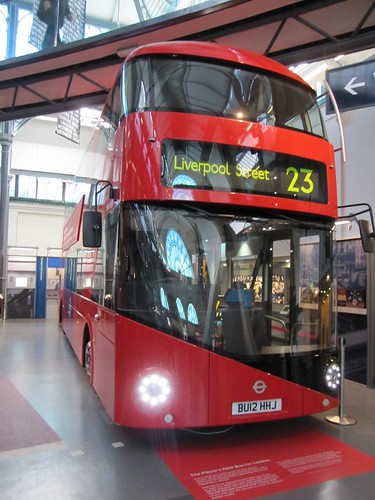
Open platform danger: the new bus
Yet it doesn’t take too much probing before the “Vote With Your Bike” thinking crumbles. How far, for example, does one regard cycling policy as stretching? Most cyclists would probably like to see more deliberately dangerous motorists losing their licences or going to jail. But what about policy on buses? One of Boris Johnson’s flagship transport policies has been to reintroduce buses with open rear platforms – a clear invitation for passengers to jump out into traffic without looking round for bikes. Is that a fit subject for a cyclist to consider when voting? The last decade’s big jump in cycling really started, meanwhile, with Ken Livingstone’s introduction of the Central London Congestion charge, which discouraged motor vehicles from coming into the city centre. Can we consider that? If so, can cyclists also take into account that Boris Johnson removed congestion charging from western central London, significantly worsening conditions there?

There are even subjects outside transport policy. One of the more sobering bike rides I’ve undertaken in the past year was a ride home from central London in the early evening of August 8 last year, the worst night of the rioting that erupted all over the city as a result of a whole range of issues, ranging from anger at the police’s behaviour to straightforward greed. Antipathy towards rioters might lead one to support Brian Paddick, the Liberal Democrat candidate, an ex-policeman who has campaigned as a crime-fighter. Is someone voting with their bike allowed to consider how a candidate’s propensity or otherwise to incite riots might affect cycling conditions? And are we allowed to consider how most fellow policemen probably regarded Commander Paddick a dangerous liberal for his tolerance of soft drugs in his area? Are we allowed to consider how Ken Livingstone’s sympathetic statements about some islamist radicals might relate to the threat of terrorism?
These Big Riders' children can grow up eccentric - but not dumb

The truth, of course, is that nearly all cyclists, save a fanatical few, rightly vote on a far broader range of issues than a narrow “vote bike” position. The mostly middle-class parents present at the Big Ride didn’t, for example, seem to want their children to grow up stupid thanks to lacklustre education. Nor are many of them likely to have felt comfortable either with a mayor – like Ken Livingstone – who sounds increasingly cranky or the foppish incumbent who describes the £250,000 he earns annually for his newspaper column as “chickenfeed”. There ought surely to be space for someone like me who can marvel at the free market’s ability to deliver marvellous bicycle products but still feel lefty bleeding-heart concern over nearly everything.

Very few of us cycle as part of an overall, hard-left political position. Many cyclists may be woolly liberal muesli-munchers. But we can surely comfort ourselves that we’re not single-mindedly obssessed woolly-minded liberal muesli-munchers.

Which brings us to how I actually cast my postal vote (since I’m currently in Leipzig and can’t vote in person). Ken Livingstone’s bold introduction of the congestion charge, his willingness to listen to advice and his eagerness to switch priorities away from smoothing traffic flow to people and cyclists all certainly recommended him. But the former mayor’s persistent bitterness and embrace of Hugo Chavez, some Islamists and other darlings of the radical left drove me away from endorsing him even with a clothespeg on my nose (the tactic that allowed me to support him in 2008).

The Invisible Visible Man Votes - with clothespeg
Instead, I held my nose at the more nutty elements of Green Party policy and gave my first preference to Jenny Jones, with Ken Livingstone second. I was swayed by her apparent personal decency – and her willingness to pledge a crackdown on lawbreaking motorists.

That leaves only the question of the fate of my partner in the Historic Bike Ride from Canary Wharf, Boris Johnson. Ever since my ride with him, I have been struck by how the mayor appears to be a cyclist but not of us. He rides a bike but can’t work out why many people dislike Cycle Superhighways that aren’t really for bikes, aren’t super and aren’t highways. His experience of cycling hasn’t taught him that it’s dangerous to have people jump off an open-backed bus in front of one - or that “smoothing traffic flow” might lead to high levels of dangerously fast, frightening traffic. My sense was confirmed on Monday, when the mayor lost his temper at hustings specifically to discuss cycling. He declared, "I may not conform to your stereotypical image of a cyclist. I do not have whippet-thin brown legs or dreadlocks or jump red lights."

The incident reminded me of part of our ride back from Canary Wharf. At a red light on Cable Street, the mayor sailed through, while I stopped. Not knowing where to go, he stopped further up the street, peering back to look for me. I was sitting by the junction, pointing piously up at the red light.

The mayor may, when the votes are counted on Friday evening, have cause to look similarly ruefully back on his campaign - and wonder where all those stereotypical cyclists’ votes have gone.

Tuesday, 24 April 2012

A General Theory of Cycling, Motorists and Money

It was when I witnessed the staff at Brixton Cycles standing worried by a distraught customer that I first appreciated the intense human dramas played out at the bike shop. The woman had just been given some bad news about the cost of fixing her bicycle – or the impossibility of repair. She collapsed into such hysterical sobs that someone scurried off to the back offices to find a chair, sit her down and offer her whatever the bike-shop equivalent of grief counselling is. I’m sure they’d done everything they could.

A Surly Big Dummy outside Brixton Cycles: who knows
what dramas lurk inside the doors?
It was only the messiest of countless collisions I’ve witnessed in bike shops between people’s expectations about the economics of cycling and the reality. Because it costs nothing to jump on a bike in the morning - and people forget that assets require regular maintenance and occasional replacement - many expect it to cost nothing at all. I can’t pretend to be entirely bemused. I open my wallet with something like gay abandon for the bike shop. But I never quite remember that the same money is no longer available to replace trousers worn out by catching on mudguards or shirt collars worn out by over-optimism about my neck’s fatness. I wander round for the most part in the clothing equivalent of the squeaking, buckled-wheel bikes I encounter on the roads – shirt collars frayed, trouser seats nearly worn through.

Yet one doesn’t need to cycle for long in most western countries to encounter someone who thinks cycling should be costing far more. This was roughly the view of the SUV driver who came crowding into the cyclist-only advance stop area at a set of lights one night on south London’s Clapham Road. As I tried to turn right across the oncoming traffic, he should, I pointed out, have been behind me, giving me space. “You don’t pay road tax!” he leant out of his window to shout. It was an only slightly less sophisticated version of the argument that John Griffin, the chairman of Addison Lee, London’s biggest private-hire car company, put forward in a recent issue of his company magazine where he ranted about the danger cyclists posed and their failure to pay road tax. "It is time for us to say to cyclists 'You want to join our gang, get trained and pay up'," the chairman opined.

A beautiful, up-to-date bike: all in a day's work for
the market's invisible hand
Cyclists consequently find themselves in some dark middle ground between the paid-for-but-well-funded city of Motoring and the free-but-clearly-unchargeable village of Disregarded Pedestrianism. Most are paying out far more to the private sector than they might like to keep their bikes on the road – but getting ever-lighter, ever-faster, ever more beautiful bikes in return. They are meanwhile paying, in many people’s view, nothing for use of road networks towards whose uptake most motorised users pay substantial annual taxes. They get in return roads built almost wholly for non-cyclists, and the contempt or antipathy of the police forces meant to keep those roads safe. A powerful headlight is needed to illuminate this road. Who, if anyone, is getting ripped off here? Could there be a better arrangement?

There is certainly an irony about watching the smashing of free-market capitalism’s carbon fibre road bike into liberal cyclists’ custom-built retro roadster at Brixton Cycles, the bike shop that attracts the vast bulk of the Invisible Visible Family’s substantial bike expenditure. The shop avers itself an opponent of normal, capitalistic ways of doing things and is a workers’ cooperative. It is festooned with the paraphenalia of anti-establishment urban culture. I’ve grown so used to them I barely notice them. But, recently, as we left the shop the Invisible Visible Girl stayed, her 10-year-old faced glued to a sign in the window. “Daddy, what’s a Dykes on Bikes ride?” she asked.

The Invisible Visible Man's Surly Long Haul Trucker
He knows he's used this picture before - but suspects
others must enjoy gazing at it just as he does
Yet capitalism’s genius for parting people from their money screams so loud from every corner of the shop that even adverts for biking Lesbians can’t drown it out. I used 15 years ago to reach down to the bike’s down tube to change gears on my early road bikes. When I bought my Surly Long Haul Trucker touring bike in late 2007, I was delighted to find I could change gears between a choice of 24 with a sideways flick of either the brake levers or little switches beside them. Two years later, I found shifters for a mere 24 gears were no longer available. Instead, for much the same price, I was offered seamless shifting between 27 speeds.

When I first brought a road bike from Edinburgh to London in 1997, I had to glue in ineffective Kevlar linings to protect them against puncture risks. Now, thanks to the latest Schwalbe Marathon Plus tyres, punctures are rare, landmark events. My early road bikes’ brakes were neither strong nor easy to service. My Long Haul Trucker boasts easily adjustable brakes that stop me quickly and efficiently from a substantial speed – and that even a mechanical know-nothing such as I can adjust. Twenty years ago, I wrestled with dim lights demanding heavy batteries and apt to stop working suddenly. I now attract complaints from those around me for the dazzling brightness of far smaller, lighter, less energy-hungry lights.

Denmark's Henrik Norby with the Viva Bikes
the market tells him to design
The market’s invisible hand has, in other words, fitted bike manufacturers’ products to cyclists’ real needs as smoothly as a well-lubricated gear cable slips through its cable housing. No mere bureaucrat, for example, could have anticipated the sudden rush away from the order and progress of ever-improving gears into the chaos of gearlessness. But the world has suddenly filled, without breakdowns in supply or vast deliveries of unwanted bikes, the gearless, sometimes brakeless, pared-down machines some of the public seem to want. Cycling advocates have no need to pester the manufacturers to meet their needs. Whatever the market’s shortcomings in, say, providing stable banks or creating just societies, it has responded to cyclists’ changing whims as smoothly as a new chain and rear cassette mesh when bidden by STI shifters like those on my bike.

The transmission between governments and cyclists’ needs works more like the derailleurs on some unloved old mountain bike abandoned outside a town hall. The reactions are either delayed or over-sudden, the outcome unpredictable and everything accompanied by a great deal of squealing.

Rust clogs up the mechanism. The sense that cyclists will never exist in large enough numbers to justify significant spending fouls up many links along the chain. The feeling that cycling is an optional extra sits like great blisters of rust on the rear mechanism.

But undoubtedly the most obstructive bit of rust - two great browny-red agglomerations around the wheels that keep the chain taut - is the feeling that there somehow isn’t a stream of money that justifies spending on cycling. It helps to make the police, largely untroubled by insurance companies’ worries about the cost of cycle accidents, apathetic. It helps to bore local politicians eager to shape dramatic new junctions for cars, rather than dinky bike lanes. The outraged anger of people like John Griffin or the man beside me on Clapham Road makes the politicians scared of being seen to clean off the rust.

The problem takes me on a mental journey to some outbuildings of Oregon State University, in the neat college town of Corvallis. There the university some years ago devised equipment to charge cars for their road use in Oregon by a more rational method than the simple gas tax. A meter, guided by a GPS beacon, would measure the car’s mileage on Oregon’s roads and in the most congested area around Portland. Charges would vary according to the time of day, the car’s carbon emissions and a range of other factors. At fuel stations, an electronic pad would detect the meter, knock the fuel duty charge off the driver’s bill and collect the required road-user charge.

Oregon paid for the apparatus I saw in Corvallis because fuel tax revenue, shrinking as car engines grew more efficient, no longer covered even the state roads' repair costs. Most European countries try to cover the costs of new roads, accidents, pollution, greenhouse gases and congestion as well. But, whatever the approach, introduction of so much clearer and more straightforward a charging system might, I think, have eased even the Angry SUV Driver’s frustration. It would have been clear that he was paying for the damage his SUV did – and that what he paid wasn’t covering everything. Most transport economists even in heavily-taxed Britain think motoring tax receipts fall at least £3bn short of covering all the costs motoring imposes. My taxes are already helping to foot the bill for cars – it’s hard to see I should be charged, as Mr Griffin wants, for using my bike as well.

An Addison Lee cab in traffic: price signals might
keep him in line
But it’s not necessary to wait until everywhere adopts a system like the Oregon experiment – which the state has now, sadly, abandoned – to see the magic of clear, strong price signals working to protect cyclists. Cyclists swarmed on April 23 toAddison Lee’s offices to protest against Mr Griffin’s comments and demand consumers boycott the company. The protest echoed a practice I’ve occasionally adopted when harassed by a particularly aggressive taxi driver. If the driver remains unrepentant after one complaint, I reach for the passenger window, knock on it and shout to the occupant, “no tip!”.

It’s a tactic that’s never well-received and seldom calms down a confrontation. But it’s hard to imagine that, if my knocking on the window prompts a stream of passengers to leave a few more pounds in their purses, there won’t be at least some change. The market’s invisible hand is unlikely immediately to make cars as responsive to cyclists’ needs as bike manufacturers already are. But it could start nudging things imperceptibly towards the right direction.

Thursday, 5 April 2012

Am I real to you? Noam Chomsky and the real questions on the road


There were, I have to admit, a lot of ideas that shocked me half a life-time ago at university. But one of my more wasted fits of the vapours was over a psychology lecture I attended about Noam Chomsky’s ideas on grammar. It made no sense, according to Chomsky's theories, to imagine languages followed hidebound rules on whether infinitives could be split or what the accusative of the interrogative pronoun “who” was. Languages instead followed “derived grammars” – a set of principles that could be divined by working out how the language’s speakers actually used it.

“Whom does he think he is kidding?” my pedantic late-teenage self asked. “Who is he boldly to go into the question like this?”

Yet, however schocking I found the great Chomsky’s views, his ideas have been coming back to me lately. In this blog, I’ve written a lot about how people should think about cycling and other ways of using the roads. I’ve been looking at how best to enforce de jure, written-down rules. For this blog, I'm changing perspective, looking around and trying to divine what Chomsky might call the “derived principles of road use”. Forget what the rules say. How do people actually use the roads?

The principles I've deduced seem to me to do a far better job than any other explanation I've seen of dealing with some otherwise inexplicable phenomena I encounter on the roads.


The first of my Great Derived Principles of road use, for example, explains a mystery that's bothered me for some time. Why, I've often wondered as I watch some driver slalom around the road while using their telephone, are so many people willing to risk others' lives for the sake of a possibly entirely trival 'phone conversation?


A chilling warning - but only to motorists who understand
everyone else is real too
It's now dawned on me that hardly any of those drivers see the imbalance between the risk for other road users and their convenience in those terms. When using the roads (or undertaking quite a few other social interactions, for that matter) many people simply don’t appreciate that other people are really real. They certainly don't feel they're real in the complex, contradictory, emotionally and intellectually sophisticated way they themselves are.

It’s going to be difficult, I recognise, for some readers to accept this theory since it's coming from me and I, at the end of the day, amn’t you. Some of you might have drawn different conclusions from my confrontation a few weeks ago with the Angry Man of Clapham Road. It's entirely possible, I suppose, that the AMCR, who took badly to being told not to drive into an area reserved for cyclists, fully understood his fellow road-users’ humanity. He might simply have thought it reasonable to express his irritation by pulling his car, as I saw him do, across a cyclist’s path. Maybe he’d thought fully about the lives he would wreck if he seriously injured the man and still thought it worth making his point.

But ask yourself, I urge you, this question: when did you last see someone else using the road who struck you as as wise, sophisticated and intelligent a road user as yourself? When, by contrast, did you last ask yourself, “What’s this idiot up to?” or mentally or audibly shout some term of dismissive abuse at another person on the roads? If you’ve noted, say, half as many wise people as idiots, I grant that you have your arms round the idea that other people are as real as you. For anyone else, I fear you don’t. It is only natural, as far as you're concerned, to treat others' fears, concerns and complaints on the roads with both contempt and incomprehension. Which would be a problem only if everyone else also felt like the world’s only real person and were using the roads on the same basis that only he or she really mattered.

Many of you may still, nevertheless, feel protected by another phenomenon I’ve spotted. Just as Billy Bragg once sang, “Sexuality, your laws do not apply to me,” many of my fellow road users seem to be humming something similar about old-fashioned Newtonian physics (“Physics, I can see/ Your principles don’t work for me,” perhaps?).

It’s a tendency I first observed when catching taxis around the cities of the Balkans a decade ago. From Skopje to Sarajevo, Bucharest to Belgrade, it was pretty much unheard-of to find a taxi driver who, if one reached for the front-seat seatbelt, didn’t try physically to restrain one, shouting, “No problem, meester”. There was no need for a seatbelt, no need to ensure one’s body’s momentum wouldn’t carry one on in a crash through the windscreen. I was in the care of one of the 99 per cent of Skopje’s or Sarajevo’s or Bucharest’s or Belgrade’s taxi drivers with above-average driving skills – so above average, indeed, that they could prevent other people too from driving badly around us.

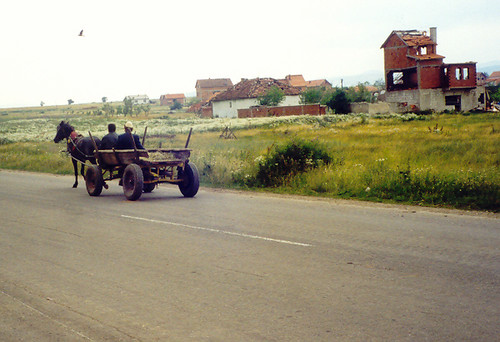
A typically bucolic scene in post-war Kosovo:
special physics is keeping the farmers on the wagon.
Those special powers, I came to realise, had been magically granted to many of the other drivers on the roads as well. Early post-war Kosovo seemed to me to present an unusually wide array of ways to crash. Kosovo Liberation Army foot patrols were apt to spring suddenly from the roadside into one’s path, giving a simple “how-not-to” class in running a vehicle checkpoint. Roads were apt to run out abruptly where a bridge had been bombed. Some were simply very, very heavily bomb-cratered. But, when I looked around, I noticed that pretty much everyone who wasn’t me or driving a tank was seatbelt-free, protected by the magic of their special driving.

The principle applies beyond the Balkans. Philip Hammond, the past UK transport secretary, argued that enforcement of road rules should no longer focus so heavily on speed or persecuting the “law-abiding majority”. Instead, it should focus on “anti-social driving”. The “law-abiding majority”, it seems, release less energy when hitting another road user at 45mph in a 30mph speed limit than someone imparting “anti-social momentum”.

Among cyclists, the “suspension of physics” crowd have their adherents among what I call the “chicken licken” cyclists – those I see cycling around wearing helmets with the chinstraps undone. According to conventional physical principles, unattached helmets offer excellent protection against the risk that the sky will fall. But, in any actual, foreseeable crash, they would fly off, offering protection barely beyond the “lucky charm” level – “I’ll be safe because I’ve made a gesture in the direction of being so”.

However, perhaps the surest proof that some people think physics has been suspended is the persistence both of in-line skating and the behaviour I encountered one afternoon on the Serpentine Road in London’s Hyde Park. The road is generally a stressful place to ride because of its popularity as a place for skaters to grapple with the fundamental problems of their means of transport. Some lay out little obstacle courses; others practise skating backwards. All fail to realise a means of transport where braking automatically overbalances you doesn’t work.

This man, however, went a step further. After a brief argument over how his sticking a skate into my path had forced me to swerve, he started shoving me. Given that the slightest return push would have sent him sprawling to the ground, he either saw himself as above physics or saw the Invisible Visible Man as a liberal wuss who would never dare shove back. The second idea is, obviously, one we can safely discard. He thought physics was only for the little people.

Yet, for anyone who doesn’t find it preposterously prattish, perhaps the appeal of in-line skating lies in the Third Great Derived Principle of Road Use: that form is more important than function, that it’s more important to be cool than safe.

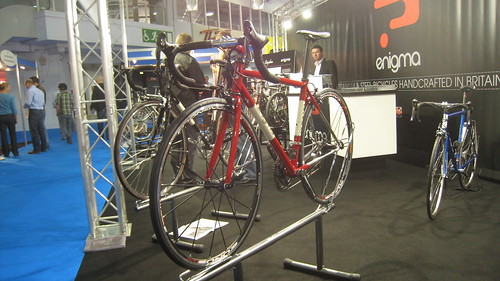
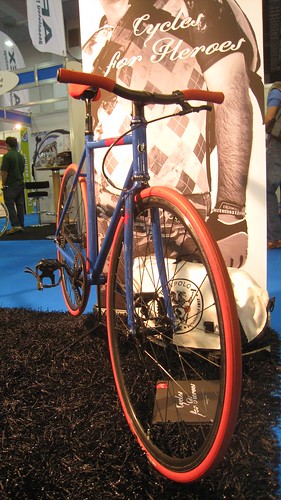
A fixie at the Bike Show: this one
seems designed for looks
rather than function
One of the great exemplars of this phenomenon is the recent popularity of certain kinds of fixed-wheel bikes for road use. Many of these bikes lack brakes (albeit it’s possible to slow down by pushing backwards on the pedals). All lack gears to match the cadence of the rider’s pedalling to the bike’s current speed, the road gradient and any number of other factors.

There are, granted, circumstances where such bikes’ simplicity is an advantage (track racing, bicycle polo and, well, track racing and cycle polo). But it’s hard to escape the conclusion that they’re popular mainly because their clean, classic lines look cool. People are prepared, as a result, to put on their knees the strain that gears would otherwise handle.

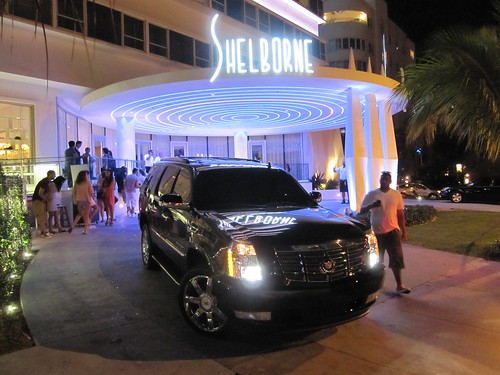
An SUV with tinted windows: not obviously sensible.
Drivers have been following the "cool matters most" principle pretty much ever since Chrysler first stole a march on Ford by coming out with a new model range every year. In south London, it’s a nightly occurrence to encounter performance cars with windows so heavily tinted they must be nearly opaque. Music blares out of many so loudly the whole car shakes. Navigating in safety seems to be the last priority.

But it’s not just in their kit that people show their desire to be cool. A pedestrian I encountered last week in Waterloo illustrated all three Great Derived Principles. He was too cool to look up as I rang my bell at him and too unconcerned about the physics of the looming collision to break his stride. Nor did he seem to grasp much why I might be annoyed he’d made me swerve.

“Caaaalm dowwwn,” he said, slowly and patronisingly when I suggested laughing at me might not have been the most appropriate response to a mildly sarcastic reprimand.

Perhaps, however, that sums up the conflict. I’ve spent years puzzling out the most rational way of getting people to relate to each other on the roads. The vast bulk of road-users regard my efforts with the same puzzlement as my efforts to keep the pronoun “whom” alive or infinitives together.

With the grammar, I’ve long since giving up on persuading others to agree. The encounter with the AMCR has reduced my enthusiasm for making the point on the roads. It ended with his threatening, fists raised, to assault me and my desperately calling the police. Call me a coward if you will – I can’t quite face a beating over this gulf of understanding.