Showing posts with label cycle blogs. Show all posts

Sunday, 3 February 2013

A dead mayor, a live cycling boom - and why cycling might be back to stay

For new residents of New York City like me, there has been something almost mind-bending about the last couple of days. Ever since Ed Koch, the city’s mayor from 1977 to 1989, died in the early hours of Friday, obituaries have been transporting us back to an unrecognisable city. Drug addicts lie prone on Manhattan streets, looting breaks out when the power fails and the subway is celebrated mainly for the range and inventiveness of its graffiti. It’s hardly surprising that the person who pitted himself against this chaos had a personality as pathologically extroverted as our current mayor’s is buttoned-up and controlled.
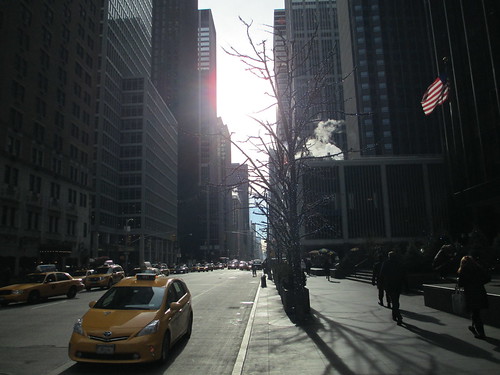
Sixth Avenue: bike-lane-less, as Ed Koch
preferred it on mature consideration

But, for a newcomer who’s a cyclist, one detail of the Ed Koch saga highlights a particularly striking change in the city. In 1980, at the height of the second oil price shock, Koch ordered the installation of segregated bike lanes on Fifth, Sixth and Seventh Avenues and Broadway in Manhattan. Then, only weeks later, having been ridiculed for his bike lane “fetish,” Koch had the lanes torn out again. He went on, in 1987, to try to ban cycling altogether from mid-town Manhattan. While that set-back took years to overcome, Koch nevertheless died in a city criss-crossed by a growing network of bike lanes. Installation is moving – despite setbacks as Nimbys in some neighbourhoods oppose new lanes - so fast that my 2012 NYC cycling map already feels quite badly out of date.

Thinking about that sharp turnaround – a tribute to the commitment of Michael Bloomberg, the current mayor, and Janette Sadik-Khan, his transport commissioner - has linked up in my mind several hopeful signs for cycling over the last couple of months. In both the US and the UK – the countries where I’ve done most cycling – cycling numbers are going up and official acceptance of cycling appears to be growing.

The question is whether this is a fundamental, long-term shift or just another short-term bit of faddism like Ed Koch's.

A Detroit Madison Street: borrowed chic for Lincoln
The question brings to my mind a mental picture of a copper-and-black Detroit Bicycle Company fixed-wheel bike. As someone who likes both gears and highly practical bikes, it’s not a machine I aspire to own. But I came across the bike – a Detroit Madison Street, trivia fans – in the unlikely setting of the Lincoln stand at Detroit’s annual North American International Auto Show. It was being held up as an example of the kind of finely-made luxury product of which Lincoln – which is trying to relaunch itself as a desirable luxury marque – approved.

Still more remarkably, it was one of quite a few bikes I spotted around the show floor.  The Smart stand boasted an E-Bike, which the manufacturer will be selling, while Toyota displayed a concept for a conventional bike. Kia was showing a small-wheeled bike that it sells in Korea, while Hyundai had a fixed-wheel bike sticking out the  back of a coupe. Subaru had stuck a couple of mountain bikes on the roof rack of one of its vehicles.

The unmistakeable impression was that carmakers thought bikes now had a certain cachet – which they wanted to borrow. Compare that with how the UK’s Raleigh in the 1960s felt it had to ape motorbike design to get kids to ride bikes.

The bikes’ presence on the automakers’ stands struck me all the more forcibly because of an article I’d written in my day job just before Christmas. It detailed how all the Detroit Three big automakers – General Motors, Ford and Chrysler – were struggling to reverse or live with recent years’ steep decline in young people’s learning to drive and subsequent buying of cars. Part of the carmakers’ problem stems from a gradual revival in recent years of the US’s inner cities – which are less littered than they once were with unconscious drug addicts - and, for some of the residents, a drift away from cars and towards bicycles. It’s the kind of gain for cycling that would have been scarcely imaginable in most industrialised countries 25 years ago when Mayor Koch was trying to ban cycling altogether.

A YouTube video posted by Gaz, a keen helmet-cam user reminded me that the process has already gone far further in the UK. His video – shot one recent January day – showed 50 cyclists on one short stretch of Cycle Superhighway 7 (a former Roman road, as it happens). If so many people are cycle commuting in January, Gaz suggests, the spring and summer are likely to see London’s highest cycle commuting numbers in many years.

Kent Ave, Williambsurg: Denis Hamil wants
those bike lanes gone
The worry, of course, is that cycling also looked so much like the coming thing in 1980 that a gadfly populist such as Ed Koch briefly took the risk of backing it. If car companies thought there was a way other than sticking two bikes on the roofrack to show their car was associated with an outdoor, aspirational lifestyle, I’m sure they’d happily use it. Denis Hamil, a columnist in the New York Daily News last week said he would support any mayoral candidate who promised to scrap the current crop of bike lanes. One of the likeliest contenders for mayor – Christine Quinn, a Democrat – has sought to appease bike lane haters by saying lanes are “controversial” and advising people not to discuss them at dinner parties.

In London, even Boris Johnson, the mayor, who is a daily cyclist, fell before the last mayoral election into the trap of caricaturing cyclists as dread-locked red-light jumpers. As with road safety – where the current UK government has reversed years of steady improvements by cutting funding for speed cameras – there is always a risk that someone will take steps that reverse apparently inexorable progress in a positive direction.

It doesn’t, for what it’s worth, feel as if such a step is coming immediately either here in New York or in the UK. Concern about the environment, changes in living patterns, concern about health and cycle technology improvements are all conspiring to make this cycling boom feel far more solid and longer-lasting than the second oil shock one.

Yes, cycling's made progress. But, as long as FedEx drivers
think across one of  New York's busiest bike lanes is a good place
to park, it won't be mainstream
But it’s worth remembering that, even after recent years’ quadrupling of New York cycling numbers and the last decade’s doubling in London, riding a bike remains a fringe pursuit that’s far from winning mainstream acceptance.

That point came home to me particularly clearly one Friday night just before Christmas. Riding home around 10pm down W55th street from my office, I was surprised to find a limousine pull up next to me and wind down its window. Inside was a curious tourist who couldn’t understand what I was doing. No, I told him, I wasn’t delivering anything. Yes, I was just riding home from my office.

Recognising that he wasn’t going to get to the bottom of it, he finally said: “Just seems kind of… European.”

The incident set a new mental benchmark for me for cycling in New York and other big cities where it’s still not one of the main modes of travel. Cycling, I’ve decided, will finally be mainstream when an encounter with a commuter cyclist is no longer one of the “darndest things about New York” that a returning tourist recounts to his friends in Peoria.

Sunday, 18 November 2012

My ride to work - and why the cars resemble little hurricanes

Very few of the runners, stroller-pushing parents, drunks and others who wander into my path each day on the cycle lane up New York’s Hudson River Greenway strike me as especially brilliant people. If they were, they might spot the signs telling them they’re not allowed on the path and stick to the rather pleasant waterside walkway that’s been provided for them.
The runner on the left has, remarkably, chosen the footpath on
the Hudson River Greenway. One can only hope she made
the kind of solid risk assessment the Invisible Visible Man advocates

But, disturbingly, the cycle lane obstructors (CLOs) seem to be better at prioritising the risks facing pedestrians than the head of the New York Police Department’s traffic squad. The CLOs have decided that, if they’re going to obstruct traffic, it’s many, many times safer to get in cyclists’ way than cars’. Having so far seen hundreds – possibly thousands – of CLOs in four months’ cycling in New York, I’ve yet to see one choosing to take his or her chances running down the fast-moving, multi-lane West Side Highway next to the cycle path.

Yet Brian McCarthy, a deputy chief of the NYPD with responsibility for traffic policing, explained in October to WNYC, the public radio station, why its ironically-named Operation Cycle Safe – the programme that focuses police resources on fining cyclists, rather than the road users that cause traffic deaths – was now mainly tackling riding on the sidewalk (pavement, British readers). This behaviour, he reasoned, posed particular dangers to pedestrians. But, while I can find no recent record of a cyclist’s killing a pedestrian on a New York City sidewalk, it is depressingly regular for motorists to do so through excessive speed or lack of attention. The NYPD barely ever prosecutes the motoring offences that lead to such deaths. Its prioritisation is so skewed that, for it to be correct, I should probably be spotting runners every morning taking their chances with speeding SUVs on the highway, away from the terrifying bicycles.

The contrast between the CLOs and Deputy Chief McCarthy illustrates something profound about the vagaries of human beings’ efforts to assess risks. Most humans are reasonably adept at spotting and assessing the most immediate dangers. It’s pretty clear even to a stupid, inconsiderate runner unconcerned about inconveniencing others that it’s less foolish to take the chance of a collision with a cyclist riding at 20mph than a motorist driving at 50mph (the West Side Highway speed limit is 35mph – fun fact that most motorists entirely ignore). Very few people, however, are good at assessing risks in an abstract context such as a decision about how to allocate police resources. The NYPD, as I pointed out in a previous post, hands out 5 per cent of its traffic violation tickets to cyclists, way out of proportion to cyclists’ roughly 1 per cent share of city traffic. But a cyclist last killed someone in New York City in March 2009 – and even that incident wasn’t on the sidewalk. Around 1,000 people have died in the time since at the hands of motor vehicles. A sober risk assessment aimed at bringing down the number of deaths in the city would target an entirely different set of behaviours.

The problem appears to be a widespread one. In the UK, newspaper reporting about the crash that injured Bradley Wiggins – one of my great heroes – ended up producing the same, predictable commentary claiming cyclists endanger pedestrians and, somehow, cars. That’s even though the Tour de France winner’s accident involved his colliding with a car that seems to have pulled out into his path from a filling station without looking. In other words, people started complaining on the basis of the kind of accident that happens quite a lot (one where a negligent motorist injures a cyclist) about things that hardly ever happen – accidents where cyclists hurt other road users.

The question is whether it’s possible to get better to get better at understanding the risks the roads and other places pose - and to start reacting to them more rationally.

A subway station closed for Hurricane Sandy. New York's subway
turned out to be better at assessing risk than many New Yorkers.
My mind’s been particularly drawn to risk assessment in the last three weeks because of events in my new home city. At the end of the week when superstorm Sandy hit New York, I took a trip to Staten Island to report on some of the damage there. Person after person told me they’d ignored the evacuation order for the area on the grounds that a previous hurricane last year – Hurricane Irene – had mostly turned out less damaging than expected. As the sea swept in and inundated their street, they found themselves cowering in their homes’ upper storeys, with waves lapping at the windows even there. A person died in the basement of one of the houses in the street I visited, electrocuted when he stepped into flood water that had electric current flowing through it. The storm was on an entirely different scale from Hurricane Irene.

That miscalculation, it seems to me, is of a piece with people’s miscalculations about road use. In both situations, people rely far too much on personal experience and the evidence of their own senses. In the run-up to the storm, it was clear that the city was very windy but not immediately obvious that the storm would cause historic levels of damage. To realise that, one had to pay attention to something one couldn’t see – the vast storm surge that forecasters were predicting that was preparing to push its way into New York Bay to flood large tracts of the city.

Many people assessing the risks of cycling, meanwhile, look at cyclists in traffic and conclude that the slender, unprotected machines among the big metal boxes are more vulnerable than most figures actually suggest them to be. They see a cyclist on a sidewalk and assume that his greater speed compared with the pedestrians makes him a significant risk to them. It only adds, it seems to me, to people’s irritation with cyclists that bikes are quiet and people tend to notice them only at the last minute. This seems certain to trigger the kind of last-minute, fight-or-flight response that must have been useful for vulnerable cavemen. It’s a far less reliable indicator than people think of the risks around in a complex, modern urban streetscape.

Most people have particular lacunae when it comes to rare events that pose catastrophic risks. A hurricane is precisely such an event. There are fine, hard-to-discern differences between a hurricane that will do little damage – as Hurricane Irene did – kill scores of people and do billions of dollars of damage – as superstorm Sandy did – and one that will kill many hundreds – as Hurricane Katrina did. It is far beyond a normal person’s gut instinct to discern which storms need special attention, yet ordinary people continue to use their gut instincts to assess how they should react.
The motorists are blocking the bike lane. The cyclist's too close to the cars.
And they'll probably all get away with the risks they're taking.

In a road context, the catastrophic events are crashes involving cars, buses and trucks. It’s so common to see motorists driving while ‘phoning, speeding, giving cyclists too little room and so forth that it’s easy to conclude that these behaviours are trivial and pose little risk. Many people compare them with the alarming experience of finding a cycle messenger rush past their nose on a pedestrian crossing and conclude that it’s the cyclist who poses the real danger. The truth is that each time a motorist drives too fast, drives while distracted or turns without looking for cyclists he or she is involved in profoundly risky behaviour – and it’s only the luck of the particular circumstances that divides the outcome from nothing at all and a multiple-fatality crash.

People are still more blind to their actions’ long-term consequences. Almost no-one sees a cyclist on a busy street and remembers that he or she is far less likely to die of heart disease or diabetes in several decades than the neighbouring motorist cursing him or her from the exercise-free cocoon of his or her motor car. The global warming that may be making hurricanes more frequent is a still more remote such risk.

None of this is to excuse stupid behaviour by cyclists. It’s worth stopping for red lights, giving pedestrians plenty of space and going the right way up one-way streets. It shows an example of good practice and avoids annoying one’s fellow citizens. I do my best to obey the rules.

But industries prone to catastrophic but rare risks – the nuclear power industry, for example, or railways – tackle them by looking for the near-misses and minor accidents that suggest people are indulging in risky behaviour. Police forces that hold off warning motorists about dangerous behaviour and minor accidents explicitly miss the chance to follow such a policy.

I at least can do my part. I accept that runners will bound into my path on the Hudson River Greenway and cycle at a speed and on a line that means I should avoid them. I know that cars sometimes sweep across even some lightly-used crossings on the route from angles that are hard to see. So I stop for those red lights as other cyclists and runners speed past me, no doubt thinking me an over-cautious worrier. I do my best to assess when I’ve done something foolish and to avoid repeating the mistake. I can only hope that, as New York and other cities start to grapple with a future made more complicated by extreme weather, far more of those around me start to give the matter the same consideration too.

Sunday, 4 November 2012

Whatever the weather, cycling's proved a post-Sandy surprise

Most mornings, as I cycle to work, I smile to myself as it occurs to me that my children and I both start the day by looking at the American flag. But, while the Invisible Visible Children are taking the Pledge of Allegiance at the start of their school day, I’m looking to the flag for a more practical reason. The stars and stripes that fly from the top of the Brooklyn Bridge tell me which way and how strongly the wind is blowing. Since I moved to New York in the summer, it’s been the direction and strength of the wind on the main section of my morning cycle commute – north up the Hudson River Greenway – that’s been the biggest single determinant of how quickly I can make the journey. A following wind can get me there as much as five minutes faster than the prevailing headwind, I estimate.
The Hudson River Greenway: wind challenge

It’s one of countless ways that moving to New York has reminded me of how cycling makes me far more aware than any other way I might travel of nature’s forces. The summer heat is hotter here than in London, where I lived before, and the humidity higher. The rain is less frequent but the cloudbursts more intense. The winter, when it comes, will be more likely to bring very low temperatures and heavy snowfall. But the last week has made me realise that it’s only my constant awareness of the conditions around me that sets me apart from my fellow New Yorkers. Living for the most part on islands on the edge of a bay vulnerable to storm surges, we’re all to some extent going about our business at the pleasure of the elements. And it’s turning out that when nature really pays us back for the presumption of living in such an exposed position bicycles have a rather important role to play.

It was when I saw the mixture of embarrassment and pity on the CEO’s face that I realised I would need to change some of my cycling routines to fit New York’s weather. It was late June, I had just cycled briskly to my office in nearly 40 centigrade heat amid high humidity to encounter a colleague unexpectedly asking me to join his meeting with an important visiting chief executive. I had ridden – as I used to do in London – in my work shirt with the sleeves rolled up. In the greater New York heat, I was dripping with perspiration. My shirt was damp enough that my chest hairs were visible. I did my best to make myself look respectable. But, when I entered the meeting, it was clear I was still looking rather freakish. “Looks like you’ve done a hard day’s work already,” the CEO said. The next day, I started cycling in a T-Shirt and changing on reaching the office.

The heat and humidity, however, are nothing compared with getting caught in a proper New York downpour. Having cycled regularly in rain in London, I thought myself ready to face the worst a temperate-climate city could produce in the way of rain. Then I set out for home one evening in mid-September amid a deluge that would not have disgraced monsoon-season Chennai. A gutter running downhill on Ninth Avenue had turned into a respectable-sized, fast-flowing, deep river. Every surface was slick with water. The mixture of high humidity, torrential rain and darkness left me struggling to see where I was going. My waterproof jacket became so thoroughly soaked that my BlackBerry, tucked inside a pocket, got fatally wet. It was one of the rare occasions when I regretted the folly of my determination to get about by bike.

9th Street, Brooklyn during Sandy:
the Invisible Visible Man is invisible in this picture for a simple reason
- he wasn't riding when it got like this
As a result of that experience, I resigned myself, when I heard that a tropical storm was approaching New York, to weather that would stop me cycling for a few days. On the Saturday evening before superstorm Sandy hit, I took the Invisible Visible Girl by bike to a friend’s house for a Halloween sleepover. By the time I went to pick her up the next morning, the wind was up enough to send leaf debris stinging into our eyes. By late in the afternoon, as I ferried the Invisible Visible Boy on his trailerbike to a playdate with a friend, I was beginning to doubt the wisdom of being out. Every other means of transport gradually came to a halt too. The Monday was a rare day when I dared not cycle anywhere. I monitored the storm’s progress by walking cautiously down to the canal near our apartment. By the evening, I could see water up to the rooves of nearby buildings where we’d walked around earlier in the day.

But the same surge of water I could see in the canal was devastating many areas I couldn’t see. Water was pouring into subway, commuter rail and road tunnels all round the city. It was pouring through the Staten Island ferry terminal in Manhattan and carrying onto the shore the large ship I would see later in the week beached in Staten Island. It was, in other words, knocking out pretty much every means of transport that depends on any complex electrical or electronic control system. It was even shutting down the pipeline that supplied fuel to the city, laying the groundwork for queues hundreds of yards long to appear by gas stations later in the week.

As a result, I found myself in an unusual position among my colleagues over the next few days, possessed of the one means of transport that enabled me to consider a lengthy commute into Manhattan. I abandoned an initial attempt to reach the office on Tuesday, discovering in still-powerless lower Manhattan the value of the traffic lights whose numbers in New York City I’ve previously decried. But, skirting round the powerless section via Greenpoint and Queens, I found myself back in the office on Wednesday, able to slip past traffic jams and wheel my bike round downed trees. By Friday, I was volunteering to report from Staten Island, putting my bike on the first ferry after the service resumed. I pedalled my way down to bits of the island where the surge had come up to the ceilings of residents’ ground floors. My main thought was that I was fortunate to live in a part of the city where our main moan was a brief Internet outage and a shortage of bread in the shops. While a man had died in his basement in one street I visited in Staten Island, we had never been in serious danger.

But, as I cycled past queues for fuel so long that different gas stations’ lines met each other in the middle and heard anguished stories of islanders’ four-hour journeys to work, I also felt a new appreciation of my bike. New York largely depends on transport systems so overstretched that every extra journey puts a strain on them. I needed little more than a solid surface under my wheels and made few demands on anyone else as I used it.

I don’t know how long my bravado in the face of bad weather will continue into the coming, probably harsh winter. The weather is already making it feel more comfortable to be inside than out. But the past week has made me appreciate afresh the flipside of a cyclist’s vulnerability to the elements. I might have felt dangerously exposed at points on Sunday – more exposed than someone using other means of transport. Yet that also reflects cycling’s simplicity – the thing that’s allowed me to keep skipping round the city in a week when others have spent hours in traffic jams or waiting for shuttle buses.
The Manhattan Bridge bike lane:
this climb's a Mont Ventoux to a novice

New York’s most pressing problem is that thousands of my fellow New Yorkers remain without heat, light and, in many cases, shelter as the weather gets colder. But some hopeful signs are emerging from the post-Sandy gloom. The most impressive is undoubtedly New Yorkers’ willingness to help each other – the pile of donations I saw in church this evening, ready to go from well-off Brooklyn Heights a couple of miles down the road to inundated Red Hook. But there was also something stirring about watching the inexperienced cyclists on the Manhattan Bridge on Friday. One knew so little about his cruiser bike he was riding with the kickstand down. Others felt the need for a breather only a third of the way across the bridge. All seemed possessed of a sense that their work or some other business was so important that their physical limitations or experience of cycling shouldn’t stand in the way.

As the city rebuilds, one can only hope that at least some of those forced converts experienced at least a little of the satisfaction of experiencing and overcoming the power of nature while cycling. Having seen the vulnerability of the city’s overstretched transport systems to disaster, I harbour at least a hope that some of them might choose to stay on their bikes and keep battling the elements with me.

Sunday, 9 September 2012

Farewell to London - where cycling's popular, but just on paper

It was the closest I’ve come in the last little while to ending up under the wheels of a car. As I cycled home from work in London on July 20, just by the Oval cricket ground, a car passed me far, far too close. I pulled towards the kerb and jammed on my brakes. But, amid precisely the kind of light drizzle that makes roads treacherous, the slippery surface of one of the London Mayor’s ironically-named Cycle Superhighways nearly did for me. I started to skid alarmingly, swinging side to side in close proximity to the speeding car. It’s the kind of incident I’m sometimes inclined to think may reflect my cowardice rather than the actual danger. But, as I slithered to a stop and my right pedal skinned the back of my calf, a pedestrian came up to me, looking worried. “Did he hit you?” he asked.

Brooklyn Bridge: a new focus for
the Invisible Visible Man's frustrations
Nasty though it was, my sliding stop at the Oval would not have been especially notable – except that it took place on my last commute for the foreseeable future in London. My route-to-work gripes are now about the stupidity of tourists on the Brooklyn Bridge, the traffic snarl of downtown Brooklyn and when precisely the large model rat that protesters have placed in one lane of W54th Street in Manhattan might disappear for good. The London mayor’s superhighways and the Metropolitan Police’s indifference towards anti-cyclist crime are fast becoming a distant memory.

W54th street: rat trouble
But the incident seemed as neat a bookend as any to 11 years of cycling in London – nine years during my most recent stint and two years prior before our four-and-a-half years in Hungary. As I thought about it afterwards, my mind wandered back to a dark January night in 1997 when I swung my leg over my then Raleigh Mercury bicycle and set off for my first-ever bike ride in London. I was at a car rental depot in Catford and had just returned the rented van that had brought my and the Invisible Visible Woman’s belongings down from Edinburgh. I had to find my way across the alternately grim and genteel suburbs of south-east London to my new home.

To hear London’s politicians bragging about their recent achievements in encouraging cycling, one would imagine that my journey 15-odd years ago should have been nearly impossible. In fact, there were already some designated cycle routes to guide me across tracts of non-descript suburbia such as Forest Hill. The journey was about as pleasant as a ride on a cold January evening in a strange area could be.

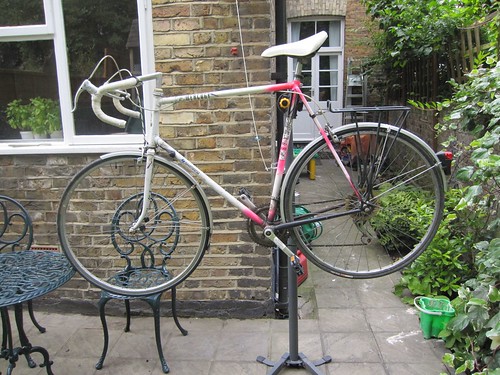
The Invisible Visible Man's Raleigh Mercury:
gaudy-coloured veteran of his first ride in London.
The memory of cycling all that time ago nevertheless put a question in my mind. Are London and other cities enjoying fast-rising cycling numbers rising because cities are making progress, learning from their past mistakes, in their treatment of cyclists? Or are cycling numbers increasing despite city authorities’ failure to understand what cyclists need?

It would be silly, naturally, to claim London cycling had shown no improvement over my time. The biggest positive change has been the wholesale redesign of many urban London roads. The space at many junctions has been narrowed, to prevent cars swinging round them at high speed. Many streets have been made to look narrower, a step that has brought motorists’ speed down. Parking spaces in many places are now more clearly marked as an area off to the side of the main carriageway. I used, when I first cycled in London, inwardly to ask drivers who’d prevented my swinging round a parked car, “How did you think I’d get round it? Fly?” It’s a line that popped into my head far less often later in my time in London than in the late 1990s. That it’s coming back to me again regularly in New York illustrates how big a lesson the Big Apple’s traffic planners have to learn from London in this area.

Cycle Superhighway 7 at Southwark Bridge.
This part still has a slippery surface -
but is at least protected from poor drivers
There has been some modest improvement in the quality of cyclist-specific infrastructure in London too. The number of bike parking places has increased sharply – albeit not as fast in many areas as the demand to park bicycles. The number of markings telling motorists to leave space for cyclists at junctions has increased. The cycle superhighways have appeared along a number of main roads, although my experience in July illustrates the problems with putting routes with slippery surfaces along busy main roads where nothing is done to prevent cars driving poorly.

But the curious point that my July 20 experience illustrates is not how much has changed since 1997 but how much remains the same, despite 15 years when every senior politician associated with London has expressed devotion to improving the cyclist’s lot.

I’d seen the motorist that buzzed me behind me at traffic lights and, seeing that he was driving a black, souped-up saloon car, guessed that he was likely to overtake me dangerously. Sure enough, instead of waiting for a safe place and space, he barged through as if, essentially, I weren’t there. Looking at it from the motorist’s point of view, perhaps that isn’t surprising. The British Highway Code certainly tells motorists they should give cyclists as much passing space as another car. But who’s reminding motorists of that point? Aside from a half-hearted Transport for London campaign a few years ago urging motorists and cyclists to “share the road,” there’s been almost no effort to educate motorists over ten years when cyclist numbers have doubled.

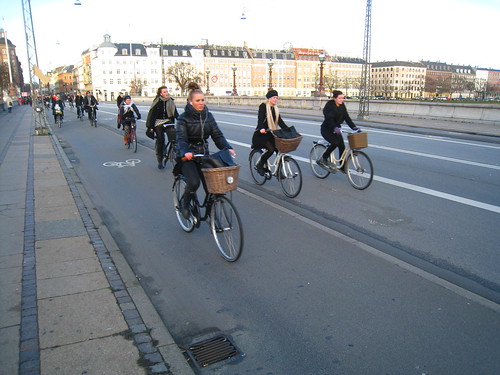
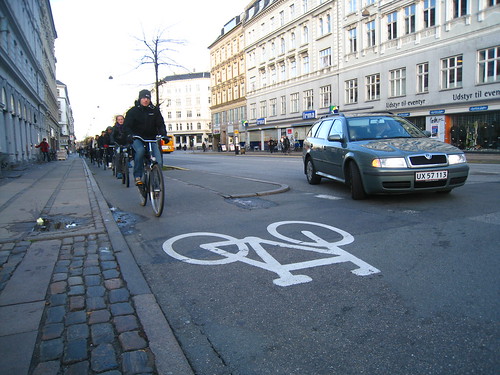
Copenhagen: other cities want the sense of cool -
but not the messy reality of cyclists
Yet almost none of the politicians or officials I’ve heard talking about encouraging cycling has seemed to have cyclists and cycling as their focus. Cycling was meant to cut road congestion, or reduce pollution or increase people’s physical activity rates. With some politicians, it’s tempting to conclude that they want mass cycling almost as a sign of their city’s coolness – look, our people cycle just like people in Amsterdam! Look, you could barely tell us apart from Copenhagen! A few years ago, there was a similar craze in Europe for planning light rail systems. Bikes seem, in more straitened times, to have taken over.

The result is that the people who make decisions in big cities seem ill-prepared for cycling’s messy reality. Since 1997, tens of thousands more Londoners have started pedalling into central London every morning. Most of them are in a hurry; many are no more considerate of their fellow road users than the motorists alongside them and all of them take up at least some space on the roads. The picture of cycling in many politicians’ heads seems to be drawn from the architectural drawings they show off when boasting about a planned riverside park or other “green” amenity. The cyclists in those never look like they’re in a hurry or like they’re shouting at some idiot that’s stepped into the cycle lane without looking. Many policymakers – and plenty of motorists – seem affronted when cyclists diverge from this unrealistic ideal. Nobody wants to spell out to motorists that, in a given road space, more cyclists means less space for cars. We’re  meant to take as little effort to pass as the paper-thin, pencil-drawn cyclists in the politicians’ drawings. People are happy if their neighbours free up a parking space by taking up cycling – and furious if they ever get in their way on the road.

It’s certainly not a London-only problem. Ten days after my permanent move to New York, I was bowling fast down a marked cycle lane in Brooklyn, reflecting that the lane was far too close to the parked cars. A car door suddenly opened, I jammed on my brakes and, just as I had in London, lost traction and skidded – once again fairly safely – to a halt. New York cycle lanes’ placing reflects the same, apparently widespread delusions as policy in London – that cyclists should take up no space, have no momentum and always be ready to give way to pretty much any other road user.

It’s not inevitable, however, that every politician will always prefer to let motorists set the agenda. The change that has done most since 1997 in London to boost cycling numbers was introduction in 2003 of a charge for driving into central London during weekday peak hours. The decision, by making clear the costs of road use, instantly removed large numbers of vehicles from central London's roads. Cyclists took up some of the freed space. Advisers to Ken Livingstone, London’s then mayor, advised strongly against introduction of the congestion charge, on the grounds that no battle with London’s motorists could ever be won. In recent mayoral elections, while candidates have proposed modifications, no serious candidate has suggested ending the charge altogether.

It’s hard to foresee the circumstances that would prompt a future London leader – or a mayor of New York or any other similar world city – to take firm action finally to prioritise bicycles properly over cars. Until it happens, there may be further, incremental rises in cyclist numbers of the kind London has experienced since 2003. But proper progress will require real boldness.

Thursday, 5 April 2012

Am I real to you? Noam Chomsky and the real questions on the road


There were, I have to admit, a lot of ideas that shocked me half a life-time ago at university. But one of my more wasted fits of the vapours was over a psychology lecture I attended about Noam Chomsky’s ideas on grammar. It made no sense, according to Chomsky's theories, to imagine languages followed hidebound rules on whether infinitives could be split or what the accusative of the interrogative pronoun “who” was. Languages instead followed “derived grammars” – a set of principles that could be divined by working out how the language’s speakers actually used it.

“Whom does he think he is kidding?” my pedantic late-teenage self asked. “Who is he boldly to go into the question like this?”

Yet, however schocking I found the great Chomsky’s views, his ideas have been coming back to me lately. In this blog, I’ve written a lot about how people should think about cycling and other ways of using the roads. I’ve been looking at how best to enforce de jure, written-down rules. For this blog, I'm changing perspective, looking around and trying to divine what Chomsky might call the “derived principles of road use”. Forget what the rules say. How do people actually use the roads?

The principles I've deduced seem to me to do a far better job than any other explanation I've seen of dealing with some otherwise inexplicable phenomena I encounter on the roads.


The first of my Great Derived Principles of road use, for example, explains a mystery that's bothered me for some time. Why, I've often wondered as I watch some driver slalom around the road while using their telephone, are so many people willing to risk others' lives for the sake of a possibly entirely trival 'phone conversation?


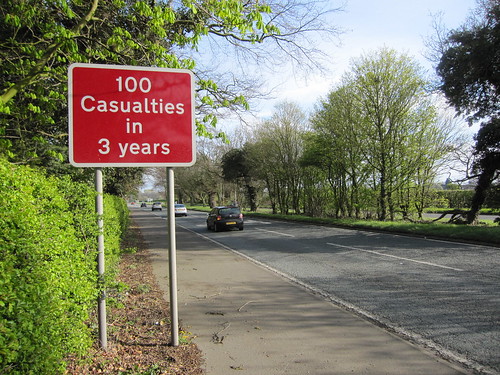
A chilling warning - but only to motorists who understand
everyone else is real too
It's now dawned on me that hardly any of those drivers see the imbalance between the risk for other road users and their convenience in those terms. When using the roads (or undertaking quite a few other social interactions, for that matter) many people simply don’t appreciate that other people are really real. They certainly don't feel they're real in the complex, contradictory, emotionally and intellectually sophisticated way they themselves are.

It’s going to be difficult, I recognise, for some readers to accept this theory since it's coming from me and I, at the end of the day, amn’t you. Some of you might have drawn different conclusions from my confrontation a few weeks ago with the Angry Man of Clapham Road. It's entirely possible, I suppose, that the AMCR, who took badly to being told not to drive into an area reserved for cyclists, fully understood his fellow road-users’ humanity. He might simply have thought it reasonable to express his irritation by pulling his car, as I saw him do, across a cyclist’s path. Maybe he’d thought fully about the lives he would wreck if he seriously injured the man and still thought it worth making his point.

But ask yourself, I urge you, this question: when did you last see someone else using the road who struck you as as wise, sophisticated and intelligent a road user as yourself? When, by contrast, did you last ask yourself, “What’s this idiot up to?” or mentally or audibly shout some term of dismissive abuse at another person on the roads? If you’ve noted, say, half as many wise people as idiots, I grant that you have your arms round the idea that other people are as real as you. For anyone else, I fear you don’t. It is only natural, as far as you're concerned, to treat others' fears, concerns and complaints on the roads with both contempt and incomprehension. Which would be a problem only if everyone else also felt like the world’s only real person and were using the roads on the same basis that only he or she really mattered.

Many of you may still, nevertheless, feel protected by another phenomenon I’ve spotted. Just as Billy Bragg once sang, “Sexuality, your laws do not apply to me,” many of my fellow road users seem to be humming something similar about old-fashioned Newtonian physics (“Physics, I can see/ Your principles don’t work for me,” perhaps?).

It’s a tendency I first observed when catching taxis around the cities of the Balkans a decade ago. From Skopje to Sarajevo, Bucharest to Belgrade, it was pretty much unheard-of to find a taxi driver who, if one reached for the front-seat seatbelt, didn’t try physically to restrain one, shouting, “No problem, meester”. There was no need for a seatbelt, no need to ensure one’s body’s momentum wouldn’t carry one on in a crash through the windscreen. I was in the care of one of the 99 per cent of Skopje’s or Sarajevo’s or Bucharest’s or Belgrade’s taxi drivers with above-average driving skills – so above average, indeed, that they could prevent other people too from driving badly around us.

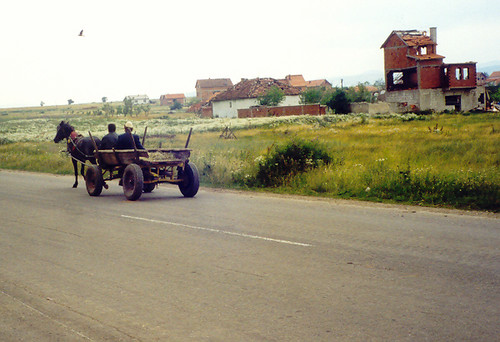
A typically bucolic scene in post-war Kosovo:
special physics is keeping the farmers on the wagon.
Those special powers, I came to realise, had been magically granted to many of the other drivers on the roads as well. Early post-war Kosovo seemed to me to present an unusually wide array of ways to crash. Kosovo Liberation Army foot patrols were apt to spring suddenly from the roadside into one’s path, giving a simple “how-not-to” class in running a vehicle checkpoint. Roads were apt to run out abruptly where a bridge had been bombed. Some were simply very, very heavily bomb-cratered. But, when I looked around, I noticed that pretty much everyone who wasn’t me or driving a tank was seatbelt-free, protected by the magic of their special driving.

The principle applies beyond the Balkans. Philip Hammond, the past UK transport secretary, argued that enforcement of road rules should no longer focus so heavily on speed or persecuting the “law-abiding majority”. Instead, it should focus on “anti-social driving”. The “law-abiding majority”, it seems, release less energy when hitting another road user at 45mph in a 30mph speed limit than someone imparting “anti-social momentum”.

Among cyclists, the “suspension of physics” crowd have their adherents among what I call the “chicken licken” cyclists – those I see cycling around wearing helmets with the chinstraps undone. According to conventional physical principles, unattached helmets offer excellent protection against the risk that the sky will fall. But, in any actual, foreseeable crash, they would fly off, offering protection barely beyond the “lucky charm” level – “I’ll be safe because I’ve made a gesture in the direction of being so”.

However, perhaps the surest proof that some people think physics has been suspended is the persistence both of in-line skating and the behaviour I encountered one afternoon on the Serpentine Road in London’s Hyde Park. The road is generally a stressful place to ride because of its popularity as a place for skaters to grapple with the fundamental problems of their means of transport. Some lay out little obstacle courses; others practise skating backwards. All fail to realise a means of transport where braking automatically overbalances you doesn’t work.

This man, however, went a step further. After a brief argument over how his sticking a skate into my path had forced me to swerve, he started shoving me. Given that the slightest return push would have sent him sprawling to the ground, he either saw himself as above physics or saw the Invisible Visible Man as a liberal wuss who would never dare shove back. The second idea is, obviously, one we can safely discard. He thought physics was only for the little people.

Yet, for anyone who doesn’t find it preposterously prattish, perhaps the appeal of in-line skating lies in the Third Great Derived Principle of Road Use: that form is more important than function, that it’s more important to be cool than safe.

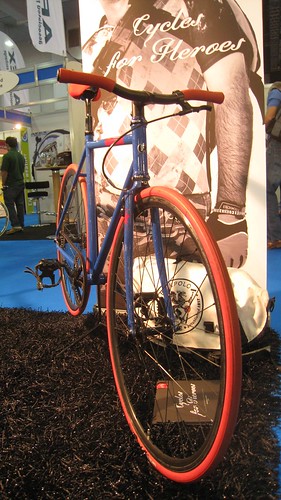
A fixie at the Bike Show: this one
seems designed for looks
rather than function
One of the great exemplars of this phenomenon is the recent popularity of certain kinds of fixed-wheel bikes for road use. Many of these bikes lack brakes (albeit it’s possible to slow down by pushing backwards on the pedals). All lack gears to match the cadence of the rider’s pedalling to the bike’s current speed, the road gradient and any number of other factors.

There are, granted, circumstances where such bikes’ simplicity is an advantage (track racing, bicycle polo and, well, track racing and cycle polo). But it’s hard to escape the conclusion that they’re popular mainly because their clean, classic lines look cool. People are prepared, as a result, to put on their knees the strain that gears would otherwise handle.

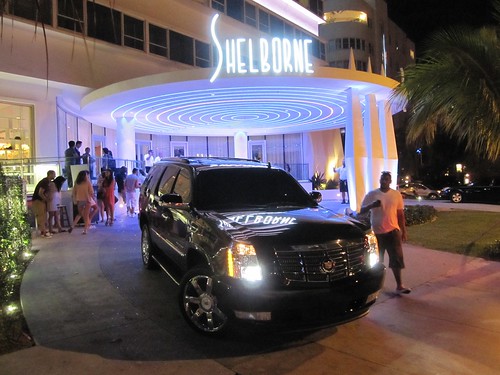
An SUV with tinted windows: not obviously sensible.
Drivers have been following the "cool matters most" principle pretty much ever since Chrysler first stole a march on Ford by coming out with a new model range every year. In south London, it’s a nightly occurrence to encounter performance cars with windows so heavily tinted they must be nearly opaque. Music blares out of many so loudly the whole car shakes. Navigating in safety seems to be the last priority.

But it’s not just in their kit that people show their desire to be cool. A pedestrian I encountered last week in Waterloo illustrated all three Great Derived Principles. He was too cool to look up as I rang my bell at him and too unconcerned about the physics of the looming collision to break his stride. Nor did he seem to grasp much why I might be annoyed he’d made me swerve.

“Caaaalm dowwwn,” he said, slowly and patronisingly when I suggested laughing at me might not have been the most appropriate response to a mildly sarcastic reprimand.

Perhaps, however, that sums up the conflict. I’ve spent years puzzling out the most rational way of getting people to relate to each other on the roads. The vast bulk of road-users regard my efforts with the same puzzlement as my efforts to keep the pronoun “whom” alive or infinitives together.

With the grammar, I’ve long since giving up on persuading others to agree. The encounter with the AMCR has reduced my enthusiasm for making the point on the roads. It ended with his threatening, fists raised, to assault me and my desperately calling the police. Call me a coward if you will – I can’t quite face a beating over this gulf of understanding.

Tuesday, 27 March 2012

The Good Life looks marginally worse, thanks to a voice from my past...

Reported Road Casualties Great Britain - Definitions, symbols and conventions
Readers who’ve read as far back as the first post on this blog – posted in the now long-ago days of January 20 – may recall that I fretted about my prospects of one day feeling my life slipping away on some south London road because of the foolish bravado of some BMW driver. It was melodramatic, I admit – I started feeling more secure on the roads shortly afterwards, when I replaced my worn Schwalbe Marathon Pluses with new, better-gripping ones.

But I now realise I should have been thinking just as hard about the prospect I might find myself slipping into an irreversible coma.

After my second-last post on this blog, about whether cycling was part of the traditional philosophical conception of the Good Life, I emailled Gordon Graham, the philosopher who introduced me 24 years ago to the idea of the Good Life, to see what he made of the piece. Prof Graham, now at Princeton Theological Seminary, was generous enough to say he’d enjoyed the post but asked a question: were my data incomplete? Prof Graham wondered if, perhaps, while motorists were far less likely than cyclists to die on the roads, they might be more prone to injury.

Pedestrians, albeit not in the UK: set to get fewer smug looks
from the Invisible Visible Man


The gloomy answer, on investigation in the Department for Transport statistics, is that there’s actually an especially high proportion of serious injuries to deaths for cyclists. And I don’t like the sound of a serious injury. It’s “an injury for which a person is detained in hospital as an in-patient, or any of the following injuries whether or not they are detained in hospital: fractures, concussion, internal injuries, crushings, burns (excluding friction burns), severe cuts, severe general shock requiring medical treatment and injuries causing death 30 or more days after the accident”.

In 2010, there were, I calculate, 23.96 serious injuries to cyclists for every fatality, 11.86 for motorbikes, 10.67 for car occupants and 12.84 for pedestrians. The only good news is that a broken wrist or severe shock is enough to get you into company with people who die after six weeks in a coma – and that cycling still looks much safer than riding a motorbike. For every billion vehicle kilometres, 553 cyclists were killed or seriously injured in 2010, against 1,021 motorcyclists, 322 pedestrians and 15 people in cars.

While cycling is still less likely than many people assume to kill you, you've got a relatively higher chance of being hurt badly. If something makes it through the steel shell of a car, meanwhile, there's a relatively high chance it's going to kill you.

The health and environmental benefits still mean I’m pedalling towards the Good Life, I reckon. But I’ll be looking that little bit less smugly at the pedestrians as I go there.

Do the new figures change your minds about whether cycling is part of the Good Life? Do please comment below.

Wednesday, 21 March 2012

In which our hero picks up cycling policy's hottest potato...

Most evenings, as I head home towards reunion with the Invisible Visible Woman, I pedal, as I’ve noted before, in the footsteps of Roman soldiers along London’s Cycle Superhighway 7. But, on nights of the light, misty rain that are a spring and autumn speciality of London’s weather, something unusual happens. As I and other cyclists swing onto a section of the Cycle Superhighway by Kennington Park, we veer out of the marked, blue-painted part of the road that’s meant to be reserved for us. We all know by now that the marking was done on the cheap with a simple layer of blue gloss paint. In such weather, it becomes scarily slippery. We consequently sit towards the outside of the near-side lane. The sight of the line of bikes, all frightened to use a dangerous facility intended to keep us safe, always leads me to raise at least a mental, mildly amused eyebrow.

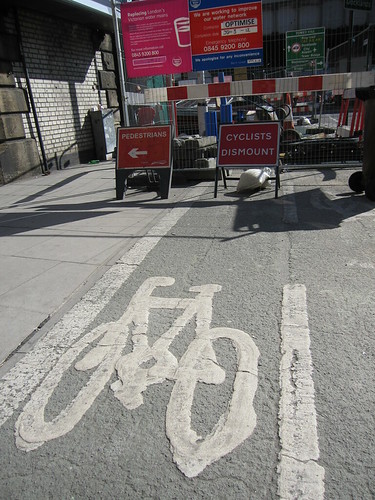
Roadworks in the City: guess which transport mode
everyone decided was dispensable
I smile a similarly wry inward smile when cycling along any section of pavement (sidewalk, American readers) that’s been divided between pedestrians and cyclists. The standard UK practice is to mark the separate pedestrians and cyclist sides with ridged tiles (to help vision-impaired people). The ridged tiles on the cyclists’ side are laid parallel to the bike’s wheels, however. Those on the pedestrian side run acrossways. A reasonably cautious cyclist consequently has to veer onto the pedestrian side at the tiles, to avoid the small but real danger the ridges will catch his front wheel. Having narrowly missed crashing after catching my wheel a few times on such a tile, I’m unwilling to take more chances.

My main thought as I negotiate these obstacles (or, more properly, “cycle facilities”) is to wonder whether their designers are even vaguely familiar with a bicycle and its basic physical properties. I think we can dismiss out of hand the idea that they might actually regularly ride a velocipede.

However, there’s a second, more serious thought. If this is the rich world’s idea of cycling infrastructure, why are so many cycling organisations pressing for more of it?

Such a notion pitches me, of course, into a bitter intra-cyclist dispute. It echoes, in a way, the divisions everywhere among oppressed groups seeking greater freedom. Do we seek, like pedalling Malcolm Xs, the segregation of the separate cycle facility, using mainly lanes free of our motor-powered oppressors? Or do we pursue peacefully the dream of integration, winning the right to the respect we deserve on the wider, more diverse society of the road?

It’s worth saying, of course, that I am as open as the next person to enjoying a car-free environment. When visiting my parents-in-law, I cycle to their church in north Wales partly on a tarmac path along an old railway line. On a Sunday morning, with few runners or other cyclists about, it can be one of the purest, most uncomplicated bike-riding experiences available. One of the most enjoyable cycle facilities to use in London is a fully segregated cycle lane along Cable Street in the East End. The absence on most of the route of worries about car behaviour is undoubtedly one of its attractions.

It’s the difference in stress levels using such routes that leads admirable campaigners in many countries to demand better, separate cycle provision. In the UK, it’s currently common for such campaigners to say cycling will remain a niche activity for the eccentric few (such as the Invisible Visible Man) until the country boasts the same kind of network of segregated cycle routes as the mass-cycling Netherlands or Denmark. They look at people like me who think there are chances of forging a basic understanding between road users and shake their heads. Isn’t it sad how determined we are to restrict cycling to ourselves and a few other members of the privileged middle classes?

I have, as it happens, a fundamental distrust of the idea of segregating any groups of people that can’t seem to get along. But I’m worried about the practicality of cutting cyclists off from other traffic too.

Nørrebrogade: exhibit A in the segregationists' case
It’s certainly hard to feel too sceptical about segregation standing in the morning on Nørrebrogade, in Copenhagen, the street that carries traffic from the west of Copenhagen over a string of lakes into the city centre. I went to look at it in late 2009 and, even towards the end of the rush hour, there were hundreds of bikes streaming down neat, segregated cycle lanes. Niels Tørsløv, the head of Copenhagen’s city traffic department, told me the city timed the traffic lights to fit in with the flow of bikes, rather than cars. One of the major controversies he was tackling was over the number of cargo bikes in the city. He was having to widen the cycle lanes to make it easier to overtake them. Such are the problems of directing traffic in a city where 37 per cent of people get to work, school or college by bike.

A Copenhagen motorist helpfully illustrates
the Invisible Visible Man's point about side-street conflicts
But, according to Mr Tørsløv, the segregated lanes only rearranged the accidents, putting them at the intersections between roads and cycle paths, rather than at even spaces along the roads. Copenhagen put in the cycle lanes, he said, only because they encouraged people to cycle – cycling numbers rose 10 per cent when a street gained a cycle lane. I happened later the same day to see a motorist knock off a cyclist using a segregated cycle lane.

After that visit, I started to notice, as I sped along Cable Street towards meetings in Canary Wharf, how disproportionately at risk I was from motorists pulling across my path at side streets. I was out of their eye line and difficult to see.

The Invisible Visible Man's hired cruiser bike.
He's not on it - but obviously
drivers saw it like this all the time
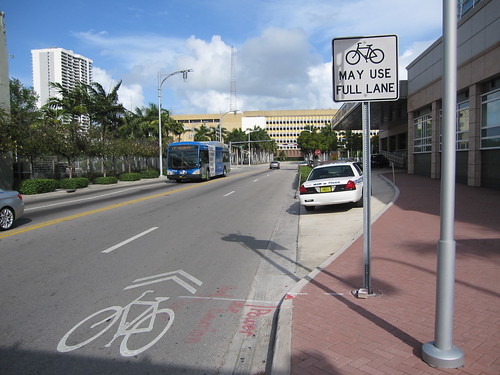
My experiences last week in the US (the reason, dear readers, for the late production of this latest blog post) underlined my worries about segregation. Unable to bear any longer missing my bike languishing across the Atlantic, I hired a cheap cruiser bike and headed across the causeway from Miami Beach into downtown Miami proper. I was encouraged at points to see cycle lanes marked on the road. But then I spotted a sign with a bike picture and the words “may use full lane”. This was a rare piece of permission, I realised. The painted lanes were less a facility than a prison, confining me to the fringes of the roads.

Given the number of motorists I’ve already had tell me in Britain that I shouldn’t be outside some rebranded gutter masquerading as a cycle lane, it made me worry what kind of message a heavy concentration on segregated lanes would send. Certain motorists would quickly come to think of on-road cycling as banned.

A whole lane? The City of Miami, for once, spoils cyclists
I’m consequently positioning myself in the middle of the lane, staring round at any potentially menacing drivers - and pedalling my way into the camp that says cyclists and motor vehicles broadly have to coexist in most city streets. This action will, I know, put me, to some advocates, irrevocably in the Not a Good Person camp. They will look upon me henceforth the way a reactionary newspaper columnist would if he had seen me cycle through a red light and mount a pavement, mouthing obscenities.

Yet I’m reluctant to side firmly with either camp because bike behaviour doesn’t seem to me the most important issue on the roads. Watching politicians’ obvious nervousness when discussing road funding in the UK this week has illustrated how fear of drivers continues to drive attitudes about how roads are used. The same fear holds back police forces from tackling speeding, driving while distracted and the other driver behaviour that puts some cyclists off.  After a driver threatened to assault me recently, the police showed no interest in investigating the driving offence that led to the confrontation. The driver had deliberately pulled his car across the path of a cyclist in, I suspect, full view of a CCTV camera. It would have been a “disproportionate use of police resources” to try to retrieve the film.

There doesn’t even seem to be an appetite for explaining the law. Many drivers, I suspect, don’t actually understand they’re not meant to intrude into cycle-only stop areas or that cyclists are allowed to ride outside cycle lanes. It would take too much courage to embark on a simple public information campaign.

Motorists’ attitudes are certainly not immutable – I’ve referred before to the transformation in views about drink driving in many countries as an example. It’s my guess that, if motorists were behaving better, far fewer people would yearn for the apparent sanctuary of segregated lanes. Meanwhile, if the apathetic planners currently in charge in many western countries set about building new cycle infrastructure, it’s a fair bet it would tend more to keep cyclists out of motorists’ way than to help cyclists.

It's unfortunate, too, if the debate polarises advocates into backing two separate approaches. Some places – the busy roads by the Thames in London, for instance – look perfectly set up for separate cycle lanes. The narrow streets in the City of London look best suited to assertive, on-the-road cycling. Many junctions need redesigning. Others would be fine if the current ignored rules were enforced.

But, for the moment, cyclists’ real needs are so far from policy makers’ minds that they’ve built a “Cycle Superhighway” out of stuff that makes bikes skid. I’d prioritise changing motorists’ and officials’ thinking over pressing the same people to build more of their flawed idea of cycling facilities.

Wednesday, 7 March 2012

It may be fun - but is cycling part of the Good Life?


At the end of most weekdays during my first year of higher education, I would cycle to the central quadrangle of St Andrews University’s ancient buildings, head into a down-at-heel lecture theatre and ponder some of the biggest questions facing humankind. The most eagerly-anticipated Moral Philosophy lectures were by Gordon Graham, the department’s most charismatic lecturer. We teenage students would enter the room to find Dr Graham grasping the podium and peering keenly up at the rows of wooden seats. He brought to mind nothing so much as a hawk eager for some intellectually lazy morsel of first-year thinking to devour.

Praise from Dr Graham for one’s contribution from the floor would leave one feeling a little elevated for days – one enconium boosts my fragile ego 24 years later. Dr Graham’s scorn would leave a discernible chill.

The question is which side Dr Graham, who gave a particularly memorable lecture series on how to live “the Good Life”, would have come down on whether to get around a city by bicycle. The Good Life, Dr Graham eventually concluded, was “the rational life”, where one sought to do good to others, make the most of one’s abilities but also to be effective and rational. One should  reject mere gestures in favour of doing things that genuinely improved the human condition.

A cyclist in London rain: cycling feels part of the Good Life
some days more than others
I’ve dwelt in past posts on the irrationality of other road users’ behaviour towards me, as well as cycling’s capacity to spring sudden, joyful surprises. But are my own actions any more part of a rational life than those of the road-users I criticise? To put it less gracefully, would Dr Graham side with the tooth-suckers – the people who see my high-visibility vest and helmet, suck in their breath through clenched teeth and say, “I think you have to be mad to cycle in London”?

I should say at the outset that I’m not managing to live the rational life. A wholly rational person would drink less than I do, knowing that he was outweighing any health benefits by the damage incurred. A wholly rational person would eat less, weigh probably 20kg less, get more sleep and get less stressed about working in a job that, while it feels like one is writing the first draft of history, is ultimately fairly trivial. That’s even before tackling the subject of my wider belief systems, which I would stoutly defend but many people would criticise.

Nevertheless, it strikes me as more worthwhile to make a stab at living the rational life than merely to do what whim and hunch suggest. It’s consquently worth examining whether an activity that takes up at least an hour most days – more on many – and occupies an irrationally large amount of my waking thinking fits with such an aspiration.

It’s with the tooth-suckers that I most often discuss cycling’s rationality. The conversation generally starts with their saying, “I think you’re very brave” or “I love cycling but I wouldn’t like to try it in London” or just, “Isn’t it very dangerous?” The most depressing instance was the first time I met Geoff Hoon, then UK transport secretary, in his office. “So can you cycle around London?” he asked. I recognised how well pro-cycling initiatives would do under his leadership.

A big truck: the tooth-suckers think
one of these will get me some time
The tooth-suckers are ultimately claiming that any benefits I might gain from cycling are outweighed by a substantial risk that, sooner or later, I’ll find myself beneath the wheels of an articulated lorry. The hopeless dream that my steel-framed bike and vulnerable body could co-exist with trucks taking baked goods to Sainsbury’s will have literally been crushed.

My standard answer is to quote research conducted some years ago by the Cyclists’ Touring Club which showed the average British cyclist who cycled into middle age enjoyed life expectancy enhanced by two years, while risking on average losing only two months through cycling accidents. It’s a 12 to one benefit to cost ratio, I tell people. I even occasionally mention the subtle message of the obituaries page in the Cyclist Touring Clubs’ Cyclist magazine. Stories abound of wiry old devotees of the Sunday club run succumbing eventually only in their 80s or 90s.

Although I might have to hide a receipt for the latest £100 spent on my transmission while doing so, I could also point the tooth-suckers towards the financial advantages of cycling. Even with the amount of damage I seem to do to bike parts, I’m sure I’m spending less than if I commuted by public transport. I impose virtually no costs on others through wear and tear on the public roads.

There are also, of course, the environmental benefits, which many non-cyclists assume are a major factor in many people’s cycling. It is indubitably one of the few forms of transport – amid a motley selection including skateboarding and cross-country skiing – to involve carbon emissions only in the making of the equipment. It’s just unfortunate that one sounds so insufferably pompous talking about it.

The only time I’ve been tempted to raise my superior carbon status was when a woman honked loudly at me after I blew my congested nose’s contents onto a road at traffic lights. It was, I’m sure, not a pretty sight. But there was an irony in being reprimanded over my biodegradable mucus as she merrily pumped out long-lasting greenhouse gases.


While some motorists seem to regard me as a vast, insuperable obstacle in their way, it also seems rational to me to use a vehicle that takes up relatively little of the precious urban space devoted to roads. I'm sometimes tempted to ask motorists frustrated with being stuck behind me whether they'd prefer I was sitting in front of them in a car.

There is, meanwhile, scope for me to manage the safety risks. Although Transport for London research attributes blame for roughly two-thirds of accidents involving cyclists to the motor vehicles involved, there’s still substantial scope for me to cut down my chances of ending up in the road. Failing to look properly, failing to judge another person’s path or speed and being careless or in a hurry were the top three reasons for accidents attributed to cyclists. A careful cyclist can work at avoiding all of those.

Pedestrians: shouldn't they be
wearing helmets?
Yet there remains the objection I heard from one senior figure in my office. He had, he’d told me, been asked, on appointment to his present job, to stop cycling to work. He’d become too important to lose. To my point about cycling’s health benefits, he retorted that he went regularly to the gym. It is clearly true that the CTC’s averages for life expectancies mask very different distributions of the benefits and risks of cycling. Nearly every cyclist gets the extra two years – while the average lifespan lost through accidents represents an unfortunate few, each of whom may lose decades each.

Nevertheless, a check through Great Britain’s accident statistics for 2010 backs up a point I’d already deduced looking around my office. The intersection between colleagues who motorbiked and those to be seen outside with the smokers was striking. These are the real risk-takers - there were, I discovered, 36 cyclist deaths per billion vehicle miles in 2010, against a hair-raising 138 for motorcyclists. Even for pedestrians, the fatality rate per billion miles walked was 37. The only really safe group, I realised, was car occupants, wrapped in their steel shell and suffering only three fatalities for every billion vehicle miles. Each of the 111 cyclist deaths represents a real, avoidable tragedy. There should be far fewer. But I, for one, am prepared to accept the risks of an activity that, despite the appearances, is safer than walking.

Of course, it’s reasonable to ask whether any evidence I could have uncovered would have driven me off my bike. I would certainly be profoundly reluctant to give up the satisfaction of making my way around under my own power, feeling the wind on my face and hands and catching a sense of the city living around me.

But the powerful evidence in favour of cycling does, for me, improve the experience. It feels like the right choice, a rational choice. Then, occasionally, when the wind is in the right direction, the drivers polite and the roads clear, I even sense that I am, indeed, living the Good Life.


Are you making a rational decision to cycle? Are you making an irrational decision not to cycle? Are you making an irrational decision to cycle? You can work out roughly how these questions are working, so please just use the comments box to let us all know your answer.