Showing posts with label bicycle bloggers. Show all posts

Sunday, 24 March 2013

Crashes - and communities' deadly preferences

At the foot of Wellington Street in London, where the busy cycle route from Waterloo Bridge heads into Covent Garden, there was, for a while when I lived there, a notice. The police had received numerous complaints, it said, from “the community” about standards of cyclist behaviour in Covent Garden. It suggested, essentially, that cyclists should smarten up their act or face unspecified consequences.

The notice irritated me on several levels – but the most profound was the notion that “the community” were the real people and the cyclists some alien, invasive species. The irritation was all the greater because as an area Covent Garden seldom showed much respect for cyclists’ rights. I have a vivid memory of cycling across the pavement (sidewalk, American readers) at the foot of Wellington Street with a drunk tourist yelling at me that I wasn’t allowed to ride there. He was standing directly on top of a bike symbol, on the clearly marked cycle lane.
A stencil marks where Martha Atwater died: one of
far too many such death sites in New York City

Questions about traffic and its relationship with communities have been occurring to me again over the last month as I’ve pondered a series of appalling tragedies on the streets of New York City, where I live now. The highest profile – the killing in a car crash in the early hours of March 3 of two expectant parents, Nachman and Raizel Glauber, and their baby son, delivered prematurely after the crash – raised the issue most clearly because of their own community’s very obvious reaction. The couple, only 21, belonged to prominent Hasidic Jewish families. Their deaths – a speeding, possibly drunk driver smashed into the livery cab they were using - were marked by a funeral that brought 1,000 men in dark coats and wide-brimmed hats onto the streets of Williamsburg, one of Hasidism’s Brooklyn strongholds.

But nearly any traffic tragedy – and there have been many in New York this past month besides the widely-noticed ones - raises at least some questions about how different communities relate to and use the street involved.
Potted plants show the grief of Martha Atwater's community

I’ve been thinking particularly deeply about the link each morning recently as I’ve cycled past the junction of Clinton Street and Atlantic Avenue in Brooklyn Heights on my way to work. A line of potted plants by a shop window and a stencilled outline on the sidewalk mark where, on the evening of February 22, a driver mounted the sidewalk in his speeding, out of control SUV. Martha Atwater, a 48-year-old writer and mother of two children, was emerging from a bagel shop and died on the sidewalk shortly after the vehicle hit her.

The regular arrival of fresh floral tributes testifies to what I read in the days after Ms Atwater’s death – that she was a well-known, well-liked participant in many local activities. She was the embodiment of the strong sense of mutual responsibility and joint action that makes the best New York neighbourhoods such desirable places to live.

But I saw little reflection amid the tragedy of Ms Atwater’s death on New York’s wider traffic culture, which claimed another high-profile victim less than six days later. On the morning of February 28, Amar Diarrassouba, 6, was crossing E117th street in East Harlem on his way to school when a huge truck drove through the crosswalk, killing him instantly as his 9-year-old brother, who was accompanying him, looked on.

The grief in Amar’s case focused not on the miserable, pointless loss of a bright young boy or the driver’s culpability but on Amar’s school crossing guard. The woman, who on a previous occasion reportedly snatched a child out of the path of an oncoming car, should have been present at the crossing when the collision occurred but wasn’t. Astonishingly, the police investigation of the truck driver appears to have concluded with his receiving traffic tickets for failure to yield and failure to execute due care – minor violations that nevertheless suggest he was entirely responsible for Amar’s death. The investigation into the crossing guard – someone who, whatever her shortcomings, did not negligently drive a huge truck over a blameless six-year-old – continues.

The attention on the crossing guard was typical of the focus after each of the tragedies on the crash’s individual circumstances and what made it exceptional. There has been very little reflection on how general traffic conditions in the areas concerned contributed to the deaths.

The intersection the driver that killed Martha Atwater crossed.
Traffic calming would do no good here, according to some residents
That omission struck me particularly in Martha Atwater’s case because of an online argument I entered a few months ago with a resident of Cobble Hill, just across Atlantic from the crash scene, about traffic calming. He was angrily complaining about how unsightly a projected traffic-calming scheme for the area would be and what congestion it would cause. But it seems fair to suspect that such traffic-calming would have made it much less likely a speeding SUV would shoot across Atlantic Avenue and kill someone.

The most shocking effort to shift blame came in Amar Diarrassouba’s case. The community board for the area where Amar died – the local body that has the final say on many local planning issues in New York – in late 2011 withdrew previous approval for a protected bike lane along First Avenue in the area. Most studies suggest such lanes, as well as benefitting cyclists, make crashes like the one that killed Amar less likely. Yet when Steve Vaccaro, a cycling lawyer and activist, pointed out the community board’s role on Twitter to Erik Mayor, a local restaurateur and community board member, Mayor preferred to put the blame on the least blameworthy actor in the entire episode. “The child was being walked by his nine-year-old brother, who did not pay attention,” Mayor wrote.

Kent Ave: a surviving Williamsburg bike lane,
which some Hasidim might prefer weren't there.
The truth is that road deaths all over the world nearly always result at least in part from failures of road governance. Those often result from local communities’ tendency to assume the main priority for roads is to meet the needs of the people that they regard as their “community” – people who have similar needs and habits to them.

That is particularly revealingly the case where the Glaubers’ community is concerned. Few Hasidic Jews cycle and some Williamsburg Hasidim successfully campaigned for removal of a cycle lane along Bedford Avenue through the heart of their community. One community spokesman said that, although the ostensible reason for the campaign was their disapproval of women cyclists’ “immodest” dress, it was also the case that “everyone” knew a bike lane was a “nuisance”. There have also been attempts to discourage cyclists from using bike lanes along Kent Avenue, the street where the Glaubers were killed, apparently because Hasidim wanted back the parking spaces that the bike lane took.

Erik Mayor’s reaction shows a similar myopia. He couched his original opposition to the first avenue bike lane in terms of the likely effect on local children. He claimed – improbably – that a bike lane would increase asthma among children because it would increase congestion and hence emissions from idling cars. But when the lane’s absence contributed to the crushing to death of a boy from the area’s distinctive west African community, his sympathy seems to have evaporated.

A strong theme running through many “community” expressions of concern about their local roads is that they focus on the problems that cause the most vocal complaints locally – the struggle to find parking places or local shopkeepers’ grumbles about business – rather than local roads’ role as thoroughfares.

Yet roads are inevitably the vehicle for the habits of one community, no matter how distinctive it might be in many things, to run – sometimes literally – into another’s. The wide, unobstructed local road might seem vital to you because it offers plenty of parking spaces. If it looks to people from neighbouring communities like an invitation to drive at twice the speed limit, your community is likely to pay a heavy price.

It’s for that reason that it makes little sense to hand governance over important issues of roads policy to bodies as locally focused as New York City’s community boards. The New York City cycling map testifies to their influence, with cycle lanes along long avenues changing in nature or disappearing altogether according to their whims. It’s an area where London, for all its drawbacks, seems largely to be doing better than New York. The boroughs of Wandsworth, Westminster and Barnet – all controlled by the Conservative Party – are undoubtedly less bike-friendly than Camden or Tower Hamlets, controlled by the Labour Party. But the overall strategy seems less likely than New York’s to be derailed in places because of loud, locally-focused complaints.

More generally, meanwhile, it’s always worth thinking when anyone talks about “the community” about whom their definition excludes. While “community” as a term comes wrapped in warm pictures of neighbours chatting and people banding together to do good, it often says as much – as in that Covent Garden notice – about who’s on the outside. The Covent Garden community clearly excluded people who rode bikes. The community board for East Harlem seems to have seen itself as more answerable to car-users than cyclists or people who might benefit from safer streets.

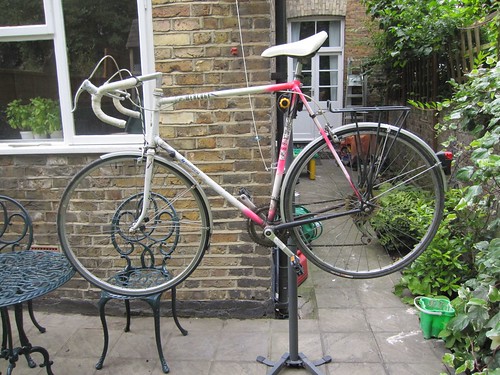
The Invisible Visible Man thinks this bike's rider
didn't feel like part of his community.
The police think we're all part of the same problem.
My own tendency to think sloppily on this topic came home to me on Thursday evening when I encountered the aftermath of a collision on my way home. An ambulance was taking away a cyclist whose mangled bike lay by the roadside. A quick scan of the machine – a nasty aluminium full-suspension mountain bike – led me to a quick conclusion. This was the machine of either a food-delivery cyclist or one of the youths from the local public housing. He wasn’t part of my cycling community.

That made little difference to one of the policemen at the scene, however. Having already apparently decided the cyclist’s failure to stop appropriately had caused the crash, he was keen to share the news with anyone else rash enough to ride a bicycle – even one dutifully stopped at the traffic lights. Looking towards me as he walked back towards his patrol car, he addressed me with a sneer in his voice. “I guess he just had to stop,” he said, shaking his head.

Monday, 11 February 2013

Staten Island and why the Invisible Visible Man is the Opposite of a Canary

It was a brief taste of how most of suburban America and Europe lives and it wasn’t, frankly, terribly pleasant. This past Wednesday, for work reasons, I took my bike and, for only the second time in my life, travelled by ferry to Staten Island, an island off the New Jersey shore that historical accident has made part of New York City. Having mostly developed only in the 1960s after the opening of the Verrazano Narrows road bridge to Brooklyn, it was designed around the private car far more than other parts of the city. It’s the nearest thing in New York City to a chunk of true American suburbia – featureless apart from occasional strip malls and criss-crossed by wide, fast-moving, multi-lane expressways.
A shared cycle route marking in St George: much the likeliest
way to see a bike on the road in Staten Island

I began to have concerns about cycling conditions even before I was properly out of St George, the borough’s capital. A bus driver drove at me, apparently astonished that my being ahead of him in traffic meant I thought I should go first through a pinch point. Later on, I started to wonder if I had put myself in serious danger. Unable to use the seafront cycle path – still blocked with sand from Superstorm Sandy – I headed inland along long, straight six-lane avenues. The 30mph and 35mph speed limits on these roads seemed to be regarded as minimum permissible speeds. Encountering a cyclist, such drivers simply drove straight on, at speed, towards the bike, on the apparent assumption the cyclist would scuttle out of the way.


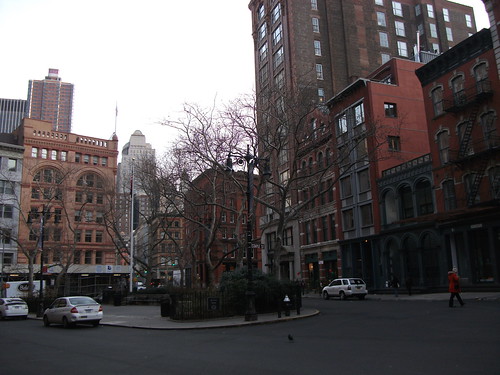
Duane Square, TriBeCa: not specifically cycle-friendly
- but not hostile either
But I probably shouldn’t have found the conditions surprising. While I have multiple complaints about cycling conditions in brownstone Brooklyn and Manhattan – the places where I currently mostly ride – and in London – where I used to ride – these are actually atypically cycle-friendly environments. Many roads are narrow – inhibiting drivers’ tendency to speed – and the traffic’s sheer volume makes the speeds on Staten Island mostly impossible. The obvious attractions in such an environment of the bicycle – which can slip along such streets while cars remain gnarled in traffic jams – have contributed to recent years’ rapid growth in inner-city cycling numbers. Better provision is slowly arriving in the wake of increased cycling.

Conditions on Staten Island are far more typical of the places that most rich countries’ inhabitants live. Such places provide most inhabitants with a house on its own plot of land – but suffer from the sheer volume of traffic that sprawling, low-density cities generate.  I’ve encountered similar conditions in parts of commuter-belt Oxfordshire, Cheshire and Scotland’s central belt. Cyclists tend not to give much thought to such places for the simple reason that very few cyclists live in them.

The natural reaction might be to conclude that cycling is impossible in such places, to avoid visiting them as far as possible and to leave the bicycle behind when circumstance forces one to do so. The only alternative is a wholesale rethink of the car’s role in such societies.

It’s often said that cycling children are a kind of “canary-in-the-coalmine” of cycling policy. If you disperse pretty much every danger factor for cyclists in your city, you’ll find primary school children riding to school. Let even a few of them creep back and the kids will disappear.

After his Staten Island visit, the Invisible
Visible Man will hardly complain in future
about scenes such as this in Manhattan.
By that standard, I’m closer to being the explosion in the coalmine. I regularly cycle along fairly busy, high-traffic roads, including fast-moving dual carriageways in the UK. If the danger factors somewhere have built up to the point somewhere that they’re intimidating me, it’s a reasonable sign cycling conditions are seriously, dangerously hostile.

I mostly managed in Staten Island to stick to the principle that a cyclist should boldly take the lane and force motorists to manoeuvre safely around him. But even I at points hugged closer to the kerb than normal, darting out into the threatening traffic mainly to get round obstructions such as parked cars. It felt hard to keep taking the lane on seeing a line of fast-moving SUVs, three abreast, bearing down on one, giving no sign whatever of yielding to a cyclist in front of them. I wasn’t confident I wanted to waste my dying breaths explaining to some over-sized car’s driver precisely why my road craft should have prevented him from running me over.

So is there an alternative for cyclists to the appalling conditions that currently exist in Staten Island and many other suburban areas? One standard cycling lobby answer is to argue that entirely separate cyclist provision is needed and that to call for anything less is counter-productive. Cyclists and such heavy, fast-moving traffic can never co-exist.

Yet I left Staten Island doubting that calls for a network of dedicated cycle lanes on Staten Island would get very far under current conditions. I saw, as far as I can recall, one other cyclist during an afternoon and early evening on the island. It’s hard to see that a democratic society can risk spending heavily to create facilities for a group – Staten Island utility cyclists – that might not even emerge in the end. That’s all the more the case at the moment, when my cycle route took me past large tracts of shoreline land that remained flooded and empty in the wake of Sandy’s devastation of the island. Even as a dedicated cyclist, I think finite budgets at the moment are best spent on ensuring all Staten Island’s people again have waterproof, heated houses.

There are nevertheless compelling reasons beyond encouraging cycling to stop the cancer of car-dependence from draining the life out of Staten Island. The wide, uncalmed roads, it was clear, were intimidating away people other than cyclists. I saw just as few people walking the sidewalks of the busiest roads as I saw people cycling. The excellent “weekly carnage”feature on Streetsblog, the transport website, features regular stories of Staten Island’s elderly and other vulnerable people crushed by motor vehicles refusing to yield at corners. Many of those fast-moving vehicles end up ploughing into each other, at a high human cost. There’s every reason even for someone who’s not a cyclist to support the installations of road designs that slow drivers down and speed cameras.

Ideally, the United States would increase fuel taxes to cover more of the costs cars impose on places such as Staten Island. A rational system of per-mile charging could calm down the worst of the congestion. Research suggests that cars might even get where they’re going faster under such a regime than they do at present.
Manhattan approaching, from the Staten Island ferry:
a welcome sight, from a cyclist's point of view

A new approach to cars would, of course, produce a better environment for on-road cycling too. It’s far from impossible that in Staten Island calmer, less threatening roads might start to entice out of their hiding places some of the bikes that must be lying unused in the borough’s homes. The island might start participating more fully in the cycling boom that’s taking place, to varying degrees, in New York’s other four boroughs. That, in turn, might make it easy to justify new cycle-only lanes for some future reporter who finds himself heading to a distant corner of Staten Island on an assignment.

As it was, finding dark had descended and contemplating the prospect of a 10½ mile ride on threatening roads back to the ferry, I took, unusually, the line of least resistance. Fending off threatening cars, I rode half a mile to the nearest Staten Island Railway Station and, my bike leaning against my seat, took in the island’s night-time lights as most of its inhabitants do – from within the comfort of a metal shell.

Sunday, 20 January 2013

A blown nose, a blown world environment - and why some people confuse the two


It’s one of the few times I’ve managed seriously to annoy a motorist while stationary on my bike. One dark winter night a couple of years ago in London, I blew my nose while waiting at traffic lights. But, lacking the time to fish out a handkerchief, I snorted onto the road.

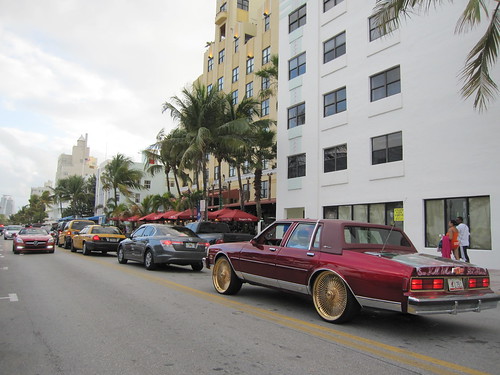
Traffic queuing in Miami Beach. Some of these cars might look to you
like polluters - but the drivers might think snot more offensive
It can’t, I accept, have made for a pretty sight. But the reaction of a woman in a car behind still surprised me. Leaning on her horn, she gesticulated her disgust wildly. The irony instantly struck me. In contemporary society, it’s regarded as entirely acceptable to make urban journeys in vehicles that spew out gases that will pollute and warm the atmosphere for a century or more. Clear one’s airways of a little biodegradable mucus, however, and one puts oneself entirely beyond the pale.

But the more I’ve thought about it since, the more I’ve realised the Outraged Driver of Kennington Park was exhibiting attitudes to environmental pollution and emissions very common in industrialised societies across the world. She regarded herself as having the right to an environment treated as she wanted. She felt perfectly entitled to criticise others’ treatment of that environment. Her attitudes, however, made no reference to any ultimate yardstick about the fate of the world environment as a whole.

I’ve said before on this blog that I am nothing like as exercised about environmental issues as many people assume cyclists are. I enjoy the overall sense that cycling is a rational way to get around – that it makes good use of scarce city space, that it contributes very little to congestion, that it keeps me healthy, that it’s enjoyable. It’s part of that picture that each trip contributes hardly at all to overall carbon emissions. But the environmental factors form only one corner of the overall scene.

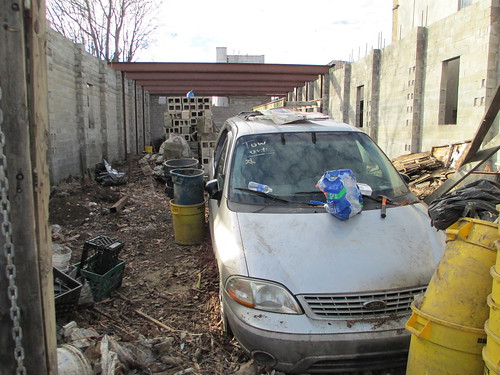
A car abandoned in the lot the Invisible Visible Man
helped to clear. Some scientists reckon the car's emissions
helped to cause the destruction in this corner of Brooklyn
That said, I regularly currently confront vivid evidence of the seriousness of the world’s environmental problems. Parts of the Hudson River Greenway, which I use for nearly half my daily commute in New York City, were under five feet – 1.6m – of water at the height of Superstorm Sandy in October. Many scientists think such extreme weather events are becoming more common as the world’s climate changes. Yesterday, I cycled down to Coney Island, one of the parts of the city worst-hit in the storm, to help clear out a vacant lot that was under seven feet of water on the night the record high water swept up New York Bay. The weather was so unseasonably mild that on the way home it felt oppressively warm. There’s an undeniable sense that climate change is becoming a more urgent, practical issue, which anyone who takes an interest in the wider world needs to address.

A modern, fuel-efficient container ship:
a surprisingly clean way to import food
Yet few of the responses to the issue rise much above the level of honking one’s horn at behaviour one dislikes. I’ve frequently heard it averred, for example, that it’s good for the environment to eat local, seasonal produce. But very few of the people who claim that can give a detailed accounting of local, seasonal produce’s carbon costs – even though the ships that import food to temperate, rich-world countries use remarkably little fuel. It’s certainly far from clear that buying fruit imported on such a ship from a country where it grows easily is worse than eating greenhouse-grown local fruit that’s come to the farmer’s market in a small, inefficient van.

Railway lobbyists also make blanket claims that their transport mode is invariably more environmentally friendly than using a car. But, while that is undoubtedly true for a well-filled train in the London rush hour, it isn’t true for a nearly-empty train spewing diesel fumes into the air to move a couple of passengers to their destinations. When I lived in the UK, my most regular long-distance rail journey was London to Chester on a Super Voyager diesel-powered train. I would give a rueful smile as I remembered that the complex, heavy but fast train issued much the highest level of emissions per seat mile of any UK train model. It was, on average, a better environmental bet to take the train for that journey than to hire a car. But the margin was not very wide at all.

There are some similarly questionable attitudes towards cycling’s environmental performance. I’ve recently come across a number of attacks on cycling’s environmental record that point out, for example, that manufacturing bikes produces carbon emissions – an undeniable point, which makes it clear that one shouldn’t replace one’s bike more often than necessary. Such attacks generally go on to point out that fuelling a bike involves carbon emissions. There are carbon costs to moving the extra food that cyclists eat that they otherwise wouldn’t. And the food generates emissions that the Outraged Driver of Kennington Park would presumably dislike even more than mucus – in the form of methane, a far more potent greenhouse gas than the carbon monoxide from cars.

The most entertainingly bonkers attack of this kind I’ve encountered was a recent blogpost from an Ian Pearson who claims to give “a more accurate guide to the future” (How can he tell?) on bikes’ carbon performance. Cycling might well, Mr Pearson accepts, produce next-to-no carbon emissions per kilometre. But, when a cyclist rides in traffic, he asserts, the extra carbon cost of attending to accidents – and the effect on cars’ carbon performance of slowing down then accelerating to overtake cyclists – probably produces so much extra carbon that it would have been more environmentally friendly for the cyclist to go by car.

This new Ford pick-up truck concept will be more fuel-efficient
when it launches than its current equivalent.
But that won't make its drivers necessarily
friends of the environment.
The common thread between all these questionable assertions is that they treat the environment’s fate as an abstract matter – as susceptible to objective observation as the question of how to live the good life or whether God exists. People who profess concern about the environment often have a bias in favour of things that appear traditional and prepared without the benefit of complex, modern scientific advances. Many assume locally-produced food must be better for the environment because, well, it feels as if it should be. Similarly, people who are relatively unconcerned about environmental issues have a tendency to work back from their own behaviour to a spurious justification. “My car’s not as polluting as it might be” gets rationalised into “I am environmentally virtuous”. “I don’t like manoeuvring around these cyclists” becomes “these cyclists are bad for the environment”.

Yet, for the effects of air pollution and global warming, it is ultimately possible to estimate the effects objectively. Scientists now have a reasonable idea of what kind of damage different levels of carbon emissions produce. It is even possible to come up with rough figures for the costs that different kinds of emissions impose on wider society.

In a rational world, governments would now be rushing to take the guesswork out of estimating environmental impacts. Food products would include a label detailing the carbon costs of their production and include a tax reflecting them. Air tickets would include something similar, while the carbon costs of burning each unit of fuel would form a clear and distinct part of the petrol price at the pump. Past experiments with introducing new prices for previously-free goods – such as the Central London Congestion Charge – suggest consumers would move swiftly away from the most environmentally damaging behaviours towards less damaging ones.

I am robustly confident that such an exercise would make far clearer than the existing tax systems in most rich-world countries that bikes have big environmental advantages over most other transport modes. It is hard to imagine that the change would not significantly increase cycling levels.

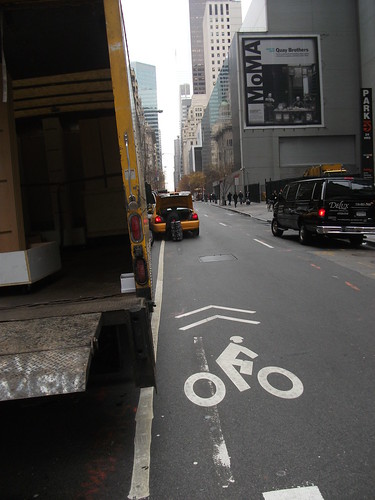
A bicycle sign on New York's W54th street:
the kind of decisive action on the environment
that many governments are taking
The challenge, however, is that such a move would upset groups commonly supposed to be hugely influential – motorists, regular air-travellers and the owners of big houses – while pleasing few others. Governments consequently lay down a few cycle lanes on the roads, offer some subsidies for electric cars, meet some of the cost of better home insulation and generally gesture vaguely in the environment’s direction. Action that would make a real difference remains resoundingly untaken.

Yet that, perhaps, should be no surprise. Across the industrialised world, governments depend on the votes of people as inconsistent as the Outraged Driver of Kennington Park, Ian Pearson and, come to that, each of us reading (and writing) this blog. There’s no firm consensus yet among all those people in favour of firm action to rein in the galloping horse of the worsening global climate. That many governments consequently seem little more rational on the issue than an irritated, late-night driver may be sad – but it is depressingly understandable.

Sunday, 9 December 2012

Washington, a stabbing - and why an individual cyclist tells you nothing about the rest

Washington, DC surprises me every time I visit. While New York feels just as bustling, large-scale and chaotic as the films and TV programmes would suggest, the US’s capital feels nothing like the West Wing. Sure, there are people influencing the whole world’s fate in lots of those neoclassical buildings – but Washington’s atmosphere most reminds me of other sleepy US administrative capitals like Richmond, Virginia or Harrisburg, Pennsylvania.

Washington, DC: provincial to me
- but full of cycling savages according to one Facebook user
During a visit last week, it nevertheless occurred what an advantage it was that Washington seemed a far calmer place than New York to ride a bike. The cyclists I saw during the visit mostly seemed to be riding sedately, calmly and in general harmony with other road users around them.

This was, however, entirely the wrong conclusion, according to at least one person I know. On Friday evening, two days after I came back from my DC daytrip, a Facebook friend commented on a story about an altercation between a cyclist and a motorist in North-West Washington the night I visited. The motorist appears to have somehow alarmed the cyclist, who responded by hitting the driver’s car with his D-Lock. The ensuing argument ended with the cyclist stabbing the motorist, who suffered rib injuries but looks likely to survive.

“Savages,” my Facebook friend commented. “Civility is an alien concept,” someone else replied in agreement. The clear implication was that I, as a cyclist, was complicit in an appalling, entirely unjustified assault of a kind I would never have contemplated.

My immediate instinct was to launch into an argument, pointing out the fatuousness of jumping from a single, knife-wielding cyclist to the implied generalisation – all cyclists are savages. Concluding that I was unlikely to change clearly entrenched attitudes, I limited myself to “unfriending” the person responsible.

But, as I cycled home that evening, a more mature reflection occurred to me – one sparked in part by the controversy in the UK over the inflammatory “War on Britain’s Roads” documentary. If it made no sense to draw a conclusion from a single stabbing - or the misleading footage of an alleycat race in the documentary  - to cyclists’ general behaviour, why did I feel free to criticise in general the culture of driving or the police? Was I making any more sense than my former Facebook friend?

One possible response to the “cyclists are savages” claim would, of course, have been to point to some of the numerous incidents of motorist-cyclist violence. In the space of a year of cycling in London, I suffered one actual – albeit mild – assault and had to make an emergency call to police to avert another. The first incident involved a bus driver who abandoned his bus – and passengers - to confront me because I’d photographed him blocking, illegally, a cyclist-only area at traffic lights. He smashed the mobile ‘phone I was using as a camera out of my hand. The second incident came as I tried to photograph a motorist I’d previously seen deliberately drive across the path of a cyclist who’d complained about his driving. He threatened – alarmingly convincingly - to smash up both me and my camera.

The most pertinent case I could have raised, however, was the stabbing in September of Colin Albright, a cyclist in Pittsburgh, whom a motorist pursued as he carried his bike away from a road up a set of steps. The motorist stabbed Albright repeatedly, including in the throat, possibly over some perceived slight involving a traffic incident.
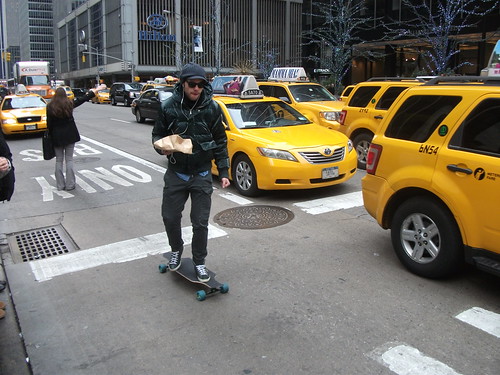
You might have prejudices about people who make strange
transport choices - like skateboarding down Sixth Avenue.
It doesn't mean you know anything about this individual skateboarder.

Albright’s case would have been pertinent precisely because it illustrates the absurdity of generalising from something extraordinarily rare – a stabbing over a disagreement on the roads – to the generality of day-by-day on-road relationships. In late October, Anthony Scholl confessed to attacking Albright. Scholl was already in custody over an alleged attempt to burn down his parents’ house. While there is little information so far on Scholl’s motive for stabbing Albright, the alleged arson attempt seems to have been aimed, in Scholl’s mind, at preventing his parents from killing him and feeding him to their (presumably imaginary) pet alligator.  Albright’s stabbing also looks likely to have stemmed from what Scholl’s mother has called his “psychological issues”. It seems similarly unlikely that the appalling Washington stabbing will turn out to involve an ordinary, mentally-balanced cycle commuter who just happens to pack a knife to mete out summary justice on uppity drivers.

That anyone could ever have thought the Washington stabbing had anything to do with broader cyclist behaviour, of course, stems from humans’ powerful desire to pin blame for problems on out-groups. The only thing so far known about the Washington motorist’s assailant is that he was on a means of transport against which large numbers of people have powerful prejudices. Few people have the mental self-discipline to avoid working on the basis of such limited information and their prejudices to jump to wholly unwarranted conclusions.

It’s telling, for example, that hardly anyone blames the antics of bank robbers’ getaway drivers purely on their being drivers. Drivers are too numerous and familiar to act as convenient out-group scapegoats. No-one sought to blame the assault I suffered or the threatened assault merely on the perpetrators’ status as motorists. I received, instead, some close questioning about the immigration status of the bus driver and the race of the man who threatened to assault me. Establish a link to immigrants or African-Caribbean men, the implication seemed to be, and the incidents were far more easily explained away.

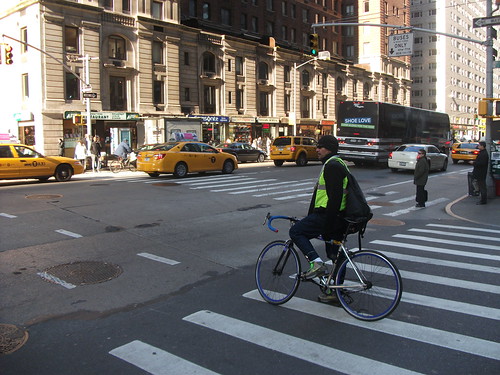
A cyclist, cars and pedestrians at 55th Street. Which of them
is a "savage" will be in the  eye of the beholder
The prejudices are all the more powerful for not appearing to the prejudiced to be prejudices at all. Have your eye out for poor cyclist behaviour in Washington and you’ll spot instances of such behaviour, rather than the courtesy and calm I witnessed. Assume the main road problem is the cyclists and you’re unlikely to spot the multiple ways motorists misbehave.

The truth is that, in all the incidents I’ve described, the attackers acted as individuals, rather than a member of a group. Their behaviour stemmed from their own characters or mental states, rather than their status as cyclists, motorists, bus drivers, immigrants or anything else. To imagine that the behaviour in a single instance of a single member of a large group has anything to say about the wider group as a whole is a thinking error of a kind that would be shocking were it not also fairly common.

That point could, of course, lay me open to the objection someone recently made in an online forum to my use of statistics to point out that cars generally posed a far greater danger to pedestrians than bikes. That was beside the point, the poster wrote. Each motorist or driver differs so much that it makes no sense to discuss a general level of risk from motorists or cyclists. A very poor cyclist could conceivably pose a greater danger to a pedestrian than an extremely careful, conscientious motorist. I am perhaps particularly vulnerable to such a charge because of my habit of illustrating points on this blog by reference to specific – usually extreme – incidents that I take to illuminate a wider truth.

Yet I have, I hope, been careful when complaining about general problems to have sought evidence that my experience speaks to a broader reality. It remains a verifiable fact, for example, that motorists kill a disproportionately high number of other road users in both the UK and New York City. Collisions with cyclists in both places account for a far lower proportion of road fatalities than cyclists make up of road traffic. Research in New York suggests motorists’ failure to yield as required to pedestrians is the biggest single cause of road deaths. Research in the UK suggests failure on motorists’ part to pay attention causes a disproportionate number of crashes.
Court Street at night. Just because most motorists speed here
doesn't mean they all do.

It makes sense on such a basis to say there is a general problem with motorists’ failure to yield to New York pedestrians or to pay proper attention in the UK. I am even confident enough in my own judgement to diagnose a few more local, unmeasured problems. There is, for example, a general problem that many motorists regard Brooklyn’s Court Street as an appropriate place for excessive speed and not somewhere where cyclists’ requirement for space on the roads need be considered. It just doesn’t make sense to predict on this basis that the next motorist one encounters on Court Street won’t be a model of caution, courtesy and respect.

I feel acutely sorry for the victim of the Washington stabbing. His experience last Wednesday must have been appallingly frightening. I trust the District of Columbia police will swiftly identify the attacker and bring him before the courts. I wish the victim a swift and smooth recovery. But I also devoutly hope that no-one in future will make the lazy and offensive mistake of imagining any of what happened had anything to do with me.

Sunday, 4 November 2012

Whatever the weather, cycling's proved a post-Sandy surprise

Most mornings, as I cycle to work, I smile to myself as it occurs to me that my children and I both start the day by looking at the American flag. But, while the Invisible Visible Children are taking the Pledge of Allegiance at the start of their school day, I’m looking to the flag for a more practical reason. The stars and stripes that fly from the top of the Brooklyn Bridge tell me which way and how strongly the wind is blowing. Since I moved to New York in the summer, it’s been the direction and strength of the wind on the main section of my morning cycle commute – north up the Hudson River Greenway – that’s been the biggest single determinant of how quickly I can make the journey. A following wind can get me there as much as five minutes faster than the prevailing headwind, I estimate.
The Hudson River Greenway: wind challenge

It’s one of countless ways that moving to New York has reminded me of how cycling makes me far more aware than any other way I might travel of nature’s forces. The summer heat is hotter here than in London, where I lived before, and the humidity higher. The rain is less frequent but the cloudbursts more intense. The winter, when it comes, will be more likely to bring very low temperatures and heavy snowfall. But the last week has made me realise that it’s only my constant awareness of the conditions around me that sets me apart from my fellow New Yorkers. Living for the most part on islands on the edge of a bay vulnerable to storm surges, we’re all to some extent going about our business at the pleasure of the elements. And it’s turning out that when nature really pays us back for the presumption of living in such an exposed position bicycles have a rather important role to play.

It was when I saw the mixture of embarrassment and pity on the CEO’s face that I realised I would need to change some of my cycling routines to fit New York’s weather. It was late June, I had just cycled briskly to my office in nearly 40 centigrade heat amid high humidity to encounter a colleague unexpectedly asking me to join his meeting with an important visiting chief executive. I had ridden – as I used to do in London – in my work shirt with the sleeves rolled up. In the greater New York heat, I was dripping with perspiration. My shirt was damp enough that my chest hairs were visible. I did my best to make myself look respectable. But, when I entered the meeting, it was clear I was still looking rather freakish. “Looks like you’ve done a hard day’s work already,” the CEO said. The next day, I started cycling in a T-Shirt and changing on reaching the office.

The heat and humidity, however, are nothing compared with getting caught in a proper New York downpour. Having cycled regularly in rain in London, I thought myself ready to face the worst a temperate-climate city could produce in the way of rain. Then I set out for home one evening in mid-September amid a deluge that would not have disgraced monsoon-season Chennai. A gutter running downhill on Ninth Avenue had turned into a respectable-sized, fast-flowing, deep river. Every surface was slick with water. The mixture of high humidity, torrential rain and darkness left me struggling to see where I was going. My waterproof jacket became so thoroughly soaked that my BlackBerry, tucked inside a pocket, got fatally wet. It was one of the rare occasions when I regretted the folly of my determination to get about by bike.

9th Street, Brooklyn during Sandy:
the Invisible Visible Man is invisible in this picture for a simple reason
- he wasn't riding when it got like this
As a result of that experience, I resigned myself, when I heard that a tropical storm was approaching New York, to weather that would stop me cycling for a few days. On the Saturday evening before superstorm Sandy hit, I took the Invisible Visible Girl by bike to a friend’s house for a Halloween sleepover. By the time I went to pick her up the next morning, the wind was up enough to send leaf debris stinging into our eyes. By late in the afternoon, as I ferried the Invisible Visible Boy on his trailerbike to a playdate with a friend, I was beginning to doubt the wisdom of being out. Every other means of transport gradually came to a halt too. The Monday was a rare day when I dared not cycle anywhere. I monitored the storm’s progress by walking cautiously down to the canal near our apartment. By the evening, I could see water up to the rooves of nearby buildings where we’d walked around earlier in the day.

But the same surge of water I could see in the canal was devastating many areas I couldn’t see. Water was pouring into subway, commuter rail and road tunnels all round the city. It was pouring through the Staten Island ferry terminal in Manhattan and carrying onto the shore the large ship I would see later in the week beached in Staten Island. It was, in other words, knocking out pretty much every means of transport that depends on any complex electrical or electronic control system. It was even shutting down the pipeline that supplied fuel to the city, laying the groundwork for queues hundreds of yards long to appear by gas stations later in the week.

As a result, I found myself in an unusual position among my colleagues over the next few days, possessed of the one means of transport that enabled me to consider a lengthy commute into Manhattan. I abandoned an initial attempt to reach the office on Tuesday, discovering in still-powerless lower Manhattan the value of the traffic lights whose numbers in New York City I’ve previously decried. But, skirting round the powerless section via Greenpoint and Queens, I found myself back in the office on Wednesday, able to slip past traffic jams and wheel my bike round downed trees. By Friday, I was volunteering to report from Staten Island, putting my bike on the first ferry after the service resumed. I pedalled my way down to bits of the island where the surge had come up to the ceilings of residents’ ground floors. My main thought was that I was fortunate to live in a part of the city where our main moan was a brief Internet outage and a shortage of bread in the shops. While a man had died in his basement in one street I visited in Staten Island, we had never been in serious danger.

But, as I cycled past queues for fuel so long that different gas stations’ lines met each other in the middle and heard anguished stories of islanders’ four-hour journeys to work, I also felt a new appreciation of my bike. New York largely depends on transport systems so overstretched that every extra journey puts a strain on them. I needed little more than a solid surface under my wheels and made few demands on anyone else as I used it.

I don’t know how long my bravado in the face of bad weather will continue into the coming, probably harsh winter. The weather is already making it feel more comfortable to be inside than out. But the past week has made me appreciate afresh the flipside of a cyclist’s vulnerability to the elements. I might have felt dangerously exposed at points on Sunday – more exposed than someone using other means of transport. Yet that also reflects cycling’s simplicity – the thing that’s allowed me to keep skipping round the city in a week when others have spent hours in traffic jams or waiting for shuttle buses.
The Manhattan Bridge bike lane:
this climb's a Mont Ventoux to a novice

New York’s most pressing problem is that thousands of my fellow New Yorkers remain without heat, light and, in many cases, shelter as the weather gets colder. But some hopeful signs are emerging from the post-Sandy gloom. The most impressive is undoubtedly New Yorkers’ willingness to help each other – the pile of donations I saw in church this evening, ready to go from well-off Brooklyn Heights a couple of miles down the road to inundated Red Hook. But there was also something stirring about watching the inexperienced cyclists on the Manhattan Bridge on Friday. One knew so little about his cruiser bike he was riding with the kickstand down. Others felt the need for a breather only a third of the way across the bridge. All seemed possessed of a sense that their work or some other business was so important that their physical limitations or experience of cycling shouldn’t stand in the way.

As the city rebuilds, one can only hope that at least some of those forced converts experienced at least a little of the satisfaction of experiencing and overcoming the power of nature while cycling. Having seen the vulnerability of the city’s overstretched transport systems to disaster, I harbour at least a hope that some of them might choose to stay on their bikes and keep battling the elements with me.

Saturday, 6 October 2012

Do as you like, motorists - and don't blame us for the deaths


It’s a disturbing scene to encounter on the way to work. Every morning recently that I’ve cycled to the office, I’ve come part way down West 54th Street on a badly-damaged airport shuttle minibus. The passenger doors on one side are mangled; the right-hand front wheelarch obviously took a heavy blow and the front radiator grille is nowhere to be seen. It was, I instantly recognised, the result of a crash with a large vehicle, travelling at high speed, hitting the bus then spinning round to hit it a second time. Some research suggests a Mercedes Benz sped up Sixth Avenue early on September 16 and hit the minibus as it crossed at 50th street. Some witnesses said the driver had been racing another vehicle. He was arrested on suspicion of drunken driving. Not surprisingly, given the vehicle’s condition, four passengers and the bus driver were badly hurt - one had a fractured skull, while others suffered head and neck injuries.
The crushed minibus of W54th street: yet more evidence
that cyclists are the true menace to New Yorkers

Injuries and deaths from traffic accidents like the one involving the minibus are growing more common after years of declines in New York. In the year to June, 291 people died in traffic accidents of various kinds in New York City, up 23 per cent from the previous year. The numbers of pedestrians and cyclists killed rose 11 per cent to 176. The same goes for the UK, from which I've just moved. Statistics released in the last week show 3 per cent more people died in road traffic accidents in the UK in 2011 than in 2010, well above the increase in traffic volumes. Civil servants and politicians in both places profess bemusement at the reversal of fortunes.

But it’s hard to believe the puzzlement is sincere. From a crime point of view, New York City has become a far, far safer place than a couple of decades ago – it's just the city won't use the policies it applied to crime to stamp out bad driving. In the UK, transport officials know that speed and traffic light cameras can sharply reduce road deaths – and have encouraged their removal because drivers don’t like them. The question is how many more minibus passengers and drivers have to be rushed to hospital on both sides of the Atlantic before the various authorities start to do something.

I’m lucky that both my encounters so far with officers of the New York Police Department have been fairly benign. On September 29, when I was riding across the Brooklyn Bridge towards Manhattan, I met a police officer leading thousands of people marching towards Brooklyn for a charity event. It wasn’t safe to cycle, he said, because of the numbers of people. I huffily dismounted and pushed my bike towards City Hall. A few weeks earlier, I’d passed a mounted policeman during my morning ride to work along the Hudson River Greenway. I then dutifully stopped at red traffic lights where a road crosses the path – only for the officer impatiently to tell me to get on with it and keep riding.

A typical Manhattan intersection, making it clear why the police
should prioritise cracking down on cyclists
Other cyclists' experience of the NYPD is very different. Last year, the NYPD issued 50,000 tickets of various kinds – for running red lights and so on – to cyclists, compared with only 25,000 for trucks. The division set up to get trucks to follow the law issued more tickets to cyclists than to trucks. Cyclists – who account for maybe 1 per cent of New York traffic and barely ever kill another road user – received around 5 per cent of all traffic tickets. Cyclists should follow the rules of the road, as should every other road user type. But the NYPD is so keen on ticketing cyclists that even perfectly legal cycling gets the treatment. At the height of the NYPD’s effort to intimidate cyclists last year, the filmmaker Casey Neistat received a ticket for cycling outside the cycle lane – which is simply not an offence.

The NYPD no doubt feels that its crackdown on poor cycling is simply bringing to road safety of the “broken windows” approach that’s generally thought to have helped to bring down other kinds of crime in New York. In the 1990s, Bill Bratton, then the police commissioner, and Rudy Giuliani, then New York’s mayor, told the police to tackle petty, “quality-of-life” pieces of anti-social behaviour, which they'd largely ignored before. Police started arresting vandals and the men who extorted money from motorists by cleaning their car windows at intersections. The approach is generally thought to have played at least some part in making the sitting a significantly less scary place to live. Cyclists certainly seem to be feeling the heat for some of the same reasons vandals and squeegee men started getting arrested. There are stories of community meetings with police where residents' top demand is a crackdown on allegedly scofflaw cyclists.

But it’s hard to imagine that broken windows would have been judged a success if the NYPD had concentrated on the squeegee men at the expense of going after murderers. It’s well documented that NYPD’s current policy for accidents involving cyclists is to investigate only if the cyclist has died or looks like doing so. Even then, the investigations seem to be perfunctory at best. While the fatality figures for the last year don’t give much detail on the nature of the fatal accidents, it’s clear that deaths of car occupants are the ones that are going up sharpest – and it’s essentially impossible that cyclists caused any of them. The city is determinedly not prosecuting motor vehicle crime.

A food delivery cyclist on 6th Avenue:
spreading fear, no doubt, among those he may imminently crush
That view seems in no danger of changing. Amid the alarming reversal in the safety statistics, New York’s latest transport safety crackdown is not on the trucks that I see careering at 50 mph up Sixth Avenue but on food delivery cyclists. I bow to no man in my irritation when I find a vacant-looking man on an electric-assist bike carrying chop suey the wrong way up a bike lane towards me. But, given the numbers of families losing fathers, mothers and children to bad driving, it’s mildly obscene that the focus is on a minor irritant of city life. I would feel even stronger, I imagine, were I, say, a relative of the woman killed in a particularly disturbing incident in late August in the West Village where the truck driver was so oblivious to the woman he hit that he dragged her body in his wheels for two blocks before stopping. The same must hold for the family of the young cyclist killed in an incident on Queens Boulevard on September 25, where the truck seems to have gone straight through a stop line. These are clearly incidents for which no food delivery bike, no matter how poorly ridden, could ever be responsible.

A well worked-out effort to tackle quality of life crime on roads in New York City  - or pretty much any big settlement - would concentrate on prosecuting motorists’ red-light jumping at the most dangerous intersections, failure to yield to pedestrians when required, illegal turning across other vehicles’ paths and excessive speed, especially at the most deadly junctions. Perhaps most importantly, it would try to stop people driving while distracted by their telephones or iPads - an area where prosecutions have fallen sharply even as the habit has become more and more widespread. The strategy, in other words, would seek to catch the kind of person who thinks it’s appropriate to race a Mercedes up Sixth Avenue - and address his behaviour before he ploughs into a minibus. The problem, of course, is that speeding motorists are, by their nature, hard to catch. It can be tough to gather the evidence to prosecute a car driver for dangerous but non-fatal behaviour such as deliberately driving intimidatingly close to a cyclist (a regular event in New York). Police forces everywhere have a predeliction for detecting offences that have a 100 per cent clear-up rate, of which cyclists’ light-jumping is a perfect example. The offence will almost never be reported except by a watching policeman. The offender is easy to catch and unlikely to argue his or her innocence successfully.

The change in tone in the 1990s in policing in New York City – and many other large cities worldwide that followed its lead – resulted from a revolution in thinking. City bosses realised it was no longer acceptable to let crime make parts of the city uninhabitable. The puzzle is why such thinking goes only as far as the kerb, and not onto the roads.

A van yields to pedestrians in mid-town Manhattan:
life would be better if this always happened
The British statistics, meanwhile, take me in my mind back to May 2010 and the day when I and other reporters were ushered into a room in the UK’s Department for Transport to meet Philip Hammond, the then-new UK transport secretary. “We will end the war on motorists,” Hammond told us, a keen glint in his eye no doubt reflecting his personal excitement at gaining greater freedom to drive his sport cars. One peace dividend for the motorists was a cut in funding for speed and traffic light cameras. Local authorities weren’t exactly told to take the things down – but the government did the next best thing. It stopped telling them they had to use some of their central government money for cameras - and cut the funding for road safety spending greatly.

The ensuing changes took me a little under a year later to the village of Nuneham Courtenay, on a stretch of the busy A4047 road just out side Oxford. Residents there had grown desperate enough to offer to pay to have their speed camera restarted. Cars that had been slowing down sharply through the village when there as a speed camera now swept through at 60mph. The same day I visited, Oxfordshire police were reintroducing speed cameras throughout the county after scraping together the money to pay for their operation. Because I knew plenty of places were simply abandoning speed cameras and I'd read research saying they saved 80 lives annually in the UK, I'd known for a long time that the UK's record of improving road safety was likely to be spoilt as it was by the recent statistics.

None of this is to say it's easy to stop future Mercedes bashing into minibuses. There's an urgent need to revise deep-seated attitudes about the priority given to cars and drivers’ rights. The driver who smashed into the minibus might, I suppose, have been a first-time offender whom an effort to target the riskiest drivers would have missed. But there’s a steady, demoralising stream of news at the moment on both sides of the Atlantic – a young musician killed on his bike in Queens, an elderly woman hit on a pedestrian crossings in London, a man hit on a crosswalk in Manhattan. As long as officials put off using speed cameras more and targetting the riskiest motorist behaviour, they're throwing away the chance to slow the flow at least a little.

Sunday, 9 September 2012

Farewell to London - where cycling's popular, but just on paper

It was the closest I’ve come in the last little while to ending up under the wheels of a car. As I cycled home from work in London on July 20, just by the Oval cricket ground, a car passed me far, far too close. I pulled towards the kerb and jammed on my brakes. But, amid precisely the kind of light drizzle that makes roads treacherous, the slippery surface of one of the London Mayor’s ironically-named Cycle Superhighways nearly did for me. I started to skid alarmingly, swinging side to side in close proximity to the speeding car. It’s the kind of incident I’m sometimes inclined to think may reflect my cowardice rather than the actual danger. But, as I slithered to a stop and my right pedal skinned the back of my calf, a pedestrian came up to me, looking worried. “Did he hit you?” he asked.

Brooklyn Bridge: a new focus for
the Invisible Visible Man's frustrations
Nasty though it was, my sliding stop at the Oval would not have been especially notable – except that it took place on my last commute for the foreseeable future in London. My route-to-work gripes are now about the stupidity of tourists on the Brooklyn Bridge, the traffic snarl of downtown Brooklyn and when precisely the large model rat that protesters have placed in one lane of W54th Street in Manhattan might disappear for good. The London mayor’s superhighways and the Metropolitan Police’s indifference towards anti-cyclist crime are fast becoming a distant memory.

W54th street: rat trouble
But the incident seemed as neat a bookend as any to 11 years of cycling in London – nine years during my most recent stint and two years prior before our four-and-a-half years in Hungary. As I thought about it afterwards, my mind wandered back to a dark January night in 1997 when I swung my leg over my then Raleigh Mercury bicycle and set off for my first-ever bike ride in London. I was at a car rental depot in Catford and had just returned the rented van that had brought my and the Invisible Visible Woman’s belongings down from Edinburgh. I had to find my way across the alternately grim and genteel suburbs of south-east London to my new home.

To hear London’s politicians bragging about their recent achievements in encouraging cycling, one would imagine that my journey 15-odd years ago should have been nearly impossible. In fact, there were already some designated cycle routes to guide me across tracts of non-descript suburbia such as Forest Hill. The journey was about as pleasant as a ride on a cold January evening in a strange area could be.

The Invisible Visible Man's Raleigh Mercury:
gaudy-coloured veteran of his first ride in London.
The memory of cycling all that time ago nevertheless put a question in my mind. Are London and other cities enjoying fast-rising cycling numbers rising because cities are making progress, learning from their past mistakes, in their treatment of cyclists? Or are cycling numbers increasing despite city authorities’ failure to understand what cyclists need?

It would be silly, naturally, to claim London cycling had shown no improvement over my time. The biggest positive change has been the wholesale redesign of many urban London roads. The space at many junctions has been narrowed, to prevent cars swinging round them at high speed. Many streets have been made to look narrower, a step that has brought motorists’ speed down. Parking spaces in many places are now more clearly marked as an area off to the side of the main carriageway. I used, when I first cycled in London, inwardly to ask drivers who’d prevented my swinging round a parked car, “How did you think I’d get round it? Fly?” It’s a line that popped into my head far less often later in my time in London than in the late 1990s. That it’s coming back to me again regularly in New York illustrates how big a lesson the Big Apple’s traffic planners have to learn from London in this area.

Cycle Superhighway 7 at Southwark Bridge.
This part still has a slippery surface -
but is at least protected from poor drivers
There has been some modest improvement in the quality of cyclist-specific infrastructure in London too. The number of bike parking places has increased sharply – albeit not as fast in many areas as the demand to park bicycles. The number of markings telling motorists to leave space for cyclists at junctions has increased. The cycle superhighways have appeared along a number of main roads, although my experience in July illustrates the problems with putting routes with slippery surfaces along busy main roads where nothing is done to prevent cars driving poorly.

But the curious point that my July 20 experience illustrates is not how much has changed since 1997 but how much remains the same, despite 15 years when every senior politician associated with London has expressed devotion to improving the cyclist’s lot.

I’d seen the motorist that buzzed me behind me at traffic lights and, seeing that he was driving a black, souped-up saloon car, guessed that he was likely to overtake me dangerously. Sure enough, instead of waiting for a safe place and space, he barged through as if, essentially, I weren’t there. Looking at it from the motorist’s point of view, perhaps that isn’t surprising. The British Highway Code certainly tells motorists they should give cyclists as much passing space as another car. But who’s reminding motorists of that point? Aside from a half-hearted Transport for London campaign a few years ago urging motorists and cyclists to “share the road,” there’s been almost no effort to educate motorists over ten years when cyclist numbers have doubled.

Copenhagen: other cities want the sense of cool -
but not the messy reality of cyclists
Yet almost none of the politicians or officials I’ve heard talking about encouraging cycling has seemed to have cyclists and cycling as their focus. Cycling was meant to cut road congestion, or reduce pollution or increase people’s physical activity rates. With some politicians, it’s tempting to conclude that they want mass cycling almost as a sign of their city’s coolness – look, our people cycle just like people in Amsterdam! Look, you could barely tell us apart from Copenhagen! A few years ago, there was a similar craze in Europe for planning light rail systems. Bikes seem, in more straitened times, to have taken over.

The result is that the people who make decisions in big cities seem ill-prepared for cycling’s messy reality. Since 1997, tens of thousands more Londoners have started pedalling into central London every morning. Most of them are in a hurry; many are no more considerate of their fellow road users than the motorists alongside them and all of them take up at least some space on the roads. The picture of cycling in many politicians’ heads seems to be drawn from the architectural drawings they show off when boasting about a planned riverside park or other “green” amenity. The cyclists in those never look like they’re in a hurry or like they’re shouting at some idiot that’s stepped into the cycle lane without looking. Many policymakers – and plenty of motorists – seem affronted when cyclists diverge from this unrealistic ideal. Nobody wants to spell out to motorists that, in a given road space, more cyclists means less space for cars. We’re  meant to take as little effort to pass as the paper-thin, pencil-drawn cyclists in the politicians’ drawings. People are happy if their neighbours free up a parking space by taking up cycling – and furious if they ever get in their way on the road.

It’s certainly not a London-only problem. Ten days after my permanent move to New York, I was bowling fast down a marked cycle lane in Brooklyn, reflecting that the lane was far too close to the parked cars. A car door suddenly opened, I jammed on my brakes and, just as I had in London, lost traction and skidded – once again fairly safely – to a halt. New York cycle lanes’ placing reflects the same, apparently widespread delusions as policy in London – that cyclists should take up no space, have no momentum and always be ready to give way to pretty much any other road user.

It’s not inevitable, however, that every politician will always prefer to let motorists set the agenda. The change that has done most since 1997 in London to boost cycling numbers was introduction in 2003 of a charge for driving into central London during weekday peak hours. The decision, by making clear the costs of road use, instantly removed large numbers of vehicles from central London's roads. Cyclists took up some of the freed space. Advisers to Ken Livingstone, London’s then mayor, advised strongly against introduction of the congestion charge, on the grounds that no battle with London’s motorists could ever be won. In recent mayoral elections, while candidates have proposed modifications, no serious candidate has suggested ending the charge altogether.

It’s hard to foresee the circumstances that would prompt a future London leader – or a mayor of New York or any other similar world city – to take firm action finally to prioritise bicycles properly over cars. Until it happens, there may be further, incremental rises in cyclist numbers of the kind London has experienced since 2003. But proper progress will require real boldness.