Showing posts with label cycling infrastructure. Show all posts

Thursday, 5 February 2015

A barging garbage truck, a slippery Greenway - and why New York's bike routes are like a 747

It was far from being the most dignified manoeuvre I’ve ever made on a bicycle. Around 9.25am on January 29, as I rode to work down Prince St in lower Manhattan, I heard a garbage truck approaching me from behind, its driver blaring the horn. Since the bike lane was still full of snow and I was in the middle of the street’s single travel lane, I was immediately in the vehicle’s path – and fearful the driver wouldn’t stop before hitting me. I pulled over into a clear patch of the bike lane, jammed on my brakes and apologised to the cyclist following me for pulling across her path. The garbage truck careered past.
A bike on Vandam Street, SoHo, testifies to my fellow
cyclists' enthusiasm for tackling New York streets in the snow

The next morning, chastened by my experience and with fresh, light snow falling, I decided to mix with motor vehicles as little as practicable, to ride over the Brooklyn Bridge, through TriBeCa and up the Hudson River Greenway, which had been well cleared of snow the night before. But, when I pulled onto the Greenway, I found there had been no new treatment following the light overnight snow. I rode very gingerly uptown, worrying that the layer of slushy slow would cause my tyres to lose their grip.

The two experiences encapsulated the challenge that even I, a fairly hardy cycle commuter, face when trying to get around a city by bicycle, especially in winter. I need a network of viable routes I can follow to get places. I’m more likely than many people to regard a route that includes jostling with motorists or that isn’t marked as a bike route “viable”. Yet people unused to city cycling or in areas with poor infrastructure probably spend most of the time feeling the way I do when there’s snow and ice about. It’s as if the subway offered a choice of only highly circuitous routes or routes that stop every few blocks and required one to walk.
 
The Hudson Greenway after snow: a slippery connection in
the network
The realisation explains a fundamental disconnect I’ve noticed in perceptions of New York’s efforts to boost cycling. I regularly hear from cyclists in other places – particularly London – who’ve seen pictures of New York’s flagship cycle infrastructure projects and been impressed with the city’s apparent commitment to boost cycling. Few accept my reply that, since only 1 per cent of commuter trips in New York are by bicycle, the efforts are at least partially failing. “At least it’s better than we’ve got here,” they tend to reply, gazing longingly at pictures of the Prospect Park West bike lane or Allen St.

Still fewer correspondents contacting me from London accept my follow-up point. Although London currently lacks many showpiece, well-designed facilities to match the best in New York, I point out, 4 per cent of commuting trips in London are by bicycle. There is clearly some aspect of cycling policy in Londonbedevilled as it has been by a lack of boldness and a reliance on dubiously effective road markings – that has proved vastly more successful than New York’s approach. The question is what’s making the difference.
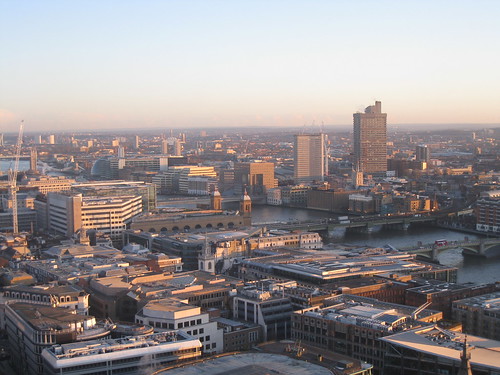
 
London from St Paul's Cathedral; there are networks there,
if you know where to find them
The answers, of course, don’t lie entirely in road layout. London has, for example, the Central London congestion charge, which over the last 12 years has sharply cut the numbers of vehicles entering Central London daily. Thanks partly to Sheldon Silver – the recently-disgraced former speaker of the New York state senate – New York lacks such a mechanism to keep through traffic out of lower Manhattan.

Public transport in London is also far more expensive than in New York, making a switch to cycling far more attractive financially.

London’s streets are, in addition, far safer than New York’s, even if that’s damning London with faint praise. For 2013, the last full year for which figures are available, there were 294 road fatalities in New York, which has a slightly lower population than London, including 168 pedestrians and 10 cyclists. In London in the same year, there were 132 road deaths in total, including 65 pedestrians and 14 cyclists. London’s far higher cycling rates make it clear that it’s a far safer place to ride per mile travelled than New York.

Yet one of the biggest parts of the answer, I’d suggest, can be found in thinking about the fate of the Boeing 747. The jumbo jet, hugely successful though it has been, faces phasing out at least partly because it was designed for an era when airlines sought consistently to operate “hub-and-spoke” services, feeding traffic from around a given region into a hub. Passengers would be transferred at those hubs onto long-haul flights on airlines’ hyper-efficient 747s.
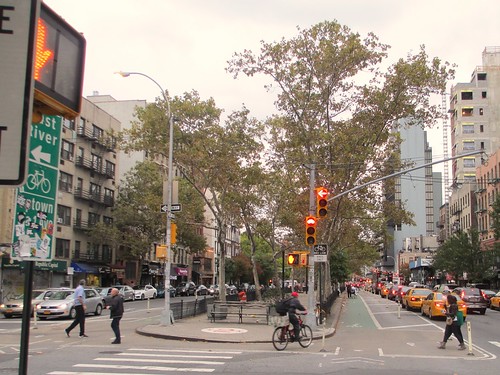
The Allen St bike lanes: enjoy the view, wistful Londoners -
but be sceptical this picture tells the whole story
The jumbo is suffering partly, analysts say, from improving efficiency - the biggest 777 aircraft can carry pretty much as many people with just two engines. But it is also losing out to aircraft such as the Boeing 787 and Airbus A350 that can fly long distances but are far easier to fill up. It’s much simpler with such aircraft to offer passengers direct flights from the city where they’re starting out to the city on another continent where they want to go. It turns out passengers don’t crave the excitement of running to transfer between flights at big hub airports, worrying whether their baggage is being treated with the same urgency. There's a growing preference for going the lowest-stress, most direct route.
 
New York, I’d suggest, has done an excellent job of sorting out a few key hubs for a network – protected lanes up Allen St and along Sands St sorting out some of the trickiest approaches to the Manhattan Bridge, for example. There’s a protected bike lane along Prospect Park West funnelling cyclists through Park Slope. There are bike paths along parts of the two sides of Manhattan. New York has provided the Atlanta-Hartsfield or London Heathrow type hubs and some of the routes that link them. But the system features too many disconnects – too many frantic dashes across the system’s gaps – to offer a full range of comfortable, point-to-point journeys.

First Avenue’s bike lane – often praised as a good example of recent improvements – disappears suddenly for 10 blocks (or half a mile) between the United Nations and 59th Street, pitching cyclists into chaotic motor traffic climbing towards the Queensboro Bridge. Worse still, anyone who has successfully cycled to the Upper East Side and is wondering how to head south again will find not even a painted bike lane for more than three miles on 2nd Avenue between 100th St and 34th St. The 8th Avenue bike lane disappears for five blocks around the Port Authority Bus Terminal, the chaotic point on the trip where cyclists are most in need of protection. The 9th Avenue bike lane disappears for a couple of blocks around Penn Station. There are more.
 
A sharrow marks a bike route in St George, Staten Island:
this look like part of a network to you?
Instead of a network, New York has built a series of sections of bike lane, with noisy objections to the loss of parking or some other complexity keeping the sections all too often separate from each other. The regular changes in colour of the routes on the city’s bike map – indicating a change from a protected lane to a painted lane, to mere “sharrows” then back – are testament to New York officials’ weakness in the face of noisy, local protest. Perhaps the emblematic failure relates to the Hudson River Greenway. It’s one of the safest, most comfortable to use bike facilities in the city. But nearly every means of accessing it south of 59th St involves a suicidally dangerous manoeuvre amid lines of fast-moving cars seeking to reach the West Side Highway.

It’s little surprise that, presented with confusing routes that disappear in the most dangerous places, relatively few New Yorkers are taking up the invitation to start cycling.

When I lived in London, by contrast, my head was full of the routes – often complex and roundabout, admittedly – of the London Cycle Network. The LCN – now out of fashion, since its introduction was overseen by Ken Livingstone, the former mayor - follows routes mainly along back streets across the city. It is so comprehensive that, by the time I left London, I could do 30-mile round trips on it without consulting a map. London’s existing Cycle Superhighways – appallingly designed as most are – at least seek to provide routes that take people to places. Both reflect what seems to me a greater tendency on the part of London’s planners than New York’s to think in terms of routes, not isolated projects.
Southwark Bridge, London: a key part of my mental map
of London's cycling networks

This week’s decision by Transport for London, the London mayor’s transport body, to go ahead with a comprehensive network of segregated bike paths should make the position far, far better. Unlike New York’s rather disjointed system, they should act more and more like the most efficient networks – like metro systems that draw commuters in from distant suburbs into heavily-used, highly-efficient core areas or express parcel networks. Such networks’ strength is their comprehensiveness – well-planned new metro lines generate disproportionately high numbers of journeys because they unlock new point-to-point journeys both on the existing network and the new line. London’s networks, at least in theory, aim to provide a reasonably consistent journey for a high proportion of the trips in the city that are possible by bicycle.
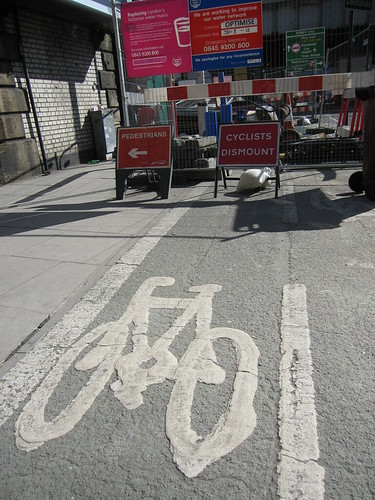
 
A London cycle path: an example of
the "infrastructure" that made me once
doubt infrastructure was the answer
Not, of course, that the simple dichotomies are the whole story. London’s cycle planners are, I know, prone to some of the same shortcomings as those in New York. I so despaired when I lived in London of the dire quality of much of the existing cycle infrastructure that I preferred an approach that sought to make onroad cycling safer. The roundabout, backstreet routes I often used are so circuitous that many simply won’t use them. In thousands of rides past South London’s busy Elephant & Castle interchange, I took one of the avoiding routes off the main roads every single time. To many other people, that route is so painfully slow that they prefer the main roads, where there are regular deaths.
New York’s project-based approach has at least improved some of the biggest barriers to cycling, even if it has always joined the bits together. I find the experience of mixing with fast-moving traffic on multi-lane New York streets sufficiently scary that I welcome any relief from it. I also understand, given the challenges of getting anything meaningful done in New York, why Janette Sadik-Khan - the city’s former, much missed, transportation commissioner – focused so hard on some flagship projects. The projects have proved resounding successes – had she sought to turn the projects into perfectly-realised networks, she could easily have become bogged down in the bureaucratic malaise that seems to have swallowed Polly Trottenberg, her well-meaning successor.
 
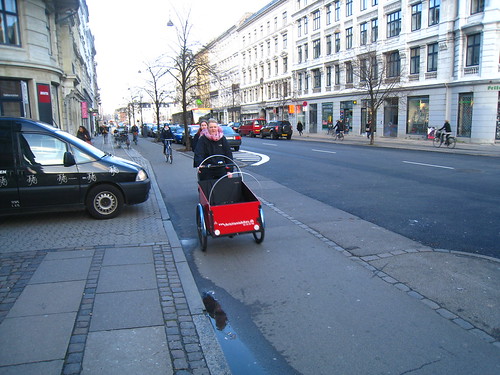
Copenhagen: an acutal cycle network, in magnificent action
Nevertheless, New York currently risks, it seems to me, watching from the sidelines as London’s new network of protected routes turns the city’s existing provision into a still more successful network. It’s hard to imagine New York’s achieving anywhere close to its target of having 6 per cent of trips by bikes by 2020 until it starts taking the challenges of providing a real network seriously.

Ms Trottenberg may be about to start tackling the issue in earnest, even if her department's record of retreat on markings for "slow zones" suggests otherwise. But the history of the Bleecker St – Broadway-Lafayette station on the New York City subway is a stark reminder that such changes don’t happen on their own in this city. The city’s IND subway network built Broadway-Lafayette station in 1936 immediately under Bleecker St station of the Interborough Rapid Transit Corporation. In 1940, the city subsequently took over the IRT and its rival BMT subway, forming them with the IND into an allegedly unified system enjoying the benefits of being a single network. Yet it was only in June 2012, after I arrived in New York, that a full connection between the two stations – which had sat immediately adjacent to each other for 76 years – was finally opened.

If New York is serious about encouraging more than a hardy band of souls to cycle round the city, changes to its cycling infrastructure cannot possibly take that long.

Sunday, 14 April 2013

A broken-down church - and a broken, asymmetric flow of information

I was only a little way into my first ride to work after moving into my apartment in Brooklyn when I started to get into a terrible tangle. Trying to get down Kane Street, in Cobble Hill, I found the road marked closed. After heading past the road cones, I found it was a proper road closure, not the kind where one just wheels the bike on the sidewalk past the obstruction. The closure was absurd, I muttered to myself, as the one-way system pushed my route further and further from the one I’d planned. It was, I reasoned, probably some piece of stupidity on the part of the police, worried about being sued over an unlikely accident near some relatively innocuous building work.
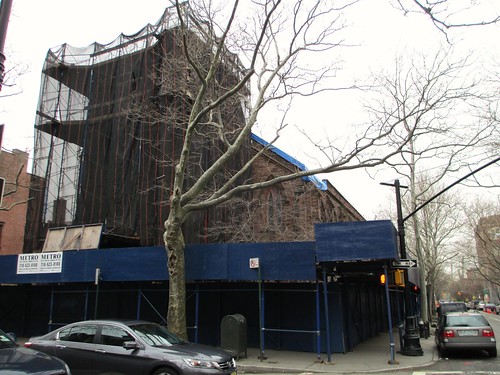
Christ Church, Cobble Hill: source of frustration on
the Invisible Visible Man's commute

I calmed down considerably, however, after finding out via Google why the street was closed. On July 26, while I had been back in Europe, lightning had struck Christ Church, the Episcopal church at the junction of Clinton Street and Kane Street. The spectacular tower – and scaffolding around it – had come crashing down as Richard Schwartz, a pedestrian, was walking underneath. The falling scaffolding had killed him. The building was a serious danger – and hadn’t yet been made safe.

The incident helped to crystallise an idea that had been slopping in fluid form around my mind for a while. I’d never have been irritated about the Kane St closure, I realised, if I’d had better information in the first place. It was, it occurred to me, one of many instances where confusion arises because two different parties – the New York City Department of Transportation and myself, in the Kane Street case – have different understandings of what’s going on on a road. The asymmetric information sharing had at least left me only inwardly irritated, however. The more I thought about it, the more I realised there were times when such information asymmetry probably killed people.

I encountered one potentially serious example the other morning while riding to work. I waited at traffic lights by the start of the Tillary Street segregated bike lane near the Brooklyn Bridge. When the lights changed, I moved off, only to find turning across my path a car heading in the other direction that should have been yielding to me. The driver’s behaviour was entirely wrong, based on his failure to understand what I knew - that the bike lane was as much part of the traffic flow at the intersection as the roads he was using. But, as he moved across my path, he leant out of his window. “Green light!” he yelled at me, self-righteously.

Traffic on W54th street. Those tainted windows don't,
in the Invisible Visible Man's experience, conceal
motorists pondering hard what information they might lack
about other road users' rights
Cycle lanes can give rise to information asymmetry as well. As I approached my office one morning last month, a truck driver opened his door in my path as I made my way up the side of some stalled traffic. He didn’t need to look for cyclists on that side of W54th street, he argued, because there was a bike lane painted down the other. Because of our asymmetric understanding of cyclists’ road rights, he had understood the cycle lane – which I knew to be a refuge for cyclists that didn’t stop me from using the rest of the road – as a kind of prison, to which cyclists should be confined.

Perhaps the most striking and persistent problem of information asymmetry that I’ve come across, however, was in London, where I lived until last August. Most traffic lights at busy intersections in London feature an “advanced stop line” for cyclists – an area where cyclists are meant to wait ahead of the other traffic for the lights to change. Many cyclists value advance stop lines as an idea, since they should, in theory, allow cyclists to get away after lights change, get clipped back into their pedals and get back into a suitable line on the road before the motor traffic catches up. Few motorists, however, seem to have much idea either about the principles of the advanced stop areas or when they should stay out of them. At least one motorist informed me, indignantly, when I complained about his occupying the area that when he’d arrived there had been no cyclists waiting, so he’d simply driven into the bike area.

Advance stop lines were involved in all three of the worst confrontations I had with motorists in London. In one case, a motorist deliberately drove very close to me and then very dangerously overtook me after I remonstrated with him about his driving into the ASL area as I was using it. A bus driver assaulted me (abandoning a bus full of passengers to do so) after I photographed his occupying the ASL area at a particularly dangerous junction. I had to call the police to stave off a threatened assault from another motorist to whom I’d complained about his driving into the ASL area.

Leaving aside the more eye-catching incidents, ASLs were a daily source of tension and frustration. I’d often squeeze past a line of stationary traffic to reach what was meant to be a haven for cyclists – only to fill it full of motorists grumpy at one’s presumption in seeking to get a jump on them at the lights. It’s reasonable, I think, to assume that even a fairly modest publicity campaign might have let at least a little of the fresh air of information into the foetid atmosphere of confrontation surrounding ASLs. In New York, it surely wouldn’t take much of a campaign to educate drivers about the role of bike lanes and the dangers of passing bikes too close to improve driving standards at least a little bit. The New York cycling map, after all, features excellent advice for cyclists on how motorists should give cyclists at least three feet's clearance when passing.

It isn’t, after all, a neutral thing to encourage new cyclists onto a city’s streets and then not tell motorists how to behave around them. Nature seems to abhor an information vacuum just as much as a literal one. In the absence of the pure oxygen of accurate, well-founded information, the information vacuum fills up with the carbon-monoxide-laden air of motorists’ assumptions about cyclists’ rights and responsibilities. It’s perhaps hardly surprising, given that no-one’s telling them otherwise, that so many motorists assume cyclists who ride well outside the door zone away from cars are acting maliciously, rather than entirely sensibly. In New York, it’s still less surprising given how many bike lanes – including most of those I use every day – are painted in precisely the part of the road – next to the parked cars’ doors – that cyclists know to be the most dangerous.

The air has grown still more poisoned because the agency meant to set the limits of acceptable behaviour in most modern societies – the police force – so often seems to have abandoned that role with regard to the road rules. Motorists, after all, like most other people see what they see others doing unmolested and assume it’s acceptable. One telling recent case I spotted involved a police effort to start fining motorists who drove in a bike lane on a narrow street at Twickenham, in South-West London (I’ll give New York cyclists a moment here to come to terms with the idea that, just across the Atlantic, there’s a police force that has, at least once, acted against motorists using a bike lane). A local newspaper quoted Nick Blyth, an officer involved in the enforcement effort, as saying: “Most of the motorists tend to comment when stopped that everyone else does it and they were just following them.”
 
Park right across one of New York City's busiest bike lanes?
Until someone says you shouldn't, you probably will.
It’s hardly surprising, given the New York Police Department’s reluctance to enforce a wide swathe of road rules, that few motorists seem even to understand the harm they cause when double-parking in bike lanes or refusing to yield to a cyclist in a bike lane. Nor, in London, is it terribly surprising that ASL infringements continue at the rate they do when even the Metropolitan Police department charged with processing complaints against motorists from cyclists (normally backed by helmet camera evidence) is currently pleading with leading London cycle bloggers to tell people to send in no more pictures of ASL infringements. They say, to all intents and purposes, they’ve no interest in prosecuting them.

The police’s attitude reflects, in an understated way, the strangeness of the political discourse around cycling. Politicians are eager, when announcing new policies between elections, to borrow cycling’s mantle of greenness and modernity and to encourage its growth. Closer to election time, meanwhile, many seem to revert to a different type – to claiming, like one minister I met, that cyclists were“their own worst enemies” or claiming like Boris Johnson, London’s mayor, that “typical” cyclists had skinny legs and ran red lights. No politician engaged in this delicate dance between pro and anti-cycling positions is likely to back a public information campaign explaining to frustrated motorists why, yes, that cyclist who yelled at you about your dangerous driving actually had an excellent point.

However, until such information is made more widely available and police across the industrialised world are backing up the politicians’ line with proper enforcement, few people will experience the relief I felt at letting go of my frustration over the Kane St closure. Relief is certainly not the emotion that comes naturally to me each morning as I ride along the now-reopened Clinton St towards the Brooklyn Bridge. I am all too often forced into the narrow bike lane, in danger from car doors, as motorists seek to push past me. But, as I reach the Kane St intersection and see Christ Church, still wrecked but now made safe, I still recall at least a little bit of that feeling.

Monday, 11 February 2013

Staten Island and why the Invisible Visible Man is the Opposite of a Canary

It was a brief taste of how most of suburban America and Europe lives and it wasn’t, frankly, terribly pleasant. This past Wednesday, for work reasons, I took my bike and, for only the second time in my life, travelled by ferry to Staten Island, an island off the New Jersey shore that historical accident has made part of New York City. Having mostly developed only in the 1960s after the opening of the Verrazano Narrows road bridge to Brooklyn, it was designed around the private car far more than other parts of the city. It’s the nearest thing in New York City to a chunk of true American suburbia – featureless apart from occasional strip malls and criss-crossed by wide, fast-moving, multi-lane expressways.
A shared cycle route marking in St George: much the likeliest
way to see a bike on the road in Staten Island

I began to have concerns about cycling conditions even before I was properly out of St George, the borough’s capital. A bus driver drove at me, apparently astonished that my being ahead of him in traffic meant I thought I should go first through a pinch point. Later on, I started to wonder if I had put myself in serious danger. Unable to use the seafront cycle path – still blocked with sand from Superstorm Sandy – I headed inland along long, straight six-lane avenues. The 30mph and 35mph speed limits on these roads seemed to be regarded as minimum permissible speeds. Encountering a cyclist, such drivers simply drove straight on, at speed, towards the bike, on the apparent assumption the cyclist would scuttle out of the way.


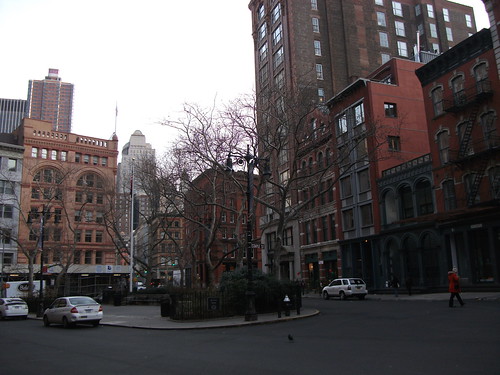
Duane Square, TriBeCa: not specifically cycle-friendly
- but not hostile either
But I probably shouldn’t have found the conditions surprising. While I have multiple complaints about cycling conditions in brownstone Brooklyn and Manhattan – the places where I currently mostly ride – and in London – where I used to ride – these are actually atypically cycle-friendly environments. Many roads are narrow – inhibiting drivers’ tendency to speed – and the traffic’s sheer volume makes the speeds on Staten Island mostly impossible. The obvious attractions in such an environment of the bicycle – which can slip along such streets while cars remain gnarled in traffic jams – have contributed to recent years’ rapid growth in inner-city cycling numbers. Better provision is slowly arriving in the wake of increased cycling.

Conditions on Staten Island are far more typical of the places that most rich countries’ inhabitants live. Such places provide most inhabitants with a house on its own plot of land – but suffer from the sheer volume of traffic that sprawling, low-density cities generate.  I’ve encountered similar conditions in parts of commuter-belt Oxfordshire, Cheshire and Scotland’s central belt. Cyclists tend not to give much thought to such places for the simple reason that very few cyclists live in them.

The natural reaction might be to conclude that cycling is impossible in such places, to avoid visiting them as far as possible and to leave the bicycle behind when circumstance forces one to do so. The only alternative is a wholesale rethink of the car’s role in such societies.

It’s often said that cycling children are a kind of “canary-in-the-coalmine” of cycling policy. If you disperse pretty much every danger factor for cyclists in your city, you’ll find primary school children riding to school. Let even a few of them creep back and the kids will disappear.

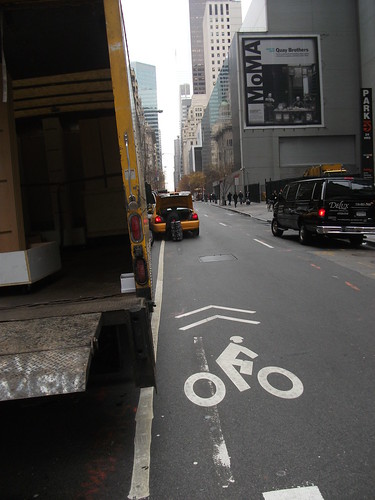
After his Staten Island visit, the Invisible
Visible Man will hardly complain in future
about scenes such as this in Manhattan.
By that standard, I’m closer to being the explosion in the coalmine. I regularly cycle along fairly busy, high-traffic roads, including fast-moving dual carriageways in the UK. If the danger factors somewhere have built up to the point somewhere that they’re intimidating me, it’s a reasonable sign cycling conditions are seriously, dangerously hostile.

I mostly managed in Staten Island to stick to the principle that a cyclist should boldly take the lane and force motorists to manoeuvre safely around him. But even I at points hugged closer to the kerb than normal, darting out into the threatening traffic mainly to get round obstructions such as parked cars. It felt hard to keep taking the lane on seeing a line of fast-moving SUVs, three abreast, bearing down on one, giving no sign whatever of yielding to a cyclist in front of them. I wasn’t confident I wanted to waste my dying breaths explaining to some over-sized car’s driver precisely why my road craft should have prevented him from running me over.

So is there an alternative for cyclists to the appalling conditions that currently exist in Staten Island and many other suburban areas? One standard cycling lobby answer is to argue that entirely separate cyclist provision is needed and that to call for anything less is counter-productive. Cyclists and such heavy, fast-moving traffic can never co-exist.

Yet I left Staten Island doubting that calls for a network of dedicated cycle lanes on Staten Island would get very far under current conditions. I saw, as far as I can recall, one other cyclist during an afternoon and early evening on the island. It’s hard to see that a democratic society can risk spending heavily to create facilities for a group – Staten Island utility cyclists – that might not even emerge in the end. That’s all the more the case at the moment, when my cycle route took me past large tracts of shoreline land that remained flooded and empty in the wake of Sandy’s devastation of the island. Even as a dedicated cyclist, I think finite budgets at the moment are best spent on ensuring all Staten Island’s people again have waterproof, heated houses.

There are nevertheless compelling reasons beyond encouraging cycling to stop the cancer of car-dependence from draining the life out of Staten Island. The wide, uncalmed roads, it was clear, were intimidating away people other than cyclists. I saw just as few people walking the sidewalks of the busiest roads as I saw people cycling. The excellent “weekly carnage”feature on Streetsblog, the transport website, features regular stories of Staten Island’s elderly and other vulnerable people crushed by motor vehicles refusing to yield at corners. Many of those fast-moving vehicles end up ploughing into each other, at a high human cost. There’s every reason even for someone who’s not a cyclist to support the installations of road designs that slow drivers down and speed cameras.

Ideally, the United States would increase fuel taxes to cover more of the costs cars impose on places such as Staten Island. A rational system of per-mile charging could calm down the worst of the congestion. Research suggests that cars might even get where they’re going faster under such a regime than they do at present.
Manhattan approaching, from the Staten Island ferry:
a welcome sight, from a cyclist's point of view

A new approach to cars would, of course, produce a better environment for on-road cycling too. It’s far from impossible that in Staten Island calmer, less threatening roads might start to entice out of their hiding places some of the bikes that must be lying unused in the borough’s homes. The island might start participating more fully in the cycling boom that’s taking place, to varying degrees, in New York’s other four boroughs. That, in turn, might make it easy to justify new cycle-only lanes for some future reporter who finds himself heading to a distant corner of Staten Island on an assignment.

As it was, finding dark had descended and contemplating the prospect of a 10½ mile ride on threatening roads back to the ferry, I took, unusually, the line of least resistance. Fending off threatening cars, I rode half a mile to the nearest Staten Island Railway Station and, my bike leaning against my seat, took in the island’s night-time lights as most of its inhabitants do – from within the comfort of a metal shell.

Sunday, 3 February 2013

A dead mayor, a live cycling boom - and why cycling might be back to stay

For new residents of New York City like me, there has been something almost mind-bending about the last couple of days. Ever since Ed Koch, the city’s mayor from 1977 to 1989, died in the early hours of Friday, obituaries have been transporting us back to an unrecognisable city. Drug addicts lie prone on Manhattan streets, looting breaks out when the power fails and the subway is celebrated mainly for the range and inventiveness of its graffiti. It’s hardly surprising that the person who pitted himself against this chaos had a personality as pathologically extroverted as our current mayor’s is buttoned-up and controlled.
Sixth Avenue: bike-lane-less, as Ed Koch
preferred it on mature consideration

But, for a newcomer who’s a cyclist, one detail of the Ed Koch saga highlights a particularly striking change in the city. In 1980, at the height of the second oil price shock, Koch ordered the installation of segregated bike lanes on Fifth, Sixth and Seventh Avenues and Broadway in Manhattan. Then, only weeks later, having been ridiculed for his bike lane “fetish,” Koch had the lanes torn out again. He went on, in 1987, to try to ban cycling altogether from mid-town Manhattan. While that set-back took years to overcome, Koch nevertheless died in a city criss-crossed by a growing network of bike lanes. Installation is moving – despite setbacks as Nimbys in some neighbourhoods oppose new lanes - so fast that my 2012 NYC cycling map already feels quite badly out of date.

Thinking about that sharp turnaround – a tribute to the commitment of Michael Bloomberg, the current mayor, and Janette Sadik-Khan, his transport commissioner - has linked up in my mind several hopeful signs for cycling over the last couple of months. In both the US and the UK – the countries where I’ve done most cycling – cycling numbers are going up and official acceptance of cycling appears to be growing.

The question is whether this is a fundamental, long-term shift or just another short-term bit of faddism like Ed Koch's.

A Detroit Madison Street: borrowed chic for Lincoln
The question brings to my mind a mental picture of a copper-and-black Detroit Bicycle Company fixed-wheel bike. As someone who likes both gears and highly practical bikes, it’s not a machine I aspire to own. But I came across the bike – a Detroit Madison Street, trivia fans – in the unlikely setting of the Lincoln stand at Detroit’s annual North American International Auto Show. It was being held up as an example of the kind of finely-made luxury product of which Lincoln – which is trying to relaunch itself as a desirable luxury marque – approved.

Still more remarkably, it was one of quite a few bikes I spotted around the show floor.  The Smart stand boasted an E-Bike, which the manufacturer will be selling, while Toyota displayed a concept for a conventional bike. Kia was showing a small-wheeled bike that it sells in Korea, while Hyundai had a fixed-wheel bike sticking out the  back of a coupe. Subaru had stuck a couple of mountain bikes on the roof rack of one of its vehicles.

The unmistakeable impression was that carmakers thought bikes now had a certain cachet – which they wanted to borrow. Compare that with how the UK’s Raleigh in the 1960s felt it had to ape motorbike design to get kids to ride bikes.

The bikes’ presence on the automakers’ stands struck me all the more forcibly because of an article I’d written in my day job just before Christmas. It detailed how all the Detroit Three big automakers – General Motors, Ford and Chrysler – were struggling to reverse or live with recent years’ steep decline in young people’s learning to drive and subsequent buying of cars. Part of the carmakers’ problem stems from a gradual revival in recent years of the US’s inner cities – which are less littered than they once were with unconscious drug addicts - and, for some of the residents, a drift away from cars and towards bicycles. It’s the kind of gain for cycling that would have been scarcely imaginable in most industrialised countries 25 years ago when Mayor Koch was trying to ban cycling altogether.

A YouTube video posted by Gaz, a keen helmet-cam user reminded me that the process has already gone far further in the UK. His video – shot one recent January day – showed 50 cyclists on one short stretch of Cycle Superhighway 7 (a former Roman road, as it happens). If so many people are cycle commuting in January, Gaz suggests, the spring and summer are likely to see London’s highest cycle commuting numbers in many years.

Kent Ave, Williambsurg: Denis Hamil wants
those bike lanes gone
The worry, of course, is that cycling also looked so much like the coming thing in 1980 that a gadfly populist such as Ed Koch briefly took the risk of backing it. If car companies thought there was a way other than sticking two bikes on the roofrack to show their car was associated with an outdoor, aspirational lifestyle, I’m sure they’d happily use it. Denis Hamil, a columnist in the New York Daily News last week said he would support any mayoral candidate who promised to scrap the current crop of bike lanes. One of the likeliest contenders for mayor – Christine Quinn, a Democrat – has sought to appease bike lane haters by saying lanes are “controversial” and advising people not to discuss them at dinner parties.

In London, even Boris Johnson, the mayor, who is a daily cyclist, fell before the last mayoral election into the trap of caricaturing cyclists as dread-locked red-light jumpers. As with road safety – where the current UK government has reversed years of steady improvements by cutting funding for speed cameras – there is always a risk that someone will take steps that reverse apparently inexorable progress in a positive direction.

It doesn’t, for what it’s worth, feel as if such a step is coming immediately either here in New York or in the UK. Concern about the environment, changes in living patterns, concern about health and cycle technology improvements are all conspiring to make this cycling boom feel far more solid and longer-lasting than the second oil shock one.

Yes, cycling's made progress. But, as long as FedEx drivers
think across one of  New York's busiest bike lanes is a good place
to park, it won't be mainstream
But it’s worth remembering that, even after recent years’ quadrupling of New York cycling numbers and the last decade’s doubling in London, riding a bike remains a fringe pursuit that’s far from winning mainstream acceptance.

That point came home to me particularly clearly one Friday night just before Christmas. Riding home around 10pm down W55th street from my office, I was surprised to find a limousine pull up next to me and wind down its window. Inside was a curious tourist who couldn’t understand what I was doing. No, I told him, I wasn’t delivering anything. Yes, I was just riding home from my office.

Recognising that he wasn’t going to get to the bottom of it, he finally said: “Just seems kind of… European.”

The incident set a new mental benchmark for me for cycling in New York and other big cities where it’s still not one of the main modes of travel. Cycling, I’ve decided, will finally be mainstream when an encounter with a commuter cyclist is no longer one of the “darndest things about New York” that a returning tourist recounts to his friends in Peoria.