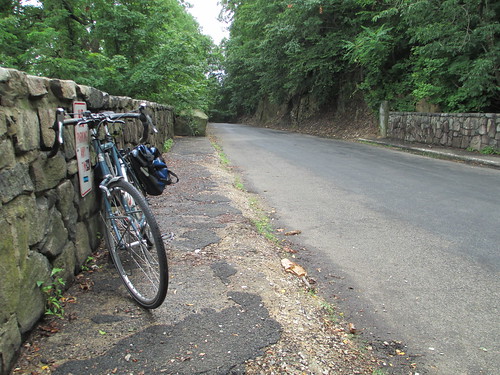
It was far from being the most dignified manoeuvre I’ve ever
made on a bicycle. Around 9.25am on January 29, as I rode to work down Prince
St in lower Manhattan ,
I heard a garbage truck approaching me from behind, its driver blaring the horn. Since the
bike lane was still full of snow and I was in the middle of the street’s single
travel lane, I was immediately in the vehicle’s path – and fearful the driver
wouldn’t stop before hitting me. I pulled over into a clear patch of the bike
lane, jammed on my brakes and apologised to the cyclist following me for
pulling across her path. The garbage truck careered past.
 |
| A bike on Vandam Street, SoHo, testifies to my fellow cyclists' enthusiasm for tackling New York streets in the snow |
The next morning, chastened by my experience and with fresh,
light snow falling, I decided to mix with motor vehicles as little as
practicable, to ride over the Brooklyn Bridge , through TriBeCa
and up the Hudson River Greenway, which had been well cleared of snow the night
before. But, when I pulled onto the Greenway, I found there had been no new
treatment following the light overnight snow. I rode very gingerly uptown,
worrying that the layer of slushy slow would cause my tyres to lose their grip.
The two experiences encapsulated the challenge that even I,
a fairly hardy cycle commuter, face when trying to get around a city by bicycle,
especially in winter. I need a network of viable routes I can follow to get
places. I’m more likely than many people to regard a route that includes
jostling with motorists or that isn’t marked as a bike route “viable”. Yet people
unused to city cycling or in areas with poor infrastructure probably spend most
of the time feeling the way I do when there’s snow and ice about. It’s as if
the subway offered a choice of only highly circuitous routes or routes that
stop every few blocks and required one to walk.
 |
| The Hudson Greenway after snow: a slippery connection in the network |
The realisation explains a fundamental disconnect I’ve
noticed in perceptions of New York ’s
efforts to boost cycling. I regularly hear from cyclists in other places –
particularly London – who’ve seen pictures of New York ’s flagship
cycle infrastructure projects and been impressed with the city’s apparent
commitment to boost cycling. Few accept my reply that, since only 1 per cent of
commuter trips in New York are by bicycle, the efforts are at least
partially failing. “At least it’s better than we’ve got here,” they tend to
reply, gazing longingly at pictures of the Prospect Park West bike lane or Allen St .
Still fewer correspondents contacting me from London accept my follow-up
point. Although London currently lacks many showpiece,
well-designed facilities to match the best in New York ,
I point out, 4 per cent of commuting trips in London are by bicycle. There is clearly some
aspect of cycling policy in London – bedevilled as it has been by a lack of boldness and a reliance on dubiously effective road
markings – that has proved vastly more successful than New York ’s approach. The question is what’s
making the difference.
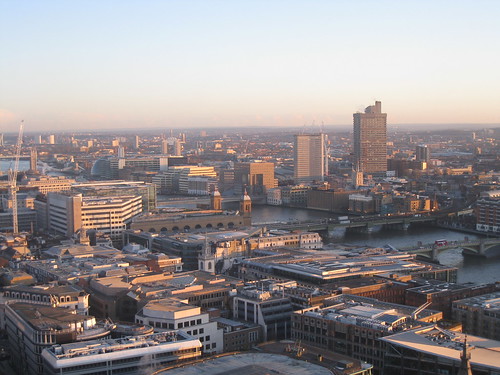 |
| London from St Paul's Cathedral; there are networks there, if you know where to find them |
The answers, of course, don’t lie entirely in road layout. London has, for example, the Central London congestion
charge, which over the last 12 years has sharply cut the numbers of vehicles
entering Central London daily. Thanks partly
to Sheldon Silver – the recently-disgraced former speaker of the New York state senate – New York
lacks such a mechanism to keep through traffic out of lower Manhattan .
Public transport in London is
also far more expensive than in New
York , making a switch to cycling far more attractive financially.
Yet one of the biggest parts of the answer, I’d suggest, can
be found in thinking about the fate of the Boeing 747. The jumbo jet, hugely
successful though it has been, faces phasing out at least partly because it was designed for an
era when airlines sought consistently to operate “hub-and-spoke” services,
feeding traffic from around a given region into a hub. Passengers would be
transferred at those hubs onto long-haul flights on airlines’ hyper-efficient
747s.
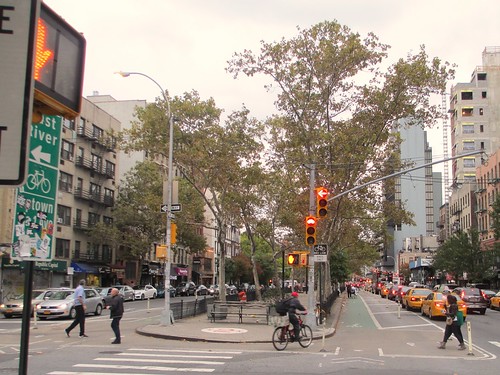 |
| The Allen St bike lanes: enjoy the view, wistful Londoners - but be sceptical this picture tells the whole story |
 |
| A sharrow marks a bike route in St George, Staten Island: this look like part of a network to you? |
Instead of a network, New
York has built a series of sections of bike lane,
with noisy objections to the loss of parking or some other complexity keeping
the sections all too often separate from each other. The regular changes in
colour of the routes on the city’s bike map – indicating a change from a
protected lane to a painted lane, to mere “sharrows” then back – are testament
to New York officials’ weakness in the face of noisy, local protest. Perhaps
the emblematic failure relates to the Hudson River Greenway. It’s one of the
safest, most comfortable to use bike facilities in the city. But nearly every
means of accessing it south of 59th
St involves a suicidally dangerous manoeuvre amid
lines of fast-moving cars seeking to reach the West Side Highway.
It’s little surprise that, presented with confusing routes
that disappear in the most dangerous places, relatively few New Yorkers are taking up
the invitation to start cycling.
When I lived in London ,
by contrast, my head was full of the routes – often complex and roundabout,
admittedly – of the London Cycle Network. The LCN – now out of fashion, since
its introduction was overseen by Ken Livingstone, the former mayor - follows
routes mainly along back streets across the city. It is so comprehensive that,
by the time I left London ,
I could do 30-mile round trips on it without consulting a map. London ’s existing Cycle Superhighways –
appallingly designed as most are – at least seek to provide routes that take people
to places. Both reflect what seems to me a greater tendency on the part of London ’s planners than New York ’s to think in terms of routes, not
isolated projects.
 |
| Southwark Bridge, London: a key part of my mental map of London's cycling networks |
This week’s decision by Transport for London ,
the London
mayor’s transport body, to go ahead with a comprehensive network of segregated bike paths should make the position far, far better. Unlike New York ’s rather disjointed system, they
should act more and more like the most efficient networks – like metro systems
that draw commuters in from distant suburbs into heavily-used, highly-efficient
core areas or express parcel networks. Such networks’ strength is their
comprehensiveness – well-planned new metro lines generate disproportionately
high numbers of journeys because they unlock new point-to-point journeys both
on the existing network and the new line. London ’s
networks, at least in theory, aim to provide a reasonably consistent journey for
a high proportion of the trips in the city that are possible by bicycle.
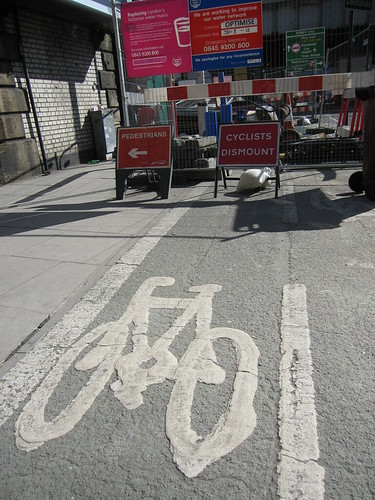 |
| A London cycle path: an example of the "infrastructure" that made me once doubt infrastructure was the answer |
Not, of course, that the simple dichotomies are the whole
story. London ’s cycle planners are, I know,
prone to some of the same shortcomings as those in New York . I so despaired when I lived in
London of the dire quality of much of the existing cycle infrastructure that I
preferred an approach that sought to make onroad cycling safer. The roundabout,
backstreet routes I often used are so circuitous that many simply won’t use
them. In thousands of rides past South London ’s
busy Elephant & Castle interchange, I took one of the avoiding routes off
the main roads every single time. To many other people, that route is so
painfully slow that they prefer the main roads, where there are regular deaths.
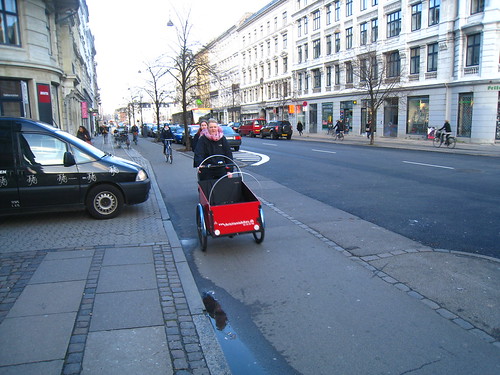 |
| Copenhagen: an acutal cycle network, in magnificent action |
Nevertheless, New York
currently risks, it seems to me, watching from the sidelines as London ’s new network of
protected routes turns the city’s existing provision into a still more
successful network. It’s hard to imagine New York’s achieving anywhere close to
its target of having 6 per cent of trips by bikes by 2020 until it starts
taking the challenges of providing a real network seriously.
Ms Trottenberg may be about to start
tackling the issue in earnest, even if her department's record of retreat on markings for "slow zones" suggests otherwise. But the history of the Bleecker St – Broadway-Lafayette
station on the New York City
subway is a stark reminder that such changes don’t happen on their own in this
city. The city’s IND
subway network built Broadway-Lafayette station in 1936 immediately under Bleecker St station
of the Interborough Rapid Transit Corporation. In 1940, the city subsequently took over
the IRT and its rival BMT subway, forming them with the IND into an allegedly unified
system enjoying the benefits of being a single network. Yet it was only in June
2012, after I arrived in New York ,
that a full connection between the two stations – which had sat immediately
adjacent to each other for 76 years – was finally opened.
If New York