Showing posts with label New York City cycling. Show all posts

Monday, 23 May 2016

A cancelled bike lane, a crowded F Train - and why New York planning has to start muting the noisy

A few times recently, while cycling in Queens I’ve taken routes that carried me across Queens Boulevard – once known as the “Boulevard of Death,” for its dreadful safety record – and seen some of its smart new bike lanes. But I’ve never actually used them, for a simple reason. While Queens Boulevard goes to some useful places, the current, 1.3-mile stretch of bike lane doesn’t link up to anywhere I want to go.
A sign points towards the Queens Boulevard bike lanes -
or, as Community Board 4 would have preferred,
the bike path to practically nowhere.

If Queens’ Community Board 4 had had its way, that arrangement would have continued. In a vote on May 10, members of the board – a strange, officially-sponsored but still only advisory and unelected local planning committee – voted to approve safety improvements for their stretch of the boulevard, the 1.2 miles immediately east of the existing bike lanes. But they voted to remove the bike lanes from the project (cyclists’ safety should be an “afterthought”, one member said). The step prompted bafflement and outrage because it threatened not only the stretch of the road in Community Board 4 but the whole effort to turn the Boulevard of Death into a less forbidding space.

Yet the story of CB 4’s bike lanes stands out in New York City’s transport planning only because of how the story ends. The decision was so obviously contrary to the public interest – and so procedurally flawed - that Bill de Blasio, the mayor, unusually found the courage to overturn the board’s recommendation the next day. He instead ordered the Department of Transportation to continue developing the improvements with the bike lanes intact. Plenty of other changes that would improve the city as a whole get blocked because a noisy handful of people on a community board or  other  group object loudly enough that the greater good doesn’t prevail. Two other bike lane projects have fallen foul of such objections just this month.
 
"What do you mean the city's transport is poorly planned?
"Oh, I see."
The question is whether it’s a bug or a feature of New York’s democracy – and that of many other places around the world – that relatively small, vocal groups can either bring to life or kill projects in a way that damages the wider society. It’s the kind of argument familiar to anyone who’s spent time in India, where desperately-needed infrastructure projects are often held up by scores of pettifogging obstructions. Officials when challenged on this – and the stark contrast with China’s greater effectiveness at getting things done – tend to hold up their hands in defeat and say, “But we’re a democracy”.

True democracy, I think, should be more sophisticated than the crude system often practised in New York, where the noisy enjoy disproportionate influence over the apparent will of the less vocal majority. The current system unsurprisingly suits many of those who have grown up with it, however. After the mayor’s overturning of the CB4 decisions, Melinda Katz, the Queens borough president, put herself firmly in the democracy-is-the-right-to-block camp.

“Any action to install bike lanes along this stretch at this time, regardless of merit, would… understandably be perceived as an imposition by the administration, running directly counter to and overriding the Community Board’s explicitly-stated wishes,” Ms Katz said in a statement.

The bizarre case of F Train express subway service in Brooklyn highlights how illogical the effects of this kind of democracy can be.
A F Train leaves Smith-9th St after stopping: David Greenfield
dreams of the coming day when it'll zip past, whisking
his constituents home faster

The Metropolitan Transportation Authority, the state organisation that runs the subway, has been pressured into considering reintroduction of an express F subway service in Brooklyn – skipping all but a handful of stations in the inner parts of the borough – by a campaign by David Greenfield, a member of New York City council representing outer parts of the borough such as Bensonhurst and Borough Park. The idea has generally been regarded as a non-starter for practical reasons. Because capacity in Manhattan is restricted, any introduction of express trains would mean fewer local trains. Since the stations that have only local track platforms – including Smith-9th St, by my apartment - are mostly busier than those with express platforms, an express service would delay more people than it helped and increase overcrowding.

The MTA has nevertheless caved to David Greenfield’s campaign. On May 17, the subway operator announced its decision to restart service in 2017 alongside publication of a feasibility study that, to the casual reader, seemed stuffed with evidence that that was a terrible idea. While express service users would on average get a journey 3.4 minutes shorter, the study said, local train riders would be suffer an average 1.3 minute delay standing gazing at the new express service zipping by. Since there are more users of the local train stations and some could suffer serious overcrowding, it is hard to resist the conclusion that the new service is a retrograde step being taken solely for political reasons.
 
A sign apologises that some F Trains
are passing stations without stopping -
but today's service disruption could be
next year's service "enhancement"
In both the F Express and Queens Boulevard cases, small, geographically distinct groups have advocated for their needs to dictate how the whole of a particular bit of road or subway track is used. The Bensonhurst would-be express train riders will produce negative knock-on effects all along the line. Similarly, community board members who express horror about potential bike lanes’ effects on “their” parking spaces affect road users all along the corridor.

The current approach virtually ensures the city’s infrastructure works less efficiently, less safely and less fairly than it ideally would do. To become better-functioning, more effective democracies, New York and other big cities need the ability to plan carefully and to push through elements of the plan that will benefit the whole city even if small, vocal groups protest. There is a strong case for introducing a far more comprehensive process of strategic planning for the city to try to cut down on the number of wasteful subway services started and stranded, isolated bike lanes.

Change is particularly urgent because many of the problems facing the city require solutions to problems that affect nearly everyone a little but that a few noisy interest groups oppose. There can be little doubt, for example, that the congestion-charging system proposed under the Move New York plan would be at least as successful as London’s equivalent. But no noisy interest group is as interested in solving the problem as a handful of motorists are in continuing to drive free into Manhattan.

The city’s housing crisis drives up nearly everyone’s rent. But the interests of people who don’t want a new apartment tower next to their brownstone help to ensure it goes unaddressed. It’s no coincidence that road safety – which few people regard as a big problem for them personally – has suffered under the current arrangements. Few people recognise how grave a threat dangerous streets pose to them, while a handful of passionate people are determined to defend their access to free parking from safety improvements.
 
A CB4 member called cyclists "missiles on wheels".
Here, some refuel.
The lack of a strong planning function reflects deliberate choices, rather than mere happenstance. Robert Moses, the bureaucrat who shaped modern, car-dominated New York, carefully demolished efforts to introduce systematic planning in the years between the first and second world wars. Robert Caro’s The Power Broker details how that gave Moses free rein for decades to build in the city more or less whatever  he chose – and to avoid building things he disliked, like new subway lines.

David Greenfield and other loud-mouthed politicians currently operate in that Moses gap, as do community boards. If the city had a comprehensive planning function that measured the city’s needs as a whole, it would probably provide a strong counterbalance to politicians’ efforts to push plans that sacrifice the city’s needs to those of their constituents. If the city had a strong planning function, it would take into account legitimate concerns from people like CB4. But it would surely not stand for the present approach to building bike lanes, where it’s a battle to build each short stretch and the differences between community boards manifest themselves in bike lanes that are high quality for 20 blocks or so before disappearing for the next 20.
 
A picture of Clinton Avenue makes it clear just how
damaging it could have been to make it one-way
and install a two-way bike lane.
The effects of the failure to act are everywhere. On Saturday, I hauled my son on his trailer bike from our home to the Museum of the Moving Image in Astoria. Our route to the Flushing Avenue bike lanes was less safe than if the city had already built the proposed two-way bike lane on Clinton Avenue in Wallabout that was scrapped last week because of residents’ objections. We saw signs to the Queens Boulevard bike lanes. On Sunday, a fellow parishioner at my church talked in really panicky terms about the effects of rent increases. Because I’m going on a trip this week, I used the F Train to get to work this morning, boarding at Carroll St, one of the stations whose users will suffer if the poorly conceived express plan is carried out.

Yet the system’s attractions for politicians and powerful interest groups are obvious. Even in London – a city that’s generally, I think, better governed than New YorkBoris Johnson on becoming mayor removed the west London extension of the congestion charging zone. There are persistent rumours that Sadiq Khan, who’s just been elected to replace him, will harm well-thought-out plans to develop a network of protected bike lanes by scrapping some future parts of the programme.

Passengers board an already-crowded F Train at Carroll St:
let's hope the right lessons are learnt when this gets
far worse next year.
In New York, the current arrangements sometimes suit even politicians who disapprove of the system’s outcomes. Mayor de Blasio was able to win far easier, more immediate praise from safe streets activists for overturning the Queens Boulevard decision than if he’d had to work to make sure there was a more rational system in place at the start. Andrew Cuomo, New York’s governor, may one day heroically intervene to cancel the F Express plans - with even more fanfare than he deployed in the first place to announce them.

There remains, nevertheless, the possibility that, as the poor decisions mount up, the public will start to demand serious reform. While I hope that there are no deaths or injuries on Clinton Avenue, if any occur advocates should point out noisy special interests’ responsibility for them. The people with whom I shared the F Train this morning may also prove a powerful constituency in future. The train at Carroll St was packed this morning, as it is nearly every morning. It was bizarre to reflect that the MTA was contemplating measures that would worsen the position still further. If the express plans proceed, I hope the jammed-in commuters will remember to blame not only David Greenfield but the rotten system that allows him to succeed.

Thursday, 5 February 2015

A barging garbage truck, a slippery Greenway - and why New York's bike routes are like a 747

It was far from being the most dignified manoeuvre I’ve ever made on a bicycle. Around 9.25am on January 29, as I rode to work down Prince St in lower Manhattan, I heard a garbage truck approaching me from behind, its driver blaring the horn. Since the bike lane was still full of snow and I was in the middle of the street’s single travel lane, I was immediately in the vehicle’s path – and fearful the driver wouldn’t stop before hitting me. I pulled over into a clear patch of the bike lane, jammed on my brakes and apologised to the cyclist following me for pulling across her path. The garbage truck careered past.
A bike on Vandam Street, SoHo, testifies to my fellow
cyclists' enthusiasm for tackling New York streets in the snow

The next morning, chastened by my experience and with fresh, light snow falling, I decided to mix with motor vehicles as little as practicable, to ride over the Brooklyn Bridge, through TriBeCa and up the Hudson River Greenway, which had been well cleared of snow the night before. But, when I pulled onto the Greenway, I found there had been no new treatment following the light overnight snow. I rode very gingerly uptown, worrying that the layer of slushy slow would cause my tyres to lose their grip.

The two experiences encapsulated the challenge that even I, a fairly hardy cycle commuter, face when trying to get around a city by bicycle, especially in winter. I need a network of viable routes I can follow to get places. I’m more likely than many people to regard a route that includes jostling with motorists or that isn’t marked as a bike route “viable”. Yet people unused to city cycling or in areas with poor infrastructure probably spend most of the time feeling the way I do when there’s snow and ice about. It’s as if the subway offered a choice of only highly circuitous routes or routes that stop every few blocks and required one to walk.
 
The Hudson Greenway after snow: a slippery connection in
the network
The realisation explains a fundamental disconnect I’ve noticed in perceptions of New York’s efforts to boost cycling. I regularly hear from cyclists in other places – particularly London – who’ve seen pictures of New York’s flagship cycle infrastructure projects and been impressed with the city’s apparent commitment to boost cycling. Few accept my reply that, since only 1 per cent of commuter trips in New York are by bicycle, the efforts are at least partially failing. “At least it’s better than we’ve got here,” they tend to reply, gazing longingly at pictures of the Prospect Park West bike lane or Allen St.

Still fewer correspondents contacting me from London accept my follow-up point. Although London currently lacks many showpiece, well-designed facilities to match the best in New York, I point out, 4 per cent of commuting trips in London are by bicycle. There is clearly some aspect of cycling policy in Londonbedevilled as it has been by a lack of boldness and a reliance on dubiously effective road markings – that has proved vastly more successful than New York’s approach. The question is what’s making the difference.
 
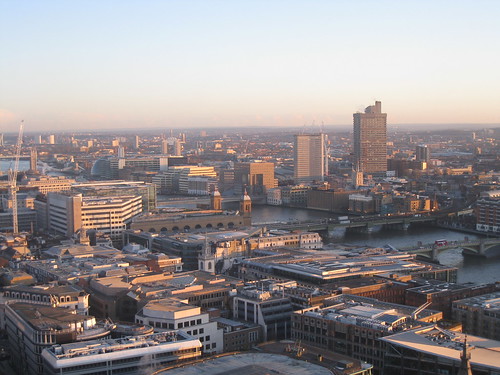
London from St Paul's Cathedral; there are networks there,
if you know where to find them
The answers, of course, don’t lie entirely in road layout. London has, for example, the Central London congestion charge, which over the last 12 years has sharply cut the numbers of vehicles entering Central London daily. Thanks partly to Sheldon Silver – the recently-disgraced former speaker of the New York state senate – New York lacks such a mechanism to keep through traffic out of lower Manhattan.

Public transport in London is also far more expensive than in New York, making a switch to cycling far more attractive financially.

London’s streets are, in addition, far safer than New York’s, even if that’s damning London with faint praise. For 2013, the last full year for which figures are available, there were 294 road fatalities in New York, which has a slightly lower population than London, including 168 pedestrians and 10 cyclists. In London in the same year, there were 132 road deaths in total, including 65 pedestrians and 14 cyclists. London’s far higher cycling rates make it clear that it’s a far safer place to ride per mile travelled than New York.

Yet one of the biggest parts of the answer, I’d suggest, can be found in thinking about the fate of the Boeing 747. The jumbo jet, hugely successful though it has been, faces phasing out at least partly because it was designed for an era when airlines sought consistently to operate “hub-and-spoke” services, feeding traffic from around a given region into a hub. Passengers would be transferred at those hubs onto long-haul flights on airlines’ hyper-efficient 747s.

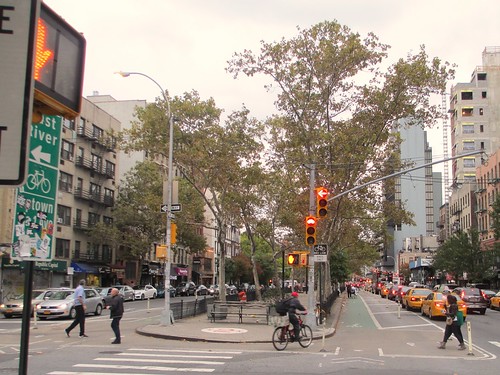
The Allen St bike lanes: enjoy the view, wistful Londoners -
but be sceptical this picture tells the whole story
The jumbo is suffering partly, analysts say, from improving efficiency - the biggest 777 aircraft can carry pretty much as many people with just two engines. But it is also losing out to aircraft such as the Boeing 787 and Airbus A350 that can fly long distances but are far easier to fill up. It’s much simpler with such aircraft to offer passengers direct flights from the city where they’re starting out to the city on another continent where they want to go. It turns out passengers don’t crave the excitement of running to transfer between flights at big hub airports, worrying whether their baggage is being treated with the same urgency. There's a growing preference for going the lowest-stress, most direct route.
 
New York, I’d suggest, has done an excellent job of sorting out a few key hubs for a network – protected lanes up Allen St and along Sands St sorting out some of the trickiest approaches to the Manhattan Bridge, for example. There’s a protected bike lane along Prospect Park West funnelling cyclists through Park Slope. There are bike paths along parts of the two sides of Manhattan. New York has provided the Atlanta-Hartsfield or London Heathrow type hubs and some of the routes that link them. But the system features too many disconnects – too many frantic dashes across the system’s gaps – to offer a full range of comfortable, point-to-point journeys.

First Avenue’s bike lane – often praised as a good example of recent improvements – disappears suddenly for 10 blocks (or half a mile) between the United Nations and 59th Street, pitching cyclists into chaotic motor traffic climbing towards the Queensboro Bridge. Worse still, anyone who has successfully cycled to the Upper East Side and is wondering how to head south again will find not even a painted bike lane for more than three miles on 2nd Avenue between 100th St and 34th St. The 8th Avenue bike lane disappears for five blocks around the Port Authority Bus Terminal, the chaotic point on the trip where cyclists are most in need of protection. The 9th Avenue bike lane disappears for a couple of blocks around Penn Station. There are more.
 
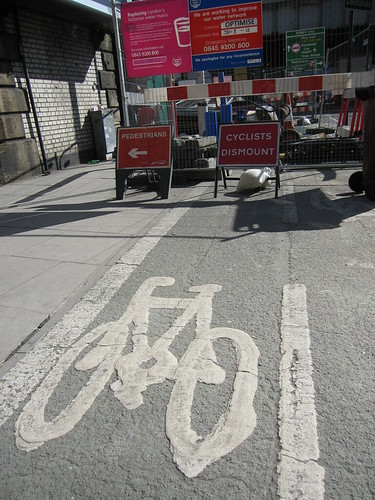
A sharrow marks a bike route in St George, Staten Island:
this look like part of a network to you?
Instead of a network, New York has built a series of sections of bike lane, with noisy objections to the loss of parking or some other complexity keeping the sections all too often separate from each other. The regular changes in colour of the routes on the city’s bike map – indicating a change from a protected lane to a painted lane, to mere “sharrows” then back – are testament to New York officials’ weakness in the face of noisy, local protest. Perhaps the emblematic failure relates to the Hudson River Greenway. It’s one of the safest, most comfortable to use bike facilities in the city. But nearly every means of accessing it south of 59th St involves a suicidally dangerous manoeuvre amid lines of fast-moving cars seeking to reach the West Side Highway.

It’s little surprise that, presented with confusing routes that disappear in the most dangerous places, relatively few New Yorkers are taking up the invitation to start cycling.

When I lived in London, by contrast, my head was full of the routes – often complex and roundabout, admittedly – of the London Cycle Network. The LCN – now out of fashion, since its introduction was overseen by Ken Livingstone, the former mayor - follows routes mainly along back streets across the city. It is so comprehensive that, by the time I left London, I could do 30-mile round trips on it without consulting a map. London’s existing Cycle Superhighways – appallingly designed as most are – at least seek to provide routes that take people to places. Both reflect what seems to me a greater tendency on the part of London’s planners than New York’s to think in terms of routes, not isolated projects.
Southwark Bridge, London: a key part of my mental map
of London's cycling networks

This week’s decision by Transport for London, the London mayor’s transport body, to go ahead with a comprehensive network of segregated bike paths should make the position far, far better. Unlike New York’s rather disjointed system, they should act more and more like the most efficient networks – like metro systems that draw commuters in from distant suburbs into heavily-used, highly-efficient core areas or express parcel networks. Such networks’ strength is their comprehensiveness – well-planned new metro lines generate disproportionately high numbers of journeys because they unlock new point-to-point journeys both on the existing network and the new line. London’s networks, at least in theory, aim to provide a reasonably consistent journey for a high proportion of the trips in the city that are possible by bicycle.
 
A London cycle path: an example of
the "infrastructure" that made me once
doubt infrastructure was the answer
Not, of course, that the simple dichotomies are the whole story. London’s cycle planners are, I know, prone to some of the same shortcomings as those in New York. I so despaired when I lived in London of the dire quality of much of the existing cycle infrastructure that I preferred an approach that sought to make onroad cycling safer. The roundabout, backstreet routes I often used are so circuitous that many simply won’t use them. In thousands of rides past South London’s busy Elephant & Castle interchange, I took one of the avoiding routes off the main roads every single time. To many other people, that route is so painfully slow that they prefer the main roads, where there are regular deaths.

New York’s project-based approach has at least improved some of the biggest barriers to cycling, even if it has always joined the bits together. I find the experience of mixing with fast-moving traffic on multi-lane New York streets sufficiently scary that I welcome any relief from it. I also understand, given the challenges of getting anything meaningful done in New York, why Janette Sadik-Khan - the city’s former, much missed, transportation commissioner – focused so hard on some flagship projects. The projects have proved resounding successes – had she sought to turn the projects into perfectly-realised networks, she could easily have become bogged down in the bureaucratic malaise that seems to have swallowed Polly Trottenberg, her well-meaning successor.
 
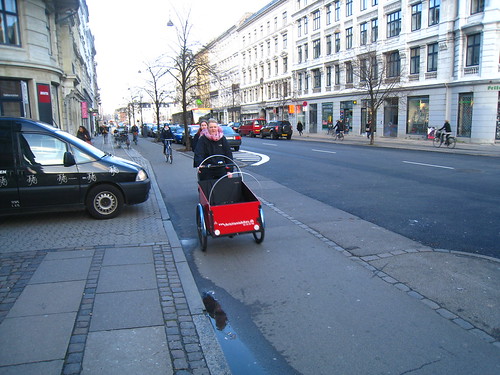
Copenhagen: an acutal cycle network, in magnificent action
Nevertheless, New York currently risks, it seems to me, watching from the sidelines as London’s new network of protected routes turns the city’s existing provision into a still more successful network. It’s hard to imagine New York’s achieving anywhere close to its target of having 6 per cent of trips by bikes by 2020 until it starts taking the challenges of providing a real network seriously.

Ms Trottenberg may be about to start tackling the issue in earnest, even if her department's record of retreat on markings for "slow zones" suggests otherwise. But the history of the Bleecker St – Broadway-Lafayette station on the New York City subway is a stark reminder that such changes don’t happen on their own in this city. The city’s IND subway network built Broadway-Lafayette station in 1936 immediately under Bleecker St station of the Interborough Rapid Transit Corporation. In 1940, the city subsequently took over the IRT and its rival BMT subway, forming them with the IND into an allegedly unified system enjoying the benefits of being a single network. Yet it was only in June 2012, after I arrived in New York, that a full connection between the two stations – which had sat immediately adjacent to each other for 76 years – was finally opened.

If New York is serious about encouraging more than a hardy band of souls to cycle round the city, changes to its cycling infrastructure cannot possibly take that long.