Showing posts with label roads policy. Show all posts

Sunday, 24 March 2013

Crashes - and communities' deadly preferences

At the foot of Wellington Street in London, where the busy cycle route from Waterloo Bridge heads into Covent Garden, there was, for a while when I lived there, a notice. The police had received numerous complaints, it said, from “the community” about standards of cyclist behaviour in Covent Garden. It suggested, essentially, that cyclists should smarten up their act or face unspecified consequences.

The notice irritated me on several levels – but the most profound was the notion that “the community” were the real people and the cyclists some alien, invasive species. The irritation was all the greater because as an area Covent Garden seldom showed much respect for cyclists’ rights. I have a vivid memory of cycling across the pavement (sidewalk, American readers) at the foot of Wellington Street with a drunk tourist yelling at me that I wasn’t allowed to ride there. He was standing directly on top of a bike symbol, on the clearly marked cycle lane.
A stencil marks where Martha Atwater died: one of
far too many such death sites in New York City

Questions about traffic and its relationship with communities have been occurring to me again over the last month as I’ve pondered a series of appalling tragedies on the streets of New York City, where I live now. The highest profile – the killing in a car crash in the early hours of March 3 of two expectant parents, Nachman and Raizel Glauber, and their baby son, delivered prematurely after the crash – raised the issue most clearly because of their own community’s very obvious reaction. The couple, only 21, belonged to prominent Hasidic Jewish families. Their deaths – a speeding, possibly drunk driver smashed into the livery cab they were using - were marked by a funeral that brought 1,000 men in dark coats and wide-brimmed hats onto the streets of Williamsburg, one of Hasidism’s Brooklyn strongholds.

But nearly any traffic tragedy – and there have been many in New York this past month besides the widely-noticed ones - raises at least some questions about how different communities relate to and use the street involved.
Potted plants show the grief of Martha Atwater's community

I’ve been thinking particularly deeply about the link each morning recently as I’ve cycled past the junction of Clinton Street and Atlantic Avenue in Brooklyn Heights on my way to work. A line of potted plants by a shop window and a stencilled outline on the sidewalk mark where, on the evening of February 22, a driver mounted the sidewalk in his speeding, out of control SUV. Martha Atwater, a 48-year-old writer and mother of two children, was emerging from a bagel shop and died on the sidewalk shortly after the vehicle hit her.

The regular arrival of fresh floral tributes testifies to what I read in the days after Ms Atwater’s death – that she was a well-known, well-liked participant in many local activities. She was the embodiment of the strong sense of mutual responsibility and joint action that makes the best New York neighbourhoods such desirable places to live.

But I saw little reflection amid the tragedy of Ms Atwater’s death on New York’s wider traffic culture, which claimed another high-profile victim less than six days later. On the morning of February 28, Amar Diarrassouba, 6, was crossing E117th street in East Harlem on his way to school when a huge truck drove through the crosswalk, killing him instantly as his 9-year-old brother, who was accompanying him, looked on.

The grief in Amar’s case focused not on the miserable, pointless loss of a bright young boy or the driver’s culpability but on Amar’s school crossing guard. The woman, who on a previous occasion reportedly snatched a child out of the path of an oncoming car, should have been present at the crossing when the collision occurred but wasn’t. Astonishingly, the police investigation of the truck driver appears to have concluded with his receiving traffic tickets for failure to yield and failure to execute due care – minor violations that nevertheless suggest he was entirely responsible for Amar’s death. The investigation into the crossing guard – someone who, whatever her shortcomings, did not negligently drive a huge truck over a blameless six-year-old – continues.

The attention on the crossing guard was typical of the focus after each of the tragedies on the crash’s individual circumstances and what made it exceptional. There has been very little reflection on how general traffic conditions in the areas concerned contributed to the deaths.

The intersection the driver that killed Martha Atwater crossed.
Traffic calming would do no good here, according to some residents
That omission struck me particularly in Martha Atwater’s case because of an online argument I entered a few months ago with a resident of Cobble Hill, just across Atlantic from the crash scene, about traffic calming. He was angrily complaining about how unsightly a projected traffic-calming scheme for the area would be and what congestion it would cause. But it seems fair to suspect that such traffic-calming would have made it much less likely a speeding SUV would shoot across Atlantic Avenue and kill someone.

The most shocking effort to shift blame came in Amar Diarrassouba’s case. The community board for the area where Amar died – the local body that has the final say on many local planning issues in New York – in late 2011 withdrew previous approval for a protected bike lane along First Avenue in the area. Most studies suggest such lanes, as well as benefitting cyclists, make crashes like the one that killed Amar less likely. Yet when Steve Vaccaro, a cycling lawyer and activist, pointed out the community board’s role on Twitter to Erik Mayor, a local restaurateur and community board member, Mayor preferred to put the blame on the least blameworthy actor in the entire episode. “The child was being walked by his nine-year-old brother, who did not pay attention,” Mayor wrote.

Kent Ave: a surviving Williamsburg bike lane,
which some Hasidim might prefer weren't there.
The truth is that road deaths all over the world nearly always result at least in part from failures of road governance. Those often result from local communities’ tendency to assume the main priority for roads is to meet the needs of the people that they regard as their “community” – people who have similar needs and habits to them.

That is particularly revealingly the case where the Glaubers’ community is concerned. Few Hasidic Jews cycle and some Williamsburg Hasidim successfully campaigned for removal of a cycle lane along Bedford Avenue through the heart of their community. One community spokesman said that, although the ostensible reason for the campaign was their disapproval of women cyclists’ “immodest” dress, it was also the case that “everyone” knew a bike lane was a “nuisance”. There have also been attempts to discourage cyclists from using bike lanes along Kent Avenue, the street where the Glaubers were killed, apparently because Hasidim wanted back the parking spaces that the bike lane took.

Erik Mayor’s reaction shows a similar myopia. He couched his original opposition to the first avenue bike lane in terms of the likely effect on local children. He claimed – improbably – that a bike lane would increase asthma among children because it would increase congestion and hence emissions from idling cars. But when the lane’s absence contributed to the crushing to death of a boy from the area’s distinctive west African community, his sympathy seems to have evaporated.

A strong theme running through many “community” expressions of concern about their local roads is that they focus on the problems that cause the most vocal complaints locally – the struggle to find parking places or local shopkeepers’ grumbles about business – rather than local roads’ role as thoroughfares.

Yet roads are inevitably the vehicle for the habits of one community, no matter how distinctive it might be in many things, to run – sometimes literally – into another’s. The wide, unobstructed local road might seem vital to you because it offers plenty of parking spaces. If it looks to people from neighbouring communities like an invitation to drive at twice the speed limit, your community is likely to pay a heavy price.

It’s for that reason that it makes little sense to hand governance over important issues of roads policy to bodies as locally focused as New York City’s community boards. The New York City cycling map testifies to their influence, with cycle lanes along long avenues changing in nature or disappearing altogether according to their whims. It’s an area where London, for all its drawbacks, seems largely to be doing better than New York. The boroughs of Wandsworth, Westminster and Barnet – all controlled by the Conservative Party – are undoubtedly less bike-friendly than Camden or Tower Hamlets, controlled by the Labour Party. But the overall strategy seems less likely than New York’s to be derailed in places because of loud, locally-focused complaints.

More generally, meanwhile, it’s always worth thinking when anyone talks about “the community” about whom their definition excludes. While “community” as a term comes wrapped in warm pictures of neighbours chatting and people banding together to do good, it often says as much – as in that Covent Garden notice – about who’s on the outside. The Covent Garden community clearly excluded people who rode bikes. The community board for East Harlem seems to have seen itself as more answerable to car-users than cyclists or people who might benefit from safer streets.

The Invisible Visible Man thinks this bike's rider
didn't feel like part of his community.
The police think we're all part of the same problem.
My own tendency to think sloppily on this topic came home to me on Thursday evening when I encountered the aftermath of a collision on my way home. An ambulance was taking away a cyclist whose mangled bike lay by the roadside. A quick scan of the machine – a nasty aluminium full-suspension mountain bike – led me to a quick conclusion. This was the machine of either a food-delivery cyclist or one of the youths from the local public housing. He wasn’t part of my cycling community.

That made little difference to one of the policemen at the scene, however. Having already apparently decided the cyclist’s failure to stop appropriately had caused the crash, he was keen to share the news with anyone else rash enough to ride a bicycle – even one dutifully stopped at the traffic lights. Looking towards me as he walked back towards his patrol car, he addressed me with a sneer in his voice. “I guess he just had to stop,” he said, shaking his head.

Monday, 11 February 2013

Staten Island and why the Invisible Visible Man is the Opposite of a Canary

It was a brief taste of how most of suburban America and Europe lives and it wasn’t, frankly, terribly pleasant. This past Wednesday, for work reasons, I took my bike and, for only the second time in my life, travelled by ferry to Staten Island, an island off the New Jersey shore that historical accident has made part of New York City. Having mostly developed only in the 1960s after the opening of the Verrazano Narrows road bridge to Brooklyn, it was designed around the private car far more than other parts of the city. It’s the nearest thing in New York City to a chunk of true American suburbia – featureless apart from occasional strip malls and criss-crossed by wide, fast-moving, multi-lane expressways.
A shared cycle route marking in St George: much the likeliest
way to see a bike on the road in Staten Island

I began to have concerns about cycling conditions even before I was properly out of St George, the borough’s capital. A bus driver drove at me, apparently astonished that my being ahead of him in traffic meant I thought I should go first through a pinch point. Later on, I started to wonder if I had put myself in serious danger. Unable to use the seafront cycle path – still blocked with sand from Superstorm Sandy – I headed inland along long, straight six-lane avenues. The 30mph and 35mph speed limits on these roads seemed to be regarded as minimum permissible speeds. Encountering a cyclist, such drivers simply drove straight on, at speed, towards the bike, on the apparent assumption the cyclist would scuttle out of the way.


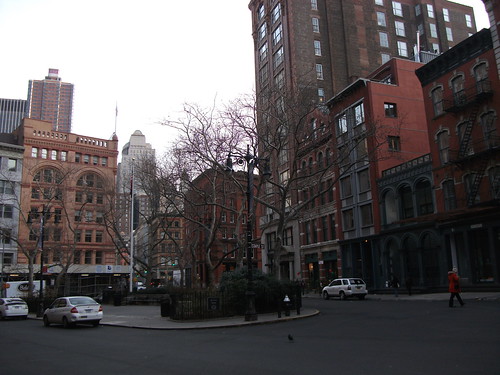
Duane Square, TriBeCa: not specifically cycle-friendly
- but not hostile either
But I probably shouldn’t have found the conditions surprising. While I have multiple complaints about cycling conditions in brownstone Brooklyn and Manhattan – the places where I currently mostly ride – and in London – where I used to ride – these are actually atypically cycle-friendly environments. Many roads are narrow – inhibiting drivers’ tendency to speed – and the traffic’s sheer volume makes the speeds on Staten Island mostly impossible. The obvious attractions in such an environment of the bicycle – which can slip along such streets while cars remain gnarled in traffic jams – have contributed to recent years’ rapid growth in inner-city cycling numbers. Better provision is slowly arriving in the wake of increased cycling.

Conditions on Staten Island are far more typical of the places that most rich countries’ inhabitants live. Such places provide most inhabitants with a house on its own plot of land – but suffer from the sheer volume of traffic that sprawling, low-density cities generate.  I’ve encountered similar conditions in parts of commuter-belt Oxfordshire, Cheshire and Scotland’s central belt. Cyclists tend not to give much thought to such places for the simple reason that very few cyclists live in them.

The natural reaction might be to conclude that cycling is impossible in such places, to avoid visiting them as far as possible and to leave the bicycle behind when circumstance forces one to do so. The only alternative is a wholesale rethink of the car’s role in such societies.

It’s often said that cycling children are a kind of “canary-in-the-coalmine” of cycling policy. If you disperse pretty much every danger factor for cyclists in your city, you’ll find primary school children riding to school. Let even a few of them creep back and the kids will disappear.

After his Staten Island visit, the Invisible
Visible Man will hardly complain in future
about scenes such as this in Manhattan.
By that standard, I’m closer to being the explosion in the coalmine. I regularly cycle along fairly busy, high-traffic roads, including fast-moving dual carriageways in the UK. If the danger factors somewhere have built up to the point somewhere that they’re intimidating me, it’s a reasonable sign cycling conditions are seriously, dangerously hostile.

I mostly managed in Staten Island to stick to the principle that a cyclist should boldly take the lane and force motorists to manoeuvre safely around him. But even I at points hugged closer to the kerb than normal, darting out into the threatening traffic mainly to get round obstructions such as parked cars. It felt hard to keep taking the lane on seeing a line of fast-moving SUVs, three abreast, bearing down on one, giving no sign whatever of yielding to a cyclist in front of them. I wasn’t confident I wanted to waste my dying breaths explaining to some over-sized car’s driver precisely why my road craft should have prevented him from running me over.

So is there an alternative for cyclists to the appalling conditions that currently exist in Staten Island and many other suburban areas? One standard cycling lobby answer is to argue that entirely separate cyclist provision is needed and that to call for anything less is counter-productive. Cyclists and such heavy, fast-moving traffic can never co-exist.

Yet I left Staten Island doubting that calls for a network of dedicated cycle lanes on Staten Island would get very far under current conditions. I saw, as far as I can recall, one other cyclist during an afternoon and early evening on the island. It’s hard to see that a democratic society can risk spending heavily to create facilities for a group – Staten Island utility cyclists – that might not even emerge in the end. That’s all the more the case at the moment, when my cycle route took me past large tracts of shoreline land that remained flooded and empty in the wake of Sandy’s devastation of the island. Even as a dedicated cyclist, I think finite budgets at the moment are best spent on ensuring all Staten Island’s people again have waterproof, heated houses.

There are nevertheless compelling reasons beyond encouraging cycling to stop the cancer of car-dependence from draining the life out of Staten Island. The wide, uncalmed roads, it was clear, were intimidating away people other than cyclists. I saw just as few people walking the sidewalks of the busiest roads as I saw people cycling. The excellent “weekly carnage”feature on Streetsblog, the transport website, features regular stories of Staten Island’s elderly and other vulnerable people crushed by motor vehicles refusing to yield at corners. Many of those fast-moving vehicles end up ploughing into each other, at a high human cost. There’s every reason even for someone who’s not a cyclist to support the installations of road designs that slow drivers down and speed cameras.

Ideally, the United States would increase fuel taxes to cover more of the costs cars impose on places such as Staten Island. A rational system of per-mile charging could calm down the worst of the congestion. Research suggests that cars might even get where they’re going faster under such a regime than they do at present.
Manhattan approaching, from the Staten Island ferry:
a welcome sight, from a cyclist's point of view

A new approach to cars would, of course, produce a better environment for on-road cycling too. It’s far from impossible that in Staten Island calmer, less threatening roads might start to entice out of their hiding places some of the bikes that must be lying unused in the borough’s homes. The island might start participating more fully in the cycling boom that’s taking place, to varying degrees, in New York’s other four boroughs. That, in turn, might make it easy to justify new cycle-only lanes for some future reporter who finds himself heading to a distant corner of Staten Island on an assignment.

As it was, finding dark had descended and contemplating the prospect of a 10½ mile ride on threatening roads back to the ferry, I took, unusually, the line of least resistance. Fending off threatening cars, I rode half a mile to the nearest Staten Island Railway Station and, my bike leaning against my seat, took in the island’s night-time lights as most of its inhabitants do – from within the comfort of a metal shell.

Monday, 31 December 2012

A car crash, Sandy Hook and the limits of freedom

My BlackBerry takes really poor pictures -
but somewhere in there are an upturned car
and a bunch of firefighters

“Bang! Boom-boom-boom-boom.” The successive thuds I heard from my apartment’s kitchen one Tuesday night two-and-a-bit weeks ago sounded out of the ordinary, even for an area where subway maintenance, truck movements and any number of other things are apt to create noise. When I then heard the wails of multiple emergency vehicles, I knew something was seriously amiss. Reporter’s instincts awakened, I headed out to the street, to find a car overturned further up the block. The driver had come down neighbouring Court Street too fast, according to people who’d seen it, misjudged the turn into our street and somehow flipped the car. The driver, who by now was in police custody, had seemed very drunk on getting out – mercifully unhurt – from the car, onlookers told me.

The incident could easily have qualified as the biggest event of my week had it not been for the events of the Friday. Just as I remember working in the Edinburgh newsroom of The Scotsman in 1996 when news started coming through of a shooting at a school 35 miles away in Dunblane, I found myself that Friday following reports of an incident at a school 75 miles away in Connecticut. Once again, I experienced the gut-jolting realisation that this incident, far from being a run-of-the-mill, local tragedy, was on a scale that would grab the attention of an aghast world. Whereas the Dunblane massacre killed 16 children, the one in Connecticut had killed 20.

The crash and the Newtown shootings might, at first blush, look unrelated. They are certainly of contrasting gravity. The car crash dented a few vehicles and led to the driver’s arrest. The Connecticut shootings killed 20 children, seven adults and culminated in the shooter’s suicide. But they both ultimately raise the same questions – ones that apply both to road-users and gun-owners – about the limits of individual freedom. It’s an issue that I confront every evening as I cycle a few blocks on Court Street amid cars that no-one restrains from driving at grossly excessive speed. It extends all the way to my worries about my own children’s safety in their own elementary school, where “shelter drills” train them how to react if a dangerous intruder is on the loose.

Midtown Manhattan in winter sun:
not self-evidently a city built by stupid people
It certainly makes a difference to my perspective that I’m writing in the United States, where I moved in August, rather than the United Kingdom, where I had been living for nine years. It’s fashionable in Europe to sneer at some of the US’s freedoms – particularly when it comes to gun ownership – as if they were merely factors in a general national craziness. Why, patronising European voices ask, doesn’t the US just ban guns? The tone of the comments often carries undertones of the ultimate European sneer - that the people of the world’s richest, most successful country are either collectively a bit stupid or morally bankrupt.

Yet there is something profoundly valuable about many parts of the American constitutional system – and one of them is undoubtedly the Bill of Rights’ guarantee of certain freedoms. Only the most unbending critic of the United States could fail to be impressed by how the country’s constitution and democracy have flexed to deal with successive historical challenges. The system has adapted to stitching the US back together after the civil war, national mobilisation for the second world war, the cold war and the civil rights movement. Many constitutional rights – including the rights to free speech and freedom of assembly – have come under attack at the times of the worst strain. It has surely been part of the US’s successful negotiation of these crises that the rights have largely survived intact.

Nor is there something unique about US politicians’ willingness to sacrifice the lives of vulnerable citizens in the name of other people’s freedom. The day that Philip Hammond was appointed the first transport secretary in the current UK government, he vowed to end the “war on the motorist” – shorthand for a series of measures that included the introduction of speed and traffic-light cameras at the most dangerous accident blackspots. The gradual withdrawal of funding for such successful safety measures has been accompanied by a slow but steady increase in the number of motorists, pedestrians and cyclists thrown fatally into the air by speeding vehicles, crushed under trucks’ wheels or bleeding slowly to death amid the wreckage of their cars.

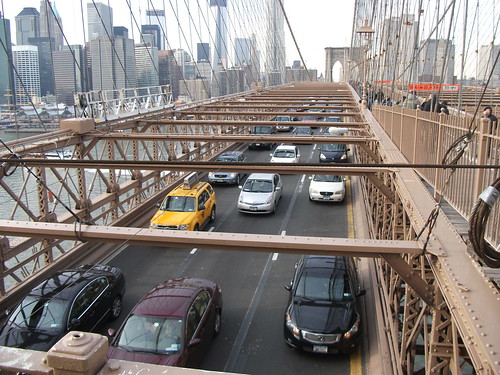
These cars were all free to drive over the Brooklyn Bridge on
Christmas Eve - so none of them was free to cross it fast.
There is a similar fear in many countries of the world – including the Netherlands and United States – about introducing distance-based charging for road use. Nearly every transport economist knows that only a direct charge for road use, varying according to the time of day, can tackle most rich countries’ congestion problems. Yet the only country so far to have introduced a national scheme to charge for using the busiest roads is Singapore – which uncoincidentally suffers an acute shortage of land, allied to intense relaxation about restricting individual freedoms.

Even on guns, the shocked insistence of some US politicians that citizens must be able to retain guns for hunting, self-defence and other legitimate uses is not unique. I remember vividly the controversy when the Duke of Edinburgh, the queen’s husband, insisted after the Dunblane massacre that proposed bans on the ownership of certain kinds of handguns were an unfair imposition on sportsmen. He asked whether, if someone had burst into a school and beaten 17 people to death with a cricket bat, the government would also legislate to ban them. The obvious point that guns’ capabilities set them apart from other potentially deadly weapons passed the Duke, like so many US gun lobbyists, entirely by.

Yet I remain instinctively suspicious of any freedom that is predominantly exercised by the well-off and already free at the expense of their poorer, less-free neighbours. US advocates for gun-owner freedoms tend to be overwhelmingly white and relatively rich. Even in a country with car ownership as high as the United States, the heaviest users of cars - and those of whom the politicians are most fearful – are the better off. Anecdotal evidence around New York suggests that the pedestrians paying the price for uncontrolled car use are disproportionately people like Maleka Begum, a 54-year-old mother of three, originally from Bangladesh. Ms Begum died after a bus hit her on a pedestrian crossing in Queens in October, in an incident that witnesses attributed entirely to the bus driver’s poor driving.

A speed-limit sign by the Brooklyn Bridge.
Most people accept in theory that
speed limits are a reasonable restriction
on freedom - for other people, at least.
The truth is that even the keenest advocate of the freedom to drive a car or shoot a gun ultimately depends on some curtailment of those rights. Motorists share roads with each other, cyclists like me and pedestrians. If everyone were given pure freedom to drive anywhere at whatever speed they liked, with no price restrictions to curb demand, gridlock would quickly set in and the accident rate soar. Even the US’s National Rifle Association would surely eventually tire of the arms race if, for example, anyone in the US who wanted it could arm him or herself with a rocket-propelled grenade launcher, depleted uranium rounds or – why not? – biological or tactical nuclear weapons. Drivers depend on the police’s restricting the rights of the worst drivers to drive, while gun-owners ultimately rely on the state to prevent their finding themselves outgunned by fellow citizens toting battlefield weapons.

The question, consequently, isn’t whether to impose curbs on drivers’ ability to speed drunk down Brooklyn streets or to hold large caches of deadly, high-powered weapons. It’s where to set the tipping point between their rights and others’ rights to protection from them.

It’s my powerful conviction, based on my own experience of trying to bring dangerous drivers to account and witnessing the toll of gun crime in the United States, that the emphasis in recent years has fallen far too heavily on protecting the drivers and gun-owners. Some of the clearest evidence is how cowardly many countries’ police forces and legislators have become about enforcing even existing, sensible rules. There are, for example, no speed cameras in New York City, even though excessive speed seems to be a factor in many fatal crashes. Astonishingly, background checks on those planning to buy weapons are not enforced at gun shows, which as a result account for a growing proportion of gun sales. Eagerness to safeguard drivers’ and gun-owners’ rights is slowly but surely toppling over into a lawless free-for-all.

The barriers in the way of better, more effective enforcement of road rules are at least relatively minor, both in the United States and elsewhere. Properly-framed laws or police procedures could re-energise the effort to catch drivers that, for example, speed through busy junctions or ignore red lights. In the US, the constitution’s strangely-worded second amendment, with its guarantee for the right to bear arms, stands in the way of change. It’s not a right that I personally would have chosen to enshrine in the constitution. But it’s not an amendment that’s going to be repealed or changed in the foreseeable future.

As a result, my modest proposal would be that gun-owners should be subject to one new obligation that already faces drivers – and that seems to be reducing deaths on the roads. The owners of the cars that the drunk driver on my street hit could at least be confident, it occurred to me afterwards, that the driver had – or should have – comprehensive insurance. The families of Sandy Hook’s dead will know the guns’ owner carried no comparable insurance. It’s a grotesque mismatch that the owners of vehicles that kill people as a byproduct of their use are forced to insure themselves, while owners of purposely-designed killing machines are not.

An insurance scheme would continue to facilitate the kinds of gun use that the NRA says it supports. A hunter who keeps a shotgun or bolt-action rifle locked up in his study would present only a modest risk and need pay only modestly to insure against it. A woman who wanted to keep a semi-automatic rifle with a large magazine and two powerful handguns unsecured in the house with her 20-year-old would probably face a prohibitively high bill, however.

Insurance companies’ risk assessments already seem to be playing a role in reducing road accidents. The costs of insuring the youngest – and most dangerous – drivers appear to be preventing them from taking up driving until they are older, and safer.

My proposal would not, of course, solve everything. Criminals would continue to pass around powerful, illegally-held, uninsured weapons. Ill-intentioned or unhinged people might still manage to steal or otherwise misappropriate the weapons needed for horrific massacres. But it would, I think, reduce the chances that, one day, it might be my children and their teachers facing an angry young man who has found weapons powerful and destructive enough to express his anger, rage and despair. As such, the curtailment of freedom involved seems to me a very modest price to pay.

Sunday, 18 November 2012

My ride to work - and why the cars resemble little hurricanes

Very few of the runners, stroller-pushing parents, drunks and others who wander into my path each day on the cycle lane up New York’s Hudson River Greenway strike me as especially brilliant people. If they were, they might spot the signs telling them they’re not allowed on the path and stick to the rather pleasant waterside walkway that’s been provided for them.
The runner on the left has, remarkably, chosen the footpath on
the Hudson River Greenway. One can only hope she made
the kind of solid risk assessment the Invisible Visible Man advocates

But, disturbingly, the cycle lane obstructors (CLOs) seem to be better at prioritising the risks facing pedestrians than the head of the New York Police Department’s traffic squad. The CLOs have decided that, if they’re going to obstruct traffic, it’s many, many times safer to get in cyclists’ way than cars’. Having so far seen hundreds – possibly thousands – of CLOs in four months’ cycling in New York, I’ve yet to see one choosing to take his or her chances running down the fast-moving, multi-lane West Side Highway next to the cycle path.

Yet Brian McCarthy, a deputy chief of the NYPD with responsibility for traffic policing, explained in October to WNYC, the public radio station, why its ironically-named Operation Cycle Safe – the programme that focuses police resources on fining cyclists, rather than the road users that cause traffic deaths – was now mainly tackling riding on the sidewalk (pavement, British readers). This behaviour, he reasoned, posed particular dangers to pedestrians. But, while I can find no recent record of a cyclist’s killing a pedestrian on a New York City sidewalk, it is depressingly regular for motorists to do so through excessive speed or lack of attention. The NYPD barely ever prosecutes the motoring offences that lead to such deaths. Its prioritisation is so skewed that, for it to be correct, I should probably be spotting runners every morning taking their chances with speeding SUVs on the highway, away from the terrifying bicycles.

The contrast between the CLOs and Deputy Chief McCarthy illustrates something profound about the vagaries of human beings’ efforts to assess risks. Most humans are reasonably adept at spotting and assessing the most immediate dangers. It’s pretty clear even to a stupid, inconsiderate runner unconcerned about inconveniencing others that it’s less foolish to take the chance of a collision with a cyclist riding at 20mph than a motorist driving at 50mph (the West Side Highway speed limit is 35mph – fun fact that most motorists entirely ignore). Very few people, however, are good at assessing risks in an abstract context such as a decision about how to allocate police resources. The NYPD, as I pointed out in a previous post, hands out 5 per cent of its traffic violation tickets to cyclists, way out of proportion to cyclists’ roughly 1 per cent share of city traffic. But a cyclist last killed someone in New York City in March 2009 – and even that incident wasn’t on the sidewalk. Around 1,000 people have died in the time since at the hands of motor vehicles. A sober risk assessment aimed at bringing down the number of deaths in the city would target an entirely different set of behaviours.

The problem appears to be a widespread one. In the UK, newspaper reporting about the crash that injured Bradley Wiggins – one of my great heroes – ended up producing the same, predictable commentary claiming cyclists endanger pedestrians and, somehow, cars. That’s even though the Tour de France winner’s accident involved his colliding with a car that seems to have pulled out into his path from a filling station without looking. In other words, people started complaining on the basis of the kind of accident that happens quite a lot (one where a negligent motorist injures a cyclist) about things that hardly ever happen – accidents where cyclists hurt other road users.

The question is whether it’s possible to get better to get better at understanding the risks the roads and other places pose - and to start reacting to them more rationally.

A subway station closed for Hurricane Sandy. New York's subway
turned out to be better at assessing risk than many New Yorkers.
My mind’s been particularly drawn to risk assessment in the last three weeks because of events in my new home city. At the end of the week when superstorm Sandy hit New York, I took a trip to Staten Island to report on some of the damage there. Person after person told me they’d ignored the evacuation order for the area on the grounds that a previous hurricane last year – Hurricane Irene – had mostly turned out less damaging than expected. As the sea swept in and inundated their street, they found themselves cowering in their homes’ upper storeys, with waves lapping at the windows even there. A person died in the basement of one of the houses in the street I visited, electrocuted when he stepped into flood water that had electric current flowing through it. The storm was on an entirely different scale from Hurricane Irene.

That miscalculation, it seems to me, is of a piece with people’s miscalculations about road use. In both situations, people rely far too much on personal experience and the evidence of their own senses. In the run-up to the storm, it was clear that the city was very windy but not immediately obvious that the storm would cause historic levels of damage. To realise that, one had to pay attention to something one couldn’t see – the vast storm surge that forecasters were predicting that was preparing to push its way into New York Bay to flood large tracts of the city.

Many people assessing the risks of cycling, meanwhile, look at cyclists in traffic and conclude that the slender, unprotected machines among the big metal boxes are more vulnerable than most figures actually suggest them to be. They see a cyclist on a sidewalk and assume that his greater speed compared with the pedestrians makes him a significant risk to them. It only adds, it seems to me, to people’s irritation with cyclists that bikes are quiet and people tend to notice them only at the last minute. This seems certain to trigger the kind of last-minute, fight-or-flight response that must have been useful for vulnerable cavemen. It’s a far less reliable indicator than people think of the risks around in a complex, modern urban streetscape.

Most people have particular lacunae when it comes to rare events that pose catastrophic risks. A hurricane is precisely such an event. There are fine, hard-to-discern differences between a hurricane that will do little damage – as Hurricane Irene did – kill scores of people and do billions of dollars of damage – as superstorm Sandy did – and one that will kill many hundreds – as Hurricane Katrina did. It is far beyond a normal person’s gut instinct to discern which storms need special attention, yet ordinary people continue to use their gut instincts to assess how they should react.
The motorists are blocking the bike lane. The cyclist's too close to the cars.
And they'll probably all get away with the risks they're taking.

In a road context, the catastrophic events are crashes involving cars, buses and trucks. It’s so common to see motorists driving while ‘phoning, speeding, giving cyclists too little room and so forth that it’s easy to conclude that these behaviours are trivial and pose little risk. Many people compare them with the alarming experience of finding a cycle messenger rush past their nose on a pedestrian crossing and conclude that it’s the cyclist who poses the real danger. The truth is that each time a motorist drives too fast, drives while distracted or turns without looking for cyclists he or she is involved in profoundly risky behaviour – and it’s only the luck of the particular circumstances that divides the outcome from nothing at all and a multiple-fatality crash.

People are still more blind to their actions’ long-term consequences. Almost no-one sees a cyclist on a busy street and remembers that he or she is far less likely to die of heart disease or diabetes in several decades than the neighbouring motorist cursing him or her from the exercise-free cocoon of his or her motor car. The global warming that may be making hurricanes more frequent is a still more remote such risk.

None of this is to excuse stupid behaviour by cyclists. It’s worth stopping for red lights, giving pedestrians plenty of space and going the right way up one-way streets. It shows an example of good practice and avoids annoying one’s fellow citizens. I do my best to obey the rules.

But industries prone to catastrophic but rare risks – the nuclear power industry, for example, or railways – tackle them by looking for the near-misses and minor accidents that suggest people are indulging in risky behaviour. Police forces that hold off warning motorists about dangerous behaviour and minor accidents explicitly miss the chance to follow such a policy.

I at least can do my part. I accept that runners will bound into my path on the Hudson River Greenway and cycle at a speed and on a line that means I should avoid them. I know that cars sometimes sweep across even some lightly-used crossings on the route from angles that are hard to see. So I stop for those red lights as other cyclists and runners speed past me, no doubt thinking me an over-cautious worrier. I do my best to assess when I’ve done something foolish and to avoid repeating the mistake. I can only hope that, as New York and other cities start to grapple with a future made more complicated by extreme weather, far more of those around me start to give the matter the same consideration too.

Wednesday, 21 March 2012

In which our hero picks up cycling policy's hottest potato...

Most evenings, as I head home towards reunion with the Invisible Visible Woman, I pedal, as I’ve noted before, in the footsteps of Roman soldiers along London’s Cycle Superhighway 7. But, on nights of the light, misty rain that are a spring and autumn speciality of London’s weather, something unusual happens. As I and other cyclists swing onto a section of the Cycle Superhighway by Kennington Park, we veer out of the marked, blue-painted part of the road that’s meant to be reserved for us. We all know by now that the marking was done on the cheap with a simple layer of blue gloss paint. In such weather, it becomes scarily slippery. We consequently sit towards the outside of the near-side lane. The sight of the line of bikes, all frightened to use a dangerous facility intended to keep us safe, always leads me to raise at least a mental, mildly amused eyebrow.

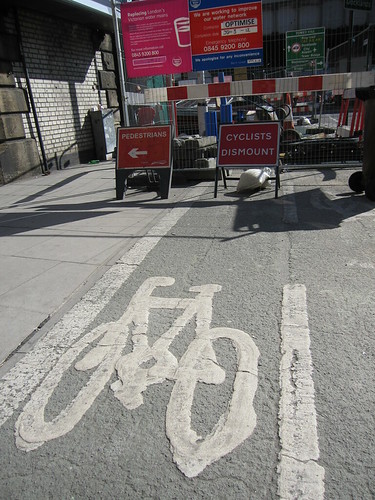
Roadworks in the City: guess which transport mode
everyone decided was dispensable
I smile a similarly wry inward smile when cycling along any section of pavement (sidewalk, American readers) that’s been divided between pedestrians and cyclists. The standard UK practice is to mark the separate pedestrians and cyclist sides with ridged tiles (to help vision-impaired people). The ridged tiles on the cyclists’ side are laid parallel to the bike’s wheels, however. Those on the pedestrian side run acrossways. A reasonably cautious cyclist consequently has to veer onto the pedestrian side at the tiles, to avoid the small but real danger the ridges will catch his front wheel. Having narrowly missed crashing after catching my wheel a few times on such a tile, I’m unwilling to take more chances.

My main thought as I negotiate these obstacles (or, more properly, “cycle facilities”) is to wonder whether their designers are even vaguely familiar with a bicycle and its basic physical properties. I think we can dismiss out of hand the idea that they might actually regularly ride a velocipede.

However, there’s a second, more serious thought. If this is the rich world’s idea of cycling infrastructure, why are so many cycling organisations pressing for more of it?

Such a notion pitches me, of course, into a bitter intra-cyclist dispute. It echoes, in a way, the divisions everywhere among oppressed groups seeking greater freedom. Do we seek, like pedalling Malcolm Xs, the segregation of the separate cycle facility, using mainly lanes free of our motor-powered oppressors? Or do we pursue peacefully the dream of integration, winning the right to the respect we deserve on the wider, more diverse society of the road?

It’s worth saying, of course, that I am as open as the next person to enjoying a car-free environment. When visiting my parents-in-law, I cycle to their church in north Wales partly on a tarmac path along an old railway line. On a Sunday morning, with few runners or other cyclists about, it can be one of the purest, most uncomplicated bike-riding experiences available. One of the most enjoyable cycle facilities to use in London is a fully segregated cycle lane along Cable Street in the East End. The absence on most of the route of worries about car behaviour is undoubtedly one of its attractions.

It’s the difference in stress levels using such routes that leads admirable campaigners in many countries to demand better, separate cycle provision. In the UK, it’s currently common for such campaigners to say cycling will remain a niche activity for the eccentric few (such as the Invisible Visible Man) until the country boasts the same kind of network of segregated cycle routes as the mass-cycling Netherlands or Denmark. They look at people like me who think there are chances of forging a basic understanding between road users and shake their heads. Isn’t it sad how determined we are to restrict cycling to ourselves and a few other members of the privileged middle classes?

I have, as it happens, a fundamental distrust of the idea of segregating any groups of people that can’t seem to get along. But I’m worried about the practicality of cutting cyclists off from other traffic too.

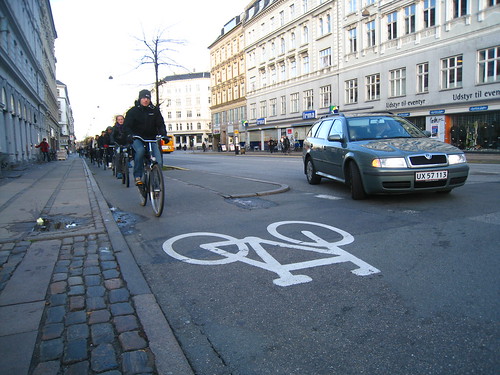
Nørrebrogade: exhibit A in the segregationists' case
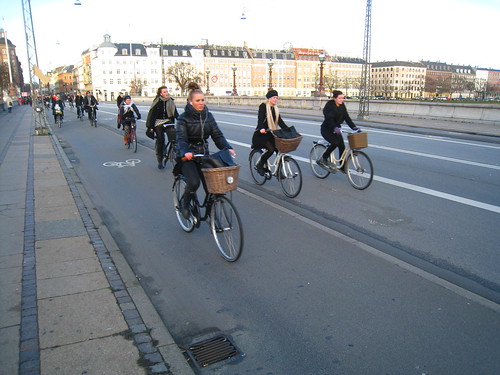
It’s certainly hard to feel too sceptical about segregation standing in the morning on Nørrebrogade, in Copenhagen, the street that carries traffic from the west of Copenhagen over a string of lakes into the city centre. I went to look at it in late 2009 and, even towards the end of the rush hour, there were hundreds of bikes streaming down neat, segregated cycle lanes. Niels Tørsløv, the head of Copenhagen’s city traffic department, told me the city timed the traffic lights to fit in with the flow of bikes, rather than cars. One of the major controversies he was tackling was over the number of cargo bikes in the city. He was having to widen the cycle lanes to make it easier to overtake them. Such are the problems of directing traffic in a city where 37 per cent of people get to work, school or college by bike.

A Copenhagen motorist helpfully illustrates
the Invisible Visible Man's point about side-street conflicts
But, according to Mr Tørsløv, the segregated lanes only rearranged the accidents, putting them at the intersections between roads and cycle paths, rather than at even spaces along the roads. Copenhagen put in the cycle lanes, he said, only because they encouraged people to cycle – cycling numbers rose 10 per cent when a street gained a cycle lane. I happened later the same day to see a motorist knock off a cyclist using a segregated cycle lane.

After that visit, I started to notice, as I sped along Cable Street towards meetings in Canary Wharf, how disproportionately at risk I was from motorists pulling across my path at side streets. I was out of their eye line and difficult to see.

The Invisible Visible Man's hired cruiser bike.
He's not on it - but obviously
drivers saw it like this all the time
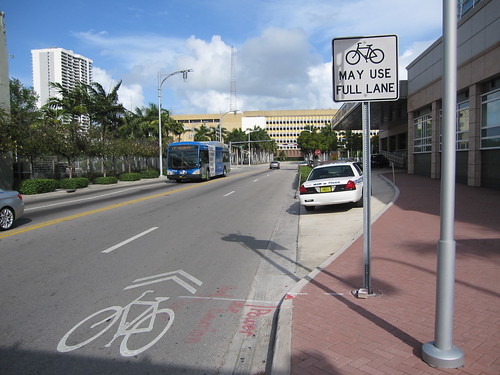
My experiences last week in the US (the reason, dear readers, for the late production of this latest blog post) underlined my worries about segregation. Unable to bear any longer missing my bike languishing across the Atlantic, I hired a cheap cruiser bike and headed across the causeway from Miami Beach into downtown Miami proper. I was encouraged at points to see cycle lanes marked on the road. But then I spotted a sign with a bike picture and the words “may use full lane”. This was a rare piece of permission, I realised. The painted lanes were less a facility than a prison, confining me to the fringes of the roads.

Given the number of motorists I’ve already had tell me in Britain that I shouldn’t be outside some rebranded gutter masquerading as a cycle lane, it made me worry what kind of message a heavy concentration on segregated lanes would send. Certain motorists would quickly come to think of on-road cycling as banned.

A whole lane? The City of Miami, for once, spoils cyclists
I’m consequently positioning myself in the middle of the lane, staring round at any potentially menacing drivers - and pedalling my way into the camp that says cyclists and motor vehicles broadly have to coexist in most city streets. This action will, I know, put me, to some advocates, irrevocably in the Not a Good Person camp. They will look upon me henceforth the way a reactionary newspaper columnist would if he had seen me cycle through a red light and mount a pavement, mouthing obscenities.

Yet I’m reluctant to side firmly with either camp because bike behaviour doesn’t seem to me the most important issue on the roads. Watching politicians’ obvious nervousness when discussing road funding in the UK this week has illustrated how fear of drivers continues to drive attitudes about how roads are used. The same fear holds back police forces from tackling speeding, driving while distracted and the other driver behaviour that puts some cyclists off.  After a driver threatened to assault me recently, the police showed no interest in investigating the driving offence that led to the confrontation. The driver had deliberately pulled his car across the path of a cyclist in, I suspect, full view of a CCTV camera. It would have been a “disproportionate use of police resources” to try to retrieve the film.

There doesn’t even seem to be an appetite for explaining the law. Many drivers, I suspect, don’t actually understand they’re not meant to intrude into cycle-only stop areas or that cyclists are allowed to ride outside cycle lanes. It would take too much courage to embark on a simple public information campaign.

Motorists’ attitudes are certainly not immutable – I’ve referred before to the transformation in views about drink driving in many countries as an example. It’s my guess that, if motorists were behaving better, far fewer people would yearn for the apparent sanctuary of segregated lanes. Meanwhile, if the apathetic planners currently in charge in many western countries set about building new cycle infrastructure, it’s a fair bet it would tend more to keep cyclists out of motorists’ way than to help cyclists.

It's unfortunate, too, if the debate polarises advocates into backing two separate approaches. Some places – the busy roads by the Thames in London, for instance – look perfectly set up for separate cycle lanes. The narrow streets in the City of London look best suited to assertive, on-the-road cycling. Many junctions need redesigning. Others would be fine if the current ignored rules were enforced.

But, for the moment, cyclists’ real needs are so far from policy makers’ minds that they’ve built a “Cycle Superhighway” out of stuff that makes bikes skid. I’d prioritise changing motorists’ and officials’ thinking over pressing the same people to build more of their flawed idea of cycling facilities.

Monday, 13 February 2012

Why no man is an island - even in his car


One day in 2001, I was standing by an intersection in Pristina, the monument to dingy Yugoslav urban design that serves as Kosovo’s capital. A souped-up saloon car squeezed inside a vehicle stopped by a set of traffic lights. Then, the moment the lights showed amber, the saloon car’s wheels screamed. It accelerated forward, then swung round in front of the other vehicle. The driver wanted to get ahead as the two cars turned left. The overtaking driver could easily have lost control of his vehicle and spun off the road; he could have hit the other driver as he swung round – and he moved himself only one place up a line of traffic that was probably just going to join a traffic jam further on.
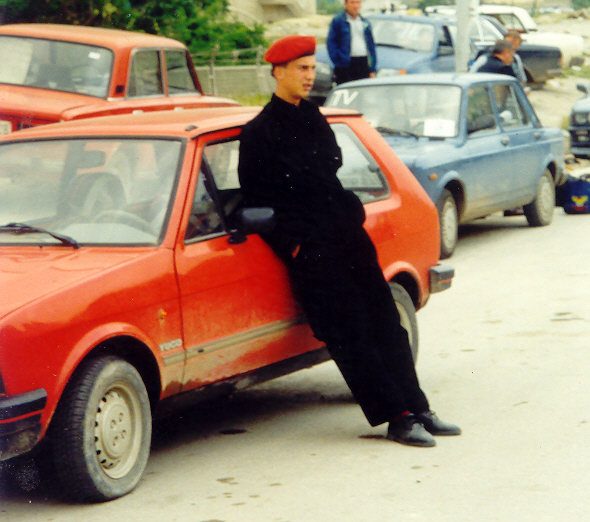
A KLA policeman: tellingly, not looking eager
to tackle Kosovo's traffic culture problem

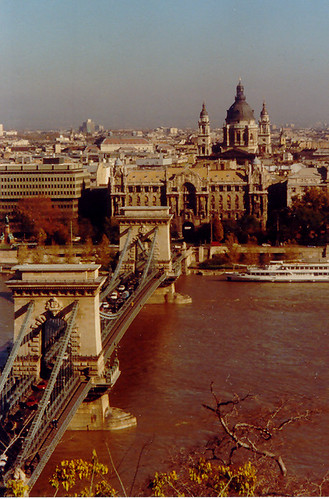
The following year, I was cycling through the centre of Budapest, then my home city, when a car cut suddenly across my path. Shocked and thinking the driver might simply not have seen me, I slapped a side panel of his car. When the window wound down, the stream of words that issued started “a büdös anyád” (your stinking mother). A general tone thus established, the driver went on to suggest that I shouldn’t be on the road - and that he was well within his rights to act like a homicidal maniac.

The incidents in Pristina and Budapest helped to germinate the seed of an idea that was already planted in my mind. I began increasingly to pay close attention to what light the culture of a country’s roads shed on its wider society. It was illuminating precisely because, to people sitting inside cars, using a road often feels like a purely private enterprise. On busy roads, it is in fact one of the most complex social interactions many human beings undertake.

Budapest: beautiful - but one driver was
misinformed about my mother's personal hygiene
It perhaps wasn’t surprising that Kosovo’s road culture was fairly nihilistic. On a previous visit to Kosovo, shortly after the 1999 war, I had found a farm in western Kosovo whose courtyard was scattered with human ashes and bodies left for the dogs. According to local Albanians, it was the aftermath of a massacre by Serb forces. By the time I saw the bad driving just under two years later, most Kosovo Serbs had left either because of revenge attacks or the expectation of them. The callousness towards others and contempt for the rule of law that had marred Kosovo’s recent history carried straight over, it seemed to me, to how people drove.

Hungary was nothing like as damaged a society as Kosovo – despite the horrors of decades of first right-wing dictatorship and then Communism. But I would regularly report on the miserable living conditions of those who lived in dirty hovels on the edges of towns or run-down bits of Budapest – the country’s gypsies. My experience with the angry motorist – and the boorish tendency of drivers of the most powerful cars on the country’s motorways to drive at speeds that seriously endangered older, slower-moving cars – suggested vulnerable road users attracted similar contempt.

But in Hungary, Kosovo and many other long-misgoverned parts of the world, decades of misrule have discredited both the rule of law and any sense of a wider social good. In such societies, it became heroic to defy even good laws because those imposing them were so distrusted. The negative examples nevertheless suggest something about how road users should conduct themselves in healthier societies. Members of a well-ordered society abide not just by its agreed laws but also by the higher principle that they seek, as far as possible, to respect each other’s interests. They pay particular attention to the interests of the most vulnerable, who are least able to stand up for themselves. They restrain their exercise of their own rights to enhance others’ ability to enjoy theirs.

So we shouldn't be constantly worrying, it seems to me, what others might do to us if we break the rules or behave discourteously. We should all be thinking what our behaviour says about ourselves and our society. If we behave rudely or flout the rules, even if it does no direct harm, we tell those that see us that we are uninterested in their wellbeing. Every time we break road rules, we tell those that see us that we despise the rule of law generally. We’re slowly but surely corroding the bonds that ought to bind us together as a society – and as people who share the limited, precious space our society devotes to roads.

Those who regularly follow the developed world’s controversies over the role of cycling will by now think they know what’s coming. This could easily be the point where I start to bemoan the behaviour of some of my fellow cyclists, shaking my head metaphorically over how those that jump red lights, ride on pavements and so forth besmirch the good name of the rest of us.

My point is, I hope, a bit more subtle. To protect vulnerable road users, it's vital to pay most attention to the vehicles that do most harm. Politicians, police forces and journalists in many countries express outrage at cyclists’ alleged general disrespect for the law. But the less conspicuous law-breaking of motor vehicle drivers – the breaking of speed limits, the driving while distracted by a telephone and the contempt for measures meant to keep cyclists safe – kills thousands of people each year in most developed countries. Many motorists would be surprised how often their fellow motorists even ignore red lights - the failing often, in Britain at least, assumed to be particular to cyclists. I have twice narrowly avoided cars that were simply driving too fast to spot stop lights when I was heading across their paths. The depressing reluctance of many police forces to regard such behaviour as serious and criminal surely leaves vulnerable road users who try to stand up for their rights more exposed.

But there is no point pretending that some cyclists’ behaviour contributes nothing to the malaise. As I argued in a previous blog, cyclists generally harm no-one but themselves if they run red lights, ride on pavements or head the wrong way up a one-way street. Yet motorists or pedestrians seeing such behaviour must surely, to some extent, feel freer to disregard the rules or behave intolerantly themselves. Cyclists have so much potentially to gain from an improvement in road culture that it is surely worth each cyclist’s pondering which way his or her behaviour shifts the delicate balance between tolerance and intolerance on the roads.

It will not solve everything for cyclists to follow the rules. I have previously argued – and still believe – that much anti-cyclist behaviour stems from a simple irritation at cyclists’ choice of an obviously different way of doing things. I have also often been abused for alleged rule breaking when riding (perfectly properly) on on-pavement cycle paths or using one-way streets with a contraflow cycle lane. Some motorists fly into a rage at seeing a cyclist pulling ahead of them into the boxes that are meant to let cyclists leave traffic lights in most British cities ahead of the cars.

But there is a tendency on the part of all road user groups to criticise others for their failure to adhere to the fixed rules of the road – then make up their own minds which rules seriously apply to them. It is a system few people think appropriate with regard to the rules about assault or theft – and one that is no more appropriate about the rules for how people share the roads. Consequently, when I get on board my bike today, I will be looking out for - and trying to obey - traffic lights, one-way street signs and all the other myriad traffic symbols I see about me. It may not directly make my day better. It may not even make me directly safer. But it will reflect my conviction that, because my actions affect a far wider circle of people than myself, I have to respect the only commonly-agreed set of rules that we have.

Sunday, 29 January 2012

Why some people get angry with cyclists: and why it's time to do something about it

“What was the problem back there?” I asked the motorist who had sat behind my bike honking her horn. She said I’d been blocking the road. On a four-lane road, I pointed out, a cyclist riding a car door’s width from parked cars wasn't much of an obstruction. I also had as good a right as she to use the road. “You don’t pay road tax,” she answered. Roads were funded from general taxation, rather than a specific tax, I retorted – and, I added, no respectable transport economist believes motoring taxes cover all the costs of motoring pollution and other damage. As a higher-rate income tax payer, I was subsidising her driving. She changed tack. “F*** off back to Scotland,” she said – except that she didn’t use the stars.

A double provocation to the Angry Woman of Camberwell:
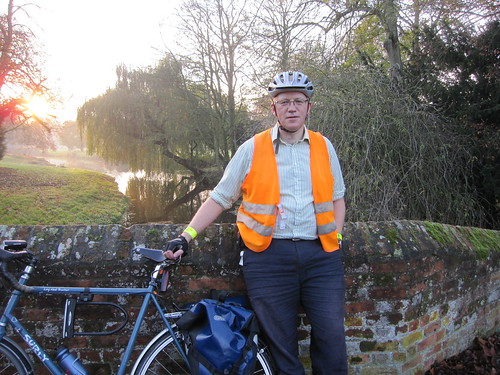
me, with my bike and still in England. While I am normally invisible,
sharp-eyed readers will spot me towards the centre of the bridge.
It would be tempting to describe my partner in this impromptu Socratic dialogue as typical of motorists in general – but unfair. There are, of course, many considerate, thoughtful motorists – it could hardly be otherwise in a decent, democratic country where cars account for the vast majority of personal journeys. But I have had enough ecounters with angry motorists – and read enough angry commentary from those exasperated with cyclists’ perceived shortcomings – to think that a sizeable minority share her feelings. I’ve seen no evidence attitudes elsewhere in the world are significantly different - and a fair amount that they’re much the same.

The woman’s mentioning of my ethnicity was suggestive. Cycling may be only a personal transport choice – but her attitude towards me as a cyclist seemed of a piece with her casual racism. Her comment about my going “back” also illustrated the dangers of jumping to conclusions about someone based on limited information. I was, despite my accent, born in west London. Even if one accepted the dubious idea that only Londoners should be in London, I probably had at least as strong a claim on citizenship of the Capital as the Angry Woman of Camberwell.

But the nature of some people’s feelings about cyclists is clear from what they write about us. In December 2007, Matthew Parris wrote in The Times that life in his village would be better if someone strung piano wire across the country lanes to decapitate passing cyclists. Cyclists, he said, were responsible for the litter found in local hedgerows because the litter was at cyclist, rather than runner, height. I’ve been trying ever since to work out how different a cyclist’s height is from a runner’s. Around the same time, a column in the Guardian – for which I can’t now find a precise reference – complained about cyclists in general and in particular their “pompous little plastic helmets”.

In September 2009, meanwhile, James Martin – a TV chef –wrote a car review for the Mail on Sunday of an electric sportscar. Having mentioned in the piece his irritation at the number of cyclists riding on the roads in his area, he wrote about how he had seen two cyclists ahead of him when driving the silent car. He had, he wrote, deliberately accelerated as he passed them - then honked the horn.

"The look of sheer terror as they tottered into the hedge was the best thing I've ever seen in my rear-view mirror,” he wrote.

Matthew Parris’s column, the Guardian piece, James Martin’s car review and Camberwell Motorist all seem to express an anger out of all proportions to the anger’s stated motive. I had delayed the woman by milliseconds from reaching the end of a traffic jam. Even if cyclists had been littering in Matthew Parris’s hedgerows, it’s hard to see death is a reasonable punishment. Helmets are no more capable of pomposity than any other inanimate object – the columnist who imagined it was expressing only his own rage. James Martin seemed content to describe himself committing a crime against cyclists for no other reason than that they were there and vulnerable.

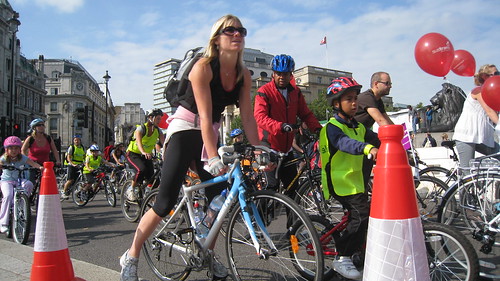
Thousands of cyclists at the 2009 London SkyRide:
decapitating them all would be messy -
but, according to Matthew Parris, fair
Parris and Martin subsequently half-apologised by saying their columns had been meant as jokes. What comfort one is meant to draw from the idea that Matthew Parris thinks it amusing to imagine cyclists being decapitated remains a mystery to me, however. I still wonder which other crimes against fellow citizens the conservative, bourgeois Mail on Sunday would have regarded it as a joke for one of its columnists to describe.

Such anti-cyclist anger reminds me in many ways of the feelings about gypsies that I would hear expressed when in lived in central Europe. In Hungary, people would tell me they disliked gypsies because they were lazy and dishonest. In Romania, some gypsy groups were unpopular because they were more successful than most Romanians, and built large, vulgar houses to show it. The truth was that gypsies – like, I would suggest, cyclists - were unpopular principally for being different.

Humans seem to feel a rage against those who get away with things they long to do – with the gypsies for seeming carefree and unconcerned about bourgeois norms, with gay men who flaunt their feminine side, with cyclists for skipping ahead of them to the front of the traffic queue. It would be wrong to claim that cyclists – mostly, in London, articulate, middle-class men - face anything like the problems that the perpetually victimised gypsies or blacks or gays face. But I think the instincts have a similar genesis.

None of this of course would matter much either if the sentiments expressed produced no real world consequences or if anything were being done to tackle the prejudices. Yet there are real-world consequences – and significant reluctance to tackle them.

Days after Matthew Parris’s Times column, I was cycling out of Hyde Park across Knightsbridge one Saturday, heading towards home. Seeing me heading towards a cycle-only section of road, a young man on the pavement aimed a punch at me. He then guffawed with his friends at how his gesture made me wobble. I met Ken Livingstone, the then mayor of London, a few days later when he announced plans for what is now the London Cycle Hire Scheme. I recounted my story and asked the mayor how he planned to stop such – fairly common – behaviour from putting new cyclists off. He brushed it aside. “Well, I’ve often felt like punching a journalist myself,” he droned, before launching into the story of a constituent who, in his days as a member of parliament, had been seriously injured when knocked down by a cyclist. Cyclists, he seemed to imply – against all the evidence – were the real menace.

As long as veteran left-wingers like London’s former mayor continue to make common cause with the worst parts of the right-wing press and the least reflective motorists on cyclists’ rights, cycling in London – and many other parts of the developed world – will remain an activity for the determined few. When it becomes as unthinkable to joke about cyclists deserving death as it rightly is about any other group, tempers on the roads might less easily get frayed.