Showing posts with label cycling culture. Show all posts

Sunday, 28 April 2013

Boston, bikelessness and how cycling makes me feel at home

The policeman stood in the middle of Arsenal Street, the main road through Watertown, Massachusetts, and screamed at any vehicle that didn’t belong to some arm of law enforcement or the emergency services: “Turn round! You need to get turned round!” Either side of him in the 1am dark sped, flashed and wailed a procession of emergency vehicles of a variety and quantity that, even in a career where I’ve covered a reasonable amount of terrorism and other trouble, I had never before seen.

A little up the road, I now know, Tamerlan Tsarnaev, one of the presumed bombers of the Boston Marathon, already lay dead. Somewhere else in the nearby suburban streets, Dzhokhar Tsarnaev, his brother, was hiding, trying to evade the arrest that would come around 18 hours later. And my attention, for at least a few seconds, was focused on a bicycle.
 
Practicalities: a board in a Boston hotel gives
post-bombing advice
It was one of the themes of the week I spent in the Boston area, starting a week ago last Monday, covering the aftermath of the bombings at the annual marathon, that I often found myself staring longingly at bicycles. I missed my wife and children very much. I was moved at some of the expressions of shock and grief I encountered. But the sight of people on bicycles provided a persistent, nagging reminder of what I was missing about my everyday life. Those people, for that moment, could experience the uncomplicated feeling of freedom that so often comes from riding on a bicycle – and I couldn’t.

The whole episode started, however, with an unusually frantic bike ride – from my office in Manhattan across the Brooklyn Bridge home to Brooklyn, to pick up my laptop, a change of clothes and washbag. A little over two hours before, two bombs had gone off near the finish line for the Boston marathon. My bosses wanted someone to get up there and, after some discussion, it was decided the person would be I. I pedalled as fast a I could in the warm early evening sunshine, fretting all the while about whether I would have enough time to get back to Pennsylvania Station for my train. Then, having transferred a few notebooks, a rain jacket and some other essentials out of my pannier bags into my overnight case, I headed out for the subway station – and into what turned out to be a week of that sad state known as bikelessness.

I didn’t, of course, worry too much about my transit status in my initial panic as I rode north. I had been to Boston only once before, in 1999, and would, I knew, have to find a way to file some kind of story about the scene there immediately after I arrived at midnight. I scoured maps to work out where I’d be arriving and where the bombs had gone off. I arrived in a city still festooned with signs and portable toilets put out for the marathon. The discarded runners’ heat sheets, the heavy police and national guard presence and the chaotic pile of wheelchairs outside a medical tent testified to the chaos in which the event had ended.
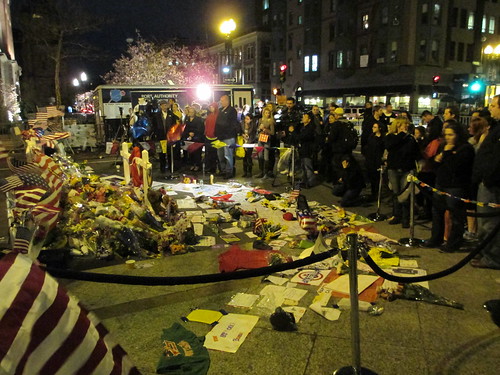
 
Grief: how Boston's people marked the bombings
Even as I took in the scene for my first piece, however, I found my gaze wandering. Two cyclists stopped at the junction of Arlington and Boylston streets to look in the darkness towards where the bombs had gone off. “Fixed wheel,” I thought to myself. “I wonder if they’re more popular in Boston than in New York.” They pedalled slowly off, their lights pin pricks in the darkness. I took a taxi to a distant, expensive hotel, filed a short piece about the scene, had a few hours’ sleep and woke up again, launching myself into several frantic days of rushing around the city on the tail of the latest overheated rumour about what was going on.

I got about a lot over the next couple of days by public transport. In my tired and over-emotional state, I felt a particular pang about not being able to discuss Boston’s subway – the T – with my late father, who worked on metros all his life. He would, it occurred to me, have enjoyed discussing the vagaries of the US’s oldest subway. I took the T on Wednesday to Boston’s federal court house, as a crowd gathered outside on false reports that two arrested suspects were about to arrive there.

I had spotted by this time the Hubway bikeshare station outside my new, downtown hotel. But it seemed a stretch to use it to reach Thursday’s post-bombing Service of Healing. I had no idea where the vast police cordon around Holy Cross Cathedral designed to protect the visiting President Obama would spread. So I walked that and many other trips over the week – peering at the cyclists, trying to work out how their journeys to work compared with mine, what the cyclists were making of the events in the city and whether Boston’s drivers were any more friendly to bikes than New York’s. I looked out, too, for Boston’s most celebrated cycle blogger – Bikeyface – but saw no-one who looked like a pen-and-ink drawing and gave up.
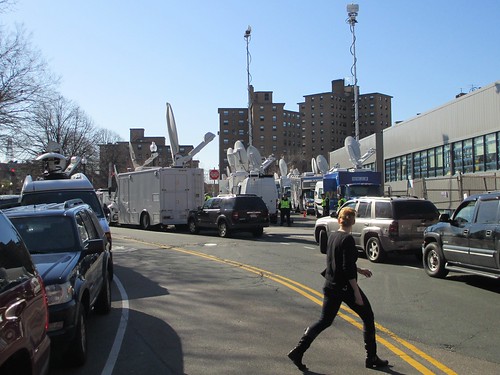
 
Satellite trucks outside the Service of Healing:
reporters kept finding something in their eyes
I reported on the service – inwardly noting how many fellow reporters, struggling with their feelings much as I was, were wiping something out of their eyes. Some even joined in the applause and standing ovation for the president. I prepared to write a long, considered piece for the weekend about the bombings’ impact on Boston. I made a mental note that, as interest in the attacks waned, some time over the next couple of days I would get out one of those Hubway bikes and take it for an explore of the city.

It wasn’t to work out like that. On Thursday evening, as I worked on my long, considered piece, an email from a colleague alerted me to an apparent disturbance over the Charles River on the campus of the Massachusetts Institute of Technology. Exhausted and preoccupied with the piece I was trying to write, I nevertheless caught a taxi to a site that turned out to be swarming with police. I started writing a story on my BlackBerry and talking to a news editor in Hong Kong. Then, seeing scores of police vehicles speeding away from MIT, I caught another taxi, with a French TV reporter, to Watertown, where I encountered the screaming, panicky policeman.

Yet, amid that chaos, the detail that caught my eye was the Hubway bike. Somehow, amid the chaos and confusion of one of Boston’s most extraordinary nights, a fellow reporter had responded to the injunction to get out to Watertown as fast as he could by hiring a Hubway bike and pedalling more than five miles by the Charles River out to this suddenly world-famous patch of suburbia. I felt an instant sense of fellowship with the person involved – I recalled how I had cycled across London to get to the site of the 2005 Edgware Road bombing during the July 7 attacks on London. I respected, too, his extraordinary bravery – scores of screaming emergency vehicles must have made even worse road-fellows than the worst New York City-area drivers. Then, before I could make my fellow reporter’s acquaintance, my mobile ‘phone died. I was forced to hail an arriving reporter’s taxi back into central Boston.

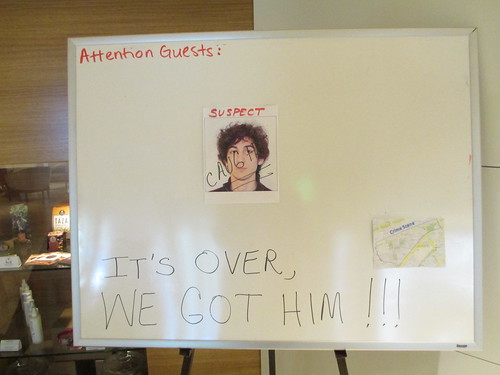
That hotel whiteboard after Dzhokhar's arrest:
because sometimes crass triumphalism just feels right
I recognised, nevertheless, the sense of community I’d felt on spotting another cyclist and sought it out again. I chatted amiably on Friday to two young reporters who had cycled to Watertown’s media staging area as we awaited news of the eventually successful hunt for Dzhokhar. I looked over the shoulder of a photographer who had reached near the site of his eventual arrest by bike and grabbed unusually good pictures. On Saturday, seeking out the opinion of people in Cambridge, Massachusetts, at having had two terrorists living in their midst, I went up to a woman practising in a park riding in clipless shoes. I felt an instant sense of warmth for each of these people – a knowledge that each of us knew the pleasure of getting about under one’s own power, the joy of speeding down a hill, the satisfaction of climbing one. Those moments of fellowship did a great deal to keep me going until the point last Sunday afternoon when I was finally able to return to Back Bay Station and put myself aboard a fast train bound for New York City.

That journey inevitably began a long unwinding process. I took the Monday off work, catching up with undone tasks and giving my bike an overdue degrease, clean and lubricate. A cycling neighbour chatted amiably as I worked at the task in our building’s back yard.

Come Tuesday morning, however, it came time to return to normal. Having dashed about for a week covering one of the world’s biggest news stories, I was back to the unforgiving schedule of writing up company results. The change of pace under such circumstances can be as wearing as the process of covering the big story itself.

But, for the first time in more than a week, I was swinging my leg over my Brooks saddle, pushing down on my pedals and rolling off onto New York City’s streets. There was a steady drizzle in the air and a blustery wind. It was far from an ideal day for cycling. A week away from it, however, had made me realise that this activity made me feel at home, regardless of where I undertook it.

This post is an entirely personal, private post and in no way reflects the views of my employer

Sunday, 14 April 2013

A broken-down church - and a broken, asymmetric flow of information

I was only a little way into my first ride to work after moving into my apartment in Brooklyn when I started to get into a terrible tangle. Trying to get down Kane Street, in Cobble Hill, I found the road marked closed. After heading past the road cones, I found it was a proper road closure, not the kind where one just wheels the bike on the sidewalk past the obstruction. The closure was absurd, I muttered to myself, as the one-way system pushed my route further and further from the one I’d planned. It was, I reasoned, probably some piece of stupidity on the part of the police, worried about being sued over an unlikely accident near some relatively innocuous building work.
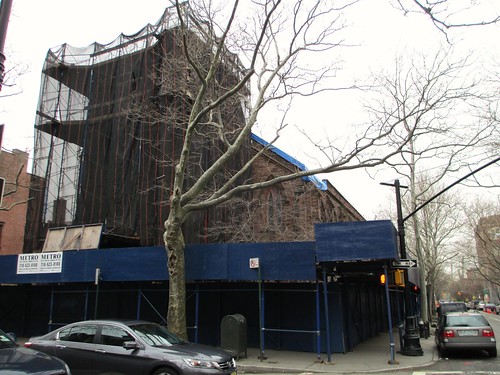
Christ Church, Cobble Hill: source of frustration on
the Invisible Visible Man's commute

I calmed down considerably, however, after finding out via Google why the street was closed. On July 26, while I had been back in Europe, lightning had struck Christ Church, the Episcopal church at the junction of Clinton Street and Kane Street. The spectacular tower – and scaffolding around it – had come crashing down as Richard Schwartz, a pedestrian, was walking underneath. The falling scaffolding had killed him. The building was a serious danger – and hadn’t yet been made safe.

The incident helped to crystallise an idea that had been slopping in fluid form around my mind for a while. I’d never have been irritated about the Kane St closure, I realised, if I’d had better information in the first place. It was, it occurred to me, one of many instances where confusion arises because two different parties – the New York City Department of Transportation and myself, in the Kane Street case – have different understandings of what’s going on on a road. The asymmetric information sharing had at least left me only inwardly irritated, however. The more I thought about it, the more I realised there were times when such information asymmetry probably killed people.

I encountered one potentially serious example the other morning while riding to work. I waited at traffic lights by the start of the Tillary Street segregated bike lane near the Brooklyn Bridge. When the lights changed, I moved off, only to find turning across my path a car heading in the other direction that should have been yielding to me. The driver’s behaviour was entirely wrong, based on his failure to understand what I knew - that the bike lane was as much part of the traffic flow at the intersection as the roads he was using. But, as he moved across my path, he leant out of his window. “Green light!” he yelled at me, self-righteously.

Traffic on W54th street. Those tainted windows don't,
in the Invisible Visible Man's experience, conceal
motorists pondering hard what information they might lack
about other road users' rights
Cycle lanes can give rise to information asymmetry as well. As I approached my office one morning last month, a truck driver opened his door in my path as I made my way up the side of some stalled traffic. He didn’t need to look for cyclists on that side of W54th street, he argued, because there was a bike lane painted down the other. Because of our asymmetric understanding of cyclists’ road rights, he had understood the cycle lane – which I knew to be a refuge for cyclists that didn’t stop me from using the rest of the road – as a kind of prison, to which cyclists should be confined.

Perhaps the most striking and persistent problem of information asymmetry that I’ve come across, however, was in London, where I lived until last August. Most traffic lights at busy intersections in London feature an “advanced stop line” for cyclists – an area where cyclists are meant to wait ahead of the other traffic for the lights to change. Many cyclists value advance stop lines as an idea, since they should, in theory, allow cyclists to get away after lights change, get clipped back into their pedals and get back into a suitable line on the road before the motor traffic catches up. Few motorists, however, seem to have much idea either about the principles of the advanced stop areas or when they should stay out of them. At least one motorist informed me, indignantly, when I complained about his occupying the area that when he’d arrived there had been no cyclists waiting, so he’d simply driven into the bike area.

Advance stop lines were involved in all three of the worst confrontations I had with motorists in London. In one case, a motorist deliberately drove very close to me and then very dangerously overtook me after I remonstrated with him about his driving into the ASL area as I was using it. A bus driver assaulted me (abandoning a bus full of passengers to do so) after I photographed his occupying the ASL area at a particularly dangerous junction. I had to call the police to stave off a threatened assault from another motorist to whom I’d complained about his driving into the ASL area.

Leaving aside the more eye-catching incidents, ASLs were a daily source of tension and frustration. I’d often squeeze past a line of stationary traffic to reach what was meant to be a haven for cyclists – only to fill it full of motorists grumpy at one’s presumption in seeking to get a jump on them at the lights. It’s reasonable, I think, to assume that even a fairly modest publicity campaign might have let at least a little of the fresh air of information into the foetid atmosphere of confrontation surrounding ASLs. In New York, it surely wouldn’t take much of a campaign to educate drivers about the role of bike lanes and the dangers of passing bikes too close to improve driving standards at least a little bit. The New York cycling map, after all, features excellent advice for cyclists on how motorists should give cyclists at least three feet's clearance when passing.

It isn’t, after all, a neutral thing to encourage new cyclists onto a city’s streets and then not tell motorists how to behave around them. Nature seems to abhor an information vacuum just as much as a literal one. In the absence of the pure oxygen of accurate, well-founded information, the information vacuum fills up with the carbon-monoxide-laden air of motorists’ assumptions about cyclists’ rights and responsibilities. It’s perhaps hardly surprising, given that no-one’s telling them otherwise, that so many motorists assume cyclists who ride well outside the door zone away from cars are acting maliciously, rather than entirely sensibly. In New York, it’s still less surprising given how many bike lanes – including most of those I use every day – are painted in precisely the part of the road – next to the parked cars’ doors – that cyclists know to be the most dangerous.

The air has grown still more poisoned because the agency meant to set the limits of acceptable behaviour in most modern societies – the police force – so often seems to have abandoned that role with regard to the road rules. Motorists, after all, like most other people see what they see others doing unmolested and assume it’s acceptable. One telling recent case I spotted involved a police effort to start fining motorists who drove in a bike lane on a narrow street at Twickenham, in South-West London (I’ll give New York cyclists a moment here to come to terms with the idea that, just across the Atlantic, there’s a police force that has, at least once, acted against motorists using a bike lane). A local newspaper quoted Nick Blyth, an officer involved in the enforcement effort, as saying: “Most of the motorists tend to comment when stopped that everyone else does it and they were just following them.”
 
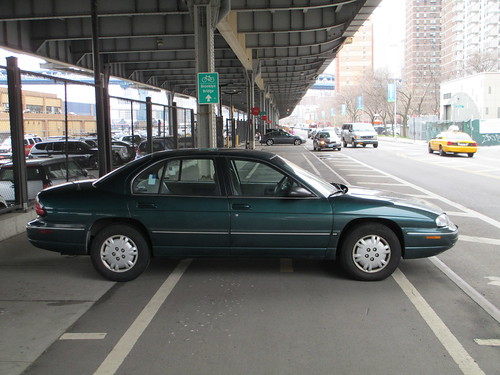
Park right across one of New York City's busiest bike lanes?
Until someone says you shouldn't, you probably will.
It’s hardly surprising, given the New York Police Department’s reluctance to enforce a wide swathe of road rules, that few motorists seem even to understand the harm they cause when double-parking in bike lanes or refusing to yield to a cyclist in a bike lane. Nor, in London, is it terribly surprising that ASL infringements continue at the rate they do when even the Metropolitan Police department charged with processing complaints against motorists from cyclists (normally backed by helmet camera evidence) is currently pleading with leading London cycle bloggers to tell people to send in no more pictures of ASL infringements. They say, to all intents and purposes, they’ve no interest in prosecuting them.

The police’s attitude reflects, in an understated way, the strangeness of the political discourse around cycling. Politicians are eager, when announcing new policies between elections, to borrow cycling’s mantle of greenness and modernity and to encourage its growth. Closer to election time, meanwhile, many seem to revert to a different type – to claiming, like one minister I met, that cyclists were“their own worst enemies” or claiming like Boris Johnson, London’s mayor, that “typical” cyclists had skinny legs and ran red lights. No politician engaged in this delicate dance between pro and anti-cycling positions is likely to back a public information campaign explaining to frustrated motorists why, yes, that cyclist who yelled at you about your dangerous driving actually had an excellent point.

However, until such information is made more widely available and police across the industrialised world are backing up the politicians’ line with proper enforcement, few people will experience the relief I felt at letting go of my frustration over the Kane St closure. Relief is certainly not the emotion that comes naturally to me each morning as I ride along the now-reopened Clinton St towards the Brooklyn Bridge. I am all too often forced into the narrow bike lane, in danger from car doors, as motorists seek to push past me. But, as I reach the Kane St intersection and see Christ Church, still wrecked but now made safe, I still recall at least a little bit of that feeling.

Sunday, 9 December 2012

Washington, a stabbing - and why an individual cyclist tells you nothing about the rest

Washington, DC surprises me every time I visit. While New York feels just as bustling, large-scale and chaotic as the films and TV programmes would suggest, the US’s capital feels nothing like the West Wing. Sure, there are people influencing the whole world’s fate in lots of those neoclassical buildings – but Washington’s atmosphere most reminds me of other sleepy US administrative capitals like Richmond, Virginia or Harrisburg, Pennsylvania.

Washington, DC: provincial to me
- but full of cycling savages according to one Facebook user
During a visit last week, it nevertheless occurred what an advantage it was that Washington seemed a far calmer place than New York to ride a bike. The cyclists I saw during the visit mostly seemed to be riding sedately, calmly and in general harmony with other road users around them.

This was, however, entirely the wrong conclusion, according to at least one person I know. On Friday evening, two days after I came back from my DC daytrip, a Facebook friend commented on a story about an altercation between a cyclist and a motorist in North-West Washington the night I visited. The motorist appears to have somehow alarmed the cyclist, who responded by hitting the driver’s car with his D-Lock. The ensuing argument ended with the cyclist stabbing the motorist, who suffered rib injuries but looks likely to survive.

“Savages,” my Facebook friend commented. “Civility is an alien concept,” someone else replied in agreement. The clear implication was that I, as a cyclist, was complicit in an appalling, entirely unjustified assault of a kind I would never have contemplated.

My immediate instinct was to launch into an argument, pointing out the fatuousness of jumping from a single, knife-wielding cyclist to the implied generalisation – all cyclists are savages. Concluding that I was unlikely to change clearly entrenched attitudes, I limited myself to “unfriending” the person responsible.

But, as I cycled home that evening, a more mature reflection occurred to me – one sparked in part by the controversy in the UK over the inflammatory “War on Britain’s Roads” documentary. If it made no sense to draw a conclusion from a single stabbing - or the misleading footage of an alleycat race in the documentary  - to cyclists’ general behaviour, why did I feel free to criticise in general the culture of driving or the police? Was I making any more sense than my former Facebook friend?

One possible response to the “cyclists are savages” claim would, of course, have been to point to some of the numerous incidents of motorist-cyclist violence. In the space of a year of cycling in London, I suffered one actual – albeit mild – assault and had to make an emergency call to police to avert another. The first incident involved a bus driver who abandoned his bus – and passengers - to confront me because I’d photographed him blocking, illegally, a cyclist-only area at traffic lights. He smashed the mobile ‘phone I was using as a camera out of my hand. The second incident came as I tried to photograph a motorist I’d previously seen deliberately drive across the path of a cyclist who’d complained about his driving. He threatened – alarmingly convincingly - to smash up both me and my camera.

The most pertinent case I could have raised, however, was the stabbing in September of Colin Albright, a cyclist in Pittsburgh, whom a motorist pursued as he carried his bike away from a road up a set of steps. The motorist stabbed Albright repeatedly, including in the throat, possibly over some perceived slight involving a traffic incident.
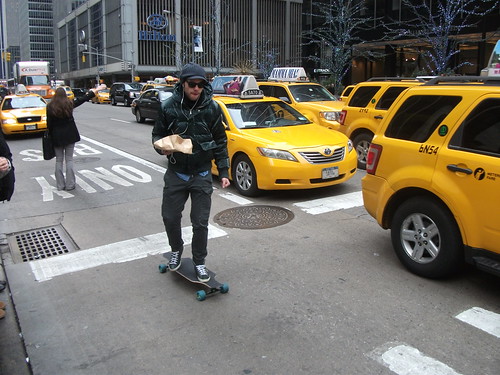
You might have prejudices about people who make strange
transport choices - like skateboarding down Sixth Avenue.
It doesn't mean you know anything about this individual skateboarder.

Albright’s case would have been pertinent precisely because it illustrates the absurdity of generalising from something extraordinarily rare – a stabbing over a disagreement on the roads – to the generality of day-by-day on-road relationships. In late October, Anthony Scholl confessed to attacking Albright. Scholl was already in custody over an alleged attempt to burn down his parents’ house. While there is little information so far on Scholl’s motive for stabbing Albright, the alleged arson attempt seems to have been aimed, in Scholl’s mind, at preventing his parents from killing him and feeding him to their (presumably imaginary) pet alligator.  Albright’s stabbing also looks likely to have stemmed from what Scholl’s mother has called his “psychological issues”. It seems similarly unlikely that the appalling Washington stabbing will turn out to involve an ordinary, mentally-balanced cycle commuter who just happens to pack a knife to mete out summary justice on uppity drivers.

That anyone could ever have thought the Washington stabbing had anything to do with broader cyclist behaviour, of course, stems from humans’ powerful desire to pin blame for problems on out-groups. The only thing so far known about the Washington motorist’s assailant is that he was on a means of transport against which large numbers of people have powerful prejudices. Few people have the mental self-discipline to avoid working on the basis of such limited information and their prejudices to jump to wholly unwarranted conclusions.

It’s telling, for example, that hardly anyone blames the antics of bank robbers’ getaway drivers purely on their being drivers. Drivers are too numerous and familiar to act as convenient out-group scapegoats. No-one sought to blame the assault I suffered or the threatened assault merely on the perpetrators’ status as motorists. I received, instead, some close questioning about the immigration status of the bus driver and the race of the man who threatened to assault me. Establish a link to immigrants or African-Caribbean men, the implication seemed to be, and the incidents were far more easily explained away.

A cyclist, cars and pedestrians at 55th Street. Which of them
is a "savage" will be in the  eye of the beholder
The prejudices are all the more powerful for not appearing to the prejudiced to be prejudices at all. Have your eye out for poor cyclist behaviour in Washington and you’ll spot instances of such behaviour, rather than the courtesy and calm I witnessed. Assume the main road problem is the cyclists and you’re unlikely to spot the multiple ways motorists misbehave.

The truth is that, in all the incidents I’ve described, the attackers acted as individuals, rather than a member of a group. Their behaviour stemmed from their own characters or mental states, rather than their status as cyclists, motorists, bus drivers, immigrants or anything else. To imagine that the behaviour in a single instance of a single member of a large group has anything to say about the wider group as a whole is a thinking error of a kind that would be shocking were it not also fairly common.

That point could, of course, lay me open to the objection someone recently made in an online forum to my use of statistics to point out that cars generally posed a far greater danger to pedestrians than bikes. That was beside the point, the poster wrote. Each motorist or driver differs so much that it makes no sense to discuss a general level of risk from motorists or cyclists. A very poor cyclist could conceivably pose a greater danger to a pedestrian than an extremely careful, conscientious motorist. I am perhaps particularly vulnerable to such a charge because of my habit of illustrating points on this blog by reference to specific – usually extreme – incidents that I take to illuminate a wider truth.

Yet I have, I hope, been careful when complaining about general problems to have sought evidence that my experience speaks to a broader reality. It remains a verifiable fact, for example, that motorists kill a disproportionately high number of other road users in both the UK and New York City. Collisions with cyclists in both places account for a far lower proportion of road fatalities than cyclists make up of road traffic. Research in New York suggests motorists’ failure to yield as required to pedestrians is the biggest single cause of road deaths. Research in the UK suggests failure on motorists’ part to pay attention causes a disproportionate number of crashes.
Court Street at night. Just because most motorists speed here
doesn't mean they all do.

It makes sense on such a basis to say there is a general problem with motorists’ failure to yield to New York pedestrians or to pay proper attention in the UK. I am even confident enough in my own judgement to diagnose a few more local, unmeasured problems. There is, for example, a general problem that many motorists regard Brooklyn’s Court Street as an appropriate place for excessive speed and not somewhere where cyclists’ requirement for space on the roads need be considered. It just doesn’t make sense to predict on this basis that the next motorist one encounters on Court Street won’t be a model of caution, courtesy and respect.

I feel acutely sorry for the victim of the Washington stabbing. His experience last Wednesday must have been appallingly frightening. I trust the District of Columbia police will swiftly identify the attacker and bring him before the courts. I wish the victim a swift and smooth recovery. But I also devoutly hope that no-one in future will make the lazy and offensive mistake of imagining any of what happened had anything to do with me.

Monday, 13 August 2012

Commuting, Racing - and the French col climb in our heads

For a week of the Invisible Visible Family’s recently-completed family holiday in France, I had the task every morning of going to fetch supplies of bread, croissants and other ingredients for a continental breakfast. Jumping aboard my bike, I’d sweep down a hill and around the series of turns that took the road through the nearby village. Hunched down on my drop handlebars, I was, of course, in my head leading some audacious breakaway on an etape of the Tour de France. I could almost see the smiles on the faces of the gap-toothed peasantry of Dampierre sur Boutonne lining the roads to cheer me on.
The chateau at Dampierre sur Boutonne: its townspeople
would have cheered the Invisible Visible Man on,
except that the race was only in his head.

But the illusion would quickly break down on the return journey as I ground my way back up the hill. A baguette would be protruding from a pannier bag and a load of jus d’orange and pains au raisin would be slowing me down. I felt again what I truly am – a person who gets about by bike, rather than a sportsman.

Following this year’s Tour de France and Olympics, there has been no shortage of opportunities for British cyclists to reflect on the links between our day-to-day cycling and how Bradley Wiggins rides a time trial or Chris Hoy attacks a track sprint. We’re engaged in many senses in entirely different activities. Bradley Wiggins and Chris Hoy shave their legs to achieve maximum aerodynamic efficiency. I cart around 10 kilos of spare weight just because I won’t lay off the beer in the evenings. It has nevertheless made me happier than perhaps any previous sporting result to see Bradley Wiggins – a cyclist intimately familiar with some of the same London roads that I have ridden so often – control so comprehensively the Tour de France. I couldn’t quite speak for choking up as I described to the Invisible Visible Woman how Chris Hoy from Edinburgh – a city whose streets I have cycled hundreds of times – had won the Olympic keirin.

The question is whether my reaction to British cyclists’ victories reflects anything at all in common between what we both do. Is cycling mainly a sport or just a way of getting about? Should it be mainly a sport or a way of getting about?

It’s worth stressing quite how miserably humiliating my efforts to coax my big, lumbering body into sporting activity have generally proved. I recall, for example, 30 years ago entering the back stroke at a Glasgow Boys’ Brigade swimming gala. It took my fellow competitors the same time to complete both lengths of the race as I did for my first. The difficulty in telling my back stroke from the thrashings of a drowning boy led one of the organisers to inquire after my wellbeing.

The Invisible Visible Man at play: does this honestly look to you
like a body that should be undertaking triathlons?
The swimming gala came back vividly to me when, a few years ago, a chirpy public relations man suggested that, since I was a keen cyclist, I should undoubtedly compete in triathlons, as he did. I also recalled how I had often accompanied my asthmatic and chronically obese classmates in the trailing group on my school year’s annual cross-country run. The run – which was sponsored - was perenially used to raise funding for a desperately-needed new drainage system for the school’s sports fields. Since the event was run mostly round said sports fields in the midst of a Glasgow winter, my group consisted predominantly of overweight, mud-spattered boys, many reaching for their asthma inhalers amid the gathering mid-afternoon gloom.

My automatic reaction when asked to participate in a sporting event is, in fact, to start feeling humiliated. That stems in part from an incident when a PE teacher taught me and my 12-year-old classmates how to throw a discus. We then each had a go to see which would go forward to the school sports day. Ever the optimist, I was convinced I could improve after my initial, laughable effort and put my hand up when the teacher asked if anyone wanted a second go. “Don’t waste your own and everyone else’s time,” he replied. I focused attention on the school choir and public speaking instead.

I should, in other words, be easy prey for the view - which I’ve seen expressed in the British Cyclists’ Touring Club magazine but which could equally apply to American cycling - that the focus on sport has been bad for cycling more widely. Visit a bike shop in Britain, so the argument goes, and most of the options on dipslay will have been designed primarily – with fancy gears, lightweight frames and no mudguards – to help people finish races more quickly than their rivals. According to this argument, there’d be more people cycling to work in Britain – or America – if the average bike shop resembled one in the Netherlands. They should be full of heavy, practical bikes with mudguards, upright riding positions and the gears hidden neatly inside the wheel hub. Cycling should be just a faster form of walking, proponents of this position sometimes suggest.

That view has the substantial merit that it explains why some sights I encounter as a commuter cyclist seem so absurd. Along the Hudson River Greenway in my new home in New York, I encounter many commuter cyclists engaging in the rough equivalent of driving a Formula 1 or Indy racing car to work. Perched on high-end road bikes costing thousands of dollars, they must end up splattered with muddy water when it rains and the bikes must suffer appalling damage from New York’s streets. It would be no surprise, after all, if it some New York road surfaces turned out to have been deliberately maintained by Nasa as test beds for new rovers destined for distant, crater-pocked planets.

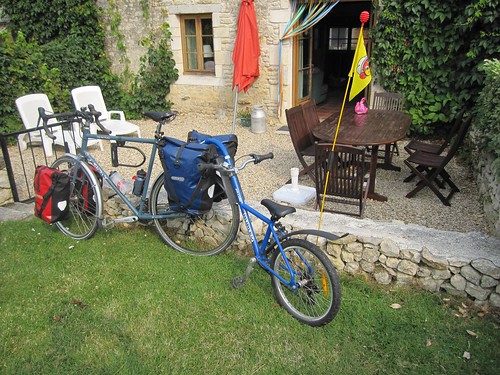
The Invisible Visible Man's bike, in France.
Sure, Bradley Wiggins, you can win the Tour de France.
But could you manage a load of four panniers,
a trailer bike and a four-year-old?
Yet, even for an ill-co-ordinated incompetent such as me, there remains far too much fun in riding a bike fast to reject the link with sport altogether. I can, after all, coax my touring bike into managing journeys in the countryside at an average of around 16mph (26kph) and can get up to around 50kph in favourable conditions. It’s not, I admit, much compared with Bradley Wiggins’ 49kph average for the whole Olympic time trial, but it gives me a sense of achievement. I even, in a moment to counterbalance the snarling of my school PE teachers, had the satisfaction four years ago of being complimented on my speed by a fellow cyclist. After I held off his efforts to overtake me for several miles of our joint commute home, he found me at some traffic lights and advised I try riding at the local velodrome. “You’ve got a fair turn of speed,” he said. If I can manage that, it seems sad to tell the many others with real sporting talent that they should be riding bikes incapable of a decent pace.

I’m sometimes baffled too by the idea that slow, Dutch-style bikes are a realistic option in the biggest cities. My new commute to work is around nine miles each way. Treat that as an opportunity for a slightly faster form of walking and I’ll be turning round to head home as soon as I arrive – for the few times I make the trip before they sack me.

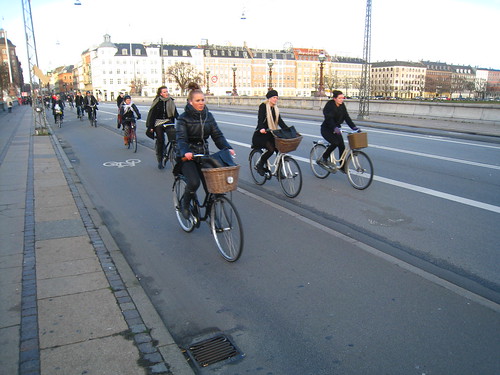
Bikes in Copenhagen: they're sensible, practical
- and barely any fun to ride at all
There isn’t, as far as I can see, much link between a country’s cycling sport success and its people’s propensity to use bikes for transport. Three of the countries with the most glittering records in the Tour de France – France, Italy and Spain – all have lower or similar proportions of journeys by bicycle than the scarcely cyclist-mobbed United Kingdom. The two countries with the highest cycling levels – Denmark and the Netherlands – have both produced distinguished riders in the Tour de France but have generally enjoyed less success in cycling sport than might be expected from the numbers riding a bike every day.

Nevertheless, I can’t help feeling that British cycling’s sporting success has to bring at least a small dividend for the country’s commuter cyclists. A few drivers may, perhaps, briefly regard cyclists not as worrisome obstacles to get past but future Victoria Pendletons or Laura Trotts whom they should respect instead of despising. I, like I suspect many other British cyclists, am holding my head a little higher – or perhaps lower, given the position’s superior aerodynamics – when cycling. I’m deeply proud to come from a country with such a powerful cycling sporting position.

It’s not, I suspect, the kind of benefit that many of Britain’s victorious cyclists were seeking when they underwent their years of painful training and conditioning. It is, however, one of many pleasures their achievements have given me. On behalf of every commuter who’s scaled an imaginary Col du Tourmalet while cycling to work, I salute them.

Saturday, 14 July 2012

Grids, lights and why New York's traffic should be less metronomic

All day long, as I look from the 14th floor window of my new office in midtown Manhattan, a hypnotic scene plays out in the streets below. As one set of traffic lights turns green, vehicles – sometimes swarmed four or five deep across the street – resume their journey, like so many multi-coloured woodlice, north up sixth avenue towards Central Park. Then the lights change and two ant-like swarms of pedestrians march out from either side of Sixth Avenue and merge in the middle. One swarm of woodlouse-cars meanwhile makes its way west along 51st street and a second heads east along 50th. Then, at a regular tempo, the pattern starts again, changing only when some oddity comes along. I watched one day as a food vendor pushing his cart across the intersection was marooned mid-crossing by a change of lights. Cars nudged up against the unexpected obstruction and pedestrians marched round it, like water finding its way around a rock newly fallen into a stream.

Then, every now and again, between the woodlice and the ants appears a gnat – a bicycle picking its way around the parked cars and zig-zagging between the pedestrians. Both the pedestrian-ants and the woodlouse-cars seem impatient with them. It is, after all, especially clear from my vantage point that the bicycles – dodging out behind stopped cars, darting between the ranks of cars stopped at lights – travel in very different lines from the straight up-and-down or across-town of most other Manhattan traffic. Every now and again, some sudden lurch by a taxi or truck has me fearing I’ll need to run to the elevator, head down to the street and act as a witness on some prone cyclist’s behalf.

West 15th Street: Orderly, but not in a very human way
The view from my window has sprinkled yeast on an idea that’s been fermenting in my mind all the three weeks I’ve so far been cycling around New York. It’s that the shape of a city’s infrastructure does more than anything else to forge the culture of its roads. New York’s infrastructure, moreover, seeks a lot of the time to force human beings into the neat patterns that sprang from the minds of its 19th century planners. It was a bold idea, a refreshing change from the haphazard patterns of a city like London, whose street plan in parts dates back as far as Roman times. But it’s hardly suprising that the less-than-straight lines of most humans’ attitudes and behaviour sometimes lead them to burst out of the grid’s constraints.

When I tell people I’m cycling in New York, it conjures up a mental picture for most of my pedalling down some vast Manhattan avenue, skyscrapers towering over me and threatening streams of cars, trucks and buses roaring past. In fact, most of my Manhattan cycling has involved my making my way to the car-free Hudson River Greenway, cycling to the appropriate cross street then cutting across the island to my destination. A brief ride this week was a rare exception. Keen to pick up a train ticket quickly from Pennsylvania station, I headed down Broadway, through Times Square and on down 7th Avenue.

I was suddenly after leaving the Broadway bike lane one of the gnats I could see from my office window, navigating along the line of parked cars to the side of four roaring streams of traffic. At cross streets where the lights were in my favour, I would still frequently face obstruction from a turning car, trying to nose its way through the cross-street pedestrians but stuck in my path. I had to maneouvre out round each, trusting that I wouldn’t find myself, if one of the vehicles made a sudden change of course, heading for a collision.

The 7th avenue experience was almost wholly a product of the city’s decisions about how to use its space. Seventh Avenue could have been a perfectly adequate – and probably far less intimidating – two-way street, with traffic forced into the relatively narrow confines of most London thoroughfares. Cars would then have been far less inclined to swing wildly across the lanes, ignoring general traffic law and the speed limit. Someone preferred, many years ago, to prioritise the swift passage of cars on the avenues over making them feel more human-scale. It created vast tarmac tracts that, when empty, must feel to a driver like some huge auto playground.

The West Side highway, with the Hudson River Greenway:
a chance to watch nearly every road user type breaking rules.
I face a different set of challenges using the Hudson River Greenway. The Greenway may, as I’ve noted before, be the finest piece of cycling infrastructure in the English-speaking world. It’s spacious, largely unaffected by traffic and offers fine vistas across the river to New Jersey. It even afforded me, one recent morning, the chance to race a ship. The general cargo vessel was heading up the Hudson at, I think, a speed of around 15 knots – more or less the perfect pacer for a cyclist heading into the wind on an old hybrid. I was able to catch up at points but held back now and again by traffic lights.

Yet, despite the numerous signs telling them to follow their own path, the cycle track is thick with runners, often pushing strollers (baby buggies, for British readers). Overtaking them safely requires a swing into the opposite lane, often into the face of an oncoming cyclist intent on maintaining the appropriate tempo for his triathlon training. The Greenway is also, while less stop-and-start than a Manhattan Avenue, dotted with traffic lights, protecting turnings across the path into the police department’s pound for towed vehicles, the city’s cruise terminal, the 30th street heliport and others.  A number of these lights spend much of their time showing red for cyclists and green for cars, even though motor vehicles are rare. The pattern at the cruise terminal remains unchanged, for example, whether a ship is disembarking or the terminal’s gates are locked. Even a cyclist as rules-obsessed as I finds it impossible to stop at these junctions, sticking pointlessly to the letter of the law while around motorists zip at 50mph down the 35mph westside highway, cyclists buzz pedestrians and runners jog, talking on their iPhones, down a path meant only for cyclists and skaters.

The traditional response to all these different forms of chaos is to bemoan road users’ failure to obey the rules. The still-more traditional response is to berate cyclists as if they were the only ones breaking them. There is obviously some merit in wishing road users were generally more careful of others’ needs. I was certainly embarrassed on behalf of cyclists generally when, one Sunday morning, I watched a string of speeding cyclists yell out of the way cruise passengers trying entirely legitimately to use a crossing on the Greenway.

But it’s more interesting, I think, to examine why New York’s traffic system seems to encourage possibly even more widespread rule-flouting than London’s more chaotic sprawl.

Police horses on Sixth Avenue:
not every animal in the traffic is metaphorical
The answer, I’d suggest, lies in the similarities between renting a New York apartment and riding in the city. Both exhibit America’s tendency to make every rule clear and unambiguous – for the avoidance of doubt, as a very American phrase puts it. Large British corporations may, I suspect, have been bought and sold with less paperwork than was required for me to rent a Brooklyn loft for my family. Everything from whether the building had ever had a bed bug infestation to whether we needed guards on the windows to protect the children was carefully and methodically spelt out. On the roads, a far higher proportion of intersections in New York are traffic light controlled than in London. There’s far less reliance than in London on allowing road users’ good sense and public spirit work out the best traffic flows at less busy junctions.

That stems in part from an admirable instinct. The United States, a country founded by dissidents and populated by immigrants, recognises that not everyone implicitly shares the same approach to problems. It codifies nearly everything. That has many undoubted strengths over the British assumption that good chaps will have the common sense to understand how things should be done. One country has a hallowed constitution whose workings are overseen by nine learned justices. The other has never even written its constitution down. The American principle, as laid down by John Adams, the second president, is “the rule of laws, not the rule of men”.

Yet there’s a risk, as with any regulation, that it becomes like the Russian tax system – so onerous that, because no-one can fully follow it, it hands arbitrary power to the rule-enforcers. With the apartment, the bureaucratic problems seemed insurmountable until I threatened to take my business elsewhere and the formalities concluded suspiciously speedily. As a cyclist, it is surprisingly difficult heading along a Manhattan avenue not at least to rush through traffic lights as they’re changing. The blocks’ shape – shorter north-south than they are east-west – and the lights’ timing to suit motor vehicle, rather than cyclist, speed mean one can face a red light close to every 100 yards. With the short time pedestrians have to cross, it’s small wonder so many start crossing streets with lights on red, neglecting to look out for cyclists following behind the mass of traffic. The police effectively have free rein to issue violation notices to pretty much any road user they choose – and cyclists, who are far less likely to cause fatalities than motorists, are often the target.

Greeley Square, in midtown: tailored to motorists' speed,
rather than cyclists' comfort
Even more corrosively, the burden of rules can send a message to road users to abandon judgement and good sense. The red lights protecting roads on the Greenway seem to me a subtle message that the rules are arbitrary and weighted against cyclists. While it’s unfortunate, it’s small wonder that so many then go on to ignore the rules designed to protect pedestrians at crossings.

None of this is to say that New York doesn’t work for cyclists. I’ve encountered, I think, less straightforward aggression from motorists than in London. With the competition for road space less frantic, fewer drivers seem to feel quite as embattled as the worst in London. I’ve had no-one deliberately try to intimidate me with his or her driving yet – a fairly regular occurrence in London. Many of the cycle facilities are excellent.

But I can’t help thinking a slight change in New York’s approach might produce some surprising results. A few less traffic lights and I would certainly be looking down from my window at a less metronomically regular scene. I might even be observing one where the woodlice and gnats were willing to let the ants cross - and the woodlice less prone to cutting across the zig-zagging gnats’ paths.