Showing posts with label cycling blogs. Show all posts

Saturday, 14 July 2012

Grids, lights and why New York's traffic should be less metronomic

All day long, as I look from the 14th floor window of my new office in midtown Manhattan, a hypnotic scene plays out in the streets below. As one set of traffic lights turns green, vehicles – sometimes swarmed four or five deep across the street – resume their journey, like so many multi-coloured woodlice, north up sixth avenue towards Central Park. Then the lights change and two ant-like swarms of pedestrians march out from either side of Sixth Avenue and merge in the middle. One swarm of woodlouse-cars meanwhile makes its way west along 51st street and a second heads east along 50th. Then, at a regular tempo, the pattern starts again, changing only when some oddity comes along. I watched one day as a food vendor pushing his cart across the intersection was marooned mid-crossing by a change of lights. Cars nudged up against the unexpected obstruction and pedestrians marched round it, like water finding its way around a rock newly fallen into a stream.

Then, every now and again, between the woodlice and the ants appears a gnat – a bicycle picking its way around the parked cars and zig-zagging between the pedestrians. Both the pedestrian-ants and the woodlouse-cars seem impatient with them. It is, after all, especially clear from my vantage point that the bicycles – dodging out behind stopped cars, darting between the ranks of cars stopped at lights – travel in very different lines from the straight up-and-down or across-town of most other Manhattan traffic. Every now and again, some sudden lurch by a taxi or truck has me fearing I’ll need to run to the elevator, head down to the street and act as a witness on some prone cyclist’s behalf.
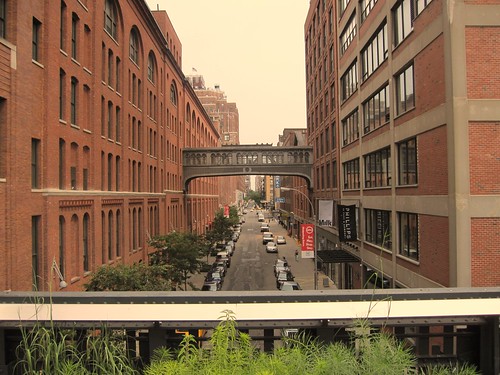
West 15th Street: Orderly, but not in a very human way
The view from my window has sprinkled yeast on an idea that’s been fermenting in my mind all the three weeks I’ve so far been cycling around New York. It’s that the shape of a city’s infrastructure does more than anything else to forge the culture of its roads. New York’s infrastructure, moreover, seeks a lot of the time to force human beings into the neat patterns that sprang from the minds of its 19th century planners. It was a bold idea, a refreshing change from the haphazard patterns of a city like London, whose street plan in parts dates back as far as Roman times. But it’s hardly suprising that the less-than-straight lines of most humans’ attitudes and behaviour sometimes lead them to burst out of the grid’s constraints.

When I tell people I’m cycling in New York, it conjures up a mental picture for most of my pedalling down some vast Manhattan avenue, skyscrapers towering over me and threatening streams of cars, trucks and buses roaring past. In fact, most of my Manhattan cycling has involved my making my way to the car-free Hudson River Greenway, cycling to the appropriate cross street then cutting across the island to my destination. A brief ride this week was a rare exception. Keen to pick up a train ticket quickly from Pennsylvania station, I headed down Broadway, through Times Square and on down 7th Avenue.

I was suddenly after leaving the Broadway bike lane one of the gnats I could see from my office window, navigating along the line of parked cars to the side of four roaring streams of traffic. At cross streets where the lights were in my favour, I would still frequently face obstruction from a turning car, trying to nose its way through the cross-street pedestrians but stuck in my path. I had to maneouvre out round each, trusting that I wouldn’t find myself, if one of the vehicles made a sudden change of course, heading for a collision.

The 7th avenue experience was almost wholly a product of the city’s decisions about how to use its space. Seventh Avenue could have been a perfectly adequate – and probably far less intimidating – two-way street, with traffic forced into the relatively narrow confines of most London thoroughfares. Cars would then have been far less inclined to swing wildly across the lanes, ignoring general traffic law and the speed limit. Someone preferred, many years ago, to prioritise the swift passage of cars on the avenues over making them feel more human-scale. It created vast tarmac tracts that, when empty, must feel to a driver like some huge auto playground.

The West Side highway, with the Hudson River Greenway:
a chance to watch nearly every road user type breaking rules.
I face a different set of challenges using the Hudson River Greenway. The Greenway may, as I’ve noted before, be the finest piece of cycling infrastructure in the English-speaking world. It’s spacious, largely unaffected by traffic and offers fine vistas across the river to New Jersey. It even afforded me, one recent morning, the chance to race a ship. The general cargo vessel was heading up the Hudson at, I think, a speed of around 15 knots – more or less the perfect pacer for a cyclist heading into the wind on an old hybrid. I was able to catch up at points but held back now and again by traffic lights.

Yet, despite the numerous signs telling them to follow their own path, the cycle track is thick with runners, often pushing strollers (baby buggies, for British readers). Overtaking them safely requires a swing into the opposite lane, often into the face of an oncoming cyclist intent on maintaining the appropriate tempo for his triathlon training. The Greenway is also, while less stop-and-start than a Manhattan Avenue, dotted with traffic lights, protecting turnings across the path into the police department’s pound for towed vehicles, the city’s cruise terminal, the 30th street heliport and others.  A number of these lights spend much of their time showing red for cyclists and green for cars, even though motor vehicles are rare. The pattern at the cruise terminal remains unchanged, for example, whether a ship is disembarking or the terminal’s gates are locked. Even a cyclist as rules-obsessed as I finds it impossible to stop at these junctions, sticking pointlessly to the letter of the law while around motorists zip at 50mph down the 35mph westside highway, cyclists buzz pedestrians and runners jog, talking on their iPhones, down a path meant only for cyclists and skaters.

The traditional response to all these different forms of chaos is to bemoan road users’ failure to obey the rules. The still-more traditional response is to berate cyclists as if they were the only ones breaking them. There is obviously some merit in wishing road users were generally more careful of others’ needs. I was certainly embarrassed on behalf of cyclists generally when, one Sunday morning, I watched a string of speeding cyclists yell out of the way cruise passengers trying entirely legitimately to use a crossing on the Greenway.

But it’s more interesting, I think, to examine why New York’s traffic system seems to encourage possibly even more widespread rule-flouting than London’s more chaotic sprawl.

Police horses on Sixth Avenue:
not every animal in the traffic is metaphorical
The answer, I’d suggest, lies in the similarities between renting a New York apartment and riding in the city. Both exhibit America’s tendency to make every rule clear and unambiguous – for the avoidance of doubt, as a very American phrase puts it. Large British corporations may, I suspect, have been bought and sold with less paperwork than was required for me to rent a Brooklyn loft for my family. Everything from whether the building had ever had a bed bug infestation to whether we needed guards on the windows to protect the children was carefully and methodically spelt out. On the roads, a far higher proportion of intersections in New York are traffic light controlled than in London. There’s far less reliance than in London on allowing road users’ good sense and public spirit work out the best traffic flows at less busy junctions.

That stems in part from an admirable instinct. The United States, a country founded by dissidents and populated by immigrants, recognises that not everyone implicitly shares the same approach to problems. It codifies nearly everything. That has many undoubted strengths over the British assumption that good chaps will have the common sense to understand how things should be done. One country has a hallowed constitution whose workings are overseen by nine learned justices. The other has never even written its constitution down. The American principle, as laid down by John Adams, the second president, is “the rule of laws, not the rule of men”.

Yet there’s a risk, as with any regulation, that it becomes like the Russian tax system – so onerous that, because no-one can fully follow it, it hands arbitrary power to the rule-enforcers. With the apartment, the bureaucratic problems seemed insurmountable until I threatened to take my business elsewhere and the formalities concluded suspiciously speedily. As a cyclist, it is surprisingly difficult heading along a Manhattan avenue not at least to rush through traffic lights as they’re changing. The blocks’ shape – shorter north-south than they are east-west – and the lights’ timing to suit motor vehicle, rather than cyclist, speed mean one can face a red light close to every 100 yards. With the short time pedestrians have to cross, it’s small wonder so many start crossing streets with lights on red, neglecting to look out for cyclists following behind the mass of traffic. The police effectively have free rein to issue violation notices to pretty much any road user they choose – and cyclists, who are far less likely to cause fatalities than motorists, are often the target.

Greeley Square, in midtown: tailored to motorists' speed,
rather than cyclists' comfort
Even more corrosively, the burden of rules can send a message to road users to abandon judgement and good sense. The red lights protecting roads on the Greenway seem to me a subtle message that the rules are arbitrary and weighted against cyclists. While it’s unfortunate, it’s small wonder that so many then go on to ignore the rules designed to protect pedestrians at crossings.

None of this is to say that New York doesn’t work for cyclists. I’ve encountered, I think, less straightforward aggression from motorists than in London. With the competition for road space less frantic, fewer drivers seem to feel quite as embattled as the worst in London. I’ve had no-one deliberately try to intimidate me with his or her driving yet – a fairly regular occurrence in London. Many of the cycle facilities are excellent.

But I can’t help thinking a slight change in New York’s approach might produce some surprising results. A few less traffic lights and I would certainly be looking down from my window at a less metronomically regular scene. I might even be observing one where the woodlice and gnats were willing to let the ants cross - and the woodlice less prone to cutting across the zig-zagging gnats’ paths.

Wednesday, 7 March 2012

It may be fun - but is cycling part of the Good Life?


At the end of most weekdays during my first year of higher education, I would cycle to the central quadrangle of St Andrews University’s ancient buildings, head into a down-at-heel lecture theatre and ponder some of the biggest questions facing humankind. The most eagerly-anticipated Moral Philosophy lectures were by Gordon Graham, the department’s most charismatic lecturer. We teenage students would enter the room to find Dr Graham grasping the podium and peering keenly up at the rows of wooden seats. He brought to mind nothing so much as a hawk eager for some intellectually lazy morsel of first-year thinking to devour.

Praise from Dr Graham for one’s contribution from the floor would leave one feeling a little elevated for days – one enconium boosts my fragile ego 24 years later. Dr Graham’s scorn would leave a discernible chill.

The question is which side Dr Graham, who gave a particularly memorable lecture series on how to live “the Good Life”, would have come down on whether to get around a city by bicycle. The Good Life, Dr Graham eventually concluded, was “the rational life”, where one sought to do good to others, make the most of one’s abilities but also to be effective and rational. One should  reject mere gestures in favour of doing things that genuinely improved the human condition.

A cyclist in London rain: cycling feels part of the Good Life
some days more than others
I’ve dwelt in past posts on the irrationality of other road users’ behaviour towards me, as well as cycling’s capacity to spring sudden, joyful surprises. But are my own actions any more part of a rational life than those of the road-users I criticise? To put it less gracefully, would Dr Graham side with the tooth-suckers – the people who see my high-visibility vest and helmet, suck in their breath through clenched teeth and say, “I think you have to be mad to cycle in London”?

I should say at the outset that I’m not managing to live the rational life. A wholly rational person would drink less than I do, knowing that he was outweighing any health benefits by the damage incurred. A wholly rational person would eat less, weigh probably 20kg less, get more sleep and get less stressed about working in a job that, while it feels like one is writing the first draft of history, is ultimately fairly trivial. That’s even before tackling the subject of my wider belief systems, which I would stoutly defend but many people would criticise.

Nevertheless, it strikes me as more worthwhile to make a stab at living the rational life than merely to do what whim and hunch suggest. It’s consquently worth examining whether an activity that takes up at least an hour most days – more on many – and occupies an irrationally large amount of my waking thinking fits with such an aspiration.

It’s with the tooth-suckers that I most often discuss cycling’s rationality. The conversation generally starts with their saying, “I think you’re very brave” or “I love cycling but I wouldn’t like to try it in London” or just, “Isn’t it very dangerous?” The most depressing instance was the first time I met Geoff Hoon, then UK transport secretary, in his office. “So can you cycle around London?” he asked. I recognised how well pro-cycling initiatives would do under his leadership.

A big truck: the tooth-suckers think
one of these will get me some time
The tooth-suckers are ultimately claiming that any benefits I might gain from cycling are outweighed by a substantial risk that, sooner or later, I’ll find myself beneath the wheels of an articulated lorry. The hopeless dream that my steel-framed bike and vulnerable body could co-exist with trucks taking baked goods to Sainsbury’s will have literally been crushed.

My standard answer is to quote research conducted some years ago by the Cyclists’ Touring Club which showed the average British cyclist who cycled into middle age enjoyed life expectancy enhanced by two years, while risking on average losing only two months through cycling accidents. It’s a 12 to one benefit to cost ratio, I tell people. I even occasionally mention the subtle message of the obituaries page in the Cyclist Touring Clubs’ Cyclist magazine. Stories abound of wiry old devotees of the Sunday club run succumbing eventually only in their 80s or 90s.

Although I might have to hide a receipt for the latest £100 spent on my transmission while doing so, I could also point the tooth-suckers towards the financial advantages of cycling. Even with the amount of damage I seem to do to bike parts, I’m sure I’m spending less than if I commuted by public transport. I impose virtually no costs on others through wear and tear on the public roads.

There are also, of course, the environmental benefits, which many non-cyclists assume are a major factor in many people’s cycling. It is indubitably one of the few forms of transport – amid a motley selection including skateboarding and cross-country skiing – to involve carbon emissions only in the making of the equipment. It’s just unfortunate that one sounds so insufferably pompous talking about it.

The only time I’ve been tempted to raise my superior carbon status was when a woman honked loudly at me after I blew my congested nose’s contents onto a road at traffic lights. It was, I’m sure, not a pretty sight. But there was an irony in being reprimanded over my biodegradable mucus as she merrily pumped out long-lasting greenhouse gases.


While some motorists seem to regard me as a vast, insuperable obstacle in their way, it also seems rational to me to use a vehicle that takes up relatively little of the precious urban space devoted to roads. I'm sometimes tempted to ask motorists frustrated with being stuck behind me whether they'd prefer I was sitting in front of them in a car.

There is, meanwhile, scope for me to manage the safety risks. Although Transport for London research attributes blame for roughly two-thirds of accidents involving cyclists to the motor vehicles involved, there’s still substantial scope for me to cut down my chances of ending up in the road. Failing to look properly, failing to judge another person’s path or speed and being careless or in a hurry were the top three reasons for accidents attributed to cyclists. A careful cyclist can work at avoiding all of those.

Pedestrians: shouldn't they be
wearing helmets?
Yet there remains the objection I heard from one senior figure in my office. He had, he’d told me, been asked, on appointment to his present job, to stop cycling to work. He’d become too important to lose. To my point about cycling’s health benefits, he retorted that he went regularly to the gym. It is clearly true that the CTC’s averages for life expectancies mask very different distributions of the benefits and risks of cycling. Nearly every cyclist gets the extra two years – while the average lifespan lost through accidents represents an unfortunate few, each of whom may lose decades each.

Nevertheless, a check through Great Britain’s accident statistics for 2010 backs up a point I’d already deduced looking around my office. The intersection between colleagues who motorbiked and those to be seen outside with the smokers was striking. These are the real risk-takers - there were, I discovered, 36 cyclist deaths per billion vehicle miles in 2010, against a hair-raising 138 for motorcyclists. Even for pedestrians, the fatality rate per billion miles walked was 37. The only really safe group, I realised, was car occupants, wrapped in their steel shell and suffering only three fatalities for every billion vehicle miles. Each of the 111 cyclist deaths represents a real, avoidable tragedy. There should be far fewer. But I, for one, am prepared to accept the risks of an activity that, despite the appearances, is safer than walking.

Of course, it’s reasonable to ask whether any evidence I could have uncovered would have driven me off my bike. I would certainly be profoundly reluctant to give up the satisfaction of making my way around under my own power, feeling the wind on my face and hands and catching a sense of the city living around me.

But the powerful evidence in favour of cycling does, for me, improve the experience. It feels like the right choice, a rational choice. Then, occasionally, when the wind is in the right direction, the drivers polite and the roads clear, I even sense that I am, indeed, living the Good Life.


Are you making a rational decision to cycle? Are you making an irrational decision not to cycle? Are you making an irrational decision to cycle? You can work out roughly how these questions are working, so please just use the comments box to let us all know your answer.

Tuesday, 28 February 2012

Bikes can be hard to overtake - especially if they're faster than your car

It was one morning in December that I came across the driver who, because I wouldn’t let him overtake me, came close to driving over me instead. I had turned into a short, one-way street near my house when he swung in menacingly close behind. I felt no special worry, however. The road’s speed humps, which slow cars more than they do my bicycle, mean that, even when pulling my son in a trailer, most mornings I pull away from cars behind. I’m far more often stuck behind slower-moving cars in front.

But that was reckoning without this driver’s deep-seated need to overtake. Keeping his foot on the accelerator and the car in a low gear, he maintained his speed, unslackened, over the first speed bump, staying a metre or so behind me. I quickly found myself trapped in an urban cycling version of the film Speed. The road was so narrow, and so clogged with parked cars, that I couldn’t get out of the driver’s path. He was so close, however, that, if I’d slowed down to turn into the few vacant parking spaces, I could easily have gone under his wheels. Just as Keanu Reeves’ character in Speed has to keep a bus travelling at more than 50mph to stop a bomb going off, I had to stay riding fast enough for long enough, without skidding on the slippery speed bumps, that my pursuer wouldn’t hit me. He underlined his point by leaning out of his window to yell abuse.

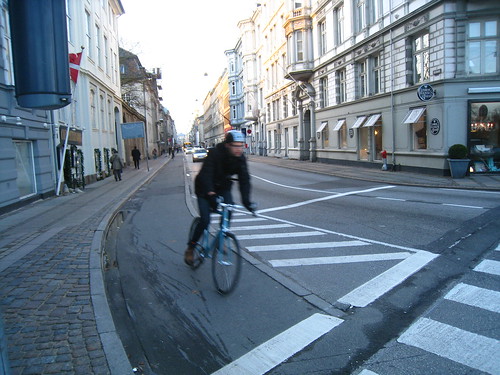
A cyclist on Copenhagen's generously-proportioned
cycle lanes: the Irate Minivan Man of Brixton Hill
might not appreciate this charming Scandinavian city.
It’s one of motorists’ most common complaints about cyclists – along with the perennial (inaccurate) claim that we all ignore red lights – that bikes hold them up and get in their way. But my encounter highlights how some motorists feel something far stronger than a desire to avoid delay. My pursuer put himself close to me only by a deliberate, provocative, highly dangerous effort. It’s not hard to read into his behaviour – and that of quite a few other motorists and pedestrians I’ve encountered – a deeper set of reactions. It’s inherently unlikely, after all, that bicycles – vehicles that take up little road space and form a minority of road vehicles in most developed countries – are a genuinely significant cause of delay. I have certainly heard more cyclists complain about a journey’s being prolonged by the volume of cars than I have motorists complain about the same because of the volume of  bikes.

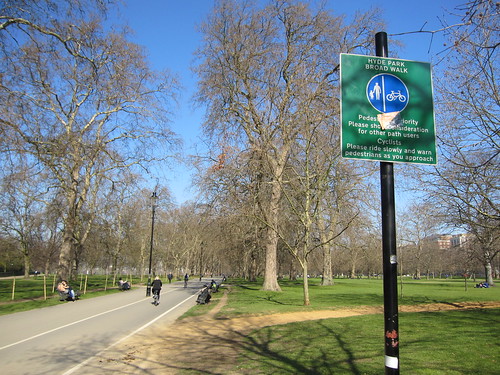
Cyclists, it seems, don't actually have priority on this
cycle path in Hyde Park,according to the sign.
But, well, why would they?
Some people’s existential irritation about sharing the road – or a cycle path - instead takes me back to my meeting with an embittered Protestant 14 years ago in a field outside Portadown, one of Northern Ireland's strongholds of Protestant loyalism to the United Kingdom. The man, who was protesting against the police and army’s blocking of a loyalist parade through a mainly Roman Catholic-Irish Nationalist area, described to me how, as a member of the Protestant majority, he felt downtrodden and oppressed by the Roman Catholic minority. The Catholics, who account for 40 per cent of the population, were getting more and more say in how things were run, he said. The province’s most influential jobs, I pointed out, remained in the hands of Protestants. Catholics remained, on average, poorer. Catholics, I also pointed out, had faced systematic discrimination until the 1970s, excluded from many jobs, from public housing and consequently from voting, which was restricted to householders. He hadn’t known anything about all that, he said. He hadn’t been aware of any problems.

His complaints were similar to ones I've heard from Serbs in Bosnia-Herzegovina about the country’s being controlled by Bosniaks, the country’s Muslims. A colleague once told me with distaste about how a white South African mining executive bitterly suggested to her that, given another life, he’d come back as a black woman. His theory – not, I suspect, based on a thorough investigation of women’s lives in the rough bits of Soweto – was that positive discrimination now made black women’s lives easier than those of white South African men.

All such complaints reflect, it seems to me, the powerful human instinct for those who belong to privileged groups to believe their status a reflection of their own group’s merit. If those privileges are reduced – or extended to another, excluded group – the reaction is often similar. The formerly-downtrodden – whether of a different ethnic group or simply using a different kind of vehicle – are seen as bumptious, difficult, undeserving usurpers.

Which brings me back to the Irate Minivan Driver of Brixton Hill.

 A bike lane on Southwark Bridge: many London motorists
have concluded, the Invisible Visible Man can exclusively reveal,
that the bike pictures in such facilities are a new form of pavement art.
It can hardly, they've decided, be as if cyclists should be given
all this road space.
I can only imagine that my pursuer, if he has been driving around central London for any significant proportion of the last ten years, has felt “his” share of the road shrinking around him. Cyclist numbers have doubled or more on many central London streets, meaning that he will increasingly often have to moderate his behaviour to cope with bicycles. There have been similar increases in other big rich world cities. The issues surrounding cycling are less all-encompassing than the questions that face Northern Irish Catholics or South African blacks. But, in many metropolises, drivers like the Irate Minivan Man feel, it seems to me, a nostalgia similar to that of the man I met in Portadown for the says before a resented, encroaching group started to get ideas above their station.

Even for those drivers I genuinely force to slow down, however, it is rare for a delay to stretch beyond milliseconds into seconds. I have, as I have detailed in a previous blog, been abused by an angry motorist because I had delayed her arrival at the end of a traffic jam. The sheer numbers of motor vehicles – which really do cause congestion – have risen sharply in recent years in many big cities at the same time as cycling numbers. The vehicles, both parked and on the move, have also grown steadily larger, exacerbating their congestion-causing effect. In a rational world, my minivan-driving hunter would have been just as angry with the parked cars, the real reason it was unsafe to let him pass. Any doubts I might have had about motorists' attitude on this matter were dispelled when I read a comment on a (since deleted) post on the excellent Cycling Lawyer blog. The commenter complained about how s/he particularly worried about passing the biggest, fittest cyclists because they tended to outpace his or her car up hills.

Clapham Common: pedestrians can get
just as angry as minivan drivers
Yet an incident a couple of years ago on Clapham Common, a couple of kilometres from where I encountered the Irate Minivan Driver, suggests the real root of some of the resentment. I was cycling across the common, on a designated cycle path, when I encountered a man, with his back to me, pushing a baby buggy. I slowed down and, because he was turned away, rang my bell several times, to no effect. “Don’t worry – I heard you,” he eventually shouted over his shoulder, refusing even to look round. There was a whole common for me to cycle across, he suggested. He wouldn’t get out of my way.

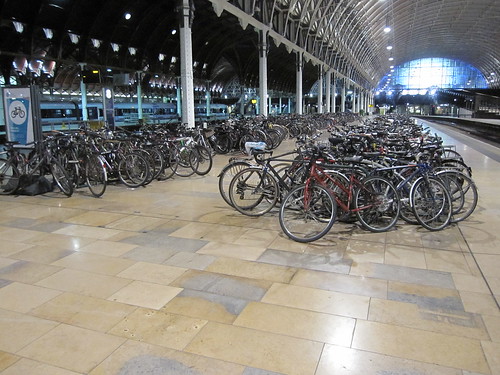
London's Paddington Station: The Invisible Visible Man's bike is in
here somewhere (though, predictably,  not visible). Network Rail,
the station's owners, seem as reluctant as others in London
to give bikes the space they need.
The parallel pedestrian path, nevertheless, was only a couple of metres away. There was only one designated cycle route the way I needed to go. The man seemed as infuriated at the devotion of space to a cycle path as Irate Minivan Man was at my taking up space on the road. It is one of several similar incidents I’ve encountered on paths across the Common.

On a road just by the common, meanwhile, I pulled in one Saturday to the space devoted to bikes at a set of traffic lights. I was pulling the Invisible Visible Boy in a trailer and pulled towards the centre of the road to let the Invisible Visible Woman into the area with the Invisible Visible Girl and her trailer bike. Incensed by my using the space for its designated purpose, a well-spoken, middle-class motorist pulled forward beside me, rolled down his window and said, with an air of deliberate threat: “If you stay at the side of the road, you won't get hit.” When the lights turned green, he accelerated away so fast his tyres squealed. Interestingly, pedestrians generally avoid obstructing the several roads that cut across and spoil the Common the way some feel compelled to do on the cycle paths.

Yet such bizarre, ingrained attitudes aren’t immutable. It was once held axiomatic that very little could be done to reduce drinking and driving – a problem that has been sharply reduced in many countries through consistent, unequivocal public information campaigns. Only a few years ago, prejudice against gays and lesbians went unchallenged. Before that, broad generalisations about blacks or Asians were accepted in polite society.

Such progress looks some way off for cyclists, however. Until it arrives, I’ll have to hope encounters with the likes of Irate Minivan Man end as relatively harmlessly as that one eventually did. After around 150 frantically-pedalled metres, a long break in the cars let me pull over. He accelerated past me and screeched off round a junction. He was, I imagine, frustrated. It requires self-discipline for any group to tolerate ceding territory to another. But nothing I did could have cost him more than a few moments. Had I slipped on one of the speed bumps or otherwise lost my nerve, the consequences of his driving for me could have been many, many times further-reaching.

Sunday, 5 February 2012

Why family, for me, is a bit about the bike

Watching television some years ago, I happened upon an advert that used home video footage from the childhood of Lance Armstrong, the winner eventually of more Tours de France than any other cyclist. Young Lance was receiving a birthday present of his first-ever bicycle. I am no doubt a sucker for this kind of thing. Given the hostility Lance Armstrong seems to arouse, there will probably be people who allege the footage was in some way faked. But I suddenly found myself feeling overwhelmed.


The emotion came partly from the knowledge of what was to come. This was the moment Lance Armstrong, author of determined, gritted-teeth time trials and numerous audacious attacks, became a bike owner. But it was the thought of his family that choked me up. Lance’s parents had decided he was old enough to experience the freedom and responsibility of owning a bike. It was time to pass on the precious, thoroughly grown-up gift of cycling that they had presumably enjoyed in their own youths.

It is surely one of the unalloyed joys of riding bicycles that the habit tends to run in families. My father taught me the way to handle myself on the road, to load luggage and the best way to fix a puncture. He, I know, learnt many of those things from his own father. I recently had the pleasure of explaining to my 10-year-old daughter the workings of a derailleur gear, surely one of the world’s most beautiful marriages of mechanical simplicity and efficiency.

It’s not, however, only that cycling is something we learn from our parents and pass on to our children – it’s the time of life at which we do it. We nurture children in the habit of cycling when they’re past the point of childish helplessness but before the sourness of adolescence. It’s a point at which parents are still heroes to their children and children still distinguished by their potential rather than their shortcomings. I can’t be the only one who experienced some of his most intimate moments with his father while cycling with him.

The day of my tenth birthday was not normal. My parents were being presented to the Queen during a visit to Glasgow and mum and dad decided my sister and I should take the day off school to see the royal walkabout. The next day my sister, aunt and I were on the front page of the Daily Record, my sister having just thrust a bunch of garden flowers into her majesty’s hands. “Happiness is talking to the queen for these youngsters,” read the caption – ironically, since even then I think I harboured some republican sympathies.

Yet it was the present waiting at home that made it a red-letter day for me. It was a sit-up-and-beg Raleigh bicycle, with metal mudguards, not-very-impressive brakes and Sturmey Archer three-speed gears. For neither the first nor last time, I failed to cut a dash amid my peers. They were either contorting themselves to fit the drop handlebars of cheap racing bikes (rrayssurrs, in Glasgow parlance) or strutting their stuff on the ubiquitous and absurd Raleigh Chopper. “Robert’s got a granny bike,” a group of boys taunted me at school when I described it.

Never mind. My dad forced a wooden mallet underneath the saddle for a handle and would run behind me, holding me upright, while I learnt to ride. The skill mastered, I took to pootering around the neighbouring streets and, every now and again, heading off on longer rides. My dad would come with me, reaching down to the handlebars of an ancient Dawes tourer.

That bike – a present to my dad on his 15th birthday 30 years before - had the same, inflexible three-speed Sturmey Archer gear arrangement as my bike. My dad, I’ve since discovered from an old photo album, once rode it alongside his father from Edinburgh to Cheltenham. It wouldn’t look much of a thing now – but, to us, its classic road bike lines made it possibly the coolest, most authentic bike ever.

I remain wary of being forced too close to the road edge after catching the kerb on a down hill during one of those rides and somersaulting head-first into a gravel driveway. My dad, far more anxiously and tenderly solicitous than normal, bought me an ice lolly from a nearby shop. He wanted, I think, to get the swelling in my upper lip down before my mum saw me.

I also remember receiving some of my first anti-cyclist abuse. My dad, sister and I were out on our bikes one Sunday afternoon looking, to the disdain of a local youth, unbearably middle-class. “The family ones on bikes,” he sneered, in a la-di-dah voice.

Yet, even though my cycling tailed off for a while once I outgrew that first bike,  something picked up on those outings told me bikes and I – and my family and bikes - belonged together.

I took that old Dawes tourer to university when I started and gradually destroyed it, testing components nearly 40 years old and finding them wanting. I remember bowling down a footpath in St Andrews and screaming other students out of the way after the brake blocks had failed and flown off. I replaced it with, at last, a drop-bar road bike and rode it all over Scotland, particularly the summer after my grandfather died. Some days I’d take my bike through to Edinburgh and cycle to his old house to get on with the clearing up. Other days, I’d head off in the morning and ride 70, 80, 100 miles, heading up the side of Loch Lomond, across to Fife or down towards the southern uplands, slogging my way through mile after mile of what seems looking back extraordinarily uncomplicated, enjoyable cycling.

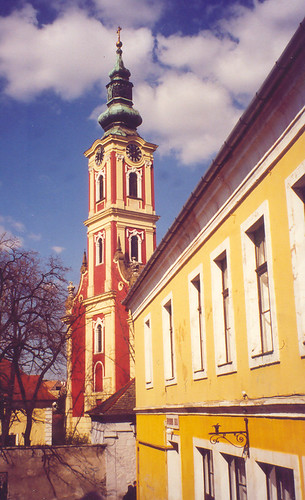
Szentendre: I cycled a fair bit
of the way there
Another Raleigh road bike, cheap in a sale because of its nasty pink colour, came along after that first bike was stolen. It was with me when I married and later when I moved to London. Badly bashed about during my move to Hungary, it sat unused for several years until I could face foregoing cycling no more. “Csonkott a vaz,” said the men in the bike shop: “the frame is broken”. But, doing a very eastern European job of patch and mend, they got me back cycling. Speaking one Sunday evening shortly afterwards to my father, I intended to mention I was riding again – but kept forgetting. The pride of my 12-year-old self in my achievements wanted to share with him my excitement at my accomplishments. I rode to an appointment up in the Buda hills! I followed the Danube path most of the way to Szentendre!

It was the last time I spoke to him. Later that week, his already serious illness took a turn for the worse and, much faster than any of us had anticipated, he died. Had I known we were saying goodbye, I would of course have told him how, without my realising it, he had become my template for how to be a man: I was as fixated as he on trying to do what I, in my stubborn mind, saw as the Right Thing. I was trying to emulate his gentle kindness towards the vulnerable. But, given that I would never have said such things in what seemed like a normal, Sunday night telephone call, I still regret not having mentioned the cycling. It was an activity that, whenever I discussed it with my father, always seemed, even when we saw life very differently, to revive the glow of those early rides together.

Why that particular regret nagged at me, however, wouldn’t be entirely clear until my own children had bikes. Then, this past Christmas, my daughter, having been given cycling clothes, demanded, at five o’clock on Christmas Day, to go out for a ride. It was a demand that my dad, with his stubborn individualism, would have well understood. Some weekends at present, I run round the pavements behind my four-year-old son, holding him upright as he, as I did before him, tries to learn to ride. Most weekends, we head off on some trip, my son in his trailer behind me, my daughter behind that and my wife bringing up the rear – a procession of a certain kind of British middle-class eccentricity.

But cycling is a family activity for me at other times too. My father barely ever cycled in his final decades but I still recall how he set himself over his bike, pushed down with his right leg and set off. It’s much the same way, I suspect, I do the same thing. His voice and attitudes echo around my head. Even on the loneliest country roads and dark south London streets in the early hours, I never seem to cycle entirely alone.

Monday, 23 January 2012

The minister who made the Invisible Visible Man see red


It was the kind of reasoning you’d expect from someone who has spent so long trying to reconcile competing instincts and priorities that he’d lost all track of common sense. One summer several years ago, over lunch with a junior transport minister in the then UK government, I asked about the future of speed cameras - cameras for catching speeding motorists that his own government’s research showed saved more than a hundred lives every year. Putting on a serious voice and knitting his brows, the minister – who clearly disapproved of the official support for the cameras - told me that motorists were worried about speed cameras’ effectiveness because of the “regression to mean” effect. The effect describes how part of the fall in accidents at a given site after a camera’s installation is probably a statistical quirk, rather than a result of the camera’s presence.

I tried – but didn’t fully succeed – to control my irritation. I told the minister – forcefully – that in my experience far more motorists were simply worried about being caught speeding. They didn’t have intellectual doubts about speed cameras – they just thought they should be allowed to drive whatever speed they damn well pleased. The minister clearly didn’t think it was important to enforce speed limits.

Cyclists on Lower Thames Street, London Skyride 2009.
They're their "own worst enemies",  according to one minister -
yet they seem oblivious to the danger.
The minister’s understanding for rule-breaking motorists did not, however, extend to cyclists. I went on to ask what the government was doing to make roads safer for cyclists. “To be honest,” he replied, “I think cyclists are their own worst enemies”. I had little doubt I had much, much worse enemies on the roads than myself – and I had encountered several even during my short cycle ride to lunch. I nearly – but  didn’t quite – follow the inner urge to get myself out of the presence of someone who thought I wasn’t worth protecting. It would all have been less alarming if he hadn’t been the road safety minister.

The lunch was the moment when I started to realise how completely the thinking about road use of most people – even those who devote their days to deciding on road safety policy – comes from the gut, rather than the higher brain centres. The minister’s gut wanted to drive fast – I later discovered he had a number of convictions for speeding – and disliked cyclists. My gut, clearly, likes cycling and doesn’t care for driving. But I like to think my frontal cortex at least gets to review the gut’s decisions. I recognised – I still recognise – that lots of people need to drive, that motor vehicles are not about to stop being the main means of making most trips in the UK – or most other parts of the world – and that even the keenest cyclist has to find some modus vivendi with the dominant road users. It was depressing to find a government minister relying so thoroughly on the lower reaches of his abdomen that he was holding two utterly contradictory views.

But anyone who’s spent any significant time cycling anywhere where cycling is a fringe activity will know that cyclists scratch out feelings from well below some people's civilised veneers. Some motorists’ determination to get past cyclists just to reach the end of the traffic jam ahead faster; the curious determination of some pedestrians to step in front of cyclists even when they can see the cyclist clearly; the daily battles over precedence in the special boxes for cyclists at traffic lights: these all betoken a gut distaste for cyclists that doesn’t seem based on detailed perusal of road casualty rates.

Nevertheless, it is probably worth laying out clearly how intellectually disreputable the minister’s views were. In 2010, 1,850 people died on the UK’s roads – and only four were killed by cyclists. In each of 2008 and 2009, only a single pedestrian died after being hit by a bicycle. Cyclists – who account for just under 2 per cent of traffic but far more in the urban areas where most accidents occur – consequently were responsible for just 0.22 per cent of 2010’s road user fatalities. The proportion had been still lower the two preceding years. Even among pedestrians – the only group of road users that cyclists seriously threaten – cyclists accounted for fewer than 1 per cent of the 405 killed. Other road users, meanwhile, killed 111 cyclists.

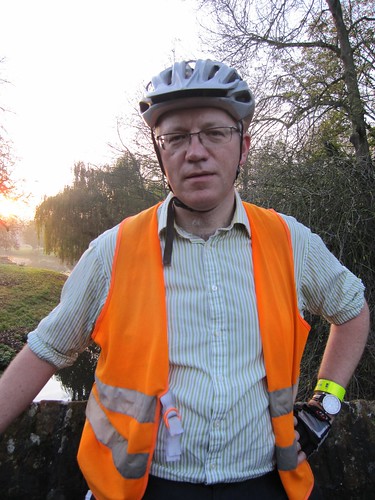
Me in cycling gear: a sight, one reporter says,
that ought to terrify pedestrians. Note to motorist
readers: since you won't be able to see me, I'm near
the picture's middle, wearing high-visibility clothing
These figures, of course, are rather as simple Newtonian physics would suggest. The energy released when a single cyclist hits a pedestrian at, say, 15mph and when a car, van or lorry hits a pedestrian at 30mph are many orders of magnitude different. I can testify to this point particularly congently after unwillingly conducting my own experiment in early 2009. On February 4, I was knocked off by a glancing blow from a minivan crossing my path on Brixton Road, south London. On March 13 the same year, I was hit squarely by a cyclist running a red light near Elephant & Castle. The minivan incident left me sore for a year – the collision with the cyclist only a few days. Cyclists running red lights, going the wrong way up one-way streets and mounting pavements are an irritation – but little more. Motorists who speed, talk on their telephones, fail to see red lights or deliberately drive dangerously regularly prove a lethal danger.

Politicians who want to make life safer for pedestrians and other road users should consequently be encouraging cycling, even if cyclists continue to run red lights (which I think they shouldn’t) or mount the occasional pavement. We cyclists represent far less of a danger to other road users than any other form of wheeled transport.

Yet, when I spoke to Lord Adonis, the then newly-appointed transport secretary, in mid-2009 along with another transport correspondent, the other reporter turned beetroot red when I asked about enhancing safety for cyclists. He interrupted before the minister could answer. “What are you going to do about aggressive cyclists?” he demanded. “What aggressive cyclists?” I retorted, pointing out that people perched on metal frames and two wheels were in a weak position to be truly, dangerously aggressive. My theories about what drives such anger will have to wait, however, for another post. It will take some space to explain why some people hate others simply for their choice of transport mode…

Friday, 20 January 2012

The Invisible Visible Man


I am 1m 93cm tall and weigh 110kg – a weight that, despite my substantial height, makes the National Health Service think I’m nearly part of the obesity epidemic. Although I grew up in Glasgow, I have never, unlike most Glaswegian men, been addressed in the street as “Jimmy”. When you look like me, you’re “big man”.

A London Cycle Campaign photo of my
rear proves my essential invisibility.
I am the vehicle on the left, if you can see me.
Yet, surprisingly, I have a nearly infallible method of making myself invisible. I put on a bright silver helmet, pull on a high visibility jacket, reflective wristbands and trouser straps, get on a light blue touring bicycle and head off down the road. My sudden invisibility has led me twice to be battered into the road by cars whose drivers claimed not to have seen me – and to have had countless uncomfortably close encounters with others.

The snag is that, as soon as I in any way impede a motor vehicle, I not only seem to reappear but to assume for drivers proportions still larger and more lumbering than my real self. I’m suddenly an elephant, incapable of speed, out of place on an urban street and committing the unpardonable sin of Making a Motorist Moderate his Speed.

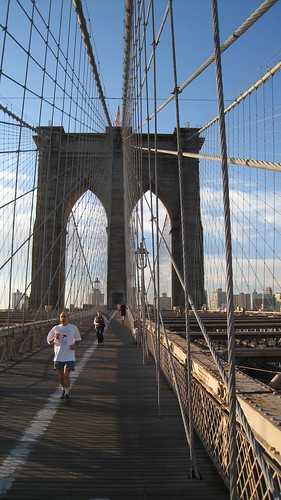
The Brooklyn Bridge Cycle Lane:
the Invisible Visible Man would put
a clever caption here - but he's lost in a reverie
about becoming a New York cycle commuter
I nevertheless, year in, year out, get on my bike on sunny days and rainy, when it’s freezing outside and uncomfortably hot, hunch my body over my drop handlebars and every year cycle around 4,000 miles – 6,400 kilometres. I am now nervous about any life change that might make me give this activity up. When it briefly looked as if I might move to Johannesburg, I seriously investigated the prospects for getting around one of the world’s most crime-ridden, sprawling cities by bicycle. Turns out it would have presented some problems. When I think about the possibility of moving to New York, I am, in truth, mainly day-dreaming about my potential cycle commute. I walked over the Brooklyn Bridge once and want the film of my life to show me speeding daily along the cycle lane over that piece of 19th century engineering magnificence.

I am a husband and a father. I am a Christian and, more specifically, an Anglican. I make my living by writing. But being a cyclist is no longer anywhere near as far behind those other core elements of my identity as a choice about personal transport ought to be.

This blog is an effort to explain to some of the impatient motorists stuck behind me, puzzled friends and colleagues and - perhaps most of all myself - why that is. I hope along the way to provide some cheap entertainment – nearly all of it at the expense of my absurd self.

…………………………………………………………………….

The funny thing I’ve realised is that I don’t get much simple enjoyment out of cycling. My wife is endlessly frustrated at the number of times I arrive home jumpy or angry after some confrontation with a taxi driver or close shave with a motorist. I long to explain to some of them that a road lane with a cyclist in it is actually still occupied. On one memorable occasion, a bus driver assaulted me. Long story short, he hadn’t enjoyed being reminded that the special area for bicycles at many British traffic junctions is not intended for buses. The bad news for him: there was probably no other cyclist on that road that night who not only personally knew, but had the email address of, his bus company’s chief executive.

I’m a cautious cyclist – a cautious person, in truth. I find the regular threats from such motorists a real and recurring source of worry. I wake sometimes in the early hours and go over incidents. What if I hadn’t managed to control that wobble? What if I hadn’t managed to stay just ahead of that motorist who deliberately drove too close behind me? What if I hadn’t controlled that skid? Will I one day feel my life slipping away, bathetically, as I lie on some piece of south London tarmac because of a BMW driver’s bravado? The thoughts gnaw away at my guts – and I gaze with incomprehension at my fellow cyclists who squeeze through the narrowest gaps, shoot lights or ride without lights. I’m constantly surprised at myself for tolerating far smaller risks.

Not, of course, that there aren’t moments. My parents-in-law live in Cheshire and attend church 20km away in north Wales. When I set off at 9.30 on a Sunday morning, the main road near their house is quiet and straight. I can cover the first 12km or so at an average of 32kph. My body, normally so lumbering and clumsy, feels on a good day at one with the bike. It reminds me of a claim I once heard – whose veracity I’ve never established – that the bicycle is the world’s most efficient machine. So much of the effort I put in seems to turn itself into forward motion.

My bike: speak ill of this machine and I may well weep
One warm day in 2008, I remember arriving in Ipswich from London on a train with my bike, heading for Felixstowe to undertake an interview. Told the train onward to Felixstowe had been cancelled, I had to cycle – and sped 14 miles on pleasant, quiet roads across the Suffolk countryside, feeling an entirely unanticipated lightness of heart. I experience a little surge of excitement when one company I regularly cover tells me it has an executive visiting London it would like me to meet. The meetings are always on the far side of Hyde Park from my offices and afford a chance – a legitimate chance, sanctioned by work needs – to speed along Rotten Row, a cycle and pedestrian path south of the Serpentine. Some of London’s best architecture fringes the park as I bowl along across the vast open spaces. Once a month or so, a day dawns clear, dry and bright and my morning ride to work passes in a surge of endorphins, my bike sliding smoothly around the traffic, unimpeded by motor vehicles and unharrassed by angry van drivers.

To move onto the fastest gears on my bike, I push the left-hand brake lever on my handlebars – the one that controls the rear brake - to the right. It shifts the chain onto the outermost, largest chain ring by the pedals. The noise involved – grind-grind-grind-grind-click! – could be my favourite sound in the world. It’s ugly on its own – but, as surely as one of Pavlov’s dogs salivated at the sound of the buzzer, my brain knows that sound signifies a stretch of open road or gentle downhill and the joy of a rapid acceleration. It’s ultimately a very simple, childish joy – not much more complicated, really, than the chance to say to oneself, “Whee!”

I’ve become an inveterate cyclist partly, no doubt, because I’m chasing that feeling. To return to Pavlov’s salivating dogs, it’s well established that, when an animal receives a reward for pecking at a hole, pushing a button or whatever, it will keep doing so far longer after the reward stops if the reward has been intermittent than reliable. The insight explains the persistence of gambling and other kinds of addiction. People keep pursuing elusive rewards for longer than they do predictable ones. It’s the promise of another surprise, perfect run into work that keeps one slogging through the rain, confrontations with angry van drivers and sheer hard slog.

But there’s more to it than that. I wonder, ultimately, if I’m really looking for fun in life. I think, instead, that I spend a great deal of time chasing the satisfaction of having put in an effort and accomplished something. It makes me work silly hours at my job, chasing the vindication of having beaten other newspapers to a story, seeing my name on the front page or simply having produced a nicely-crafted description of some unpromising container port or laid-up ship. It gives me a charmless earnestness I’ve been imposing on others since childhood. I recall being reprimanded by someone in my university hall of residence after I tried to start a conversation about some complex point of our moral philosophy course. It was, she remarked reasonably if a little snappily, breakfast.

The need to put in effort sits conjoined in me, I think, with a need to engage with the world. I’ve had an impulse as long as I can remember to grab the world by the lapels and try to tell it about this new thing that’s happened, this new music to listen to, the way this ship works or God.

Cycling ticks all the boxes for someone with such needs – and then some. The “I made it” feel on dismounting one’s bicycle after a difficult journey seems to be for me a more powerful reinforcer than the feeling of mere excitement after an enjoyable ride. The physical effort of shoving down with my thighs to slog myself to the end of some trip I should probably have undertaken by train soothes some deep anxiousness inside me. No-one can say I haven’t tried hard enough. When my need for such satisfaction is at its height, I constantly check the mileage recorded on my bicycle computer. I feel far happier and more content when my daily average cycling distance sits comfortably above 11 miles.

The sense of engagement with the world – the wind in my face, the smell of the petrol fumes, the snatches of conversation from passing pedestrians – only heighten the satisfaction. It’s one of the factors that appeals to many people about motoring – the car’s ability to become a moving extension of one’s own home, cut off from those around – that most puts me off owning a car. The depth of this feeling struck me recently when on a cold day I found my hands unexpectedly warm in my full-finger gloves – the rarely-used cycling gloves that cover my whole hand. I was shocked at the calm I felt on switching to my normal cycling gloves, with cut-off finger ends. I could once again feel the wind over my fingers. I was in touch with the world.

I believe in theory in doing things for good, positive reasons, inspired by rational thinking. There are rational reasons for cycling. I’m fitter than I otherwise would be, less prone to illness and pumping out fewer greenhouse gases into the atmosphere than a non-cyclist I would. But, when I wake up on a rainy morning with a headache in a foul mood, those positive reasons aren’t what count. It’s the fear of losing those deeper satisfactions – the sense of having put in the right effort, the feeling of being in touch with the world – that get me out onto the road on my bike: the invisible, high-viz man.