It’s the kind of intervention in one’s journey home that’s
never normally welcome. As I rode my way down Grand St in lower Manhattan around 10.30 in
the evening, I found a skinny young man wearing a headset blocking my way.
No-one was allowed onto the next block, he said, until the film crew had
finished this take. It took only a couple of minutes – although the time felt
longer, given that I’d rashly for the time of year put on only a t-shirt on my
top half.
 |
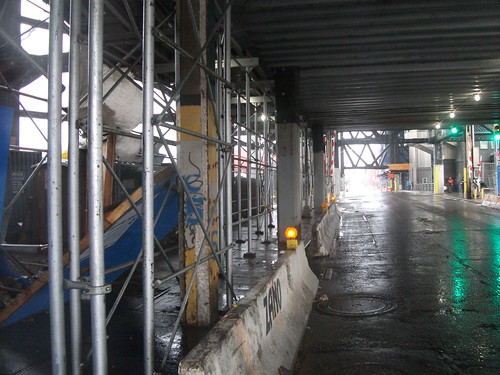
| Grand St in Chinatown: city street, film set or cyclocross track - it can't settle on a single role |
But, despite the inconvenience, I felt a little thrill at
being stopped on my way home on Friday. That a film crew was filming on a road
on my way home was confirmation that I was, once again, the kind of cyclist
whose routes lay along grittily interesting urban streets. For more than a year
since moving to New York , I’ve done the
majority of my Manhattan
cycling on the waterfront greenways, riding often at speed but grappling only
in little bites with the serious urban cycling of riding on a street with
traffic. Following a move in my employer’s office, I now ride across lower Manhattan from the Manhattan
Bridge to Hudson St in SoHo ,
on city streets for nearly all the distance.
The change has reminded me of some of the sheer pleasures of
being an urban cyclist. My riding patterns far more closely resemble those I had in London,
where I’d ride mostly along the London Cycle Network of routes along quiet back
streets. I’m catching once again little vignettes of city life – I notice, for
example, how oddly resigned and depressed the faces of the people waiting each
morning for the opening of the Prince Street Apple store are. Pushing a hot dog cart to its place in the morning looks like really hard work.
The contrast between midtown and the relatively relaxed cycling environment in lower Manhattan – where there’s
motor traffic, but not on the same scale as further uptown - has also highlighted
another truth. Cycling in any place where cars dominate the public space can be pretty
dispiriting. I’m missing the last mile of my old work route – where I’d battle
my way up 54th street
from the Hudson River to my office – not at
all. If big cities want to encourage cycling, conditions in such forbidding
areas need to be addressed.
 |
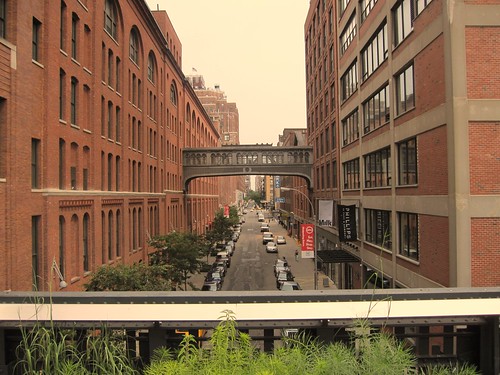
| The USS Intrepid: just one of the Hudson River landmarks no longer on the Invisible Visible Man's daily route. |
Yet these aren't the reactions I'd expected.
For months before the move, I’d been telling anyone who’d listen – and a fair
few that wouldn’t – how I was dreading the move. I’d grown used to commuting nine
miles each way to and from work, including a four-mile sprint up the Hudson
River Greenway along the west side of Manhattan. I was particularly concerned
about my waistline. Within a few months of undertaking a daily 18-mile
round-trip commute, I was noticing the difference when I stood on the bathroom
scales in the morning. I’d dropped a good five or six kilos compared with when
I moved in August 2012 from London .
There are certainly sad points about no longer having a daily ride by
the Hudson . On
my last morning on my old route, I was looking wistfully across at the
buildings in New Jersey , glittering in the autumn sun on the river's far bank. I
cast a sentimental glance to my right up at the Empire State
Building
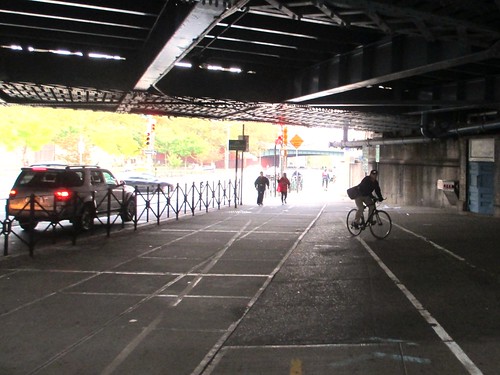 |
| The bike route onto the Manhattan Bridge: a quick route to lower Manhattan streets - and romantically urban to a fault. |
But, on my second morning in the new office, it occurred to
me that it was worth trying the simplest, straightest route across town to the
new site. I sped over the Manhattan Bridge , instead of the Brooklyn Bridge, dropped down into Chinatown
and navigated my way across to Prince
St . I discovered how the old, muddled-up street
plan meant no-one expected to speed across SoHo .
More to the point, I arrived with a smile on my face. The route had been
chaotic, grimy and a little bit noisy – far more unmistakeably a ride through New York than my former ride on a calm, orderly path up
by the Hudson .
I also, I’ll admit, felt a little bit cooler than before.
For the last 14 months as I’ve fulminated about this or that aspect of New York ’s road culture,
I’ve had a sneaking feeling that maybe I wasn’t quite getting it. Nearly
two-thirds of my ride to work was car-free and I’d found some of my efforts at
on-street riding pretty terrifying. I’d watched on Twitter the discussions
between more seasoned New York cyclists of their experience in the lower east
side, SoHo, Chelsea and elsewhere in the island’s lower reaches and suspected
they were simply cooler, more sophisticated, bolder people than I. Most of them
remain, no doubt, cooler and more sophisticated than I – but I have less awe of
their willingness to ride on these areas’ streets.
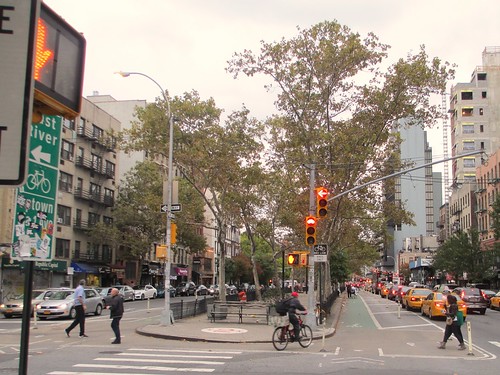 |
| Bike lanes on Allen St at the Rivington St intersection: a small-time entrepreneur wheeling goods down the bike lane adds an authentic detail. |
It’s certainly not a perfect experience. The journey would
be more fun still if more New Yorkers had a better understanding of where the
stress in the phrase “bike lanes” is meant to lie. Many seem to hear the term “lanes”
and adopt them as the ideal spot to wheel their food truck, haul their suitcase
or park their police car. Better protection for many bike lanes would be
welcome, as would a reining-in of many vehicles’ speed. I’ve also yet to find
an ideal route home. One of those cooler, more experienced cyclists, Joanna Oltman
Smith, warned me before the move to avoid Grand St, the most direct route,
which extensive sewer works have turned into a cross between a slalom course
and a rutted country track. I’ve not yet found a better alternative – and,
truth to tell, am enjoying the sense that I might be quietly training for
unexpected stardom on the seniors cyclocross circuit.
On the other hand, I now look almost fondly on the elderly
Chinese woman I see each morning blocking the Rivington Street London Chinatown . Factories
that once made clothing have been transformed into trendy offices for those of
us in the media set. I hear even more of the city's sounds. Next summer, I expect to be still more aware of its smells. I was cycling round New York City on my old route. Now I arrive at the office, a smile on my face, excited at how I've been riding in it.