At the end of most weekdays during my
first year of higher education, I would cycle to the central quadrangle of St
Andrews University’s ancient buildings, head into a down-at-heel lecture
theatre and ponder some of the biggest questions facing humankind. The most
eagerly-anticipated Moral Philosophy lectures were by Gordon Graham, the
department’s most charismatic lecturer. We teenage students would enter the
room to find Dr Graham grasping the podium and peering keenly up at the rows of
wooden seats. He brought to mind nothing so much as a hawk eager for some
intellectually lazy morsel of first-year thinking to devour.
Praise from Dr Graham for one’s
contribution from the floor would leave one feeling a little elevated for days
– one enconium boosts my fragile ego 24 years later. Dr Graham’s scorn would
leave a discernible chill.
The question is which side Dr Graham, who
gave a particularly memorable lecture series on how to live “the Good Life”,
would have come down on whether to get around a city by bicycle. The Good Life,
Dr Graham eventually concluded, was “the rational life”, where one sought to do
good to others, make the most of one’s abilities but also to be effective and
rational. One should reject mere
gestures in favour of doing things that genuinely improved the human condition.
 |
| A cyclist in London rain: cycling feels part of the Good Life some days more than others |
I should say at the outset that I’m not managing
to live the rational life. A wholly rational person would drink less than I do,
knowing that he was outweighing any health benefits by the damage incurred. A
wholly rational person would eat less, weigh probably 20kg less, get more sleep
and get less stressed about working in a job that, while it feels like one is
writing the first draft of history, is ultimately fairly trivial. That’s even
before tackling the subject of my wider belief systems, which I would stoutly
defend but many people would criticise.
Nevertheless, it strikes me as more worthwhile
to make a stab at living the rational life than merely to do what whim and
hunch suggest. It’s consquently worth examining whether an activity that takes
up at least an hour most days – more on many – and occupies an irrationally large
amount of my waking thinking fits with such an aspiration.
It’s with the tooth-suckers that I most
often discuss cycling’s rationality. The conversation generally starts with
their saying, “I think you’re very brave” or “I love cycling but I wouldn’t
like to try it in London UK London
 |
| A big truck: the tooth-suckers think one of these will get me some time |
My standard answer is to quote research
conducted some years ago by the Cyclists’ Touring Club which showed the average
British cyclist who cycled into middle age enjoyed life expectancy enhanced by
two years, while risking on average losing only two months through cycling
accidents. It’s a 12 to one benefit to cost ratio, I tell people. I even
occasionally mention the subtle message of the obituaries page in the Cyclist
Touring Clubs’ Cyclist magazine. Stories abound of wiry old devotees of the
Sunday club run succumbing eventually only in their 80s or 90s.
Although I might have to hide a receipt
for the latest £100 spent on my transmission while doing so, I could also point
the tooth-suckers towards the financial advantages of cycling. Even with the
amount of damage I seem to do to bike parts, I’m sure I’m spending less than if
I commuted by public transport. I impose virtually no costs on others through
wear and tear on the public roads.
There are also, of course, the
environmental benefits, which many non-cyclists assume are a major factor in
many people’s cycling. It is indubitably one of the few forms of transport –
amid a motley selection including skateboarding and cross-country skiing – to
involve carbon emissions only in the making of the equipment. It’s just
unfortunate that one sounds so insufferably pompous talking about it.
The only time I’ve been tempted to raise
my superior carbon status was when a woman honked loudly at me after I blew my
congested nose’s contents onto a road at traffic lights. It was, I’m sure, not
a pretty sight. But there was an irony in being reprimanded over my
biodegradable mucus as she merrily pumped out long-lasting greenhouse gases.
While some motorists seem to regard me as a vast, insuperable obstacle in their way, it also seems rational to me to use a vehicle that takes up relatively little of the precious urban space devoted to roads. I'm sometimes tempted to ask motorists frustrated with being stuck behind me whether they'd prefer I was sitting in front of them in a car.
While some motorists seem to regard me as a vast, insuperable obstacle in their way, it also seems rational to me to use a vehicle that takes up relatively little of the precious urban space devoted to roads. I'm sometimes tempted to ask motorists frustrated with being stuck behind me whether they'd prefer I was sitting in front of them in a car.
There is, meanwhile, scope for me to manage the
safety risks. Although Transport for London
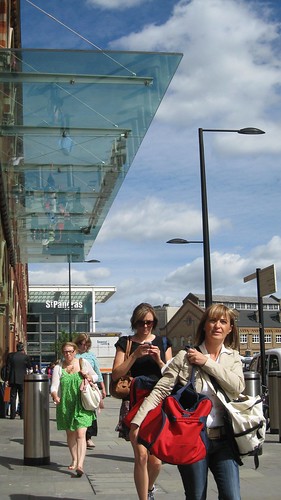 |
| Pedestrians: shouldn't they be wearing helmets? |
Nevertheless, a check through Great Britain’s accident statistics for 2010 backs up a point I’d already deduced looking
around my office. The intersection between colleagues who motorbiked and those
to be seen outside with the smokers was striking. These are the real
risk-takers - there were, I discovered, 36 cyclist deaths per billion vehicle
miles in 2010, against a hair-raising 138 for motorcyclists. Even for
pedestrians, the fatality rate per billion miles walked was 37. The only really
safe group, I realised, was car occupants, wrapped in their steel shell and
suffering only three fatalities for every billion vehicle miles. Each of the 111 cyclist deaths represents a real, avoidable tragedy. There should be far fewer. But I, for one, am
prepared to accept the risks of an activity that, despite the appearances, is
safer than walking.
Of course, it’s reasonable to ask whether
any evidence I could have uncovered would have driven me off my bike. I would
certainly be profoundly reluctant to give up the satisfaction of making my way around under my own power, feeling the wind on my face and hands and catching a
sense of the city living around me.
Are you making a rational decision to cycle? Are you making an irrational decision not to cycle? Are you making an irrational decision to cycle? You can work out roughly how these questions are working, so please just use the comments box to let us all know your answer.