When I was a regular traveller on the West Coast Main Line,
the UK ’s
busiest long-distance rail route, I would keep a careful lookout for the two
loops of track either side of the line just north of the England-Scotland
border. They marked, I would tell more or less interested travelling
companions, the site of the UK ’s
worst-ever rail disaster.
 |
| A lesson in negligence: a carriage burns at Quintinshill. Photo: Illustrated London News |
On May 22, 1915, a mistake by signallers led a southbound
troop train to collide at Quintinshill, in Dumfriesshire, with a stationary northbound
local stopping train that had been shunted into its path. A northbound express
train, which the local train had been moved aside to let pass, then collided
with the wreckage. The crash and a fire on the troop train – whose carriages
were wooden and lit by gas lamps – killed an estimated 226 people. The burning
of the soldiers’ regimental roll in the fire means the death toll has never
been precisely known.
The disaster has been in my mind the last few days because
of a debate following a crash in Williamsburg ,
not far from where I currently live in Brooklyn .
On Friday morning, a bus driver negotiating a corner apparently drove through a crosswalk as Jiahuan Xu, a 15-year-old girl, was crossing with the right of
way. The bus hit her and trapped her leg, which she’s likely to lose. The
driver has been charged under road safety legislation passed last year with
hitting a pedestrian who had right of way in a crosswalk.
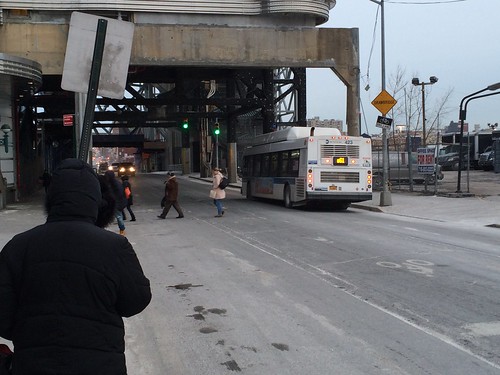 |
| A New York City bus: this one isn't being badly driven - but that doesn't mean it should be above the law |
The incident is linked in my mind with the far more serious
incident at Quintinshill because it was through reading about the rail disaster
as a child that I first encountered the idea someone might face criminal
charges for negligence at work. The Scottish courts in 1915 jailed both George
Meakin and James Tinsley, the two signallers whose negligence led to the crash,
for culpable homicide – manslaughter, in English legal terms, negligent
homicide, in US
parlance – and breach of duty.
I've been surprised, nearly 100 years on, to find that neither New York ’s main transport union nor a group
of city council members seems fully to support a principle to which I'd assumed pretty much everyone assented.
Last Thursday, the council members - Daneek Miller, Peter
Koo and Donovan Richards – introduced an amendment to New York ’s right-of-way legislation –
introduced only last year - to exempt bus drivers. Reginald Prescott, another
bus driver, in December became one of the first people charged under the law
after he killed Jean Bonne-Annee with his bus in East
Flatbush .
 |
| "Your choices behind the wheel matter": a message that, 100 years after Quintinshill, shouldn't need spelling out - but clearly does. |
“To arrest an operator for an unintentional accident is
really just absolutely outrageous, illogical and anti-worker,” Samuelson said.
Samuelson’s view probably reflects many people’s feelings
about prosecutions for dangerous driving. In the UK , juries are notably reluctant to
convict drivers – probably on the grounds that they feel just such an incident
could easily befall them. In November, Cyrus Vance, district attorney for Manhattan , explained his
failure to bring more than a handful of prosecutions over road deaths to their being
“accidents,” not results of criminal negligence.
“What should be criminal and what shouldn’t be criminal is
obviously subject to very subjective and emotional reactions,” Vance told Aaron
Naparstek, a safe streets activist, at an event in November.
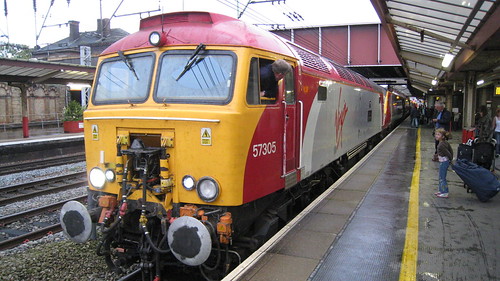 |
| A rescue locomotive prepares to haul a train at Crewe, on the modern West Coast Main Line. Such operations are far more safely performed nowadays, thanks to the lessons of past disasters such as Quintinshill. |
On the morning of the disaster, the filling in of the logbook so distracted the men that they forgot to place locks on the
appropriate signal levers to remind them the local train was blocking the main
line and prevent their letting a train onto the track. They also neglected to
warn the next signalbox north that the main line was obstructed. One of them,
forgetting about the local train’s presence, then accepted from the next signal
box north the southbound troop train, setting off the calamitous sequence of
crashes.
Meakin and Tinsley must have safely accepted trains from neighbouring
signalboxes hundreds of times. They had no more intention that morning of causing a catastrophe than any of Mr Samuelson's members ever does. It is certainly true that the Caledonian Railway could have fitted better safety equipment at Quintinshill. The fire would probably have been less serious if the carriages had not been wooden and gaslit. The fireman of the halted local train was meant to check the proper safeguards were in place but failed to do so.
 |
| My bike in Prospect Park: I'm very unlikely to kill or main someone else while riding it. But I recognise my moral obligation to exercise due care. |
Yet, even as an 11-year-old, I came to realise after some initial reluctance that the men’s attitude was so cavalier as to be criminally culpable. Tinsley was sentenced to three years’ hard labour in prison, while Meakin was sentenced to 18 months’ imprisonment. No mysterious force prompted the signallers to make their errors. They acted with casual disregard for their responsibility for the fates of the hundreds of people moving about on trains around them.
Bus drivers, thank goodness, have never unleashed a
catastrophe on the scale of Quintinshill and are unlikely ever to do so. Few probably make a string of decisions as poor as those of the Quintinshill signal workers. But they
have just as sure an obligation to move their buses only when it is safe to do
so as James Tinsley had an obligation to accept a southbound train only if the
track was clear. Although Nicole Gelinas, a transport expert, has since put a kinder construction on events, initial accounts suggested de Jesus was turning fast through the crosswalk when he struck Jiahuan.
It was no more inevitable that the bus would move through the crosswalk that than that someone at Quintinshill would ring the bell to tell the neighbouring signalbox to allow the troop train to proceed. His union insists that de Jesus had a good safety record. That may well be true – but I on my bicycle, drivers in their motor vehicles and anyone whose actions could harm another has a responsibility to exercise reasonable care every single time.
It was no more inevitable that the bus would move through the crosswalk that than that someone at Quintinshill would ring the bell to tell the neighbouring signalbox to allow the troop train to proceed. His union insists that de Jesus had a good safety record. That may well be true – but I on my bicycle, drivers in their motor vehicles and anyone whose actions could harm another has a responsibility to exercise reasonable care every single time.
Bus drivers in New York City have difficult, complicated
jobs. But it is symptomatic of many drivers’ faulty assessment of the causes of
street dangers that John Samuelson, president of Transport Workers’ Union Local
100, complains the police aren’t getting pedestrians out of his members’ way. That
assessment flies in the face of the multiple pieces of research that show
drivers cause the big majority of crashes between motor vehicles and pedestrians and cyclists, not the other way round.
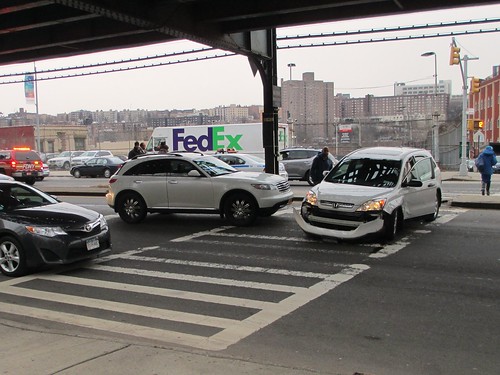 |
| The outcome of a driver's negligence in Inwood - or, if you're a member of Transport Workers' Union Local 100, a statistical inevitability |
Another union representative, JP Patafio, portrayed bus
drivers as nearly helpless victims of circumstance on the roads. That view is hard
to square with the fact that, according to Transportation Alternatives, the
pressure group, eight of the nine pedestrians who died under New York City buses last year were hit when
in crosswalks, crossing with the light.
“We drive for a living on the busiest streets in America ,”
Patafio told the New York Daily News. “The law of averages has it we’re going
to get into an accident.”
This is not, of course, to say that transport workers are
automatically to blame whenever there is a crash. The High Court in Edinburgh acquitted
George Hutchinson, fireman of the local train at Quintinshill, of culpable
homicide and breach of duty on the grounds that he bore relatively little of
the blame for the incident. Bus drivers are frequently involved in crashes for
which they’re not responsible. Perhaps, as Nicole Gelinas suggests, de Jesus will be acquitted. Drivers should expect public sympathy and gratitude
after being involved in incidents they did not cause, not blame.
There are also many different degrees of negligence - and it may well be that de Jesus, if he was negligent, was guilty of only a momentary lapse. Negligence, meanwhile, lies at the lower end of a scale of motor vehicle misuse that runs from inattention, to recklessness and can stray into acts most people would regard as terrorism.
There are also many different degrees of negligence - and it may well be that de Jesus, if he was negligent, was guilty of only a momentary lapse. Negligence, meanwhile, lies at the lower end of a scale of motor vehicle misuse that runs from inattention, to recklessness and can stray into acts most people would regard as terrorism.
But it is a piece of the purest cynicism – reminiscent of
that of Ray Kelly, the former NYPD commissioner, who suggested “accidents” were
inevitable – to suggest crashes are an immutable fact of life. The evidence
from everywhere that has made a systematic effort to improve transport safety
is that dramatic improvements have been possible. On the UK railways,
for example, there has been only one passenger fatality in an incident caused
by the rail system since 2002. The UK ’s speed camera programme and
other improvements helped sharply to reduce the number of road deaths before
politicians grew nervous of continuing with it. Scores more people in the UK are leading
productive lives and enjoying their families’ company than would be doing so if
rail safety regulators or local authorities had shrugged and accepted the “law
of averages”.
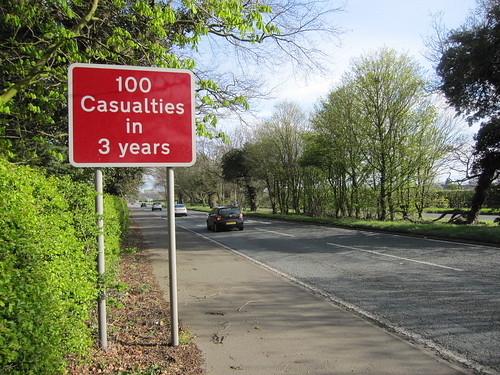 |
| A sign seeking to improve safety on a road in The Wirral, north-west England - defying the inevitable, if one's Ray Kelly or a TWU leader |
It also makes a mockery of the conscientious efforts of careful
bus drivers, rail workers and ordinary citizens who act safely to pretend that
the actions of the negligent are inevitable.
The highest stakes, after all, are not those that confronted
Meakin and Tinsley – who both went on to live until after the second world war –
or de Jesus, whose right-of-way charge carries only a $250 fine. They are
those confronting the passengers, pedestrians and others whose bodies are at
risk of mangling beneath or inside negligently-operated trains, cars and buses.
The consequences can be out of all proportion to the
sometimes momentary negligence responsible. At Quintinshill, the soldiers of
the Royal Scots, trapped in the wreckage and burning alive, are said to have
begged their officers to shoot them to ensure a less painful death. On the
street in Williamsburg ,
meanwhile, Jiahuan Xu grasped the hand of her father who came to comfort her and
spoke to him in Chinese.
