As I peered through the arches at the bottom of Manhattan ’s imposing
borough hall the other Saturday, I could hear a distinctive voice echoing round
the area inside, outside the New York Police Department headquarters. Al
Sharpton - who is, depending on one's point of view either a veteran civil rights campaigner or a rabble-rouser – was addressing a rally of thousands of people. They
included Sybrina Fulton, mother of Trayvon Martin, the young, black teenager
murdered last year in Florida .
The rally was protesting over the trial of Trayvon’s killer, which a week
earlier had led to the killer’s acquittal on all charges.
The cyclist’s plight, in other words, reflects a rottenness
in some police and public attitudes with, it seems to me, similar roots to racism, homophobia
and misogyny. It reflects a refusal to extend equal legal protection to all
that should worry even people who never ride a bicycle. In the worst cases,
anti-cyclist attitudes can leave a person dead, as Trayvon Martin is, yet
failed by the legal system, as he has been.
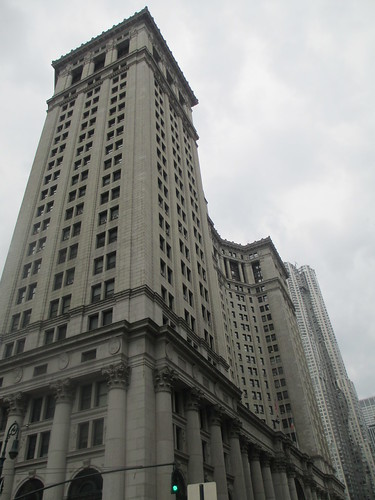 |
| Manhattan Borough Hall: its design alone shows how close the city wants to be to street-level concerns |
My better self – which is even more outraged at the
continued racist treatment of many black people in the United States
than the rest of me – urged me to lock up my bike and join the protest, changing my plans to cycle in the day's stifling heat up to Westchester County. The rest of me was
bearing in mind that it was already nearly lunchtime and, if I was to complete
my planned 50-mile round-trip, I’d better keep riding onward. My least noble side wondered whether a
rally over the fate of a young, black man in Florida
was really the most relevant protest for a middle-aged white Briton resident in
New York to
join. The rest of me won the latest of many easy victories over my better self
and we all rode on.
Yet, on the day of the protest, I was feeling so profoundly
exercised about another issue that I would gladly have abandoned my ride to Yonkers to protest about it. The previous evening, Hilda Cohen, a New York cycle activist
whom I’ve had the pleasure of meeting a couple of times, had described online the series of events that led to her receiving two criminal charges over her cycling on her way home. Her crime had, essentially, been to encounter a police
trap for cyclists and two officers frustrated at her failure to do anything
wrong. When she protested that, no, they couldn’t charge her for riding through
a yellow light, they charged her for reckless operation of a bicycle and
obstructing traffic – because she had left the street’s narrow (non-compulsory)
bike lane to navigate round their police car.
The treatment of Hilda – a conscientious cyclist known for
her enthusiastic opposition to bad cycling behaviour – filled me with the mixture
of rage and personal fear that only a deep injustice that impinges on one
personally can. “If it can happen to her, it can happen to you,” the Invisible
Visible Woman pointed out to me.
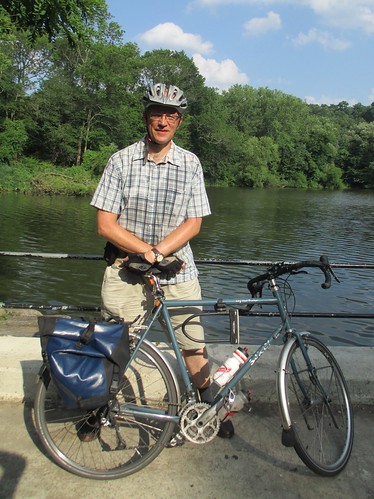 |
| On my way back from Westchester: Not shown, my better self (absent) |
Hilda’s treatment crystallised for me a sense that just by
riding a bike daily in New York
I was putting myself in the way of harassment from the city’s police
department. Since the launch of the city’s Citibike bikeshare scheme, the
police have increased the number of ticket traps they operate to catch
cyclists, often stationing themselves on, for example, quiet sidewalks by
uneven, cobbled streets. The clear intention has been to maximise the number of
tickets issued, regardless of the relative innocuousness of the targeted
behaviour.
A series of events since have reinforced my sense that there
are many people worldwide – in positions of varying authority – who feel towards cyclists the
mixture of resentment and violent rage that racists feel about those different
from them. The Friday after my ride to Westchester, I was disturbed to read
another account of anti-cyclist harassment from London
– this time from Elisabeth Anderson, a young London
cycle blogger – describing how two cars drove straight at a group of cyclists towards the end of that evening’s Critical Mass ride in central London. One motorist
deliberately drove over one of the victims “like a speed bump,” Anderson recounted.
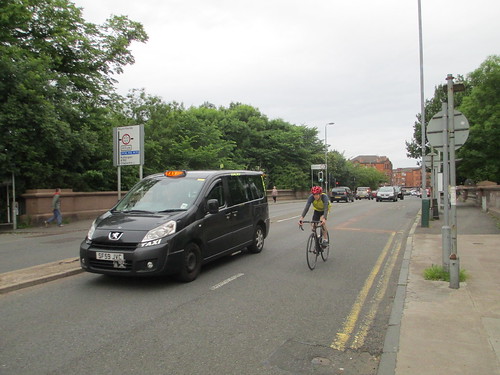 |
| A street in Cathcart, Glasgow. The cyclist here has the same obligation to keep this road safe as all the cars, according to a breathtakingly misguided campaign. |
My anger hasn’t been at all assuaged by the launch last
Monday in Scotland ,
my home country, of a bizarre “road safety” campaign, known as the Nice Way Code,
paid for from the Scottish government’s cycling budget, urging all road users
to show each other “mutual respect”. The campaign, which claims that all road
users have an equal duty to make the roads safe, is a stinging slap in the face
for the relatives of most vulnerable road users killed on Scotland ’s
roads. However little role their loved one’s own behaviour had in his or her
death, it seems to suggest, maybe it wouldn’t have happened if the victim had
shown the perpetrator more “mutual respect”.
The question, consequently, is: how far I was right to think
the Trayvon Martin rally wasn’t my personal battle? Don't civil rights issues affect me?
The clearest point to make is that, as a cyclist, I have the
distinct advantage over other groups the police and politicians don’t like. I –
and the vast majority of cyclists in the UK and US – am able most of the
time to exercise the privileges of being a reasonably well-off, articulate,
well-connected member of the professional classes. Were I to be shot dead on
the street tomorrow by a vigilante, provided my bike wasn’t involved, my death
would be treated very differently from that of Trayvon Martin. My assailant’s
murder trial probably wouldn’t be allowed to turn into a trial of my posthumous
reputation.
It consequently makes little sense to put cyclists’ problems
in the same bracket as those of, say, the non-white people rounded up on the
street in the UK for no reason other than their having no immediate way of
proving their right to be in the country. I would expect, through legal due
process or moral persuasion, to be able to get out of patently unjust, trumped-up
charges such as those Hilda Cohen faces. I will be still more alarmed about the general state of New York justice if Hilda doesn't succeed in having her charges overturned.
 |
| A New York food delivery biker. Want to know how the authorities would like to treat you, New York cyclists? Look at how they regulate this guy. |
In fact, however unfair the harassment that commuter cyclists can face, the plight of New York’s food delivery cyclists shows how much worse things could be. A city council that frequently seems
bored by the challenges of New York ’s
high road deaths rate seems never to tire of thinking up new regulations to
make the already trying lives of the delivery cyclists - mostly poor immigrants - more difficult. New York's articulate bike lobby might not be, as the bizarre Dorothy Rabinowitz has claimed, "all-powerful" but it has at least saved commuter cyclists from food delivery rider style registration and over-regulation.
Nevertheless, it’s hard not to see striking similarities
between aspects of some drivers' and police forces' stances towards
cyclists and the general climate of prejudice that some racial and other minorities face. It’s hard, for
example, not to see the police’s harassment of Hilda Cohen and disproportionate ticketing of cyclists as another expression
of the attitudes that have made the NYPD such enthusiastic advocates of “stop
and frisk” – the department’s tactic of stopping and searching large numbers of
young, mostly black males on minimal pretexts. It’s hard to escape the idea
that some policemen’s instincts are that both minorities and cyclists represent
potential trouble, needing constant reminders to keep in their place.
The violence of many people’s language when talking about cyclists and their desire to run them over is also clearly reminiscent of
racism. Incidents like the one Elisabeth Anderson witnessed, where drivers use
their vehicles as weapons, are a still more disgusting expression of that same
kind of impotent, incoherent rage against the different.
The Nice Way Code, meanwhile, is a reminder of prejudice’s
insidiousness. The campaign’s authors have been busy protesting since its
launch that its intentions are good. But it’s
hard not also to see their insistence that cyclists can’t expect to be respected
until they behave better as a new expression of old kinds of prejudice. Yes,
rape is awful – but why did she wear such a short skirt? Hey, we’re letting you
vote in Mississippi
– now forget the uppity manners that Dr King taught you, boy.
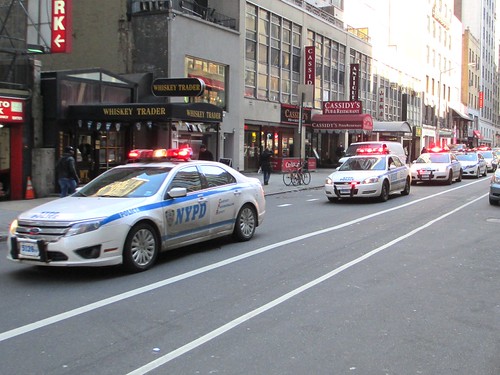 |
| NYPD squad cars: when I'm on my bike, I think the "Courtesy, Professionalism, Respect" motto on the side is satire. When I'm walking, I see it as a reassuring promise |
There needs, however, to be some other word –
“justice-denied groups,” perhaps? – for those of us fortunate enough to be able to choose our fate. I might wince when I see an NYPD squad car while cycling,
fearing the officers will invent a crime for me to have committed. My
experience of that feeling should, perhaps, have made me dismount and stand
with Trayvon Martin’s mother. But I must also bear in mind that I have the
privilege of putting my bike away and walking down the street. As a middle-aged, affluent white man, I can at least choose to have less to fear
from the police than many millions of less fortunate fellow UK citizens and inhabitants of New York .
