Showing posts with label cycling. Show all posts

Monday, 16 January 2017

A smug expectation, a messy reality - and why it's time to get to grips with a tough conundrum

Before I got out on my bike, I was anticipating that Monday, January 9, was going to be my smuggest cycling day since returning to London from New York in July. A strike by station staff on the London Underground had brought the busiest bits of the capital’s most important public transport system to a halt. And, as I sat at home writing initial stories about what was happening, I noticed account after account of chaos on the roads as would-be underground users turned to cars and buses to get to work. I imagined myself slipping casually through the traffic on my bike, warmly congratulating myself on the excellence of my transport choices.

In the event, the day ended up feeling less like a triumph and more like a reminder of the acuteness of the transport policy challenges facing London. By the time I left home to ride to the office, around 10am, the bus lanes that I’d normally use for the early stages of my journey were choked with other forms of motor traffic. Progress was so slow I retreated to the side streets, which in places were little better.
Traffic backed up on Vauxhall Bridge on January 9: a visible
demonstration of London's reliance on its underground.

The incident dramatised an issue that’s been worrying me for some time. London’s roads become congested when people are emptied out of the underground and other non-road forms of transport onto the roads. Yet it’s an uncomfortable truth of campaigns to encourage cycling in inner London that the vast bulk of the growth in cycle commuting must be coming from a similar, slow-motion shift from rail-based modes onto already over-stretched streets. More and more complex demands are being heaped onto constrained roadspace, without much sign of a strategic plan to manage the resulting pressures.

On top of that, I noticed once I got to work how many twitter users were complaining of having hours spent on buses even on short journeys. Later in the week, would-be commuters on Southern, the mainline rail service, would undertake similarly unpleasant journeys during strikes by their service’s drivers. The stories illustrated the shortcomings of decades of efforts to encourage cycling. Cycle provision in most of London still consists of signed routes down backstreets, most of which are growing ever busier and less attractive. It’s clear that most people will not consider riding on these, even in the most desperate circumstances.

Faced with placating demand for better cycle provision and the challenges of congested, polluted roads, Sadiq Khan, London’s mayor, seems anxious about building more of the direct, segregated cycle routes that might get such reluctant cyclists pedalling.

The challenge for everyone in London who wants more, safer cycling in central London is to devise arguments for better provision that recognise the new realities. It’s vital as the system accommodates growing cycling to safeguard road provision for the buses, delivery vehicles, emergency vehicles and other vital road-users that make up a high proportion of central London’s current road users. The challenge is similar for advocates in other big urban centres - including New York, my old home - where people shift to cycle commuting mainly from modes that don’t depend on the roads.
 
Pedestrians spill out of Southwark underground station by the
north-south cycle superhighway. How many of them can switch
to cycling before the roads get even more congested?
Yet some of the most influential figures on London’s transport scene continue to insist that the conundrum is so simple it barely exists. On January 5, Andrew Gilligan, London’s former cycling commissioner, tweeted a graph from Transport for London’s latest “Travel in London report that attributed 75 per cent of London’s congestion to “excess traffic”. The conclusion was “blindingly obvious to all but motorists,” he wrote, dismissively.

A little digging into the statistics for central London fills in the details of the policy dilemma. Traffic volumes entering Central London fell 3.4 per cent between the June to September quarter in 2015 and the same quarter in 2016, part of a long-term decline that’s seen the volume of motor traffic entering central London decline by more than 20 per cent since 2000. Instead of increasing with declining traffic volumes, however, average traffic speeds in central London - the easiest available proxy for congestion - fell 3.5 per cent, to 7.8mph. The network’s capacity is very clearly falling even faster than motor vehicle are going away. The amount of traffic that it takes for traffic to become “excess” is falling.

It is not clear, either, which part of the traffic can easily be reduced to alleviate the problem and free up space for cycling. The same Travel in London report that Andrew Gilligan quoted says that private cars now account for only 18 per cent of motor traffic during weekdays in the central London congestion charging zone. The other vehicles - private-hire cars, taxis, vans and heavy lorries - all have at least some arguable economic reason to be in the area. They are likely to be more resistant than private vehicle owners to stopping driving in the area.
 
A typical traffic queue on Southwark Bridge: it's not clear
crackdowns on private cars or encouragement for cargo bikes
will solve this problem.
One of the most popular suggestions among cyclists for reducing the traffic is that more of the growing numbers of internet deliveries being made in central London could be shifted to cargo bikes. The idea is sufficiently attractive that I investigated the subject in my day job for a piece about the growing numbers of cargo bikes I see around central London. Yet I emerged from interviewing even courier companies that use cargo bikes a little depressed. While cargo bikes were helping them to make urgent deliveries despite the heavy traffic, courier companies told me, they would always be a niche vehicle compared with the vans that were their fleets’ mainstays.

Amid this growing crisis, meanwhile, the one unutterable suggestion among cycle campaigners is that the building of segregated cycle superhighways along a number of central London roads might be contributing to the problem. When Florence Eshalomi, a member of the London Assembly, asked cyclists on twitter on January 11 whether they agreed with a senior TfL manager that cycle lanes had had some impact on bus journeys, the replies mostly struck a similar note.

“Making London a byword for cycling is more important than bus usage,” one twitter user replied.

“I think any far measurement of bus delays would show that excess cars are the main cause,” wrote another. “There aren't that many cycle lanes.”

The replies drew on the now-conventional wisdom among London cyclists that the 12 miles of new cycle superhighways in central London - which I love using, especially when with my children - have had no significant effect on congestion. The facilities, however, have been put in on arterial roads that were already operating at or near full capacity. They have, crucially, introduced new, cyclist-only light phases that can only have introduced extra waiting time for motor vehicles both on the streets with the new facilities and those crossing them.
 
A bus in a traffic jam by the cycle superhighway
on Blackfriars Road: the superhighway has no bearing
on what goes on on the rest of the road, it's said.
While there are plenty of other factors restricting London’s road capacity, it seems fanciful to imagine that cycle facilities alone can remove capacity from busy roads and have little effect on congestion. It is certainly clear the capacity of London’s roads fell around the time the new facilities were built. It is not unreasonable, it seems to me, for Sadiq Khan and Mike Brown, commissioner of Transport for London, to seek to reduce the effect of any new facilities on congestion before giving them the go-ahead.

Yet to say that the challenges facing London’s leaders are hard is very definitely not to say they are impossible. It is quite clear, for example, that action that reined in the growth of services such as Uber in central London could have a significant effect. Private hire vehicles - the vehicles that provide the Uber service - now account for 12 per cent of traffic in central London on weekdays. Any measure that makes deliveries to the scores of construction sites in central London more efficient could free up significant amounts of road space. It is hard to understand why low-emission vehicles, which take up the same road space as others, remain entirely exempt from congestion charging.

It is regrettable, meanwhile, that London relies so heavily on the double-deck New Bus for London given its poor capacity and the time it takes to load and unload. A wholesale reform and extension of the current central London congestion charge to make it more sophisticated and more closely related to the space each vehicle takes up on the road seems overdue. The mayor should continue to pursue increases in cycling because bikes provide clean, healthy, flexible transport. Extra cycling journeys can almost certainly be catered for more economically than extra journeys on the underground.
 
Fog and pollution haze sits over south London:
more cycling might avert such incidents
It is far too easy, however, for the debate over this complex issue to slip into glibness. Taxi driver groups slip into this trap when they claim the simple removal of new cycle paths would restore London’s roads to flowing freely. Cycling groups fall into it when they pretend new cycle paths magically shift London commuters from wasteful cars onto space-efficient bikes.

The rest of my ride to work on January 9 was a stark reminder of the risks of ducking serious debate. I encountered drivers engaged in fierce rows over road space, a furious woman cyclist yelling at a man who had somehow wronged her and, in van after van, long lines of stressed-looking delivery drivers and workmen. An air of unhappiness and frustration hung over everything.

While the scenes were far worse than those on a normal day, I made an inward vow to renew my efforts to think more seriously in future about the less acute but still worrying levels of congestion I encounter daily.

If others do the same, it may prove easier to build wide support for the kind of excellent facility I found myself using towards the end of the trip. Wanting to take in the scene, I rode over Vauxhall Bridge then down the east-west cycle superhighway along the Embankment. As van and taxi drivers sat motionless in the neighbouring traffic jam, I was finally slipping by the traffic jams, as I’d anticipated. Looking at the grim faces of the stationary drivers, it was a pleasure I was keenly aware I shouldn’t take for granted.

Sunday, 20 November 2016

Obstructive pedestrians, a crass video - and why your city's cyclists are the kind you don't like

If I’d gone out looking for evidence of how differently people regard cyclists from how I regard myself, I could scarcely have done better than my experience this Saturday. In the afternoon, as I rode with my wife and my son along the Embankment in Central London, we encountered a crowd of pedestrians crossing the cycle track against the signal. “Watch out in the cycle track, please!” I shouted.

The East-West Cycle Superhighway near Parliament Square:
site of the Invisible Visible Man's contretemps with
a group of pedestrians
Then, in the evening, I came across a trailer for Trigger Happy, a new series of Channel 4 comedy shorts. The first - Angry Cyclist - features helmet camera footage of the eponymous cyclist riding around streets. “Cycle lane!” he shouts at pedestrians, in imitation of precisely the tone I’d taken than afternoon. He then rides onto a section of pavement that is not, in fact, a cycle lane.

The video was only the latest evidence I’ve seen in recent weeks of how cyclists continue to be regarded in the UK - and possibly even more in the US - as a strange, fringe out-group whose behaviour is baffling and infuriating to others. Earlier in the week, I’d felt a similar sinking feeling when I saw Tweets by Mark Dennison, a presenter on BBC Nottingham, a local radio station, encouraging people to call his show. “Cyclists… what do they do that winds you up?” he asked. He later defended the transparently tendentious tweet as merely a way of encouraging a “balanced” debate.

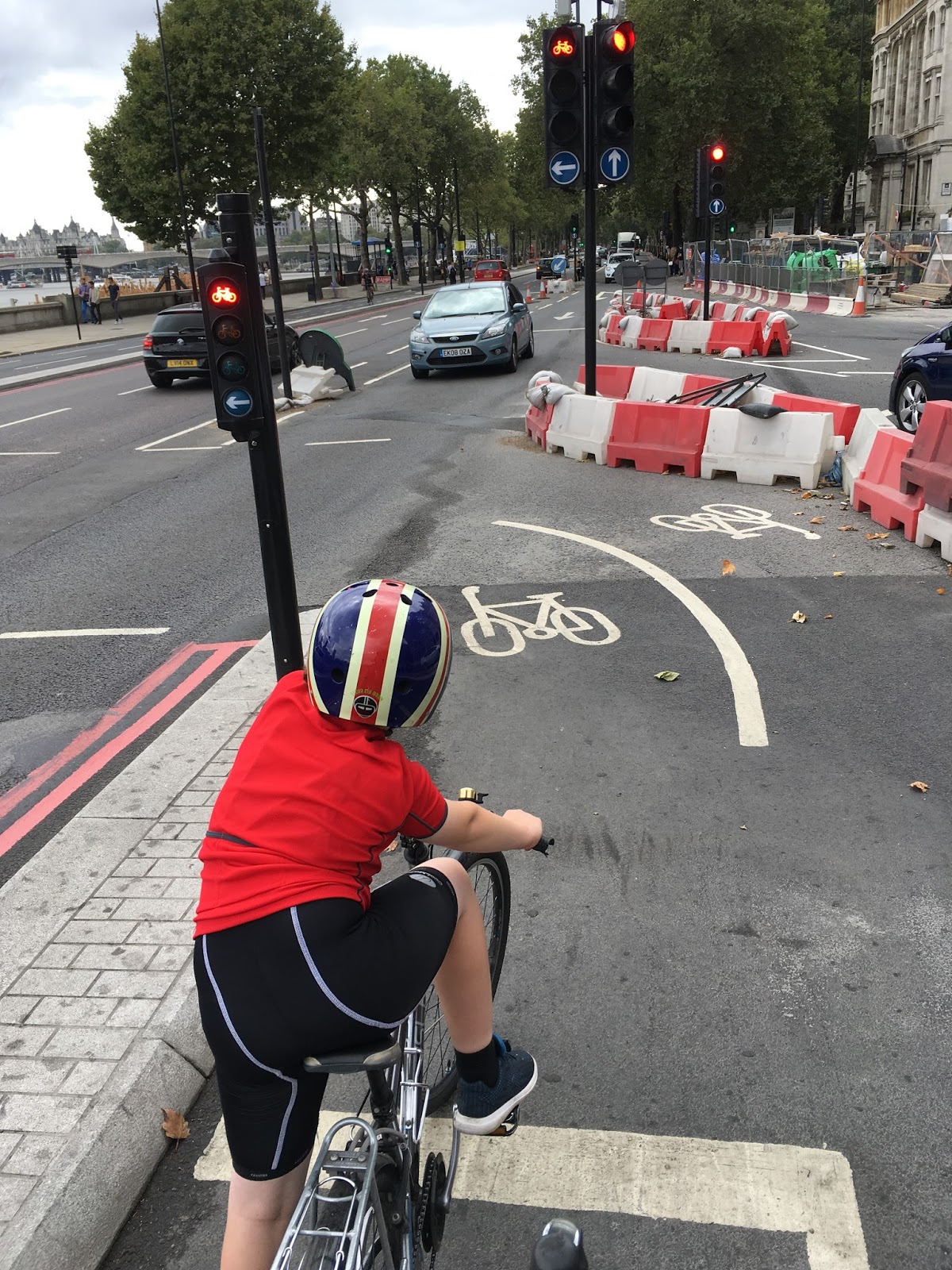
The comedy short and Mark Dennison’s tweet both came across as belittling a group of people who, at least when sharing the roads with motor vehicles, are vulnerable and relatively powerless. They showed the depth of the chasm of misunderstanding between cyclists and others. While my request to the pedestrians on the Embankment would have seemed self-righteous or priggish to the makers of Trigger Happy, it was in fact motivated by fear. I was worried that, unless they got out of the way, my nine-year-old would be marooned in the roadway when motor vehicles restarted.
The Invisible Visible Boy on his bike
in central London: a reason for concern I hope
even the haters can understand

The incidents have led me to query why so many people continue to find me and other cyclists so bafflingly alienating. It strikes me as an especially important question given that many cyclists, like me, believe their countries’ transport systems would work better if more people joined them by starting cycling. Current attitudes appear to be both a symptom and a cause of cycling’s remaining a niche activity, practised by a relatively small group of people.

I should say, first of all, that I understand at least a little bit of why Trigger Happy finds some cyclist behaviour funny. There is an underlying similarity to a lot of helmet camera video footage that cyclists post on YouTube. The cyclist is riding along a road - often at some speed - when a motorist does something stupid, dangerous and possibly malevolent. The driver’s behaviour is then held up for general condemnation in a tone that generally suggests the poster is standing, hands-on-hips shaking his head in shocked but unsurprised disbelief. I am sure that, while I don’t use a camera, my complaints about bad driver behaviour have a similar, rather priggish tone. I can see how someone might find it so predictable that it starts to seem a little ridiculous.

But the jokes become far less funny, it seems to me, the moment one starts to think about what shapes the culture that Trigger Happy and others hold up to ridicule. I’m surrounded by fast, aggressive cyclists on my morning commute down Clapham Road not because Londoners are by nature fast and aggressive when cycling but because the conditions have selected both who rides and how they do it. People who don’t feel capable of maintaining a steady 20mph are unlikely to feel comfortable riding down a wide, straight road in close proximity to drivers driving at 30mph and faster.

Cyclists at the Oval on my route to work:
some clichés about London cyclists persist
because they're partly true.
The cyclists I see around me have been as surely shaped by their environment as giraffes have been by conditions on the savanna or the American bison by the high plains. People wear bright clothing and helmets because they hope they’ll help to prevent or ameliorate collisions with fast-moving motor vehicles. It takes both the skills of racing cycling and a road-racer’s appetite for risk truly to embrace this style of commuting. That point came home to me forcibly on Friday when a fellow cyclist, to my astonishment, slipped through the gap - of barely a metre - that I’d allowed myself when overtaking a bus. One especially stressful recent morning, I witnessed a blazing row between two fellow cyclists over an apparent near-collision caused, as far as I could tell, by excessive risk-taking by one of them. The argument continued over a considerable distance, being resumed as both stopped at successive junctions.

This environment explains one of the most frequently remarked upon issues about the demographics of London cycling - that cyclists disproportionately tend to be better off, whiter and more male than the city as a whole. In a car-centric city where people feel skill, knowledge and equipment are necessary to cycle commuting, it's hardly surprising that cycle commuters often come from the class of people who have the leisure and finance to develop the requisite cycling skills recreationally.

A fairly typical bike path in London's
Docklands: experts can't work out why
cycling hasn't taken off here.
I’ve been struck recently by how even I, someone who’s cycled an average of nearly 4,000 miles a year for the last 13 years, feel a little spooked by conditions on much of my commute. I’ve had so many close passes from drivers after pulling out round stopped buses that I find myself increasingly stopping to let buses pull away. On Friday morning, a beautiful morning with nearly ideal conditions, I remembered well over half-way into my commute that I’d forgotten my security pass. I felt a frisson of fear as well as excitement when I realised I’d have to turn around and head home for it, even though I’d normally welcome the excuse to put in some extra miles.

There have, undoubtedly, been efforts to widen cycling’s appeal, both in London and New York, where I lived for four years until July. But Trigger Happy’s scoffing at cyclists’ tendency to shout at other road users about their rights highlights the big problem with many of them. Inadequate on-road cycle lanes, areas where cyclists and pedestrians share space and some quiet routes down parking-clogged back streets build in a significant level of conflict between cyclists and others. It might seem irritating to pedestrians to be asked please not to walk in a bike lane. But it is profoundly frustrating regularly to have to use spaces whose use is so unclear that other users obstruct cyclists unless specifically asked not to do so.

It should certainly surprise no-one that, in existing conditions, some cyclists are apt to break the road rules. If one knows, after all, that the traffic lights on a certain road are timed to suit drivers, not cyclists, and that a phalanx of drivers will chase after one the moment the lights change, the temptation to ride off through a red light and get away in peace can be very strong.

Helmetless, relaxed tourists on the east-west cycle
superhighway: evidence of how conditions dictate who rides.
The way to shape this culture is not, it seems to me, to berate existing cyclists for being as they are but to create conditions that will encourage a different kind of cycling. I certainly feel very different during the brief period each day when I cycle on the protected north-south cycle superhighway from when I’m in a 20mph pack racing down a bus lane. Even small changes can have a big effect. While I still jostle drivers for most of my commute, there are now segregated bike lanes through Stockwell Cross and past Kennington Park, previously the riskiest parts of the route I take. It’s no coincidence, I think, that, since those improvements, I see the occasional couple cycling to work and holding hands at traffic lights. While lycra-clad men still predominate, I find my heart lifting over such normal, human moments.

Better conditions are even, I think, starting to generate different types of cyclists. For four weeks in July and August, when we first returned from New York, I rode each day from our temporary apartment down the Cable Street protected bike path in the East End and onto the east-west cycle superhighway. I couldn’t help noticing that, in a deprived area with such good facilities, I’d see some families of eastern European immigrants out getting about by bike. On Prudential Ride London weekend, when many streets in the capital were closed to motor vehicles, I vividly recall the sight that most raised my hopes for the future. Near Blackfriars Bridge, a Bangladeshi woman in Salwar Kameez clothes paused on her hire bike as she waited for her son to make his way up the hill from the Blackfriars underpass.

The East-West Cycle Superhighway in
Parliament Square: politicians will be slow
to build more such facilities while
cyclists remain alien
Yet the challenge remains that, for the moment, many existing cyclists fit into the kind of stereotypical pattern that can prompt others to label us as “them”. That makes politicians reluctant to provide the kinds of facilities that would produce more obviously non-alien cyclists. It is certainly not surprising that London’s new, left-wing mayor is back-pedalling on his predecessor’s plans to encourage cycling. It is easy to understand his concern that his natural constituency of poorer voters will find themselves stuck on the bus while middle-class cyclists such as I zip by on new facilities and vote for his rivals.

Until that impasse is broken, however, London and other big cities will find that most of its cyclists are people prepared to face down sometimes naked aggression from motorists and even, sometimes, from frustrated pedestrians.

The challenge was made brutally clear to me as I completed my lengthy commute on Friday. As I neared Elephant & Castle, a van driver deliberately pulled into my path. Then, apparently eager to ensure he cleared the junction before the traffic light changed, he tried, despite my clear signals to him, to turn across my path and force me to stop. It was hard not to be reminded of the most succinct answer to Mark Dennison’s question about what cyclists did that wound people up. “Breathe” was one of the very first responses.

Sunday, 30 October 2016

A clichéd advert, cycling in the mist - and what a foggy London reveals about the city's identity

When La Défense, Paris’ equivalent of London’s Canary Wharf, launched a campaign to woo financial services firms from London earlier this month, they used a slogan to make long-term London residents sigh. “Tired of the fog?” it asked. “Try the frogs!” It was an irritating illustration of how comprehensively people’s ideas of London continue to be shaped by Charles Dickens and Arthur Conan Doyle. Especially since the advent of clean air legislation, it’s really not a typical London experience to find a man in a deerstalker emerge into view from only a few feet away, by the light of a conveniently-placed gaslamp.

Foggy London might be as much of a cliché as 
parliament's clock tower. But, as this picture
taken in this week's misty weather shows,
both still exist. 
Yet clichés survive when there’s a little bit of truth in them. The last few days in London have been a powerful reminder for me, after four years in New York’s very different climate, about the distinctiveness of London’s weather. Day after day has dawned with anything ranging from a slight mist to a definite fog. As I’ve cycled to work or to meetings, the air’s felt an odd mixture of warm from the enveloping blanket of mist and cold from the pervasive dampness. Each day has felt slightly different, in a way that’s obvious only to someone travelling about by bike. The experience has stood in sharp contrast to the switchback ride between hot high summer and chilly late fall that my friends still in New York seem to have been experiencing.

The relative mildness of London’s climate fits with a general atmosphere that’s more subdued than in some other metropolises. More intense, denser, in-your-face New York bakes its residents - and especially cyclists - in summer, only to freeze them in winter. Even its fog is more intense. While the city’s less prone to the generalised, damp mist that’s settled over London the last few days, such dense, impenetrable fog sometimes settles over the East River that I sometimes rode to work over the Manhattan Bridge unable to see the water below.

Even its fog is more intense: cyclists head into dense,
East River fog on the Manhattan Bridge bike lane.

My feelings about the weather have made me realise how puzzlingly rural much of London continues to feel. Generation after generation has sought to erect a very English calm facade for a metropolis of nearly 9m people. I’m always a little surprised here when I encounter the same dense crowds of people I’d expect to see at every corner in Manhattan. In Manhattan, by contrast, if workmen were digging a hole and I saw soil underneath, I always felt a little incredulous. The city felt like a mass made solely of concrete and steel that should properly be bolted straight into the bedrock.

The issue has serious implications. In dense New York, far more people live within what should, theoretically, be easy cycling distance of their places of work and education. London’s lower density makes many trips longer and the rationale for getting about by motor vehicle stronger.
The Wimbledon Common windmill: a bucolic scene
a short bike ride from a town centre wrecked by excess traffic

But it’s also striking how London’s current dependence on cars is strangling much of what’s worth preserving. London is formed of a collection of villages that happened to be swallowed by a city. Yet town centres, such as Wimbledon’s, that could be the hearts of communities are instead noisy, polluted and divided rather than held together by roads that should be their main public spaces.

My main insight from the last few days, nevertheless, is simply that fog simply sits well on London, like a comfortable sweater on a middle-aged man. It is almost by definition a form of mild, still, temperate weather. In the streets around where I live in genteel Brixton Hill, that’s of a piece with the rows upon rows of Victorian houses. Instead of being built to impress with their opulence, these represent an ideal of restraint, moderation and good taste. The fog heightens that sense still further because it obscures a skyline cluttered with the towers that are increasingly making the City and the banks of the Thames resemble Dubai.
A City of London back alley in last week's mist:
an oasis thanks to two millennia of haphazard
development.

The effect is thanks partly to fog’s muting effect on the city’s sounds. It may be partly because it so disrupts flights into Heathrow Airport but there has been an eerie calm around my area today thanks to the fog. It’s a very different feeling from our Brooklyn apartment, where we were treated nearly 24 hours a day to a cacophony of emergency vehicles, squealing subway trains and building work. The effect has been all the more striking because I can, if I want, ride down urban streets that feel, in the fog’s limited visibility, as deserted as a country lane. London’s haphazard growth has left it with a wealth of such meandering back streets. The metronomic grid of a more planned metropolis tends to distribute cars more evenly.

I find my horizons closing in metaphorically as well as literally. A foggy day prods one to feel one’s way gently to the local shops, rather than to venture farther afield. Where one’s local town centre is feels mostly like a better-defined question in London than in many other cities. When an improvised bomb exploded at W23rd Street & 6th Avenue in Manhattan in September, for example, there was considerable confusion about how to describe the area (Chelsea? Flatiron?). In London, where some streets were laid out as long ago as the Roman occupation, the delineations mostly seem clearer.

Fog-induced myopia could on such a day trick one into sentimentality about London’s clear, organic links with its past. As I rode my bike back from church in this morning’s fog, I even passed an older spinster lady I know heading by bike towards a later service. She was a living embodiment of one of George Orwell’s archetypal pictures of England - “old maids biking to Holy Communion through the mists of the autumn morning”.

An unfinished part of the east-west cycle superhighway
in Hyde Park: vested interest at work
Yet one of the most striking factors behind the city’s current atmosphere is the prevalence of vested interests among those who control its territory. I was able to cycle across Clapham Common, for example, because the ancient right of Clapham’s people to graze their livestock on a patch of land by the village. Such commons are dotted all across London, often taking up several square miles of empty space. The influence of royalty is still more pervasive. St James’ Park, Hyde Park, Regent’s Park and others occupy vast swathes of Central London thanks to their ownership by the crown. The City of London Corporation, the unelected government of the square mile where the financial industry is concentrated, also owns some big tracts of land, including Hampstead Heath.

These big, conservative landowners are often fixated on their narrow ideas of how their open spaces should be used and hard to pressure to change. Foot-dragging by Royal Parks currently appears to be holding up further development at the west end of London’s east-west cycle superhighway, yet the body’s very unaccountability makes it impossible to force it to obey the will of the people who ultimately fund it.
London's new towers might be as unloveable as Dubai's,
but a denser, more urban London is probably necessary.

The generally suburban feeling in even large parts of Central London, meanwhile, represents a tendency that’s no less insidious. The UK has for centuries nurtured a cultural bias towards the idea that the countryside is more wholesome and honest than the city. Much of London was built with houses surrounded by gardens big enough to persuade their inhabitants that they were not really in an urban setting. Its housing shortages, congestion and car dependency could all be more easily resolved if the city had embraced the need for density far earlier, as constrained New York has all along been forced to do. While London’s distinctive atmosphere will suffer if more high-rise housing is built, the underground, surface trains, buses and cycling will all gain.

Yet it’s easy on a foggy morning to let those big worries go, at least for a while. Instead, this morning I slipped out of the house with my son and headed off along the deserted, early morning streets towards church. The dampness in the air hung so heavy that we felt big droplets kissing our cheeks as our breath filled the air in front of us. Only the leaves stood out, as if they’d painted themselves red and gold expressly to stand out against the fuzzy-white background.
Fog on Clapham Common: scene for an Orwellian idyll.

The mystery only increased as we rode out onto the common. Trees looked like grease stains on a bag from a bakery, the mist rolling more densely round the bases of their trunks than round their branches. Other cyclists and runners emerged from the mist then faded back into it.

The most remarkable point, however, was that this scene was unfolding not in some old, idealised landscape painting but a mere five miles from central London. I was, once again, reminded of the remarkable privileges I can enjoy by simply riding a bicycle to get around this big, infuriating but ultimately endlessly beguiling city.

Monday, 25 July 2016

A ride on autopilot, a famous cricket ground - and why I feel more optimistic when I'm on my bike

It was a curious feeling to ride my bike home from church this Sunday along the back-street cycle route that used to be my regular route between home and work. I felt a superficial unfamiliarity - it was my first time back in the area since spending four years living in New York. But at the same time so little had changed on many of the roads that a kind of auto-pilot took hold of me. I followed a complex, twisting and turning route with the instinctiveness that comes from having gone the same way literally thousands of times before.

Canary Wharf's towers loom over the neo-classical
splendour of maritime Greenwich: symbols of London's
endurance and its adaptability
The feeling reflects much of my wider experience of returning to living and cycling in London. There are some big, welcome changes - the new, segregated cycle superhighways being the most obvious. But I’ve been surprised in the last week to find that routes I’ve been using since 1997 - many using facilities designed to encourage cycling by the outmoded method of pushing cyclists towards back streets - still work surprisingly well. I’ve been navigating byways in Covent Garden and quaintly-named alleys in the City of London financial district with almost the same ease as if I’d never been away.

My experience doesn’t feel like a merely practical lesson in getting around London. I’ve come to feel that it’s telling me something wider about the metropolis as a place. London is in some ways peculiarly resistant to change - or at least has a great propensity to preserve the past. While St Paul’s Chapel in lower Manhattan feels almost miraculously old for dating from before 1776, I rode my bike to church partly down a road first laid down by the Romans nearly 2,000 years ago. I currently cycle daily past the Tower of London, whose construction started after the Norman Conquest 950 years ago, in the same year that the last Viking kingdom in England was defeated.

The Walkie Talkie, Cheesegrater and Gherkin:
what London's new towers' names lack in grace
they make up for in memorability
Yet the city also feels peculiarly adaptable. While the Tower has changed little in parts since the 11th century, several of the most prominent skyscrapers - including the Cheesegrater and Walkie Talkie - have sprouted just in the four years I’ve been away. While I didn’t want to leave New York, London’s mixture of stability and flexibility makes it a peculiarly comforting place to be living at a time when the world is descending into turmoil. I cycle daily past reminders that the city has withstood the Black Death, the Bubonic Plague, levelling by fire, the horrors of The Blitz and the vast IRA bombs of the early 1990s. If London spoke like a New Yorker, it might be asking fate, “Is that all you got?”

I encountered an excellent example of the city’s spirit during my ride back from church. I emerged from a back street onto a stretch of Harleyford Road in Kennington in the shadow of the Oval cricket ground. Surrey County Cricket Club’s ground hosted the first ever international cricket test match in 1880. Traditionally home of the last test of each English season, it is steeped in the history of acts of late summer sporting daring. Yet Harleyford Road - once the highest-stress part of my daily commute - has been enhanced with a new, two-way protected bike lane that carries cyclists all the way over the once-terrifying Vauxhall Bridge into Pimlico. The juxtaposition of the cricket ground’s Victorian grandeur and the bold new transport experiment was striking.

The glory days of Jack Hobbs, Surrey's master batsman,
are a thing of the past at the Oval, over the brick wall in this
picture. But so, thankfully, are the days of death-defying
cycling manoeuvres over multiple lanes of traffic
on Harleyford Road

The relative mildness of London’s response to change, of course, reflects partly the city’s being a less bracing place than New York. The crowding of the key bits of New York onto small areas of two islands in New York Harbour produces greater density and a greater propensity to eradicate the past. But it also propagates an impatience with anything that’s not immediately useful or profitable. That certainly helps to encourage some negatives - the dreadful driving standards, for example, or the peculiar anger over any effort to reallocate street space away from car parking. But it also produces an energy and buzz that aren’t quite there in lower-rise, lower-stress London.

I don’t mean, either, to sentimentalise London. I’ve noticed since I returned that my younger colleagues are living further and further from central London, pushed into more and more obscure outer suburbs by crazily spiralling housing costs. I’m protected from them only by the good fortune of having bought a house 12 years ago.

A graffiti mural in Park Slope, Brooklyn: a reminder of
New York's more frenetic street life
The riots in many parts of the city in 2011 suggest many members of poor minority groups feel little stake in London’s wellbeing. Some of the UK’s poorest people continue to live in such jarring proximity to members of the global super-rich that it seems remarkable the city has maintained such relative social peace.

The city’s tolerance of change and incomers is perhaps the flipside of a rather English reserve about them. In the serviced apartment complex where my family, my bike and I are currently living, no-one seems perturbed that the staff all speak Romanian to each other. But most people barely seem to notice the staff at all.

The Brick Lane Jamme Masjid - formerly the Spitalfields
Great Synagogue, formerly London's Huguenots' Neuve
Eglise: symbol of London's flexibility
Nevertheless, I am reconnecting with the city’s distinctive spirit. I rode down on Saturday, for example, to Greenwich through the Isle of Dogs. I cycled part of the way with a group of boys whose accents were a strange mixture of Caribbean, South Asian and traditional cockney. Given the mixture of the language and their own ethnicites, their term for each other - “bruv” - sounded like a strangely universal embrace.

Our temporary accommodation, meanwhile, is near the Brick Lane Mosque - a building famously built by Huguenot refugees, subsequently taken over by Jewish refugees and now a place of worship for east London’s Bangladeshis. Its history seems mainly to be a source of some pride, rather than anguish over what has been lost.

Striking juxtaposition: a man rides down a few months old
cycle track, past a tower whose origins go back 950 years
These positive feelings, of course, could prove fragile. As the UK’s wealthiest, most international city, London has far more to lose from the economic pain of leaving the European Union than some other parts of the UK that, unlike London, voted in favour of leaving. Having experienced the trauma of the July 2005 terror attacks on London, I know that the city’s relative calm could be tested if the successor to the Nice or Munich terror attacks takes place on London streets.

But I ride daily amid a city that feels as if it’s flourishing, despite the abundant evidence of past catastrophes. The ground below Upper Thames Street where I ride each morning contains piers abandoned by the Romans when they left the city in ruins. To my right as I ride to work is the monument to the dead of the city’s 1666 Great Fire. A mere recitation of the grim facts of London's current situation makes it feel as if it's undergoing another historic disaster. But, riding a bike amid the ghosts of past horrors overcome, it's far easier to feel optimistic.

Sunday, 6 December 2015

First Avenue Harassment, Talking Down to Pedestrians - and a Culture That Needs to Change

There could hardly have been a clearer illustration of what’s wrong with the culture of New York’s city streets. Two Saturdays ago, as I rode my bike up 1st Avenue on the Upper East Side towards the Metropolitan Museum, I succeeded in shouting forcefully enough to get one turning driver to yield to me momentarily – as legally required – as I rode straight on through an intersection. But his brief slowing – more a result of confusion at my shouting, I think, than a genuine effort to let me through – enraged another driver waiting to turn.

“C’mon – let’s go!” he yelled out of his window at the driver who’d slowed, urging him, in effect, to drive over me.
 
Poorly-designed intersections and illegal maneouvres
by drivers: welcome to First Avenue
It’s the kind of incident I’ve noticed many times in recent weeks as I’ve been trying to understand the persistently high death toll on New York’s streets – particularly a dreadful spate of 12 pedestrian deaths between October 31 and November 11. It’s common to see drivers honk loudly at others who have correctly yielded to pedestrians in crosswalks. I’ve personally been on the receiving end of a fair amount of harassment from drivers who imagined they had a right to overtake me even in places where it was unsafe.

This impatience from city drivers shapes the atmosphere, making pedestrians and cyclists fearful and making the business of using the streets often miserable and stressful for everyone else. Many drivers, traffic planners and police officers seem to accept this aggressive driving culture as an almost charming symptom of the city’s general bustle and as unchangeable as the weather. They seem to regard anyone who breaks the formal law while acting within the limits of this accepted style of driving as essentially not culpable.
 
New York City pedestrians: their own worst
enemies, except for all the bigger, more
dangerous enemies.
The area’s political class are also worryingly oblivious to the nature of the problem. On November 10, Mike Simanowitz, a member of the New York State assembly, chose at a press conference organised by the New York Police Department’s 109th precinct to criticise pedestrians for creating the problems themselves. It was as if he was complaining about the timidity of his pet mice while doing nothing about the gang of unruly cats rampaging through his house.

“If you're crossing in the middle of the street, you're wrong, you're endangering yourself, you're endangering others, you're endangering drivers," Mr Simanowitz said.

He gave no explanation of how pedestrian behaviour might endanger drivers.

“Cross at the green, not in-between, and hopefully we will be able to reduce the number of traffic fatalities," he added.

There is, of course, something fundamentally nebulous about the claim that a set of observed behaviours adds up to a “culture”. I resist sweeping statements about how “bikers” as a whole behave or stereotypes about British people or white people or all the other various groups to which I belong.

Yet I was struck when visiting Los Angeles in mid-November at how differently the average driver behaved from his or her New York counterpart. Los Angeles drivers seem when yielding to pedestrians to stop the car well outside the crosswalk until the pedestrian is out of the way. Used to New York drivers’ constant harrying of pedestrians to hurry them out of crosswalks, I found their stopping at that point so freakish that I’d hesitate a little, wondering what was wrong.

LA drivers meanwhile had a tendency to creep forward into the crosswalk if anticipating they might be able to make a coveted right-turn on a red light (permitted when no pedestrians are crossing). Once clear of intersections, they would take off at horrendous speeds, encouraged by the city’s wide streets.
 
Traffic on Hollywood Boulevard: surprisingly accommodating
to basic standards of decency.
The contrasting patterns of behaviour reflect the two cities’ different road conditions. In New York, on Manhattan avenues and many other places, there can be 20 intersections every mile, with each controlled by traffic lights. In drivers, New Yorkers’ famed impatience expresses itself in a desperate desire to reach the next traffic light before it has been red for too long. Angelenos are famously more laid back – and they can make up for any delay at an intersection by speeding up on the long spaces between lights.

The moment one starts looking for the jostling for position in New York, however, it’s everywhere. If I position myself safely at the head of a line of traffic waiting at a red light, I will typically find the driver first in the line creeping up alongside me, putting me in precisely the proximity to him I was trying to avoid. Every morning, as I ride down Smith St in Brooklyn, I find drivers seeking to turn from side streets have turned half-way through the intersection, blocking the cycle lane and crosswalks, to reserve their rightful place in the street’s slow-moving traffic jam. Drivers are so desperate to get out of parking spaces and into the traffic that they seem truly to look at what's going on only once they're under way down the street.

These habits are far more than local foibles like New Yorkers’ tendency to be rude or fondness for street food. New York city bus drivers alone killed three pedestrians in November – two hit by drivers turning through crosswalks and another hit by a driver apparently speeding. The police appear to be attributing a crash on October 31 that killed Louis Perez, 64, Nyanna Aquil, 10, and Kristian Leka, 24, on a sidewalk in The Bronx to the driver’s “medical issue”. But, whatever happened immediately before the crash, the driver was driving a powerful Dodge Charger car at such a speed that it became airborne after hitting another car and landed on top of the victims. A read through Radio WNYC’s list of this year’s traffic fatalities – 228 at the time of writing – reveals a steady stream of people killed by drivers ignoring their right of way, driving too fast or mounting a sidewalk after crashes resulting from excessive speed.
 
125th St in Harlem: I see excessive speed and fast, risky
turns. But a New York assembly member sees this as a space
spoilt by pedestrians' recklessness.
There is a mountain of evidence about the costs and causes of the current traffic culture. While the number of traffic deaths to the end of November - 224 – was down on the 252 for the same period in 2014, only 127 people died in London – a slightly larger city with more motor traffic – in the whole of 2014. Research by Streetsblog, the campaigning website, shows that only around 7 or 8 per cent of crashes involving pedestrians in New York are labelled a result of an error by a pedestrian.

There's no denying that New York pedestrians and cyclists are also often in a hurry. I am frequently frustrated, for example, by pedestrians' rush to cross the street after cars have passed, without looking out for cyclists. I find it tempting to ride through traffic lights just as they're changing precisely because it means I can avoid jostling with drivers when the lights turn green again. When I run through lights a little later than I should, however, I find an even later car nearly invariably following me through. The behaviour of both pedestrians and cyclists is dictated mainly, it seems to me, by their desire to avoid crossing streets or moving away from lights at the same time that cars are doing so.

Mr Simanowitz’s comments are unusually revealing, meanwhile, about why politicians and the police persist in trying to berate pedestrians and cyclists into solving the problem rather than going after the real issue – driver behaviour. The patronising rhyme – “cross at the green, not in-between” – makes it clear that he regards pedestrians as irresponsible children in contrast to the grown-ups – the drivers – in the streets. I encountered similar reasoning myself recently when I got into a row with a driver who’d pulled out into my path and he quickly fell to insinuating that cycling was a children’s activity.

“You’re a grown-ass man on a push bike!” he yelled, incredulously, as if being an adult in charge of an elderly, collision-damaged Lexus SUV were inherently superior.
The sign says "slow zone"; the design says fast.
Which do you think motorists do?

The rhyme suggests that Mr Simanowitz’s thinking – and, I suspect, that of many other senior politicians – remains dominated by the facile road safety lessons given to children. Those are, typically, predicated on the idea that it’s children’s own job to keep themselves safe. They embrace none of the complexity that the statistics reveal – that most road traffic victims suffer from someone else’s negligence, not their own. It’s as if they were trying to solve the mice’s timidity by giving the mice lessons in strengthening their characters, not keeping the cats at a safe distance.

There’s little mystery about what it would take to alter the traffic culture. Many New York streets at present look designed precisely to encourage excess speed, not to discourage it. The sidewalks and cycle lanes are mostly add-ons that are sacrificed anywhere that cyclists or pedestrians might slow down or otherwise hamper traffic. Enforcement of traffic laws is haphazard and often directed at harassing cyclists and pedestrians, based on the same fundamental misunderstanding of road relationships that Mr Simanowitz betrayed.

London, which has made little concerted effort to address road safety and whose transport policies have many shortcomings, has far better figures largely by dint of having better road design, better places to cross the street and far more speed cameras.

But it’s hard to avoid the conclusion that the city as a whole for now takes the view of the people I encountered as I rode down MacDougal St in Greenwich Village on Thursday evening. They stepped out into the bike lane to hail a taxi which then, with considerable predictability, veered left into the bike lane cutting me off and forcing me to come abruptly to a halt.

They were superficially apologetic and sympathetic.

“Oh – that’s not right,” one of them said.

But the sympathy wore off in less time than it took me to ask the driver what he thought he was doing.

“Be on your way – we’re in a hurry,” the initially sympathetic man shouted at me, in the stilted tone of a character in a novel.

Then, as I accepted defeat and headed off towards Bleecker Street, he spoke for the city when he yelled after me: “Shit happens – get used to it!”

This blog is the first after a lengthy delay caused by the Invisible Visible Man’s efforts, among other things, to interest publishers and agents in the possibility of a book based on the blog. I apologise for the interruption.

The timing of future blogposts will depend on progress in the efforts to find a publisher. Anyone interested in taking me on as an agent or publisher is free to contact me at robert dot wright at ft dot com.