Showing posts with label Mike Brown. Show all posts

Monday, 16 January 2017

A smug expectation, a messy reality - and why it's time to get to grips with a tough conundrum

Before I got out on my bike, I was anticipating that Monday, January 9, was going to be my smuggest cycling day since returning to London from New York in July. A strike by station staff on the London Underground had brought the busiest bits of the capital’s most important public transport system to a halt. And, as I sat at home writing initial stories about what was happening, I noticed account after account of chaos on the roads as would-be underground users turned to cars and buses to get to work. I imagined myself slipping casually through the traffic on my bike, warmly congratulating myself on the excellence of my transport choices.

In the event, the day ended up feeling less like a triumph and more like a reminder of the acuteness of the transport policy challenges facing London. By the time I left home to ride to the office, around 10am, the bus lanes that I’d normally use for the early stages of my journey were choked with other forms of motor traffic. Progress was so slow I retreated to the side streets, which in places were little better.
Traffic backed up on Vauxhall Bridge on January 9: a visible
demonstration of London's reliance on its underground.

The incident dramatised an issue that’s been worrying me for some time. London’s roads become congested when people are emptied out of the underground and other non-road forms of transport onto the roads. Yet it’s an uncomfortable truth of campaigns to encourage cycling in inner London that the vast bulk of the growth in cycle commuting must be coming from a similar, slow-motion shift from rail-based modes onto already over-stretched streets. More and more complex demands are being heaped onto constrained roadspace, without much sign of a strategic plan to manage the resulting pressures.

On top of that, I noticed once I got to work how many twitter users were complaining of having hours spent on buses even on short journeys. Later in the week, would-be commuters on Southern, the mainline rail service, would undertake similarly unpleasant journeys during strikes by their service’s drivers. The stories illustrated the shortcomings of decades of efforts to encourage cycling. Cycle provision in most of London still consists of signed routes down backstreets, most of which are growing ever busier and less attractive. It’s clear that most people will not consider riding on these, even in the most desperate circumstances.

Faced with placating demand for better cycle provision and the challenges of congested, polluted roads, Sadiq Khan, London’s mayor, seems anxious about building more of the direct, segregated cycle routes that might get such reluctant cyclists pedalling.

The challenge for everyone in London who wants more, safer cycling in central London is to devise arguments for better provision that recognise the new realities. It’s vital as the system accommodates growing cycling to safeguard road provision for the buses, delivery vehicles, emergency vehicles and other vital road-users that make up a high proportion of central London’s current road users. The challenge is similar for advocates in other big urban centres - including New York, my old home - where people shift to cycle commuting mainly from modes that don’t depend on the roads.
 
Pedestrians spill out of Southwark underground station by the
north-south cycle superhighway. How many of them can switch
to cycling before the roads get even more congested?
Yet some of the most influential figures on London’s transport scene continue to insist that the conundrum is so simple it barely exists. On January 5, Andrew Gilligan, London’s former cycling commissioner, tweeted a graph from Transport for London’s latest “Travel in London report that attributed 75 per cent of London’s congestion to “excess traffic”. The conclusion was “blindingly obvious to all but motorists,” he wrote, dismissively.

A little digging into the statistics for central London fills in the details of the policy dilemma. Traffic volumes entering Central London fell 3.4 per cent between the June to September quarter in 2015 and the same quarter in 2016, part of a long-term decline that’s seen the volume of motor traffic entering central London decline by more than 20 per cent since 2000. Instead of increasing with declining traffic volumes, however, average traffic speeds in central London - the easiest available proxy for congestion - fell 3.5 per cent, to 7.8mph. The network’s capacity is very clearly falling even faster than motor vehicle are going away. The amount of traffic that it takes for traffic to become “excess” is falling.

It is not clear, either, which part of the traffic can easily be reduced to alleviate the problem and free up space for cycling. The same Travel in London report that Andrew Gilligan quoted says that private cars now account for only 18 per cent of motor traffic during weekdays in the central London congestion charging zone. The other vehicles - private-hire cars, taxis, vans and heavy lorries - all have at least some arguable economic reason to be in the area. They are likely to be more resistant than private vehicle owners to stopping driving in the area.
 
A typical traffic queue on Southwark Bridge: it's not clear
crackdowns on private cars or encouragement for cargo bikes
will solve this problem.
One of the most popular suggestions among cyclists for reducing the traffic is that more of the growing numbers of internet deliveries being made in central London could be shifted to cargo bikes. The idea is sufficiently attractive that I investigated the subject in my day job for a piece about the growing numbers of cargo bikes I see around central London. Yet I emerged from interviewing even courier companies that use cargo bikes a little depressed. While cargo bikes were helping them to make urgent deliveries despite the heavy traffic, courier companies told me, they would always be a niche vehicle compared with the vans that were their fleets’ mainstays.

Amid this growing crisis, meanwhile, the one unutterable suggestion among cycle campaigners is that the building of segregated cycle superhighways along a number of central London roads might be contributing to the problem. When Florence Eshalomi, a member of the London Assembly, asked cyclists on twitter on January 11 whether they agreed with a senior TfL manager that cycle lanes had had some impact on bus journeys, the replies mostly struck a similar note.

“Making London a byword for cycling is more important than bus usage,” one twitter user replied.

“I think any far measurement of bus delays would show that excess cars are the main cause,” wrote another. “There aren't that many cycle lanes.”

The replies drew on the now-conventional wisdom among London cyclists that the 12 miles of new cycle superhighways in central London - which I love using, especially when with my children - have had no significant effect on congestion. The facilities, however, have been put in on arterial roads that were already operating at or near full capacity. They have, crucially, introduced new, cyclist-only light phases that can only have introduced extra waiting time for motor vehicles both on the streets with the new facilities and those crossing them.
 
A bus in a traffic jam by the cycle superhighway
on Blackfriars Road: the superhighway has no bearing
on what goes on on the rest of the road, it's said.
While there are plenty of other factors restricting London’s road capacity, it seems fanciful to imagine that cycle facilities alone can remove capacity from busy roads and have little effect on congestion. It is certainly clear the capacity of London’s roads fell around the time the new facilities were built. It is not unreasonable, it seems to me, for Sadiq Khan and Mike Brown, commissioner of Transport for London, to seek to reduce the effect of any new facilities on congestion before giving them the go-ahead.

Yet to say that the challenges facing London’s leaders are hard is very definitely not to say they are impossible. It is quite clear, for example, that action that reined in the growth of services such as Uber in central London could have a significant effect. Private hire vehicles - the vehicles that provide the Uber service - now account for 12 per cent of traffic in central London on weekdays. Any measure that makes deliveries to the scores of construction sites in central London more efficient could free up significant amounts of road space. It is hard to understand why low-emission vehicles, which take up the same road space as others, remain entirely exempt from congestion charging.

It is regrettable, meanwhile, that London relies so heavily on the double-deck New Bus for London given its poor capacity and the time it takes to load and unload. A wholesale reform and extension of the current central London congestion charge to make it more sophisticated and more closely related to the space each vehicle takes up on the road seems overdue. The mayor should continue to pursue increases in cycling because bikes provide clean, healthy, flexible transport. Extra cycling journeys can almost certainly be catered for more economically than extra journeys on the underground.
 
Fog and pollution haze sits over south London:
more cycling might avert such incidents
It is far too easy, however, for the debate over this complex issue to slip into glibness. Taxi driver groups slip into this trap when they claim the simple removal of new cycle paths would restore London’s roads to flowing freely. Cycling groups fall into it when they pretend new cycle paths magically shift London commuters from wasteful cars onto space-efficient bikes.

The rest of my ride to work on January 9 was a stark reminder of the risks of ducking serious debate. I encountered drivers engaged in fierce rows over road space, a furious woman cyclist yelling at a man who had somehow wronged her and, in van after van, long lines of stressed-looking delivery drivers and workmen. An air of unhappiness and frustration hung over everything.

While the scenes were far worse than those on a normal day, I made an inward vow to renew my efforts to think more seriously in future about the less acute but still worrying levels of congestion I encounter daily.

If others do the same, it may prove easier to build wide support for the kind of excellent facility I found myself using towards the end of the trip. Wanting to take in the scene, I rode over Vauxhall Bridge then down the east-west cycle superhighway along the Embankment. As van and taxi drivers sat motionless in the neighbouring traffic jam, I was finally slipping by the traffic jams, as I’d anticipated. Looking at the grim faces of the stationary drivers, it was a pleasure I was keenly aware I shouldn’t take for granted.

Monday, 1 September 2014

A street drug arrest, a crackdown on cyclists - and why Broken Windows is a bust

It was as I walked down San Francisco’s Market St with my family on August 10 that I spotted a scene I’d previously witnessed only in TV shows such as The Wire. Two policemen were running towards us, guns drawn. As I started shepherding the family out of the potential line of fire, I spotted the reason for the fracas. A young-ish black man was sprinting towards us. He threw a large, plastic wrapped parcel over a wooden hoarding then, having ditched the evidence, surrendered himself. We continued our stroll as he knelt on the sidewalk, face towards a building, with the police officers handcuffing his hands behind his back.
 
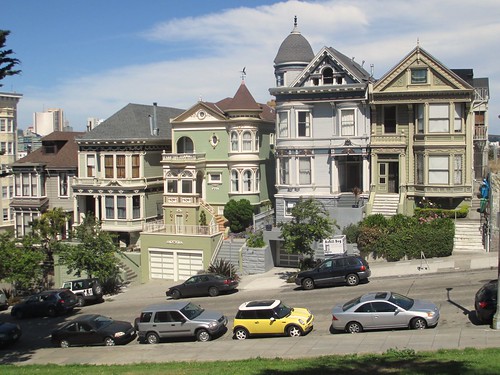
San Francisco's Painted Ladies: the epitome of Victorian
respectability - and only a short walk from where our family
encountered a street drugs bust.
I didn’t know it at the time but, the previous evening, half a continent away, a confrontation between a young black man and white police officers had ended tragically differently. In Ferguson, Missouri, a police officer had pumped six bullets into Michael Brown, a black 18-year-old, who was apparently holding up his hands in surrender and saying, “Don’t shoot!” One shot – to the head – killed him. The source of the confrontation appears to have been a demand by the officer than Michael and his friends walk on the sidewalk, rather than the road.

The scene in San Francisco ran through my head over the next few days as we saw, despite our holiday isolation, pictures of police in Ferguson equipped for war but facing mainly peaceful protesters. I also found myself making mental links between the scene we’d encountered and a far less grave injustice that was closer to home for me – the New York Police Department’s disproportionately harsh Operation Cyclesafe crackdown on cyclists’ rule-breaking.

The street drugs bust, the events in Ferguson and the NYPD’s harassment of cyclists all look to me to be the work of police forces more concerned about asserting their own authority than actually making the places they police safer. It’s hard in light of these and other incidents to avoid the conclusion that many US police forces are currently bereft of ideas and moral sense. While UK police forces rethought some aspects of their policing 30 years ago after urban rioting, the Metropolitan Police’s recent purchase of a water cannon hints that such thinking is creeping back in the UK too.

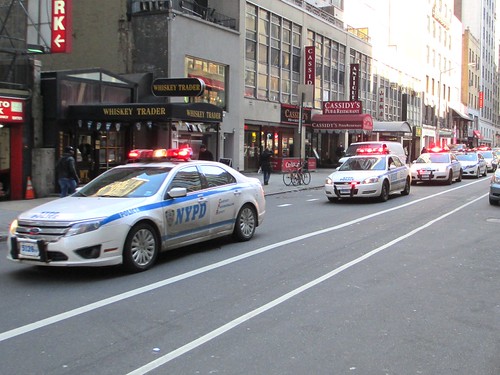
NYPD cruisers: sensitive, intelligence-led policing
The priority is to end appalling injustices such as the killings of Michael Brown and, closer to my home in New York, of Eric Garner, choked in Staten Island as New York police officers arrested him for a minor alleged offence. But better police forces would also surely reassess which offences demanded most of their attention. They would surely take more seriously the dreadful toll of death and injury on the US’s streets and give that national – but largely unacknowledged – tragedy a far higher priority.

I wouldn’t say I was precisely naïve about the potential misuse of police power, even before recent events. In one obviously conflict-ridden society, Bosnia, I remember seeing Bosnian Croat police harassing the mainly Bosniak – Bosnian Muslim – passengers on a bus where I was travelling in 1995 during the Bosnian war. Hungary’s police seldom impressed me when I lived there.
 
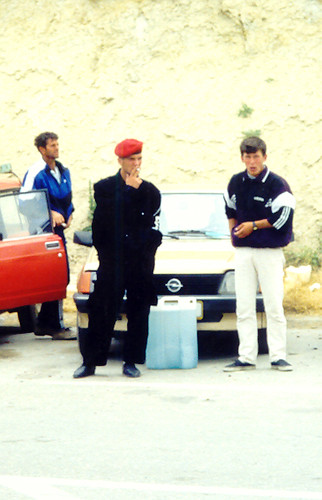
A Kosovo Liberation Army "policeman"
smokes while supervising sales of
smuggled fuel: just one of many
less-than-impressive officers I've
encountered during more than two
decades' reporting.
I have a particularly vivid memory from my home country of watching the reaction of Northern Ireland’s Royal Ulster Constabulary in July 1996 to rioting by members of the mainly Irish Nationalist Catholic community on the outskirts of Portadown, in the centre of the province. For five days previously, the police – mainly pro-British Protestants – had reacted with remarkable restraint as Protestants rioted over the routing of a march by the Protestant Orange Order in Portadown. After the police finally forced the march down Garvaghy Road, against the mainly Catholic residents’ wishes, I watched the police fire rubber bullets freely. At one point, I saw people of all ages, violent and non-violent alike, flee into a narrow passageway between shops. The police pumped plastic bullets indiscriminately into the passageway, knowing they would hit rioters and non-rioters.

My personal experiences as a cyclist have made me realise that bad policing affects places other than obviously conflict-ridden societies and people other than clearly discriminated-against minority groups. I’ve been lectured by City of London Police officers who were themselves breaking the road rules about my allegedly irresponsible behaviour. In May, I encountered a man who claimed – to my satisfaction – to be an off-duty cop. He grew verbally abusive when I asked him to move his car out of a busy, two-way cycle lane. There are stretches of road in New York where I know I’m likely to encounter police cars or vans illegally parked in the cycle lane and to have to dodge around them.

Yet I had retained, I now recognise, a residue of rather British innocence about democratic countries’ police forces, a feeling that they must somehow be on the side of the law-abiding, no matter their colour or background, against those who would harm them. I remember the times my parents had to call on the police when I was young and their polite attitude when they visited our large, respectable house.
 
Broken windows might have helped to make it safe for me
to walk nearly anywhere in this picture - it hasn't necessarily
done the same for people with darker skin.
Recent events have washed that residue out of me. I increasingly recognise how it was my family’s whiteness and respectability that won the police’s politeness. If I were black or belonged to some other obviously marginalised group, I would have far more – and probably far worse – stories about police behaviour. I’m more and more sceptical of the policing philosophy that’s come to dominate much of the western world in recent years – the idea that police intolerance of minor misdemeanours is critical to tackling crime overall. Bill Bratton, the police commissioner who returned to the top post in the NYPD earlier this year, pioneered this “broken windows” approach in New York City. Its apparent success in making the city safe again in the 1990s has led to its widespread acceptance as a policing approach elsewhere.

It’s to some extent because of broken windows that officers felt justified, I suspect, in violently restraining Eric Garner while arresting him for the minor crime of selling untaxed cigarettes. It’s because police officers are encouraged to create an orderly atmosphere on the streets, I suspect, that officer Darren Wilson thought it important to confront Michael Brown and his friends about where they walked. It’s a sense that street drug-dealing is worse than more discreet drug-dealing that leads to scenes like the one we encountered in San Francisco. I’ve long had a strong sense that the broken windows approach explained the NYPD’s tendency to give disproportionate numbers of traffic tickets to cyclists. If one believes that a police force’s main goal is to tackle the problems that create most noise at public meetings, it might well make sense to run a two-week crackdown on dangerous cycling.
 
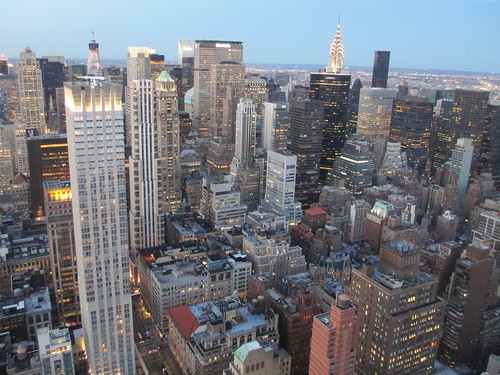
Midtown Manhattan: a bad place to break a window,
thanks to Bill Bratton, but not a bad place, necessarily,
to commit a serious fraud
The approach’s limitations are clear as soon as one starts examining them. Any strategy that deliberately devotes disproportionate resources to small, “quality-of-life” offences by its nature takes resources away from investigating the crimes – racketeering, murder, rape, fraud – for which society imposes the harshest penalties. The approach quickly degenerates into an anti-intellectual tendency to go after the crimes whose victims make the loudest noise, rather than those that are the biggest problem. It’s obvious that the arrest of one street-level dealer is unlikely to do anything to eradicate demand for illegal drugs in San Francisco or the business of supplying them.

Some good might yet come out of the grim events in Ferguson and elsewhere in the US this summer if they prompt a thorough re-examination of how the US is policed – a change that would surely have repercussions in other countries too. It would be heartening to see police forces question whether the constant harassment of the poorest groups under broken windows makes sense. There is surely scope to ponder which offences cause the most overall harm and start to tackle them.

I’ve argued before that traffic policing would be far better if commanding officers’ pay depended partly on the numbers of people injured on their areas’ streets, rather than the numbers of tickets handed out. A police force focused on preventing crime rather than enforcing order would surely not have thought a confrontation over where a group of young men walked worth provoking. Intelligent traffic policing might even seek to encourage cycling, recognising that cyclists are far less likely to kill other road users than motorists are.

It’s hard to be optimistic that such changes are coming soon, however. Reaction to the events in Ferguson has followed a pattern all too familiar in the contemporary US – right-wingers have defended the police, while the left have criticised them. On Twitter last week, Bill Bratton wrote that he was “gratified but not surprised” that New Yorkers appreciated “quality of life enforcement measures”. I’ve seen even cyclists welcome Operation Cyclesafe’s misdirection of resources, saying that, since they never break the rules, they have nothing to fear from it. Few people seem to recognise how crackdowns on minor crime misdirect resources.
 
Operation Cyclesafe made this cycle lane on my route to work
no safer for me to use
Two experiences on our return from California crystallised the nature of the problem. I returned to my regular cycle commute in the last days of Operation Cyclesafe to find that the crackdown had unsurprisingly done nothing to make the streets safer for cyclists. The cycle lanes appeared still more regularly blocked than normal and drivers’ behaviour still worse than normal.

The Invisible Visible Woman, meanwhile, heard two women discussing Eric Garner’s death on the street. It’s hard to avoid the conclusion that broken windows policing has turned some police forces into vehicles for the kinds of prejudice our neighbours were expressing.

“People say they heard him say, ‘I can’t breathe’,” one of them commented to the other, who nodded sagely. “But you have to remember – this was a man who’d been to prison ten times.”

An uncritical readiness to go after the offences that most annoy people quickly degenerates into a readiness to go after the people that most annoy the majority. That will sometimes be cyclists. It will far more often – and with far more deadly outcomes – be poor people like Eric Garner, condemned by prejudice to miserable and public deaths.