Showing posts with label prejudice. Show all posts

Monday, 1 September 2014

A street drug arrest, a crackdown on cyclists - and why Broken Windows is a bust

It was as I walked down San Francisco’s Market St with my family on August 10 that I spotted a scene I’d previously witnessed only in TV shows such as The Wire. Two policemen were running towards us, guns drawn. As I started shepherding the family out of the potential line of fire, I spotted the reason for the fracas. A young-ish black man was sprinting towards us. He threw a large, plastic wrapped parcel over a wooden hoarding then, having ditched the evidence, surrendered himself. We continued our stroll as he knelt on the sidewalk, face towards a building, with the police officers handcuffing his hands behind his back.
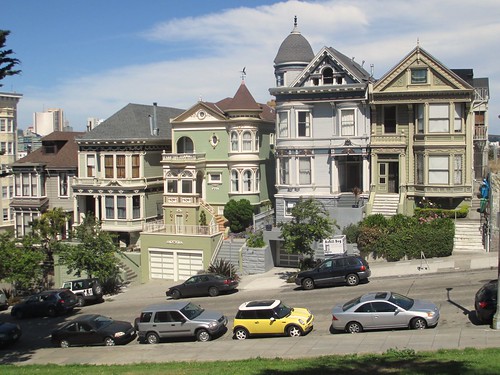
 
San Francisco's Painted Ladies: the epitome of Victorian
respectability - and only a short walk from where our family
encountered a street drugs bust.
I didn’t know it at the time but, the previous evening, half a continent away, a confrontation between a young black man and white police officers had ended tragically differently. In Ferguson, Missouri, a police officer had pumped six bullets into Michael Brown, a black 18-year-old, who was apparently holding up his hands in surrender and saying, “Don’t shoot!” One shot – to the head – killed him. The source of the confrontation appears to have been a demand by the officer than Michael and his friends walk on the sidewalk, rather than the road.

The scene in San Francisco ran through my head over the next few days as we saw, despite our holiday isolation, pictures of police in Ferguson equipped for war but facing mainly peaceful protesters. I also found myself making mental links between the scene we’d encountered and a far less grave injustice that was closer to home for me – the New York Police Department’s disproportionately harsh Operation Cyclesafe crackdown on cyclists’ rule-breaking.

The street drugs bust, the events in Ferguson and the NYPD’s harassment of cyclists all look to me to be the work of police forces more concerned about asserting their own authority than actually making the places they police safer. It’s hard in light of these and other incidents to avoid the conclusion that many US police forces are currently bereft of ideas and moral sense. While UK police forces rethought some aspects of their policing 30 years ago after urban rioting, the Metropolitan Police’s recent purchase of a water cannon hints that such thinking is creeping back in the UK too.
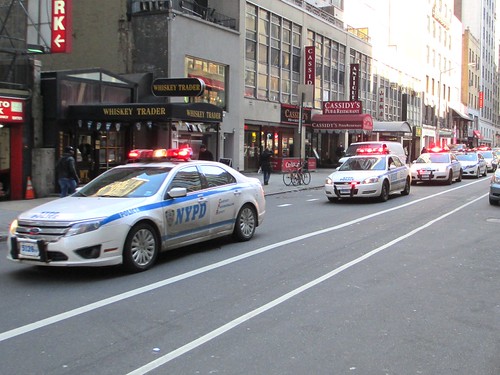
NYPD cruisers: sensitive, intelligence-led policing
The priority is to end appalling injustices such as the killings of Michael Brown and, closer to my home in New York, of Eric Garner, choked in Staten Island as New York police officers arrested him for a minor alleged offence. But better police forces would also surely reassess which offences demanded most of their attention. They would surely take more seriously the dreadful toll of death and injury on the US’s streets and give that national – but largely unacknowledged – tragedy a far higher priority.

I wouldn’t say I was precisely naïve about the potential misuse of police power, even before recent events. In one obviously conflict-ridden society, Bosnia, I remember seeing Bosnian Croat police harassing the mainly Bosniak – Bosnian Muslim – passengers on a bus where I was travelling in 1995 during the Bosnian war. Hungary’s police seldom impressed me when I lived there.
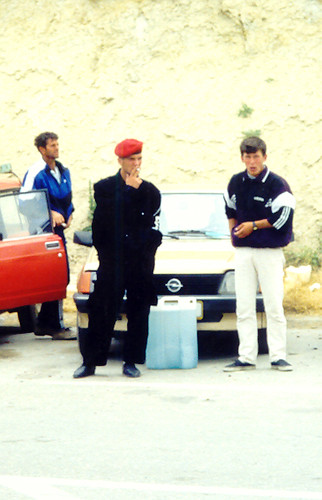
 
A Kosovo Liberation Army "policeman"
smokes while supervising sales of
smuggled fuel: just one of many
less-than-impressive officers I've
encountered during more than two
decades' reporting.
I have a particularly vivid memory from my home country of watching the reaction of Northern Ireland’s Royal Ulster Constabulary in July 1996 to rioting by members of the mainly Irish Nationalist Catholic community on the outskirts of Portadown, in the centre of the province. For five days previously, the police – mainly pro-British Protestants – had reacted with remarkable restraint as Protestants rioted over the routing of a march by the Protestant Orange Order in Portadown. After the police finally forced the march down Garvaghy Road, against the mainly Catholic residents’ wishes, I watched the police fire rubber bullets freely. At one point, I saw people of all ages, violent and non-violent alike, flee into a narrow passageway between shops. The police pumped plastic bullets indiscriminately into the passageway, knowing they would hit rioters and non-rioters.

My personal experiences as a cyclist have made me realise that bad policing affects places other than obviously conflict-ridden societies and people other than clearly discriminated-against minority groups. I’ve been lectured by City of London Police officers who were themselves breaking the road rules about my allegedly irresponsible behaviour. In May, I encountered a man who claimed – to my satisfaction – to be an off-duty cop. He grew verbally abusive when I asked him to move his car out of a busy, two-way cycle lane. There are stretches of road in New York where I know I’m likely to encounter police cars or vans illegally parked in the cycle lane and to have to dodge around them.

Yet I had retained, I now recognise, a residue of rather British innocence about democratic countries’ police forces, a feeling that they must somehow be on the side of the law-abiding, no matter their colour or background, against those who would harm them. I remember the times my parents had to call on the police when I was young and their polite attitude when they visited our large, respectable house.
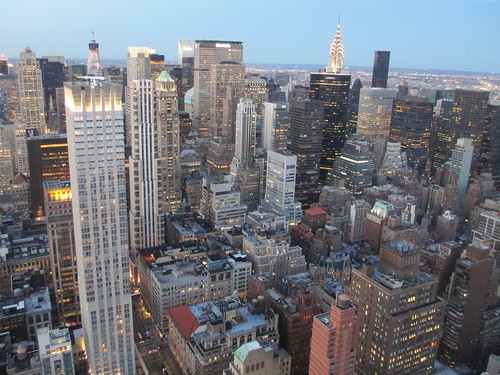
 
Broken windows might have helped to make it safe for me
to walk nearly anywhere in this picture - it hasn't necessarily
done the same for people with darker skin.
Recent events have washed that residue out of me. I increasingly recognise how it was my family’s whiteness and respectability that won the police’s politeness. If I were black or belonged to some other obviously marginalised group, I would have far more – and probably far worse – stories about police behaviour. I’m more and more sceptical of the policing philosophy that’s come to dominate much of the western world in recent years – the idea that police intolerance of minor misdemeanours is critical to tackling crime overall. Bill Bratton, the police commissioner who returned to the top post in the NYPD earlier this year, pioneered this “broken windows” approach in New York City. Its apparent success in making the city safe again in the 1990s has led to its widespread acceptance as a policing approach elsewhere.

It’s to some extent because of broken windows that officers felt justified, I suspect, in violently restraining Eric Garner while arresting him for the minor crime of selling untaxed cigarettes. It’s because police officers are encouraged to create an orderly atmosphere on the streets, I suspect, that officer Darren Wilson thought it important to confront Michael Brown and his friends about where they walked. It’s a sense that street drug-dealing is worse than more discreet drug-dealing that leads to scenes like the one we encountered in San Francisco. I’ve long had a strong sense that the broken windows approach explained the NYPD’s tendency to give disproportionate numbers of traffic tickets to cyclists. If one believes that a police force’s main goal is to tackle the problems that create most noise at public meetings, it might well make sense to run a two-week crackdown on dangerous cycling.
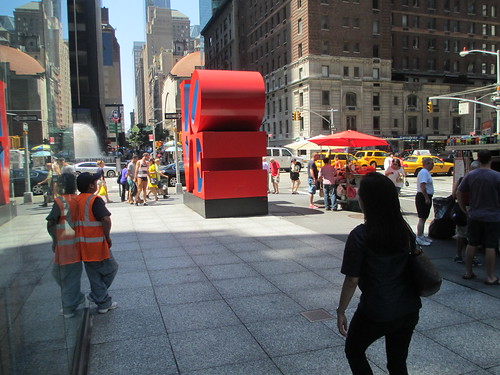
 
Midtown Manhattan: a bad place to break a window,
thanks to Bill Bratton, but not a bad place, necessarily,
to commit a serious fraud
The approach’s limitations are clear as soon as one starts examining them. Any strategy that deliberately devotes disproportionate resources to small, “quality-of-life” offences by its nature takes resources away from investigating the crimes – racketeering, murder, rape, fraud – for which society imposes the harshest penalties. The approach quickly degenerates into an anti-intellectual tendency to go after the crimes whose victims make the loudest noise, rather than those that are the biggest problem. It’s obvious that the arrest of one street-level dealer is unlikely to do anything to eradicate demand for illegal drugs in San Francisco or the business of supplying them.

Some good might yet come out of the grim events in Ferguson and elsewhere in the US this summer if they prompt a thorough re-examination of how the US is policed – a change that would surely have repercussions in other countries too. It would be heartening to see police forces question whether the constant harassment of the poorest groups under broken windows makes sense. There is surely scope to ponder which offences cause the most overall harm and start to tackle them.

I’ve argued before that traffic policing would be far better if commanding officers’ pay depended partly on the numbers of people injured on their areas’ streets, rather than the numbers of tickets handed out. A police force focused on preventing crime rather than enforcing order would surely not have thought a confrontation over where a group of young men walked worth provoking. Intelligent traffic policing might even seek to encourage cycling, recognising that cyclists are far less likely to kill other road users than motorists are.

It’s hard to be optimistic that such changes are coming soon, however. Reaction to the events in Ferguson has followed a pattern all too familiar in the contemporary US – right-wingers have defended the police, while the left have criticised them. On Twitter last week, Bill Bratton wrote that he was “gratified but not surprised” that New Yorkers appreciated “quality of life enforcement measures”. I’ve seen even cyclists welcome Operation Cyclesafe’s misdirection of resources, saying that, since they never break the rules, they have nothing to fear from it. Few people seem to recognise how crackdowns on minor crime misdirect resources.
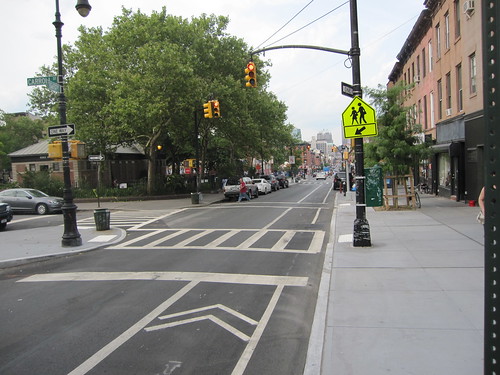
 
Operation Cyclesafe made this cycle lane on my route to work
no safer for me to use
Two experiences on our return from California crystallised the nature of the problem. I returned to my regular cycle commute in the last days of Operation Cyclesafe to find that the crackdown had unsurprisingly done nothing to make the streets safer for cyclists. The cycle lanes appeared still more regularly blocked than normal and drivers’ behaviour still worse than normal.

The Invisible Visible Woman, meanwhile, heard two women discussing Eric Garner’s death on the street. It’s hard to avoid the conclusion that broken windows policing has turned some police forces into vehicles for the kinds of prejudice our neighbours were expressing.

“People say they heard him say, ‘I can’t breathe’,” one of them commented to the other, who nodded sagely. “But you have to remember – this was a man who’d been to prison ten times.”

An uncritical readiness to go after the offences that most annoy people quickly degenerates into a readiness to go after the people that most annoy the majority. That will sometimes be cyclists. It will far more often – and with far more deadly outcomes – be poor people like Eric Garner, condemned by prejudice to miserable and public deaths.

Sunday, 9 December 2012

Washington, a stabbing - and why an individual cyclist tells you nothing about the rest

Washington, DC surprises me every time I visit. While New York feels just as bustling, large-scale and chaotic as the films and TV programmes would suggest, the US’s capital feels nothing like the West Wing. Sure, there are people influencing the whole world’s fate in lots of those neoclassical buildings – but Washington’s atmosphere most reminds me of other sleepy US administrative capitals like Richmond, Virginia or Harrisburg, Pennsylvania.

Washington, DC: provincial to me
- but full of cycling savages according to one Facebook user
During a visit last week, it nevertheless occurred what an advantage it was that Washington seemed a far calmer place than New York to ride a bike. The cyclists I saw during the visit mostly seemed to be riding sedately, calmly and in general harmony with other road users around them.

This was, however, entirely the wrong conclusion, according to at least one person I know. On Friday evening, two days after I came back from my DC daytrip, a Facebook friend commented on a story about an altercation between a cyclist and a motorist in North-West Washington the night I visited. The motorist appears to have somehow alarmed the cyclist, who responded by hitting the driver’s car with his D-Lock. The ensuing argument ended with the cyclist stabbing the motorist, who suffered rib injuries but looks likely to survive.

“Savages,” my Facebook friend commented. “Civility is an alien concept,” someone else replied in agreement. The clear implication was that I, as a cyclist, was complicit in an appalling, entirely unjustified assault of a kind I would never have contemplated.

My immediate instinct was to launch into an argument, pointing out the fatuousness of jumping from a single, knife-wielding cyclist to the implied generalisation – all cyclists are savages. Concluding that I was unlikely to change clearly entrenched attitudes, I limited myself to “unfriending” the person responsible.

But, as I cycled home that evening, a more mature reflection occurred to me – one sparked in part by the controversy in the UK over the inflammatory “War on Britain’s Roads” documentary. If it made no sense to draw a conclusion from a single stabbing - or the misleading footage of an alleycat race in the documentary  - to cyclists’ general behaviour, why did I feel free to criticise in general the culture of driving or the police? Was I making any more sense than my former Facebook friend?

One possible response to the “cyclists are savages” claim would, of course, have been to point to some of the numerous incidents of motorist-cyclist violence. In the space of a year of cycling in London, I suffered one actual – albeit mild – assault and had to make an emergency call to police to avert another. The first incident involved a bus driver who abandoned his bus – and passengers - to confront me because I’d photographed him blocking, illegally, a cyclist-only area at traffic lights. He smashed the mobile ‘phone I was using as a camera out of my hand. The second incident came as I tried to photograph a motorist I’d previously seen deliberately drive across the path of a cyclist who’d complained about his driving. He threatened – alarmingly convincingly - to smash up both me and my camera.

The most pertinent case I could have raised, however, was the stabbing in September of Colin Albright, a cyclist in Pittsburgh, whom a motorist pursued as he carried his bike away from a road up a set of steps. The motorist stabbed Albright repeatedly, including in the throat, possibly over some perceived slight involving a traffic incident.
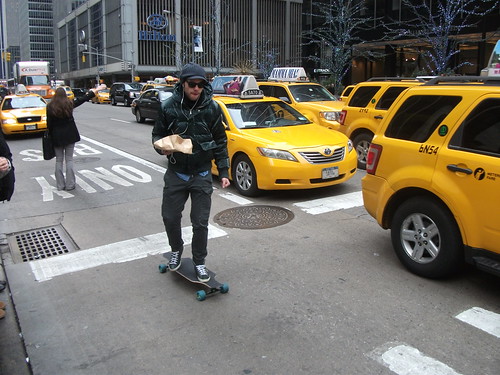
You might have prejudices about people who make strange
transport choices - like skateboarding down Sixth Avenue.
It doesn't mean you know anything about this individual skateboarder.

Albright’s case would have been pertinent precisely because it illustrates the absurdity of generalising from something extraordinarily rare – a stabbing over a disagreement on the roads – to the generality of day-by-day on-road relationships. In late October, Anthony Scholl confessed to attacking Albright. Scholl was already in custody over an alleged attempt to burn down his parents’ house. While there is little information so far on Scholl’s motive for stabbing Albright, the alleged arson attempt seems to have been aimed, in Scholl’s mind, at preventing his parents from killing him and feeding him to their (presumably imaginary) pet alligator.  Albright’s stabbing also looks likely to have stemmed from what Scholl’s mother has called his “psychological issues”. It seems similarly unlikely that the appalling Washington stabbing will turn out to involve an ordinary, mentally-balanced cycle commuter who just happens to pack a knife to mete out summary justice on uppity drivers.

That anyone could ever have thought the Washington stabbing had anything to do with broader cyclist behaviour, of course, stems from humans’ powerful desire to pin blame for problems on out-groups. The only thing so far known about the Washington motorist’s assailant is that he was on a means of transport against which large numbers of people have powerful prejudices. Few people have the mental self-discipline to avoid working on the basis of such limited information and their prejudices to jump to wholly unwarranted conclusions.

It’s telling, for example, that hardly anyone blames the antics of bank robbers’ getaway drivers purely on their being drivers. Drivers are too numerous and familiar to act as convenient out-group scapegoats. No-one sought to blame the assault I suffered or the threatened assault merely on the perpetrators’ status as motorists. I received, instead, some close questioning about the immigration status of the bus driver and the race of the man who threatened to assault me. Establish a link to immigrants or African-Caribbean men, the implication seemed to be, and the incidents were far more easily explained away.

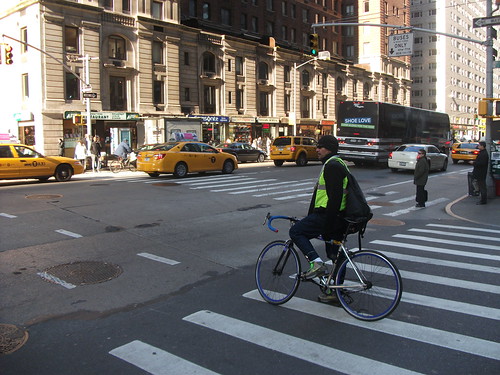
A cyclist, cars and pedestrians at 55th Street. Which of them
is a "savage" will be in the  eye of the beholder
The prejudices are all the more powerful for not appearing to the prejudiced to be prejudices at all. Have your eye out for poor cyclist behaviour in Washington and you’ll spot instances of such behaviour, rather than the courtesy and calm I witnessed. Assume the main road problem is the cyclists and you’re unlikely to spot the multiple ways motorists misbehave.

The truth is that, in all the incidents I’ve described, the attackers acted as individuals, rather than a member of a group. Their behaviour stemmed from their own characters or mental states, rather than their status as cyclists, motorists, bus drivers, immigrants or anything else. To imagine that the behaviour in a single instance of a single member of a large group has anything to say about the wider group as a whole is a thinking error of a kind that would be shocking were it not also fairly common.

That point could, of course, lay me open to the objection someone recently made in an online forum to my use of statistics to point out that cars generally posed a far greater danger to pedestrians than bikes. That was beside the point, the poster wrote. Each motorist or driver differs so much that it makes no sense to discuss a general level of risk from motorists or cyclists. A very poor cyclist could conceivably pose a greater danger to a pedestrian than an extremely careful, conscientious motorist. I am perhaps particularly vulnerable to such a charge because of my habit of illustrating points on this blog by reference to specific – usually extreme – incidents that I take to illuminate a wider truth.

Yet I have, I hope, been careful when complaining about general problems to have sought evidence that my experience speaks to a broader reality. It remains a verifiable fact, for example, that motorists kill a disproportionately high number of other road users in both the UK and New York City. Collisions with cyclists in both places account for a far lower proportion of road fatalities than cyclists make up of road traffic. Research in New York suggests motorists’ failure to yield as required to pedestrians is the biggest single cause of road deaths. Research in the UK suggests failure on motorists’ part to pay attention causes a disproportionate number of crashes.
Court Street at night. Just because most motorists speed here
doesn't mean they all do.

It makes sense on such a basis to say there is a general problem with motorists’ failure to yield to New York pedestrians or to pay proper attention in the UK. I am even confident enough in my own judgement to diagnose a few more local, unmeasured problems. There is, for example, a general problem that many motorists regard Brooklyn’s Court Street as an appropriate place for excessive speed and not somewhere where cyclists’ requirement for space on the roads need be considered. It just doesn’t make sense to predict on this basis that the next motorist one encounters on Court Street won’t be a model of caution, courtesy and respect.

I feel acutely sorry for the victim of the Washington stabbing. His experience last Wednesday must have been appallingly frightening. I trust the District of Columbia police will swiftly identify the attacker and bring him before the courts. I wish the victim a swift and smooth recovery. But I also devoutly hope that no-one in future will make the lazy and offensive mistake of imagining any of what happened had anything to do with me.