Showing posts with label bicycles. Show all posts

Sunday, 19 May 2013

Routes - and Why I Prefer Developing my Hippocampus to my Quadriceps

It’s fairly easy for even a casual observer to spot what cycling does for some bits of my body. While I’m far less fit than I’d like to be, I boast thighs that some mature trees would be happy to call their trunks. Since moving to New York and cycling farther each day, I’ve also lost some weight, as testified to by the sag in my trousers’ waistbands below the belt loops.

I’ll probably never know, however, precisely what I’m doing to the posteriors of my hippocampi, two tiny glands on either side of my brain that help me to find my way around. I get just as much satisfaction, nevertheless, from the idea that I’m making them bigger, more complicated and more useful than they used to be as I do from my bulging thighs and slimming-if-still-overlarge waist.
 
The Invisible Visible Man's CaBi bike at Union Station:
mission accomplished
That satisfaction came home to me particularly forcefully this past week after I conquered my nervousness to have a go at cycling between Arlington, Virginia and my train home from Washington’s Union Station. I headed off tentatively on a Capital Bikeshare bike, worrying that my only rudimentary sense of the area’s geography would soon leave me hopelessly lost. I very nearly gave up immediately after getting the bike out of the docking station, alarmed at the bike’s handling when loaded with all my various bits of baggage.

An hour or so later, however, I was pushing the bike’s wheel into the Union Station docking station, feeling strangely elated. It was, it occurred to me, the kind of satisfaction that's soon going to be available to more people in New York, with the introduction of the Citibike bike share system. I’d tackled the mental puzzle of working out my way and reached a satisfactory conclusion.

My interest in the hippocampus dates back, however, to long before I ever set foot in the United States. I first heard of the brain structure while studying psychology at St Andrews University. I particularly associate it with a visit once with a friend to a room lined with cages full of rats. The friend was a PhD student working with the rats on neurophysiology, had gone in to check on them over the weekend and invited me along.

On the room’s ceiling, I could see the outline of a now-removed round disc. It marked, my friend told me, where Richard Morris, a neurophysiologist, had first conducted a famous experiment on the hippocampus’s role. He had set up a pool in the room with a hidden platform that the rats had to find. A video camera in the ceiling disc’s middle tracked their progress. Rats proved good at learning where the platform was. But, when Prof Morris injected a drug into their hippocampi to stop them working, they were no longer able reliably to locate it. The hippocampus seemed to organise their memory for direction.
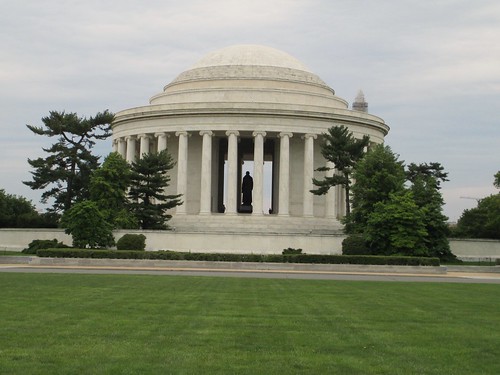
The Jefferson Memorial, during my great, trans-Washington
bike ride. Yeah, the picture's squint. I took it seated on a bike.
Get used to it already.

I made a connection between the hippocampus and my getting about by bike when I heard about Eileen Maguire’s research on taxi drivers. In a series of studies, Prof Maguire – of University College London - has examined changes in the posterior hippocampus in London taxi drivers as they first learn the Knowledge – the test they have to pass on the city’s geography – then apply it. The posterior hippocampus – the rear part of the structure - tended to be bigger and more complex in drivers who had passed the Knowledge than in would-be drivers who had failed it, she found.

My brain, I recognised, was probably undergoing similar changes to the taxi drivers’. The gradual trial-and-error process of learning how best to get to a place – the frustration at missing that vital turning again, the fear at suddenly finding oneself unintentionally on an over-busy road, the satisfaction on finally getting a route right – were playing themselves out in my hippocampi. New neurons were growing and new connections were forming as I gradually built up a more solid picture of the best ways to get about.
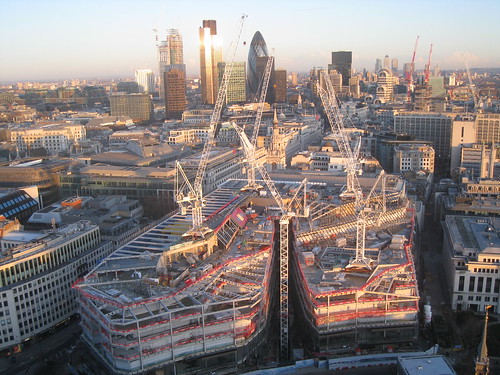
Streets in the City of London: it may look a mess to you -
but the Invisible Visible Man's mental maps can help you
round this maze

The process, however, has been nothing like as clinical as a neurophysiological description might imply. I recall, for example, how, shortly after moving south from Edinburgh in 1997, I set off, cycle map in pocket, to work out my route from home in Brixton to my employer’s offices. The 4½ mile journey took me 45 minutes of missing turnings in my bike route, failing to understand how traffic flows worked and repeatedly checking the map.

Latterly in London, I could make it home on a good night in 20 minutes – albeit down busier main roads. My mental map of South London’s cycling routes could switch more smoothly and efficiently than any satellite navigation device. By the time I left London, I knew every pothole and manhole cover of many of the roads I’d cycled most often, preparing to avoid them well before I had reached them.

My mental map spread well beyond my regular commuting area. I’d feel a little surge of excitement if, for example, I got invited to some press event 15 miles from the office in Wembley. Why, I hardly ever got to use my carefully-memorised route out to that area, I’d think to myself. I was surprised and delighted one time when I found another reporter had made the same decision as I to cycle from Central London. We earnestly swapped thoughts on busy roads and helpful shortcuts.
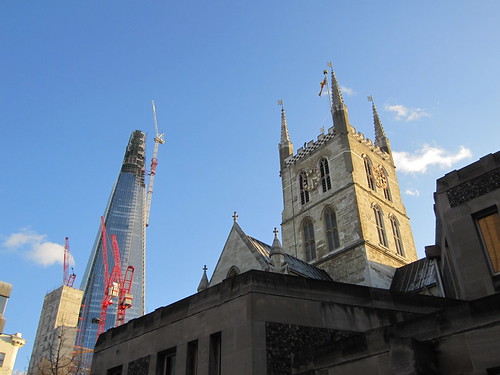
 
The Shard: on my route to City Airport
It was my enthusiasm for the route that gave me a bias in favour of flying from London City Airport. My route for the 13 or so miles from my house to the airport – which distinguished itself by having good bike parking – was, I often felt, something of a work of art. I would pedal across the Thames, down Cable Street in the densely-packed East End, past Canary Wharf, then out into the grim housing estates of still working-class docklands. I would encounter evidence of every period in London’s history, from the Romans to the new Shard skyscraper. There can be few better ways of feeling at one with a city than to know intimately a route like the one I used to reach City Airport. It would take me from a beautiful but obscure quiet Georgian Square then out across the internationally-recognised landmark of Tower Bridge.

I’ve experienced something similar in New York. When apartment hunting, I found myself a couple of times nastily off course – on the wrong side of a busy expressway from where I wanted to be or careering down a six-lane avenue of scary, fast-moving traffic. But I know my mental map of the city is slowly but surely stitching together, somewhere in the back of my hippocampi. Without thought, I head north a couple of blocks to avoid the most constricted sections of W54 street most mornings, then south again before the office. I’ve been trying out a route up the east side bike path some other mornings. I take joy in now knowing the Lexington-Park-Madison-5th sequence of avenues I cross as I head to work. But I shun that route in the evenings, well aware, after previous experience, of the miseries of trying to head southbound on 2nd avenue.

The Empire State Building in pink:
cycling to photograph it was more fun for me than a party
I felt that same sense of having access to secrets of the city closed to others when, one night recently, my employer organised on the Upper East Side a party to celebrate its 125th anniversary. As others headed off afterwards to an after-party, I made excuses – but knew my main motivation was my desire to try the way home I’d crafted in my head. Before long, I was bowling down from the top of the Queensboro Bridge’s bike path, which I last used regularly in the aftermath of Superstorm Sandy. Then I was into Queens and navigating streets under elevated subway lines so romantically urban they should have had a permanent Chicago Blues soundtrack.
 
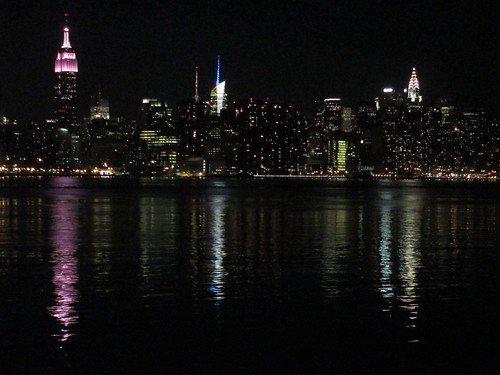
I looked across as I headed down the East River at the Empire State building, lit up pink in honour of the anniversary. I was, I felt sure, enjoying myself far more on this solitary exploration of the city than anyone yelling at a colleague to be heard over the music at the party.

Which brings me back to Washington.

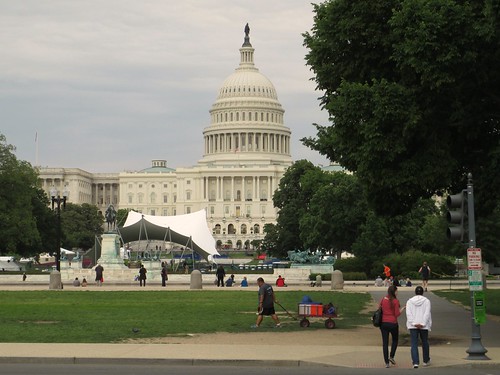
The US Capitol: how to get there by bike is now fixed in
the Invisible Visible Man's hippocampi
Whatever my initial misgivings, they disappeared immediately I found myself on a bike path by the Potomac and catching my first glimpse of the Jefferson memorial and US capitol sitting on the other side. I sped – as much as one can on a bikeshare bike – over the 14th street Bridge and slowly worked out the best route along the National Mall. A little bit of guesswork once I’d got north of Pennsylvania Avenue and I was finally at the station, embarrassed to find myself feeling little less elated than Edmund Hillary can have felt on his first conquest of Everest.

But there were, it came to me, few satisfactions in life more total than completing such a journey. I had set out to tackle a challenge and, as I pushed the bike back into the docking station, comprehensively conquered it. I had made the journey entirely on my own resources. And, somewhere in my two hippocampi, just as those rats in St Andrews learnt where the platform was, my mental maps for cycling in Washington and northern Virginia were starting to form.

Sunday, 14 April 2013

A broken-down church - and a broken, asymmetric flow of information

I was only a little way into my first ride to work after moving into my apartment in Brooklyn when I started to get into a terrible tangle. Trying to get down Kane Street, in Cobble Hill, I found the road marked closed. After heading past the road cones, I found it was a proper road closure, not the kind where one just wheels the bike on the sidewalk past the obstruction. The closure was absurd, I muttered to myself, as the one-way system pushed my route further and further from the one I’d planned. It was, I reasoned, probably some piece of stupidity on the part of the police, worried about being sued over an unlikely accident near some relatively innocuous building work.
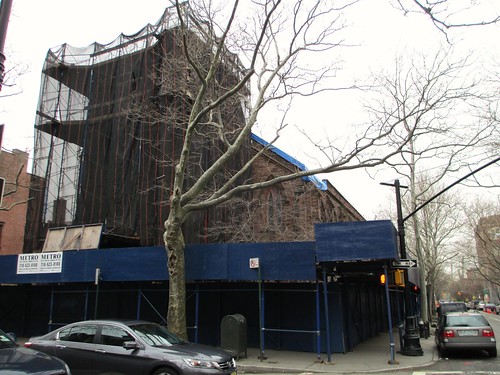
Christ Church, Cobble Hill: source of frustration on
the Invisible Visible Man's commute

I calmed down considerably, however, after finding out via Google why the street was closed. On July 26, while I had been back in Europe, lightning had struck Christ Church, the Episcopal church at the junction of Clinton Street and Kane Street. The spectacular tower – and scaffolding around it – had come crashing down as Richard Schwartz, a pedestrian, was walking underneath. The falling scaffolding had killed him. The building was a serious danger – and hadn’t yet been made safe.

The incident helped to crystallise an idea that had been slopping in fluid form around my mind for a while. I’d never have been irritated about the Kane St closure, I realised, if I’d had better information in the first place. It was, it occurred to me, one of many instances where confusion arises because two different parties – the New York City Department of Transportation and myself, in the Kane Street case – have different understandings of what’s going on on a road. The asymmetric information sharing had at least left me only inwardly irritated, however. The more I thought about it, the more I realised there were times when such information asymmetry probably killed people.

I encountered one potentially serious example the other morning while riding to work. I waited at traffic lights by the start of the Tillary Street segregated bike lane near the Brooklyn Bridge. When the lights changed, I moved off, only to find turning across my path a car heading in the other direction that should have been yielding to me. The driver’s behaviour was entirely wrong, based on his failure to understand what I knew - that the bike lane was as much part of the traffic flow at the intersection as the roads he was using. But, as he moved across my path, he leant out of his window. “Green light!” he yelled at me, self-righteously.

Traffic on W54th street. Those tainted windows don't,
in the Invisible Visible Man's experience, conceal
motorists pondering hard what information they might lack
about other road users' rights
Cycle lanes can give rise to information asymmetry as well. As I approached my office one morning last month, a truck driver opened his door in my path as I made my way up the side of some stalled traffic. He didn’t need to look for cyclists on that side of W54th street, he argued, because there was a bike lane painted down the other. Because of our asymmetric understanding of cyclists’ road rights, he had understood the cycle lane – which I knew to be a refuge for cyclists that didn’t stop me from using the rest of the road – as a kind of prison, to which cyclists should be confined.

Perhaps the most striking and persistent problem of information asymmetry that I’ve come across, however, was in London, where I lived until last August. Most traffic lights at busy intersections in London feature an “advanced stop line” for cyclists – an area where cyclists are meant to wait ahead of the other traffic for the lights to change. Many cyclists value advance stop lines as an idea, since they should, in theory, allow cyclists to get away after lights change, get clipped back into their pedals and get back into a suitable line on the road before the motor traffic catches up. Few motorists, however, seem to have much idea either about the principles of the advanced stop areas or when they should stay out of them. At least one motorist informed me, indignantly, when I complained about his occupying the area that when he’d arrived there had been no cyclists waiting, so he’d simply driven into the bike area.

Advance stop lines were involved in all three of the worst confrontations I had with motorists in London. In one case, a motorist deliberately drove very close to me and then very dangerously overtook me after I remonstrated with him about his driving into the ASL area as I was using it. A bus driver assaulted me (abandoning a bus full of passengers to do so) after I photographed his occupying the ASL area at a particularly dangerous junction. I had to call the police to stave off a threatened assault from another motorist to whom I’d complained about his driving into the ASL area.

Leaving aside the more eye-catching incidents, ASLs were a daily source of tension and frustration. I’d often squeeze past a line of stationary traffic to reach what was meant to be a haven for cyclists – only to fill it full of motorists grumpy at one’s presumption in seeking to get a jump on them at the lights. It’s reasonable, I think, to assume that even a fairly modest publicity campaign might have let at least a little of the fresh air of information into the foetid atmosphere of confrontation surrounding ASLs. In New York, it surely wouldn’t take much of a campaign to educate drivers about the role of bike lanes and the dangers of passing bikes too close to improve driving standards at least a little bit. The New York cycling map, after all, features excellent advice for cyclists on how motorists should give cyclists at least three feet's clearance when passing.

It isn’t, after all, a neutral thing to encourage new cyclists onto a city’s streets and then not tell motorists how to behave around them. Nature seems to abhor an information vacuum just as much as a literal one. In the absence of the pure oxygen of accurate, well-founded information, the information vacuum fills up with the carbon-monoxide-laden air of motorists’ assumptions about cyclists’ rights and responsibilities. It’s perhaps hardly surprising, given that no-one’s telling them otherwise, that so many motorists assume cyclists who ride well outside the door zone away from cars are acting maliciously, rather than entirely sensibly. In New York, it’s still less surprising given how many bike lanes – including most of those I use every day – are painted in precisely the part of the road – next to the parked cars’ doors – that cyclists know to be the most dangerous.

The air has grown still more poisoned because the agency meant to set the limits of acceptable behaviour in most modern societies – the police force – so often seems to have abandoned that role with regard to the road rules. Motorists, after all, like most other people see what they see others doing unmolested and assume it’s acceptable. One telling recent case I spotted involved a police effort to start fining motorists who drove in a bike lane on a narrow street at Twickenham, in South-West London (I’ll give New York cyclists a moment here to come to terms with the idea that, just across the Atlantic, there’s a police force that has, at least once, acted against motorists using a bike lane). A local newspaper quoted Nick Blyth, an officer involved in the enforcement effort, as saying: “Most of the motorists tend to comment when stopped that everyone else does it and they were just following them.”
 
Park right across one of New York City's busiest bike lanes?
Until someone says you shouldn't, you probably will.
It’s hardly surprising, given the New York Police Department’s reluctance to enforce a wide swathe of road rules, that few motorists seem even to understand the harm they cause when double-parking in bike lanes or refusing to yield to a cyclist in a bike lane. Nor, in London, is it terribly surprising that ASL infringements continue at the rate they do when even the Metropolitan Police department charged with processing complaints against motorists from cyclists (normally backed by helmet camera evidence) is currently pleading with leading London cycle bloggers to tell people to send in no more pictures of ASL infringements. They say, to all intents and purposes, they’ve no interest in prosecuting them.

The police’s attitude reflects, in an understated way, the strangeness of the political discourse around cycling. Politicians are eager, when announcing new policies between elections, to borrow cycling’s mantle of greenness and modernity and to encourage its growth. Closer to election time, meanwhile, many seem to revert to a different type – to claiming, like one minister I met, that cyclists were“their own worst enemies” or claiming like Boris Johnson, London’s mayor, that “typical” cyclists had skinny legs and ran red lights. No politician engaged in this delicate dance between pro and anti-cycling positions is likely to back a public information campaign explaining to frustrated motorists why, yes, that cyclist who yelled at you about your dangerous driving actually had an excellent point.

However, until such information is made more widely available and police across the industrialised world are backing up the politicians’ line with proper enforcement, few people will experience the relief I felt at letting go of my frustration over the Kane St closure. Relief is certainly not the emotion that comes naturally to me each morning as I ride along the now-reopened Clinton St towards the Brooklyn Bridge. I am all too often forced into the narrow bike lane, in danger from car doors, as motorists seek to push past me. But, as I reach the Kane St intersection and see Christ Church, still wrecked but now made safe, I still recall at least a little bit of that feeling.

Sunday, 24 February 2013

Subway fares, gas tax - and why it's too expensive to cycle in New York

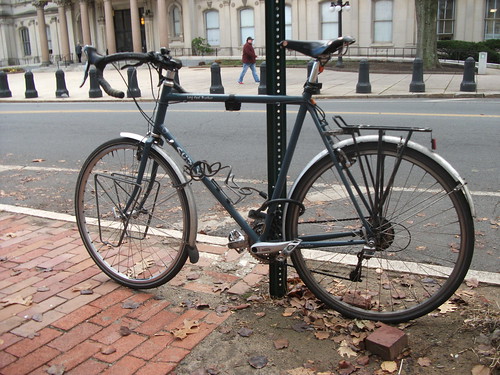
There are few New York businesses that command as much of my loyalty as 718 Cyclery, a friendly, specialist bike shop near where I live in Brooklyn. But there’s no question that I’ve handed them a fair amount of my money lately. A quick check through past bank statements suggests that in less than four months since last October 30 I’ve given this deserving business around $270 in spending on my own bicycle, plus another $14 or so on the Invisible Visible Girl’s machine. That’s leaving aside another $30 or so on bicycle maintenance at other bike shops and the $33 I shelled out yesterday for a replacement clip-on light for one that had gone missing. It’s cost me, in other words, around $80 a month over the last four months to keep my bike on the road.
The Invisible Visible Man's Surly Long Haul Trucker:
fun to use - but not that cheap

Some of that spending was certainly making up for a near-absence of spending in the few months before October. But add in the cost of the extra food I guzzle to fuel my nine-miles-there-nine-miles-back commute and the cost of the higher wear and tear on my clothes and it’s not clear I’m doing myself a financial favour by using transport that I don’t pay for daily. At the current basic New York subway fare of $2.25 for a single ride, four weeks’ commuting would cost me $90 – and there are numerous ways of getting the rides cheaper than that. Even a looming – and highly controversial – hike in the basic fare to $2.50 may not put me in the black.

But it’s not the bike shop’s fault I’m getting a relatively raw deal. It’s noticeably cheaper to keep my bike maintained in New York than it was when I lived in London. 718 Cyclery has been more than generous in carrying out free adjustments and calculating its labour charges. I’m at a disadvantage because pretty much every other means of getting about New York City gets a significant explicit or implicit subsidy of some kind.

It’s not a purely New York City problem. Virtually no developed country charges drivers enough in fuel taxes, tolls or car ownership fees to cover the costs that congestion, crashes and pollution impose on everyone else. Nearly every big international city tries to encourage commuters to shift to other transport means by susbidising public transport.

New York is nevertheless an extreme example. According to the Tax Foundation, a think-tank, taxes, tolls and other charges on motorists in New York State cover only 43.8 per cent of spending on the state’s roads. The proportion of the New York subway’s running costs covered by fares is still lower – and the system is visibly crumbling through lack of maintenance and upgrade expenditure. One might think that, along with reducing the appalling death toll on the city’s streets, a comprehensive rethink of charging for and funding of the city’s transport network would be the top subject for debate ahead of this year’s mayoral elections.

Yet there have been only two big transport talking points so far among the likely candidates to succeed Michael Bloomberg as mayor. One is whether the city should hand over a few more slivers of its vast road network to cyclists or, indeed, start taking out the bike lanes already in place. The other has been whether the city should turn its back permanently on congestion charging – the one policy that any city has shown can tackle problems like New York’s.

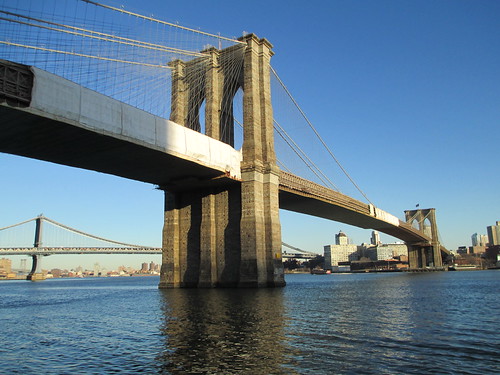
The Brooklyn Bridge: majestic - and under repair after
its pounding from all those New Jersey-bound drivers
Those problems, meanwhile, are immediate and practical. While the £10 ($16) congestion charge used to funnel through traffic away from my cycle route to work in central London, New York’s current financing arrangements actually push such traffic towards me. Every morning in TriBeCa, one of the most densely-packed areas of lower Manhattan, I see swarms of New Jersey-registered cars heading from the Brooklyn Bridge towards the Holland Tunnel going to New Jersey. Many seem to be avoiding the $13 toll charged westbound on the Verrazano Narrows Bridge further down New York Habour linking Brooklyn, Staten Island and ultimately New Jersey. Further uptown, the streets east of Central Park swarm with the traffic that pours from Queens across the free Queensboro Bridge to avoid the tolled alternative routes.

Yet it’s hard to imagine persuading men like the motorist I encountered on Vanderbilt Avenue in Brooklyn the other day that higher fuel taxes are the answer. Clambering out of his car with a weary look, he cast a wary glance over my bike and said, “Well, you’re certainly saving money on gas, buddy.” Precisely because US motorists pay far lower taxes on fuel than road-users elsewhere, they’ve seen far bigger percentage hikes in costs from recent years’ high oil prices. It’s impossible to imagine any politician persuading a US electorate in the foreseeable future of the case for increased fuel taxes.

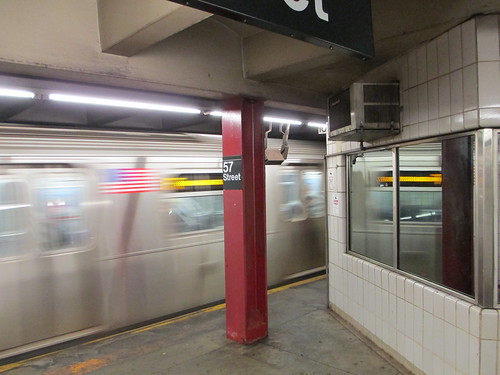
The F Train at 57th street: cheap to use - but not much fun
Nor is it easy to imagine any politician raising subway fares to a level close to covering the system’s high costs. Visiting the New York Transit Museum last Tuesday, I read the grim story of how politicians have always struggled to raise fares on the system, first from a nickel to a dime and then gradually upwards. The problem is further exacerbated by the system’s inability to charge different fares for different distances. Most people would surely agree that $2.25 is a bargain to ride from Coney Island to the outer reaches of the Bronx. But start talking about raising fares and people picture themselves paying $3 to ride from Penn Station to 59th street, a different prospect altogether.

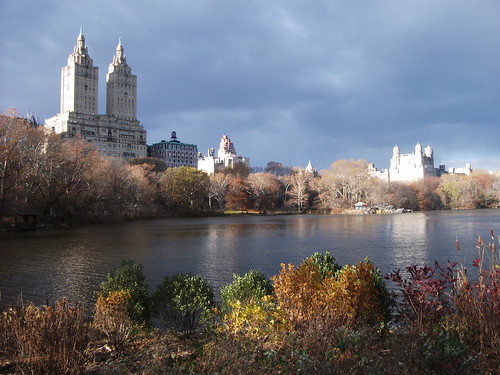
Central Park: scenic - and a neat northern border
for a charging zone
The only feasible answer, it’s clear, is for the successful mayoral candidate to resurrect plans to charge cars to enter the area where they are least needed and do most damage – Manhattan south of Central Park. The area is well defined, excellently served by public transport and currently blighted by vast quantities of traffic, much of which could go elsewhere. A reasonable charge would not only raise badly-needed revenue but also make a subway fare hike far more politically feasible. Those two manoeuvres together could unclog Manhattan’s streets, increase the incentives for drivers to switch to other modes and actually make it financially advantageous for commuters to switch to walking and cycling – the only modes doing virtually no damage to the city's environment or infrastructure. There’s no mystery about such a policy’s effectiveness. Congestion charging has reduced sharply and continuously the number of cars entering central London since its introduction 10 years ago. New York could surely come up with a more cost-effective charging system than the British capital.

Yet Christine Quinn, the city council speaker and the person many people expect to be elected mayor later this year, earlier this month said she didn’t anticipate congestion pricing’s “coming back around” after an effort she spearheaded to introduce the policy in 2007. That effort died after state-level politicians in Albany vetoed it. She has subsequently recanted slightly, saying she still supports the policy but doubts it can be successfully introduced.

That leaves New York City in a far worse state transport-wise than London before its congestion charge’s introduction. The Metropolitan Transportation Authority spends much of its income servicing its growing burden of debt, rather than improving the subway. New York City’s roads are crumbling under the weight of cars that pay far too little to make the damage good. The incentives for other mugs to join me on a less damaging transport mode remain negligible.

Future generations will look back with amazement at such predicaments in New York and elsewhere, shaking their heads and wondering why no-one had the courage to take the obvious policy steps. Some kind of charge for road use in Manhattan and many other big centres will inevitably come along. The spread of electric or partially electric vehicles – which pay no fuel tax – ensures it. In London’s story we already know it was the unlikely figure of Ken Livingstone – left-wing firebrand and scourge of Margaret Thatcher – who finally had the courage to bring in such a policy. For New York, it remains a mystery which visionary mayor will have his or her picture in the museums as the transport system’s saviour.

The tragedy for New York is that the identity of its transport system's saviour looks set to remain a mystery for many more years - through the whole administration of Christine Quinn or whichever other uninspiring choice next sits in City Hall.

Sunday, 20 January 2013

A blown nose, a blown world environment - and why some people confuse the two


It’s one of the few times I’ve managed seriously to annoy a motorist while stationary on my bike. One dark winter night a couple of years ago in London, I blew my nose while waiting at traffic lights. But, lacking the time to fish out a handkerchief, I snorted onto the road.

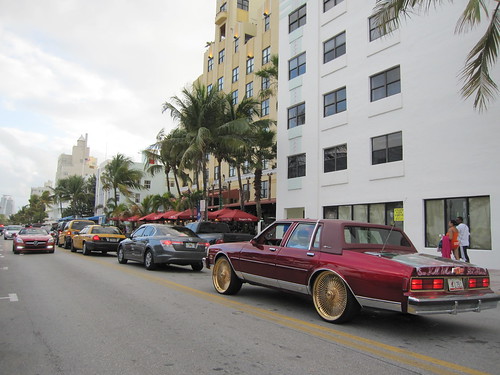
Traffic queuing in Miami Beach. Some of these cars might look to you
like polluters - but the drivers might think snot more offensive
It can’t, I accept, have made for a pretty sight. But the reaction of a woman in a car behind still surprised me. Leaning on her horn, she gesticulated her disgust wildly. The irony instantly struck me. In contemporary society, it’s regarded as entirely acceptable to make urban journeys in vehicles that spew out gases that will pollute and warm the atmosphere for a century or more. Clear one’s airways of a little biodegradable mucus, however, and one puts oneself entirely beyond the pale.

But the more I’ve thought about it since, the more I’ve realised the Outraged Driver of Kennington Park was exhibiting attitudes to environmental pollution and emissions very common in industrialised societies across the world. She regarded herself as having the right to an environment treated as she wanted. She felt perfectly entitled to criticise others’ treatment of that environment. Her attitudes, however, made no reference to any ultimate yardstick about the fate of the world environment as a whole.

I’ve said before on this blog that I am nothing like as exercised about environmental issues as many people assume cyclists are. I enjoy the overall sense that cycling is a rational way to get around – that it makes good use of scarce city space, that it contributes very little to congestion, that it keeps me healthy, that it’s enjoyable. It’s part of that picture that each trip contributes hardly at all to overall carbon emissions. But the environmental factors form only one corner of the overall scene.

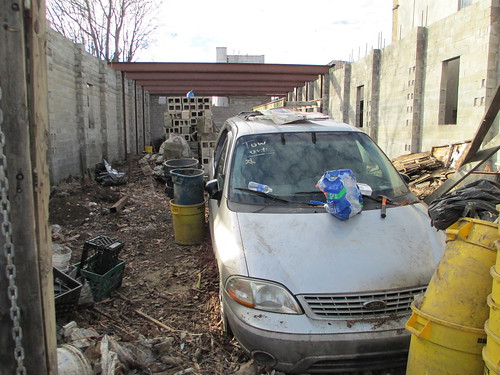
A car abandoned in the lot the Invisible Visible Man
helped to clear. Some scientists reckon the car's emissions
helped to cause the destruction in this corner of Brooklyn
That said, I regularly currently confront vivid evidence of the seriousness of the world’s environmental problems. Parts of the Hudson River Greenway, which I use for nearly half my daily commute in New York City, were under five feet – 1.6m – of water at the height of Superstorm Sandy in October. Many scientists think such extreme weather events are becoming more common as the world’s climate changes. Yesterday, I cycled down to Coney Island, one of the parts of the city worst-hit in the storm, to help clear out a vacant lot that was under seven feet of water on the night the record high water swept up New York Bay. The weather was so unseasonably mild that on the way home it felt oppressively warm. There’s an undeniable sense that climate change is becoming a more urgent, practical issue, which anyone who takes an interest in the wider world needs to address.

A modern, fuel-efficient container ship:
a surprisingly clean way to import food
Yet few of the responses to the issue rise much above the level of honking one’s horn at behaviour one dislikes. I’ve frequently heard it averred, for example, that it’s good for the environment to eat local, seasonal produce. But very few of the people who claim that can give a detailed accounting of local, seasonal produce’s carbon costs – even though the ships that import food to temperate, rich-world countries use remarkably little fuel. It’s certainly far from clear that buying fruit imported on such a ship from a country where it grows easily is worse than eating greenhouse-grown local fruit that’s come to the farmer’s market in a small, inefficient van.

Railway lobbyists also make blanket claims that their transport mode is invariably more environmentally friendly than using a car. But, while that is undoubtedly true for a well-filled train in the London rush hour, it isn’t true for a nearly-empty train spewing diesel fumes into the air to move a couple of passengers to their destinations. When I lived in the UK, my most regular long-distance rail journey was London to Chester on a Super Voyager diesel-powered train. I would give a rueful smile as I remembered that the complex, heavy but fast train issued much the highest level of emissions per seat mile of any UK train model. It was, on average, a better environmental bet to take the train for that journey than to hire a car. But the margin was not very wide at all.

There are some similarly questionable attitudes towards cycling’s environmental performance. I’ve recently come across a number of attacks on cycling’s environmental record that point out, for example, that manufacturing bikes produces carbon emissions – an undeniable point, which makes it clear that one shouldn’t replace one’s bike more often than necessary. Such attacks generally go on to point out that fuelling a bike involves carbon emissions. There are carbon costs to moving the extra food that cyclists eat that they otherwise wouldn’t. And the food generates emissions that the Outraged Driver of Kennington Park would presumably dislike even more than mucus – in the form of methane, a far more potent greenhouse gas than the carbon monoxide from cars.

The most entertainingly bonkers attack of this kind I’ve encountered was a recent blogpost from an Ian Pearson who claims to give “a more accurate guide to the future” (How can he tell?) on bikes’ carbon performance. Cycling might well, Mr Pearson accepts, produce next-to-no carbon emissions per kilometre. But, when a cyclist rides in traffic, he asserts, the extra carbon cost of attending to accidents – and the effect on cars’ carbon performance of slowing down then accelerating to overtake cyclists – probably produces so much extra carbon that it would have been more environmentally friendly for the cyclist to go by car.

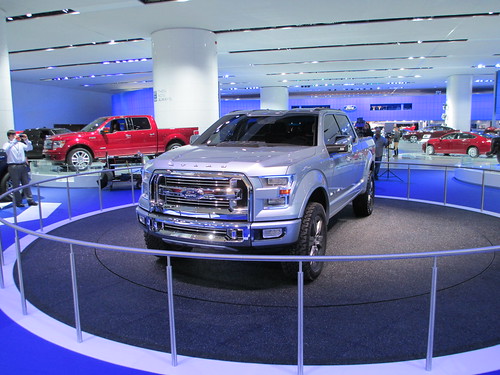
This new Ford pick-up truck concept will be more fuel-efficient
when it launches than its current equivalent.
But that won't make its drivers necessarily
friends of the environment.
The common thread between all these questionable assertions is that they treat the environment’s fate as an abstract matter – as susceptible to objective observation as the question of how to live the good life or whether God exists. People who profess concern about the environment often have a bias in favour of things that appear traditional and prepared without the benefit of complex, modern scientific advances. Many assume locally-produced food must be better for the environment because, well, it feels as if it should be. Similarly, people who are relatively unconcerned about environmental issues have a tendency to work back from their own behaviour to a spurious justification. “My car’s not as polluting as it might be” gets rationalised into “I am environmentally virtuous”. “I don’t like manoeuvring around these cyclists” becomes “these cyclists are bad for the environment”.

Yet, for the effects of air pollution and global warming, it is ultimately possible to estimate the effects objectively. Scientists now have a reasonable idea of what kind of damage different levels of carbon emissions produce. It is even possible to come up with rough figures for the costs that different kinds of emissions impose on wider society.

In a rational world, governments would now be rushing to take the guesswork out of estimating environmental impacts. Food products would include a label detailing the carbon costs of their production and include a tax reflecting them. Air tickets would include something similar, while the carbon costs of burning each unit of fuel would form a clear and distinct part of the petrol price at the pump. Past experiments with introducing new prices for previously-free goods – such as the Central London Congestion Charge – suggest consumers would move swiftly away from the most environmentally damaging behaviours towards less damaging ones.

I am robustly confident that such an exercise would make far clearer than the existing tax systems in most rich-world countries that bikes have big environmental advantages over most other transport modes. It is hard to imagine that the change would not significantly increase cycling levels.

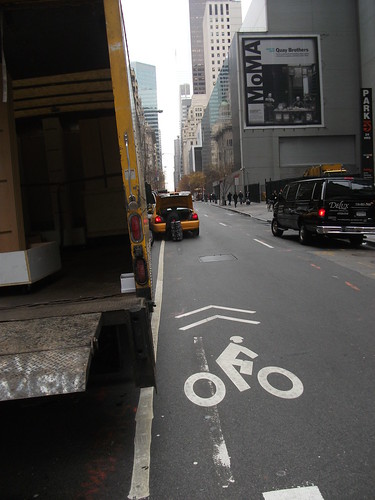
A bicycle sign on New York's W54th street:
the kind of decisive action on the environment
that many governments are taking
The challenge, however, is that such a move would upset groups commonly supposed to be hugely influential – motorists, regular air-travellers and the owners of big houses – while pleasing few others. Governments consequently lay down a few cycle lanes on the roads, offer some subsidies for electric cars, meet some of the cost of better home insulation and generally gesture vaguely in the environment’s direction. Action that would make a real difference remains resoundingly untaken.

Yet that, perhaps, should be no surprise. Across the industrialised world, governments depend on the votes of people as inconsistent as the Outraged Driver of Kennington Park, Ian Pearson and, come to that, each of us reading (and writing) this blog. There’s no firm consensus yet among all those people in favour of firm action to rein in the galloping horse of the worsening global climate. That many governments consequently seem little more rational on the issue than an irritated, late-night driver may be sad – but it is depressingly understandable.

Sunday, 9 December 2012

Washington, a stabbing - and why an individual cyclist tells you nothing about the rest

Washington, DC surprises me every time I visit. While New York feels just as bustling, large-scale and chaotic as the films and TV programmes would suggest, the US’s capital feels nothing like the West Wing. Sure, there are people influencing the whole world’s fate in lots of those neoclassical buildings – but Washington’s atmosphere most reminds me of other sleepy US administrative capitals like Richmond, Virginia or Harrisburg, Pennsylvania.

Washington, DC: provincial to me
- but full of cycling savages according to one Facebook user
During a visit last week, it nevertheless occurred what an advantage it was that Washington seemed a far calmer place than New York to ride a bike. The cyclists I saw during the visit mostly seemed to be riding sedately, calmly and in general harmony with other road users around them.

This was, however, entirely the wrong conclusion, according to at least one person I know. On Friday evening, two days after I came back from my DC daytrip, a Facebook friend commented on a story about an altercation between a cyclist and a motorist in North-West Washington the night I visited. The motorist appears to have somehow alarmed the cyclist, who responded by hitting the driver’s car with his D-Lock. The ensuing argument ended with the cyclist stabbing the motorist, who suffered rib injuries but looks likely to survive.

“Savages,” my Facebook friend commented. “Civility is an alien concept,” someone else replied in agreement. The clear implication was that I, as a cyclist, was complicit in an appalling, entirely unjustified assault of a kind I would never have contemplated.

My immediate instinct was to launch into an argument, pointing out the fatuousness of jumping from a single, knife-wielding cyclist to the implied generalisation – all cyclists are savages. Concluding that I was unlikely to change clearly entrenched attitudes, I limited myself to “unfriending” the person responsible.

But, as I cycled home that evening, a more mature reflection occurred to me – one sparked in part by the controversy in the UK over the inflammatory “War on Britain’s Roads” documentary. If it made no sense to draw a conclusion from a single stabbing - or the misleading footage of an alleycat race in the documentary  - to cyclists’ general behaviour, why did I feel free to criticise in general the culture of driving or the police? Was I making any more sense than my former Facebook friend?

One possible response to the “cyclists are savages” claim would, of course, have been to point to some of the numerous incidents of motorist-cyclist violence. In the space of a year of cycling in London, I suffered one actual – albeit mild – assault and had to make an emergency call to police to avert another. The first incident involved a bus driver who abandoned his bus – and passengers - to confront me because I’d photographed him blocking, illegally, a cyclist-only area at traffic lights. He smashed the mobile ‘phone I was using as a camera out of my hand. The second incident came as I tried to photograph a motorist I’d previously seen deliberately drive across the path of a cyclist who’d complained about his driving. He threatened – alarmingly convincingly - to smash up both me and my camera.

The most pertinent case I could have raised, however, was the stabbing in September of Colin Albright, a cyclist in Pittsburgh, whom a motorist pursued as he carried his bike away from a road up a set of steps. The motorist stabbed Albright repeatedly, including in the throat, possibly over some perceived slight involving a traffic incident.
You might have prejudices about people who make strange
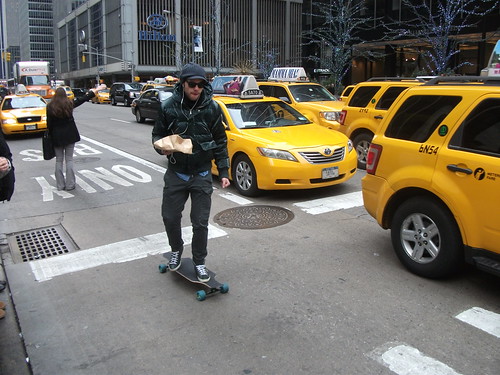
transport choices - like skateboarding down Sixth Avenue.
It doesn't mean you know anything about this individual skateboarder.

Albright’s case would have been pertinent precisely because it illustrates the absurdity of generalising from something extraordinarily rare – a stabbing over a disagreement on the roads – to the generality of day-by-day on-road relationships. In late October, Anthony Scholl confessed to attacking Albright. Scholl was already in custody over an alleged attempt to burn down his parents’ house. While there is little information so far on Scholl’s motive for stabbing Albright, the alleged arson attempt seems to have been aimed, in Scholl’s mind, at preventing his parents from killing him and feeding him to their (presumably imaginary) pet alligator.  Albright’s stabbing also looks likely to have stemmed from what Scholl’s mother has called his “psychological issues”. It seems similarly unlikely that the appalling Washington stabbing will turn out to involve an ordinary, mentally-balanced cycle commuter who just happens to pack a knife to mete out summary justice on uppity drivers.

That anyone could ever have thought the Washington stabbing had anything to do with broader cyclist behaviour, of course, stems from humans’ powerful desire to pin blame for problems on out-groups. The only thing so far known about the Washington motorist’s assailant is that he was on a means of transport against which large numbers of people have powerful prejudices. Few people have the mental self-discipline to avoid working on the basis of such limited information and their prejudices to jump to wholly unwarranted conclusions.

It’s telling, for example, that hardly anyone blames the antics of bank robbers’ getaway drivers purely on their being drivers. Drivers are too numerous and familiar to act as convenient out-group scapegoats. No-one sought to blame the assault I suffered or the threatened assault merely on the perpetrators’ status as motorists. I received, instead, some close questioning about the immigration status of the bus driver and the race of the man who threatened to assault me. Establish a link to immigrants or African-Caribbean men, the implication seemed to be, and the incidents were far more easily explained away.

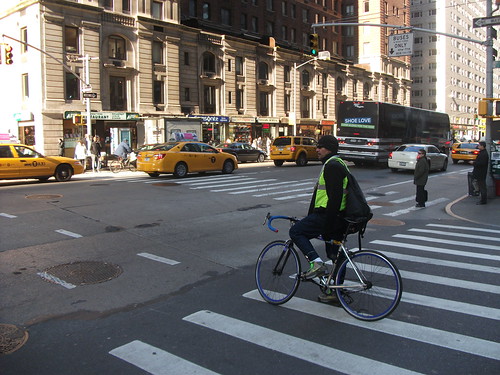
A cyclist, cars and pedestrians at 55th Street. Which of them
is a "savage" will be in the  eye of the beholder
The prejudices are all the more powerful for not appearing to the prejudiced to be prejudices at all. Have your eye out for poor cyclist behaviour in Washington and you’ll spot instances of such behaviour, rather than the courtesy and calm I witnessed. Assume the main road problem is the cyclists and you’re unlikely to spot the multiple ways motorists misbehave.

The truth is that, in all the incidents I’ve described, the attackers acted as individuals, rather than a member of a group. Their behaviour stemmed from their own characters or mental states, rather than their status as cyclists, motorists, bus drivers, immigrants or anything else. To imagine that the behaviour in a single instance of a single member of a large group has anything to say about the wider group as a whole is a thinking error of a kind that would be shocking were it not also fairly common.

That point could, of course, lay me open to the objection someone recently made in an online forum to my use of statistics to point out that cars generally posed a far greater danger to pedestrians than bikes. That was beside the point, the poster wrote. Each motorist or driver differs so much that it makes no sense to discuss a general level of risk from motorists or cyclists. A very poor cyclist could conceivably pose a greater danger to a pedestrian than an extremely careful, conscientious motorist. I am perhaps particularly vulnerable to such a charge because of my habit of illustrating points on this blog by reference to specific – usually extreme – incidents that I take to illuminate a wider truth.

Yet I have, I hope, been careful when complaining about general problems to have sought evidence that my experience speaks to a broader reality. It remains a verifiable fact, for example, that motorists kill a disproportionately high number of other road users in both the UK and New York City. Collisions with cyclists in both places account for a far lower proportion of road fatalities than cyclists make up of road traffic. Research in New York suggests motorists’ failure to yield as required to pedestrians is the biggest single cause of road deaths. Research in the UK suggests failure on motorists’ part to pay attention causes a disproportionate number of crashes.
Court Street at night. Just because most motorists speed here
doesn't mean they all do.

It makes sense on such a basis to say there is a general problem with motorists’ failure to yield to New York pedestrians or to pay proper attention in the UK. I am even confident enough in my own judgement to diagnose a few more local, unmeasured problems. There is, for example, a general problem that many motorists regard Brooklyn’s Court Street as an appropriate place for excessive speed and not somewhere where cyclists’ requirement for space on the roads need be considered. It just doesn’t make sense to predict on this basis that the next motorist one encounters on Court Street won’t be a model of caution, courtesy and respect.

I feel acutely sorry for the victim of the Washington stabbing. His experience last Wednesday must have been appallingly frightening. I trust the District of Columbia police will swiftly identify the attacker and bring him before the courts. I wish the victim a swift and smooth recovery. But I also devoutly hope that no-one in future will make the lazy and offensive mistake of imagining any of what happened had anything to do with me.

Sunday, 4 November 2012

Whatever the weather, cycling's proved a post-Sandy surprise

Most mornings, as I cycle to work, I smile to myself as it occurs to me that my children and I both start the day by looking at the American flag. But, while the Invisible Visible Children are taking the Pledge of Allegiance at the start of their school day, I’m looking to the flag for a more practical reason. The stars and stripes that fly from the top of the Brooklyn Bridge tell me which way and how strongly the wind is blowing. Since I moved to New York in the summer, it’s been the direction and strength of the wind on the main section of my morning cycle commute – north up the Hudson River Greenway – that’s been the biggest single determinant of how quickly I can make the journey. A following wind can get me there as much as five minutes faster than the prevailing headwind, I estimate.
The Hudson River Greenway: wind challenge

It’s one of countless ways that moving to New York has reminded me of how cycling makes me far more aware than any other way I might travel of nature’s forces. The summer heat is hotter here than in London, where I lived before, and the humidity higher. The rain is less frequent but the cloudbursts more intense. The winter, when it comes, will be more likely to bring very low temperatures and heavy snowfall. But the last week has made me realise that it’s only my constant awareness of the conditions around me that sets me apart from my fellow New Yorkers. Living for the most part on islands on the edge of a bay vulnerable to storm surges, we’re all to some extent going about our business at the pleasure of the elements. And it’s turning out that when nature really pays us back for the presumption of living in such an exposed position bicycles have a rather important role to play.

It was when I saw the mixture of embarrassment and pity on the CEO’s face that I realised I would need to change some of my cycling routines to fit New York’s weather. It was late June, I had just cycled briskly to my office in nearly 40 centigrade heat amid high humidity to encounter a colleague unexpectedly asking me to join his meeting with an important visiting chief executive. I had ridden – as I used to do in London – in my work shirt with the sleeves rolled up. In the greater New York heat, I was dripping with perspiration. My shirt was damp enough that my chest hairs were visible. I did my best to make myself look respectable. But, when I entered the meeting, it was clear I was still looking rather freakish. “Looks like you’ve done a hard day’s work already,” the CEO said. The next day, I started cycling in a T-Shirt and changing on reaching the office.

The heat and humidity, however, are nothing compared with getting caught in a proper New York downpour. Having cycled regularly in rain in London, I thought myself ready to face the worst a temperate-climate city could produce in the way of rain. Then I set out for home one evening in mid-September amid a deluge that would not have disgraced monsoon-season Chennai. A gutter running downhill on Ninth Avenue had turned into a respectable-sized, fast-flowing, deep river. Every surface was slick with water. The mixture of high humidity, torrential rain and darkness left me struggling to see where I was going. My waterproof jacket became so thoroughly soaked that my BlackBerry, tucked inside a pocket, got fatally wet. It was one of the rare occasions when I regretted the folly of my determination to get about by bike.

9th Street, Brooklyn during Sandy:
the Invisible Visible Man is invisible in this picture for a simple reason
- he wasn't riding when it got like this
As a result of that experience, I resigned myself, when I heard that a tropical storm was approaching New York, to weather that would stop me cycling for a few days. On the Saturday evening before superstorm Sandy hit, I took the Invisible Visible Girl by bike to a friend’s house for a Halloween sleepover. By the time I went to pick her up the next morning, the wind was up enough to send leaf debris stinging into our eyes. By late in the afternoon, as I ferried the Invisible Visible Boy on his trailerbike to a playdate with a friend, I was beginning to doubt the wisdom of being out. Every other means of transport gradually came to a halt too. The Monday was a rare day when I dared not cycle anywhere. I monitored the storm’s progress by walking cautiously down to the canal near our apartment. By the evening, I could see water up to the rooves of nearby buildings where we’d walked around earlier in the day.

But the same surge of water I could see in the canal was devastating many areas I couldn’t see. Water was pouring into subway, commuter rail and road tunnels all round the city. It was pouring through the Staten Island ferry terminal in Manhattan and carrying onto the shore the large ship I would see later in the week beached in Staten Island. It was, in other words, knocking out pretty much every means of transport that depends on any complex electrical or electronic control system. It was even shutting down the pipeline that supplied fuel to the city, laying the groundwork for queues hundreds of yards long to appear by gas stations later in the week.

As a result, I found myself in an unusual position among my colleagues over the next few days, possessed of the one means of transport that enabled me to consider a lengthy commute into Manhattan. I abandoned an initial attempt to reach the office on Tuesday, discovering in still-powerless lower Manhattan the value of the traffic lights whose numbers in New York City I’ve previously decried. But, skirting round the powerless section via Greenpoint and Queens, I found myself back in the office on Wednesday, able to slip past traffic jams and wheel my bike round downed trees. By Friday, I was volunteering to report from Staten Island, putting my bike on the first ferry after the service resumed. I pedalled my way down to bits of the island where the surge had come up to the ceilings of residents’ ground floors. My main thought was that I was fortunate to live in a part of the city where our main moan was a brief Internet outage and a shortage of bread in the shops. While a man had died in his basement in one street I visited in Staten Island, we had never been in serious danger.

But, as I cycled past queues for fuel so long that different gas stations’ lines met each other in the middle and heard anguished stories of islanders’ four-hour journeys to work, I also felt a new appreciation of my bike. New York largely depends on transport systems so overstretched that every extra journey puts a strain on them. I needed little more than a solid surface under my wheels and made few demands on anyone else as I used it.

I don’t know how long my bravado in the face of bad weather will continue into the coming, probably harsh winter. The weather is already making it feel more comfortable to be inside than out. But the past week has made me appreciate afresh the flipside of a cyclist’s vulnerability to the elements. I might have felt dangerously exposed at points on Sunday – more exposed than someone using other means of transport. Yet that also reflects cycling’s simplicity – the thing that’s allowed me to keep skipping round the city in a week when others have spent hours in traffic jams or waiting for shuttle buses.
The Manhattan Bridge bike lane:
this climb's a Mont Ventoux to a novice

New York’s most pressing problem is that thousands of my fellow New Yorkers remain without heat, light and, in many cases, shelter as the weather gets colder. But some hopeful signs are emerging from the post-Sandy gloom. The most impressive is undoubtedly New Yorkers’ willingness to help each other – the pile of donations I saw in church this evening, ready to go from well-off Brooklyn Heights a couple of miles down the road to inundated Red Hook. But there was also something stirring about watching the inexperienced cyclists on the Manhattan Bridge on Friday. One knew so little about his cruiser bike he was riding with the kickstand down. Others felt the need for a breather only a third of the way across the bridge. All seemed possessed of a sense that their work or some other business was so important that their physical limitations or experience of cycling shouldn’t stand in the way.

As the city rebuilds, one can only hope that at least some of those forced converts experienced at least a little of the satisfaction of experiencing and overcoming the power of nature while cycling. Having seen the vulnerability of the city’s overstretched transport systems to disaster, I harbour at least a hope that some of them might choose to stay on their bikes and keep battling the elements with me.

Saturday, 6 October 2012

Do as you like, motorists - and don't blame us for the deaths


It’s a disturbing scene to encounter on the way to work. Every morning recently that I’ve cycled to the office, I’ve come part way down West 54th Street on a badly-damaged airport shuttle minibus. The passenger doors on one side are mangled; the right-hand front wheelarch obviously took a heavy blow and the front radiator grille is nowhere to be seen. It was, I instantly recognised, the result of a crash with a large vehicle, travelling at high speed, hitting the bus then spinning round to hit it a second time. Some research suggests a Mercedes Benz sped up Sixth Avenue early on September 16 and hit the minibus as it crossed at 50th street. Some witnesses said the driver had been racing another vehicle. He was arrested on suspicion of drunken driving. Not surprisingly, given the vehicle’s condition, four passengers and the bus driver were badly hurt - one had a fractured skull, while others suffered head and neck injuries.
The crushed minibus of W54th street: yet more evidence
that cyclists are the true menace to New Yorkers

Injuries and deaths from traffic accidents like the one involving the minibus are growing more common after years of declines in New York. In the year to June, 291 people died in traffic accidents of various kinds in New York City, up 23 per cent from the previous year. The numbers of pedestrians and cyclists killed rose 11 per cent to 176. The same goes for the UK, from which I've just moved. Statistics released in the last week show 3 per cent more people died in road traffic accidents in the UK in 2011 than in 2010, well above the increase in traffic volumes. Civil servants and politicians in both places profess bemusement at the reversal of fortunes.

But it’s hard to believe the puzzlement is sincere. From a crime point of view, New York City has become a far, far safer place than a couple of decades ago – it's just the city won't use the policies it applied to crime to stamp out bad driving. In the UK, transport officials know that speed and traffic light cameras can sharply reduce road deaths – and have encouraged their removal because drivers don’t like them. The question is how many more minibus passengers and drivers have to be rushed to hospital on both sides of the Atlantic before the various authorities start to do something.

I’m lucky that both my encounters so far with officers of the New York Police Department have been fairly benign. On September 29, when I was riding across the Brooklyn Bridge towards Manhattan, I met a police officer leading thousands of people marching towards Brooklyn for a charity event. It wasn’t safe to cycle, he said, because of the numbers of people. I huffily dismounted and pushed my bike towards City Hall. A few weeks earlier, I’d passed a mounted policeman during my morning ride to work along the Hudson River Greenway. I then dutifully stopped at red traffic lights where a road crosses the path – only for the officer impatiently to tell me to get on with it and keep riding.

A typical Manhattan intersection, making it clear why the police
should prioritise cracking down on cyclists
Other cyclists' experience of the NYPD is very different. Last year, the NYPD issued 50,000 tickets of various kinds – for running red lights and so on – to cyclists, compared with only 25,000 for trucks. The division set up to get trucks to follow the law issued more tickets to cyclists than to trucks. Cyclists – who account for maybe 1 per cent of New York traffic and barely ever kill another road user – received around 5 per cent of all traffic tickets. Cyclists should follow the rules of the road, as should every other road user type. But the NYPD is so keen on ticketing cyclists that even perfectly legal cycling gets the treatment. At the height of the NYPD’s effort to intimidate cyclists last year, the filmmaker Casey Neistat received a ticket for cycling outside the cycle lane – which is simply not an offence.

The NYPD no doubt feels that its crackdown on poor cycling is simply bringing to road safety of the “broken windows” approach that’s generally thought to have helped to bring down other kinds of crime in New York. In the 1990s, Bill Bratton, then the police commissioner, and Rudy Giuliani, then New York’s mayor, told the police to tackle petty, “quality-of-life” pieces of anti-social behaviour, which they'd largely ignored before. Police started arresting vandals and the men who extorted money from motorists by cleaning their car windows at intersections. The approach is generally thought to have played at least some part in making the sitting a significantly less scary place to live. Cyclists certainly seem to be feeling the heat for some of the same reasons vandals and squeegee men started getting arrested. There are stories of community meetings with police where residents' top demand is a crackdown on allegedly scofflaw cyclists.

But it’s hard to imagine that broken windows would have been judged a success if the NYPD had concentrated on the squeegee men at the expense of going after murderers. It’s well documented that NYPD’s current policy for accidents involving cyclists is to investigate only if the cyclist has died or looks like doing so. Even then, the investigations seem to be perfunctory at best. While the fatality figures for the last year don’t give much detail on the nature of the fatal accidents, it’s clear that deaths of car occupants are the ones that are going up sharpest – and it’s essentially impossible that cyclists caused any of them. The city is determinedly not prosecuting motor vehicle crime.

A food delivery cyclist on 6th Avenue:
spreading fear, no doubt, among those he may imminently crush
That view seems in no danger of changing. Amid the alarming reversal in the safety statistics, New York’s latest transport safety crackdown is not on the trucks that I see careering at 50 mph up Sixth Avenue but on food delivery cyclists. I bow to no man in my irritation when I find a vacant-looking man on an electric-assist bike carrying chop suey the wrong way up a bike lane towards me. But, given the numbers of families losing fathers, mothers and children to bad driving, it’s mildly obscene that the focus is on a minor irritant of city life. I would feel even stronger, I imagine, were I, say, a relative of the woman killed in a particularly disturbing incident in late August in the West Village where the truck driver was so oblivious to the woman he hit that he dragged her body in his wheels for two blocks before stopping. The same must hold for the family of the young cyclist killed in an incident on Queens Boulevard on September 25, where the truck seems to have gone straight through a stop line. These are clearly incidents for which no food delivery bike, no matter how poorly ridden, could ever be responsible.

A well worked-out effort to tackle quality of life crime on roads in New York City  - or pretty much any big settlement - would concentrate on prosecuting motorists’ red-light jumping at the most dangerous intersections, failure to yield to pedestrians when required, illegal turning across other vehicles’ paths and excessive speed, especially at the most deadly junctions. Perhaps most importantly, it would try to stop people driving while distracted by their telephones or iPads - an area where prosecutions have fallen sharply even as the habit has become more and more widespread. The strategy, in other words, would seek to catch the kind of person who thinks it’s appropriate to race a Mercedes up Sixth Avenue - and address his behaviour before he ploughs into a minibus. The problem, of course, is that speeding motorists are, by their nature, hard to catch. It can be tough to gather the evidence to prosecute a car driver for dangerous but non-fatal behaviour such as deliberately driving intimidatingly close to a cyclist (a regular event in New York). Police forces everywhere have a predeliction for detecting offences that have a 100 per cent clear-up rate, of which cyclists’ light-jumping is a perfect example. The offence will almost never be reported except by a watching policeman. The offender is easy to catch and unlikely to argue his or her innocence successfully.

The change in tone in the 1990s in policing in New York City – and many other large cities worldwide that followed its lead – resulted from a revolution in thinking. City bosses realised it was no longer acceptable to let crime make parts of the city uninhabitable. The puzzle is why such thinking goes only as far as the kerb, and not onto the roads.

A van yields to pedestrians in mid-town Manhattan:
life would be better if this always happened
The British statistics, meanwhile, take me in my mind back to May 2010 and the day when I and other reporters were ushered into a room in the UK’s Department for Transport to meet Philip Hammond, the then-new UK transport secretary. “We will end the war on motorists,” Hammond told us, a keen glint in his eye no doubt reflecting his personal excitement at gaining greater freedom to drive his sport cars. One peace dividend for the motorists was a cut in funding for speed and traffic light cameras. Local authorities weren’t exactly told to take the things down – but the government did the next best thing. It stopped telling them they had to use some of their central government money for cameras - and cut the funding for road safety spending greatly.

The ensuing changes took me a little under a year later to the village of Nuneham Courtenay, on a stretch of the busy A4047 road just out side Oxford. Residents there had grown desperate enough to offer to pay to have their speed camera restarted. Cars that had been slowing down sharply through the village when there as a speed camera now swept through at 60mph. The same day I visited, Oxfordshire police were reintroducing speed cameras throughout the county after scraping together the money to pay for their operation. Because I knew plenty of places were simply abandoning speed cameras and I'd read research saying they saved 80 lives annually in the UK, I'd known for a long time that the UK's record of improving road safety was likely to be spoilt as it was by the recent statistics.

None of this is to say it's easy to stop future Mercedes bashing into minibuses. There's an urgent need to revise deep-seated attitudes about the priority given to cars and drivers’ rights. The driver who smashed into the minibus might, I suppose, have been a first-time offender whom an effort to target the riskiest drivers would have missed. But there’s a steady, demoralising stream of news at the moment on both sides of the Atlantic – a young musician killed on his bike in Queens, an elderly woman hit on a pedestrian crossings in London, a man hit on a crosswalk in Manhattan. As long as officials put off using speed cameras more and targetting the riskiest motorist behaviour, they're throwing away the chance to slow the flow at least a little.