Showing posts with label cycling in New York City. Show all posts

Sunday, 10 July 2016

A prosecutor's phone call, remembrance of stresses past - and why I'm glad of a public policy miracle

It was on Friday afternoon, as I was sitting at my new desk in my office in London, that a phone call took me lurching back into the stresses of my daily cycle commute in New York.

The North-South Cycle Superhighway, at Southwark Street: surprising balm for the soul.
The call came from a prosecutor at the New York Taxi and Limousine Commission who was dealing with a complaint I’d submitted in May. Within a few minutes, I was being sworn in and examined at a hearing of the commission’s tribunal. It was the first time, after a succession of driver no-shows and last-minute plea bargains, that I’ve actually had to testify against a driver. Then, I was cross-examined by the attorney for a driver who’d first tailgated me and a group of other cyclists then driven down a street yelling abuse at me. I felt my heart racing and my temper rise.

But it was only a little later, as I discussed the joys of London’s new cycle superhighways with colleagues, that it dawned on me why the call from New York had set off quite so many fight-or-flight responses. Having arrived back in the UK with my family early on Thursday, I’d had two days of mostly stress-free cycling riding on London’s new segregated cycle tracks. The experience, it dawned on me, had lifted a burden of anxiety that had sat on me all the time I battled with New York’s drivers. As I recounted the tailgating then dealt with the cross-examination from the driver’s attorney, the burden’s full weight came crushing down on me again.

That low-stress riding has produced in me - to my own surprise - an unusual feeling of lightness of spirit when I’m on my bike. This weekend, staying with my parents-in-law in rural Cheshire, I noticed when I took my bike on a muddy, sometimes hard-to-navigate country trail that I was willing to tackle trickier slopes and tougher surfaces than I had been when riding similar routes while living in New York. There are undoubtedly complex public policy questions about how much road space in London to allocate to bicycles and how much to other traffic. But, for me in the short term, the changes’ effect has been to liberate a little joy in my soul.

A muddy section of the Wirral Trail, in Cheshire:
site of my unaccustomed boldness

Even if I’d still been in New York, however, it would still have been stressful to relive the events of the morning of May 12 - all the more so because they reflected failings typical of New York’s streets. I’d complained about a taxi driver who drove close behind me and some other cyclists, trying to honk us out of his way, as we moved to turn left at the busy intersection of Canal and Allen Streets. After I photographed the driver so that I could report him, he drove parallel to me as I rode up Allen Street, shouting what sounded like abuse at me as I rode in the street’s - thankfully protected and segregated - bike lane.

The incident reflected many of the weaknesses of New York’s provision for cyclists. The two blocks of Canal St where I was riding connect the Manhattan Bridge bike path - one of the city’s busiest cycling locations - with the bike lanes on Allen St, a critical, high-quality, north-south route. Yet those two blocks are busy, chaotic and devoid of any cycling provision save for some rather optimistic “sharrow” markings. Those are generally obscured beneath double-parked vehicles.

Conditions were particularly challenging on the morning in question because Canal St had just been milled - had its surface removed prior to laying of new tarmac. The manhole covers and other ironwork - always potential landmines of the New York streetscape - were sticking up well above the temporary surface, presenting a high-stakes obstacle course for commuting cyclists.

The honking taxi driver of milled Canal St:
a picture to get the stress hormones racing
By contrast, the striking feature of my rides so far on London’s new cycle tracks is that they provide seamless journeys. The paths are generally continuous, mostly wide and, so far at least, have excellent, high-quality surfaces. I can think of almost no piece of cycling infrastructure in New York - including the Hudson River Greenway, the city’s best route - that so completely eliminates the challenge for cyclists of interacting with drivers.

The London routes don’t, like so much provision in New York, disappear at the points where conditions get most challenging. From my temporary accommodation in Limehouse, East London, I zipped to work on Thursday and Friday down Upper Thames Street, a traffic sewer through the City of London financial district. Riding there used to involve terrifying games of chicken with big trucks and black taxis. Last week, it was, for the first time I can recall, a positive pleasure to ride on, thanks to the east-west cycle superhighway, which bore me down towards Southwark Bridge untroubled by any interactions with the neighbouring vehicles. The contrast with the treatment of difficult areas in New York - say, the section of Second Avenue where cyclists have to deal with traffic turning into the Queens-Midtown Tunnel - could scarcely be more stark.
Upper Thames Street: a cycling paradise if not exactly
regained, at least found for the first time

Yet the grudging tone of those involved in the Taxi and Limousine Commission hearing was at least as depressing as the recollection of the incident itself. There seemed to be a general feeling that for a group of cyclists to be followed closely by an angrily honking taxi driver wasn’t really that big a deal. The defence attorney, meanwhile, demanded to know if I’d been in the bike lane when honked at. The question suggested the attorney didn’t know the street had no bike lane. It was built on the false assumption that bike lanes should serve as prisons for cyclists, not havens. It also entirely missed the point that a left-turning cyclist could scarcely stay in a bike lane on the right, even had one existed.
The Victoria Embankment not only hosts
those darling little lights - but an actual,
well-designed cycle track junction


London’s new cycle tracks, by contrast, feel like acts of generosity. They are mostly wide and those I’ve used so far seem well designed. My enthusiasm for them isn’t unique. One colleague - previously only an intermittent commuter cyclist - raved to me about how she could scarcely believe London had built such things. “They’ve got those little lights!” she squealed excitedly, referring to the small repeater traffic lights positioned at cyclists’ eye level. The other striking point is how quickly it’s possible to get around a city by bike when one isn’t constantly dodging around cars double-parked in bike lanes or grappling with “mixing zones” of vehicles trying to cross one’s path. My bike computer is consistently telling me I’m going around 1mph faster on average than I used to in New York.

The tracks’ building is clearly an act of political boldness that far outstrips even Janette Sadik-Khan’s efforts to put in cycling infrastructure in New York. The scale of that boldness was clear to me as my family and I rode on Thursday morning from Heathrow Airport to our temporary accommodation. At mid-morning, as we were making the trip, motor traffic remained heavy and very slow-moving while, next to us, wide, well-designed cycle lanes stood, getting only relatively light use.

It is hard to imagine any contemporary senior New York politicians’ having the nerve to try to push such a network not only through the city council but also through the myriad of community boards that are determined to obstruct progress. My experience of testifying before the taxi and limousine commission’s tribunal was certainly a reminder that there is so far not even the vaguest consensus in New York that cyclists have a legitimate place in urban transport.

In London, meanwhile, I share my colleague’s wonder at the cycle tracks’ construction. The tracks are associated closely with Boris Johnson, a bumbling mayor whose other contributions to British public life - including his role in the recent European Union referendum - have been almost entirely negative. The tracks were shepherded through by Andrew Gilligan, Johnson’s “cyclist tsar,” who received substantial, justified criticism for his shoddy methods in the 2004 Hutton Inquiry into the suicide of David Kelly, a government scientist whom Gilligan had used as a source.

London cyclists like these were yearning
for a miraculous transformation.
Astonishingly, they seem to have found one.
The tracks came to be built only after Johnson rashly built a network of extraordinarily dangerous “cycle superhighways” consisting only of paint on very busy main roads. The decision to build something better followed the justified outcry over the number of cyclists killed riding on the old super highways. That such a flawed process and flawed individuals could end up producing excellent, well-designed infrastructure feels like a public policy miracle.

But, of course, the miracle is a limited one. The cycle tracks cover only a relatively small area of central London. When not on them, I’ve already had some negative experiences. I was, for example, chased down a bus lane on Brixton Road on Thursday by an impatient van driver who should not have been in the lane at the time. This evening, as I cycled home from Euston station, on one of the few parts of the journey where I wasn’t using protected infrastructure, a minicab driver cut me off as I sought to pull out round a parked car. I can only hope that the cycle tracks are not so bold a step that they end up ripped out, as New York’s first experiments in segregated bike lanes were, when the complaints from motorists complaining about congestion became too much.

The other worries are for the future, however. I continue in many ways to pine for New York - its unique atmosphere, the open, friendly people, even the excitement of discovering the city by bike. But London’s bold cycling experiment makes me glad, at least when I’m on my bicycle, that I’m here.

Wednesday, 20 April 2016

An angry driver on 8th St, two tragedies - and why New York cyclists aren't meant to be really there

It wasn’t a surprise but it was a disappointment. As I rode my bike on Saturday, fast, down 8th Street in Park Slope, a driver, coming up from behind me, thought she knew better than I where in the street I should be riding. She started – as happens very frequently when one rides down these streets, correctly, in the middle of the road - trying to honk me out of her way.

I’d ridden down 8th St because neighbouring, busier 9th St’s bike lane – sandwiched in the dangerous door zone for parked cars – is invariably clogged with double-parked cars. It’s far more dangerous and stressful than its narrower, one-way neighbours.
 
8th St: not New York's narrowest street - but would you want a
car passing you at 30mph as you barreled down here?
But, when she caught up with me at the next intersection, the woman explained why she thought she had the right to breeze past as if I weren’t there.

“You shouldn’t be in the middle of the road,” the woman told me.

“I was stopping you from overtaking me until I could let you past safely,” I said.

“You don’t belong in the middle of the road,” she said.

“Yes I do,” I answered.

Then, inevitably, as I rode off, a bystander shouted after me.

“Hey, you need to be on a street with a bike lane! You should be on Ninth Street!”

The exchange illustrated, in part, people’s automatic, infuriating assumption that they are clever and sophisticated and cyclists are uninformed simpletons making stupid decisions for unfathomable reasons.
 
A cyclist dodges round a car parked in the 9th St bike lane:
this is the idyll one bystander recommended I use
instead of 8th St.
But it also shed light on a problem facing cyclists in many cities making half-hearted attempts at accommodating cyclists. I was struck, as I rode on, by how cycling had been shoe-horned into New York City in a way that’s meant to avoid inconveniencing anyone else. No-one had ever told this woman that, yes, she might occasionally have to wait a few seconds to get past a cyclist. The builders (more accurately, painters) of the 9th St bike lane had sought to make it barely impinge on drivers.

The designs betray a profound confusion in public policy. There’s a vague instinct that cyclists can’t be entirely denied better facilities. But that goes hand in hand with cowardice about the idea that promoting cycling is a public good. There’s no sense that sacrifices to encourage cycling might be worth everybody’s while. The unspoken sense is that cyclists should take up no space, have no momentum and cause no-one else to modify any part of their behaviour.

The inevitable result is that cyclists are forced into making the compromises that others get to avoid. As I rode down 8th St, I faced a choice between being harassed for riding down the middle of the street or taking the risk of being hit by an inattentive driver’s opening door and knocked into the path of a driver passing me at 30mph. Had I chosen instead to ride down 9th St, I’d have faced a combination of both dangers. I’d have had to ride in the parked cars’ door zone then pull out round the parked vehicles, being tailgated by drivers who thought I should somehow not be out of the bike lane.
The Jay St "bike lane" in downtown Brooklyn:
evidence on its own of why New York's bike commuting rate
is so low.

It’s no surprise under these circumstances that cycling in New York remains a fringe activity, confined to a relative handful of us who think the personal benefits of getting about by bike outweigh the costs. It’s a situation mirrored in the many cities across North America and some parts of Europe.

The current circumstances practically guarantee that the benefits the planners were seeking from cycling – cleaner air, safer streets, better use of road space – won’t materialise. The dominant surviving forms of cycling – fast riding by the young and fit, coupled with widespread rule-breaking by riders fleeing dangerous drivers – are used as evidence that promoting cycling is a Bad Thing. It’s time for such cities either to get serious about cycling provision or to stop the current dangerous and stressful pretence.

Not, I’m sure, that any of this  would make sense from the perspective of the Angry BMW Driver of 8th St. It must, I accept, seem odd when driving a large vehicle down a street to see a cyclist, a single person on a  narrow vehicle, taking up the centre of the lane. It must, in certain circumstances, feel like a theft of the road space.
 
My bike computer after one run-in with
an angry driver being held up:
unacceptably slow in a city with
a 25mph speed limit.
I don’t ride down the middle of the road to make some abstruse point, however. As I use these streets, my bike computer often tells me I’m going well over 20mph. As a large man on a heavy bike with luggage, I have significant momentum. If a driver opened a door into my path or pulled out of a parking space without looking, I would be sent flying over my handlebars. These aren’t marginal, theoretical risks. Only a few weeks ago on 8th St, I had to swerve at high speed after a driver pulled out, fast, from a parking space into my path. Had I been riding where the Angry Woman thought I should, I could easily have been killed.

Nor was I in any real sense inconveniencing the woman. Like other narrow Park Slope streets, 8th Street is regularly clogged by double-parkers. The next block downhill features two speed bumps, which I can take without slowing down and drivers can’t.

The woman’s inability to pass me was clearly, however, an affront to her sense of her rights. Her lack of human sympathy for me as a fellow road-user seemed to have bled over into a wider resentment at my having any physical presence at all.

It’s a feeling I encounter surprisingly frequently, from both drivers and pedestrians. I’ve recounted before a run-in with a pedestrian who insisted on obstructing the Grand St bike lane in Manhattan. The Saturday before my dispute with the angry woman on 8th Street, I was yelled at by a tourist who insisted that, because he wanted to walk on the Brooklyn Bridge’s bike lane, I too should walk, not ride, over the bridge. I’ve come to understand taxi drivers’ tendency to pull out of parking places into my path as more a mark of their sense that cyclists can and should yield to them at will, more than a mere symptom of inattention.
 
The Brooklyn Bridge, complete with the bike lane
one recent critic told me no cyclist should expect to use.
The misunderstanding extends to those meant to enforce New York’s traffic rules. There has been understandable outrage after it emerged that a right-turning police officer knocked a cyclist off his bike on 9th St in Gowanus, very near my apartment, then had a fellow-officer write that his turn had been perfectly legal. My sense is that the incident might partly reflect police officers’ genuine conviction that it’s a cyclist’s job to avoid traffic turning across his or her path, not a driver’s job to yield.

I used to encounter similar attitudes when I cycled in London – and I can’t imagine they’ll have disappeared entirely when I return there later this year.

But London has at least started groping towards an answer to the kinds of incidents I keep encountering. After the disaster of the initial, blue-painted Cycle Superhighways, Transport for London has finally been shamed into providing some decent, segregated cycle paths on some of its busiest streets. Even when I lived there, London was already far better than New York at providing calming on side streets like 8th St to avoid incidents like the one I suffered on Saturday. There’s tragically no sign at all that anyone in New York feels under pressure to provide anything like that on this side of the Atlantic.

Yet New York’s continuing state of cycling limbo isn’t a merely theoretical problem. Cyclists truly can’t screech instantly to a halt of float harmlessly away from vehicles that menace them. The day before my row with the Angry Driver, a driver a couple of miles away had killed a cyclist riding to work in Clinton Hill. This morning, a huge truck, driving on a street where it wasn’t permitted, killed a man on his bike in Park Slope only 15 blocks or so from where I had my row.

Pedestrians walk down a temporary bike lane on 8th Avenue -
in a city that tells you cyclists don't really matter,
why wouldn't you?
The police’s instinct in both cases was immediately to blame the cyclists, essentially, for being where they were. They claimed – improbably, given what is known about her – that Lauren Davis, the victim in Clinton Hill, had been riding against traffic. They have focused, still more improbably, in the Park Slope crash on the theory that James Gregg, the victim, was hanging onto the truck that killed him to hitch a ride. I have never seen a cyclist in New York City do such a thing.

The instinct to exonerate the truck driver is all the more extraordinary given that it is clear he was breaking the law just by driving down that street. Both victims seem to me to have died from the grubby compromises forced on cyclists by cowardly road designers and politicians.

I am fortunate indeed that I have so far derived only physical benefits and no serious harm from my New York cycling. Yet, just hours after the Park Slope tragedy, I encountered the kind of contemptuous attitude that makes such tragedies  all too common. Riding through Fort Greene and needing to turn left, I looked over my shoulder to see the driver in the next lane absorbed in his phone, rather than his driving. Fearful that he wouldn’t spot me as I pulled across, I rode for a second or two staring at him while signalling.

That turned out to be an indignity too far. He sped up for a second or two, to block my turn. Then, when I’d successfully pulled left and turned out of his way, he yelled abuse. He was furious that I’d made him momentarily take his mind off his text.

Sunday, 7 February 2016

Christmas Eve harassment, a sociopath in Greenwich Village - and how design can cut out honking

It was always going to be a moderately challenging bike ride. It was the early evening of Christmas Eve and, after it emerged that our local wine merchants was already shut, I and my bike had been deputed to lug back from somewhere further away the wine supply for the holiday season. Even a solidly-built touring bike is apt to handle oddly when laden down with 12 bottles full of wine.
 
My bike laden with groceries: not the machine on which
to face harassment
But the trip became significantly more stressful after the driver of an SUV started driving close behind me, honking, in an effort to bully me out of the way. I was riding well out in the lane, to avoid a deep and dangerous crack in the tarmac. That outraged the driver, who thought he shouldn’t have to cross into the neighbouring lane to pass me.

“I thought you should be riding further to the left,” he said, when I found him unloading passengers near my building and asked what had provoked him.

“There was a huge crack in the road, which I was avoiding,” I told him.

“I didn’t know that,” he replied.

“Which is exactly why you should concentrate on overtaking me safely, and not trying to get me to ride in the place of the road you think I should,” I said.

The incident was one of countless times I’ve had to cope with road users’ efforts to bend someone else’s driving, cycling or walking to their will. Just a few weeks before the Christmas Eve incident, I’d had a driver deliberately accelerate his SUV at me in Greenwich Village after I shouted out to him to alert him to my presence, to ensure he didn’t swing across my path.

Yet I also recognise there are plenty of times I try to influence other road users to prevent their harming me. I had, after all, shouted at the driver in Greenwich Village to try to ensure he didn’t drive into me.
 
A mixing zone on the Broadway bike lane:
traffic engineers think this a model way to handle bike traffic
The question is when it’s legitimate to try to influence other road users’ behaviour and when it’s bullying. Most importantly, it’s vital to ask why there’s all this frustration in the first place and whether it can be averted.

The Christmas Eve incident was emblematic of the worst kind of desire to control other users because of the infuriatingly wrong-headed thinking that lay behind it. The driver insisted he’d wanted me over nearer the parked cars because he wanted, he said, to pass me safely without causing an “accident”. It’s the thinking that lies behind vast numbers of drivers’ complaints about cyclists and pedestrians – a thinking on the drivers’ part that they’re the serious adults in the situation, while pedestrians and cyclists are heedless, child-like creatures who have no idea of the danger they’re facing.

The thinking betrays a wholesale failure to understand that the driver has prime responsibility for moving his vehicle safely and that safety doesn’t consist primarily of people’s staying out of his or her way. The driver eventually seriously endangered me because I veered into the crack in the road and came close to losing control of the bike.
Chaos at a SoHo crosswalk: if the cyclists of pedestrians
yell at the drivers here, they're punching up

The fatuousness of this thinking doesn’t stop its being widespread. It’s one of the signature features of the driving culture that stems from New York’s poor enforcement and dreadful road design that drivers honk all the time. Every time a driver sounds his or her horn as a rebuke or to prompt someone to move, it’s an effort to control the other person’s actions. It’s nearly always an effort to make life more convenient for the person doing the honking.

The big difference between the honking, tailgating behaviour and my regular pleas to drivers to look out for me or stop during an illegal move across my path is the power balance. When I ride through an intersection crying out “Watch out! Wait there!” at drivers, I’m trying to get them to follow rules meant to protect vulnerable road users in cycle lanes and crosswalks. There seems to me a huge moral difference between such a “punching up” effort to control others and the “punching down” effort of drivers like the Christmas Eve minivan drivers to sweep people aside as mere inconvenient obstacles.
 
Park Slope snow the day after the January 23 blizzard:
much of this was still affecting the roads a week later
Yet it was an incident last Sunday, January 31, that brought home to me the reason for all this frustrated communication and how it can be eliminated. I was riding up 7th St in Park Slope, near my home, on my weekly journey to church. I would normally when harassed by drivers on that trip move confidently into the middle of the lane and prevent their passing until the next intersection. But, last Sunday, unmelted snow from the January 23 blizzard meant the lanes were narrower and harder to navigate. I felt even less confident than normal about trying  to “control the lane”, as vehicular cyclists put it.

Consequently, when a driver started tailgating me, I meekly moved over  to the side of the road and let him pass. A change in the structure of the road had changed, I suddenly realised, my confidence in influencing other road users’ behaviour.

That, it came home to me, was critical to all the incidents I encountered. The driver who’d harassed me on Christmas Eve had been deceived by the layout of Court St – which allows two uninterrupted streams of one-way traffic on an urban main street – into thinking he was on little short of a limited-access highway. The driver who drove at me in Greenwich Village was angry partly that I was appearing in his path from a poorly-marked, oddly-placed bike lane that must have made it feel to him as if I were deliberately obstructing him. The dreadful “mixing areas” that bring together left-turning drivers and cyclists going straight ahead on many New York streets are designed like freeway sliproads, to allow turning drivers to slow down without impeding those going straight ahead. While the drivers clearly should obey the rules and yield to the cyclists riding into these areas, it’s unsurprising that so few do.

The problems in New York, while less grave than in many parts of the US, are far more acute than those in London, where I’ve done most of my cycling as an adult. Roads in London, while still imperfect for cyclists, are filled with multiple cues to tell drivers what speed to drive and who has priority.

I now recognise New York’s honking problem for what it is. It’s the sound of the expectations that the infrastructure has given drivers being dashed against a messy reality that the street design doesn’t reflect.

Court St tells drivers, "Go as fast as you like. It's pretty much
a freeway."
Better street design isn’t the only solution to the problem. It’s noticeable, for example, that one almost never sees bicycles chained to the railings at subway entrances. There’s a general expectation that bicycles chained in such areas will be removed and cyclists have adapted their behaviour to cater to that. There’s little doubt that similarly consistent enforcement of rules about driving might have similarly striking results. That's one of many reasons why New York needs more speed cameras.

But it’s pretty clear that it’s vital to rebuild urban streets so that they no longer look like urban freeways. Cycle lanes should never be painted, as most are at present, in the most dangerous part of the street. Areas designed to bring cyclists and motorists across each other’s paths shouldn’t look like they can be navigated at 30mph.

For the moment, however, those of us who ride are forced to put up with occasional bullying like that I encountered on Christmas Eve – and to do our best to counter it.

In a city as disorderly as New York, however, that can take real energy and flair – as I discovered one morning last summer as I rode up 1st Avenue towards the New York Public Library.

Around 17th St, I encountered, as so often, a line of left-turning drivers blocking the bike-and-car mixing zone as I sought to ride straight ahead. I bleated, “Wait there! Stop!” - to little effect.

A Black cycle courier who slipped through the gap between me and the rearmost car showed me the level of determination needed to affect the behaviour of New York drivers.

“No,” he shouted at the driver, before administering a resounding slap to a side panel. “You gonna resPECT this one, Muthafucka!”

Helped more by the drivers’ astonishment than by any actual change of heart, we both slipped by the previously threatening drivers, and headed on north.

Sunday, 6 December 2015

First Avenue Harassment, Talking Down to Pedestrians - and a Culture That Needs to Change

There could hardly have been a clearer illustration of what’s wrong with the culture of New York’s city streets. Two Saturdays ago, as I rode my bike up 1st Avenue on the Upper East Side towards the Metropolitan Museum, I succeeded in shouting forcefully enough to get one turning driver to yield to me momentarily – as legally required – as I rode straight on through an intersection. But his brief slowing – more a result of confusion at my shouting, I think, than a genuine effort to let me through – enraged another driver waiting to turn.

“C’mon – let’s go!” he yelled out of his window at the driver who’d slowed, urging him, in effect, to drive over me.
 
Poorly-designed intersections and illegal maneouvres
by drivers: welcome to First Avenue
It’s the kind of incident I’ve noticed many times in recent weeks as I’ve been trying to understand the persistently high death toll on New York’s streets – particularly a dreadful spate of 12 pedestrian deaths between October 31 and November 11. It’s common to see drivers honk loudly at others who have correctly yielded to pedestrians in crosswalks. I’ve personally been on the receiving end of a fair amount of harassment from drivers who imagined they had a right to overtake me even in places where it was unsafe.

This impatience from city drivers shapes the atmosphere, making pedestrians and cyclists fearful and making the business of using the streets often miserable and stressful for everyone else. Many drivers, traffic planners and police officers seem to accept this aggressive driving culture as an almost charming symptom of the city’s general bustle and as unchangeable as the weather. They seem to regard anyone who breaks the formal law while acting within the limits of this accepted style of driving as essentially not culpable.
 
New York City pedestrians: their own worst
enemies, except for all the bigger, more
dangerous enemies.
The area’s political class are also worryingly oblivious to the nature of the problem. On November 10, Mike Simanowitz, a member of the New York State assembly, chose at a press conference organised by the New York Police Department’s 109th precinct to criticise pedestrians for creating the problems themselves. It was as if he was complaining about the timidity of his pet mice while doing nothing about the gang of unruly cats rampaging through his house.

“If you're crossing in the middle of the street, you're wrong, you're endangering yourself, you're endangering others, you're endangering drivers," Mr Simanowitz said.

He gave no explanation of how pedestrian behaviour might endanger drivers.

“Cross at the green, not in-between, and hopefully we will be able to reduce the number of traffic fatalities," he added.

There is, of course, something fundamentally nebulous about the claim that a set of observed behaviours adds up to a “culture”. I resist sweeping statements about how “bikers” as a whole behave or stereotypes about British people or white people or all the other various groups to which I belong.

Yet I was struck when visiting Los Angeles in mid-November at how differently the average driver behaved from his or her New York counterpart. Los Angeles drivers seem when yielding to pedestrians to stop the car well outside the crosswalk until the pedestrian is out of the way. Used to New York drivers’ constant harrying of pedestrians to hurry them out of crosswalks, I found their stopping at that point so freakish that I’d hesitate a little, wondering what was wrong.

LA drivers meanwhile had a tendency to creep forward into the crosswalk if anticipating they might be able to make a coveted right-turn on a red light (permitted when no pedestrians are crossing). Once clear of intersections, they would take off at horrendous speeds, encouraged by the city’s wide streets.
 
Traffic on Hollywood Boulevard: surprisingly accommodating
to basic standards of decency.
The contrasting patterns of behaviour reflect the two cities’ different road conditions. In New York, on Manhattan avenues and many other places, there can be 20 intersections every mile, with each controlled by traffic lights. In drivers, New Yorkers’ famed impatience expresses itself in a desperate desire to reach the next traffic light before it has been red for too long. Angelenos are famously more laid back – and they can make up for any delay at an intersection by speeding up on the long spaces between lights.

The moment one starts looking for the jostling for position in New York, however, it’s everywhere. If I position myself safely at the head of a line of traffic waiting at a red light, I will typically find the driver first in the line creeping up alongside me, putting me in precisely the proximity to him I was trying to avoid. Every morning, as I ride down Smith St in Brooklyn, I find drivers seeking to turn from side streets have turned half-way through the intersection, blocking the cycle lane and crosswalks, to reserve their rightful place in the street’s slow-moving traffic jam. Drivers are so desperate to get out of parking spaces and into the traffic that they seem truly to look at what's going on only once they're under way down the street.

These habits are far more than local foibles like New Yorkers’ tendency to be rude or fondness for street food. New York city bus drivers alone killed three pedestrians in November – two hit by drivers turning through crosswalks and another hit by a driver apparently speeding. The police appear to be attributing a crash on October 31 that killed Louis Perez, 64, Nyanna Aquil, 10, and Kristian Leka, 24, on a sidewalk in The Bronx to the driver’s “medical issue”. But, whatever happened immediately before the crash, the driver was driving a powerful Dodge Charger car at such a speed that it became airborne after hitting another car and landed on top of the victims. A read through Radio WNYC’s list of this year’s traffic fatalities – 228 at the time of writing – reveals a steady stream of people killed by drivers ignoring their right of way, driving too fast or mounting a sidewalk after crashes resulting from excessive speed.
 
125th St in Harlem: I see excessive speed and fast, risky
turns. But a New York assembly member sees this as a space
spoilt by pedestrians' recklessness.
There is a mountain of evidence about the costs and causes of the current traffic culture. While the number of traffic deaths to the end of November - 224 – was down on the 252 for the same period in 2014, only 127 people died in London – a slightly larger city with more motor traffic – in the whole of 2014. Research by Streetsblog, the campaigning website, shows that only around 7 or 8 per cent of crashes involving pedestrians in New York are labelled a result of an error by a pedestrian.

There's no denying that New York pedestrians and cyclists are also often in a hurry. I am frequently frustrated, for example, by pedestrians' rush to cross the street after cars have passed, without looking out for cyclists. I find it tempting to ride through traffic lights just as they're changing precisely because it means I can avoid jostling with drivers when the lights turn green again. When I run through lights a little later than I should, however, I find an even later car nearly invariably following me through. The behaviour of both pedestrians and cyclists is dictated mainly, it seems to me, by their desire to avoid crossing streets or moving away from lights at the same time that cars are doing so.

Mr Simanowitz’s comments are unusually revealing, meanwhile, about why politicians and the police persist in trying to berate pedestrians and cyclists into solving the problem rather than going after the real issue – driver behaviour. The patronising rhyme – “cross at the green, not in-between” – makes it clear that he regards pedestrians as irresponsible children in contrast to the grown-ups – the drivers – in the streets. I encountered similar reasoning myself recently when I got into a row with a driver who’d pulled out into my path and he quickly fell to insinuating that cycling was a children’s activity.

“You’re a grown-ass man on a push bike!” he yelled, incredulously, as if being an adult in charge of an elderly, collision-damaged Lexus SUV were inherently superior.
The sign says "slow zone"; the design says fast.
Which do you think motorists do?

The rhyme suggests that Mr Simanowitz’s thinking – and, I suspect, that of many other senior politicians – remains dominated by the facile road safety lessons given to children. Those are, typically, predicated on the idea that it’s children’s own job to keep themselves safe. They embrace none of the complexity that the statistics reveal – that most road traffic victims suffer from someone else’s negligence, not their own. It’s as if they were trying to solve the mice’s timidity by giving the mice lessons in strengthening their characters, not keeping the cats at a safe distance.

There’s little mystery about what it would take to alter the traffic culture. Many New York streets at present look designed precisely to encourage excess speed, not to discourage it. The sidewalks and cycle lanes are mostly add-ons that are sacrificed anywhere that cyclists or pedestrians might slow down or otherwise hamper traffic. Enforcement of traffic laws is haphazard and often directed at harassing cyclists and pedestrians, based on the same fundamental misunderstanding of road relationships that Mr Simanowitz betrayed.

London, which has made little concerted effort to address road safety and whose transport policies have many shortcomings, has far better figures largely by dint of having better road design, better places to cross the street and far more speed cameras.

But it’s hard to avoid the conclusion that the city as a whole for now takes the view of the people I encountered as I rode down MacDougal St in Greenwich Village on Thursday evening. They stepped out into the bike lane to hail a taxi which then, with considerable predictability, veered left into the bike lane cutting me off and forcing me to come abruptly to a halt.

They were superficially apologetic and sympathetic.

“Oh – that’s not right,” one of them said.

But the sympathy wore off in less time than it took me to ask the driver what he thought he was doing.

“Be on your way – we’re in a hurry,” the initially sympathetic man shouted at me, in the stilted tone of a character in a novel.

Then, as I accepted defeat and headed off towards Bleecker Street, he spoke for the city when he yelled after me: “Shit happens – get used to it!”

This blog is the first after a lengthy delay caused by the Invisible Visible Man’s efforts, among other things, to interest publishers and agents in the possibility of a book based on the blog. I apologise for the interruption.

The timing of future blogposts will depend on progress in the efforts to find a publisher. Anyone interested in taking me on as an agent or publisher is free to contact me at robert dot wright at ft dot com.

Sunday, 10 May 2015

A wary pedestrian, getting metaphysical in SoHo - and why I'm a frustrated street communicator

The young man looked at me distrustfully. I gestured to him to head across the pedestrian crossing where I’d stopped my bike for him. He again looked warily to his left, in the direction from which cars tear at high speed down Hoyt Street, in Cobble Hill, in defiance of the area’s 20mph speed limit. Having finally decided that it was safe, he crossed and I was able to resume my journey.
A New York City pedestrian: understandably wary.

The incident on Friday night was one of the clearest illustrations I’ve encountered recently of the difficulty of communicating with other road users. Such communications are often obstructed by noise, by the challenges of communicating with people inside a metal box and by people’s varying expectations about how other road users will behave. The young man I encountered was fearful of my effort to help him cross the road precisely because no-one else stops for that crosswalk, which links shops on Hoyt St to the Gowanus Houses public housing on the other side of the road. My stopping was so out of step with other road users’ behaviour that it must have seemed like some kind of practical joke.

The communication barrier facing cyclists seems particuarly high in cities like New York and London where cars dominate the streetscape. In such big, industrialised cities with only modest cycling levels, few other road users have the inbuilt sense of how cyclists might or should behave that they have with motorists and pedestrians. The scope for severe mutual misunderstanding is significant.

Yet roads remain intensely communal places, where the different users are entirely reliant on each other for safety. Cyclists, drivers and pedestrians all need to decode a complex series of verbal and non-verbal signals to work out each others’ intentions and likely future behaviour. The communication barriers play a big part in ensuring that roads remain such dangerous places. But almost no-one addresses the obstacles that the obvious and growing barriers represent.
Prince St at W Broadway, Manhattan: a venue where I often
have to practise my new communication policy with drivers.

My sensitivity to the challenges of interacting with other road users has been heightened, I suspect, by a change in my own communication policy. In the last few months, I’ve become even more prone than before to using my loud, powerful voice to try to stop drivers from running me over. I do this most often by shouting at drivers trying to cut across my path at intersections, “Stop! Wait there!” While I’m sure that many of those at whom I shout have no desire to behave legally and respect my right of way, most drivers who hear someone shout, “Stop!” loudly in their direction seem to step at least temporarily on the brake pedal.

But I’ve also been struck by the policy’s shortcomings. It regularly leads passersby to shout mockingly at me, rather as though vocal communications in traffic were subject to the same taboos as speaking in a library or an ancient sacred space. People seem to resent clear, unambiguous communication across the cyclist-driver divide.
Pearl St, in Dumbo: good luck communicating
clearly with the driver if one of those cars
starts pulling out in front of your bike.

My shouts also seem to work far less well with drivers who are pulling out of parking spaces into my path. There’s a tendency for drivers creeping slowly into a bike lane while waiting for a suitable gap to pull out to believe their intentions should be clear to those around them. When I shout, “Stop!” at such a driver moving slowly into my path, his or her rejoinder is often to shout, “I saw you!” There’s a failure on the driver’s part to understand that his or her actions communicate the intention to pull out but not that he or she has seen me and is taking care not to hit me.

It’s because I recognise that my actions are my clearest means of communicating with fellow road-users that I seek, by and large, to obey traffic signals. I hope – and I realise it’s a fairly forlorn hope – that the example of my self-discipline will communicate itself to the drivers who pose the real danger. I think there’s a usefulness to having an agreed set of standards for how to act on the roads – albeit a severely flawed one – and to making a point of obeying it.

For the same reason, I try as I cycle around to make obvious, unambiguous movements. When passing a car parked in a bike lane, I don’t squeeze by hoping that other vehicles won’t pass me too close. I swing firmly out into the neighbouring traffic lane, showing following motorists that they shouldn’t overtake. I try to make eye contact with drivers when I can. I signal clearly where I’m going. I use my bell to warn pedestrians when I’m approaching – although, frankly, a follow-up shout of “Watch out in the crosswalk!” to people crossing against the light is generally necessary.
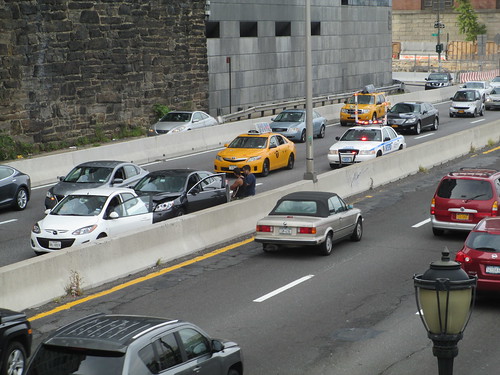
A rear-end shunt on FDR Drive: looked at another way,
it's a failure of two drivers to communicate clearly

Many of these efforts nevertheless run slap-bang into vast barriers. Some of them are cultural. New York drivers seem so used to the idea that they can pass a cyclist in a bike lane with only a tiny space to spare that it barely seems worth trying to communicate with those who do why their behaviour is so dangerous. I ran into similar challenges when I lived in London with drivers who simply didn't seem to realise they shouldn't block advance stop boxes at traffic lights.

The most inescapable fact of on-road communication, meanwhile, is that the modern motor vehicle is designed to shield users from the reality of their being involved in a social interaction. The interior of a motor car looks and feels more like someone’s home than a machine for transporting goods and people. Cadillac last year ran an advertising campaign showing a ring of cymbal-clanging toy monkeys surrounding a Cadillac CTS  expressly to boast how the vehicle’s sound-proofing, glass and even noise-cancelling equipment would silence the reality outside the vehicle. It’s no surprise that people riding in such vehicles might struggle to grasp the complexity of what’s going on in the streets surrounding them – or that they might react angrily to my rapping on the window to point out that they’ve nearly, by their negligence, run me off the road.

Inside that sensation-deprived space, there must be a heightened sense of frustration at the mismatch between the calm sounds of the vehicle’s clear stereo or white noise and the more chaotic pictures coming in through the windows. I’m confident that frustration explains many of the times I have motorists drive fast at me, blaring their horns. This silent, frantically pedalling cyclist must seem like a disorderly intrusion compared with the orderly sound world of the vehicle’s interior.

All of these obstacles play a part in keeping New York's road safety record poor, despite the current mayor's Vision Zero efforts. The position would, needless to say, grow easier if the city built more infrastructure to reduce conflicts, including more of a network of well-designed protected cycle paths.
A driver overtakes a cyclist: one of these people is in a box
sound-proofed to ensure he can ignore the other.

As it stands, people find themselves caught up in conflicts fuelled by misunderstanding - and seized of a powerful impulse to reach through the barriers and explain why they're frustrated. I saw it vividly one recent morning when a woman, wrapped up in her car’s smooth inner world, pulled out of a side street in front of a cyclist careering down Smith St on a single speed. The cyclist jammed on his brakes and landed in a heap. His immediate instinct was to spring to his feet and aim a defiant one-fingered salute towards the rear-view mirror of the motorist. I suspect she never had any inkling of the harm she had done.

I was caught up in a more complicated instance last Thursday when cycling home down Grand St in SoHo. A man in front of me was pushing a baby buggy (stroller, American readers) down the narrow bike lane, one child inside the stroller and another riding on the rear. His only reaction to my bell-ringing was to continue an exaggerated saunter, taking obvious pleasure in blocking my way.

It wasn't the first time I'd come across people deliberately blocking the lane on Grand St to prevent cyclists' using it. I've long since tired of giving people who deliberately obstruct me the tolerance I generally extend to even inattentive pedestrians. My irritation welled up when he turned to me at an intersection and sneered, “But we’ve got wheels. We’re allowed to use it.”
The Smith St bike lane: venue for a memorable
failure of communication

I started calmly, pointing out that it was irresponsible of him to block a busy bike lane and that someone could have hit him. It would have been irresponsible of me to hit him, he replied, so I was the irresponsible one. His deliberate, bullying contempt mixed in with my tiredness after a red-eye flight the night before and my dismay at the emerging British general election results. I felt the urge to communicate quite how deeply he had offended me.

I pointed out – accurately, I think – that he was setting a poor example to his children. I pointed out – again accurately – that his behaviour was making his wife slink away in embarrassment. I finished with a piece of more metaphysical speculation.

“Your soul’s shrivelling inside you because you’re so petty,” I shouted as I rode away.

I should not, clearly, have allowed myself to be provoked. But humans feel the need to connect and communicate with those around them. Far too many street and vehicle designs hinder, rather than work with, humans’ need to talk to each other. It feels like no exaggeration to say that's drying up many cities' souls.

Sunday, 12 April 2015

A signpost note, anarchy in Fort Greene - and the misery of the idle motor car

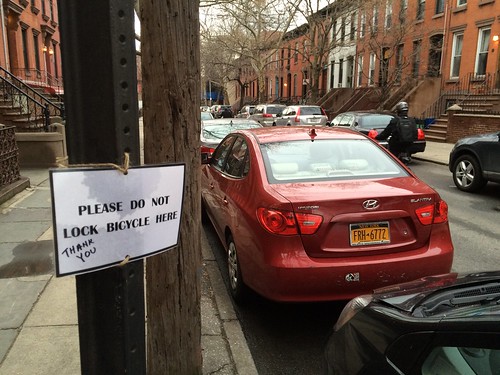
It’s not often that I’m seized with the desire to deface a sign in a public space. But, on a walk with the Invisible Visible Woman on Easter Sunday, I came very close to hacking down the handwritten notice that a householder in Nelson Street, near our apartment, had attached to a pole on the sidewalk.

“Please do not lock bicycle here, Thank You,” read the laminated note.
A rare insightment: a sign that begs to be torn down

The sign infuriated me because it struck me as an arrogant attempt to appropriate the right to dictate what happened on the public street outside the householder’s home. As a New York City taxpayer who in theory is on the hook for the cost of keeping the pole in place, I experienced the appropriation as a kind of theft.

Yet the more I’ve thought about it since, the more I’ve recognised that the householder’s act stood out only in the explicitness of its expropriation of public space. Nelson St, where parking is free, as it is on the vast bulk of New York City streets, was lined on both sides with parked cars. They had together turned the street from a potentially healthy artery in the city’s road system into a clogged, ill-functioning one. With fewer idle vehicles, the street could have had wider sidewalks, extra space for moving cars or, of course, a proper bike path.

But the sign on Nelson St – which I suspect was put there to ensure the householder could park his or her car without worrying about a bike’s obstructing the doors – illustrates how many people fail to grasp the true nature of free, on-street parking. There’s a tone of outrage about any effort to remove or curtail access to on-street parking that suggests many people think of parking spaces as essentially their property. The sudden gaps in New York’s cycle routes – where protected lanes turn into painted ones or painted lanes degenerate into “sharrow” markings – illustrate how tenaciously some communities hold onto their precious storage spaces.
 
Police supervise vehicle parking in the Kent Avenue bike lane:
a stark illustration of the depth of the city's problem.
It's my strong suspicion that the defence of parking arouses such fierce passions partly because the privilege is defensible only in emotional, rather than logical, terms. Motor cars in most developed countries, after all, spend on average 95 per cent of their time parked, taking up vast quantities of space given the paltry 5 per cent of their lives they spend actually moving. I suspect the idle time for many vehicles in New York City – where even carowners frequently commute by subway – is still higher than the average.

When they are moving, in addition, cars rely on a supply of free parking spaces at their destination. That must mean most cities have parking spaces to store far more cars than actually exist in the city. By definition, that’s space that’s taken away from actually moving things and people or generating economic value. The route to rational use of space and transport policy in many cities will almost literally have to run through the abolition of free on-street parking.

All that aside, I nevertheless feel some sympathy for motorists living in big cities over the stress of parking. There’s a purgatorial edge to the experience of trying to end one’s journey yet finding oneself desperately circling, running later and later for that meeting, and unable to stop.

It’s certainly no coincidence, I suspect, that a recently highly-publicised incident in New York where a police detective unleashed a tirade of racist vitriol at an Uber driver started when the detective was under the strain of looking for a parking spot.

I remember one resident's telling me in Fort Greene, when I was working on a story about the introduction of Citibike to the area, how he resented the loss of two parking spaces for a bikeshare station on his street. He already frequently spent half an hour circling looking for a parking spot at the end of a journey.

“What do I have to do?” he asked me. “Sell my house and move to where I can have a driveway?”

Who needs loading zones when you can get your watermelons
out in the middle of a busy street in The Bronx?
New York City also imposes on drivers the deeply-resented ritual of alternate side parking. Vehicles are banned for certain, brief hours each week from being parked on a certain side of each street, so that street cleaning machines can clean right to the kerb. When I first arrived in the city, I was baffled occasionally to see cars lined up, double-parked, on the wrong side of the street, their drivers patiently waiting for the sweeper to pass.

But it’s also easy for those used only to New York’s odd ways of doing things to lose sight of quite how anarchic the city’s parking culture is. When I lived in London, because most local shops had designated loading and unloading zones, it was rare to have to dodge round double-parked unloading trucks. In New York, double-parking is so endemic that Joel Rivera, a city council member, in 2013 introduced legislation, thankfully unsuccessfully, to make it legal for parents picking up children from school to double-park briefly.

Right by an intersection? Check. In the bike lane? Check.
Challenging weather? Check. The NYPD leads in New York's
parking chaos by terrible example.
When I visited Fort Greene to write about Citibike, local residents complained that residents of farther-flung parts of the borough drove to Fort Greene, parked on its streets and took the subway into Manhattan. Where I lived in London, the rules restricting some parking to holders of residents’ parking permits or their guests made it far harder for commuters to clog up local streets.

On my morning bike ride to work, even turning traffic lanes are clogged with parked vehicles which, because they are displaying the badge of some law enforcement agency, will be left unmolested, no matter how dangerously they are parked. I had never encountered such blatant abuse of official position - sadly a fairly standard aspect of NYPD behaviour - when living in the UK.

Five vehicles double-parked nose-to-tail in a rush-hour bike lane.
In other news, New York's cycling rate seems to be stalling.
The effects of New York’s parking anarchy and the reluctance to tackle it are far-reaching.  It’s thanks to parking’s being sacrosanct that I’m so often forced to ride up streets with narrow bike lanes painted in parked cars’ door zones – the most dangerous place to ride on the road. The lanes would be far better if more parking spaces were removed. Free on-street parking condemns vast swathes of land to producing no economic value at all. In many cities, congestion is one of the biggest external costs of motor vehicle use – and the presence of parked and double-parked cars on streets can only add to the hold-ups.

It significantly exacerbates the shortcomings of New York’s often inadequate bike lane network that vehicles park in many parts of it – both those segregated from traffic and painted lanes – with impunity. Cars parked right up to intersections frequently obscure what’s going on at intersections, increasing the risk of collisions. The sheer unpredictability of grappling with the constantly-shifting landscape of illegally-parked vehicles adds significantly to the stress of cycling in New York – and surely helps to account for the miserable proportion of trips in the city made by bicycle.

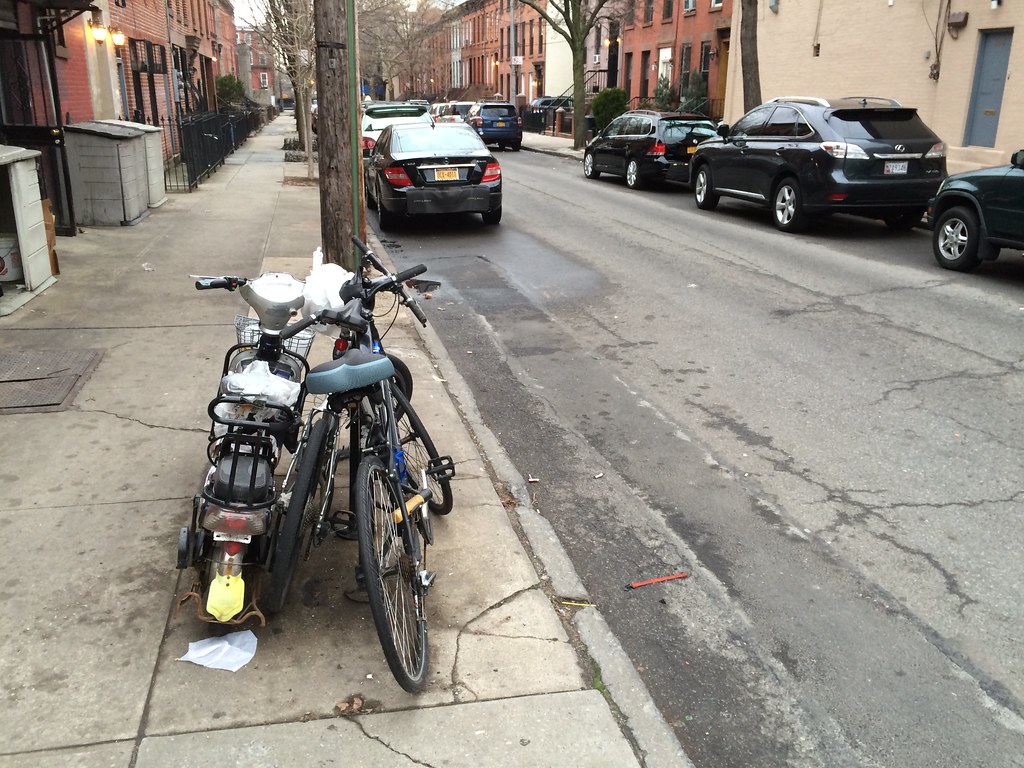
Nelson St: if you see the bikes locked to that pole and think
they're ruining the place, you'll fit right in.
There are few mysteries around how to alleviate cities’ parking problems. I remember my parents scrambling 40 years ago to buy parking tickets on my grandparents’ street in Edinburgh in Scotland under a then-new scheme to bring order to the city’s parking. It’s impossible to imagine so many New Yorkers would hang on to barely-used cars with dubiously-legal out-of-state registrations if parking cost a realistic amount in the densest parts of the city.

Yet I’ve heard since spotting the sign on Nelson St a week ago of a similar sign on another post elsewhere in the city. I see no evidence of any politician’s being willing to tackle the misery created by the wholesale storage of idle cars. New Yorkers continue, it seems, to accept the many problems created by motor vehicles but to express rage at the presence of far more space-efficient bicycles. Until that fundamental dynamic changes, many streets look set to continue to be like Nelson St – choked by the status quo, but full of residents raging at the prospect of change.