Showing posts with label Brooklyn. Show all posts

Sunday, 16 October 2016

A British Stand-off, an Unbridged Divide - and Why it's Time for Cycle Campaigners to Change the Conversation

There was something almost endearingly British about the standoff. In a typical autumnal light drizzle last Saturday in Swiss Cottage, North London, a group of other cyclists and I stood listening to speeches in support of the building of Cycle Superhighway 11, a planned segregated bike route from London’s West End, through Regent’s Park and up to the point where we were standing. Then, a demonstration against the plan arrived. Participants in the two demonstrations did some mild chanting at each other. Afterwards, we went our separate ways.
Protesters against CS11 meet its supporters, in Swiss Cottage:
a very British stand-off


But, however mild-mannered the two demonstrations at Swiss Cottage might have been, there has been no disguising in the past weeks that demonstrators like those opposing CS11 are growing increasingly vocal in many parts of the developed world. From Community Board meetings in Brooklyn to the pages of daily newspapers in the UK, there have been noisy complaints that newly-introduced or planned cycling facilities are a tyrannical imposition by unfeeling authorities out of touch with the feelings of ordinary people.

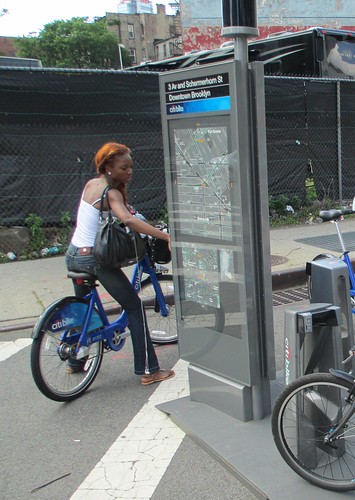
The UK’s Daily Mail two weeks ago produced the most eye-catching manifestation of the phenomenon, devoting a double-page spread to what it called “cycle lane lunacy,” which it said was “paralysing Britain”. However, there have been plenty of other examples. The Community Board that oversees planning issues in Park Slope, Brooklyn, and surrounding areas is preparing for a meeting where some locals are expected to vent their near-apoplexy over the Citibike bikeshare system’s arrival in their neighbourhood. Local councillors in Ayr, in the West of Scotland, have voted, under pressure from drivers, to remove the town’s only significant protected bike lane.
A cyclist and motorists in Regent's Park: a powerful
illustration of the arrangements the anti-CS11 campaigners
are fighting to preserve


Yet the cycling sceptics and supporters seem as incapable of meaningful communication as the two groups shouting at each other last Saturday morning. The motorists’ side complains that bike lanes often look empty. Cyclists argue that just shows cycling’s efficiency. Motorists complain that cyclists don’t pay “road tax,” as they do. Cyclists reply that vehicle excise duty in the UK has not been a hypothecated tax for many decades. Motorists complain that congestion is growing worse. Cyclists retort that the people complaining are themselves the traffic. My mind turned, as I rode home from Swiss Cottage, to whether there is some way to narrow this currently apparently unbridgeable divide.

A couple of incidents have highlighted to me the width of the communication gap. The first was on September 23 when, after I published in my day job a piece about the future of London’s roads, a former colleague wrote to me. He questioned whether it could possibly be true, as I had written in the piece, that some London roads with cycle superhighways were carrying more people per hour in rush hours than they were before the superhighways were put in place. He also asserted that cycling was, in fact, far more dangerous than people admitted and that, anyway, only the young and fit could do it.
Morning rush-hour traffic on the north-south superhighway:
no, there's no way this street's carried more people since the
segregated bike path went in


Then, two weeks ago, a fellow guest at a dinner party asked me how I’d found my just-finished four years in New York. Struggling to sum up the wealth of experience, I said that New York drivers weren’t terribly nice to cyclists. “But isn’t that how everyone feels?” he blurted out, before looking mortified as it dawned on him that I was, in fact, a cyclist.

The two incidents reminded me that cyclists, for most people, seem like a strange, alien species, taking unfathomable risks yet somehow eager to suck other, new people into participating in their strange mode of transport. The reminder was all the more stark because it was clear that neither of my interlocutors were people of ill will. They thought their frustration over growing cyclist numbers and efforts to facilitate cycling was simple common sense.

It is unsurprising to me that the many people who hold such views see dedicating road space that was previously mainly used by motor vehicles to cycling as a strange, ideologically extreme act. The Swiss Cottage demonstrators were portraying Transport for London’s determination to put in more facilities to encourage cycling as a bizarre, politically-driven effort to punish ordinary people. For many New Yorkers, the notion that a person might ride a bike to work is entirely crazy. That bikes to allow people to do so are now taking up what used to be their normal parking space must seem like a personal insult.
Drivers in a traffic jam by an empty bit of superhighway:
all, I'm sure, would be calmed to learn they're not paying
road tax.


Yet the response from many cycling advocates could be calculated to heighten the irritation, rather than calming it. For example, cycling activists often retort when drivers complain that cyclists pay no “road tax” that the UK abolished its hypothecated road tax - whose proceeds all went to road building and maintenance - in 1937. While the point is accurate, It is also a prissy, know-it-all one. Like many such responses, it deliberately misses the thrust of what cycling’s critics are trying to say - in this case, that they feel their transport choices are heavily taxed and they cannot see why others should use the same space for free.

It would make far more sense to point out that, while motoring is indeed heavily taxed in the UK, the taxes still fall short of covering the full external costs of the pollution, congestion, crashes and other side-effects. The argument is still clearer in the United States, where no state’s taxes on motoring cover even the annual cost of road maintenance. A tax-paying cyclist is, consequently, both saving the neighbouring drivers money and, if he or she previously drove a car, reducing the burden on taxpayers.

Cycling campaigners end up deploying plenty of other similar “well, actually” arguments about the terms of the debate, rather than the substance. There was a striking example in the last week when Quentin Wilson, a campaigner to shift even more of the burden for motoring onto ordinary taxpayers, tweeted a picture of the most westerly current section of London’s east-west cycle superhighway, just off Parliament Square. “Great new cycle lane but where are the cyclists?” he wrote above a picture of the empty lane.
A group of tourists refutes Quentin Wilson's contention this
bike lane goes unused - but also my fellow cyclists' claim
it's not open


Many cycling advocates accused Wilson of bad faith, responding with pictures facing in the other direction, showing a barrier that marks the end of the superhighway. I saw several people tweet with an excited, “gotcha” tone that the lane wasn’t (actually) even open yet.

I’d far rather that activists had pointed out the facts about the section of cycle track in question - and addressed the underlying issue. The section is lightly used because it’s short and doesn’t yet link to any other part of the cycle network. While I’ve used it several times myself, I have also bypassed it sometimes as inconvenient. It would, in addition, be worthwhile pointing out that the superhighways are new, incomplete and that people’s travel patterns always take a while to change after changes to infrastructure.

The Wilson case was one of a worrying number where I’ve seen cycling advocates on Twitter and Facebook accusing opponents of something close to false consciousness. Many seem reluctant to accept, for example, that the new cycle superhighways are currently lightly used outside rush hours or that, yes, motor traffic congestion really is growing worse. Yet I ride frequently on the superhighways outside rush hours and encounter few other cyclists. Arguments that accepted these points, explained what was going on and explained why cycling facilities can help to resolve the problems would be far more compelling.
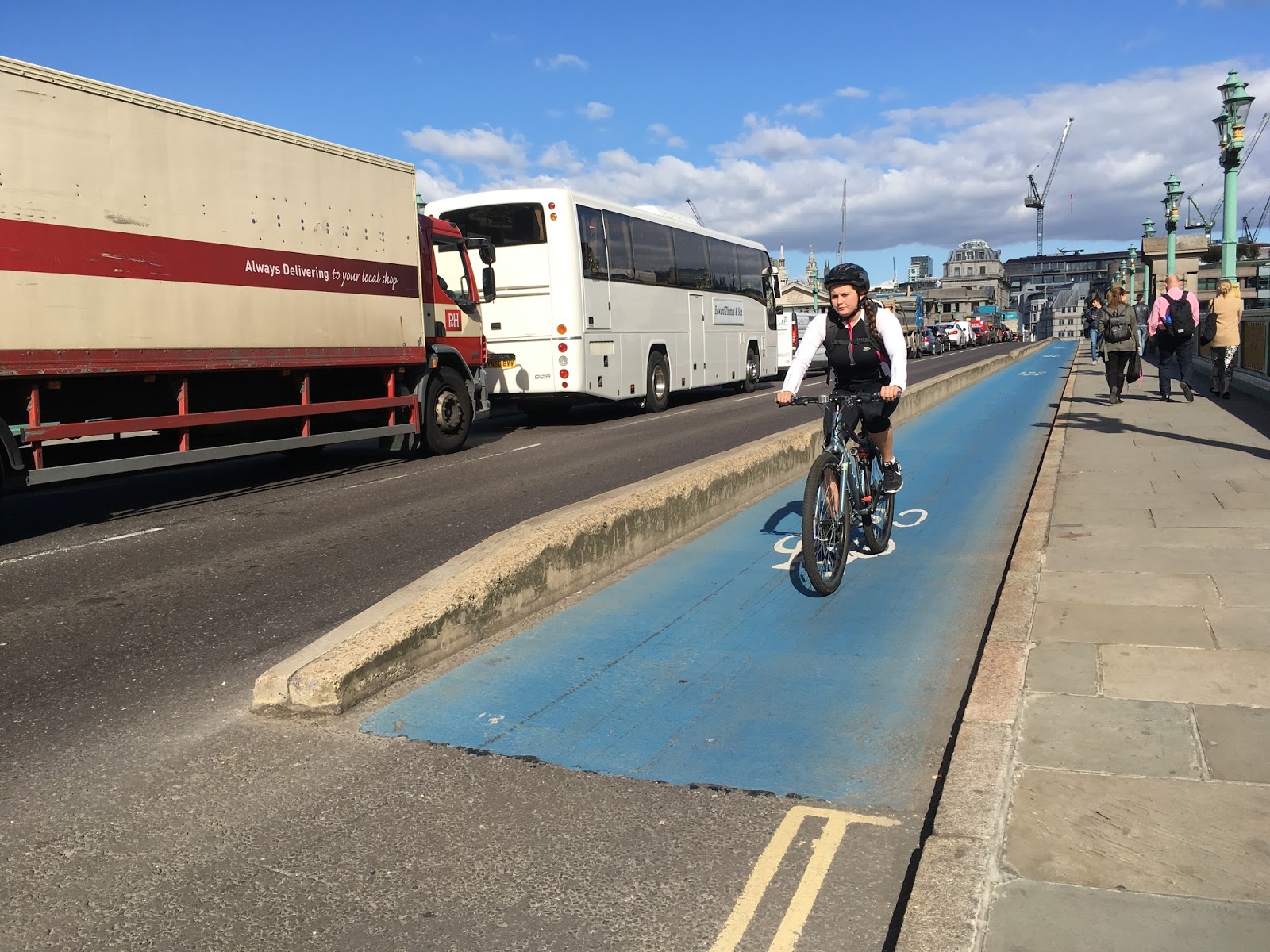
A rider uses the Southwark Bridge bike lane, one of those
singled out in the Daily Mail for paralysing Britain
The problem mirrors developments in the contemporary, polarised political scenes on both sides of the Atlantic. The echo chamber of Twitter feeds and Facebook pages full of like-minded people is gradually alienating many people from the idea that any sincere person could disagree with his or her point of view.

Such echo chambers encourage their inhabitants to feel particularly enraged at my fellow journalists. One Facebook thread I saw recently discussed how users might punish a reporter who had, the thread’s originator claimed, lied through the heinous act of reporting on the anti-cycling views of the London Chamber of Commerce and Industry. Yesterday, I saw two normally sensible Twitter users discussing how a well-regarded reporter who happens to write critically about cycling must be secretly in some sinister anti-cycling group’s pay. This afternoon, I’ve seen on Twitter a suggestion that an anti-cycling editorial in the Sunday Times might be a sign of a “concerted media campaign building”.

Sure, this space in Vauxhall is being very
well used: but how interesting is it to point
that out?
This imagining of sinister, hidden agendas behind newspaper articles betrays a frustrating lack of understanding of how actual journalists work. While I understand the London Taxi Drivers’ Association may have undertaken some lobbying and I know that some business groups oppose new cycling provision, it is naive and silly to imagine that reporters automatically bend to obvious efforts to influence them.

Nearly every reporter I know is driven by a desire to spot developing trends and to paint a picture of the world that will strike his or her readers as true and illuminating. Cycling campaigners should be far more concerned that large numbers of journalists are independently detecting a mood to dismantle or halt progress on cycling and far less concerned with finding a hidden force behind it.The truth, after all, is that progress on both sides of the Atlantic is fragile. There are strong reactionary movements in parts of Europe and North America. 

Many people see provision for cycling as part of a suspect, politically-correct effort to take away their cars. Governments and local authorities have often seemed sheepish about promoting their efforts to support cycling. The arguments for cycling - that it is more space-efficient than motor vehicles, that it causes no pollution, that it costs little to provide for and promotes health - are so obvious as to seem trite. Cycle campaigners would be better, it seems to me, to admit they have a vision for the future that’s different from that of their opponents and argue for their vision’s superiority.
Slow progress in Hyde Park: tangible evidence of the
fragile nature of recent gains
My ride home from Swiss Cottage made clear the costs of failing to get across the case for cycling. Wanting to see progress on the next sections of the east-west superhighway, I took a route through Hyde Park. I at first enjoyed riding down a completed superhighway section down the park’s western end. But then, abruptly, I not only came to the end of the open superhighway but encountered an unannounced closure of the whole southern road through the park.

After my queries about a route for cyclists round the closure drew blank looks from park staff, I instead headed reluctantly out onto the streets of Kensington, one of London’s least cycle-friendly areas. As I did so, the driver of a large Range Rover edged threateningly close to me. When that failed to elicit whatever panicked response the driver was seeking, he leaned long and hard on the vehicle’s horn, issuing a depressing reminder of where real power on the UK’s roads currently lies.

Wednesday, 20 April 2016

An angry driver on 8th St, two tragedies - and why New York cyclists aren't meant to be really there

It wasn’t a surprise but it was a disappointment. As I rode my bike on Saturday, fast, down 8th Street in Park Slope, a driver, coming up from behind me, thought she knew better than I where in the street I should be riding. She started – as happens very frequently when one rides down these streets, correctly, in the middle of the road - trying to honk me out of her way.

I’d ridden down 8th St because neighbouring, busier 9th St’s bike lane – sandwiched in the dangerous door zone for parked cars – is invariably clogged with double-parked cars. It’s far more dangerous and stressful than its narrower, one-way neighbours.
 
8th St: not New York's narrowest street - but would you want a
car passing you at 30mph as you barreled down here?
But, when she caught up with me at the next intersection, the woman explained why she thought she had the right to breeze past as if I weren’t there.

“You shouldn’t be in the middle of the road,” the woman told me.

“I was stopping you from overtaking me until I could let you past safely,” I said.

“You don’t belong in the middle of the road,” she said.

“Yes I do,” I answered.

Then, inevitably, as I rode off, a bystander shouted after me.

“Hey, you need to be on a street with a bike lane! You should be on Ninth Street!”

The exchange illustrated, in part, people’s automatic, infuriating assumption that they are clever and sophisticated and cyclists are uninformed simpletons making stupid decisions for unfathomable reasons.
 
A cyclist dodges round a car parked in the 9th St bike lane:
this is the idyll one bystander recommended I use
instead of 8th St.
But it also shed light on a problem facing cyclists in many cities making half-hearted attempts at accommodating cyclists. I was struck, as I rode on, by how cycling had been shoe-horned into New York City in a way that’s meant to avoid inconveniencing anyone else. No-one had ever told this woman that, yes, she might occasionally have to wait a few seconds to get past a cyclist. The builders (more accurately, painters) of the 9th St bike lane had sought to make it barely impinge on drivers.

The designs betray a profound confusion in public policy. There’s a vague instinct that cyclists can’t be entirely denied better facilities. But that goes hand in hand with cowardice about the idea that promoting cycling is a public good. There’s no sense that sacrifices to encourage cycling might be worth everybody’s while. The unspoken sense is that cyclists should take up no space, have no momentum and cause no-one else to modify any part of their behaviour.

The inevitable result is that cyclists are forced into making the compromises that others get to avoid. As I rode down 8th St, I faced a choice between being harassed for riding down the middle of the street or taking the risk of being hit by an inattentive driver’s opening door and knocked into the path of a driver passing me at 30mph. Had I chosen instead to ride down 9th St, I’d have faced a combination of both dangers. I’d have had to ride in the parked cars’ door zone then pull out round the parked vehicles, being tailgated by drivers who thought I should somehow not be out of the bike lane.
The Jay St "bike lane" in downtown Brooklyn:
evidence on its own of why New York's bike commuting rate
is so low.

It’s no surprise under these circumstances that cycling in New York remains a fringe activity, confined to a relative handful of us who think the personal benefits of getting about by bike outweigh the costs. It’s a situation mirrored in the many cities across North America and some parts of Europe.

The current circumstances practically guarantee that the benefits the planners were seeking from cycling – cleaner air, safer streets, better use of road space – won’t materialise. The dominant surviving forms of cycling – fast riding by the young and fit, coupled with widespread rule-breaking by riders fleeing dangerous drivers – are used as evidence that promoting cycling is a Bad Thing. It’s time for such cities either to get serious about cycling provision or to stop the current dangerous and stressful pretence.

Not, I’m sure, that any of this  would make sense from the perspective of the Angry BMW Driver of 8th St. It must, I accept, seem odd when driving a large vehicle down a street to see a cyclist, a single person on a  narrow vehicle, taking up the centre of the lane. It must, in certain circumstances, feel like a theft of the road space.
 
My bike computer after one run-in with
an angry driver being held up:
unacceptably slow in a city with
a 25mph speed limit.
I don’t ride down the middle of the road to make some abstruse point, however. As I use these streets, my bike computer often tells me I’m going well over 20mph. As a large man on a heavy bike with luggage, I have significant momentum. If a driver opened a door into my path or pulled out of a parking space without looking, I would be sent flying over my handlebars. These aren’t marginal, theoretical risks. Only a few weeks ago on 8th St, I had to swerve at high speed after a driver pulled out, fast, from a parking space into my path. Had I been riding where the Angry Woman thought I should, I could easily have been killed.

Nor was I in any real sense inconveniencing the woman. Like other narrow Park Slope streets, 8th Street is regularly clogged by double-parkers. The next block downhill features two speed bumps, which I can take without slowing down and drivers can’t.

The woman’s inability to pass me was clearly, however, an affront to her sense of her rights. Her lack of human sympathy for me as a fellow road-user seemed to have bled over into a wider resentment at my having any physical presence at all.

It’s a feeling I encounter surprisingly frequently, from both drivers and pedestrians. I’ve recounted before a run-in with a pedestrian who insisted on obstructing the Grand St bike lane in Manhattan. The Saturday before my dispute with the angry woman on 8th Street, I was yelled at by a tourist who insisted that, because he wanted to walk on the Brooklyn Bridge’s bike lane, I too should walk, not ride, over the bridge. I’ve come to understand taxi drivers’ tendency to pull out of parking places into my path as more a mark of their sense that cyclists can and should yield to them at will, more than a mere symptom of inattention.
 
The Brooklyn Bridge, complete with the bike lane
one recent critic told me no cyclist should expect to use.
The misunderstanding extends to those meant to enforce New York’s traffic rules. There has been understandable outrage after it emerged that a right-turning police officer knocked a cyclist off his bike on 9th St in Gowanus, very near my apartment, then had a fellow-officer write that his turn had been perfectly legal. My sense is that the incident might partly reflect police officers’ genuine conviction that it’s a cyclist’s job to avoid traffic turning across his or her path, not a driver’s job to yield.

I used to encounter similar attitudes when I cycled in London – and I can’t imagine they’ll have disappeared entirely when I return there later this year.

But London has at least started groping towards an answer to the kinds of incidents I keep encountering. After the disaster of the initial, blue-painted Cycle Superhighways, Transport for London has finally been shamed into providing some decent, segregated cycle paths on some of its busiest streets. Even when I lived there, London was already far better than New York at providing calming on side streets like 8th St to avoid incidents like the one I suffered on Saturday. There’s tragically no sign at all that anyone in New York feels under pressure to provide anything like that on this side of the Atlantic.

Yet New York’s continuing state of cycling limbo isn’t a merely theoretical problem. Cyclists truly can’t screech instantly to a halt of float harmlessly away from vehicles that menace them. The day before my row with the Angry Driver, a driver a couple of miles away had killed a cyclist riding to work in Clinton Hill. This morning, a huge truck, driving on a street where it wasn’t permitted, killed a man on his bike in Park Slope only 15 blocks or so from where I had my row.

Pedestrians walk down a temporary bike lane on 8th Avenue -
in a city that tells you cyclists don't really matter,
why wouldn't you?
The police’s instinct in both cases was immediately to blame the cyclists, essentially, for being where they were. They claimed – improbably, given what is known about her – that Lauren Davis, the victim in Clinton Hill, had been riding against traffic. They have focused, still more improbably, in the Park Slope crash on the theory that James Gregg, the victim, was hanging onto the truck that killed him to hitch a ride. I have never seen a cyclist in New York City do such a thing.

The instinct to exonerate the truck driver is all the more extraordinary given that it is clear he was breaking the law just by driving down that street. Both victims seem to me to have died from the grubby compromises forced on cyclists by cowardly road designers and politicians.

I am fortunate indeed that I have so far derived only physical benefits and no serious harm from my New York cycling. Yet, just hours after the Park Slope tragedy, I encountered the kind of contemptuous attitude that makes such tragedies  all too common. Riding through Fort Greene and needing to turn left, I looked over my shoulder to see the driver in the next lane absorbed in his phone, rather than his driving. Fearful that he wouldn’t spot me as I pulled across, I rode for a second or two staring at him while signalling.

That turned out to be an indignity too far. He sped up for a second or two, to block my turn. Then, when I’d successfully pulled left and turned out of his way, he yelled abuse. He was furious that I’d made him momentarily take his mind off his text.

Monday, 14 March 2016

A blizzard-blanketed morning, a Red Hook tragedy - and why road safety is part of tackling racism

On January 24, the day after New York City disappeared under a near-record blanket of snow, I managed to make the mile-long journey to morning worship at my church, All Saints’ Episcopal in Park Slope. But, when I looked round the markedly sparser-than-normal congregation, I recognised something unusual. While around half the faces looking back at me would normally be black or brown, that morning nearly everyone was white.
 
Park Slope the day after the blizzard: the streets weren't
the only thing that got whiter.
The change reflected the city’s demographics. The black – particularly African-Caribbean – families that once lived in Park Slope have been steadily shifted into outer bits of Brooklyn and Queens, with poor public transit. They were marooned at home. Far more of the white, mostly better-off members of the congregation were able to get to worship on foot or on the functioning bits of the subway.

The sudden shift was a particular regret for me that Sunday because I was due after the service to give a talk, together with Transportation Alternatives’ Tom DeVito, on the moral imperatives for making the city’s streets safer. In preparing for the talk, I’d unearthed a trove of material about the disproportionate dangers facing black people and other minorities on streets across the US. Some of the people with the most urgent stake in what I had to say wouldn’t get to hear it.

Yet much of the commentary I’ve seen on the effects of racism on black people’s transport choices focuses on the far narrower issue of black people’s disproportionate chances of being stopped by the police while driving. It’s an important issue – and one of the many reasons why I’m keen for the US to start using more colourblind traffic cameras for roads policing. However, the focus on that issue – and the squeamishness it sometimes induces about tightening up enforcement of road rules – often obscures the pervasive effects of racism on how black people get about, and how safely.

Black people often live in areas with more than their fair share of traffic deaths - but they are disproportionately unlikely to own their own vehicle. They suffer more than other groups from the bad consequences of the US’s auto culture while gaining fewer than others of its benefits. Making cities’ roads safer – and, in particular, making the streets of black people’s neighbourhoods safer – is far more than an environmentally-friendly nice-to-have. It’s an integral part of overcoming centuries of racism in the United States.
 
Hicks and Lorraine Streets in Red Hook: near my house
in distance, but a world away in experience.
It’s not hard, after all, to discover how racism leads to road deaths. On the morning of June 2, 2014, only a short distance from where I live my privileged white existence, Nicholas Soto, a 14-year-old black boy, crossed the street from the Red Hook Houses, a public housing project, to get to his school bus. As he crossed – at an intersection that if the law were properly applied would count as an unmarked crosswalk – the white driver of a BMW that seems to have been comfortably exceeding the speed limit – sent him flying up into the air, killing him.

The Red Hook Houses are among the many drab housing projects built around New York as part of the “slum clearance” programme by Robert Moses, for many decades the city’s most powerful man. Moses’s decision to place the housing in often out-of-the way places – the Red Hook Houses are deeply inconvenient for the subway, particularly because of the barrier formed by Moses’s Brooklyn-QueensExpressway – puts residents at a permanent disadvantage.

The projects were developed, meanwhile, in ways that Jane Jacobs, the pioneering urbanist, convincingly argues serve to make the spaces hostile to residents’ needs. The streets outside such projects lack the bustle they would have had if the houses had opened directly onto them. Drivers consequently tend to treat the roads – including the one where Nicholas was killed – as urban freeways, to be navigated far too fast.
 
The road past the General Grant Houses,
in northern Manhattan, in case you
wondered why more people died on the streets
in such areas.
Yet the residents of such projects – who are overwhelmingly black or from other minority communities – have little choice but to get about such streets under their own power or by public transport. In 2006, Alan Berube of the Brookings Institution and Elizabeth Deakin and Steven Raphael of the University of California Berkeley published research showing that 19 per cent of black households in the US had no access to a car, compared with 7.8 per cent of households as a whole. Even among non-poor black households, 9.9 per cent had no access to a car, compared with 4 per cent for the US as a whole. The figures for New York – which has much the lowest rate of vehicle ownership in the US – must be far higher.

The disparity probably reflects the same reluctance to extend credit to black people that left so many exposed in the first place to Moses’ mass demolitions of rental properties. The results, meanwhile, are unambiguous. Children and adults from well-off families do, tragically, die in well-off areas such as Park Slope or the Upper West Side. But people like Nicholas Soto are over-represented in the death toll.

Research in 2010 by the New York Department of Transportation found that people from minority communities were more likely to be hit while walking or cycling. The effect reflected street designs in areas such as the Red Hook Houses. There were higher crash rates in areas with high proportions of black people. But black people and other minorities were no more likely than other people to suffer crashes in areas away from their homes.

All of this, of course, should prompt some self-reflection. For people like me, it’s a reminder that we should not only think about our own demands for better bike lanes and pedestrian crossings in comfortable, inner parts of our urban areas - but also about the needs of poorer, farther-flung parts of the city. If the street outside the Red Hook Houses had been narrowed by a well-designed bike lane, the BMW driver would almost certainly not have felt able to drive as fast as he did. Nicholas might still be alive.
8th Street in Park Slope: a safer place, statistically speaking,
 for everyone to get about.

Meanwhile, for people who insist that lower speed limits, loss of parking spaces and restrictions on car use represent the smothering of a vital form of freedom, it’s worth asking whose freedom is more important. Why are the critics of change so ready to perpetuate motor cars’ dominance of urban spaces when it so clearly entrenches the privileges of richer, whiter people at poorer, browner people’s expense?

But the issue matters to me on a personal level too. When I arrived at church for worship eight days after the blizzard, I was reminded what had been missing the previous Sunday. I was greeted again in warm accents from all around the Caribbean. There was a sense, which had been dulled the previous week, that I was a member of a community alongside this diverse group of people, even though I know most of them only in passing.

Many of the attitudes that make deaths such as Nicholas’s so common reflect an aversion to treating New York City – or the US as a whole – as a true, integrated society. Some of the failures are to do with failures of road safety policy. New York’s police department often lapses into thinking victims cause most crashes. They blamed Nicholas’s death, for example, on his wearing a hoodie, which they claimed obscured his view. The evidence and common sense show drivers cause most such crashes.
 
All Saints' Church: the place that gives me
a wider sense of community
But it’s also common to hear people suggest that residents of places like the Red Hook Houses could get ahead just as well as anyone if they put their minds to it. It’s an obvious obscenity to believe that people who’ve been systematically prevented over centuries from accumulating capital or getting an education are anywhere close to starting  from the same place as privileged people such as I.

I myself largely ignore the reality of living in a complex, mixed community. Although I lived close to Nicholas Soto, it’s unlikely I’d have ever met him had he  lived. I find myself jumping to lazy assumptions about drivers or people I see on the street, based on ingrained prejudices based on their appearance.

But the Sunday morning after the blizzard and the Sunday following were a reminder that I don’t live entirely in privileged isolation. I smile at, chat with and take communion alongside people whom current policy leaves unjustly exposed to unjustifiable extra risk of traffic death. It’s just as much – if not more - my moral obligation to seek better road conditions for them as it is to seek them for myself.

Monday, 2 June 2014

An idle hour, worried taxi drivers - and why only the dumbest don't plea bargain

The man looked me up and down and, mistaking my light grey, Brooks Brothers suit for a sign I had an official role at the Taxi and Limousine Commission tribunal, asked me, “Are you the lawyer?”

“No, I’m a witness,” I replied.

A brief, awkward silence ensued.

“You are in favour of the driver?” he asked, in the accent of somewhere in South Asia.

“No,” I said. “The driver tried to assault me, so I’m very much not in favour of the driver.”
 
New York City taxi drivers, before humanisation
The man’s error, I realised during the 90 minutes I spent this past Thursday at the New York Taxi and Limousine Commission, was an understandable one. We were all at the TLC’s Office of Administrative Trials and Hearings because of things that had happened somewhere on New York City’s streets. The steady stream of mainly South Asian men that trooped out of the elevators on the 19th floor of the TLC’s building in the Financial District had all, presumably, done something negligent or dangerous that would have infuriated or horrified me if I’d witnessed it. There’s an equally strong chance that, had we encountered each other on the street, we'd have been yelling at each other.

But, as I waited for my moment of courtroom drama, I found myself viewing the drivers, shorn of their yellow cabs or Town Car limousines, differently. They were hard-working immigrants worried about what their day at the tribunal would mean for their livelihoods. Once there was no obvious sign (apart from the pair of pannier bags at my seat) that I was a cyclist, I suddenly turned into someone who might make this bad day better for them. Off the roads, our shared humanity came to the surface.
 
The scene of, if not the crime, at least the breach
of Taxi and Limousine Commission regulations
Not that the reason I was there was touching or reassuring. I was due to attend a hearing over my complaint against a car service driver that I found one night in March blocking a cycle lane at a particularly dangerous junction in downtown Brooklyn. Since he was leaning against the car and there were plenty of legal alternative places to park, I asked him to move. After he angrily refused to do so, I tried to take a picture as evidence for the TLC. That sent him spiralling into a far more intense fury and he not only swore at me and called me a “white devil” but made grabs for both my camera and bike.

When I arrived at the office at 8.50am on Thursday, however, I recognised none of the drivers waiting anxiously for hearings. A short while later, a TLC prosecuting attorney emerged to tell me my driver had so far not turned up. If he hadn’t arrived by 10am, he would be in default and found guilty of all the charges. He apologised for making me wait.
A New York taxi cab in action: quiet professionalism

But I was already growing interested in the transactions I could hear taking place around me.

“OK, so the complaint’s withdrawn,” I heard a TLC official telling a woman I took to be a driver’s lawyer. “So he doesn’t have the points. You just have to make sure he doesn’t get two more points or he’ll get another summons.”

Another driver was standing, head cocked, listening carefully to a TLC attorney.

“This is the offer,” he was being told. “We give you a $300 fine and no points.”
 
There was then some discussion about whether the driver had been given a previous chance to consider the offer, before it became clear that he would accept it.

“If that’s what you want to do, we’ll go in front of the judge and withdraw everything else,” the official told him.

Would you feel like veering left round a limo parked
at this intersection? One evening back in March, I didn't.
The tribunal, I started to realise, seldom dealt in courtroom drama of the To Kill a Mocking Bird kind. I’d carefully taken pictures of the intersection involved to show the judge how dangerous it was to park in that bike lane. But I’d never been likely to get my moment in court. The tribunal dealt instead in the kind of mildly unsatisfactory plea-deal compromise that Maurice Levy would persuade a drug gang’s members to accept in The Wire. The transactional nature of the interactions was such that I even heard someone who seemed to work at the TLC shouting cheerily to someone who appeared to be a driver, “Nice to see you here again!”

My mind went back to my most recent journey in a New York City taxi – my first since I moved permanently to the city nearly two years ago. Arriving at nearly midnight at LaGuardia Airport ten days ago, I opted for a taxi over the late-night vagaries of bus and subway. I found myself hurtling at 70mph along the uneven surfaces of the Brooklyn Queens Expressway. The driver hunched over the wheel of his Ford Escape, a hunted look in his eyes.

It was obviously dangerous driving – he tailgated other vehicles, drove too close to the concrete dividing barriers and generally, I eventually told him, drove like someone who would one day kill another road user. He didn’t seem in any way a bad person, however. He was remarkably calm and receptive once I started fully explaining to him why his driving terrified me. I slightly reduced my tip in line with my previous advice on how to shape taxi driver behaviour. I couldn’t help wondering how well the endless transactions at the TLC fulfilled the wider goal of persuading drivers like mine to use their vehicles more safely.

Yeah, sure it looks like a clear rule breach
to you. What will it look like after a
plea bargain?
Yet, as my hour ticked by, it became clear I’d got into a row with one of the few for-hire drivers who didn’t understand how to play this game. My driver had been charged with three counts – a parking violation; harassment; and making threats of, or actual use of, physical violence. He faced points on his licence for the parking, a $200 to $1,000 fine for the harassment and a fine of up to $1,500 for the violence element. He could, in theory, face a suspension or revocation of his licence but the prosecutor made it clear the judges didn’t like using that.

Having listened to the other conversations, I’m confident the prosecutors had foreseen a deal dropping the violent element in exchange for guilty pleas to the two other charges. As it turned out, unless the driver can provide a good reason why he didn’t attend, he’s been found guilty of all the charges and could face the maximum penalties.

It was an outcome that initially pleased me. I headed back outside to find the Financial District bathed in bright, warm sunshine I’d been unable to see inside, unlocked my bike and prepared to head back to the office. I remain grateful to the TLC for taking my complaint seriously and acting on it. It’s better than the only previous time I complained to them, when they insisted they couldn’t identify the driver involved based on his licence plate number.

But Beaver St, outside the offices, was packed with cars, their drivers leaning impatiently on their horns. As I headed north towards the Hudson River Greenway, motorists were cutting inside each other, jostling for minuscule advantages with little regard to the danger or inconvenience their behaviour was creating for other people. As I rode home that evening, I once again had to dodge round a for-hire vehicle parked exactly where the driver I encountered had been. I hadn’t the heart to ask him to move.

I’d won one hollow, easy victory in the campaign for more civilised streets. But I got home far from certain the war was being won.

Update, June 10: I've just heard that the driver was indeed found guilty. He will have to pay a $3,050 fine and have four points on his licence.

Wednesday, 26 March 2014

A frightened old man, an angry taxi driver - and why one big thing I fear is fearlessness

It was a rare moment when I felt sorry for a New York motorist. The elderly man, clearly confused about where to go, had got out of his car to assess where he was meant to turn at the Manhattan end of the Manhattan Bridge. But it was 11.30pm on a Friday; other drivers were impatient and he was blocking the left turn from Chrystie St into Canal St in Chinatown. “Honk!” “Hoooonk!” “Haaawnk!” His face expressed an emotion that’s all too familiar to me – fear of aggressively-driven cars. “What if one of these cars just slams into me?” he seemed to be thinking. “How can I most easily escape all this honking?”

New York City traffic: it certainly looks intimidating
The scene resonated with me. I’d not long before had an online conversation with someone who’d expressed regret that, although there was a new Citibike bikeshare station outside her house, she was too fearful to cycle in New York City. It just felt like far too great a risk, far too great a worry, she told me.

The exchange had heightened my awareness of the fundamental scariness of New York’s fast-moving traffic – and my own reaction to it. I feel concern when I hear a car speeding down a narrow, one-way street behind me. “Is it going to slow down when it reaches me?” I ask myself. “Will it tailgate me to intimidate me?” I worry when I ride through downtown Brooklyn in the mornings about anticipating the unpredictable behaviour of the drivers. The click in a car door that someone’s about to open sets off a spike of panic. People in other circumstances must feel something similar at hearing the cocking of an unseen gun. I used to feel similar alarm about cutting across the lanes of traffic around the Oval cricket ground in London during my commute to work there. “Get me out of here,” I’d think. “Any moment now, some idiot will come speeding round the blind corner.”

But my awareness of fear has also made me realise how year after year of daily cycle commuting in multiple different cities has changed my experience of the emotion. I’ve learned, I think, to manage my fear, to train it to push me towards the right decisions. I wish cycle commuting weren’t as stressful as it sometimes is and I know that riding a bike in a city isn’t nearly as dangerous as it sometimes feels. I also recognise that the health benefits from cycling on average outweigh the risks.

For the moment, however, I’m embracing the way my worries set off ancient fight-or-flight responses. I treasure how they keep me focused on riding as safely as I can amid what sometimes seems an almost unmanageably chaotic environment.

Smith St: challenging even on days without freezing rain.
That doesn't mean I wouldn't like a better cycling route to work, just as I yearned for improvements when I lived in South London. I head off each morning down Smith St in Brooklyn navigating round long lines of vehicles whose drivers clearly aren’t paying enough attention. They’ll lurch suddenly in or out of parking spaces. They’ll open doors unexpectedly. Drivers spot the side street they want and turn into it, oblivious to the idea they might be crossing someone else’s path.

The short – and generally less busy - section in Cobble Hill is still worse. Drivers floor their accelerators, speeding up like greyhounds released from traps. There, I look warily over my shoulder, knowing that, if I have to pull out of the narrow bike lane to avoid a car door, a pothole or a delivery truck, the cars could be moving too fast to avoid me. Then it’s back to a chaos of illegally double-parked cars, stray pedestrians and inattentive drivers. My stress levels and emotions swing wildly between the sections where I’m cut off from cars and can concentrate on riding – the Manhattan Bridge bike lane and Allen St in Manhattan – and the rest.
 
Allen St, Manhattan: believe it or not, this is one of the
least stressful spots on my daily commute
When I’m riding among motor vehicles, I enter a state that sometimes feels like hyper-consciousness. My attention has to dart from checking a set of traffic lights and the openness of the road ahead to focusing suddenly on the state of an individual car’s wheels. It’s badly parked and the driver’s just got in. Is it about to pull out in front of me? Oh, and just how deep is that new pothole? There’s no denying it’s so intense as sometimes to be invigorating.

I can't remember when the fear started pushing me towards safer, more sensible riding options. Once upon a time, I’d have let drivers scare me into riding right by the roadside even in the narrowest sections, where a passing car posed a serious danger. I’d let a car on my tail harass me into being uncertain about my line on the road, exasperating the impatient motorist more. I’d move back to the side of the road after swinging round a parked car as quickly as possible, without checking for obstacles in the bike lane or other riders. I’d ride in the door zone – the area where opening car doors are the biggest risk.

My anxiousness, I find now, makes me more resistant to shifting over to the side with a car on my tail, keeps me firmer in my line and makes me more cautious about making sudden changes of direction. My fear has become far better trained. It impels me constantly towards behaviour that every manual suggests is more likely to keep me safe than my former nervous, scared responses.
 
Hudson St, lower Manhattan: sure, you see
a magnificent urban thoroughfare. I see a
cycle lane I know is constantly blocked
by deliveries, food trucks and taxi drivers
So far from being a regrettable instinct in an urban cyclist, it strikes me, a well-trained fear is actually vital. It pushes me to go faster when the best way to avoid a motorist behind is to outrun him or her. It prompts me to go more slowly – with a better chance of stopping safely in an emergency – when in close proximity to seriously dangerous behaviour. It sometimes prompts me to pull over and let an aggressive motorist past on a narrow road – but only when I can safely do so.

My well-trained fear may even, it’s no exaggeration to say, have saved my life one morning in February. I was riding fast down Smith St’s cycle lane but scanning the cars. My gut instinct for when stupid behaviour is most likely had warned me of potential trouble. Sure enough, as I was almost upon it, the driver of a Ford Ranger pick-up truck pulled into my path, fast, without looking. Thanks to my inherent suspicion, I was already on my guard, aware of my surroundings and prepared to swerve left to get out of the way. I screamed “Stooooop!” at the top of my very loud voice. But I still felt a moment of certainty that I would land in the road. A mixture of my brakes, my screams and the driver’s belated response brought both of us to a halt only inches apart.

This well-trained fear, of course, isn’t going to keep me safe indefinitely. I already had it in 2009, when a car came from behind me in London, turned across my path and knocked me off. Most bike/car crashes are the motorist’s fault and there will be many circumstances where the cyclist can do nothing to avoid a motorist’s stupid behaviour.

Nor is there going to be mass cycling in rich world cities as long as things remain this intimidating. I’ve learnt how to train my fear because I have an itch to cycle. I might not have developed the itch to cycle if I’d known how scary it might sometimes feel.

But the most immediate downside to being hyper-aware of the risks one’s running is that it can produce a rather obsessive focus. That led me last Thursday into a position almost as dangerous as the ones I spend so much time avoiding.

Downtown Brooklyn, from afar. Not pictured:
homicidally negligent double parkers, furious limo drivers
Tired and frustrated as I rode home, I spotted a limousine parked blocking the bike lane at the corner of Smith and Fulton Streets. Since the driver was lounging on the vehicle, which he could easily have parked somewhere less dangerous, and since I was tired of pulling out round illegally-parked cars into traffic, I pulled up behind him and asked him to move.

Meeting a volley of abuse, including assertions that the United States was a “free country” and that I should “back the f*** off,” I decided to take a picture of the driver and licence plate, send it to the Taxi and Limousine Commission and leave it at that. I quickly found myself confronting a still angrier driver, who made grabs for both my camera and my bike.

Aware now of my misjudgement, I rode off to collect my thoughts. “You’re a white devil!” I could hear him shouting as I pulled out my phone to email myself his registration number. I was no longer feeling the constructive, focused, well-trained fear I experience when navigating the streets. I was undergoing the humiliating fear of someone who’s run away from a fight. My hands were shaking.

It was partly because of that experience I felt such fellow-feeling the following evening at seeing the frightened motorist. I wish big, western cities' traffic conditions weren't so apt to frighten people.

But somehow I still feel more dread in the pit of my stomach at the idea of a day when snow will stop me riding than at a repetition of the row with the Angry Limo Driver of Downtown Brooklyn. I even accept with some kind of resignation that I might, in future, not avoid a badly-driven car and might suffer another injury.

I shrink from some of the individual battles, it seems. But in the long run, in the war to keep riding, I don’t want to surrender.

Saturday, 8 March 2014

A snowy park, a wintry spin - and the joys of no longer being a flabby teenager

It’s not the kind of issue that normally preoccupies me while I’m cycling. But, glancing down at my bike computer, I could see my pace had dropped. Where shortly before the average speed figure had been showing 16.5mph, it was now showing 15.1. The dip gave me fresh determination. “Speed up!” I ordered myself. “Reach the top of the hill without dipping below 15!” A few seconds later, I crested the hill in Prospect Park, near my house in Brooklyn, with my computer still showing a 15mph average speed. Slipping my chain onto the biggest chainring, I sped up off down the hill towards Grand Army Plaza.
Prospect Park in the snow: however badly I ride round it,
it's a breathtaking backdrop for my humiliation

This wasn’t my normal kind of bike riding, however. I’d seen earlier in the day the forecast for yet more snow for New York City – it’s already the city’s seventh-snowiest winter on record – and I thought my chances of commuting by bike in the next few days were limited. I consequently decided, although I didn't have anywhere to go, to use a break in the weather to get some exercise. Checking that I had no immediate domestic responsibilities, I slipped off after church for a very brief bout of cycling purely for the physical activity.

I’ve found myself, when I’ve been undertaking these rides, involved in an activity that’s both entirely familiar to me and rather alien. I’m used, of course, to riding my bicycle (even if this winter has made that hard-going at times). I’m accustomed, however, to focusing on getting where I’m going in one piece – which can be demanding in a city full of angry drivers and bad road surfaces. I’m not used to focusing on the cycling – or its effect on my body – for its own sake.
 
A clear road amid deep snow: how Prospect Park has looked
for much of this miserable, long winter
I’ve been interested to discover how negative many of the associations in my mind of taking pure exercise are. As my pulse rises and my breath grows wheezier, I’m back amid the humiliations of a secondary school playing field. I feel the scorn of the teachers and my fellow, marginally less inept pupils for my uselessness at playing rugby union. As steely-faced weekend road warriors pass me, their wheels making the distinctive rumble of expensive carbon-fibre, I feel fat, lethargic and more than a little silly.

And, yet, I have to remind myself, it is this alien activity – rather than my daily transport cycling – that many people regard as the most authentic way to ride a bicycle.

This isn’t to say I’ve never cycled just for the sake of it before. My love for cycling developed substantially during my years at St Andrews University, when I’d ride off some Saturdays or Sundays towards Crail, Anstruther or one of the other nearby fishing villages. The whipping coastal winds would propel me one way. Then, after I started heading back, I’d have to dip my head down into the wind and speed along the quiet, undulating country roads across the moors.

That early, carefree exploration culminated in the summer of 1990, when I alternated between working at clearing out my recently-deceased grandfather’s house and spending days exploring Scotland. I’d head off in the morning for a ride that took me up the shore of the Gareloch – a ride made spookier by the area’s hosting the tightly-secured base for the UK’s nuclear missile submarines. I’d head back to Glasgow via the shores of Loch Lomond. I’d ride, pushed by the prevailing winds, from Glasgow to Dunfermline in the morning. Then I’d push down hard on the pedals and hunch down for a long ride back – via the Forth Road Bridge and into the wind - west.
 
"It's nice out here," remarks my bike during a rare trip outside
New York. "Why don't we do this more often?"
I didn’t find things too complicated back then. I wore no helmet, carried no supplies, rode a very basic Raleigh bike and worried about pretty much nothing. Caught in a tropical-style West-of-Scotland summer downpour? Dry yourself off under the hand dryers in the lavatories at lunchtime. Bit off more than you could chew with this 100-mile ride? Stop in every other village for a pint of milk to glug down.

I’ve had occasional bouts of just-for-the-sake-of-it riding since then, albeit the time constraints and obligations of adult life have curtailed them. When I lived in London, I’d occasionally make it to Richmond Park – the vast royal park in south-west London - where rides are enlivened by the possibility of a collision with a big, wandering deer. Last summer, with the family absent, I took two long rides over New York City’s boundaries, over into New Jersey and up into Westchester.
 
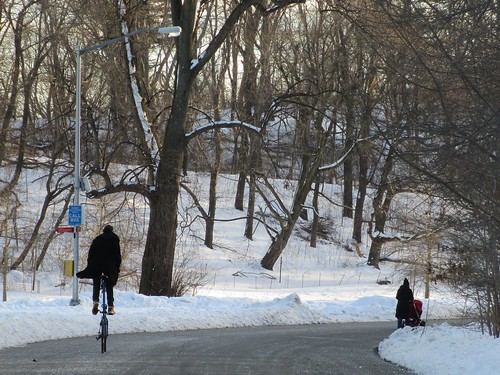
Bored with just riding round the park in circles?
Why not ride round it on a tall bike, like this guy?
But there’s something about riding in circles in Prospect Park – Brooklyn’s smaller equivalent of Central Park, non-New Yorkers – that feels far more self-consciously like Exercise - or Training, as it's now been rebranded - than any long trip to the different scenery out of town. The other riders in Prospect Park mostly wear the set, grim expression of a person battling to wrest back top spot on some Strava segment. Most seem to form a spooky unity of body, bike and clothing. Shoes merge into pedals, gloves into handlebars. The helmet might as well be some final, elaborate cap on top of the whole bike, rider, clothes ensemble, rather than a separate piece of clothing.

No-one would make that mistake with me. I arrived in Prospect Park last Sunday wearing woollen trousers, a cotton shirt and leather shoes. My waterproof jacket, trouser straps, helmet and gloves were my only cycling-specific clothing. And, of course, I was not wearing my clothes over a body honed by constant training for some forthcoming triathlon. I carry about in my body the evidence of thousands of late nights at work, followed by dashes home and swallowings of hurried dinners with wine. My clothes and body were both as floppy and aerodynamically-inefficient as many other riders’ were taut and tight-fitting. I look what I am - like a cyclist whose rides are nearly all, in sports cyclists' dismissive term, "junk miles".

That self-consciousness only rose as I started to ride, heading down the hill towards Flatbush, and sped along the road between the lake and the parade grounds at the park’s lower end. It became clear as I started climbing the hill – the ridge over which British and American forces fought the battle of Brooklyn in 1776 – that I was making an effort. I started to breathe hard and wondered why I always seem to have a cold. I briefly felt myself once again 15 and on a mud-spattered, rain-soaked cross-country run.

But much of the reward of this exercise is that I’m avoiding not doing it. In weeks when it’s been hard or impossible to ride, I’ve built up a deep twitchiness at my lack of activity, the shortage of time spent outside, a feeling of being trapped when commuting, sedentary, on the subway. Even a short, fast ride starts to scratch that itch.
 
Me - and my body - in The Bronx. There are
no excuses for my beer belly,
so I'll make none.
And, as I powered up the hill, I remembered that I was no longer entirely the unfit, unco-ordinated teenager. While my flabby torso isn’t much of an advert for commuter cycling, it sits atop a pair of legs that have spent years propelling me to 4,000 miles or more a year of riding first through South London and, now, daily between Brooklyn and lower Manhattan. Even if some of the weekend warriors overtake me on a climb, I generally gain the occasional, minor victory, pumping my legs up the hill past one of them.

I started to feel the pleasure of how a bicycle magnifies one’s effort. Pumping my legs, I climbed the hill smoothly by my standards, at around a steady 14mph. Down the hill, my biggest gears propel me to close to the park’s 25mph limit and I felt the childish sense of joy that always comes with giving oneself over to gravity’s acceleration. I started to feel a deep sense of contentment - the result, I imagine, of the release of endorphins, the exercise-related high that people keener on exercise for its own sake chase so hard.

I realised after a while that that feeling of contentment wasn't unfamiliar. I recognised how much of the time when I’m riding I’m running late, pushing myself to reach the next lights before they turn red, powering up the Manhattan Bridge to avoid being late for a meeting, switching to the big chainring to get uptown faster, accelerating away from traffic lights to get out of the way of that badly-driven taxi.

There’s no immediate danger of commuter cycling’s turning me into a lean, efficient cycling machine like the ones whirling efficiently round Prospect Park each weekend. But, as I turned out of the park again and prepare once again to tackle the indifferent conditions of New York City’s streets, there was no doubting that I was feeling better.

I appreciate with my higher brain centres the many more and practical reasons why more and safer cycling would make the city a better place. But the deep satisfaction that I felt flooding through my body reminded me that, no matter how deep my embarrassment, I retain a childish joy at the simple act of riding a bicycle. The day it starts to fade will be the day I feel as old as I look.

Sunday, 16 June 2013

Red lights, stress hormones - and sympathy for Dorothy Rabinowitz

It’s the kind of scene that anyone using a busy city’s streets in the last few years will have encountered. “Hey, red light!” a pedestrian shouted at a couple riding down the Tillary Street bike lane. Unabashed, they continued through the crosswalk and on towards the Brooklyn Bridge. I, with the Invisible Visible Boy on his trailer bike, waited for the family to finish crossing. The man did so glowing with self-righteous indignation at the cyclists who had rolled slowly through the crosswalk a few yards ahead of them.

It was an inconsequential incident, in an area where I’ve encountered the aftermath of several nasty car crashes. The family in the crosswalk were not in any way seriously endangered, while the cyclists were far from completely reckless. I partly understood the cyclists’ behaviour. The crosswalk in question is lightly used – and any cyclist who waits until the lights turn green risks either a long wait to ride onto the Brooklyn Bridge or a dash across in front of traffic just as the lights there change.

But the family, I suspect, will have gone home cursing “scofflaw” cyclists. Next time one of their friends mentions the possibility of starting to cycle to work or to get the kids to school, they’ll suck at their teeth and mention how that couple totally blew through the lights by the federal court in front of them. When they’re driving, they’ll perhaps be a little less inclined to see cyclists as fellow human beings and a little more as the kindred of those people who rode in front of the family (the closeness of the encounter may by now have become considerably exaggerated).

The back of the New York City Cycling map:
an impossibly obscure place, it seems, to hide from senior
journalists what cyclists are told about the law.
I’ve been pondering the extraordinary mismatch between the irritation over cyclist misbehaviour and the actual danger it poses over the past fortnight since the Wall St Journal published a bizarre video featuring Dorothy Rabinowitz, a member of its editorial board, sharing her thoughts on New York City’s new Citibike bikeshare scheme. Among her claims were that “everyone” in New York City knew cyclists posed a greater danger than yellow cabs (a collision with a bike last killed someone in the city more than four years ago). She also complained about seeing instructions on the doors of taxis warning her not to door cyclists, claiming that cyclists were not given similar instructions on safe behaviour (a glance at a Citibike, the NYC bike map or pretty much every other piece of cycling-related literature from the NYC Department of Transportation could have swiftly debunked this claim). The videos have helped to spur plenty of discussion about the virtues or otherwise of cycling in New York City – but have started the discussions off from a profoundly unhelpful point.

I’ve felt disinclined, however, to dismiss Ms Rabinowitz’s ravings entirely since a discussion with a colleague in the wake of the video’s release. I related to this colleague – who is certainly not unreasonable or poorly inclined towards cyclists – how that morning I had seen police stopping a cyclist who was riding recklessly. She expressed relief, on the grounds that more needed to be done to stamp out bad cycling. New York’s police department, I pointed out testily, already gave cyclists more traffic tickets than their share of the traffic would suggest they should receive. The ticketing was even further out of line with the damage that cyclists did to other people. It was motorists’ law-breaking that needed to be a higher priority. When cyclists rode on the sidewalk and she was walking her dog, however, she feared they were going to harm her dog, she replied. We both grew steadily more agitated.
 
Since we're talking politeness, I could have done without
the language on this parked single speed. Thank you.
We had both, I realised afterwards, started during our conversation to recall stressful incidents we’d experienced on New York’s streets. The stress hormones that had coursed through our bodies at the time began to move again. As our adrenalin rose, we both gradually became more defensive and less amenable to reason. The conversation made me realise that, yes, some people do find interacting with cyclists inherently stressful. In fact, looking at the stream of abuse one encounters in most online fora that discuss cycling, most people – drivers or pedestrians – find it stressful in some way. Pedestrians often fail to spot even cyclists who are behaving entirely properly – and hence get a shock when one whistles by as they stride out into the street sending a text message. Motorists find it stressful to manoeuvre around vehicles that have such different shapes on the road and move in such different ways. Handling some of these situations seems to activate ancient flight-or-fight responses in the human brain, well away from the brain parts that undertake moral and intellectual reasoning.

Not, of course, that people should surrender to mere gut instincts on these issues. No matter how irritated Dorothy Rabinowitz feels if a cyclist passes her on the sidewalk, she ought – particularly given her exalted position on a quality newspaper – to recognise there’s no intellectual basis for saying cyclists pose a bigger danger than yellow taxis. Incidents involving yellow cabs are often fatal in New York City – the last one involving a cyclist was on June 6, while one last killed a pedestrian (by mounting the kerb) on February 24. Livery cars (the New York equivalent of minicabs) pose far greater dangers.

As the February 24 death suggests, even when walking on a sidewalk (or pavement, for British readers) pedestrians are in far more danger from motorists than from cyclists. I’ve mentioned before how I ride every morning past the site where a car on the sidewalk killed Martha Atwater on February 22. There have been many such incidents across the city since – including the very sad death on June 4 of Ariel Russo, a four-year-old hit by a 17-year-old involved in a chase with the police. Any pedestrian worried about his or her safety in New York City should, logically, be begging the city authorities to encourage cycling. It’s far safer for pedestrians to be around relatively light, relatively slow bicycles than to be around cars.

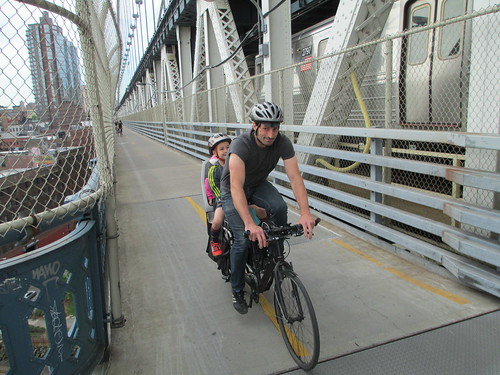
A cyclist and his son on the lovely Manhattan Bridge
bike lane: cyclists can't expect nice things like this,
Sarah Goodyear says, if we keep being naughty.
Nor am I making a point like the one that Sarah Goodyear made in a now mildly notorious piece on the Atlantic Cities website about how cyclists allegedly “wanted it both ways” demanding better enforcement against dangerous drivers while being reluctant to behave better themselves. Cyclists couldn’t expect better infrastructure, such as bike lanes, if they didn’t improve their behaviour, she argued. It’s quite clear that, if officials’ willingness to give a road user group infrastructure depended on the group’s behaviour, there wouldn’t be much road space devoted to cars. There’s no evidence that cyclists’ rule-breaking (archetypally, red light-jumping and sidewalk riding) is more widespread than motorists’ tendency to speed and pay insufficient attention. There’s plentiful evidence that cyclists’ misbehaviour causes less harm to others than motorists’.

A Citibike rider checks out the rules:
bet she'll be nicer to cyclists
next time she drives
I also stick to the view that many people’s views about cyclists are based on simple prejudice and irritation towards people who decide to do things differently, rather than either objective factual points or stress from near-misses with negligent cyclists. It’s one of my hopes for the Citibike scheme that, if it encourages more first-time New York cyclists to ride, it’s going to create a new group of pedestrians and motorists who have some understanding of the pressures on people who cycle.

But I’ve personally taken the view for a long time that there’s little point in antagonising pedestrians or motorists unnecessarily. It’s far simpler to take the position that a red light means “stop” than to engage in some complex – and inevitably error-prone – risk assessment at every traffic light-controlled junction. I don’t ever want to be in the position of being the cyclist who crashed into me near Elephant & Castle in March 2009 after going through a red light. “I didn’t see you,” he complained. “There was a red light to tell you not to go,” I replied.

I take that position not least because it’s such a distraction from the important issues if I encourage people to complain even more about cyclists. There was a chilling illustration of that on June 8, when the Wall Street Journal – encouraged, perhaps, by the website traffic from Dorothy Rabinowitz’s original rant – posted a second video featuring her views. Having considerably improved her make-up and clothes, she launched into further strange denunciations based on misunderstandings of the facts – and heaped abuse on a couple of fairly mild questions from viewers about her opinions. Around my office, I spotted headphones going on and browsers being directed to the Journal’s website as even colleagues with no interest in cycling sought to gawp at the latest episode.

Yet, just as the Journal’s editorial staff were posting the video, on 5th Avenue, just around the corner from the Journal’s offices, the driver of a sports utility vehicle lost control, mounted the sidewalk and ploughed into a crowd of people, sending six – including a small baby – to hospital. The incident was depressingly routine – but, given the numbers of people involved, I’d have hoped to see more comment and perhaps some more information on Twitter and some of the news sites I regularly visit. Instead, most were full of arguments about the largely illusory danger that bikes pose to pedestrians such as Ms Rabinowitz.

It’s my goal, as far as I can, to cycle in such a way that I don’t cause unnecessary stress to other people that I encounter. I don’t want to encourage them to focus on the pointless ephemera that were the subject of Dorothy Rabinowitz’s complaints. I hope to leave them at least a little freer to concentrate on the hundreds of annual deaths from motor vehicle crashes in New York City and other large cities worldwide. It is, after all, those, rather than a few stray bikes on sidewalks, that represent the true roads scandal of our time.