Showing posts with label cycle superhighways. Show all posts

Sunday, 9 July 2017

A move back, two angry path-blockers - and why it's time to stop writing and start remembering

On July 6 last year, I got on my bike for the last time outside my apartment building in Brooklyn. As I’d done hundreds of times before, I rode down Smith St and over the Manhattan Bridge to my employer’s office in west SoHo. Then, around lunchtime, I rode back, packed my bike into a box and headed with my family to JFK Airport. After an overnight flight to London, I did much the same as I’d done in New York in reverse. We headed to our temporary accommodation, I unpacked the bike and I rode to my employer’s London office.

A traffic jam on the Manhattan Bridge bike lane: a route I last
took a year ago last week.
That first ride in London after four years in New York was the start of a year in which it’s been a great privilege to rediscover the joys of getting around the UK by bicycle. Some of the more than 5,000 miles I’ve ridden have been for leisure. But I’ve also been rediscovering newspaper reporting by bicycle. I took my bike with me on a train to Manchester early on May 23, the morning after the appalling Manchester Arena bombing. I rode around Bradford during the general election campaign. On the night of June 3, I tried to cycle to London Bridge to investigate reports of an apparent terror attack, only to be stopped by panicky armed police officers ordering me to turn around.

Yet, as my enthusiasm for getting about by bike has reached still greater heights, I’ve found my enthusiasm for writing about it heading in the other direction. Writing on the issue that doesn’t fit the accepted narratives of people who oppose or support cycling provokes extraordinary levels of anger, I’ve discovered.
London from Parliament Hill: a joy to
rediscover by bike

Some of my posts have excited hostility from opponents of cycling. Two of my Facebook friends were so furiously resistant to the idea that drivers pose more danger to pedestrians than pavement (sidewalk) cyclists that they’re no longer my Facebook friends. But several others have inspired near-apoplexy among my fellow cyclists. The nadir of this was when one of the UK’s most respected cycle campaigners attributed my previous post to my alleged “cyclophobia”.

The problem is partly, I recognise, that this blog has always rather uncomfortably straddled twin roles as a platform for campaigning and philosophising. I’ve long believed, on one hand, that the bicycle is an excellent means of urban transportation, hoped to see more people riding bikes and supported the building of facilities that will make that possible. I’m personally slightly fanatical about trying to get around by bike whenever I can. When travelling with the prime minister to this weekend’s G20 summit, for example, I tried to find out if there was a way to park my bike at Heathrow Airport’s Royal Suite (there sadly wasn’t).

Me as I prepared to take my bike to Bradford
for a general election piece: this is what
a cyclophobe looks like, apparently
But I’ve also spent nearly 10 of the last 14 years as a reporter writing about transport issues. I’m used to meeting the people facing the daunting challenge of devising transport systems that fulfill the needs of people that want to use buses and trains as well as bicycles. While I’ve sought to frame my pieces here in the context of a cyclist’s experience, I’ve ended up writing a fair amount with the perspective of someone caught up in the wider transport debate.

The bottom line is that it’s become so exhausting dealing with hostile reactions to my blogposts that it’s detracting from my enjoyment of cycling, rather than adding to it. I’m consequently making this my last post on this blog.

As with any break-up, I should explain the ways it’s not you but I who’s at fault. On April 18, I moved from writing about transport to covering politics full-time. The shift has meant both that my head’s been a lot less full of transport policy than it used to be and that my time has been consumed with other things. I’ve been thinking about, say, the messages of the main parties’ campaign literature in the recent snap UK general election rather than how patterns of demand for transport in London are changing.

While it was a joy for the piece on campaign literature to ride my bike to the north London constituency of Hampstead & Kilburn to research it, my mind was dwelling on politics as I headed home. I might once have pondered the relative merits of Royal College St’s segregated bike paths and the quiet, backstreet routes I used elsewhere.
Election literature I picked up after riding to Hampstead:
a new preoccupation.

My enthusiasm for blogging hasn’t been enhanced by the sheer intensity of the UK’s recent news flow. Since April 18, the country has not only experienced an extraordinary general election but two terror attacks - both of which I’ve been involved in covering - and the tragic Grenfell Tower fire. Issues around cycle infrastructure remain important but have felt less pressing in these circumstances.

Yet a row I had with two fellow cyclists on June 16 encapsulates a wearying tendency on both the roads and the internet that has played a significant part in putting me off. I encountered the pair near the exit from Kensington Gardens, in west London, as I rushed to Kensington Town Hall to cover the building’s occupation by protesters angry at Kensington & Chelsea council’s mishandling of the aftermath of the Grenfell Tower fire. On a section of the route where cyclists were asked to dismount, I did so. But, being in a hurry, when I passed the dismount sign at the other end of the narrow section, I got back on my bike and tried to continue my journey.
Police stop protesters from entering Kensington Town Hall:
I had a telling experience en route to this event.

The two other cyclists were having none of it. Having failed to spot the signs telling us to remount, they kept pushing their bikes, two abreast, down the middle of the path, deliberately obstructing me from getting past. When I finally got past, one of them said to me, “Try reading the signs next time”. It immediately struck me how common such behaviour is both on the roads and online. People who are sure of their own position are prone to assuming those who act differently from them are acting out of either stupidity or malice. People have been free in attributing elements of my posts on here to both.

The frustration is all the greater because much of the anger has been motivated by my determination to make clear a single point on which most London cycle campaigners have chosen to ignore what seems to me crystal-clear evidence. It’s become conventional wisdom among London cycle campaigners to insist that the construction and opening of the east-west, north-south and Vauxhall Bridge cycleways last year had no effect on motor vehicle congestion. It’s become fashionable, among other things, to blame London’s evident growing traffic jams on extra numbers of for-hire vehicles, rather than the effects of the reduced road capacity.
The North-South Superhighway on Blackfriars Bridge,
before the latest barriers went up: useful, but not quite
the way that Transport for London spins it.

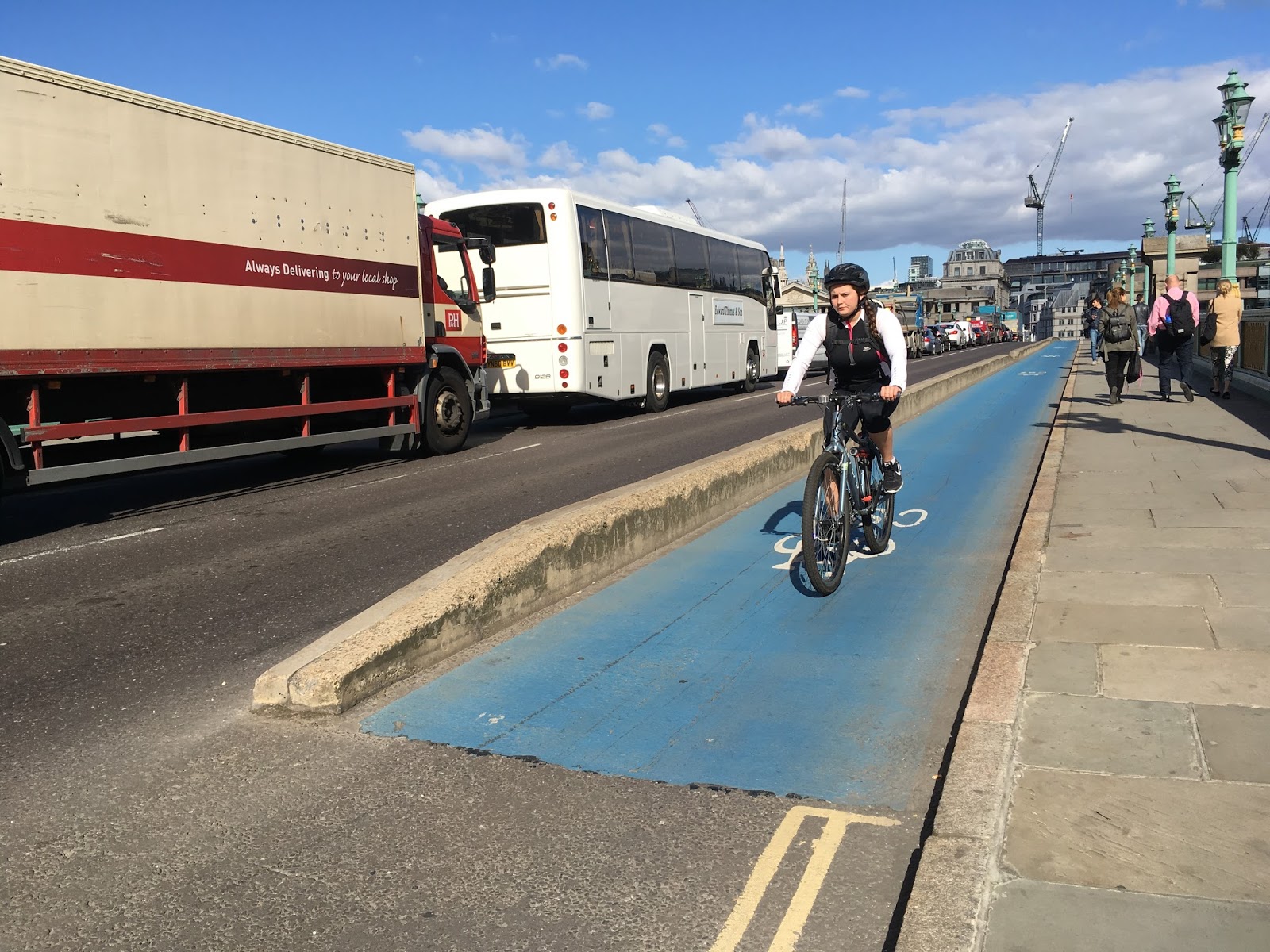
Yet there remains, it seems to me, no room for honest doubt about what’s going on in central London. Motor traffic volumes for the most recently reported quarter were down 3.4 per cent year-on-year, while average traffic speeds in the same period declined 5.4 per cent. The picture of growing congestion resulting from a shrinking of the road network’s capacity is obvious to nearly everyone outside cycle campaigning who looks at London traffic issues. That the building of the cycle superhighways has contributed significantly to the congestion is obvious from Transport for London’s report on implementation of the Cycle Superhighways, which shows eastbound journey times in the peak along the Embankment are up by 15 minutes.

The reactions I’ve received to pointing to these clear, unequivocal figures vary. A handful of people have thanked me for being willing to follow the data wherever they point. But the vast majority have involved some version of accusing me of stupidity, ill-will or a failure of imagination. Many people point to one of Transport for London’s arguments in favour of the cycle tracks - that Blackfriars Bridge now at rush hour carries more people than it did before the cycle tracks were installed. That, I think, misses the point about what’s uniquely useful about London’s roads - that much of the traffic now doesn’t involve passenger transport but deliveries, including traffic to and from the Crossrail building work, supplies for housebuilders and even the material needed to construct new segregated cycle superhighways. It also misses the point that many London roads are now congested and busy with motor traffic all day, while the peaks on the cycle tracks are far shorter.

Other critics have suggested that congestion is somehow inevitable - an argument that doesn’t fit with its having been successfully reduced by the introduction of the congestion charge in 2003. Some have welcomed the congestion because it will force people to take up cycling - an argument that I suggest won’t be much comfort to a relative of anyone stuck in an ambulance trying to get to hospital. Others have suggested that delays to buses - on which there are 6.5m daily trips - are a price worth paying for improving conditions for cyclists.
My son on the east-west Cycle Superhighway:
finally, central London routes that are
a joy to use with children

I remain delighted that the cycle superhighways, which I use daily and which have made it far easier for me to get around central London by bike on my own and with my children, have been built. I am excited daily by the huge numbers of cyclists that I see heading down Clapham Road or over Vauxhall Bridge on my commute. But I continue to worry that, as long as so many London cycling activists cling to views about the dynamics of London’s congestion that defy the evidence, progress on further improving London’s cycling conditions will be slow. Some long-standing transport professionals whom I know - one of whom has been a long-term champion of cycling - now fear to discuss London cycling because of the poisonous atmosphere around this debate.

I would much prefer cycling activists to accept that the superhighways have exacerbated congestion that was already worsening. I'd hope people would then campaign for a more sophisticated, London-wide road-charging system that would deter driving in London far more effectively than the present congestion charge.

Anyone who begins from the starting point of believing the evidence of the statistics about trends in central London traffic is generally branded an unreliable cyclist-hater, however. There's normally some insinuation that the person is in the pocket of some sinister vested interest. It was, needless to say, in a discussion over London congestion statistics that I was accused of cyclophobia.

My clearest conclusion after a year back in the UK is that my efforts to analyse what’s going on around me and argue for my approach are doomed. I’ve made my case to scores of commenters on this blog and to still more people on Twitter and Facebook. My efforts have generated far more tension and unhappiness than they have understanding. It’s time to draw the inevitable conclusion from these failures and to stop trying.

There are sensations and experiences I’d like to express. I still enjoy remembering how Kennington Park Road, one of my regular haunts, was originally a Roman road. I like to think of how Roman soldiers marched there millennia ago. I’ve got faster at cycling over the past year, partly because I’ve lost 15kg. I’ve gained a new, childlike appreciation for the joys of speed on a bike. On the morning after the Manchester bombing, I left home before 6am and experienced for the first time in years the strange excitement of riding through dawn-time London as the corner shop shutters clank open.
My daughter and our bikes on the Emirates Air Line:
she's played a role in some of my fondest cycling memories.

Some of my strongest feelings involve riding with my daughter, who’s now 15. She has become far fitter as a cyclist, having started cycling daily to and from school. Eight days ago, I was rushing home with her by bike from the Tate Britain when we came on a group of adult cyclists who were riding more slowly than we were. In its own way, it was one of my most perfectly satisfying experiences on a bike to look round, ask her, “Are you ready?” and watch as she accelerated smoothly past them, a picture of confidence on her smart red road bike.

But, while I’ve enjoyed in the past mining such experiences to make points on this blog, it’s time now to work on a different discipline. I’m going to try harder to enjoy the daily joys of riding a bicycle in the moment, while forgetting the frustrations more quickly. I thank those who’ve read this blog regularly over the years and trust that you will nurture that joy a little more too.

Monday, 16 January 2017

A smug expectation, a messy reality - and why it's time to get to grips with a tough conundrum

Before I got out on my bike, I was anticipating that Monday, January 9, was going to be my smuggest cycling day since returning to London from New York in July. A strike by station staff on the London Underground had brought the busiest bits of the capital’s most important public transport system to a halt. And, as I sat at home writing initial stories about what was happening, I noticed account after account of chaos on the roads as would-be underground users turned to cars and buses to get to work. I imagined myself slipping casually through the traffic on my bike, warmly congratulating myself on the excellence of my transport choices.

In the event, the day ended up feeling less like a triumph and more like a reminder of the acuteness of the transport policy challenges facing London. By the time I left home to ride to the office, around 10am, the bus lanes that I’d normally use for the early stages of my journey were choked with other forms of motor traffic. Progress was so slow I retreated to the side streets, which in places were little better.
Traffic backed up on Vauxhall Bridge on January 9: a visible
demonstration of London's reliance on its underground.

The incident dramatised an issue that’s been worrying me for some time. London’s roads become congested when people are emptied out of the underground and other non-road forms of transport onto the roads. Yet it’s an uncomfortable truth of campaigns to encourage cycling in inner London that the vast bulk of the growth in cycle commuting must be coming from a similar, slow-motion shift from rail-based modes onto already over-stretched streets. More and more complex demands are being heaped onto constrained roadspace, without much sign of a strategic plan to manage the resulting pressures.

On top of that, I noticed once I got to work how many twitter users were complaining of having hours spent on buses even on short journeys. Later in the week, would-be commuters on Southern, the mainline rail service, would undertake similarly unpleasant journeys during strikes by their service’s drivers. The stories illustrated the shortcomings of decades of efforts to encourage cycling. Cycle provision in most of London still consists of signed routes down backstreets, most of which are growing ever busier and less attractive. It’s clear that most people will not consider riding on these, even in the most desperate circumstances.

Faced with placating demand for better cycle provision and the challenges of congested, polluted roads, Sadiq Khan, London’s mayor, seems anxious about building more of the direct, segregated cycle routes that might get such reluctant cyclists pedalling.

The challenge for everyone in London who wants more, safer cycling in central London is to devise arguments for better provision that recognise the new realities. It’s vital as the system accommodates growing cycling to safeguard road provision for the buses, delivery vehicles, emergency vehicles and other vital road-users that make up a high proportion of central London’s current road users. The challenge is similar for advocates in other big urban centres - including New York, my old home - where people shift to cycle commuting mainly from modes that don’t depend on the roads.
 
Pedestrians spill out of Southwark underground station by the
north-south cycle superhighway. How many of them can switch
to cycling before the roads get even more congested?
Yet some of the most influential figures on London’s transport scene continue to insist that the conundrum is so simple it barely exists. On January 5, Andrew Gilligan, London’s former cycling commissioner, tweeted a graph from Transport for London’s latest “Travel in London” report that attributed 75 per cent of London’s congestion to “excess traffic”. The conclusion was “blindingly obvious to all but motorists,” he wrote, dismissively.

A little digging into the statistics for central London fills in the details of the policy dilemma. Traffic volumes entering Central London fell 3.4 per cent between the June to September quarter in 2015 and the same quarter in 2016, part of a long-term decline that’s seen the volume of motor traffic entering central London decline by more than 20 per cent since 2000. Instead of increasing with declining traffic volumes, however, average traffic speeds in central London - the easiest available proxy for congestion - fell 3.5 per cent, to 7.8mph. The network’s capacity is very clearly falling even faster than motor vehicle are going away. The amount of traffic that it takes for traffic to become “excess” is falling.

It is not clear, either, which part of the traffic can easily be reduced to alleviate the problem and free up space for cycling. The same Travel in London report that Andrew Gilligan quoted says that private cars now account for only 18 per cent of motor traffic during weekdays in the central London congestion charging zone. The other vehicles - private-hire cars, taxis, vans and heavy lorries - all have at least some arguable economic reason to be in the area. They are likely to be more resistant than private vehicle owners to stopping driving in the area.
 
A typical traffic queue on Southwark Bridge: it's not clear
crackdowns on private cars or encouragement for cargo bikes
will solve this problem.
One of the most popular suggestions among cyclists for reducing the traffic is that more of the growing numbers of internet deliveries being made in central London could be shifted to cargo bikes. The idea is sufficiently attractive that I investigated the subject in my day job for a piece about the growing numbers of cargo bikes I see around central London. Yet I emerged from interviewing even courier companies that use cargo bikes a little depressed. While cargo bikes were helping them to make urgent deliveries despite the heavy traffic, courier companies told me, they would always be a niche vehicle compared with the vans that were their fleets’ mainstays.

Amid this growing crisis, meanwhile, the one unutterable suggestion among cycle campaigners is that the building of segregated cycle superhighways along a number of central London roads might be contributing to the problem. When Florence Eshalomi, a member of the London Assembly, asked cyclists on twitter on January 11 whether they agreed with a senior TfL manager that cycle lanes had had some impact on bus journeys, the replies mostly struck a similar note.

“Making London a byword for cycling is more important than bus usage,” one twitter user replied.

“I think any far measurement of bus delays would show that excess cars are the main cause,” wrote another. “There aren't that many cycle lanes.”

The replies drew on the now-conventional wisdom among London cyclists that the 12 miles of new cycle superhighways in central London - which I love using, especially when with my children - have had no significant effect on congestion. The facilities, however, have been put in on arterial roads that were already operating at or near full capacity. They have, crucially, introduced new, cyclist-only light phases that can only have introduced extra waiting time for motor vehicles both on the streets with the new facilities and those crossing them.
 
A bus in a traffic jam by the cycle superhighway
on Blackfriars Road: the superhighway has no bearing
on what goes on on the rest of the road, it's said.
While there are plenty of other factors restricting London’s road capacity, it seems fanciful to imagine that cycle facilities alone can remove capacity from busy roads and have little effect on congestion. It is certainly clear the capacity of London’s roads fell around the time the new facilities were built. It is not unreasonable, it seems to me, for Sadiq Khan and Mike Brown, commissioner of Transport for London, to seek to reduce the effect of any new facilities on congestion before giving them the go-ahead.

Yet to say that the challenges facing London’s leaders are hard is very definitely not to say they are impossible. It is quite clear, for example, that action that reined in the growth of services such as Uber in central London could have a significant effect. Private hire vehicles - the vehicles that provide the Uber service - now account for 12 per cent of traffic in central London on weekdays. Any measure that makes deliveries to the scores of construction sites in central London more efficient could free up significant amounts of road space. It is hard to understand why low-emission vehicles, which take up the same road space as others, remain entirely exempt from congestion charging.

It is regrettable, meanwhile, that London relies so heavily on the double-deck New Bus for London given its poor capacity and the time it takes to load and unload. A wholesale reform and extension of the current central London congestion charge to make it more sophisticated and more closely related to the space each vehicle takes up on the road seems overdue. The mayor should continue to pursue increases in cycling because bikes provide clean, healthy, flexible transport. Extra cycling journeys can almost certainly be catered for more economically than extra journeys on the underground.
 
Fog and pollution haze sits over south London:
more cycling might avert such incidents
It is far too easy, however, for the debate over this complex issue to slip into glibness. Taxi driver groups slip into this trap when they claim the simple removal of new cycle paths would restore London’s roads to flowing freely. Cycling groups fall into it when they pretend new cycle paths magically shift London commuters from wasteful cars onto space-efficient bikes.

The rest of my ride to work on January 9 was a stark reminder of the risks of ducking serious debate. I encountered drivers engaged in fierce rows over road space, a furious woman cyclist yelling at a man who had somehow wronged her and, in van after van, long lines of stressed-looking delivery drivers and workmen. An air of unhappiness and frustration hung over everything.

While the scenes were far worse than those on a normal day, I made an inward vow to renew my efforts to think more seriously in future about the less acute but still worrying levels of congestion I encounter daily.

If others do the same, it may prove easier to build wide support for the kind of excellent facility I found myself using towards the end of the trip. Wanting to take in the scene, I rode over Vauxhall Bridge then down the east-west cycle superhighway along the Embankment. As van and taxi drivers sat motionless in the neighbouring traffic jam, I was finally slipping by the traffic jams, as I’d anticipated. Looking at the grim faces of the stationary drivers, it was a pleasure I was keenly aware I shouldn’t take for granted.

Monday, 7 November 2016

A rainy weather puncture, a wave of negativity - and how the haters aren't sweating cycling's details

As conditions for a cycle commute go, the steady rain this past Friday - which supplanted the recent foggy weather - was unattractive even before I started hearing a strange clicking sound from my bike’s front wheel. An inspection revealed the sound was coming from a drawing pin - or tack - stuck in the tyre. I was, briefly, hopeful that the robust puncture proofing of my Schwalbe Marathon Plus tyres might have protected my inner tube. When I pulled the tack free, however, I heard a steady hissing that told me I was going to be undertaking a roadside repair.
A chance tack in a cycle lane or a symbol
of the anti-cycling backlash? The mystery
remains unsolved

Then, after I’d discarded the tack, I started to ponder the antipathy towards cycling and cyclists that I’ve spent considerable time recently discussing in person and via social media. The UK is in the midst of one of its periodic anti-cycling backlashes and I suddenly wondered if the tack had ended up in the new cycle path by Kennington Park by happenstance or malice. I scoured the wet pavement for the tack, photographed it then posted a query on twitter to ask if anyone else had suffered similar problems in the same area.

The act of posting the picture turned my mind back to thoughts about the roots of the recent rage in some newspapers and by some politicians against the growth of cycling. After I recently wrote about the gulf in understanding between cyclists and cycling sceptics, I was bombarded with complaints that I was ignoring some vast conspiracy by the media and politicians to do down cycling. Commenters accused me of varying levels of complacency or complicity in this plot.

I've been assured that I was naive to believe there was no generalised campaign against cycling because it was naive to think automakers had changed tack since their 1920s campaign in the US to have jaywalking outlawed. I've been told that Volvo engineers' designing of a cycle helmet shows there's a plot - use of cycling helmets, after all, correlates with lower cycling levels. I have been repeatedly told that the recent spate of newspaper anti-cycling stories can't be coincidence and even seen it posited that a particular national newspaper reporter "must be in somebody's pay".

The truth is less exciting but no less worrying, I’m convinced. Having spent most of the last 13 years writing at least partly about transport, I simply don’t think most opponents of cycling - either in the UK or the US, where I lived for four years - care enough about the mode to mount such a conspiracy. It seems to me that, instead, many of the media attacks draw on unspoken paradigms about the nature of government. The sprouting of cycle lanes is taken to be an example of the work of politically correct (or possibly “bungling”) bureaucrats, who wrongly think they know better than the average, car-driving newspaper reader what the transport system needs. Cyclists are regarded as some sort of strange out-group like vegans or hardline environmentalists seeking to destroy the lifestyles that ordinary, common-sense people regard as entirely unproblematic.

The best way to combat this narrative, it seems to me, is to seek to change the terms of the debate. I believe there’s a sound, common-sense case for promoting cycling that, in the UK at least, is getting drowned out by complaints about the alleged anti-cycling conspiracy and bitter rows on twitter. It’s all the more urgent to get progress re-started because present conditions continue to prove deadly. Lucia Ciccioli, a 32-year-old Italian woman, was killed on October 24 cycling to work in Lavender Hill, not far from my house in Brixton. A week later, another Italian, Filippo Corsini, 21, was crushed by a lorry in Knightsbridge. I hope that a new venture, Humanstreets, modelled on the admirable, New York-based Streetsblog, will play an important role in making that case.
London's North-South Cycle Superhighway,
at Southwark St: yes, the Daily Mail's
written angry stories about this facility's
existence; no, I don't think they're angry
for the reasons many others suppose

But, as I stood by the side of Kennington Park Road wrestling with my hard-to-remove tyres, I wasn’t feeling optimistic.

I started to think about the nature of anti-cycling anger after seeing a post on Twitter querying why the Daily Mail - which recently ran several pieces claiming that new cycling lanes were “paralysing Britain” - had run a piece touting cycling’s health benefits. The tweet’s tone was to query the Mail’s consistency. But, to anyone who’s worked in a newspaper, the idea that different sections of a paper would need to agree on such a matter is, frankly, ludicrous. British newspaper reporters are, in my experience, mostly uninterested in the content of the policy issues that they cover and far more interested in framing it into what they regard as a compelling narrative. The Daily Mail has a powerful bias in favour of thinking civil servants and council officials are engaged in some plot to impose bad ideas on ordinary Britons. The recent attacks follow that narrative, it seems to me, rather than being based on any strong idea about cycling.

The Daily Mail’s sinister genius is its ability to seize on almost any policy development as evidence that the world does indeed work the odd way its news editors believe it does. Like many people with an interest in road safety, I’m sure, I felt my heart lift this week when I saw that the Mail had run a front page story on distracted driving - only to feel it sink again when I saw that it was defining the problem as being one of foreign drivers. The story was a reminder of how different worldviews compete within many media organisations to shape how issues are reported. The story about cycling’s health benefits reflected the paper’s conviction that its readers want to find out ways to better their health. For that section, that narrative trumped the notion that cycling promotion was the work of nanny-ish bureaucrats.

The Mail’s tendency to report the world according to a set of preconceived notions is unusually pronounced but it has its less sinister counterparts in other places. The Guardian, for example, tends to report public-sector activity favourably and to report on business’ behaviour unfavourably. Some financially-orientated publications are apt to identify strongly with private businesses’ perceived interests. Most politicians I’ve met have a similar tendency to believe in a few core principles and then, in George Orwell’s telling phrase, to buy the rest of their opinions in “matching pairs”.
The East-West Cycle Superhighway by
the Palace of Westminster: inhabited by
owners of opinions bought in matching pairs

Some of the reporting, meanwhile, reflects the one circumstance when cycling policy does get people's attention - when it threatens something important to them, such as the free parking space they regard as a right. This explains, for example, the regular rows in New York when the Citibike bike-share scheme arrives in a new neighbourhood. People have seen that Citibike is coming but take little interest until suddenly a parking space disappears. The same phenomenon explains the perennial popularity of bad and dangerous on-road cycling facilities. Many politicians are eager to enjoy the chic, green-tinged halo of introducing a bike-share scheme or theoretically encouraging cycling. Yet few are prepared to weather the political storm of introducing facilities, like London’s new segregated cycle superhighways, that truly reallocate space away from motor vehicles and give it to cyclists. Unsatisfactory compromises - bike routes down hard-to-access old railway lines, for example - proliferate.

During my 25 years in the newspaper industry, I have been far more dismayed by other reporters’ cynicism, willingness to go along with news editors’ ill-informed instincts and incuriosity about policy detail than I have by any willingness to cave to outside lobbying. Much the same goes for politicians. When he first became mayor, for example, Boris Johnson - now practically sainted among active travel lobbyists as father of the segregated superhighways - took a series of harmful steps to further what he saw as a pro-business, anti-bureaucrat agenda. He removed space-efficient articulated buses, replacing them with a far worse alternative, scrapped the successful western extension of the congestion charging zone and undertook other measures aimed at “smoothing traffic flow”. Among the traffic-smoothing measures were the admission of motorbikes to bus lanes and a tinkering with traffic-light timing that reduced the time for pedestrians to cross at many busy junctions. All of these measures have contributed to London’s continuing problem with congested, unsafe roads.
The new bus for London: one of Boris
Johnson's early contributions to making
London's roads less efficient

I see this intellectual laziness and policy cowardice as far bigger barriers to the advance of cycling than alleged campaigns - always described as “well-funded” - by sceptical cycling opponents. I recognise that the main incident that fuelled these fears - the circulation by Canary Wharf Group of a screed complaining about plans for cycle superhighways - occurred while I was in New York and away from London policy issues. I also know that London business lobby groups continue to agitate about congestion in London and to blame it disproportionately on the cycle superhighways, which are only one of a series of factors contributing to the current worsening of motor vehicle congestion in central London despite falls in traffic levels. The London Taxi Drivers’ Association continues to fight sensible cycling schemes such as the Tavistock Place cycle tracks in Bloomsbury.

Yet it seems clear to me that the basic instincts of the media organisations concerned and reporters’ tendency to copy stories that they feel have touched a nerve with readers are more than sufficient to explain the current rash of stories. The cowardice of the worst kind of local politician in the face of what he or she perceives to be the public mood is more than adequate to explain the backtracking in many parts of the UK on cycling plans and the actual ripping out of an already-built facility in the Scottish town of Ayr.

Congestion on Southwark Bridge: campaigners need to
get better at combatting fears about such conditions
if progress is to resume
The good news is that fights against prejudice and cowardice are winnable. It was once held as axiomatic on both sides of the Atlantic, for example, that the struggle against drink-driving was driven by politically-correct nannyism. The practice’s dangers are now universally accepted. There was shock last week when part of the Daily Mail’s criticism of a judge involved in the Article 50 Brexit case was that he was “openly gay”. Until the 1990s, it might have been regarded as a legitimate scoop to expose his sexual orientation.

The bad news is that such battles tend to be protracted, painful and to require considerable guile. Cycling advocates need, it seems to me, to do a far better job of addressing people’s fears about what allocation of space - and time at traffic signals - to cycling means. Will it hold up bus passengers? Can a lower-capacity road really handle all the deliveries businesses along the route expect? I’ve said before that campaigners’ arguments should be far less nit-picking and far more addressed towards a mainstream audience.
After the repair: my bike as I prepared to ride off, feeling
down at heart

It’s not only because of Friday’s experience that I feel pessimistic about prospects, however. Battle lines on both the pro and anti-cycling side seem very clearly drawn. Few people are airing novel arguments.

The worst and most bitter people, meanwhile, are resorting to more direct measures. While I don’t know how the tack I picked up came to be on the cycle path, another twitter user told me he recalled hearing of a tack’s being left around the same place recently. Multiple cyclists riding on the Bearsway cycle path north of Glasgow on Sunday picked up tacks, suggesting a co-ordinated effort at sabotage. That follows a recent, similar incident in Regent’s Park, in London.

Whether my incident was part of that pattern or not, I rode off after 20 minutes’ repair work damp and cold, with skinned knuckles, feeling decidedly downbeat. I will feel more optimistic only when the UK's debate about cycling policy breaks free of its current, unproductive impasse.

Sunday, 16 October 2016

A British Stand-off, an Unbridged Divide - and Why it's Time for Cycle Campaigners to Change the Conversation

There was something almost endearingly British about the standoff. In a typical autumnal light drizzle last Saturday in Swiss Cottage, North London, a group of other cyclists and I stood listening to speeches in support of the building of Cycle Superhighway 11, a planned segregated bike route from London’s West End, through Regent’s Park and up to the point where we were standing. Then, a demonstration against the plan arrived. Participants in the two demonstrations did some mild chanting at each other. Afterwards, we went our separate ways.
Protesters against CS11 meet its supporters, in Swiss Cottage:
a very British stand-off


But, however mild-mannered the two demonstrations at Swiss Cottage might have been, there has been no disguising in the past weeks that demonstrators like those opposing CS11 are growing increasingly vocal in many parts of the developed world. From Community Board meetings in Brooklyn to the pages of daily newspapers in the UK, there have been noisy complaints that newly-introduced or planned cycling facilities are a tyrannical imposition by unfeeling authorities out of touch with the feelings of ordinary people.

The UK’s Daily Mail two weeks ago produced the most eye-catching manifestation of the phenomenon, devoting a double-page spread to what it called “cycle lane lunacy,” which it said was “paralysing Britain”. However, there have been plenty of other examples. The Community Board that oversees planning issues in Park Slope, Brooklyn, and surrounding areas is preparing for a meeting where some locals are expected to vent their near-apoplexy over the Citibike bikeshare system’s arrival in their neighbourhood. Local councillors in Ayr, in the West of Scotland, have voted, under pressure from drivers, to remove the town’s only significant protected bike lane.
A cyclist and motorists in Regent's Park: a powerful
illustration of the arrangements the anti-CS11 campaigners
are fighting to preserve


Yet the cycling sceptics and supporters seem as incapable of meaningful communication as the two groups shouting at each other last Saturday morning. The motorists’ side complains that bike lanes often look empty. Cyclists argue that just shows cycling’s efficiency. Motorists complain that cyclists don’t pay “road tax,” as they do. Cyclists reply that vehicle excise duty in the UK has not been a hypothecated tax for many decades. Motorists complain that congestion is growing worse. Cyclists retort that the people complaining are themselves the traffic. My mind turned, as I rode home from Swiss Cottage, to whether there is some way to narrow this currently apparently unbridgeable divide.

A couple of incidents have highlighted to me the width of the communication gap. The first was on September 23 when, after I published in my day job a piece about the future of London’s roads, a former colleague wrote to me. He questioned whether it could possibly be true, as I had written in the piece, that some London roads with cycle superhighways were carrying more people per hour in rush hours than they were before the superhighways were put in place. He also asserted that cycling was, in fact, far more dangerous than people admitted and that, anyway, only the young and fit could do it.
Morning rush-hour traffic on the north-south superhighway:
no, there's no way this street's carried more people since the
segregated bike path went in


Then, two weeks ago, a fellow guest at a dinner party asked me how I’d found my just-finished four years in New York. Struggling to sum up the wealth of experience, I said that New York drivers weren’t terribly nice to cyclists. “But isn’t that how everyone feels?” he blurted out, before looking mortified as it dawned on him that I was, in fact, a cyclist.

The two incidents reminded me that cyclists, for most people, seem like a strange, alien species, taking unfathomable risks yet somehow eager to suck other, new people into participating in their strange mode of transport. The reminder was all the more stark because it was clear that neither of my interlocutors were people of ill will. They thought their frustration over growing cyclist numbers and efforts to facilitate cycling was simple common sense.

It is unsurprising to me that the many people who hold such views see dedicating road space that was previously mainly used by motor vehicles to cycling as a strange, ideologically extreme act. The Swiss Cottage demonstrators were portraying Transport for London’s determination to put in more facilities to encourage cycling as a bizarre, politically-driven effort to punish ordinary people. For many New Yorkers, the notion that a person might ride a bike to work is entirely crazy. That bikes to allow people to do so are now taking up what used to be their normal parking space must seem like a personal insult.
Drivers in a traffic jam by an empty bit of superhighway:
all, I'm sure, would be calmed to learn they're not paying
road tax.


Yet the response from many cycling advocates could be calculated to heighten the irritation, rather than calming it. For example, cycling activists often retort when drivers complain that cyclists pay no “road tax” that the UK abolished its hypothecated road tax - whose proceeds all went to road building and maintenance - in 1937. While the point is accurate, It is also a prissy, know-it-all one. Like many such responses, it deliberately misses the thrust of what cycling’s critics are trying to say - in this case, that they feel their transport choices are heavily taxed and they cannot see why others should use the same space for free.

It would make far more sense to point out that, while motoring is indeed heavily taxed in the UK, the taxes still fall short of covering the full external costs of the pollution, congestion, crashes and other side-effects. The argument is still clearer in the United States, where no state’s taxes on motoring cover even the annual cost of road maintenance. A tax-paying cyclist is, consequently, both saving the neighbouring drivers money and, if he or she previously drove a car, reducing the burden on taxpayers.

Cycling campaigners end up deploying plenty of other similar “well, actually” arguments about the terms of the debate, rather than the substance. There was a striking example in the last week when Quentin Wilson, a campaigner to shift even more of the burden for motoring onto ordinary taxpayers, tweeted a picture of the most westerly current section of London’s east-west cycle superhighway, just off Parliament Square. “Great new cycle lane but where are the cyclists?” he wrote above a picture of the empty lane.
A group of tourists refutes Quentin Wilson's contention this
bike lane goes unused - but also my fellow cyclists' claim
it's not open


Many cycling advocates accused Wilson of bad faith, responding with pictures facing in the other direction, showing a barrier that marks the end of the superhighway. I saw several people tweet with an excited, “gotcha” tone that the lane wasn’t (actually) even open yet.

I’d far rather that activists had pointed out the facts about the section of cycle track in question - and addressed the underlying issue. The section is lightly used because it’s short and doesn’t yet link to any other part of the cycle network. While I’ve used it several times myself, I have also bypassed it sometimes as inconvenient. It would, in addition, be worthwhile pointing out that the superhighways are new, incomplete and that people’s travel patterns always take a while to change after changes to infrastructure.

The Wilson case was one of a worrying number where I’ve seen cycling advocates on Twitter and Facebook accusing opponents of something close to false consciousness. Many seem reluctant to accept, for example, that the new cycle superhighways are currently lightly used outside rush hours or that, yes, motor traffic congestion really is growing worse. Yet I ride frequently on the superhighways outside rush hours and encounter few other cyclists. Arguments that accepted these points, explained what was going on and explained why cycling facilities can help to resolve the problems would be far more compelling.
A rider uses the Southwark Bridge bike lane, one of those
singled out in the Daily Mail for paralysing Britain
The problem mirrors developments in the contemporary, polarised political scenes on both sides of the Atlantic. The echo chamber of Twitter feeds and Facebook pages full of like-minded people is gradually alienating many people from the idea that any sincere person could disagree with his or her point of view.

Such echo chambers encourage their inhabitants to feel particularly enraged at my fellow journalists. One Facebook thread I saw recently discussed how users might punish a reporter who had, the thread’s originator claimed, lied through the heinous act of reporting on the anti-cycling views of the London Chamber of Commerce and Industry. Yesterday, I saw two normally sensible Twitter users discussing how a well-regarded reporter who happens to write critically about cycling must be secretly in some sinister anti-cycling group’s pay. This afternoon, I’ve seen on Twitter a suggestion that an anti-cycling editorial in the Sunday Times might be a sign of a “concerted media campaign building”.

Sure, this space in Vauxhall is being very
well used: but how interesting is it to point
that out?
This imagining of sinister, hidden agendas behind newspaper articles betrays a frustrating lack of understanding of how actual journalists work. While I understand the London Taxi Drivers’ Association may have undertaken some lobbying and I know that some business groups oppose new cycling provision, it is naive and silly to imagine that reporters automatically bend to obvious efforts to influence them.

Nearly every reporter I know is driven by a desire to spot developing trends and to paint a picture of the world that will strike his or her readers as true and illuminating. Cycling campaigners should be far more concerned that large numbers of journalists are independently detecting a mood to dismantle or halt progress on cycling and far less concerned with finding a hidden force behind it.The truth, after all, is that progress on both sides of the Atlantic is fragile. There are strong reactionary movements in parts of Europe and North America. 

Many people see provision for cycling as part of a suspect, politically-correct effort to take away their cars. Governments and local authorities have often seemed sheepish about promoting their efforts to support cycling. The arguments for cycling - that it is more space-efficient than motor vehicles, that it causes no pollution, that it costs little to provide for and promotes health - are so obvious as to seem trite. Cycle campaigners would be better, it seems to me, to admit they have a vision for the future that’s different from that of their opponents and argue for their vision’s superiority.
Slow progress in Hyde Park: tangible evidence of the
fragile nature of recent gains
My ride home from Swiss Cottage made clear the costs of failing to get across the case for cycling. Wanting to see progress on the next sections of the east-west superhighway, I took a route through Hyde Park. I at first enjoyed riding down a completed superhighway section down the park’s western end. But then, abruptly, I not only came to the end of the open superhighway but encountered an unannounced closure of the whole southern road through the park.

After my queries about a route for cyclists round the closure drew blank looks from park staff, I instead headed reluctantly out onto the streets of Kensington, one of London’s least cycle-friendly areas. As I did so, the driver of a large Range Rover edged threateningly close to me. When that failed to elicit whatever panicked response the driver was seeking, he leaned long and hard on the vehicle’s horn, issuing a depressing reminder of where real power on the UK’s roads currently lies.

Sunday, 7 August 2016

A daily obstacle course, a problem denied - and why I think it's vital to tackle congestion

One of the many old habits I’ve resumed since returning to London is to buy my lunch from a branch of Eat cafe very close to my office in Southwark, on the south bank of the River Thames. I head up the stairs from my first-floor desk, leave the building by the second-floor entrance on Southwark Bridge, then cross the road before descending again to reach the cafe, on the riverside walkway.

But a key aspect of the experience has unmistakeably changed in the four years I’ve been away in New York. The challenge used to be to dodge cars and trucks speeding across the bridge towards the City of London, the financial district. The task most days now is to pick a way between the long line of vehicles backed up across the bridge.

Traffic on Southwark Bridge: a barrier between me and
my lunchtime pie
The Southwark Bridge hold-ups are only one manifestation of a gradual worsening of traffic congestion across London in recent years. The problem has grown despite the gradual decline in traffic levels as a result of the Central London congestion charge and the general absurdity of bringing a private car into London. Average motor traffic speeds in London in the first quarter this year were down 3.9 per cent on a year before, according to Transport for London statistics, despite a 1.1 per cent decrease in the volume of traffic on major roads.

I first noticed the change on July 7, the day I returned from New York. It took me and my family a good two hours from Heathrow Airport to reach our temporary accommodation in Stepney. Forced to take a taxi by the challenges of moving five suitcases and a bicycle, we sat in nose-to-tail traffic for nearly the entire journey.

Yet I have the feeling I’m relatively rare among London cyclists in thinking that this congestion is a serious problem, which cyclists have at least as much a stake as others in having tackled. Most comments from cyclists about the issue on Twitter dismiss the problem as a reflection of motor traffic’s fundamental inefficiency. There has been particular anger over a flawed report by David Begg, a transport economist whom I’ve known for 20 years, that linked the delays facing bus passengers partly to the building of London’s segregated cycle superhighways on some roads.

Yes, the mode on the left wastes road space and, yes,
the mode to the right takes up less road space than some
critics contend. But it's still worth pondering how scenes like
this look to people stuck in traffic jams.


But, having cycled the past four years in New York, I worry about how present conditions might influence policy, particularly as Sadiq Khan takes over from Boris Johnson, champion of the superhighways, as mayor. I’ve lived, after all, through the long backlash that followed the departure from office of Janette Sadik-Khan, New York’s former pro-cycling transport commissioner, at the end of 2013. For most of the time I was in New York, few new cycling facilities were built and those that were constructed were insultingly inadequate. Those already in place were allowed to decay or become useless through non-enforcement of rules over parking or yielding to cyclists.

As long as cyclists downplay or ignore the seriousness of London’s current congestion problems, the debate about how to tackle the problems will be left to others. The ultimate risk is that London’s authorities follow the lead of Ed Koch, New York’s mayor from 1977 to 1989. In 1980, concerned about high fuel prices, Koch installed high-quality protected bike lanes along many of Manhattan’s busiest avenues. Stung by criticism of their effect on congestion and modest use levels, he then went on to rip the lanes out again within weeks. His volte face was so complete that he even sought to have cyclists banned from midtown Manhattan altogether.

I should stress, of course, that none of my concerns means I’m accepting the simplistic account of London’s congestion problem that attributes a significant role to the reallocation of road space to the cycle superhighways. Transport planners have known for many years that the number of lanes on a road has far less effect on its capacity than might be supposed. A large amount of congestion comes from motorists’ unnecessary lane-changing, which elimination of a traffic lane can actually reduce. It’s also clear - as David Begg tells me he now accepts - that the figure of 25 per cent for the reduction in road space is a ridiculous exaggeration.
The north-south Cycle Superhighway in Waterloo:
no mistaking the success

It’s also unmistakeable that the segregated superhighways are proving hugely popular as a commuting route. This past Thursday, when we moved back into our house in Brixton, I cycled in the morning rush south down the north-south cycle superhighway. I was astonished at the vast numbers of cyclists heading the other way, north into central London. Pelotons of 30 to 40 riders powered past me in clumps formed by the timing of the traffic lights. Much of the time, there must have been at least as many people using the narrow cycle track as using the far wider road for motor traffic. That striking result has been achieved only a few months after the cycle paths’ opening and before the two main cycle tracks have been extended as far as is eventually intended.

It is clear, meanwhile, to anyone observing with an open mind that there have been far more dramatic changes on London’s roads than the handing over of a single lane on a small number of roads to cyclists. For example, the traffic that I dodge as I go to buy my lunchtime pie is currently made up far more than in previous years of heavy dumper trucks going to and from the huge numbers of development sites dotted across the City. The rise of Uber has produced a surge in the numbers of private-hire vehicles on the roads, which Transport for London has very little capacity to restrain.

In the past week, I’ve cycled on multiple bits of road whose capacity was restricted for one reason or another. But they included road narrowings for work on both Crossrail, the project to build an east-west rail line right across central London, and the extension of London Underground’s Northern Line to Battersea. Both of the rail projects are generating significant construction traffic and forcing the narrowing of roads in a number of places.
Cyclists by the new route over Vauxhall
Bridge: all modes are contending with
restricted road space.

Nevertheless, I keep returning to the feeling I had as I sat in that taxi from the airport on July 7 as I sat in stalled traffic. It was hard as I looked at nearly-empty, mid-morning cycle superhighways not to yearn for my taxi driver to turn onto the invitingly open stretch of tarmac to shorten our interminable journey. If I thought that as someone who would later the same day be cycling along the same routes, it’s hardly surprising if people with less stake in encouraging cycling feel frustrated at the current situation. If that feeling is not to end up leading to the abandonment of the superhighway programme, it is vital that something is done to tackle the on-street congestion.

That, David Begg tells me, is the essential argument he was seeking to put across in his report in June on the impact of congestion on bus passengers. While much of the commentary around the report focused on the erroneous 25 per cent figure and some loose phrasing that Prof Begg tells me he also now regrets, it’s hard to escape the report’s central argument. Boris Johnson encouraged changes to the use of London’s streets that were bound to make streets more congested without having the courage to make anti-congestion measures like the congestion charge more effective. The former mayor instead did a great deal to exacerbate the congestion crisis by removing the congestion charge in Kensington and Chelsea. He also replaced high-capacity, articulated buses with the lower-capacity New Bus for London.
Another day, another set of people failed by roads policy

If cyclists are not to suffer the consequences of Boris Johnson’s policy failures, it is vital that cycle campaigners start to recognise the nature of the competition under way for scarce road space. People who start cycling, after all, are mostly switching to riding from underground, rail or bus so are not self-evidently reducing the burden on the road network.

Cycle campaigners consequently have to start noisily pointing out that the present crisis’s causes extend far beyond the installation of cycle lanes. It's also vital to start advocating for measures to manage other modes' use of that limited space. There’s a powerful case, for example, for charging lorries far more for entering central London in peak hours, for encouraging the shift of far more short-distance deliveries by bicycle, rather than van and for installing new, better-protected bus lanes to ensure buses don’t sit trapped in traffic created by demand for Uber and Amazon Prime. It’s absurd that neither taxis nor minicabs currently pay the congestion charge when they enter central London and it’s imperative that they start to do so.

These are all sensible policy measures that I’d support even if I weren’t a cyclist. As a person interested in transport policy and determined in particular that bus passengers should get a better deal, I’m convinced on principle that it’s critical to come up with solutions to pointless, wasteful congestion.
The Great Bus Wall of Fleet St: proof of failing policies
But an experience on Friday underlined to me how it’s also in cyclists’ selfish interests to deal with congestion. Coming back from a meeting on High Holborn, I rode my way through the quiet urban oasis of Lincoln’s Inn Fields and out onto Fleet St, seeking to make my way to the east-west cycle superhighway. I was greeted, however, with a scene of chaos, a nearly immobile wall of buses crowded onto the historic street, edging forward at well below walking pace.

I was in the fortunate position that I could edge my way through cracks between vehicles the few hundred metres I needed to go, find an alley leading down to the Thames and escape to the generously-proportioned, fast-to-travel-on superhighway. I am conscious, however, that the passengers on the buses - a vital form of transport used disproportionately by the poor - lacked that option. They remained stranded as I slipped away. No-one who has London’s interests at heart can think such a situation should be allowed to persist.