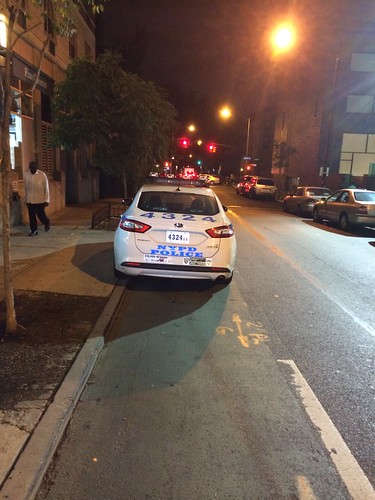
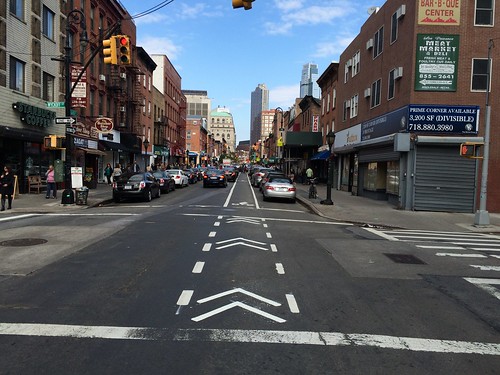
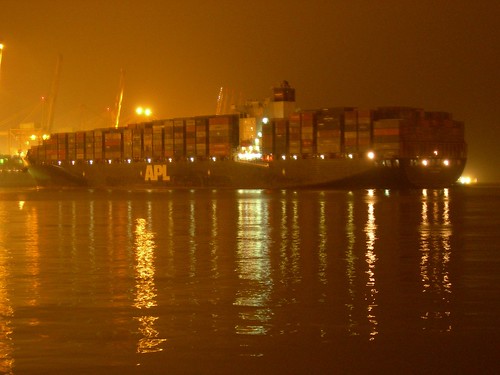
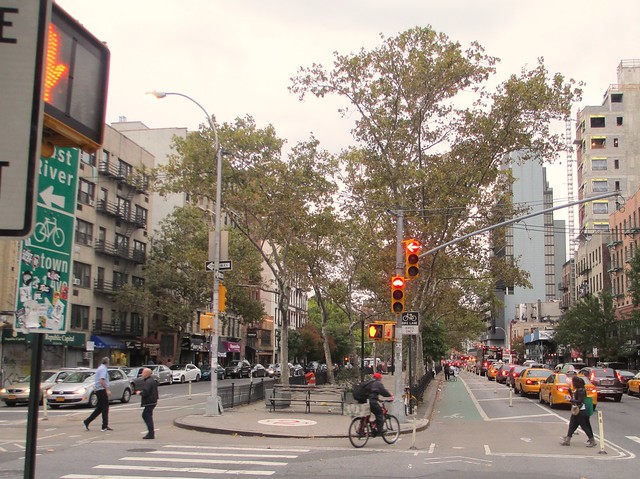
Showing posts with label New York cycling. Show all posts

Sunday, 9 July 2017

A move back, two angry path-blockers - and why it's time to stop writing and start remembering

On July 6 last year, I got on my bike for the last time outside my apartment building in Brooklyn. As I’d done hundreds of times before, I rode down Smith St and over the Manhattan Bridge to my employer’s office in west SoHo. Then, around lunchtime, I rode back, packed my bike into a box and headed with my family to JFK Airport. After an overnight flight to London, I did much the same as I’d done in New York in reverse. We headed to our temporary accommodation, I unpacked the bike and I rode to my employer’s London office.

A traffic jam on the Manhattan Bridge bike lane: a route I last
took a year ago last week.
That first ride in London after four years in New York was the start of a year in which it’s been a great privilege to rediscover the joys of getting around the UK by bicycle. Some of the more than 5,000 miles I’ve ridden have been for leisure. But I’ve also been rediscovering newspaper reporting by bicycle. I took my bike with me on a train to Manchester early on May 23, the morning after the appalling Manchester Arena bombing. I rode around Bradford during the general election campaign. On the night of June 3, I tried to cycle to London Bridge to investigate reports of an apparent terror attack, only to be stopped by panicky armed police officers ordering me to turn around.

Yet, as my enthusiasm for getting about by bike has reached still greater heights, I’ve found my enthusiasm for writing about it heading in the other direction. Writing on the issue that doesn’t fit the accepted narratives of people who oppose or support cycling provokes extraordinary levels of anger, I’ve discovered.
London from Parliament Hill: a joy to
rediscover by bike

Some of my posts have excited hostility from opponents of cycling. Two of my Facebook friends were so furiously resistant to the idea that drivers pose more danger to pedestrians than pavement (sidewalk) cyclists that they’re no longer my Facebook friends. But several others have inspired near-apoplexy among my fellow cyclists. The nadir of this was when one of the UK’s most respected cycle campaigners attributed my previous post to my alleged “cyclophobia”.

The problem is partly, I recognise, that this blog has always rather uncomfortably straddled twin roles as a platform for campaigning and philosophising. I’ve long believed, on one hand, that the bicycle is an excellent means of urban transportation, hoped to see more people riding bikes and supported the building of facilities that will make that possible. I’m personally slightly fanatical about trying to get around by bike whenever I can. When travelling with the prime minister to this weekend’s G20 summit, for example, I tried to find out if there was a way to park my bike at Heathrow Airport’s Royal Suite (there sadly wasn’t).

Me as I prepared to take my bike to Bradford
for a general election piece: this is what
a cyclophobe looks like, apparently
But I’ve also spent nearly 10 of the last 14 years as a reporter writing about transport issues. I’m used to meeting the people facing the daunting challenge of devising transport systems that fulfill the needs of people that want to use buses and trains as well as bicycles. While I’ve sought to frame my pieces here in the context of a cyclist’s experience, I’ve ended up writing a fair amount with the perspective of someone caught up in the wider transport debate.

The bottom line is that it’s become so exhausting dealing with hostile reactions to my blogposts that it’s detracting from my enjoyment of cycling, rather than adding to it. I’m consequently making this my last post on this blog.

As with any break-up, I should explain the ways it’s not you but I who’s at fault. On April 18, I moved from writing about transport to covering politics full-time. The shift has meant both that my head’s been a lot less full of transport policy than it used to be and that my time has been consumed with other things. I’ve been thinking about, say, the messages of the main parties’ campaign literature in the recent snap UK general election rather than how patterns of demand for transport in London are changing.

While it was a joy for the piece on campaign literature to ride my bike to the north London constituency of Hampstead & Kilburn to research it, my mind was dwelling on politics as I headed home. I might once have pondered the relative merits of Royal College St’s segregated bike paths and the quiet, backstreet routes I used elsewhere.
Election literature I picked up after riding to Hampstead:
a new preoccupation.

My enthusiasm for blogging hasn’t been enhanced by the sheer intensity of the UK’s recent news flow. Since April 18, the country has not only experienced an extraordinary general election but two terror attacks - both of which I’ve been involved in covering - and the tragic Grenfell Tower fire. Issues around cycle infrastructure remain important but have felt less pressing in these circumstances.

Yet a row I had with two fellow cyclists on June 16 encapsulates a wearying tendency on both the roads and the internet that has played a significant part in putting me off. I encountered the pair near the exit from Kensington Gardens, in west London, as I rushed to Kensington Town Hall to cover the building’s occupation by protesters angry at Kensington & Chelsea council’s mishandling of the aftermath of the Grenfell Tower fire. On a section of the route where cyclists were asked to dismount, I did so. But, being in a hurry, when I passed the dismount sign at the other end of the narrow section, I got back on my bike and tried to continue my journey.
Police stop protesters from entering Kensington Town Hall:
I had a telling experience en route to this event.

The two other cyclists were having none of it. Having failed to spot the signs telling us to remount, they kept pushing their bikes, two abreast, down the middle of the path, deliberately obstructing me from getting past. When I finally got past, one of them said to me, “Try reading the signs next time”. It immediately struck me how common such behaviour is both on the roads and online. People who are sure of their own position are prone to assuming those who act differently from them are acting out of either stupidity or malice. People have been free in attributing elements of my posts on here to both.

The frustration is all the greater because much of the anger has been motivated by my determination to make clear a single point on which most London cycle campaigners have chosen to ignore what seems to me crystal-clear evidence. It’s become conventional wisdom among London cycle campaigners to insist that the construction and opening of the east-west, north-south and Vauxhall Bridge cycleways last year had no effect on motor vehicle congestion. It’s become fashionable, among other things, to blame London’s evident growing traffic jams on extra numbers of for-hire vehicles, rather than the effects of the reduced road capacity.
The North-South Superhighway on Blackfriars Bridge,
before the latest barriers went up: useful, but not quite
the way that Transport for London spins it.

Yet there remains, it seems to me, no room for honest doubt about what’s going on in central London. Motor traffic volumes for the most recently reported quarter were down 3.4 per cent year-on-year, while average traffic speeds in the same period declined 5.4 per cent. The picture of growing congestion resulting from a shrinking of the road network’s capacity is obvious to nearly everyone outside cycle campaigning who looks at London traffic issues. That the building of the cycle superhighways has contributed significantly to the congestion is obvious from Transport for London’s report on implementation of the Cycle Superhighways, which shows eastbound journey times in the peak along the Embankment are up by 15 minutes.

The reactions I’ve received to pointing to these clear, unequivocal figures vary. A handful of people have thanked me for being willing to follow the data wherever they point. But the vast majority have involved some version of accusing me of stupidity, ill-will or a failure of imagination. Many people point to one of Transport for London’s arguments in favour of the cycle tracks - that Blackfriars Bridge now at rush hour carries more people than it did before the cycle tracks were installed. That, I think, misses the point about what’s uniquely useful about London’s roads - that much of the traffic now doesn’t involve passenger transport but deliveries, including traffic to and from the Crossrail building work, supplies for housebuilders and even the material needed to construct new segregated cycle superhighways. It also misses the point that many London roads are now congested and busy with motor traffic all day, while the peaks on the cycle tracks are far shorter.

Other critics have suggested that congestion is somehow inevitable - an argument that doesn’t fit with its having been successfully reduced by the introduction of the congestion charge in 2003. Some have welcomed the congestion because it will force people to take up cycling - an argument that I suggest won’t be much comfort to a relative of anyone stuck in an ambulance trying to get to hospital. Others have suggested that delays to buses - on which there are 6.5m daily trips - are a price worth paying for improving conditions for cyclists.
My son on the east-west Cycle Superhighway:
finally, central London routes that are
a joy to use with children

I remain delighted that the cycle superhighways, which I use daily and which have made it far easier for me to get around central London by bike on my own and with my children, have been built. I am excited daily by the huge numbers of cyclists that I see heading down Clapham Road or over Vauxhall Bridge on my commute. But I continue to worry that, as long as so many London cycling activists cling to views about the dynamics of London’s congestion that defy the evidence, progress on further improving London’s cycling conditions will be slow. Some long-standing transport professionals whom I know - one of whom has been a long-term champion of cycling - now fear to discuss London cycling because of the poisonous atmosphere around this debate.

I would much prefer cycling activists to accept that the superhighways have exacerbated congestion that was already worsening. I'd hope people would then campaign for a more sophisticated, London-wide road-charging system that would deter driving in London far more effectively than the present congestion charge.

Anyone who begins from the starting point of believing the evidence of the statistics about trends in central London traffic is generally branded an unreliable cyclist-hater, however. There's normally some insinuation that the person is in the pocket of some sinister vested interest. It was, needless to say, in a discussion over London congestion statistics that I was accused of cyclophobia.

My clearest conclusion after a year back in the UK is that my efforts to analyse what’s going on around me and argue for my approach are doomed. I’ve made my case to scores of commenters on this blog and to still more people on Twitter and Facebook. My efforts have generated far more tension and unhappiness than they have understanding. It’s time to draw the inevitable conclusion from these failures and to stop trying.

There are sensations and experiences I’d like to express. I still enjoy remembering how Kennington Park Road, one of my regular haunts, was originally a Roman road. I like to think of how Roman soldiers marched there millennia ago. I’ve got faster at cycling over the past year, partly because I’ve lost 15kg. I’ve gained a new, childlike appreciation for the joys of speed on a bike. On the morning after the Manchester bombing, I left home before 6am and experienced for the first time in years the strange excitement of riding through dawn-time London as the corner shop shutters clank open.
My daughter and our bikes on the Emirates Air Line:
she's played a role in some of my fondest cycling memories.

Some of my strongest feelings involve riding with my daughter, who’s now 15. She has become far fitter as a cyclist, having started cycling daily to and from school. Eight days ago, I was rushing home with her by bike from the Tate Britain when we came on a group of adult cyclists who were riding more slowly than we were. In its own way, it was one of my most perfectly satisfying experiences on a bike to look round, ask her, “Are you ready?” and watch as she accelerated smoothly past them, a picture of confidence on her smart red road bike.

But, while I’ve enjoyed in the past mining such experiences to make points on this blog, it’s time now to work on a different discipline. I’m going to try harder to enjoy the daily joys of riding a bicycle in the moment, while forgetting the frustrations more quickly. I thank those who’ve read this blog regularly over the years and trust that you will nurture that joy a little more too.

Monday, 4 July 2016

A tour of tolerant diversity, the horrors of its opposite - and why I'm sorry to say goodbye

I was waiting in line for Salvadorean food, standing next to a black fellow cyclist after the Transportation Alternatives Brooklyn-Queens Tour through New York’s two most diverse boroughs, when the announcement came for a moment of silence. Because we’d been riding our bikes, few of us knew what had happened. “Fifty people?” the rider next to me asked, in a tone of shock. I started trying to work out how one person could possibly have killed so many people.

By the end of June 12, however, I was not only learning far more about the day’s appalling massacre at the Pulse gay nightclub in Orlando, Florida, but on my way to a hotel near the scene to report on it. The job of covering the attack was all the more traumatic because I’d, unusually, remained ignorant for so long of its happening.
Cyclists wait at Citi Field to start the Brooklyn-Queens
Tour. The same parking lot was the scene, later the same day,
of a horrific revelation for many riders

Yet the experience of having ridden my bike through Brooklyn and especially multicultural Queens before heading to Orlando kept informing my thinking over the following two days. The areas where I’d been riding are some of the most diverse in any major western city, with people from countries all over the globe living next to each other in a miracle of tolerant diversity. I couldn’t help but wonder what made the difference between very different people’s ability to live together in areas like Crown Heights – where observant Jews live next to black people from the Caribbean – and the impulse that drove the hate-filled Orlando attacker.

My reactions were all the stronger because I’d undertaken the Brooklyn-Queens Tour as a farewell to New York before I leave the city to return to London on July 6. The looming deadline has made me think harder about why I love the atmosphere of New York City so deeply, despite the chaos – even the corruption - of much of the city’s functioning. I’ve decided that the chaos and its loveability are closely tied up in each other. It’s just unfortunate that the chaos overpowers the loveability on the roads, while it’s mostly the other way round everywhere else.

From the very start of my day’s riding on June 12, I’d been reminded how a cyclist – riding at moderate speeds on surface streets - is uniquely placed to appreciate the intricacy of the stitching that holds together New York’s ethnic patchwork. The morning of the Brooklyn-Queens Tour, I started at my home in traditionally Italian-American Carroll Gardens to ride to Citi Field, the New York Mets’ stadium, 13 miles away, for the start of the event. The trip took me through mainly African-American housing projects near the Brooklyn Bridge, Hasidic Jewish South Williamsburg, heavily Polish Greenpoint then over the Greenpoint Avenue Bridge into areas of Queens that are variously East Asian, South Asian and Hispanic.
 
Diversity Plaza: a twee name for a high ideal
At one point where a particularly large number of seams come together, in Jackson Heights, I rode along a block recently rather tweely renamed “Diversity Plaza”. A nearby block is almost exclusively filled with Tibetan restaurants and grocery stores, while other shops nearby sell saris to local Tamils and a Chinese supermarket supplies the neighbourhood’s Chinese. The area hums to the tune of dozens of different languages.

The boundaries between the different groups’ areas are porous and unclear. The Chinese supermarket in Jackson Heights, for example, stocks some Filipino and Vietnamese food because it recognises that the area’s far less uniform than, say, Manhattan’s Chinatown.

The arrangements are the exact opposite of what I remember seeing when I visited Bosnia in 1995 during its war of independence. As I rode with a bus full of refugees from Tuzla to Split, we kept encountering checkpoints still operating after the brief war between the Bosnian government and Bosnian Croats. The papers of the people on the bus – mostly Bosniaks, as Bosnian Muslims call themselves – all had to be carefully checked to prevent unauthorised crossing of ethnic dividing lines. While the streets of, say, Little Italy were once guarded by men who kept strangers out, there are no barriers for a contemporary New Yorker to wandering around densely-packed areas full of people who look different from him or her.

A bicycle saddle is also an excellent vantage point to see how little obvious planning has gone into forming the city’s ethnic jigsaw puzzle. Old groceries get converted into churches as new groups take over areas that once belonged to another. A grand former synagogue on Pike St in Lower Manhattan is now a mixture of a Buddhist temple, businesses and apartments. The city’s history is that it’s largely when people are able to choose their own patterns of settlement that the process goes most smoothly.
 
A viaduct on the Brooklyn-Queens Expressway:
Robert Moses' sensitive approach to city planning
on full display
It is certainly no coincidence that the neat mind of Robert Moses – the “master builder” who transformed New York in the mid-20th century – abhorred both diversity and the narrow local streets where it flourishes. In the years after the second world war, he demolished multiple areas that he regarded as slums, replacing them with whiter, duller institutions such as the Lincoln Center or expressway roads. It was obvious at many points along my ride how highways such as Moses’ Brooklyn-Queens Expressway severed once-thriving communities. The city is in many ways only just recovering from his insensitive desire to destroy in the course of building.

Perhaps the truest expression I’ve encountered of New York’s diversity is a scene I encountered on my bicycle while apartment-hunting four years ago. In a tyre shop on Coney Island Avenue in Brooklyn one evening, white-robed men were hunched over drums performing a Sufi Islamic ritual. The ceremony looked imported unchanged from the back streets of the Maghreb. It was being performed in a space intended for another purpose. Yet it was going on not only in full view of the street but on an avenue a mere five blocks from Ocean Parkway, the heart of one of the western world’s most thriving Jewish neighbourhoods.
 
A Jewish couple wait to cross Ocean Parkway - an ethnic
stronghold, yet close to diversity.
During the 40-mile Brooklyn-Queens Tour, the starkest reminder of New York’s remarkable success in building reasonably tolerant diversity was my ride through Crown Heights. The area was the last to feature full-scale inter-racial rioting in New York – in 1991, when a fatal crash involving a driver in a leading rabbi’s entourage and a Guyanan man set off three days’ clashes between black people and observant Jews. Yet, riding through the area on the Sunday morning of the tour, there were the same ambiguities as in other areas about the boundaries separating different groups. I noticed, with a sigh, that the congregation of a large, black Pentecostal church had blocked a stretch of bike lane and sidewalk as they parked for Sunday morning worship. The next moment, I was seeing boys wearing smart white shirts and kippahs heading off to Sunday morning religious classes.

It is, of course, far easier to describe what a peaceful city looks like than to describe why someone like Omar Mateen, the Orlando killer, erupts into hate-filled violence. I got the call asking whether I could go down to Orlando as I approached home at the end of a total of nearly 70 miles’ riding. Within a few hours, I’d made my excuses for a dinner party I’d been looking forward to, taken myself to LaGuardia Airport – near where I’d started my ride at Citi Field – and checked into a suburban Orlando hotel.
 
Reporters near the scene of the Orlando massacre:
feeding an unspeakable horror into the 24-hour news cycle
Starting reporting the next morning, I headed to a family reunion centre near the massacre site and spoke to César Flores, a Guatemalan immigrant whose 26-year-old daughter, Mercedez Marisol Flores, was among the 49 people Mateen killed before he was himself shot. Exactly 24 hours after I’d been riding round Brooklyn and Queens marvelling at their peaceful diversity, I watched Mr Flores hold his phone to show reporters a Facebook picture of his daughter, surrounded with the Pride flag colours. This, it was clear, was the price of  intolerance of diversity.

“She was a very happy girl all the time, a good student, a hard worker,” he said, tearfully. “But she’s gone.”

I began to make the connections between my Sunday experience in New York and my reporting in Orlando on Monday evening, as I attended a vigil for the dead in downtown Orlando. Speaker after speaker pleaded, essentially, for the values that have rescued New York from the low point of the Crown Height riots. They called for gun control – an area where New York is about as strict as the US constitution allows – and for different social groups to safeguard each others’ interests. Muslim speakers defended gay people’s rights, while speakers from gay advocacy groups denounced any potential reprisals against Muslims.
 
The Orlando vigil: a critical reminder of the importance
of "safe spaces"
It was the praise for the role of the Pulse club among Orlando’s gays that finally drove  the point about diversity home. Several speakers described gay clubs as “safe spaces,” vital to giving lesbian, gay, bisexual and transgender people the self-confidence to deal with a sometimes hostile wider world. The remark made me think of the multi-ethnic New York I’d witnessed both during the Brooklyn-Queens Tour - and during all my four years riding in the city - as a complex mix of safe places and meeting points between communities. While it’s unknown precisely what mixture of mental disturbance, islamist radicalism and homophobia drove Omar Mateen, it’s striking that such attackers often seem to come from less cosmopolitan, self-confident places. Greater tolerance should at least play a role in averting future horrors.

Not, of course, that I should sentimentalise New York. During nearly all the sections of the tour that involved riding on roads with cars, I was jostling with drivers for space. The principle that a “safe space” creates an environment for healthy interaction with others extends, I think, to well-designed protected bike lanes, of  which the city still has far too few. The city’s ethnic geography is not entirely a result of happy happenstance. Black people were barred for decades from large areas and economic injustice continues to keep some people in less desirable areas. The New York Police Department continues to do a far less good job than it should do. The police shrug at road safety problems – and it is becoming gradually clearer that police corruption drives many of their decisions about how to manage the roads.
The graduation ceremony at Brooklyn College: a case study
in the value of "defending the hyphen".

But an event on June 21 underlined for me the privileges of having lived and cycled four years amid this bracing, if untidy, experiment. I rode from my office in Manhattan down to Brooklyn College in Flatbush that evening to see my daughter graduate from middle school. For me, a highpoint of the event was a brief address from Eric Adams, Brooklyn’s borough president, in which he told us it was vital to “defend the hyphen”. It was critical, he said, in an era of intolerance to celebrate both the diversity in a Brooklyn full of African-Americans, Puerto Rican-Americans, Russian-Americans and the factors that made them all Americans too. It was a message that was easy to appreciate in a hall packed full of families originally from Asia, the former Soviet Union and South Asia all seeking similar success for their children. But it was all the easier to believe because I’d so recently come face to face with the principle's appalling opposite.

Sunday, 19 October 2014

An oafish limousine driver, an English Channel passage - and why a metro makes the case for bike paths

It was as I was riding down 13th St in Park Slope, not far from my apartment, last Sunday that I heard the sound of honking behind me. Looking over my shoulder, I saw a black Lincoln Town Car – vehicle of choice for many New York City car services – barrelling down the street towards me and my son, who was on his trailer bike behind me.

New York City's official advice on where to ride in the road:
not bedtime reading, I'd suggest for the guy I encountered
But my response wasn’t what the driver obviously hoped it would be. Knowing that the street’s single lane, though wide, lacked the space for a wide vehicle to pass safely at speed, I steered into the very centre of the lane, preventing his attempted pass. At the next traffic light, he pulled up next to us and yelled how I should have been over to one side of the street. He then gave a loud blast on his horn and passed aggressively and fast. At the light after that, I asked his passenger please to withhold her tip.

The driver was inconsiderate and dangerous, as I pointed out in my subsequent complaint to the Taxi & Limousine Commission (top tip, for-hire drivers: behave especially well if you’ve got an easily-remembered licence plate). But he also misunderstood the complicated relationship between space and speed. There are circumstances where it might be safe for a 6’ 6” wide car to pass a bicycle on a 28’ wide street where parked cars are taking up 8’ on either side. But they don’t include occasions when a person is riding a bicycle laden with groceries and hauling a trailerbike at 17mph downhill.

In the debate about how best to allocate space
on the roads, New York's police department
prefers to make practical demonstrations
of its position.
It’s at the root of very many of my arguments with motorists that few seem to understand how I expand the buffer zone I’m mentally defending around myself as my own and other road users’ speed increases. I’m sure that many motorists see me and other cyclists squeezing past stationary cars and jump to the wrong conclusions. It’s a very different business riding close to a stationary motor vehicle and next to one doing 40mph while one’s riding at 20mph. Fast-moving vehicles travel far farther while the driver is processing the need to stop and then need a far greater distance to come to a halt. It should be obvious that every mile per hour of extra speed disproportionately expands the invisible balloon of space I need to keep free.

The point is especially important because so many of the disputes about how to accommodate growing levels of cycling use – or cities’ aspiration to have more journeys by bike – come down to the allocation of road space. The debate is an asymmetric one at present. Nearly anyone who regularly rides a bike in a city will have thought about the space he or she can use on the roads, how the space is apportioned and the issues that that allocation raises. Many people who drive cars around cities seem instinctively to think the roads should be freer of obstructions in front of their cars, wider and more conducive to high speeds. To such a view, any space taken away from cars is being stolen from its rightful owners.

The whole issue has reminded me of a reporting visit I undertook 10 years ago to Line 14 of the Paris metro, the city’s first entirely driverless metro line. I noticed how trains slowed down from their 80kph (50mph) top speed well in advance of the terminal station if another train was occupying the platform. But then, as the trains slowly negotiated the junctions at the end of the line before turning back, they would come almost in touching distance of each other. They were under the control of one of the world’s most advanced signalling systems. It was constantly calculating the balloon of space it needed to maintain between trains, providing many train lengths’ of empty space in front of each train at top speed but barely any at 10kph (6mph).
 
Smith St, Brooklyn: it's a bike lane but also, on a busy morning,
a corridor of collision uncertainty.
A chaotic, busy street makes far more sense if one pictures every object encased in balloons of space like those that Line 14’s signalling system projects in front of trains. Every vehicle operator should be maintaining in front of him or her enough empty space to stop safely in the event that an unexpected danger crops up. But, just as importantly, everyone on the street needs to plot the trajectories of other vehicles or other potential obstructions. Looked at this way, it’s clear why suddenly-opened car doors pose such a danger. No other obstruction can appear as suddenly or with as little warning as a suddenly-opened car door. I refused to let the angry car service driver past to avoid being forced into the door-opening danger zone. To the driver, I’m sure that looked like a willful refusal to go into an unused, empty zone.

It’s because I draw a safety balloon round any moving vehicle that I find myself at least once a week in shouted conversation with the drivers of vehicles that have started pulling into my path. “Stop!” I’ll shout as the vehicle keeps moving across my path. “I see you!” the motorist shouts, exasperatedly, as if I should implicitly trust that the driver of a slow-moving vehicle on a collision course with me will not immediately turn into a faster-moving one.

The APL Pearl turns at the Port of Salalah: I yearn for her
navigational equipment, if not her limited maneouvrability.
I yearn for something like the collision-avoidance radar I watched a pilot use seven years ago as the APL Pearl, a container ship on which I was travelling, negotiated the chaotic shipping lanes of the English Channel. Each vessel’s radar plot had in front of it a line showing where it would be within six minutes. Slow-moving oil tankers and bulk carriers sported only relatively small, short lines. The lines before container ships like our own were longer. However, a fast ferry emerging from the Port of Boulogne suddenly threw a long, worrying line across the paths of many of the vessels, including our own, sending the pilot into a brief frenzy of calculation about collision courses.

The more one ponders the complexity of the interactions on a shared-use street – or the English Channel - the less one becomes surprised at people’s tendency to crash into each other. The surprise is how effectively most of the time people manage to miss each other.

Yet a trip the week before my run-in with the Impatient Car Service Driver of 13th Street suggested a different lesson about space. I was visiting the Burlington Northern Santa Fe railroad in North Dakota, where sudden, unexpected growth in both agricultural and oil traffic has led to significant congestion. As we drove by the company’s main line across the region, we saw an Amtrak passenger train zipping along the main line at 70mph, far faster than the 50 or 60mph common for freight trains on the route. “I’ll bet that really eats up capacity,” I said to the railroad people, to a resigned harrumph of acknowledgement.
A BNSF oil train near Ross, North Dakota: the drivers are
probably not grateful they share their tracks with faster,
lighter passenger trains.

No railwayman relishes running trains of sharply-varying speed next to each other. The fast ones constantly catch up with the slower trains in front, leaving unused space behind them. The slow ones constantly fall behind, leaving unused space in front of them.

It's key to improving road safety to control vehicles' speeds on city streets and New York in particular needs to do a far better job of the task. But there is also, it occurs to me, an Amtrak-type effect on many congested streets where bikes, cars, buses and others share space. The differing braking and acceleration statistics of the different vehicles waste space and capacity as effectively as if the New York subway decided to run the F Train with a mixture of the latest electric subway trains and its plodding diesel maintenance trains. Were New York’s Department of Transportation to provide properly-segregated bicycle lanes on downtown Brooklyn’s most chaotic streets, it’s easy to imagine that they would instantly become far more efficient places, as well as far safer ones. It’s perhaps time to label such streets as optimised streets, rather than simply safe ones.

It will, of course, be some time before all the hundreds of backstreets like the one where I was riding last Sunday will justify such optimisation. While the ultimate cure for episodes like the one I encountered might be surgery for the street, the short-term response will still be for the driver to take a don’t-be-an-inconsiderate-fool pill.

But the spaces under the streets of many cities and the rail lines that march across many countries’ open spaces show that transport can be conducted in an orderly, safe, efficient manner. It would be a tragedy not to learn at least a little more from them.

Update: I've just heard (on February 25, 2015) that the limo driver who harassed us has been dealt with - with a $200 fine an no points on his licence. I'm glad he's faced some penalty. But this strikes me as fairly paltry - and heightens my concerns about Taxi and Limousine Commission procedures.

Sunday, 4 May 2014

Brooklyn, a bridge, Manhattan - and the voice every morning in my head

Huh. Morning came around soon. Put bike into road. Swing leg over. Left shoulder? Nothing. Pull out. Brake again. Look right. Goodness that SUV’s coming fast. Swish. Swish. Swish. All gone? Start pedalling. Start pedalling, turn left, into the bike lane. Here we go.

Yeah, I like this first bit on Smith St. Head down. Bit of a slope. Get moving as fast as I can. 16mph. 17mph. Feels like skipping sometimes, pushing down hard each stroke of the pedals.

Here we go. Yup. Here we go.
Oh. Big Toyota SUV poking out from the sidestreet. Wheels? Not moving. Check over shoulder. Signal. Pull out round him. Stern look. What do I think that’s achieving? Driver probably hates me. Maybe just shakes his head.

Traffic backed up to lights. Slip down the bike lane. Car doors? Wheels moving? Doors? Wheels moving? Which way’s this guy gonna turn at these lights? Pull left round him. Stop.

Kind of like what they’ve done with Carroll St subway station. Simple. Modern. Red hand for pedestrians still flashing, flashing. Just red. So look up at lights, look up at lights, green. Go!

Move legs fast, pedal, swing right before the cars catch up. Oops. Car poking into bike lane. Brake. Look over shoulder, pull round it.

There’s the school. I wonder what Alexander’s doing in his class. What’s it like to play out in that little playground?

But yikes. Car turning right in front of me. Brake, signal left to go round turning car. Carroll Gardens festival of dangerous and negligent driving this morning. Funny how they never send me the memo about that. Scary.

But now it’s clear. Pump, pump, pump, pump legs. Slip onto the big chainring. Left shoulder? Clear. Left round that pothole. Car at the sidestreet, creeping forward slowly. Firm finger pointed at him. Eye contact. Ooh – fierce glare, driver. But you stopped, didn’t you?
Spot the gap. Head for it.

Here we go again, though. Huge truck, narrow gap letting me through to the lights. Look up at the driver. Seen me? Seen me? Good. Thumbs up. So off again. Yeah, Mr limo driver, I do need to pull out round this delivery truck. I do and that’s why I’m pulling into the middle of the lane. No, I’m sure you don’t like it.

Oh there’s that guy.

“Hi, Robert. Nice one they’ve laid on for us today.”

“I think it’s something to do with the Pulaski Skyway’s being closed.”

“Yeah, have a nice ride.”
 
Atlantic Avenue in sight. Jails, courts, chaos.
So now Atlantic Avenue.

Yes, Mr Driver: I know you want to turn right. But I’m to your right and I’m going straight on. So hold on a moment. What was that swishing sound? Oh, that cyclist thought that gap was big enough to pass on my right? How many bikes are there at this light now? One, two, three, four, five, six, seven, eight…

Green. Pedal fast, check left shoulder, guy’s not turning through me. How’s bike lane in this busy bit? Oh, guy’s signalling right into car parking. Brake. Check shoulder, signal, move left. Up to next lot of lights. Stop.

Funny seeing the Corrections Department buses. You never see the guys inside. Funny thinking how downtown Brooklyn’s got a jail. Do they look out at me from the windows? High-rise jail. Funny.

Lights green. OK. Tricky bit by where they’re doing this building work. Glad they’ve moved the barriers. Didn’t like it when they had that big bulge out into the traffic. Now this corner. What are these minibuses always stopping in the right lane here? There’s that voice, the automated voice, “The walk sign to cross Smith St is aaawn.” Broad New York accent. Always funny. Read once about the guy whose voice it is. Lives in Staten Island.

Green again.

“STOOOOP!”

Why do drivers have that look of injured innocence when they finally give way and agree not to crush you? It wasn’t a big favour to wave me through, madam. Legal and moral obligation.
 
Smith St at Fulton: a not like from the voice in my head.
Fulton St lights now. Don’t like this crossing. Pedestrians, cars, pedestrians, buses, angry people. Why is everyone so angry all the time? Oh, other bikes. Hi.

“The bridge is coming. Focus on that.”

Green again. Sir, I’m sure your life is not full of people you can defy. But I wish you’d express your sense of powerlessness another way. Your wandering slowly across my path is just frustrating when I have the light.

Cut through bus stop. Could all that grease make me skid? Into bike lane. Lights by that funny tunnel-underpass thing. Red. Stop.

Oh, please, other cyclists. Do not buzz that pedestrian. Please do not.

“Tut, tut.”

Ha, serious condemnation from a British person that, “tut, tut” – if anyone could hear me.

But no-one can and now lights are green. Mr Driver, I am not going to be able to fly over that car in the bike lane so I am sticking my arm out left until I see noticeable braking from you. Slowing down? Good, I’m pulling left and let’s go.

Green light by the college. Everybody’s flying towards Tillary St, fast. Oh, close pass. Better get over to the left somewhere. Signal left, check over shoulder in left-turn lane. Get to front of traffic at Tillary St. Lights red? Stop.

There’s the bridge. I can see the bridge. The bridge is coming; the bridge is coming.

Policewoman over there directing traffic. How does it feel standing there with all the speeding cars, all the people crossing, all the cyclists trying to get to the Brooklyn Bridge or the Manhattan Bridge? Hey, lookie here, Ms Policewoman – look at these cars trying to run down these pedestrians. Interested? Didn’t think so.
 
The bridge is in sight, people. The bridge is in sight.
OK. Green light again and pedal fast. No, Mr turning-across-my-path, you have to yield to me, you have to yield to me, OK. I’ll swerve round you. Fast, fast, fast across this intersection. Cars lined up. Always feeling like they’re just waiting for the chance to run me over.

Now Jay St bike lane again but how are we organising ourselves this morning, fellow cyclists? OK, OK. Let’s do two abreast this bit. Spurt of speed. Pull to front of pack, now upset everyone behind by stopping for these lights.

Never mind. The bridge is coming. Lights green, go. Tricky bit here. Cut across the bridge off-ramp to the  bike lane. How fast is that truck coming down the ramp? Probably OK. In the bike lane, ride down the side of the cars, get to the kerb cut for the bridge bike lane, swing onto the sidewalk, across under the bridge and it’s there: Manhattan Bridge bike path.
 
Manhattan Bridge on-ramp: excitement builds.
Best bit of the ride this, best bit of the ride. Love the spiral on-ramp for a start.

Guy on fixie ahead. Never understand why people ride fixed over the bridge. Pedal, pedal, pedal. Catch up with him. Look into the Brooklyn-bound lane, clear, and bye Mr Fixed Wheel Loser, bye. Get some gears.

Up the slope, up the slope. Subway train climbing the slope too. Scan the passengers. None to wave at. Shoot me when I no longer feel like racing subway trains. Or maybe shoot me when I no longer feel like racing subway trains but check first if I’ve changed my mind with advancing age.

Clunky hybrid rider: feel like I'll pass her, chance that I'll fail.
Bye, Mr Citibike rider. Bye, Ms Pootling Along on a Cutesie Pink Bike.

Oh, hi, fixed-wheel rider overtaking me. Yeah, well, I’ve got kind of a heavy bike. Oh, there’s the long-bike commuting-with-kids guy. Kind-of hurts when he overtakes me with his kid sitting on the back. This wind catches my big frame. That’s the problem.

But who cares now? Climbing out over the river. Barge down below. What do they carry? Look out towards the Williamsburg Bridge. Always remember now that bushfire day. City covered in smoke, could barely see the Williamsburg Bridge. Met Doug Gordon that morning. He stopped to take a picture. Can see it OK this morning. Odd-looking bridge.
 
Funny-looking bridge, days you can see it.
Now look for the Empire State Building. There it is. Sun on one side, shade on the other. Middle of midtown, looking fantastic.

Best bit of the ride, this, best bit of the ride.

Past halfway now. Getting faster. 20 on the bike computer. Bye, Mr Citibike rider, bye, Ms Clunky Hybrid. Hello, Chinatown. Not much of a cooking smell today. 22.5mph. Let’s go right over that manhole cover. Love that clanking sound. Now slow for the final curves. Final awkward downhill turn. Brake for the lights in Chinatown. Stop. But whish, whish, whish. Other riders running the lights. Oh my goodness that car is going to hit that guy. No, just missed.

Empire State Building: in Midtown, in the sun.
But now green and off, right.

Feels faster now, after the bridge.

Chinatown Dragon Fighters’ – always like that fire station name. Not sure it makes sense. But like it.

Allen St bike lane left. Oops, cut across that pedestrian slightly. Feel bad about that. Speed up – but delivery man pushing cart in bike lane. Swing round him.

Speed up. Grand St. Fast down bike lane but red light at Delancey.
Crossing Delancey: but not like in the movies.

Crossing Delancey – wasn’t that a film? Yes, it was a film. Not sure what it was about. Tough street to cross, though. Tough. Probably not a film about cyclist safety, though.

But now green, speed up and off up bike lane and then Rivington, left, fast along Rivington until, oh, that old woman’s sorting her recycling in the bike lane again. Round her, then see old synagogue. Places change. Where did that synagogue’s people go? Four-way stop, hard to see, crane neck, nothing to see, then ambulettes in the bike lane. Not even sure what ambulettes are, but they’re always blocking the bike lane here. Stop at lights. Chrystie-Forsyth Park. Robert Moses built the park, yes Robert Moses built this park the year he built lots of parks. He wouldn’t like that I can ride a bike
Allen and Rivington: left and crosstown.
across it but here I go, here I go dodging the pedestrians, here I go across Chrystie St and here I swerve round the forklift truck working in the bike lane and up to Bowery, right, then up to Prince St left, stop at the lights at Mercer St and look around.

Little Italy. Not really Italian any more of course. No Robert de Niros shouting at their wives about the steak’s being overdone. Nice, though. Like this area but don’t like its drivers. Don’t veer into the bike lane, driver, don’t come too close because the bike lane’s closed here and I need to pull left; don’t walk in front of me, pedestrians. Ah, sorry. Light’s changed. On you go.

Final push now. Lafayette, Broadway, crosstown. Feel like I’m making progress. Posh shops. Taxis stopping suddenly, manholes in the bike lane, gratings, feels like cyclocross some days, stand up on the pedals, hands on the brake levers and ready to steer fast round trouble.

But now at 6th avenue, swing round the taxis blocking the bike lane, Charlton St now, zip up the block. Signal left. No, Mr Taxi, you don’t just drive at me like that. Stop at the lights. Left onto Varick, downtown a block, then wait at lights again.
 
Vandam and Varick, SoHo. Nearly there. Nearly there.
Someone from the office.

“Hi, Randi.”

Doesn't hear me.

Then right, down Vandam, pull over to the right and stop, get off, take off the bike computer. Bike onto the sidewalk, walk to the bike entrance, security pass and in. How many other bikes today?

Lock up the bike, grab the panniers, stride out the door.

Eight bikes today? That’s some – but not many.

Never understand it.

Best bit of the day, my bike ride. Best bit of the day.

The post is an edited and abridged transcript of the things the author says to himself and other people during a typical, 40-minute cycle commute from Carroll Gardens, Brooklyn, over the Manhattan Bridge to SoHo, Manhattan.

Sunday, 14 April 2013

A broken-down church - and a broken, asymmetric flow of information

I was only a little way into my first ride to work after moving into my apartment in Brooklyn when I started to get into a terrible tangle. Trying to get down Kane Street, in Cobble Hill, I found the road marked closed. After heading past the road cones, I found it was a proper road closure, not the kind where one just wheels the bike on the sidewalk past the obstruction. The closure was absurd, I muttered to myself, as the one-way system pushed my route further and further from the one I’d planned. It was, I reasoned, probably some piece of stupidity on the part of the police, worried about being sued over an unlikely accident near some relatively innocuous building work.
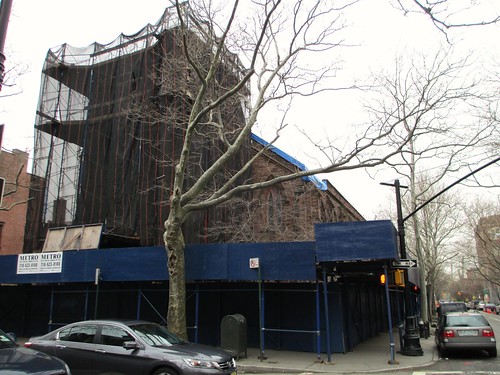
Christ Church, Cobble Hill: source of frustration on
the Invisible Visible Man's commute

I calmed down considerably, however, after finding out via Google why the street was closed. On July 26, while I had been back in Europe, lightning had struck Christ Church, the Episcopal church at the junction of Clinton Street and Kane Street. The spectacular tower – and scaffolding around it – had come crashing down as Richard Schwartz, a pedestrian, was walking underneath. The falling scaffolding had killed him. The building was a serious danger – and hadn’t yet been made safe.

The incident helped to crystallise an idea that had been slopping in fluid form around my mind for a while. I’d never have been irritated about the Kane St closure, I realised, if I’d had better information in the first place. It was, it occurred to me, one of many instances where confusion arises because two different parties – the New York City Department of Transportation and myself, in the Kane Street case – have different understandings of what’s going on on a road. The asymmetric information sharing had at least left me only inwardly irritated, however. The more I thought about it, the more I realised there were times when such information asymmetry probably killed people.

I encountered one potentially serious example the other morning while riding to work. I waited at traffic lights by the start of the Tillary Street segregated bike lane near the Brooklyn Bridge. When the lights changed, I moved off, only to find turning across my path a car heading in the other direction that should have been yielding to me. The driver’s behaviour was entirely wrong, based on his failure to understand what I knew - that the bike lane was as much part of the traffic flow at the intersection as the roads he was using. But, as he moved across my path, he leant out of his window. “Green light!” he yelled at me, self-righteously.

Traffic on W54th street. Those tainted windows don't,
in the Invisible Visible Man's experience, conceal
motorists pondering hard what information they might lack
about other road users' rights
Cycle lanes can give rise to information asymmetry as well. As I approached my office one morning last month, a truck driver opened his door in my path as I made my way up the side of some stalled traffic. He didn’t need to look for cyclists on that side of W54th street, he argued, because there was a bike lane painted down the other. Because of our asymmetric understanding of cyclists’ road rights, he had understood the cycle lane – which I knew to be a refuge for cyclists that didn’t stop me from using the rest of the road – as a kind of prison, to which cyclists should be confined.

Perhaps the most striking and persistent problem of information asymmetry that I’ve come across, however, was in London, where I lived until last August. Most traffic lights at busy intersections in London feature an “advanced stop line” for cyclists – an area where cyclists are meant to wait ahead of the other traffic for the lights to change. Many cyclists value advance stop lines as an idea, since they should, in theory, allow cyclists to get away after lights change, get clipped back into their pedals and get back into a suitable line on the road before the motor traffic catches up. Few motorists, however, seem to have much idea either about the principles of the advanced stop areas or when they should stay out of them. At least one motorist informed me, indignantly, when I complained about his occupying the area that when he’d arrived there had been no cyclists waiting, so he’d simply driven into the bike area.

Advance stop lines were involved in all three of the worst confrontations I had with motorists in London. In one case, a motorist deliberately drove very close to me and then very dangerously overtook me after I remonstrated with him about his driving into the ASL area as I was using it. A bus driver assaulted me (abandoning a bus full of passengers to do so) after I photographed his occupying the ASL area at a particularly dangerous junction. I had to call the police to stave off a threatened assault from another motorist to whom I’d complained about his driving into the ASL area.

Leaving aside the more eye-catching incidents, ASLs were a daily source of tension and frustration. I’d often squeeze past a line of stationary traffic to reach what was meant to be a haven for cyclists – only to fill it full of motorists grumpy at one’s presumption in seeking to get a jump on them at the lights. It’s reasonable, I think, to assume that even a fairly modest publicity campaign might have let at least a little of the fresh air of information into the foetid atmosphere of confrontation surrounding ASLs. In New York, it surely wouldn’t take much of a campaign to educate drivers about the role of bike lanes and the dangers of passing bikes too close to improve driving standards at least a little bit. The New York cycling map, after all, features excellent advice for cyclists on how motorists should give cyclists at least three feet's clearance when passing.

It isn’t, after all, a neutral thing to encourage new cyclists onto a city’s streets and then not tell motorists how to behave around them. Nature seems to abhor an information vacuum just as much as a literal one. In the absence of the pure oxygen of accurate, well-founded information, the information vacuum fills up with the carbon-monoxide-laden air of motorists’ assumptions about cyclists’ rights and responsibilities. It’s perhaps hardly surprising, given that no-one’s telling them otherwise, that so many motorists assume cyclists who ride well outside the door zone away from cars are acting maliciously, rather than entirely sensibly. In New York, it’s still less surprising given how many bike lanes – including most of those I use every day – are painted in precisely the part of the road – next to the parked cars’ doors – that cyclists know to be the most dangerous.

The air has grown still more poisoned because the agency meant to set the limits of acceptable behaviour in most modern societies – the police force – so often seems to have abandoned that role with regard to the road rules. Motorists, after all, like most other people see what they see others doing unmolested and assume it’s acceptable. One telling recent case I spotted involved a police effort to start fining motorists who drove in a bike lane on a narrow street at Twickenham, in South-West London (I’ll give New York cyclists a moment here to come to terms with the idea that, just across the Atlantic, there’s a police force that has, at least once, acted against motorists using a bike lane). A local newspaper quoted Nick Blyth, an officer involved in the enforcement effort, as saying: “Most of the motorists tend to comment when stopped that everyone else does it and they were just following them.”
 
Park right across one of New York City's busiest bike lanes?
Until someone says you shouldn't, you probably will.
It’s hardly surprising, given the New York Police Department’s reluctance to enforce a wide swathe of road rules, that few motorists seem even to understand the harm they cause when double-parking in bike lanes or refusing to yield to a cyclist in a bike lane. Nor, in London, is it terribly surprising that ASL infringements continue at the rate they do when even the Metropolitan Police department charged with processing complaints against motorists from cyclists (normally backed by helmet camera evidence) is currently pleading with leading London cycle bloggers to tell people to send in no more pictures of ASL infringements. They say, to all intents and purposes, they’ve no interest in prosecuting them.

The police’s attitude reflects, in an understated way, the strangeness of the political discourse around cycling. Politicians are eager, when announcing new policies between elections, to borrow cycling’s mantle of greenness and modernity and to encourage its growth. Closer to election time, meanwhile, many seem to revert to a different type – to claiming, like one minister I met, that cyclists were“their own worst enemies” or claiming like Boris Johnson, London’s mayor, that “typical” cyclists had skinny legs and ran red lights. No politician engaged in this delicate dance between pro and anti-cycling positions is likely to back a public information campaign explaining to frustrated motorists why, yes, that cyclist who yelled at you about your dangerous driving actually had an excellent point.

However, until such information is made more widely available and police across the industrialised world are backing up the politicians’ line with proper enforcement, few people will experience the relief I felt at letting go of my frustration over the Kane St closure. Relief is certainly not the emotion that comes naturally to me each morning as I ride along the now-reopened Clinton St towards the Brooklyn Bridge. I am all too often forced into the narrow bike lane, in danger from car doors, as motorists seek to push past me. But, as I reach the Kane St intersection and see Christ Church, still wrecked but now made safe, I still recall at least a little bit of that feeling.