Showing posts with label Carroll Gardens. Show all posts

Sunday, 4 May 2014

Brooklyn, a bridge, Manhattan - and the voice every morning in my head

Huh. Morning came around soon. Put bike into road. Swing leg over. Left shoulder? Nothing. Pull out. Brake again. Look right. Goodness that SUV’s coming fast. Swish. Swish. Swish. All gone? Start pedalling. Start pedalling, turn left, into the bike lane. Here we go.

Yeah, I like this first bit on Smith St. Head down. Bit of a slope. Get moving as fast as I can. 16mph. 17mph. Feels like skipping sometimes, pushing down hard each stroke of the pedals.

Here we go. Yup. Here we go.
Oh. Big Toyota SUV poking out from the sidestreet. Wheels? Not moving. Check over shoulder. Signal. Pull out round him. Stern look. What do I think that’s achieving? Driver probably hates me. Maybe just shakes his head.

Traffic backed up to lights. Slip down the bike lane. Car doors? Wheels moving? Doors? Wheels moving? Which way’s this guy gonna turn at these lights? Pull left round him. Stop.

Kind of like what they’ve done with Carroll St subway station. Simple. Modern. Red hand for pedestrians still flashing, flashing. Just red. So look up at lights, look up at lights, green. Go!

Move legs fast, pedal, swing right before the cars catch up. Oops. Car poking into bike lane. Brake. Look over shoulder, pull round it.

There’s the school. I wonder what Alexander’s doing in his class. What’s it like to play out in that little playground?

But yikes. Car turning right in front of me. Brake, signal left to go round turning car. Carroll Gardens festival of dangerous and negligent driving this morning. Funny how they never send me the memo about that. Scary.

But now it’s clear. Pump, pump, pump, pump legs. Slip onto the big chainring. Left shoulder? Clear. Left round that pothole. Car at the sidestreet, creeping forward slowly. Firm finger pointed at him. Eye contact. Ooh – fierce glare, driver. But you stopped, didn’t you?
Spot the gap. Head for it.

Here we go again, though. Huge truck, narrow gap letting me through to the lights. Look up at the driver. Seen me? Seen me? Good. Thumbs up. So off again. Yeah, Mr limo driver, I do need to pull out round this delivery truck. I do and that’s why I’m pulling into the middle of the lane. No, I’m sure you don’t like it.

Oh there’s that guy.

“Hi, Robert. Nice one they’ve laid on for us today.”

“I think it’s something to do with the Pulaski Skyway’s being closed.”

“Yeah, have a nice ride.”
 
Atlantic Avenue in sight. Jails, courts, chaos.
So now Atlantic Avenue.

Yes, Mr Driver: I know you want to turn right. But I’m to your right and I’m going straight on. So hold on a moment. What was that swishing sound? Oh, that cyclist thought that gap was big enough to pass on my right? How many bikes are there at this light now? One, two, three, four, five, six, seven, eight…

Green. Pedal fast, check left shoulder, guy’s not turning through me. How’s bike lane in this busy bit? Oh, guy’s signalling right into car parking. Brake. Check shoulder, signal, move left. Up to next lot of lights. Stop.

Funny seeing the Corrections Department buses. You never see the guys inside. Funny thinking how downtown Brooklyn’s got a jail. Do they look out at me from the windows? High-rise jail. Funny.

Lights green. OK. Tricky bit by where they’re doing this building work. Glad they’ve moved the barriers. Didn’t like it when they had that big bulge out into the traffic. Now this corner. What are these minibuses always stopping in the right lane here? There’s that voice, the automated voice, “The walk sign to cross Smith St is aaawn.” Broad New York accent. Always funny. Read once about the guy whose voice it is. Lives in Staten Island.

Green again.

“STOOOOP!”

Why do drivers have that look of injured innocence when they finally give way and agree not to crush you? It wasn’t a big favour to wave me through, madam. Legal and moral obligation.
 
Smith St at Fulton: a not like from the voice in my head.
Fulton St lights now. Don’t like this crossing. Pedestrians, cars, pedestrians, buses, angry people. Why is everyone so angry all the time? Oh, other bikes. Hi.

“The bridge is coming. Focus on that.”

Green again. Sir, I’m sure your life is not full of people you can defy. But I wish you’d express your sense of powerlessness another way. Your wandering slowly across my path is just frustrating when I have the light.

Cut through bus stop. Could all that grease make me skid? Into bike lane. Lights by that funny tunnel-underpass thing. Red. Stop.

Oh, please, other cyclists. Do not buzz that pedestrian. Please do not.

“Tut, tut.”

Ha, serious condemnation from a British person that, “tut, tut” – if anyone could hear me.

But no-one can and now lights are green. Mr Driver, I am not going to be able to fly over that car in the bike lane so I am sticking my arm out left until I see noticeable braking from you. Slowing down? Good, I’m pulling left and let’s go.

Green light by the college. Everybody’s flying towards Tillary St, fast. Oh, close pass. Better get over to the left somewhere. Signal left, check over shoulder in left-turn lane. Get to front of traffic at Tillary St. Lights red? Stop.

There’s the bridge. I can see the bridge. The bridge is coming; the bridge is coming.

Policewoman over there directing traffic. How does it feel standing there with all the speeding cars, all the people crossing, all the cyclists trying to get to the Brooklyn Bridge or the Manhattan Bridge? Hey, lookie here, Ms Policewoman – look at these cars trying to run down these pedestrians. Interested? Didn’t think so.
 
The bridge is in sight, people. The bridge is in sight.
OK. Green light again and pedal fast. No, Mr turning-across-my-path, you have to yield to me, you have to yield to me, OK. I’ll swerve round you. Fast, fast, fast across this intersection. Cars lined up. Always feeling like they’re just waiting for the chance to run me over.

Now Jay St bike lane again but how are we organising ourselves this morning, fellow cyclists? OK, OK. Let’s do two abreast this bit. Spurt of speed. Pull to front of pack, now upset everyone behind by stopping for these lights.

Never mind. The bridge is coming. Lights green, go. Tricky bit here. Cut across the bridge off-ramp to the  bike lane. How fast is that truck coming down the ramp? Probably OK. In the bike lane, ride down the side of the cars, get to the kerb cut for the bridge bike lane, swing onto the sidewalk, across under the bridge and it’s there: Manhattan Bridge bike path.
 
Manhattan Bridge on-ramp: excitement builds.
Best bit of the ride this, best bit of the ride. Love the spiral on-ramp for a start.

Guy on fixie ahead. Never understand why people ride fixed over the bridge. Pedal, pedal, pedal. Catch up with him. Look into the Brooklyn-bound lane, clear, and bye Mr Fixed Wheel Loser, bye. Get some gears.

Up the slope, up the slope. Subway train climbing the slope too. Scan the passengers. None to wave at. Shoot me when I no longer feel like racing subway trains. Or maybe shoot me when I no longer feel like racing subway trains but check first if I’ve changed my mind with advancing age.

Clunky hybrid rider: feel like I'll pass her, chance that I'll fail.
Bye, Mr Citibike rider. Bye, Ms Pootling Along on a Cutesie Pink Bike.

Oh, hi, fixed-wheel rider overtaking me. Yeah, well, I’ve got kind of a heavy bike. Oh, there’s the long-bike commuting-with-kids guy. Kind-of hurts when he overtakes me with his kid sitting on the back. This wind catches my big frame. That’s the problem.

But who cares now? Climbing out over the river. Barge down below. What do they carry? Look out towards the Williamsburg Bridge. Always remember now that bushfire day. City covered in smoke, could barely see the Williamsburg Bridge. Met Doug Gordon that morning. He stopped to take a picture. Can see it OK this morning. Odd-looking bridge.
 
Funny-looking bridge, days you can see it.
Now look for the Empire State Building. There it is. Sun on one side, shade on the other. Middle of midtown, looking fantastic.

Best bit of the ride, this, best bit of the ride.

Past halfway now. Getting faster. 20 on the bike computer. Bye, Mr Citibike rider, bye, Ms Clunky Hybrid. Hello, Chinatown. Not much of a cooking smell today. 22.5mph. Let’s go right over that manhole cover. Love that clanking sound. Now slow for the final curves. Final awkward downhill turn. Brake for the lights in Chinatown. Stop. But whish, whish, whish. Other riders running the lights. Oh my goodness that car is going to hit that guy. No, just missed.

Empire State Building: in Midtown, in the sun.
But now green and off, right.

Feels faster now, after the bridge.

Chinatown Dragon Fighters’ – always like that fire station name. Not sure it makes sense. But like it.

Allen St bike lane left. Oops, cut across that pedestrian slightly. Feel bad about that. Speed up – but delivery man pushing cart in bike lane. Swing round him.

Speed up. Grand St. Fast down bike lane but red light at Delancey.
Crossing Delancey: but not like in the movies.

Crossing Delancey – wasn’t that a film? Yes, it was a film. Not sure what it was about. Tough street to cross, though. Tough. Probably not a film about cyclist safety, though.

But now green, speed up and off up bike lane and then Rivington, left, fast along Rivington until, oh, that old woman’s sorting her recycling in the bike lane again. Round her, then see old synagogue. Places change. Where did that synagogue’s people go? Four-way stop, hard to see, crane neck, nothing to see, then ambulettes in the bike lane. Not even sure what ambulettes are, but they’re always blocking the bike lane here. Stop at lights. Chrystie-Forsyth Park. Robert Moses built the park, yes Robert Moses built this park the year he built lots of parks. He wouldn’t like that I can ride a bike
Allen and Rivington: left and crosstown.
across it but here I go, here I go dodging the pedestrians, here I go across Chrystie St and here I swerve round the forklift truck working in the bike lane and up to Bowery, right, then up to Prince St left, stop at the lights at Mercer St and look around.

Little Italy. Not really Italian any more of course. No Robert de Niros shouting at their wives about the steak’s being overdone. Nice, though. Like this area but don’t like its drivers. Don’t veer into the bike lane, driver, don’t come too close because the bike lane’s closed here and I need to pull left; don’t walk in front of me, pedestrians. Ah, sorry. Light’s changed. On you go.

Final push now. Lafayette, Broadway, crosstown. Feel like I’m making progress. Posh shops. Taxis stopping suddenly, manholes in the bike lane, gratings, feels like cyclocross some days, stand up on the pedals, hands on the brake levers and ready to steer fast round trouble.

But now at 6th avenue, swing round the taxis blocking the bike lane, Charlton St now, zip up the block. Signal left. No, Mr Taxi, you don’t just drive at me like that. Stop at the lights. Left onto Varick, downtown a block, then wait at lights again.
 
Vandam and Varick, SoHo. Nearly there. Nearly there.
Someone from the office.

“Hi, Randi.”

Doesn't hear me.

Then right, down Vandam, pull over to the right and stop, get off, take off the bike computer. Bike onto the sidewalk, walk to the bike entrance, security pass and in. How many other bikes today?

Lock up the bike, grab the panniers, stride out the door.

Eight bikes today? That’s some – but not many.

Never understand it.

Best bit of the day, my bike ride. Best bit of the day.

The post is an edited and abridged transcript of the things the author says to himself and other people during a typical, 40-minute cycle commute from Carroll Gardens, Brooklyn, over the Manhattan Bridge to SoHo, Manhattan.

Sunday, 23 June 2013

Hear this: what I heard on the street - and what it says about cycling's merits

It was as inconvenient a time for a work call as I can imagine. I had grabbed my ringing phone from my pocket just as the lights turned green at an intersection on the Invisible Visible Boy’s short route to school. “I can’t talk now,” I shouted before stuffing the phone back into my pocket, leaning heavily down on my pedal and getting myself, my bike, the boy and his trailer bike all safely again into forward motion.

But, once I’d said goodbye to the boy and phoned back my colleague in London, he didn’t immediately want to talk about the matter in hand. Instead, he made me realise how thoroughly I’d taken for granted one of my key sources of information about the world around me as I cycled. I’ve been noticing ever since how many sounds I hear as I ride around – and how richly they add to my experience.

“You didn’t ring off properly,” my colleague told me. “I could hear the sound of the wind – and your son’s giggling.”

I had, I suppose, assumed before my colleague mentioned it that most of the time while riding I wasn’t hearing very much. For much of my journeys both to and from work, I work my way past long lines of waiting cars. No-one’s saying a great deal. Even though it’s New York, people mostly don’t even bother with honking. They just sit there.

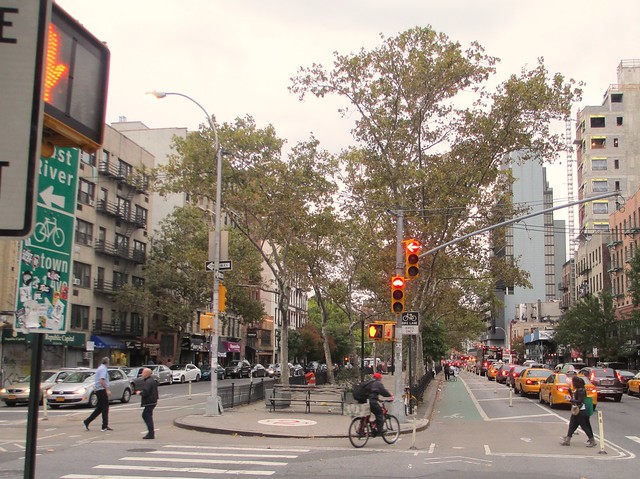
Clinton St, Cobble Hill: very nice for people - and even,
the Invisible Visible Man was surprised to hear,
a hit with gentrifying birds
But, the moment I started thinking about it, I recognised how much information my hearing was giving me. The wind whistles in my ears, with anything from a whisper to the full-throated, jet-engine roar of a seriously stormy day. I hear the gentle whir of my bike’s rear hub. There’s the gentle clicking as I change onto an easier gear and sometimes a slight clang as the gear cable loosens and lets the chain slip down to a smaller sprocket. It’s a good sign if I don’t hear very much. Recently, a tiny bit of water crept into one of my pedals and I’ve run out of the grease I need to make it completely quiet again. Every now and again it emits a little squeak, sending my stress levels a little bit upwards.

Much of the time, as I pedal along steadily, songs play in my head, to the rhythm of my breathing and pedalling. For a while now, for reasons I don’t entirely understand, the tune seems to have been Lyle Lovett’s Walk Through the Bottomland – an obscure choice, even to me, but one whose deliberate beat seems to fit with the way I cycle.

The bike’s interaction with the road makes its own sounds. Occasionally, I’ll hit some stray stone on the road and send it flying – thwack! – into a parked car. My mudguard (fender, American readers) gives off a tiny bit of a vibrating sound – a very miniaturised version of an arrow hitting a target – every time my front wheel jars into one of the countless imperfections in the road surface. On the Brooklyn Bridge, there’s the steady clack-clack of the wooden boards on the walkway, as the bike hits each and sets it vibrating against the metal underneath. One night recently, I went over the Queensboro Bridge and enjoyed the sensation of racing down into Queens on a surface made up of jointed concrete slabs – ka-boom-ka-boom-ka-boom-ka-boom, steadily faster as I picked up speed. It’s hard to sort out in my head which of these sounds is audible to the wider world and which is conveyed direct from the road to my skull as the bike judders against the crack in the road or the joint in the concrete.
 
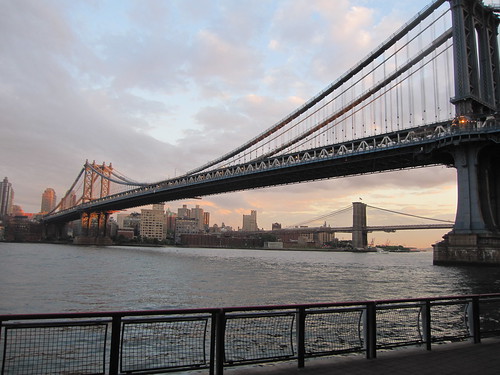
The Manhattan Bridge: a perfect urban cacophony
There are sounds of place elsewhere, too. As I leave my apartment, I hear subway trains growling complainingly around the Culver Viaduct high above my head. Then, the other morning, in another part of Carroll Gardens, I heard what I thought must be a novelty doorbell or strange alarm. No, I eventually concluded, there were actually some birds living happily enough in the trees along Clinton Street that they were singing out to each other one June morning rush hour. In some places, the audio soundtrack actually provides far more of the atmosphere than what one can see. Riding over the Manhattan Bridge yesterday, I noticed how I could hear the sound of wash breaking on the shore down below in Dumbo. Then a subway train rolled out onto the bridge, its clanking echoing off the roadway that runs above the tracks and drowning out the sounds of the motor traffic. As I raced the train over the bridge and gathered speed on the ramp down into Chinatown, I ran over one of the loose inspection covers. “Clunk-clank!” it went as I too sent the sound of my own progress echoing off the roadway’s underside.
 
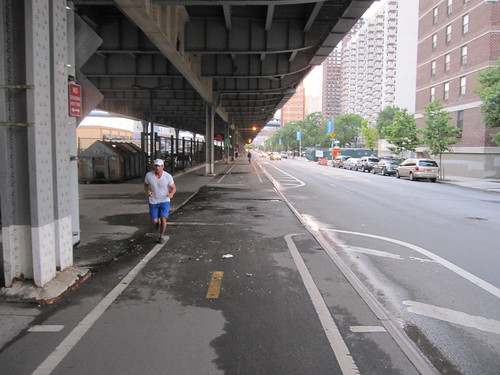
This is how the bike lanes under the FDR Highway look.
But the Invisible Visible Man hears the sound of the cars
banging over the joints in the road above
My sudden noticing of the birdsong, the sounds of the road and the cacophony on the Manhattan Bridge have all made me feel far more positive about the sounds that surround me as I cycle than I used to. Then, I noticed mainly the sounds of stress. Like most cyclists, I’m constantly listening out for the tone of the engines behind me in traffic, ready to pick out the note of a driver who’s revving his engine, ready to accelerate dangerously. It’s one of the clearest warning signs one can encounter that a driver isn’t going to behave safely.

None of that is to suggest, however, that the most noticeable sounds don't cause me anxiety. The volume of honking gradually rises each morning as I ride towards the Brooklyn Bridge – especially if there’s a garbage truck blocking Clinton Street emitting the strange low-high-low hum of its hydraulic crushing mechanism. The honking reaches a pitch as I struggle my way through TriBeCa. On Friday morning, an angry motorist in a hurry slammed on her brakes when I stopped for a red light where Chambers Street crosses the West Side Highway. She gave me a long, unmistakeably intimidatory blast of her horn for having the temerity to stop her from running the light.

Those aren’t the only worry-inducing sounds. Any encounter with a large, road-hogging SUV has an extra edge when it’s blaring out rap so loud that the whole car vibrates. The motorists with most faith in honking’s efficaciousness seem least ready to move aside for emergency vehicles and I hear their drivers using their sirens to plead their way out of traffic. The mixture of short blasts, honks and steady whines they emit sounds like nothing so much as a pitiful trapped dog. Probably no motorist driving along Boerum Place in downtown Brooklyn the other night was able to hear how desperately the woman traipsing along the street at 11.30pm with a toddler son and luggage was swearing as she pleaded for help or criticised or did whatever she was doing to the person on the other end of her ‘phone call.

But the exposure to the stress is a flipside to the joy of hearing all this sound. It’s a pleasure of cycling round the city that all my senses are in immediate, unfiltered contact with the world around me, rather than being filtered through tinted windows and soundproof doors. I’m experiencing the city far more fully than I would in a car or a subway train.

That came home to me most fully late last summer, when I had not long moved to New York. As I stopped for one of the last sets of lights near my home, an old sedan drew up next to me, its windows rolled down. For a few seconds, I was treated, wholly unexpectedly, to a blast of sublime 1960s jazz, saxophones running riot over a pulsing bass line. I looked over at the driver. We both smiled, surprised to find ourselves sharing a brief transcendent moment of musical appreciation.

Monday, 31 December 2012

A car crash, Sandy Hook and the limits of freedom

My BlackBerry takes really poor pictures -
but somewhere in there are an upturned car
and a bunch of firefighters

“Bang! Boom-boom-boom-boom.” The successive thuds I heard from my apartment’s kitchen one Tuesday night two-and-a-bit weeks ago sounded out of the ordinary, even for an area where subway maintenance, truck movements and any number of other things are apt to create noise. When I then heard the wails of multiple emergency vehicles, I knew something was seriously amiss. Reporter’s instincts awakened, I headed out to the street, to find a car overturned further up the block. The driver had come down neighbouring Court Street too fast, according to people who’d seen it, misjudged the turn into our street and somehow flipped the car. The driver, who by now was in police custody, had seemed very drunk on getting out – mercifully unhurt – from the car, onlookers told me.

The incident could easily have qualified as the biggest event of my week had it not been for the events of the Friday. Just as I remember working in the Edinburgh newsroom of The Scotsman in 1996 when news started coming through of a shooting at a school 35 miles away in Dunblane, I found myself that Friday following reports of an incident at a school 75 miles away in Connecticut. Once again, I experienced the gut-jolting realisation that this incident, far from being a run-of-the-mill, local tragedy, was on a scale that would grab the attention of an aghast world. Whereas the Dunblane massacre killed 16 children, the one in Connecticut had killed 20.

The crash and the Newtown shootings might, at first blush, look unrelated. They are certainly of contrasting gravity. The car crash dented a few vehicles and led to the driver’s arrest. The Connecticut shootings killed 20 children, seven adults and culminated in the shooter’s suicide. But they both ultimately raise the same questions – ones that apply both to road-users and gun-owners – about the limits of individual freedom. It’s an issue that I confront every evening as I cycle a few blocks on Court Street amid cars that no-one restrains from driving at grossly excessive speed. It extends all the way to my worries about my own children’s safety in their own elementary school, where “shelter drills” train them how to react if a dangerous intruder is on the loose.

Midtown Manhattan in winter sun:
not self-evidently a city built by stupid people
It certainly makes a difference to my perspective that I’m writing in the United States, where I moved in August, rather than the United Kingdom, where I had been living for nine years. It’s fashionable in Europe to sneer at some of the US’s freedoms – particularly when it comes to gun ownership – as if they were merely factors in a general national craziness. Why, patronising European voices ask, doesn’t the US just ban guns? The tone of the comments often carries undertones of the ultimate European sneer - that the people of the world’s richest, most successful country are either collectively a bit stupid or morally bankrupt.

Yet there is something profoundly valuable about many parts of the American constitutional system – and one of them is undoubtedly the Bill of Rights’ guarantee of certain freedoms. Only the most unbending critic of the United States could fail to be impressed by how the country’s constitution and democracy have flexed to deal with successive historical challenges. The system has adapted to stitching the US back together after the civil war, national mobilisation for the second world war, the cold war and the civil rights movement. Many constitutional rights – including the rights to free speech and freedom of assembly – have come under attack at the times of the worst strain. It has surely been part of the US’s successful negotiation of these crises that the rights have largely survived intact.

Nor is there something unique about US politicians’ willingness to sacrifice the lives of vulnerable citizens in the name of other people’s freedom. The day that Philip Hammond was appointed the first transport secretary in the current UK government, he vowed to end the “war on the motorist” – shorthand for a series of measures that included the introduction of speed and traffic-light cameras at the most dangerous accident blackspots. The gradual withdrawal of funding for such successful safety measures has been accompanied by a slow but steady increase in the number of motorists, pedestrians and cyclists thrown fatally into the air by speeding vehicles, crushed under trucks’ wheels or bleeding slowly to death amid the wreckage of their cars.

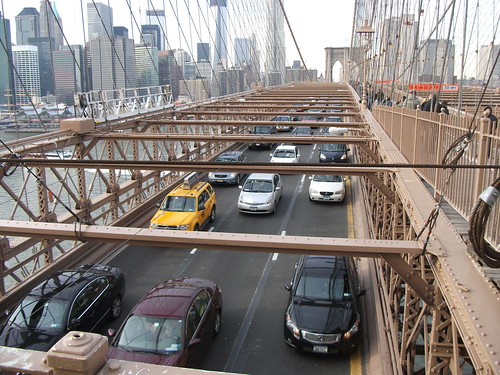
These cars were all free to drive over the Brooklyn Bridge on
Christmas Eve - so none of them was free to cross it fast.
There is a similar fear in many countries of the world – including the Netherlands and United States – about introducing distance-based charging for road use. Nearly every transport economist knows that only a direct charge for road use, varying according to the time of day, can tackle most rich countries’ congestion problems. Yet the only country so far to have introduced a national scheme to charge for using the busiest roads is Singapore – which uncoincidentally suffers an acute shortage of land, allied to intense relaxation about restricting individual freedoms.

Even on guns, the shocked insistence of some US politicians that citizens must be able to retain guns for hunting, self-defence and other legitimate uses is not unique. I remember vividly the controversy when the Duke of Edinburgh, the queen’s husband, insisted after the Dunblane massacre that proposed bans on the ownership of certain kinds of handguns were an unfair imposition on sportsmen. He asked whether, if someone had burst into a school and beaten 17 people to death with a cricket bat, the government would also legislate to ban them. The obvious point that guns’ capabilities set them apart from other potentially deadly weapons passed the Duke, like so many US gun lobbyists, entirely by.

Yet I remain instinctively suspicious of any freedom that is predominantly exercised by the well-off and already free at the expense of their poorer, less-free neighbours. US advocates for gun-owner freedoms tend to be overwhelmingly white and relatively rich. Even in a country with car ownership as high as the United States, the heaviest users of cars - and those of whom the politicians are most fearful – are the better off. Anecdotal evidence around New York suggests that the pedestrians paying the price for uncontrolled car use are disproportionately people like Maleka Begum, a 54-year-old mother of three, originally from Bangladesh. Ms Begum died after a bus hit her on a pedestrian crossing in Queens in October, in an incident that witnesses attributed entirely to the bus driver’s poor driving.

A speed-limit sign by the Brooklyn Bridge.
Most people accept in theory that
speed limits are a reasonable restriction
on freedom - for other people, at least.
The truth is that even the keenest advocate of the freedom to drive a car or shoot a gun ultimately depends on some curtailment of those rights. Motorists share roads with each other, cyclists like me and pedestrians. If everyone were given pure freedom to drive anywhere at whatever speed they liked, with no price restrictions to curb demand, gridlock would quickly set in and the accident rate soar. Even the US’s National Rifle Association would surely eventually tire of the arms race if, for example, anyone in the US who wanted it could arm him or herself with a rocket-propelled grenade launcher, depleted uranium rounds or – why not? – biological or tactical nuclear weapons. Drivers depend on the police’s restricting the rights of the worst drivers to drive, while gun-owners ultimately rely on the state to prevent their finding themselves outgunned by fellow citizens toting battlefield weapons.

The question, consequently, isn’t whether to impose curbs on drivers’ ability to speed drunk down Brooklyn streets or to hold large caches of deadly, high-powered weapons. It’s where to set the tipping point between their rights and others’ rights to protection from them.

It’s my powerful conviction, based on my own experience of trying to bring dangerous drivers to account and witnessing the toll of gun crime in the United States, that the emphasis in recent years has fallen far too heavily on protecting the drivers and gun-owners. Some of the clearest evidence is how cowardly many countries’ police forces and legislators have become about enforcing even existing, sensible rules. There are, for example, no speed cameras in New York City, even though excessive speed seems to be a factor in many fatal crashes. Astonishingly, background checks on those planning to buy weapons are not enforced at gun shows, which as a result account for a growing proportion of gun sales. Eagerness to safeguard drivers’ and gun-owners’ rights is slowly but surely toppling over into a lawless free-for-all.

The barriers in the way of better, more effective enforcement of road rules are at least relatively minor, both in the United States and elsewhere. Properly-framed laws or police procedures could re-energise the effort to catch drivers that, for example, speed through busy junctions or ignore red lights. In the US, the constitution’s strangely-worded second amendment, with its guarantee for the right to bear arms, stands in the way of change. It’s not a right that I personally would have chosen to enshrine in the constitution. But it’s not an amendment that’s going to be repealed or changed in the foreseeable future.

As a result, my modest proposal would be that gun-owners should be subject to one new obligation that already faces drivers – and that seems to be reducing deaths on the roads. The owners of the cars that the drunk driver on my street hit could at least be confident, it occurred to me afterwards, that the driver had – or should have – comprehensive insurance. The families of Sandy Hook’s dead will know the guns’ owner carried no comparable insurance. It’s a grotesque mismatch that the owners of vehicles that kill people as a byproduct of their use are forced to insure themselves, while owners of purposely-designed killing machines are not.

An insurance scheme would continue to facilitate the kinds of gun use that the NRA says it supports. A hunter who keeps a shotgun or bolt-action rifle locked up in his study would present only a modest risk and need pay only modestly to insure against it. A woman who wanted to keep a semi-automatic rifle with a large magazine and two powerful handguns unsecured in the house with her 20-year-old would probably face a prohibitively high bill, however.

Insurance companies’ risk assessments already seem to be playing a role in reducing road accidents. The costs of insuring the youngest – and most dangerous – drivers appear to be preventing them from taking up driving until they are older, and safer.

My proposal would not, of course, solve everything. Criminals would continue to pass around powerful, illegally-held, uninsured weapons. Ill-intentioned or unhinged people might still manage to steal or otherwise misappropriate the weapons needed for horrific massacres. But it would, I think, reduce the chances that, one day, it might be my children and their teachers facing an angry young man who has found weapons powerful and destructive enough to express his anger, rage and despair. As such, the curtailment of freedom involved seems to me a very modest price to pay.