 |
| My BlackBerry takes really poor pictures - but somewhere in there are an upturned car and a bunch of firefighters |
“Bang! Boom-boom-boom-boom.” The successive thuds I heard
from my apartment’s kitchen one Tuesday night two-and-a-bit weeks ago sounded
out of the ordinary, even for an area where subway maintenance, truck movements
and any number of other things are apt to create noise. When I then heard the
wails of multiple emergency vehicles, I knew something was seriously amiss.
Reporter’s instincts awakened, I headed out to the street, to find a car
overturned further up the block. The driver had come down neighbouring Court
Street too fast, according to people who’d seen it, misjudged the turn into our
street and somehow flipped the car. The driver, who by now was in police
custody, had seemed very drunk on getting out – mercifully unhurt – from the
car, onlookers told me.
The incident could easily have qualified as the biggest event of my week had it not been for the events of the Friday. Just as I remember
working in the Edinburgh newsroom of The Scotsman in 1996 when news started
coming through of a shooting at a school 35 miles away in Dunblane, I found
myself that Friday following reports of an incident at a school 75 miles away
in Connecticut. Once again, I experienced the gut-jolting realisation that this
incident, far from being a run-of-the-mill, local tragedy, was on a scale that
would grab the attention of an aghast world. Whereas the Dunblane massacre
killed 16 children, the one in Connecticut
had killed 20.
The crash and the Newtown
shootings might, at first blush, look unrelated. They are certainly of contrasting
gravity. The car crash dented a few vehicles and led to the driver’s arrest.
The Connecticut
shootings killed 20 children, seven adults and culminated in the shooter’s
suicide. But they both ultimately raise the same questions – ones that apply both
to road-users and gun-owners – about the limits of individual freedom. It’s an
issue that I confront every evening as I cycle a few blocks on Court Street
amid cars that no-one restrains from driving at grossly excessive speed. It
extends all the way to my worries about my own children’s safety in their own
elementary school, where “shelter drills” train them how to react if a
dangerous intruder is on the loose.
 |
| Midtown Manhattan in winter sun: not self-evidently a city built by stupid people |
It certainly makes a difference to my perspective that I’m
writing in the United States ,
where I moved in August, rather than the United Kingdom , where I had been
living for nine years. It’s fashionable in Europe to sneer at some of the US ’s freedoms –
particularly when it comes to gun ownership – as if they were merely factors in
a general national craziness. Why, patronising European voices ask, doesn’t the
US
just ban guns? The tone of the comments often carries undertones of the
ultimate European sneer - that the people of the world’s richest, most
successful country are either collectively a bit stupid or morally bankrupt.
Yet there is something profoundly valuable about many parts
of the American constitutional system – and one of them is undoubtedly the Bill
of Rights’ guarantee of certain freedoms. Only the most unbending critic of the
United States
could fail to be impressed by how the country’s constitution and democracy have
flexed to deal with successive historical challenges. The system has adapted to
stitching the US
back together after the civil war, national mobilisation for the second world
war, the cold war and the civil rights movement. Many constitutional rights –
including the rights to free speech and freedom of assembly – have come under
attack at the times of the worst strain. It has surely been part of the US ’s successful
negotiation of these crises that the rights have largely survived intact.
Nor is there something unique about US politicians’
willingness to sacrifice the lives of vulnerable citizens in the name of other
people’s freedom. The day that Philip Hammond was appointed the first transport
secretary in the current UK
government, he vowed to end the “war on the motorist” – shorthand for a series
of measures that included the introduction of speed and traffic-light cameras
at the most dangerous accident blackspots. The gradual withdrawal of funding
for such successful safety measures has been accompanied by a slow but steady increase in the number of motorists, pedestrians and cyclists thrown fatally
into the air by speeding vehicles, crushed under trucks’ wheels or bleeding
slowly to death amid the wreckage of their cars.
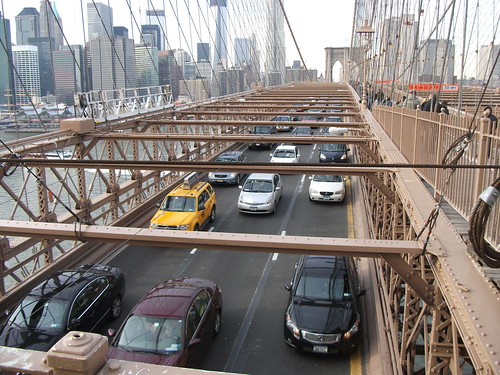 |
| These cars were all free to drive over the Brooklyn Bridge on Christmas Eve - so none of them was free to cross it fast. |
There is a similar fear in many countries of the world –
including the Netherlands
and United States
– about introducing distance-based charging for road use. Nearly every
transport economist knows that only a direct charge for road use, varying according to the time of day, can tackle most rich countries’ congestion problems.
Yet the only country so far to have introduced a national scheme to charge for
using the busiest roads is Singapore
– which uncoincidentally suffers an acute shortage of land, allied to intense
relaxation about restricting individual freedoms.
Even on guns, the shocked insistence of some US politicians
that citizens must be able to retain guns for hunting, self-defence and other
legitimate uses is not unique. I remember vividly the controversy when the Duke
of Edinburgh, the queen’s husband, insisted after the Dunblane massacre that
proposed bans on the ownership of certain kinds of handguns were an unfair
imposition on sportsmen. He asked whether, if someone had burst into a school
and beaten 17 people to death with a cricket bat, the government would also
legislate to ban them. The obvious point that guns’ capabilities set them apart
from other potentially deadly weapons passed the Duke, like so many US gun lobbyists,
entirely by.
Yet I remain instinctively suspicious of any freedom that is
predominantly exercised by the well-off and already free at the expense of
their poorer, less-free neighbours. US advocates for gun-owner freedoms tend to
be overwhelmingly white and relatively rich. Even in a country with car
ownership as high as the United
States , the heaviest users of cars - and
those of whom the politicians are most fearful – are the better off. Anecdotal
evidence around New York suggests that the
pedestrians paying the price for uncontrolled car use are disproportionately people
like Maleka Begum, a 54-year-old mother of three, originally from Bangladesh . Ms
Begum died after a bus hit her on a pedestrian crossing in Queens in October, in an incident that witnesses attributed entirely to the bus
driver’s poor driving.
 |
| A speed-limit sign by the Brooklyn Bridge. Most people accept in theory that speed limits are a reasonable restriction on freedom - for other people, at least. |
The truth is that even the keenest advocate of the freedom
to drive a car or shoot a gun ultimately depends on some curtailment of those
rights. Motorists share roads with each other, cyclists like me and
pedestrians. If everyone were given pure freedom to drive anywhere at whatever
speed they liked, with no price restrictions to curb demand, gridlock would
quickly set in and the accident rate soar. Even the US’s National Rifle
Association would surely eventually tire of the arms race if, for example,
anyone in the US who wanted it could arm him or herself with a rocket-propelled
grenade launcher, depleted uranium rounds or – why not? – biological or tactical
nuclear weapons. Drivers depend on the police’s restricting the rights of the
worst drivers to drive, while gun-owners ultimately rely on the state to
prevent their finding themselves outgunned by fellow citizens toting battlefield
weapons.
The question, consequently, isn’t whether to impose curbs on
drivers’ ability to speed drunk down Brooklyn
streets or to hold large caches of deadly, high-powered weapons. It’s where to
set the tipping point between their rights and others’ rights to protection
from them.
It’s my powerful conviction, based on my own experience of
trying to bring dangerous drivers to account and witnessing the toll of gun
crime in the United States ,
that the emphasis in recent years has fallen far too heavily on protecting the drivers
and gun-owners. Some of the clearest evidence is how cowardly many countries’
police forces and legislators have become about enforcing even existing,
sensible rules. There are, for example, no speed cameras in New York City , even though excessive speed
seems to be a factor in many fatal crashes. Astonishingly, background checks on
those planning to buy weapons are not enforced at gun shows, which as a result
account for a growing proportion of gun sales. Eagerness to safeguard drivers’
and gun-owners’ rights is slowly but surely toppling over into a lawless
free-for-all.
The barriers in the way of better, more effective
enforcement of road rules are at least relatively minor, both in the United States
and elsewhere. Properly-framed laws or police procedures could re-energise the
effort to catch drivers that, for example, speed through busy junctions or
ignore red lights. In the US ,
the constitution’s strangely-worded second amendment, with its guarantee for
the right to bear arms, stands in the way of change. It’s not a right that I
personally would have chosen to enshrine in the constitution. But it’s not an
amendment that’s going to be repealed or changed in the foreseeable future.
As a result, my modest proposal would be that gun-owners
should be subject to one new obligation that already faces drivers – and that
seems to be reducing deaths on the roads. The owners of the cars that the drunk
driver on my street hit could at least be confident, it occurred to me
afterwards, that the driver had – or should have – comprehensive insurance. The
families of Sandy Hook ’s dead will know the
guns’ owner carried no comparable insurance. It’s a grotesque mismatch that the
owners of vehicles that kill people as a byproduct of their use are forced to
insure themselves, while owners of purposely-designed killing machines are not.
An insurance scheme would continue to facilitate the kinds
of gun use that the NRA says it supports. A hunter who keeps a shotgun or
bolt-action rifle locked up in his study would present only a modest risk and
need pay only modestly to insure against it. A woman who wanted to keep a
semi-automatic rifle with a large magazine and two powerful handguns unsecured
in the house with her 20-year-old would probably face a prohibitively high bill,
however.
Insurance companies’ risk assessments already seem to be
playing a role in reducing road accidents. The costs of insuring the youngest –
and most dangerous – drivers appear to be preventing them from taking up
driving until they are older, and safer.
My proposal would not, of course, solve everything.
Criminals would continue to pass around powerful, illegally-held, uninsured
weapons. Ill-intentioned or unhinged people might still manage to steal or
otherwise misappropriate the weapons needed for horrific massacres. But it would,
I think, reduce the chances that, one day, it might be my children and their
teachers facing an angry young man who has found weapons powerful and
destructive enough to express his anger, rage and despair. As such, the
curtailment of freedom involved seems to me a very modest price to pay.
