Showing posts with label Brooklyn Bridge. Show all posts

Sunday, 14 February 2016

Thick bridge cables, police placard abuse - and why you'll get nowhere without corrupting power

Amid the sudden, late onset of a proper winter in New York, I’ve ridden to work far more often than normal in recent weeks via a longer route over the Brooklyn Bridge. The route, as well as being a pleasant change from my normal ride over the Manhattan Bridge, cuts down sharply on the amount of time I spend sharing snow-clogged Manhattan cross streets with irritable, aggressive drivers.
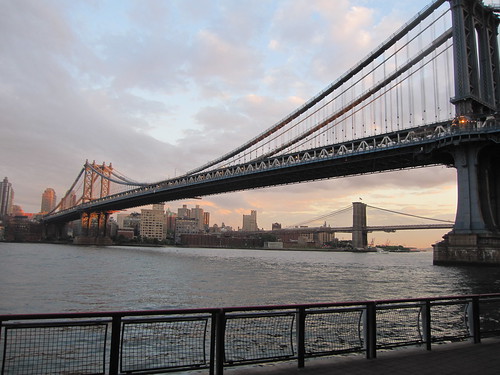
The Brooklyn Bridge, with cables: New York City corruption,
dangling over the East River

Yet the ride also affords me a chance to ponder a deep and sometimes under-recognised truth about New York City. As I cross the bridge, I marvel at the thickness of the bundle of suspension cables that holds the bridge deck in place - and remember the story behind them. The bundle is much bigger than the bridge’s designer, John Roebling, originally intended. Extra, up-to-standard wire had to be added after Washington Roebling, John’s son, discovered that corrupt contractors had sneaked large quantities of sub-standard wire into cables that had already been painstakingly stretched across the East River. Graft is literally woven into this bit of the city’s fabric.

Corruption is far from being a mere historic issue, however. The more one grapples with the challenges facing New York City, the more one comes up against relationships that powerful people’s pursuit of money or power have skewed away from working as intended. These pieces of corruption range from relationships that are straightforwardly crooked, as the relationship between the bridge builders and the wire contractors was, through a series of more or less grubby compromises to relationships that seem like a form of democracy. At that end of the scale there are institutions like the Community Boards that are meant to protect communities’ interests in planning decisions but instead end up as the vehicle of noisy vested interests.

A bike lane built under Janette Sadik-Khan now:
the reversal of progress made visible.
Cyclists are peculiarly aware of this dysfunctionality, I think, because it is a profoundly conservative force. It seeks to entrench privileges and works against change. In a city that’s nominally trying to increase its cycle commuting rate from a modest 1 per cent, that means that many of these forces are aligned against making life easier for cyclists. If one doesn’t take into account how these fundamentally regressive relationships shape life in the city, it’s impossible to understand the near-halting of progress on cycling in the city since Janette Sadik-Khan, the city’s one-time transport commissioner, stood down at the end of Michael Bloomberg's time in office in 2013. Without an advocate as forceful and effective as Sadik-Khan, regressive, conservative, corrupt forces have largely overwhelmed the continuing faltering efforts under Bill de Blasio towards change.

The scale of the challenge is clear if one thinks carefully about one of the few pieces of progress to have been made recently – the decision on February 2 by Manhattan’s Community Board 7 to approve installation of a protected bike lane on Amsterdam Avenue on the Upper West Side. The decision followed years of study and months of blocking by the co-chairs of the Community Board’s transportation committee. It was passed only after hundreds of advocates turned up at both the February 2 meeting and one in November. If such a vast lobbying effort is required to win approval for a 38-block (less than two miles) project – one that everyone except a handful of angry carowners agrees is sensible and needed - it’s unsurprising that city-wide progress towards building a cycling network looks a distant prospect.
 
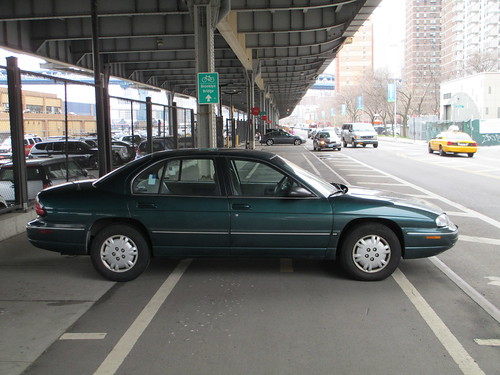
Your licence to park anywhere: the NYPD placard on an SUV
parked unnecessarily in the Hoyt St bike lane.
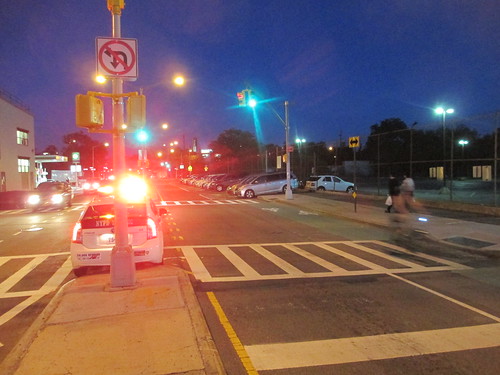
My mind started turning to the ubiquity of corruption in New York the night after the CB7 vote, as I rode home from work through a damp Brooklyn. As I rounded the corner from Schermerhorn Street into Hoyt Street in downtown Brooklyn, I was forced to brake suddenly on finding two big sports utility vehicles blocking the narrow street’s bike lane. Knowing that the area was a popular parking spot for police vehicles from the New York Police Department’s nearby transit bureau, I suspected these were officers’ private vehicles. Sure enough, on inspection the dashboards of both vehicles sported NYPD placards that police officers regard as essentially permission to park illegally wherever they choose. The following night, another private police vehicle was parked in exactly the same place. Tweets to the NYPD Transit Bureau about the issue went unanswered.
Sure, pedestrians and cyclists are having to avoid this
officer's car while legal parking spaces go unused across
the street. But what's the point in joining the NYPD
if you can't break the law with impunity?

The incident reveals a telling type of petty New York City corruption. Every morning as I battle my way down Jay St in Brooklyn to reach the Manhattan Bridge, I encounter scores of illegally-parked vehicles, obstructing turning lanes and other important places on the road. The police leave them untroubled because they bear some kind of official-looking placard – often of dubious provenance - identifying the owner as a police officer, corrections officer or firefighter. The problem illustrates the primacy of organisational culture – in this case, the feeling that emergency personnel should stick together, whatever civilians might say – in many areas of New York public life. Loyalty to the interests of one’s group – whether one’s fellow professionals,  members of the same ethnic group or people who want to defend some other privilege – exerts a far more powerful force in the city than most of the formal rules meant to govern it.

I also sometimes encounter on Jay St a red-light sting for cyclists, at the relatively quiet junction of Jay St and Concord St. The intersection is the only point on Jay St – where there is a daily riot of highly dangerous illegal double-parking, illegal U-Turns and crosswalk blocking – where I regularly see enforcement activity. In a city where motorists are still often portrayed as a proxy for ordinary, working-class New Yorkers, it is far easier for the police to pick on relatively powerless cyclists to make up their monthly ticket totals than to take the rational course of trying to stamp out the behaviour that does most damage. Since the police effectively wield far greater power than the mayor, there is little to stop police officers from engaging in this casual sleight of hand.
 
A scene from a Jay St commute: it's pretty obvious how
serious a problem cyclist behaviour is here.
None of this is to say, of course, that corruption both grave and petty is a uniquely US or New York phenomenon. When I lived in Budapest, I travelled around post-Communist societies far more scarred by corruption than the US. It is also clear that New York is far from being the US’s most corruptly-run city. It would seem almost rude to try to displace either Chicago or New Orleans from their hard-won places at the top of that league table.

Yet there is a peculiarly New York City combination of factors that works to overwhelm many positive initiatives, including efforts to promote more active transport.

Much of the power over the city is exercised by a legislature 150 miles away in Albany that often seems to view the city as little more than a source of funds. It is telling that in the recent corruption trial of Sheldon Silver, the former speaker of the state assembly, the defence’s (ultimately unsuccessful) case was essentially that the speaker had acted little differently from other members of the state legislature.
 
Police supervise blocking of the sidewalk and bike lanes
outside Satmar headquarters on a previous occasion, in
June 2014. This is what the privilege of being a powerful
voting bloc in New York City buys you.
New York’s diversity also means the city teems with different ethnic groups whom politicians can court in return for votes and money. This past Wednesday, for example, I noticed a (since-deleted) Tweet from the @HQSatmar account – from the headquarters of the powerful Satmar Hasidic Jewish community – thanking the local 90th NYPD precinct for allowing them to park their cars across the Kent Avenue two-way bike lane during a community wedding. The apparent official approval for this practice – which forces cyclists and pedestrians out into fast-moving traffic on a blind bend – illustrates how mere convenience for a powerful group can easily trump the law and the lives and health of less powerful groups.

A different version of a similar phenomenon was at work when a series of members of the New York City Council who had previously been supportive of safer streets legislation scurried to support amendments that would effectively have excused bus drivers who killed people. It is no coincidence, I suspect, that Transport Workers’ Union Local 100, the bus drivers’ union, is a significant funder of New York political races.

The presence of this mass of interest groups willing to defy the mayor’s formal authority has long made governing New York City one of the most formidable tasks in US politics. The Brooklyn Bridge corruption was a result, for example, of the presence on the bridge company’s board of directors of William Tweed, the famously corrupt boss of Tammany Hall, the hugely influential Irish-American political club. Vincent Impellitteri famously became leader of New York’s city council – and subsequently, by default, mayor when the incumbent resigned – simply because he was an Italian from Manhattan. He was needed to balance out a Democratic slate for top jobs that already had on it an Irishman from Brooklyn and a Jew from the Bronx.
 
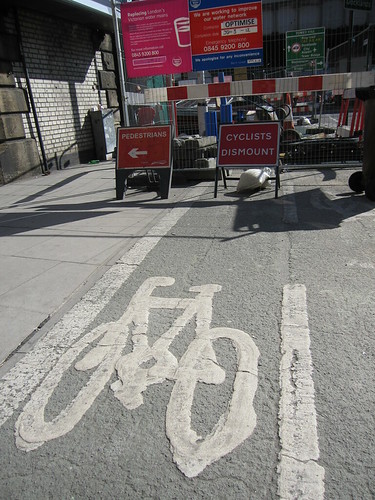
London's cycle facilities can also be imperfect,
but there is a less pervasive sense
of unaccountability
It is far easier, it seems to me, to work the levers of power in London, where identity politics plays a far smaller role, than in New York. It is no coincidence that cities in relatively uncorrupt northern Europe have had far more success in steering through complex transport projects such as cycling networks and high-quality public transit than southern European countries with a longer tradition of corruption.

The flipside of New York City’s ungovernability, meanwhile, is that it has been disproportionately shaped by the handful of people with the mix of skill and ruthlessness needed to get things done. In the 20th Century, tragically, the most notable such person was Robert Moses, the “master builder,” who, holding an unconstitutional mix of state and city jobs, promoted car-dependence by halting subway building and diverting resources to building a poorly-planned highway network, which wrecked many neighbourhoods.

So far in the 21st century, Sadik-Khan, who will celebrate her achievements in a new book out on March 8, has proved more adept than most at overcoming the city’s corrupt conservatism. She closed some of the streets through Times Square, put bike lanes down Broadway and many other important streets and forced a badly-needed bike lane down Prospect Park West in Brooklyn. The Prospect Park West project – over which a handful of rich locals continue to sue the city – went in over the noisy objections of, among others, the wife of New York’s senior US senator. Sadik-Khan oversaw huge increases in the numbers of people cycling, even if cycling’s share of trips remains negligible.

Yet it is clear that, while Sadik-Khan did a superb job of forcing through building projects, she was not able to make activists for cycling and walking a group that New York politicians genuinely had to fear. Transportation Alternatives and other lobbyists for a saner, more rational transport system remain supplicants to the city’s power brokers, rather than one of the successful groups that the power brokers have to court.

NYPD vehicles block the Broadway bike lane:
the lack of explanation is as eloquent as any explanation
One evening in early December, I encountered depressing evidence of the fate of groups who fail to get themselves into a sufficiently strong position in the city’s pecking order. I rode down the Broadway bike lanes as far as Herald Square, by Macy’s department store in midtown. But at Herald Square – which Sadik-Khan still holds up as an example of what can be achieved, with effort – I encountered two large police SUVs parked across the bike lane, closing it. I have heard so many reports since from other cyclists that I gather the police have more or less permanently barricaded the route.

There were no explanations, diversion signs or notices to alert cyclists to the change. The closure appeared to be a result of an entirely arbitrary police decision that cyclists could no longer use the route built for them only a few years ago. But, as I gazed at the police vehicles parked sullenly across my path, that almost seemed to be part of the point.

“We can do this to you whenever we want,” they seemed to be saying. “Now what are you going to do about it?”

Sunday, 20 October 2013

A Film Set, a New Route - and the Joy of Rediscovering Urban Cycling

It’s the kind of intervention in one’s journey home that’s never normally welcome. As I rode my way down Grand St in lower Manhattan around 10.30 in the evening, I found a skinny young man wearing a headset blocking my way. No-one was allowed onto the next block, he said, until the film crew had finished this take. It took only a couple of minutes – although the time felt longer, given that I’d rashly for the time of year put on only a t-shirt on my top half.
 
Grand St in Chinatown: city street, film set or cyclocross
track - it can't settle on a single role
But, despite the inconvenience, I felt a little thrill at being stopped on my way home on Friday. That a film crew was filming on a road on my way home was confirmation that I was, once again, the kind of cyclist whose routes lay along grittily interesting urban streets. For more than a year since moving to New York, I’ve done the majority of my Manhattan cycling on the waterfront greenways, riding often at speed but grappling only in little bites with the serious urban cycling of riding on a street with traffic. Following a move in my employer’s office, I now ride across lower Manhattan from the Manhattan Bridge to Hudson St in SoHo, on city streets for nearly all the distance.

The change has reminded me of some of the sheer pleasures of being an urban cyclist. My riding patterns far more closely resemble those I had in London, where I’d ride mostly along the London Cycle Network of routes along quiet back streets. I’m catching once again little vignettes of city life – I notice, for example, how oddly resigned and depressed the faces of the people waiting each morning for the opening of the Prince Street Apple store are. Pushing a hot dog cart to its place in the morning looks like really hard work.

The contrast between midtown and the relatively relaxed cycling environment in lower Manhattan – where there’s motor traffic, but not on the same scale as further uptown - has also highlighted another truth. Cycling in any place where cars dominate the public space can be pretty dispiriting. I’m missing the last mile of my old work route – where I’d battle my way up 54th street from the Hudson River to my office – not at all. If big cities want to encourage cycling, conditions in such forbidding areas need to be addressed.

The USS Intrepid: just one of the Hudson River landmarks
no longer on the Invisible Visible Man's daily route.
Yet these aren't the reactions I'd expected. For months before the move, I’d been telling anyone who’d listen – and a fair few that wouldn’t – how I was dreading the move. I’d grown used to commuting nine miles each way to and from work, including a four-mile sprint up the Hudson River Greenway along the west side of Manhattan. I was particularly concerned about my waistline. Within a few months of undertaking a daily 18-mile round-trip commute, I was noticing the difference when I stood on the bathroom scales in the morning. I’d dropped a good five or six kilos compared with when I moved in August 2012 from London.

There are certainly sad points about no longer having a daily ride by the Hudson. On my last morning on my old route, I was looking wistfully across at the buildings in New Jersey, glittering in the autumn sun on the river's far bank. I cast a sentimental glance to my right up at the Empire State Building, which I now see only in the distance. I took a picture of the USS Intrepid as I passed it for the last time as a commuter. I was dreading not only the new route’s reduced riding but also the stresses of the new route I’d planned. To the west of the new office – the angle from which I planned to approach – streets buzz with high traffic volumes, pouring into and spewing out of the cross-river Holland Tunnel.
 
The bike route onto the Manhattan Bridge: a quick route
to lower Manhattan streets - and romantically urban to a fault.
But, on my second morning in the new office, it occurred to me that it was worth trying the simplest, straightest route across town to the new site. I sped over the Manhattan Bridge, instead of the Brooklyn Bridge, dropped down into Chinatown and navigated my way across to Prince St. I discovered how the old, muddled-up street plan meant no-one expected to speed across SoHo. More to the point, I arrived with a smile on my face. The route had been chaotic, grimy and a little bit noisy – far more unmistakeably a ride through New York than my former ride on a calm, orderly path up by the Hudson.

I also, I’ll admit, felt a little bit cooler than before. For the last 14 months as I’ve fulminated about this or that aspect of New York’s road culture, I’ve had a sneaking feeling that maybe I wasn’t quite getting it. Nearly two-thirds of my ride to work was car-free and I’d found some of my efforts at on-street riding pretty terrifying. I’d watched on Twitter the discussions between more seasoned New York cyclists of their experience in the lower east side, SoHo, Chelsea and elsewhere in the island’s lower reaches and suspected they were simply cooler, more sophisticated, bolder people than I. Most of them remain, no doubt, cooler and more sophisticated than I – but I have less awe of their willingness to ride on these areas’ streets.

Bike lanes on Allen St at the Rivington St intersection:
a small-time entrepreneur wheeling goods down the bike
lane adds an authentic detail.
It’s certainly not a perfect experience. The journey would be more fun still if more New Yorkers had a better understanding of where the stress in the phrase “bike lanes” is meant to lie. Many seem to hear the term “lanes” and adopt them as the ideal spot to wheel their food truck, haul their suitcase or park their police car. Better protection for many bike lanes would be welcome, as would a reining-in of many vehicles’ speed. I’ve also yet to find an ideal route home. One of those cooler, more experienced cyclists, Joanna Oltman Smith, warned me before the move to avoid Grand St, the most direct route, which extensive sewer works have turned into a cross between a slalom course and a rutted country track. I’ve not yet found a better alternative – and, truth to tell, am enjoying the sense that I might be quietly training for unexpected stardom on the seniors cyclocross circuit.

On the other hand, I now look almost fondly on the elderly Chinese woman I see each morning blocking the Rivington Street bike lane stuffing her bags full of recycling. I marvel at the Beaux Arts magnificence of the Little Singer Building as I cross Broadway. I note how adept the city – like London, my former home – has been at reinventing itself. I see neglected-looking synagogues built for a Jewish community now mainly departed from Chinatown. Factories that once made clothing have been transformed into trendy offices for those of us in the media set. I hear even more of the city's sounds. Next summer, I expect to be still more aware of its smells. I was cycling round New York City on my old route. Now I arrive at the office, a smile on my face, excited at how I've been riding in it.

Friday, 4 October 2013

A Detroit trip, a TriBeCa greeting - and why driving leaves me feeling locked in

It wasn’t a great start to my first driving lesson. Aged 17, a minute into my introductory driving session with my dad on a local industrial estate, we came to a T-Junction, where he told me to turn left. Still unfamiliar with the accelerator pedal’s sensitivity and the steering required to turn a corner, I turned the wheels through 45 degrees and stepped – rather hard, it turned out – on the gas. Seconds later, having demolished a small tree on the way, I had wedged the car firmly onto a low wall round a nearby building.

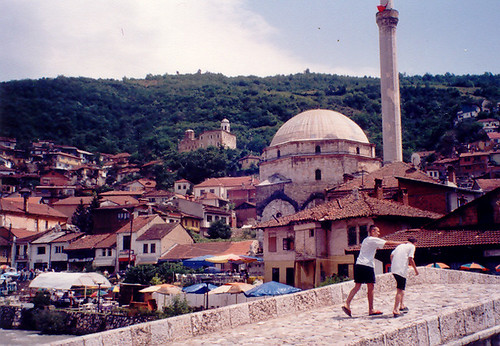
Prizren, Kosovo, just after the war: against the odds,
the Invisible Visible Man drove competently down
a recently-bombed road near here.
That still marks the only time in the many years since that I’ve caused direct (as opposed to environmental) damage or injury with a car. I’ve driven many thousands of miles, navigated cars down recently-bombed roads in Kosovo and survived an attempt by rioting youths in Belfast to hijack a car I was driving. Yet I can’t pretend I get on with cars the way I do with bikes. There are few feelings of relief greater for me than the moment I finally drop off a hire car, having damaged neither it nor anyone else during my time in charge.

It was consequently with a sinking heart that I recognised last week that, no, I was going to need a car to get to my meetings in Detroit. I headed to a downtown Enterprise rent-a-car branch with a feeling of dread.

Yet, while I was mentally prepared for many of the depressing aspects of driving a car, the overwhelming feeling I had while driving my Nissan Versa was not the one I'd been expecting. I found myself more struck than ever before at the sensation of being trapped in a metal box.

That sensation took a while to come over me, however. My first feeling after I climbed in, adjusted the mirrors and pulled out onto the wide, bleak expanse of E Jefferson Avenue was simple boredom.

I’m used to pedalling hard, looking over my shoulders, standing up at points and, on faster or windier bits of a ride, putting my hands down in the drop position on my handlebars. I shift gear regularly to match my pedalling to the bike’s speed. I push hard to restart from traffic lights. 
A Detroit streetscape: not a great compensation
for the stresses of driving

In the car, I was reduced to turning my head a little sometimes, glancing around in my mirrors, holding onto the steering wheel and alternately pushing the accelerator or brake pedals. Given that the car had an automatic transmission, there wasn’t even the modest physical activity of engaging the clutch and moving the gear stick.

That mixture of passivity and onerous but dull responsibility puts me in touch with all the things I hate about having reached middle age. Have I checked my mirrors and blind spots before starting to signal for this manoeuvre? Have I got enough money in the right bank account for this month’s mortgage payment? It’s the diametric opposite of the youthful optimism that wells up inside me most mornings as I ride my bike.

I’m almost overwhelmed when driving, meanwhile, by the challenge of navigating the thing safely. The morning after I picked up the hire car, I headed off for General Motors’ technical centre in Warren, outside Detroit. The freeway on-ramp pitched me straight into the fast lane, which I couldn't escape. I was hemmed in on one side by other vehicles and by impatient other drivers sitting right behind me. I pictured myself or one of the multiple vehicles around me making a small mistake and our slamming into the concrete barriers down the middle of the road. I had an almost tangible sense of how it would feel – the jolting, the tearing of muscles, the fear, the noises.
 
Woodward Avenue in midtown Detroit: the kind of street
that could have been designed - but probably wasn't -
to intimidate occasional drivers
like the Invisible Visible Man
It was one of several incidents that brought home to me how much bolder those around me are about speed, the time they need to switch lanes and so on. Although I think much of my caution is warranted, I feel within like a small, weak, rather scared person. It doesn’t help that when I’m on work trips I’m invariably tired, under pressure and running late. “Why did I sit up late writing that story last night?” I find myself asking as I struggle to shake off the cloudy fatigue in my brain. Then I notice that every time the car’s speed drops below 60mph the satellite navigation system’s estimated time of arrival at my destination slips a little further past the time I was meant to be there. I push myself mentally to focus harder, press down a little on the accelerator and carry on.

Yet the biggest shock to me on this trip was a result, I think, of a recent change in the way I’ve been cycling. I’ve been trying more and more to communicate with other road users, warning them of my presence, thanking them when they’ve acted safely or pointing out when I have a traffic light in my favour. It’s a habit I’ve developed partly in an effort to keep myself safe – but also because I want generally to communicate to others on the road our shared humanity. Most people find it harder to behave callously towards someone who’s made it obvious that he or she is as real and sensitive a human being as themselves.

When I found myself pitched into that highway fast lane, by contrast, I was struck dumb. The drivers around me could barely see me. They were aware only of how my slow-moving, poorly-positioned car was holding them up. My means of communicating were restricted to the use of two pathetic sets of blinking lights saying only, “I would like to turn left” or “I would like to turn right”. I could, I suppose, have honked the horn, as many New York City drivers do, but I never quite summoned up the aggression that seems to require.
 
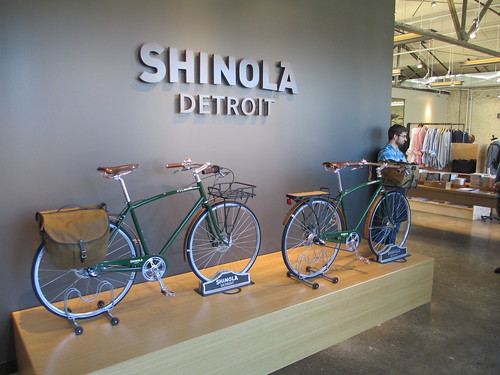
The Shinola bike works shop in Detroit. Can you guess
where the Invisible Visible Man ends up when
he feels homesick on a trip?
I consequently wandered the freeways of south-east Michigan a little bit lost, a little bit unsure of myself and a little bit anxious – but suffering a kind of automotive locked-in syndrome. “I’m a Nissan Versa and I would like to turn left” and “I’m a Nissan Versa and I would like to turn right” were the only two messages I could convey.

As a result, I had a particularly intense sense when I returned the hire car of how the stress hormones were withdrawing from my system. The attendant checked the car for new scratches, found none, and I handed back the keys for the next lucky driver. I climbed instead into the large and luxurious Jeep Grand Cherokee of the public relations executive with whom I was to lunch.

The Brooklyn Bridge Bike Lane: I ride so fast here, it seems,
I don't even recognise people I sweep past every morning.
The relief was all the greater the next morning when, back in New York, I returned to my normal routine, riding across the Brooklyn Bridge into lower Manhattan. The pleasure even cancelled out my irritation at finding building work was obstructing the “bike lane” – the space dedicated to double-parking and deliveries – on Reade Street in TriBeCa. Conscious that other riders would probably feel less cautious than I about squeezing through the remaining space, I nevertheless tried to wave the woman following me through ahead of me.

Her response illustrated precisely what I’d been missing locked up inside that car. She insisted I went ahead, saying, “You’re faster than me.” I didn’t understand why. I looked quizzically at her after we’d both reached the next set of traffic lights. “You’re faster than me,” she said. “I see you ride past me every morning on the bridge.”

Sunday, 8 September 2013

A speeding cyclist, momentum - and how sustained velocity is the enemy of consideration

Even by the high standards of a fine, late summer morning in New York, the weather was remarkably pleasant on Friday – not too hot or too humid and with a cloudless sky. The view from the Brooklyn Bridge as I rode down into Manhattan, the Financial District’s skyscrapers glinting in the sun, seemed calculated to convince even the most sceptical of the accuracy of New York’s claim to be the greatest city on earth.
 
The Brooklyn Bridge's Manhattan
off-ramp: an invitation to let one's
momentum overtake one's manners
But the cyclist who followed me down off the bridge was in no mood to admire the view. As I sat towards the left of the stream of descending bike traffic, seeking a safe opportunity to pass a slower rider I’d been following, I heard a shout of “On Your Right!” Suddenly confused, I nearly clattered into the rider squeezing between me and the railings by the walkway edge. He zipped past me – at a fair rate, given my speedometer was reading 18mph – and swung into the walkway’s crowded pedestrian side to round the guy in front. Then he disappeared off down the slope.

But he went on his way, I imagine, feeling a little more stressed than he’d been anticipating. “Idiot!” I shouted at him as he sped past. “You shouldn’t be…” he shouted before finishing the sentence with an angry gesture towards where I’d been sitting in the lane as I tried to pass the rider in front.

It was the kind of clash I’ve experienced a disproportionate number of times over the last week, as I’ve returned to New York cycle commuting after two weeks’ vacation on Cape Cod. Time and again, I’ve encountered people who’ve been utterly determined to conserve the momentum of their car, or bicycle or walking or running body at the expense of others’ safety and convenience. All seemed caught up in the idea that the complex social activity of sharing a road or path was a private enterprise, where one needn’t take account of others.

I’ve also, however, been struck by the power of fellow feeling with the road users around me to influence my own and other people’s behaviour. People caught up in the bubble of their own, desperate need to reach their meeting or soccer practice or date or whatever can transform back into normal, civil civilians the moment that they recognise how they're threatening someone else.

The contrast has been so striking that I’m currently seeing nearly everything I encounter on the roads as a conflict between these two instincts – to set one’s own pace and to treat others as one would like to be treated oneself. Every journey, I’m spotting people caught up in the excitement of their own speed and a reluctance to change it. Every journey, I’m spotting how a glance into another person’s eyes brings daylight and a sense of the wider world into that tunnel vision.

I’ve been reading some news items through the same prism. I was horrified by how proud a driver calling himself Afroduck was of his “achievement”of driving a circuit round Manhattan’s expressways in 24 minutes. As a Christian – and currently an adherent of a Presbyterian congregation – I was profoundly disappointed by reports of a lobby of Free Church of Scotland ministers to the Scottish government on widening of the A9 road serving some of the Free Church’s highland strongholds and the installation of speed cameras on the road. "Frustration" with slow cars caused more accidents than fast ones, claimed Rev Colin Macleod, who I fear didn’t ask himself how Jesus would drive a car. "Speed cameras... will lead to more frustration, more accidents and more funerals," Rev Macleod told The Scotsman.

However, it was an incident the night before that close Brooklyn Bridge pass that made clear to me the tension between the two tendencies. As I rode up Warren St in TriBeCa, I saw a BMW trying to cut across my path by pulling across the cycle lane at an intersection and into the stream of cars. As I arrived at the traffic lights, I pulled firmly into the driver’s path, looked down towards his open window, signalled to him to stop and said, “Please wait.” Somewhat to my surprise, he did.
 
A warning to cyclists on Kent Avenue, Williamsburg:
a reluctance to yield at junctions comes from the same
desire to conserve momentum as bad overtaking.
But, after he passed me and we carried on down the street towards City Hall, I noticed another cyclist riding into a temporarily narrowed section of road by some road works. Unconstrained by any personal interaction, the BMW driver barged past him in the narrow section. The rider’s arms flew up in exasperation and fear as the driver passed him with inches to spare. It was only the rider’s quick reactions that prevented his being battered into the concrete barriers, with potentially serious consequences.

It’s hardly surprising, however, that so many road users are so keen to conserve their momentum. It’s one of the great joys of piloting any vehicle – a car or especially a bicycle – to feel one’s moving at speed without having to make an effort. It’s no coincidence that I regularly hear businessmen speaking in the wooden-tongued jargon of contemporary American business describing their company as having “momentum”. It’s what political campaigns seek too. There’s a pleasure in that feeling of being carried along by the effort one’s already made, or by gravity or the wind that adds up to far more than merely the product of one’s mass multiplied by one’s velocity. I’ve described myself the pleasure of a downhill run on one of New York’s East River bridges when clear of obstructions. The desire to maintain one’s momentum comes, I suspect, from some of the deepest, most primitive bits of the brain, which house our deepest joys and fears.

There’s a serious discipline, meanwhile, involved in applying one’s brakes to suit another person. All the pleasures of feeling that onward progress disappear. It’s an effort to get going again. As the story of the barging bicyclist of the Brooklyn Bridge shows, it’s a discipline that cyclists often struggle to exercise. Yet, of course, the danger from people driving motor cars is all the greater. Someone shut inside a metal box is apt to be insulated – as Afroduck seemingly was – from the sheer danger that his or her speed represents to others. Drivers are consequently likely to behave more dangerously.
Cars zip down 8th Avenue, in Park Slope:
how conscious are the drivers of each others' humanity?

There is, nevertheless, joy in exercising that discipline. I’ve been trying especially hard since realising how much I enjoy my own momentum to stop for pedestrian crosswalks even when most other cyclists don’t. The tense faces of people glancing up and down the Hudson Greenway waiting for a gap in the bike traffic melt into a smile when they realise someone’s halted for them. There’s an inner satisfaction from knowing that one isn’t going to pass another cyclist before there’s enough, safe room for it and that one’s unlikely consequently to scare the other rider. I’ve long tried to exercise the same discipline on the rare occasions I drive a car, knowing how fearful cars can make me when they pass too fast or close.

It’s a far less visceral pleasure than the rush that Afroduck would have experienced from rounding Manhattan at an average speed of 66mph. It’s the kind of behaviour that can exasperate people who feel they must get past at any cost. Freud would have said it’s an action motivated by the superego, while the pleasure of speed belongs to the id.

Yet to use one’s brakes to act considerately towards others is also to recognise a profound truth about roads, cycle paths and all the other places that people use vehicles close to each other. They’re places that pitch us into some of the most complex social interactions possible. When so many people treat those places as if they were their own private domains, it’s no surprise so many of the people around them – the people whose reality they’re ignoring – end up getting killed.

Sunday, 23 June 2013

Hear this: what I heard on the street - and what it says about cycling's merits

It was as inconvenient a time for a work call as I can imagine. I had grabbed my ringing phone from my pocket just as the lights turned green at an intersection on the Invisible Visible Boy’s short route to school. “I can’t talk now,” I shouted before stuffing the phone back into my pocket, leaning heavily down on my pedal and getting myself, my bike, the boy and his trailer bike all safely again into forward motion.

But, once I’d said goodbye to the boy and phoned back my colleague in London, he didn’t immediately want to talk about the matter in hand. Instead, he made me realise how thoroughly I’d taken for granted one of my key sources of information about the world around me as I cycled. I’ve been noticing ever since how many sounds I hear as I ride around – and how richly they add to my experience.

“You didn’t ring off properly,” my colleague told me. “I could hear the sound of the wind – and your son’s giggling.”

I had, I suppose, assumed before my colleague mentioned it that most of the time while riding I wasn’t hearing very much. For much of my journeys both to and from work, I work my way past long lines of waiting cars. No-one’s saying a great deal. Even though it’s New York, people mostly don’t even bother with honking. They just sit there.

Clinton St, Cobble Hill: very nice for people - and even,
the Invisible Visible Man was surprised to hear,
a hit with gentrifying birds
But, the moment I started thinking about it, I recognised how much information my hearing was giving me. The wind whistles in my ears, with anything from a whisper to the full-throated, jet-engine roar of a seriously stormy day. I hear the gentle whir of my bike’s rear hub. There’s the gentle clicking as I change onto an easier gear and sometimes a slight clang as the gear cable loosens and lets the chain slip down to a smaller sprocket. It’s a good sign if I don’t hear very much. Recently, a tiny bit of water crept into one of my pedals and I’ve run out of the grease I need to make it completely quiet again. Every now and again it emits a little squeak, sending my stress levels a little bit upwards.

Much of the time, as I pedal along steadily, songs play in my head, to the rhythm of my breathing and pedalling. For a while now, for reasons I don’t entirely understand, the tune seems to have been Lyle Lovett’s Walk Through the Bottomland – an obscure choice, even to me, but one whose deliberate beat seems to fit with the way I cycle.

The bike’s interaction with the road makes its own sounds. Occasionally, I’ll hit some stray stone on the road and send it flying – thwack! – into a parked car. My mudguard (fender, American readers) gives off a tiny bit of a vibrating sound – a very miniaturised version of an arrow hitting a target – every time my front wheel jars into one of the countless imperfections in the road surface. On the Brooklyn Bridge, there’s the steady clack-clack of the wooden boards on the walkway, as the bike hits each and sets it vibrating against the metal underneath. One night recently, I went over the Queensboro Bridge and enjoyed the sensation of racing down into Queens on a surface made up of jointed concrete slabs – ka-boom-ka-boom-ka-boom-ka-boom, steadily faster as I picked up speed. It’s hard to sort out in my head which of these sounds is audible to the wider world and which is conveyed direct from the road to my skull as the bike judders against the crack in the road or the joint in the concrete.
 
The Manhattan Bridge: a perfect urban cacophony
There are sounds of place elsewhere, too. As I leave my apartment, I hear subway trains growling complainingly around the Culver Viaduct high above my head. Then, the other morning, in another part of Carroll Gardens, I heard what I thought must be a novelty doorbell or strange alarm. No, I eventually concluded, there were actually some birds living happily enough in the trees along Clinton Street that they were singing out to each other one June morning rush hour. In some places, the audio soundtrack actually provides far more of the atmosphere than what one can see. Riding over the Manhattan Bridge yesterday, I noticed how I could hear the sound of wash breaking on the shore down below in Dumbo. Then a subway train rolled out onto the bridge, its clanking echoing off the roadway that runs above the tracks and drowning out the sounds of the motor traffic. As I raced the train over the bridge and gathered speed on the ramp down into Chinatown, I ran over one of the loose inspection covers. “Clunk-clank!” it went as I too sent the sound of my own progress echoing off the roadway’s underside.
 
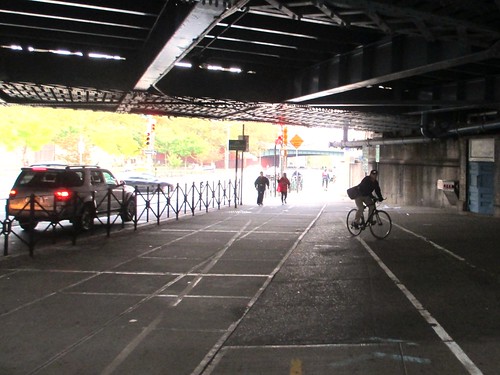
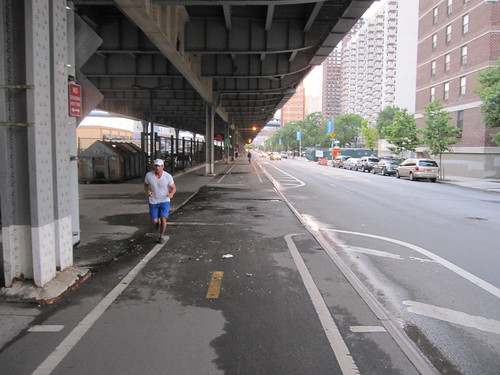
This is how the bike lanes under the FDR Highway look.
But the Invisible Visible Man hears the sound of the cars
banging over the joints in the road above
My sudden noticing of the birdsong, the sounds of the road and the cacophony on the Manhattan Bridge have all made me feel far more positive about the sounds that surround me as I cycle than I used to. Then, I noticed mainly the sounds of stress. Like most cyclists, I’m constantly listening out for the tone of the engines behind me in traffic, ready to pick out the note of a driver who’s revving his engine, ready to accelerate dangerously. It’s one of the clearest warning signs one can encounter that a driver isn’t going to behave safely.

None of that is to suggest, however, that the most noticeable sounds don't cause me anxiety. The volume of honking gradually rises each morning as I ride towards the Brooklyn Bridge – especially if there’s a garbage truck blocking Clinton Street emitting the strange low-high-low hum of its hydraulic crushing mechanism. The honking reaches a pitch as I struggle my way through TriBeCa. On Friday morning, an angry motorist in a hurry slammed on her brakes when I stopped for a red light where Chambers Street crosses the West Side Highway. She gave me a long, unmistakeably intimidatory blast of her horn for having the temerity to stop her from running the light.

Those aren’t the only worry-inducing sounds. Any encounter with a large, road-hogging SUV has an extra edge when it’s blaring out rap so loud that the whole car vibrates. The motorists with most faith in honking’s efficaciousness seem least ready to move aside for emergency vehicles and I hear their drivers using their sirens to plead their way out of traffic. The mixture of short blasts, honks and steady whines they emit sounds like nothing so much as a pitiful trapped dog. Probably no motorist driving along Boerum Place in downtown Brooklyn the other night was able to hear how desperately the woman traipsing along the street at 11.30pm with a toddler son and luggage was swearing as she pleaded for help or criticised or did whatever she was doing to the person on the other end of her ‘phone call.

But the exposure to the stress is a flipside to the joy of hearing all this sound. It’s a pleasure of cycling round the city that all my senses are in immediate, unfiltered contact with the world around me, rather than being filtered through tinted windows and soundproof doors. I’m experiencing the city far more fully than I would in a car or a subway train.

That came home to me most fully late last summer, when I had not long moved to New York. As I stopped for one of the last sets of lights near my home, an old sedan drew up next to me, its windows rolled down. For a few seconds, I was treated, wholly unexpectedly, to a blast of sublime 1960s jazz, saxophones running riot over a pulsing bass line. I looked over at the driver. We both smiled, surprised to find ourselves sharing a brief transcendent moment of musical appreciation.

Sunday, 14 April 2013

A broken-down church - and a broken, asymmetric flow of information

I was only a little way into my first ride to work after moving into my apartment in Brooklyn when I started to get into a terrible tangle. Trying to get down Kane Street, in Cobble Hill, I found the road marked closed. After heading past the road cones, I found it was a proper road closure, not the kind where one just wheels the bike on the sidewalk past the obstruction. The closure was absurd, I muttered to myself, as the one-way system pushed my route further and further from the one I’d planned. It was, I reasoned, probably some piece of stupidity on the part of the police, worried about being sued over an unlikely accident near some relatively innocuous building work.
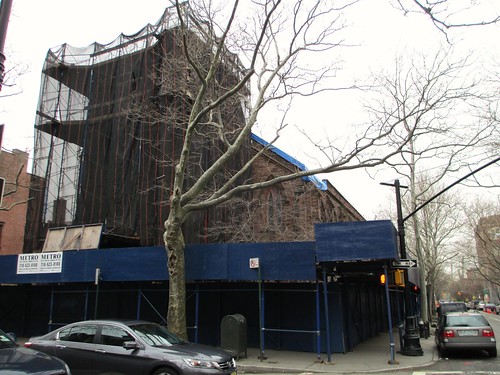
Christ Church, Cobble Hill: source of frustration on
the Invisible Visible Man's commute

I calmed down considerably, however, after finding out via Google why the street was closed. On July 26, while I had been back in Europe, lightning had struck Christ Church, the Episcopal church at the junction of Clinton Street and Kane Street. The spectacular tower – and scaffolding around it – had come crashing down as Richard Schwartz, a pedestrian, was walking underneath. The falling scaffolding had killed him. The building was a serious danger – and hadn’t yet been made safe.

The incident helped to crystallise an idea that had been slopping in fluid form around my mind for a while. I’d never have been irritated about the Kane St closure, I realised, if I’d had better information in the first place. It was, it occurred to me, one of many instances where confusion arises because two different parties – the New York City Department of Transportation and myself, in the Kane Street case – have different understandings of what’s going on on a road. The asymmetric information sharing had at least left me only inwardly irritated, however. The more I thought about it, the more I realised there were times when such information asymmetry probably killed people.

I encountered one potentially serious example the other morning while riding to work. I waited at traffic lights by the start of the Tillary Street segregated bike lane near the Brooklyn Bridge. When the lights changed, I moved off, only to find turning across my path a car heading in the other direction that should have been yielding to me. The driver’s behaviour was entirely wrong, based on his failure to understand what I knew - that the bike lane was as much part of the traffic flow at the intersection as the roads he was using. But, as he moved across my path, he leant out of his window. “Green light!” he yelled at me, self-righteously.

Traffic on W54th street. Those tainted windows don't,
in the Invisible Visible Man's experience, conceal
motorists pondering hard what information they might lack
about other road users' rights
Cycle lanes can give rise to information asymmetry as well. As I approached my office one morning last month, a truck driver opened his door in my path as I made my way up the side of some stalled traffic. He didn’t need to look for cyclists on that side of W54th street, he argued, because there was a bike lane painted down the other. Because of our asymmetric understanding of cyclists’ road rights, he had understood the cycle lane – which I knew to be a refuge for cyclists that didn’t stop me from using the rest of the road – as a kind of prison, to which cyclists should be confined.

Perhaps the most striking and persistent problem of information asymmetry that I’ve come across, however, was in London, where I lived until last August. Most traffic lights at busy intersections in London feature an “advanced stop line” for cyclists – an area where cyclists are meant to wait ahead of the other traffic for the lights to change. Many cyclists value advance stop lines as an idea, since they should, in theory, allow cyclists to get away after lights change, get clipped back into their pedals and get back into a suitable line on the road before the motor traffic catches up. Few motorists, however, seem to have much idea either about the principles of the advanced stop areas or when they should stay out of them. At least one motorist informed me, indignantly, when I complained about his occupying the area that when he’d arrived there had been no cyclists waiting, so he’d simply driven into the bike area.

Advance stop lines were involved in all three of the worst confrontations I had with motorists in London. In one case, a motorist deliberately drove very close to me and then very dangerously overtook me after I remonstrated with him about his driving into the ASL area as I was using it. A bus driver assaulted me (abandoning a bus full of passengers to do so) after I photographed his occupying the ASL area at a particularly dangerous junction. I had to call the police to stave off a threatened assault from another motorist to whom I’d complained about his driving into the ASL area.

Leaving aside the more eye-catching incidents, ASLs were a daily source of tension and frustration. I’d often squeeze past a line of stationary traffic to reach what was meant to be a haven for cyclists – only to fill it full of motorists grumpy at one’s presumption in seeking to get a jump on them at the lights. It’s reasonable, I think, to assume that even a fairly modest publicity campaign might have let at least a little of the fresh air of information into the foetid atmosphere of confrontation surrounding ASLs. In New York, it surely wouldn’t take much of a campaign to educate drivers about the role of bike lanes and the dangers of passing bikes too close to improve driving standards at least a little bit. The New York cycling map, after all, features excellent advice for cyclists on how motorists should give cyclists at least three feet's clearance when passing.

It isn’t, after all, a neutral thing to encourage new cyclists onto a city’s streets and then not tell motorists how to behave around them. Nature seems to abhor an information vacuum just as much as a literal one. In the absence of the pure oxygen of accurate, well-founded information, the information vacuum fills up with the carbon-monoxide-laden air of motorists’ assumptions about cyclists’ rights and responsibilities. It’s perhaps hardly surprising, given that no-one’s telling them otherwise, that so many motorists assume cyclists who ride well outside the door zone away from cars are acting maliciously, rather than entirely sensibly. In New York, it’s still less surprising given how many bike lanes – including most of those I use every day – are painted in precisely the part of the road – next to the parked cars’ doors – that cyclists know to be the most dangerous.

The air has grown still more poisoned because the agency meant to set the limits of acceptable behaviour in most modern societies – the police force – so often seems to have abandoned that role with regard to the road rules. Motorists, after all, like most other people see what they see others doing unmolested and assume it’s acceptable. One telling recent case I spotted involved a police effort to start fining motorists who drove in a bike lane on a narrow street at Twickenham, in South-West London (I’ll give New York cyclists a moment here to come to terms with the idea that, just across the Atlantic, there’s a police force that has, at least once, acted against motorists using a bike lane). A local newspaper quoted Nick Blyth, an officer involved in the enforcement effort, as saying: “Most of the motorists tend to comment when stopped that everyone else does it and they were just following them.”
 
Park right across one of New York City's busiest bike lanes?
Until someone says you shouldn't, you probably will.
It’s hardly surprising, given the New York Police Department’s reluctance to enforce a wide swathe of road rules, that few motorists seem even to understand the harm they cause when double-parking in bike lanes or refusing to yield to a cyclist in a bike lane. Nor, in London, is it terribly surprising that ASL infringements continue at the rate they do when even the Metropolitan Police department charged with processing complaints against motorists from cyclists (normally backed by helmet camera evidence) is currently pleading with leading London cycle bloggers to tell people to send in no more pictures of ASL infringements. They say, to all intents and purposes, they’ve no interest in prosecuting them.

The police’s attitude reflects, in an understated way, the strangeness of the political discourse around cycling. Politicians are eager, when announcing new policies between elections, to borrow cycling’s mantle of greenness and modernity and to encourage its growth. Closer to election time, meanwhile, many seem to revert to a different type – to claiming, like one minister I met, that cyclists were“their own worst enemies” or claiming like Boris Johnson, London’s mayor, that “typical” cyclists had skinny legs and ran red lights. No politician engaged in this delicate dance between pro and anti-cycling positions is likely to back a public information campaign explaining to frustrated motorists why, yes, that cyclist who yelled at you about your dangerous driving actually had an excellent point.

However, until such information is made more widely available and police across the industrialised world are backing up the politicians’ line with proper enforcement, few people will experience the relief I felt at letting go of my frustration over the Kane St closure. Relief is certainly not the emotion that comes naturally to me each morning as I ride along the now-reopened Clinton St towards the Brooklyn Bridge. I am all too often forced into the narrow bike lane, in danger from car doors, as motorists seek to push past me. But, as I reach the Kane St intersection and see Christ Church, still wrecked but now made safe, I still recall at least a little bit of that feeling.

Sunday, 31 March 2013

A pain to use but a joy to be on: in praise of the Brooklyn Bridge

It was when my then 10-month-old son refused to go back to sleep one morning in July 2008 that I first crossed the Brooklyn Bridge. We were on holiday (vacation) staying in TriBeCa. On our second morning, the jetlag from flying from London not yet having worn off, he wouldn’t nod off again after waking up at 5am. I’d headed south with him the previous morning, down towards the Staten Island ferry terminal. This time, I decided, it was about time I saw this bridge across the East River that I hadn’t properly seen on any previous visit to New York.
 
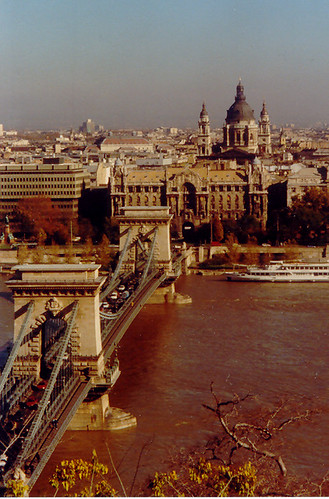
Budapest's Chain Bridge:
diminished my expectations
Other old bridges in cities had shaped my expectations. I’d cycled across the Chain Bridge in Budapest – another 19th century suspension bridge. I’d ridden over pretty much every Thames crossing between Tower Bridge and Windsor. I’d walked over the Clifton suspension bridge in Bristol. I had even noticed – with mild irritation – the numerous references in The Path Between the Seas, David McCullough’s fine history of the building of the Panama Canal, to the Brooklyn Bridge. He had written a previous book on the subject. How big a deal, I wondered, could a bridge across a river in the middle of a city be?

All of which meant I was unprepared for what I encountered as I pushed my little boy’s pushchair (stroller) over the road beyond City Hall Park and started out on the long, sloping walkway. The twin archways of the bridge’s Manhattan pier stood hundreds of yards away, towering over even many tall New York buildings. The four enormous main suspension cables reinforced the bridge’s scale.
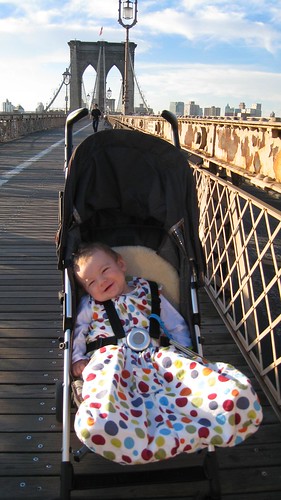
The Invisible Visible Boy:
wide awake on his first visit
to the Brooklyn Bridge
This, I suddenly realised, was more like some vast, cross-estuary bridge – I’ve ridden in the past over the Erskine, Forth and Tay bridges in Scotland – than almost anything I’d previously encountered in a city. Yet it was nearly 100 years older than most of those similar spans and taking off from the middle of one of the most densely-packed sections of one of the most densely-packed cities on earth.

I also, as I made my way out towards Brooklyn, started to notice the Manhattan-bound cyclists freewheeling down the slope. There were, it occurred to me, some lucky souls who got to commute by bike every morning over this marvel of engineering, taking in one of the world’s great views – lower Manhattan’s clustered skyscrapers. As I rolled the still wide-awake boy over the bridge, at an hour I’d normally still be sleeping, I started to imagine an alternative life from our existence in London. We would live in Brooklyn and I would get on my bike each morning and ride, amid the drama of the Brooklyn Bridge, to my job in Manhattan.

There will by this point be many people familiar with cycling in New York puzzled at my enconium for this particular bridge – and for good reason. The Brooklyn Bridge, oldest of the fixed East River crossings and the most distinctive, suffers as a place to cycle from its celebrity. I have endured journeys on sunny Saturdays when I’ve spent virtually every yard of the main crossing ringing my bell, shouting warnings or braking suddenly as heedless tourists have wandered into my path. I had a young woman shout at me, “This is a tourist area!” after I tutted at her dumping her suitcase right in the cycle lane by the Manhattan pier. Her view failed, I thought, to capture the structure's fundamental bridge-iness. Most bizarrely of all, I once had a wedding party remonstrate with me that I was cycling too fast (at a sedate 12mph) and had disrupted their efforts to pose for wedding photos in the bridge’s bike lane. I suggested that, if they didn’t mind obstructing traffic, the view from one of the adjacent car lanes might be even better.

But the challenges of using the bridge shouldn’t obscure how marvellous and unique a structure the bridge is. Using it can be one of those interactions with a city that cyclists are peculiarly privileged to enjoy. The bridge played a significant role in forming the current New York City. It's no accident that it was only in 1898, after the bridge's completion in 1883, that the cities of New York and Brooklyn merged to form one metropolis.
 
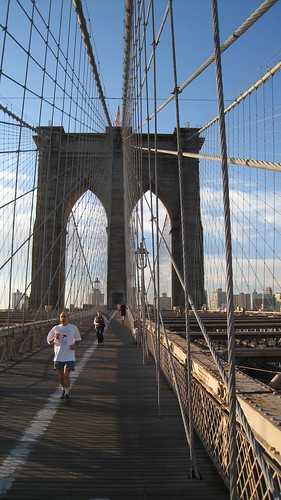
John Roebling's Gothic arches:
a bit mad when you think about it.
The aesthetics of the Great East River Bridge – as it was known during construction – also summarise something about the city itself. When John Roebling, the bridge’s designer, was planning it in the 1860s, he could easily have gone for a different look. There is, in retrospect, something eccentric about giving what was then the world’s most ambitious, modern bridge two twin stone archways in the European gothic style. The mixture of modern steel cables and gothic styling must initially have seemed as strange as, say, one of the modern-day shopping malls in Dubai themed around the medieval Muslim world.

Yet the slightly pompous adoption of European styles and modern construction techniques turned out to be the perfect mixture for a city taking over from Europe the mantle of world leadership. There were buildings in New York and Brooklyn in an archaic style before the Great Bridge. But it’s hard to believe that mixture of old and new would have become quite as prevalent without the Roeblings’ bridge. Look at the Brooklyn Bridge’s towers and you’re seeing, right there, where Gotham City’s Gothic aesthetic was born. It helps that the bridge's mix of styles is unique. As McCullough's book points out, it was one of the first suspension bridges on such a scale – but the last big one before steel towers became standard. None of the Great Bridge’s East River successors features the mixture of stone and steel.

The commemorative plaque: heroes and villains side by side
A stop I made one morning in early March, however, has prompted me also to think about the human stories behind the bridge's construction as I ride across. Stopping to change from my warm cycling jacket to a cooler high-visibility vest, I spotted above where I rested my bike, on the bridge’s Brooklyn tower, the plaque that was unveiled on May 24, 1883 when the bridge, after 14 years’ work, finally opened to the public. Having read McCullough’s The Great Bridge since that day in 2008, I found many of the names bringing incidents during its building vividly to mind.

The name John Roebling, the bridge’s original engineer, was marked with a small cross and the date 1869. He had, I knew, died slowly and painfully of tetanus after being injured surveying the bridge’s Brooklyn landing, on a spot almost precisely below where I stood. The cables above my head – a mixture of stays to hold the bridge deck steady and conventional suspension cables - bore testimony to his continuing influence. Such dual sets of cables were a trademark of his bridge designs – and testimony to his caution and thoroughness.

The name Washington Roebling, John’s son, below him, conjured up still more stories. He suffered terribly for years from the effects – both on his nerves and his body – of tackling a fierce fire in the caisson that formed the base of the bridge’s Brooklyn tower. The caisson, complete with the wood he personally repaired, was on the river bed, directly below my feet.
 
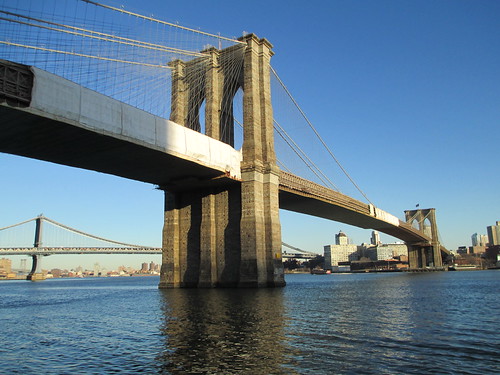
The bridge from Manhattan: dodgy wire and all
The list of the bridge’s trustees was less inspiring, meanwhile. Henry Murphy and William Kingsley, the president and vice-president of the board, had both been involved in awarding the contract to make wires for the suspension cable to J Lloyd Haigh, a shady Brooklyn contractor. Haigh perpetrated a long-running fraud to supply the bridge with sub-standard wire. It was thanks to them that the cables whose width I'd noticed in July 2008 were so thick. Washington Roebling had added extra wire to them to protect against weaknesses in the sub-standard wire, still in place more than 130 years on.

I looked at the plaque with far less insight back in 2008. My son had finally fallen asleep when I reached the Brooklyn pier and I turned back towards Manhattan, eager to suggest the Invisible Visible Woman and the Invisible Visible Girl come back with us for a second visit to the bridge. That second visit - and a picnic lunch the next day with two old friends in Fort Greene - further nurtured my growing idea of how we could live in New York. The notion of relocation to the Big Apple remained strong enough, even though the prospects of its happening seemed remote, that I rhapsodised on the possibility of commuting over the Brooklyn Bridge in the first post on this blog. The notion made me all the keener to apply when, unexpectedly, a suitable job with my employer in New York became available.

Yet there was no inevitability about my using the Brooklyn Bridge, even once we'd selected a Brooklyn apartment. My early research revealed a strong bias among cyclists in favour of using the pedestrian-free Manhattan Bridge bike path to travel between downtown Brooklyn and lower Manhattan. I’ve used all three other East River bridges – the Manhattan for trips to Lower East Side destinations, the Williamsburg for an occasional change and the Queensboro for a few days following Superstorm Sandy.
 
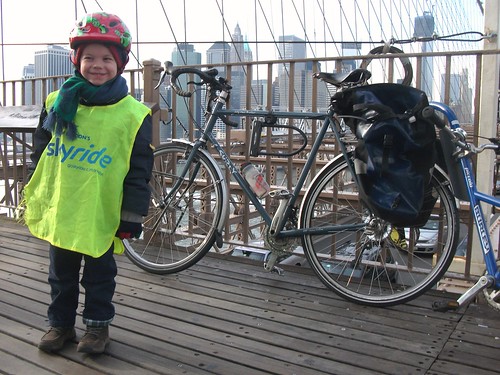
The Invisible Visible Boy, now a Brooklyn resident,
on the bridge last Christmas Eve
But, unlike the others, I eventually realised, the Brooklyn Bridge would land me in the middle of lower Manhattan, less than half a mile from the Hudson River Greenway and four miles of convenient, traffic-free riding uptown. As a result, I am now one of those lucky souls I spotted freewheeling off the bridge in 2008. I’ve ridden when snow is accumulating on the wooden walkway and in torrential rain, as well as suffocating heat and on days of such wind I’ve walked over the bridge’s centre. I’ve seen days when fog obscures Manhattan from Brooklyn, those when mist collects in the Manhattan streets and the skyscrapers poke out up above and days when rain on my glasses obscures the whole scene. I’ve cursed the wood's slipperiness on wet days and the walkway's narrowness on sunny days that bring out the tourists. On one especially memorable evening, I rode home over the bridge as spectacular thunderstorms broke over New York Harbour, periodically highlighting the buildings around me against great flashes of sheet lightning.

Through all of that, there are still days – frequent ones, in fact – when the highlight of my ride to work is the moment when I turn a corner on the walkway and the bridge first comes into view. The Roeblings’ twin gothic towers come into view against a backdrop of lower Manhattan skyscrapers glistening in the sunlight – and I remember what made me want to live in this city in the first place.