Showing posts with label bikenyc. Show all posts

Monday, 4 August 2014

A close pass, a misguided campaign - and why I won't just leave it on the road

On July 17, as I cycled to work, amid the chaos of rush-hour downtown Brooklyn, I spotted a narrow gap to the right of a line of stationary traffic. I moved into it and rode cautiously towards the next intersection. Then, to my shock, I realised a taxi driver had decided there was room between me and the other traffic for him also to squeeze through. He drove past me, much faster than I was going, leaving at most around six inches to spare. Knowing that any miscalculation would have had me tumbling under the taxi’s wheels, I felt a surge of panic and rage.
 
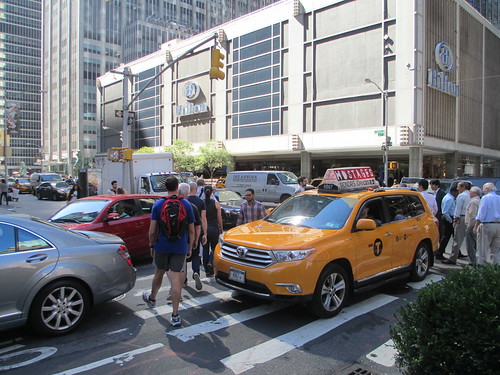
Close pass: here's how it looks when I try to photograph
a taxi moments after it's come within inches of me
with the lens on zoom and my hands still shaking
Numerous current road safety campaigns – including one by Transport for London, the London Mayor’s transport organisation – would imply that what I did next made me just as bad as the negligent driver. Catching up with him and still feeling the shock of his pointless, dangerous behaviour, I yelled at him: “You could have killed me. You’re a dangerous driver.” Looking at me with stone dead eyes, he languidly rolled up the passenger-side window and drove off as fast as the traffic jam would allow.

The Transport for London campaign – which inevitably uses the shopworn “share the road” slogan – would have enjoined me to ignore the driver’s actions, take a deep breath and head on my way as if nothing had happened. “Leave it on the road,” it advises road users. It isn’t, I think, advice about what one should do with the body fluids and teeth of people that rile one.

My example highlights the insane irrationality of such campaigns. A “leave it on the road” approach to road safety suggests that the real problem is people’s malice towards each other or negative perceptions. It ignores the evidence that negligence, inattention and poor risk assessment are significant causes of car crashes. It puts the focus on vulnerable road users’ reaction to negligent driving. It suggests that all cyclists and pedestrians are somehow collectively responsible for each others’ behaviour. Motorists are helpless vessels full of potential rage that cyclists or pedestrians can make explode or safely depressurise. The approach serves no conceivable purpose other than to comfort people like the taxi driver who put me at risk. “Yes,” is the hidden message. “The real problem is those nasty, lippy cyclists.”

Such campaigns nevertheless enjoy such continued credibility that I found myself arguing vigorously recently with a cyclist who trenchantly defended a campaign by the state government of Utah under the title “Respect is a Two-Way Street”. Most problems cyclists encountered on the road were a result of motorists’ past experience of bad cyclist behaviour, my interlocutor assured me.

I came upon this two-car shunt on Saturday on the Upper
East Side, an eminently respectable neighbourhood.
But was a lack of respect between drivers the real problem?
Utah’s campaign isn’t alone. David Zabriskie, the professional cyclist, has organised a similar (if more nuanced) campaign under the title “Yield to Life” that seeks to build “understanding, respect and appreciation for all life” between cyclists and motorists. British Cycling has called for “mutual respect” between cyclists and motorists.

Yet it’s self-evidently bizarre to argue that the solution to drivers’ killing people is to ask everyone to be nice. There is a quality-of-life argument for asking people to be calmer and more tolerant. I try when I haven’t been put in fear of my life to act considerately. But it’s hard to see that “share the road” campaigns are a better route to that destination than making the roads safe. The question is why “share the road” campaigns continue to consume energy that could be better directed elsewhere.

I suspect the answer is that transport authorities face a choice between conveying messages that are broadly popular and bringing about changes that are likely severely to annoy many. It’s not a surprise – though it’s certainly a disappointment – that the former so consistently wins.
 
Cyclists respectfully wait when asked to stop at this year's
Summer Streets event. What is it about this motor
vehicle-free environment that suddenly makes cyclists
show people more respect?
It’s not hard, after all, to guess such campaigns’ genesis. Many cities worldwide, in gestures towards environmental concern, congestion relief or obesity prevention, have sought to encourage cycling, many with more success than they expected. Surges in cyclist numbers on roads designed to facilitate smooth car movements have often led to spikes in cyclist deaths, even if the death rate per mile cycled has usually fallen. “Share the road,” “mutual respect” and other similar campaigns are all manifestations of public officials’ dilemma. They don’t want to stop the growth of cycling but lack the political capital or courage to upset vocal motorist groups, local shopkeepers, the local newspaper or the many other noisy defenders of the status quo. It must seem a beguilingly simple solution to tell everyone to up their game and hope the problem goes away.

The laws of physics, human nature and psychology keep getting in the way, however.

The taxi driver who brushed by me was driving a Toyota Highlander – a vehicle that weighs 2.5 tonnes – and moving considerably faster than I. That would have made a critical difference if he had actually hit me. His vehicle’s momentum, mass and size surely meant he had a far greater duty to be careful than I had. The emotional stakes were also entirely different. I seek to keep myself safe precisely because I know the odds if I’m hit. The driver could afford to keep his sang froid precisely because, as the driver of a large SUV, he was effectively invulnerable. I was acutely aware of how close he’d come to me because I was out in the open and constantly watching for danger. Sitting on the far side of a 6’ 4” (nearly 2m) wide vehicle, the driver probably had little conception of quite how much he was endangering me.
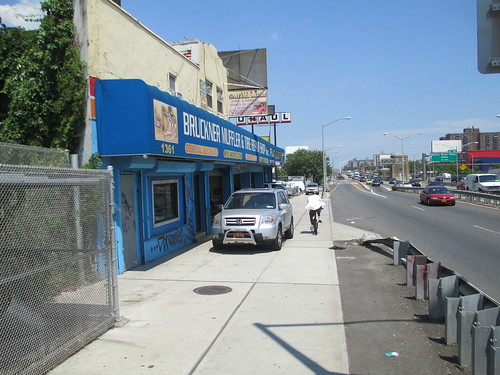
A car parked on a Bronx sidewalk-cum-cycleway. If only
that cyclist had shown more respect, perhaps the driver
wouldn't have felt forced to act this way.
New York City has not actually run a “mutual respect” campaign in the time I’ve been here but I’ve heard all the most senior road safety figures in the city – the transport commissioner, head of the police’s traffic squad and the head of the state department of motor vehicles – back the approach in speeches. The police commissioner erroneously claimed earlier this year that fatally-struck pedestrians tended to cause their own deaths – an entirely untrue assertion that, if it were true, would make some sense of “share the road” campaigns. The tenor of many of the police’s actions – the determination to hand out traffic tickets to pedestrians and, disproportionately, cyclists as well as motorists – seems to reflect the same thinking.

This “even-handed” approach isn’t making people safer, however. According to figures from WNYC, the radio station, 141 people had died in traffic in the city up to August 1, which makes it seem likely there will be almost as many traffic fatalities this year as the 274 in 2013. I can’t find any statistics for road deaths so far in London this year but there’s little indication its record – while far better, per capita, than New York’s – is improving much.
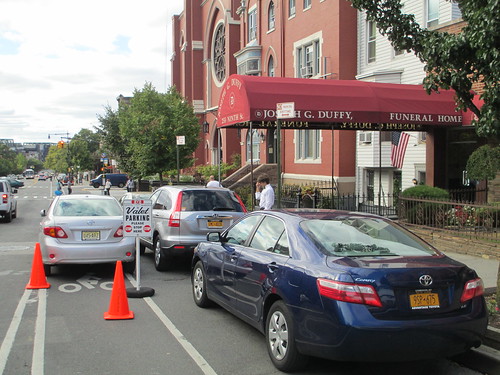
Parked cars block the new two-way bike lane on
Kent Avenue, South Williamsburg: it's absolutely clear
how much extra mutual respect would help alleviate
this problem.
There isn’t any great mystery which approach would make the big cities of the English-speaking world genuinely safer. London has a better record than New York partly because London has far more automated speed and red light enforcement via cameras. It’s also pretty obvious to anyone with experience of British cities’ side streets that there are far more speed humps, road narrowing, raised crossings and other measures to slow traffic down and make pedestrians more visible. The cities with the best cycling safety records tend to give over substantial, well-designed space to cyclists on their streets. Anyone who’s looked at the situation rationally will find these points unsurprising. There’s overwhelming evidence, from repeated studies in multiple places, that drivers’ inattention, excessive speed and other mistakes cause the vast bulk of crashes. Measures that constrain their speed or force them to pay attention unsurprisingly tend to make everyone safer.

But such measures seem to give rise in many people to a kind of existential panic. Powerful groups – men, privileged races, imperial powers – tend to think that they have their jobs, their access to better schools, their political power or their access to road space by right and by merit rather than as a result of rigged power structures. The howls of protest have the same tone of injured innocence I’ve heard in the past from Northern Irish Protestants, Kosovo Serbs and others who see privileges taken for granted being eroded.

I don’t pretend that it’s an easy political choice to take on those vested interests. There would be bitter, angry complaints if New York City’s Department of Transportation decided to put in a well-designed protected bike lane for the many cyclists riding down Smith and Jay streets every morning. It’s my own choice to take – and try to manage – the risks inherent in cycling while those arrangements aren’t in place. But, until something effective is done, I’d rather the authorities not add insult to the threat of injury. I don’t respect drivers who think their desire for convenience trumps my right to life.

Wednesday, 16 July 2014

A Concrete Plant Park chat, a Roosevelt Drive rollover - and why I may be becoming a New Yorker

The brief conversation in the park was rather different from many of the on-street discussions I have with New York City drivers.
“Hi there, how’s everything going?” the elderly man asked me, with such enthusiasm it took me slightly unawares. “Good,” he replied when I assured him things were going pretty well. “You have a good day.”
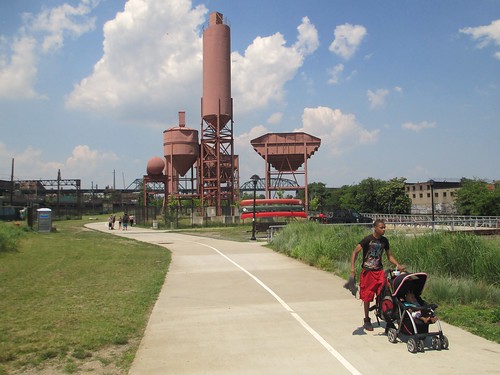
Concrete Plant Park: a park that used to be a concrete plant -
with older gentlemen speaking in Spanish

Having wished him a good day in return, I pushed my bike towards a bench, rummaged in my pannier bags and got out my lunchtime sandwiches. I ate my lunch contemplating the scenery – if that’s not too strong a word - of the Bronx River. The older man continued an animated discussion with a friend in Spanish.

The interchange in Concrete Plant Park was one of many joys of my bike ride this past Saturday almost all the way across New York, from my home in Brooklyn, to City Island, in The Bronx. I enjoyed stunning views, weather a little less stifling than the city summer norm and arrived at a charming New England fishing village strangely marooned in the city.
The Hutchison River: not most people's idea of
what The Bronx looks like

However, the aspects of the trip that stood out weren’t those I’d been anticipating. I’d expected to explore New York’s relationship with the inlets of the sea, rivers and islands that define the city’s unusual geography, confining high-rise Manhattan to one small island and allowing other parts of the city to sprawl.

I came back with a still more powerful sense of the city’s remarkable atmosphere – of its people’s readiness to engage, their straightforwardness and their sense of fun. My only regret is that the city still hasn’t properly harnessed its people’s vigour and enthusiasm to a serious effort to make its streets safer. That feeling is all the more intense because I came on my way home on the aftermath of a car crash. While it seemed to have had no serious consequences, it could easily have killed someone.

I headed out partly because I was lonely, after my wife and children went to visit family in the UK, and because I wanted to regain some fitness after being off my bike for two weeks in June with a broken foot.
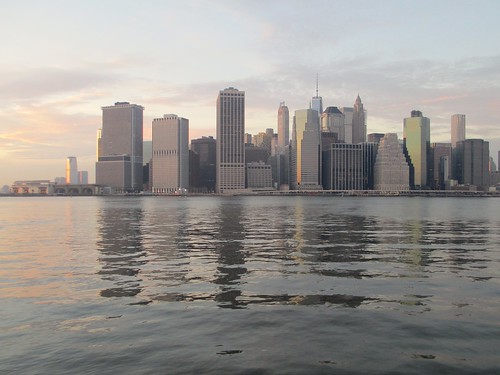
Financial District skyscrapers, reflected in the East River:
giraffes round a watering hole - or something.

I planned my route to take in all the city’s boroughs, except for Staten Island, and a series of different land masses. I would start on Long Island, where I live, cross over onto Manhattan Island, then the twin, linked Randall's and Wards Islands in the East River. Then I’d cross onto the US mainland in The Bronx and finally out onto City Island in Long Island Sound. I was particularly determined to have a positive experience after someone suggested to me I always made New York sound an appalling place when I wrote about cycling here.

I had the idea for the route because I’m struck by how it’s the areas where it’s impossible to build – the East River, the Hudson, New York Harbour – that give the land in the city its sense of place. Some of the city’s densest, highest-rise areas are crowded round the water, as if the buildings were so many giraffes, crowding round a drinking hole. The meandering Thames and the city’s other rivers and canals give parts of London a similar feeling. But there's nothing there quite as spectacular.
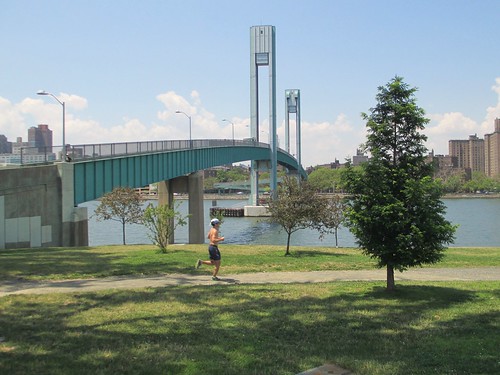
The 103rd St bridge: drama - and a passing New Yorker too

The moments of greatest drama were indeed bridges that swept over key canals and inlets of the sea. The Pulaski Bridge carried me over Newtown Creek from Brooklyn to Queens, with a dramatic view of midtown Manhattan to my left; the Queensboro Bridge soared high above Roosevelt Island in the East River; the graceful 103rd St foot and cycle bridge carried me from Manhattan onto Wards Island, in the centre of Hell Gate at the junction of the East River, Harlem River and Long Island Sound.

I was struck anew as I rode – but not surprised – by the influence over the city of Robert Moses, the powerful – unelected – official who shaped planning for New York City and state between 1924 and 1968. Moses was a passionate fan of open-water swimming, roads and parks. It was unmistakeable how that trio of interests had led him to make particularly wrenching changes to the bits of the city nearest the water. As I rode up by the East River in Manhattan, I was pedalling at one point on a promenade that Moses built above a section of East River Drive that he designed, looking across towards Randall's and Wards Islands, which he entirely reshaped, and at his Tri-Borough Bridge.
 
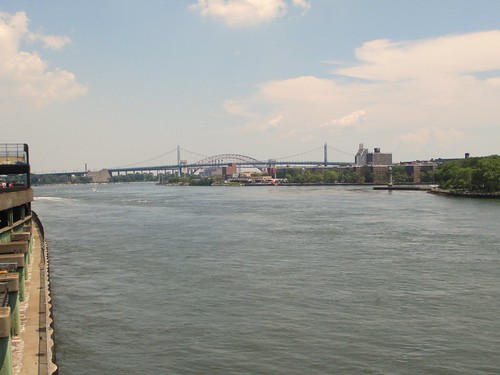
East River Drive, Tri-Borough and Wards and Randalls
Islands: Robert Moses' influence on the city, crowded round
the East River
But a different sensation started to creep over me. It began with the driver in Cobble Hill who carefully waited for me to start when some lights changed and I was stuck behind a car. “You goin’?” he asked politely, before letting me move off. It continued with the man in Concrete Plant Park. Then I noticed a man ahead of me as I rode along the Pelham Parkway in The Bronx. He was an almost laughably complete picture of how people would imagine a cyclist from the area that first spawned rap should look. His baseball cap faced backwards and his BMX bike was so tiny he had constantly to stand up. Yet he was looking, like me, to get somewhere particular, as fast as he could.

“Orchard Beach?” he asked me as we waited at a crossing over a road. He was referring to a vast beach that Robert Moses created just north of City Island. “Where dat at?”

I advised him to follow me.
 
The Bronx River, from Concrete Plant Park:
can there be nature that's also grittily urban?
Again and again as I rode, I was aware of how the city’s people were working as hard on this hot, not-too-humid Saturday at enjoying themselves as they would during the week at their jobs. As I returned home through Concrete Plant Park, I stopped to fill my water bottle at a drinking fountain and interrupted a girl – maybe three or four – filling a vast pile of water balloons. Her mother, who was assiduously helping her, told her in Spanish to wait while I filled my bottle. Then the great task – whose ultimate goal was unclear to me – continued.

Other parks were full of the elaborate barbecue parties that will be familiar to anyone who knows New York. Moustachioed fathers were lugging big grills into position while women fussed over coolers full of marinating meat. Sound systems blared Latin music.
 
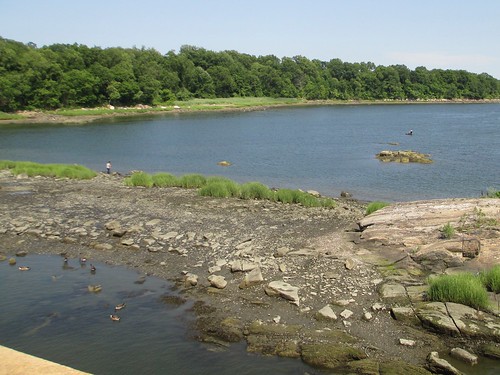
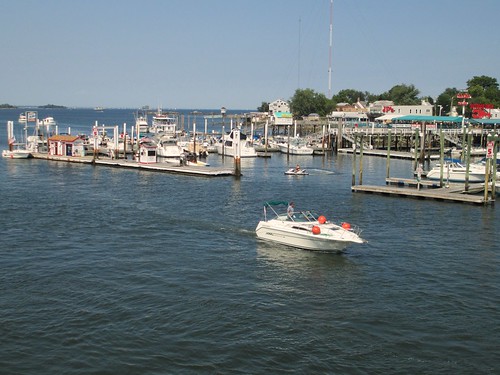
City Island: different from most outsiders'
perceptions of The Bronx
It was almost an anti-climax after immersing myself in the vibrant, multi-ethnic atmosphere of The Bronx’s parks to ride over the bridge onto City Island and find a neat suburb of clapboard houses and seafood restaurants. I rode down to the island’s tip, took some pictures of the seagulls flocking round the seafood restaurants, then rode back up the island to the Lickety Spit cafĂ©. The ice cream felt well-earned.

The impression of New York as a vast, crazy communal effort grew on me still further as I headed home. I puzzled a group of young, African-American men just after I left City Island by asking if they needed any tools for the bike they were trying to fix. It was fine, one of them assured me. He looked up, however, and added: “Thank you, my brother.”

The South Bronx: battered by Robert Moses,
but unbowed
The streets grew more and more crowded as I headed south and the sun sank in the sky. In East Tremont in The Bronx – an area where Robert Moses’ cross-Bronx expressway wreaked particular social devastation – there were little knots of people out on the streets, gathered round attractions whose significance I didn’t understand.

I was feeling, I realised, the flipside of the atmosphere in New York that makes drivers short-tempered and intolerant. Its being a hard and uncompromising place to live, I began to feel, gave many of the city’s people a directness and determination that felt life-enhancing and exciting to be around. New York has a way of pummelling the timidity and shyness out of one.
 
East River Drive: it's possibly to drive too directly and frankly
Yet, perhaps inevitably, I was to come across a reminder that that frankness and directness don’t always mix well with being on the roads. As I rode along the East River shore of northern Manhattan, I noticed an unusual number of emergency vehicles heading south on the adjoining East River drive. Rounding a corner, I found a group of them working to turn back upright an car overturned in the lanes nearest the cycle path. “It just started turning over,” I heard the clearly stunned – but thankfully not badly hurt – driver telling an ambulance crew.

“People think they can drive any speed and nothing will go wrong,” I remarked to another onlooker, trying to put across a road safety message.

He wasn’t ready to hear.

“Yeah,” he replied. “But to walk away from that – impressive!”

It was a response that, under some circumstances, I could have found depressing. It’s dispiriting that so many people focus when thinking about their road behaviour on what they can walk away from, rather than what’s rational for them and those around them. I could also have grown frustrated at how many of the miles of waiting drivers I subsequently passed were leaning on their horns, as if their frustration would make the emergency workers go faster.
 
The East River Promenade: nice enough to make one forget
the city's shortcomings.
But, even as I rode past the honking vehicles, I was taking in the different – but still positive – atmosphere of this far more prosperous part of the city. People sat on benches looking over the East River watching the powerful currents that tear through the area around the tip of Roosevelt Island. Residents of the Upper East Side wandered along the esplanade so calmly and contentedly in the setting sun that it felt almost like riding through an idealised architect’s drawing of a perfect urban scene. I noticed as I rode across the Queensboro Bridge how beautifully the bridge was reflecting in neighbouring glass buildings.

It was, in the end, a round-trip of 56 miles on a day when temperatures reached nearly 30C. I arrived home hot, sweaty and feeling a keen need for the Chinese food I’d put aside that morning.

But I’d worked at enjoying myself just as much as the grill-lugging fathers I’d seen in the parks, and I came home feeling more connection with the city’s alternately infuriating and endearing people than I’ve ever felt before.

Perhaps, a voice inside me suggests, I am becoming a New Yorker.

Sunday, 8 June 2014

An uptown ride, a Hudson incident - and why some safety messages spell danger

On April 25, instead of heading straight to the office, I cycled up the Hudson River Greenway to the ghastly Javits Convention Center, for an event grandly titled the World Traffic Safety Symposium. The centrepiece turned out to be a much-hyped announcement about improving pedestrian safety by David Friedman, acting administrator of the federal government’s National Highway Traffic Safety Administration.
The Hudson River Greenway: a ride up here put me
in a sombre mood

A scene I encountered as I cycled there shaped my experience of the event, however. Around Pier 59 in Chelsea, I found a swarm of emergency vehicles blocking most of the cycle path, busy working at something in the river. It wasn’t hard to work out that they were retrieving something significant – probably a dead person – from the water.

The sense that I’d brushed someone’s tragedy on the way put me in no mood to listen to the convenient messages that their public relations departments had given the speakers to parrot about improving road safety. It fuelled my conviction that their approach to road safety had been infected by one of the signature thinking failures of the contemporary age. Faced with a big problem with complex roots, they had decided – by stressing everyone’s collective responsibility for safety - to blame everyone involved, rather than the people most responsible.

The indignation that overtook me was similar to what I feel when I hear or read, for example, that it’s impossible to tell whether Russia or Ukraine is more to blame for Russia’s invasion of Ukraine. In the wake of the revelations about the US National Security Agency’s excessive spying, I’ve read suggestions that, since America is less free than was previously supposed, it’s really no different from China or North Korea. Other cynics say that, since it’s hard to tell which of the various UK political parties at present is least bad, one might as well regard them as all the same.

Such ideas invariably serve to help the powerful and ill-intentioned – an authoritarian Russia against a democratic if flawed Ukraine; China’s repressive government against its own people and the UK independence party against less nasty groups.

Pedestrians in midtown Manhattan: crossing the street
almost as if it weren't their personal responsibility
to keep themselves safe from the poor cars.
But this act of intellectual surrender was all the more invidious because none of the speakers – who included the commissioner of New York State’s department of motor vehicles, New York City’s traffic commissioner and the New York police’s head traffic cop - seemed to recognise it as such. In fact, they presented their message – that everyone shares responsibility for making the roads safer – as if it were the plainest common sense.

“It begins with personal responsibility,” Friedman said, before going on to say how indispensable it was that everyone take ownership of his or her own safety.

“In a rush, we might cross against the light,” he said. “On our bikes, we might not stop at every stop sign. As drivers, being late for work can mean the temptation to rush into a crosswalk before the pedestrian does to get across and save a bit of time instead of waiting for them to walk safely by.”

Friedman invited us, in other words, to equate in blameworthiness nipping across a pedestrian crossing against the light when no vehicles are around, jumping a red light on a bike when one can see a phalanx of charging cars behind one and barging one’s car through a crosswalk of children walking to school.

Riding down the 9th St bike lane in Park Slope, Brooklyn?
Don't forget to exercise your personal responsibility
to keep yourself safe there.
Research into road crashes highlights such a suggestion’s preposterousness. Every bit of research I’ve read on crashes between motorists and pedestrians or cyclists attributes blame for between two-thirds and 80 per cent of crashes to the motorist. People’s gut instinct about where the power lies between a half-tonne speeding vehicle and a vulnerable cyclist or pedestrian already appears to be making them risk-averse around cars. In New York City, more serious pedestrian injuries seem to occur to people crossing with the light in the crosswalk than crossing against the light. People who cross when traffic’s clear but the light’s not in their favour seem to do better than those who rely on turning drivers to yield to them.

The effects of this misallocation of blame are real. Since New York embarked on its effort to eliminate road crash deaths in January, police in many precincts have stepped up harassment of cyclists and pedestrians but not policing of refusal to yield or speeding. When a driver hit and killed Nicholas Soto, a 14-year-old boy, crossing the street in Red Hook, a few blocks from my house, last Monday, the instant reaction was to blame the boy’s sweatshirt for obstructing his view. But the car involved seems to have been going far too fast and the boy was in a crosswalk. The implicit assumption that responsibility for road safety lies equally with the driver of a speeding performance car and a schoolboy running for the bus has led police to blame the victim, rather than the perpetrator.
Remember, folks: exercise your personal responsibility
in getting around the cars the police have allowed
to block the sidewalk and bike lane.

On a wider scale, both in New York and other parts of the world, failure to understand crashes’ causes leads police to harass groups that don’t cause crashes and leave alone others that do. In my native Scotland, the Scottish government last year embarked on an especially bizarre "mutual respect" campaign called "the Niceway Code". The evening before Nicholas' death, I'd even come across police supervising minivan drivers who were parking blocking a sidewalk and most of a two-way bike lane. It was as if they were trying to demonstrate unequivocally whose interests they represented.

Nor is it adequate to claim that, somehow, the misleading message about safety is effective because it overcomes drivers’ resistance to being told it’s all their fault. After a taxi driver honked at me to hurry me out of a crosswalk earlier this year, he told me that, no, it wasn’t the fault of drivers like him that pedestrian deaths in the city remained high. It was the fault of pedestrians distracted by their telephones. I wasn’t using a mobile device as I crossed the street. I am confident that he is one of many drivers who, when hearing that road safety is a shared responsibility, concludes it isn’t really his at all. It’s hard not to be reminded of the way some police forces used to combat sexual assault. Yes, men, you shouldn’t rape women. But, come on women, watch how you dress and where you go. Any message that disperses blame for a problem takes pressure off the most blameworthy party.
Cycle or walk responsibly through the intersection
of 54th Street and Broadway. Otherwise you
might not be safe.

The only comfort I could draw was that the sums being put into this new initiative are so small they’re unlikely to do much harm. Friedman had come to New York to announce awards of $1.6m – the price of a few rooms of a Brooklyn brownstone – for pedestrian safety, split between three cities. New York was to receive $800,000 while the remainder would be split between Philadelphia and Louisville, Kentucky. I had no time to follow the group to a nearby celebratory press conference. So, robbed of the chance to ask awkward questions, I headed back to the office.

It was to be a memorable ride downtown. I reached Pier 59 to find the emergency vehicles gone. Only two policemen remained, seated at a picnic table playing cards. At their feet was a sheet, hiding the unmistakeable outline of the body they’d hauled out of the river.

It was hard not to see the little tableau as a metaphor for how New York and many other cities treat deaths. We’re constantly surrounded by fatal tragedies – a young man who’s jumped off a bridge, or another who’s been hit by a car. Yet we seem all too often to be so distracted, impatient and easily bored that we don’t give their deaths the respect and reflection they deserve.

There are no easy solutions. A patrol cop in the precincts by the Hudson probably sees enough bodies fished out of the river that he can be forgiven his sense of ennui. It’s hard when driving to hold onto a full sense of one’s responsibility to those around.

But, at the moment, the rush after a fatal crash is all too often to assure the survivor that, no, he couldn't have done anything to avoid it, to heap the blame on the person whose life has just been taken away. As long as that's the instinct, there won't be much reduction in the numbers of the recently-deceased left lying in the street, hidden by only a sheet, for the medical examiner to take away.

Sunday, 27 April 2014

A stunning view, a midtown ride - and why speed is as much the problem as space

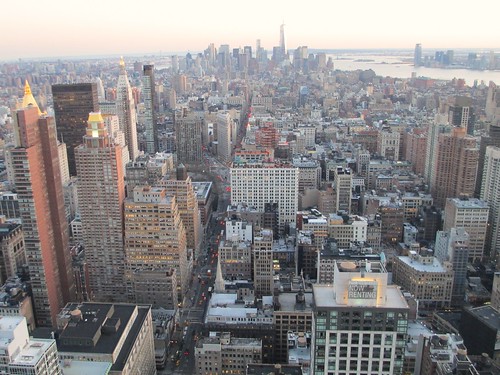
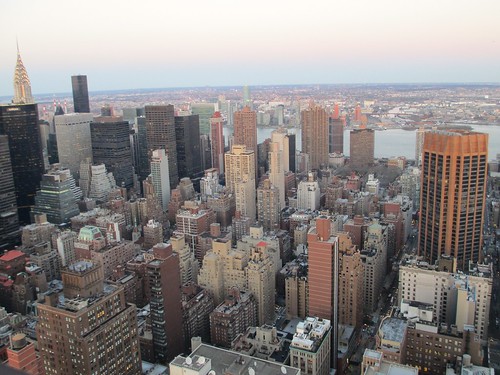
The Wednesday before Easter, thanks to a press event for a company I cover, I had my first chance since moving permanently to New York to go up the Empire State Building. Yet, as I gazed out from the 58th floor, I found myself struck by something other than the extraordinary forest of skyscrapers crowded, like trees straining towards the light, in midtown Manhattan. Looking south, it was clear how the forest canopy seemed to lower around Greenwich Village, SoHo and the Lower East Side into a less dense area of undergrowth or bush. It then rose again at the final, dense clump in the Financial District, teetering on Manhattan’s lower edge.
The Greenwich Village dip, seen from the midtown jungle
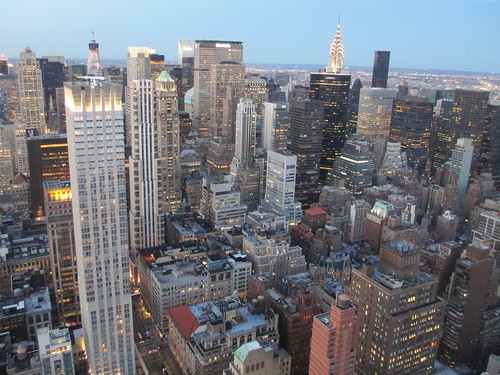
Midtown's skyscrapers: the lack of a "cyclists welcome"
sign, I'd suggest, is no coincidence

The view came to my mind the next day when I had to return to midtown for a television appearance at Fox News’ studios on Sixth Avenue. I rode up the Hudson River Greenway as far as 48th street. Then I started pedalling across town into the forest on which I’d been looking down the night before. The deeper I cycled into the mid-skyscraper canyon, the worse conditions became. I was constantly navigating around jammed-up traffic and dodging sites where workers were fixing pipes and cables. I was left wondering if, efficient though they can be, the densest parts of very dense cities such as New York are doomed to be fundamentally problematic places for human-powered transport.

The question’s relevant because many cities around the world are trying to accommodate their expanding population not, as New York City did for much of the 20th century, by sprawling outwards, but by becoming denser. There are calls for London to build new, higher buildings to absorb its growth. There is a similar movement in many parts of North America. It’s easier, so the thinking goes, to serve dense cities with public transport, since more journeys’ starting and end points can be an easy stroll from a station or bus stop. Wouldn’t it be ironic, I thought to myself, if such a movement – intended to make cities more environmentally friendly – made them worse for the bicycle, the most environmentally-friendly transport mode?
 
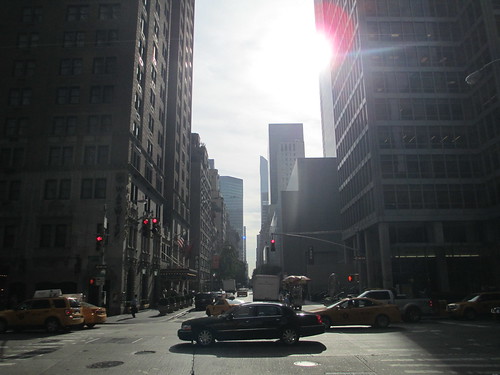
54th St, midtown. Look on this canyon, cyclists, and
at least consider despair.
It’s certainly tempting as one grapples with the reality of riding in midtown Manhattan – as I used to every day before my office moved downtown – to flirt with the idea that it’s a lost cause. The area crams into densities that in many cities would be associated with slums and squalor a mixture of high-end housing and offices teeming with some of the world’s best-paid professionals. No-one has the space or inclination to undertake a vast range of everyday activities but most have the money to pay to have them done. A stream of dry cleaners, express parcel services and food delivery cyclists consequently flows to and from the area’s offices and apartment complexes, giving the area the feel of being some vast apartment hotel crossed with a serviced office.

Since many of the best-off people feel themselves too important or fancy themselves in too much of a hurry to head into the subway, taxis and limousines buzz constantly around the doorways. The business of supplying food for the millions who swarm the area on a weekday would alone be enough to create a substantial traffic jam. The same goes for the business of keeping the people’s water, electricity, gas, sewage, hot water, internet, cable television and other services running smoothly. Almost none of the people engaged in the stressful business of meeting the area’s needs seems willing to take cyclists’ needs into account alongside the multiple other pressures they face. Cycling can be a slow, stressful business of zig-zagging around double-parked delivery vans, slipping past the edges of traffic jams and swerving to avoid the woman who leaps into the cycle lane to hail a taxi.
 
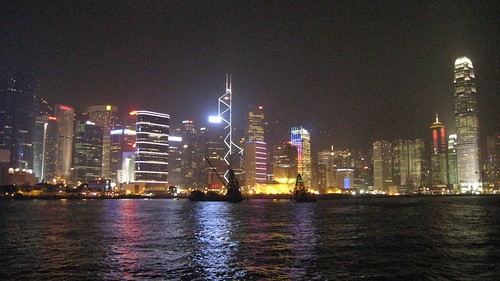
Hong Kong wasn't built specifically to make people feel
optimistic about cycling in midtown Manhattan. But
it serves the purpose very well
The intimidating atmosphere reminds me how I quailed, when it looked as if I might get a job in Hong Kong, at the thought of cycling there. Hong Kong has twice New York’s population density. I started to wonder if it might be London’s lower density – half New York’s level – that makes it generally an easier (if still severely flawed) place to cycle on-street.

Yet an incident later the day I appeared on Fox made me ponder how far space and density really were the problem. I cycled after work to Brooklyn to participate in a Maundy Thursday church service and headed off home afterwards down Garfield Place in Park Slope. I sped down the street, between rows of parked cars, at over 20mph, riding in the middle of the lane for fear a still-faster car would try to pass me. Sure enough, after a couple of blocks I noticed a Jeep Grand Cherokee close behind me, its driver clearly trying to barge me out of the way. I found myself, not for the first time, terrified of being hit from behind if I made a mistake but fearful also that, if I slowed down to pull out of the way, the driver would hit me before I was out of the way.
 
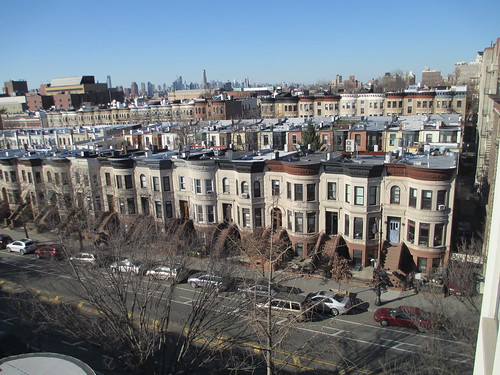
Park Slope: less dense, still speed-plagued
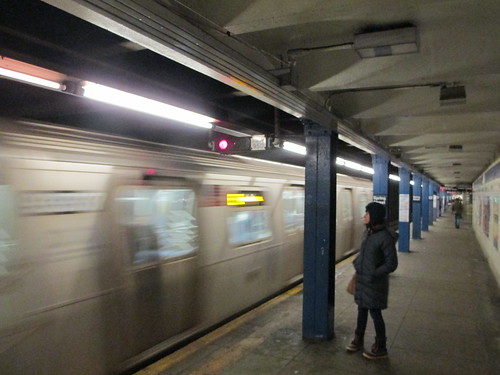
The New York City subway: speed, packaged and hidden away
I realised, instinctively, that the problem was less one of space and more one of speed. I am far happier to have a vehicle pass me on a narrow street at a reasonable speed because the scope for disaster, the room needed to correct a mistake, is so much smaller. I won’t let someone intent on breaking the speed limit on a narrow residential street pass me, because his speed has eaten up the room for error around his vehicle. We discussed some of these issues and a few more – including when he might learn to drive safely since he clearly didn’t know at present – at a red traffic light at Garfield and 5th Avenue.

When I factored speed into midtown conditions, I suddenly saw them in a very different light. The problem wasn’t so much, I realised, that there were so many delivery trucks and other commercial vehicles (although it wouldn’t hurt to switch some of these deliveries to cargo bikes). The problem was that those slow-moving vehicles had to stop every cross-town block to accommodate lines of vehicles sweeping up and down the avenues. I suddenly had a vision of a fast-moving taxi as taking up twice or three times its own road space as one that was stationary. The genius of the New York subway and other urban metro systems struck me. They take the problem of moving people fast – and consequently with lots of space around their vehicles – pack the people into space-efficient vehicles and bury the speed problem below the streets.

Beyond midtown east, out stretches low-rise Queens
Looked at it in that context, it becomes clearer that the real problem in New York lies not in midtown but in the low-rise areas I could see from the Empire State Building, stretching away towards the horizon. In New York and London – and even more so in many other big cities like Los Angeles and Houston – those distant suburbs were built with very little public transport provision. The only realistic way to get about, many residents feel, is to use a motor vehicle. To overcome their distance from the centre, the only way is to drive them fast. To cater to them, cities have built vast, space-eating high-speed roads. A significant part of midtown’s traffic problem is made up of people who drive all the way from those suburbs to work in the city centre.

The sheer unpleasantness of the world that way of living has created came home to me this Saturday as I cycled to meet my family for a day trip to the beach at Coney Island, on the edge of Brooklyn’s low-density sprawl. To cover the last stretch from a harbour-side cycle path to the beach, the marked cycle route heads onto Cropsey Avenue, a terrifying six lanes of suburban automotive culture full of vehicles seeking to drive at 40mph or faster. Far from taking the lane to tame these barrelling lumps of high-speed steel, I found myself letting my fear get the better of me. I cowered - as I once did when cycling in Staten Island - in side streets at each intersection, waited for the herd of charging cars to sweep past. Then I pedalled off after them as fast as I could, hoping to outrun the next charge.At the corner of Cropsey Avenue and Neptune Avenue - a few yards from the Invisible Visible Girl’s school – I shouted at motorists turning fast through a crossing where a man and his daughter were struggling to cross the street.
It's invidious to claim one's city has the worst cycle facility
anywhere. But is there a part of your city's cycle network
quite as grim as Cropsey Avenue?

It remains a stressful and forbidding experience to cycle in the heart of midtown Manhattan and in the densest parts of many other cities worldwide. Although I know space-efficient bicycles have many advantages as a means of urban transport, I don’t know precisely how I’d carve out space on the streets of midtown – or, come to that, the City of London or Hong Kong – to encourage people less hardened than I to cycle.

But, following Saturday’s experience, I feel confident on one point. While W48th St might be chaotic and stressful, it could yet become a healthy, functioning urban space. I’m far less confident the same can be said for Cropsey Avenue.

Sunday, 31 March 2013

A pain to use but a joy to be on: in praise of the Brooklyn Bridge

It was when my then 10-month-old son refused to go back to sleep one morning in July 2008 that I first crossed the Brooklyn Bridge. We were on holiday (vacation) staying in TriBeCa. On our second morning, the jetlag from flying from London not yet having worn off, he wouldn’t nod off again after waking up at 5am. I’d headed south with him the previous morning, down towards the Staten Island ferry terminal. This time, I decided, it was about time I saw this bridge across the East River that I hadn’t properly seen on any previous visit to New York.
 
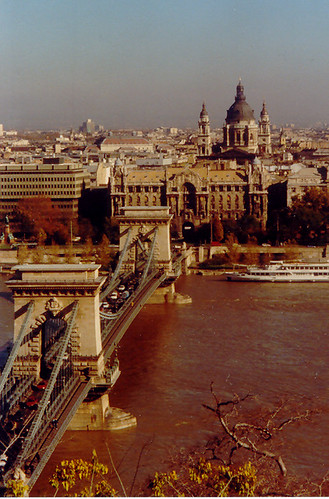
Budapest's Chain Bridge:
diminished my expectations
Other old bridges in cities had shaped my expectations. I’d cycled across the Chain Bridge in Budapest – another 19th century suspension bridge. I’d ridden over pretty much every Thames crossing between Tower Bridge and Windsor. I’d walked over the Clifton suspension bridge in Bristol. I had even noticed – with mild irritation – the numerous references in The Path Between the Seas, David McCullough’s fine history of the building of the Panama Canal, to the Brooklyn Bridge. He had written a previous book on the subject. How big a deal, I wondered, could a bridge across a river in the middle of a city be?

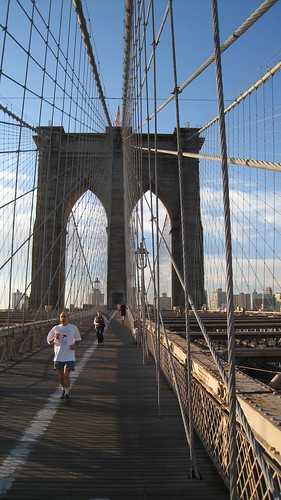
All of which meant I was unprepared for what I encountered as I pushed my little boy’s pushchair (stroller) over the road beyond City Hall Park and started out on the long, sloping walkway. The twin archways of the bridge’s Manhattan pier stood hundreds of yards away, towering over even many tall New York buildings. The four enormous main suspension cables reinforced the bridge’s scale.
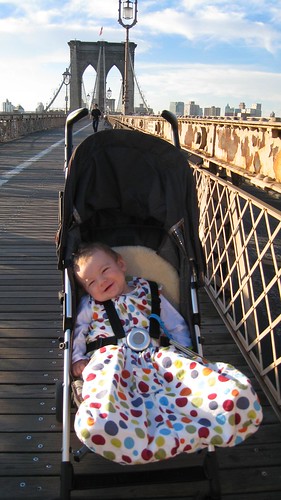
The Invisible Visible Boy:
wide awake on his first visit
to the Brooklyn Bridge
This, I suddenly realised, was more like some vast, cross-estuary bridge – I’ve ridden in the past over the Erskine, Forth and Tay bridges in Scotland – than almost anything I’d previously encountered in a city. Yet it was nearly 100 years older than most of those similar spans and taking off from the middle of one of the most densely-packed sections of one of the most densely-packed cities on earth.

I also, as I made my way out towards Brooklyn, started to notice the Manhattan-bound cyclists freewheeling down the slope. There were, it occurred to me, some lucky souls who got to commute by bike every morning over this marvel of engineering, taking in one of the world’s great views – lower Manhattan’s clustered skyscrapers. As I rolled the still wide-awake boy over the bridge, at an hour I’d normally still be sleeping, I started to imagine an alternative life from our existence in London. We would live in Brooklyn and I would get on my bike each morning and ride, amid the drama of the Brooklyn Bridge, to my job in Manhattan.

There will by this point be many people familiar with cycling in New York puzzled at my enconium for this particular bridge – and for good reason. The Brooklyn Bridge, oldest of the fixed East River crossings and the most distinctive, suffers as a place to cycle from its celebrity. I have endured journeys on sunny Saturdays when I’ve spent virtually every yard of the main crossing ringing my bell, shouting warnings or braking suddenly as heedless tourists have wandered into my path. I had a young woman shout at me, “This is a tourist area!” after I tutted at her dumping her suitcase right in the cycle lane by the Manhattan pier. Her view failed, I thought, to capture the structure's fundamental bridge-iness. Most bizarrely of all, I once had a wedding party remonstrate with me that I was cycling too fast (at a sedate 12mph) and had disrupted their efforts to pose for wedding photos in the bridge’s bike lane. I suggested that, if they didn’t mind obstructing traffic, the view from one of the adjacent car lanes might be even better.

But the challenges of using the bridge shouldn’t obscure how marvellous and unique a structure the bridge is. Using it can be one of those interactions with a city that cyclists are peculiarly privileged to enjoy. The bridge played a significant role in forming the current New York City. It's no accident that it was only in 1898, after the bridge's completion in 1883, that the cities of New York and Brooklyn merged to form one metropolis.
 
John Roebling's Gothic arches:
a bit mad when you think about it.
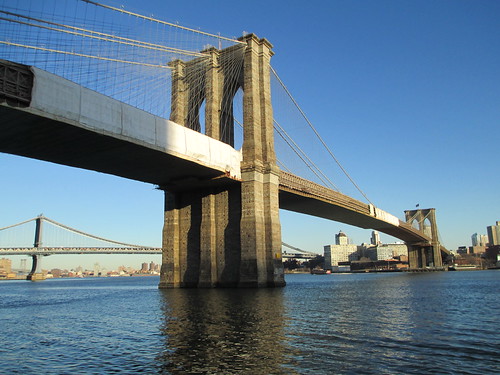
The aesthetics of the Great East River Bridge – as it was known during construction – also summarise something about the city itself. When John Roebling, the bridge’s designer, was planning it in the 1860s, he could easily have gone for a different look. There is, in retrospect, something eccentric about giving what was then the world’s most ambitious, modern bridge two twin stone archways in the European gothic style. The mixture of modern steel cables and gothic styling must initially have seemed as strange as, say, one of the modern-day shopping malls in Dubai themed around the medieval Muslim world.

Yet the slightly pompous adoption of European styles and modern construction techniques turned out to be the perfect mixture for a city taking over from Europe the mantle of world leadership. There were buildings in New York and Brooklyn in an archaic style before the Great Bridge. But it’s hard to believe that mixture of old and new would have become quite as prevalent without the Roeblings’ bridge. Look at the Brooklyn Bridge’s towers and you’re seeing, right there, where Gotham City’s Gothic aesthetic was born. It helps that the bridge's mix of styles is unique. As McCullough's book points out, it was one of the first suspension bridges on such a scale – but the last big one before steel towers became standard. None of the Great Bridge’s East River successors features the mixture of stone and steel.

The commemorative plaque: heroes and villains side by side
A stop I made one morning in early March, however, has prompted me also to think about the human stories behind the bridge's construction as I ride across. Stopping to change from my warm cycling jacket to a cooler high-visibility vest, I spotted above where I rested my bike, on the bridge’s Brooklyn tower, the plaque that was unveiled on May 24, 1883 when the bridge, after 14 years’ work, finally opened to the public. Having read McCullough’s The Great Bridge since that day in 2008, I found many of the names bringing incidents during its building vividly to mind.

The name John Roebling, the bridge’s original engineer, was marked with a small cross and the date 1869. He had, I knew, died slowly and painfully of tetanus after being injured surveying the bridge’s Brooklyn landing, on a spot almost precisely below where I stood. The cables above my head – a mixture of stays to hold the bridge deck steady and conventional suspension cables - bore testimony to his continuing influence. Such dual sets of cables were a trademark of his bridge designs – and testimony to his caution and thoroughness.

The name Washington Roebling, John’s son, below him, conjured up still more stories. He suffered terribly for years from the effects – both on his nerves and his body – of tackling a fierce fire in the caisson that formed the base of the bridge’s Brooklyn tower. The caisson, complete with the wood he personally repaired, was on the river bed, directly below my feet.
 
The bridge from Manhattan: dodgy wire and all
The list of the bridge’s trustees was less inspiring, meanwhile. Henry Murphy and William Kingsley, the president and vice-president of the board, had both been involved in awarding the contract to make wires for the suspension cable to J Lloyd Haigh, a shady Brooklyn contractor. Haigh perpetrated a long-running fraud to supply the bridge with sub-standard wire. It was thanks to them that the cables whose width I'd noticed in July 2008 were so thick. Washington Roebling had added extra wire to them to protect against weaknesses in the sub-standard wire, still in place more than 130 years on.

I looked at the plaque with far less insight back in 2008. My son had finally fallen asleep when I reached the Brooklyn pier and I turned back towards Manhattan, eager to suggest the Invisible Visible Woman and the Invisible Visible Girl come back with us for a second visit to the bridge. That second visit - and a picnic lunch the next day with two old friends in Fort Greene - further nurtured my growing idea of how we could live in New York. The notion of relocation to the Big Apple remained strong enough, even though the prospects of its happening seemed remote, that I rhapsodised on the possibility of commuting over the Brooklyn Bridge in the first post on this blog. The notion made me all the keener to apply when, unexpectedly, a suitable job with my employer in New York became available.

Yet there was no inevitability about my using the Brooklyn Bridge, even once we'd selected a Brooklyn apartment. My early research revealed a strong bias among cyclists in favour of using the pedestrian-free Manhattan Bridge bike path to travel between downtown Brooklyn and lower Manhattan. I’ve used all three other East River bridges – the Manhattan for trips to Lower East Side destinations, the Williamsburg for an occasional change and the Queensboro for a few days following Superstorm Sandy.
 
The Invisible Visible Boy, now a Brooklyn resident,
on the bridge last Christmas Eve
But, unlike the others, I eventually realised, the Brooklyn Bridge would land me in the middle of lower Manhattan, less than half a mile from the Hudson River Greenway and four miles of convenient, traffic-free riding uptown. As a result, I am now one of those lucky souls I spotted freewheeling off the bridge in 2008. I’ve ridden when snow is accumulating on the wooden walkway and in torrential rain, as well as suffocating heat and on days of such wind I’ve walked over the bridge’s centre. I’ve seen days when fog obscures Manhattan from Brooklyn, those when mist collects in the Manhattan streets and the skyscrapers poke out up above and days when rain on my glasses obscures the whole scene. I’ve cursed the wood's slipperiness on wet days and the walkway's narrowness on sunny days that bring out the tourists. On one especially memorable evening, I rode home over the bridge as spectacular thunderstorms broke over New York Harbour, periodically highlighting the buildings around me against great flashes of sheet lightning.

Through all of that, there are still days – frequent ones, in fact – when the highlight of my ride to work is the moment when I turn a corner on the walkway and the bridge first comes into view. The Roeblings’ twin gothic towers come into view against a backdrop of lower Manhattan skyscrapers glistening in the sunlight – and I remember what made me want to live in this city in the first place.

Monday, 11 February 2013

Staten Island and why the Invisible Visible Man is the Opposite of a Canary

It was a brief taste of how most of suburban America and Europe lives and it wasn’t, frankly, terribly pleasant. This past Wednesday, for work reasons, I took my bike and, for only the second time in my life, travelled by ferry to Staten Island, an island off the New Jersey shore that historical accident has made part of New York City. Having mostly developed only in the 1960s after the opening of the Verrazano Narrows road bridge to Brooklyn, it was designed around the private car far more than other parts of the city. It’s the nearest thing in New York City to a chunk of true American suburbia – featureless apart from occasional strip malls and criss-crossed by wide, fast-moving, multi-lane expressways.
A shared cycle route marking in St George: much the likeliest
way to see a bike on the road in Staten Island

I began to have concerns about cycling conditions even before I was properly out of St George, the borough’s capital. A bus driver drove at me, apparently astonished that my being ahead of him in traffic meant I thought I should go first through a pinch point. Later on, I started to wonder if I had put myself in serious danger. Unable to use the seafront cycle path – still blocked with sand from Superstorm Sandy – I headed inland along long, straight six-lane avenues. The 30mph and 35mph speed limits on these roads seemed to be regarded as minimum permissible speeds. Encountering a cyclist, such drivers simply drove straight on, at speed, towards the bike, on the apparent assumption the cyclist would scuttle out of the way.


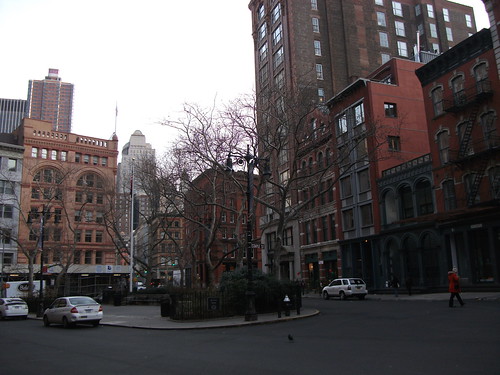
Duane Square, TriBeCa: not specifically cycle-friendly
- but not hostile either
But I probably shouldn’t have found the conditions surprising. While I have multiple complaints about cycling conditions in brownstone Brooklyn and Manhattan – the places where I currently mostly ride – and in London – where I used to ride – these are actually atypically cycle-friendly environments. Many roads are narrow – inhibiting drivers’ tendency to speed – and the traffic’s sheer volume makes the speeds on Staten Island mostly impossible. The obvious attractions in such an environment of the bicycle – which can slip along such streets while cars remain gnarled in traffic jams – have contributed to recent years’ rapid growth in inner-city cycling numbers. Better provision is slowly arriving in the wake of increased cycling.

Conditions on Staten Island are far more typical of the places that most rich countries’ inhabitants live. Such places provide most inhabitants with a house on its own plot of land – but suffer from the sheer volume of traffic that sprawling, low-density cities generate.  I’ve encountered similar conditions in parts of commuter-belt Oxfordshire, Cheshire and Scotland’s central belt. Cyclists tend not to give much thought to such places for the simple reason that very few cyclists live in them.

The natural reaction might be to conclude that cycling is impossible in such places, to avoid visiting them as far as possible and to leave the bicycle behind when circumstance forces one to do so. The only alternative is a wholesale rethink of the car’s role in such societies.

It’s often said that cycling children are a kind of “canary-in-the-coalmine” of cycling policy. If you disperse pretty much every danger factor for cyclists in your city, you’ll find primary school children riding to school. Let even a few of them creep back and the kids will disappear.

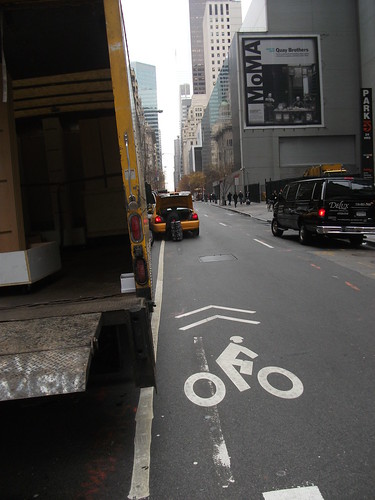
After his Staten Island visit, the Invisible
Visible Man will hardly complain in future
about scenes such as this in Manhattan.
By that standard, I’m closer to being the explosion in the coalmine. I regularly cycle along fairly busy, high-traffic roads, including fast-moving dual carriageways in the UK. If the danger factors somewhere have built up to the point somewhere that they’re intimidating me, it’s a reasonable sign cycling conditions are seriously, dangerously hostile.

I mostly managed in Staten Island to stick to the principle that a cyclist should boldly take the lane and force motorists to manoeuvre safely around him. But even I at points hugged closer to the kerb than normal, darting out into the threatening traffic mainly to get round obstructions such as parked cars. It felt hard to keep taking the lane on seeing a line of fast-moving SUVs, three abreast, bearing down on one, giving no sign whatever of yielding to a cyclist in front of them. I wasn’t confident I wanted to waste my dying breaths explaining to some over-sized car’s driver precisely why my road craft should have prevented him from running me over.

So is there an alternative for cyclists to the appalling conditions that currently exist in Staten Island and many other suburban areas? One standard cycling lobby answer is to argue that entirely separate cyclist provision is needed and that to call for anything less is counter-productive. Cyclists and such heavy, fast-moving traffic can never co-exist.

Yet I left Staten Island doubting that calls for a network of dedicated cycle lanes on Staten Island would get very far under current conditions. I saw, as far as I can recall, one other cyclist during an afternoon and early evening on the island. It’s hard to see that a democratic society can risk spending heavily to create facilities for a group – Staten Island utility cyclists – that might not even emerge in the end. That’s all the more the case at the moment, when my cycle route took me past large tracts of shoreline land that remained flooded and empty in the wake of Sandy’s devastation of the island. Even as a dedicated cyclist, I think finite budgets at the moment are best spent on ensuring all Staten Island’s people again have waterproof, heated houses.

There are nevertheless compelling reasons beyond encouraging cycling to stop the cancer of car-dependence from draining the life out of Staten Island. The wide, uncalmed roads, it was clear, were intimidating away people other than cyclists. I saw just as few people walking the sidewalks of the busiest roads as I saw people cycling. The excellent “weekly carnage”feature on Streetsblog, the transport website, features regular stories of Staten Island’s elderly and other vulnerable people crushed by motor vehicles refusing to yield at corners. Many of those fast-moving vehicles end up ploughing into each other, at a high human cost. There’s every reason even for someone who’s not a cyclist to support the installations of road designs that slow drivers down and speed cameras.

Ideally, the United States would increase fuel taxes to cover more of the costs cars impose on places such as Staten Island. A rational system of per-mile charging could calm down the worst of the congestion. Research suggests that cars might even get where they’re going faster under such a regime than they do at present.
Manhattan approaching, from the Staten Island ferry:
a welcome sight, from a cyclist's point of view

A new approach to cars would, of course, produce a better environment for on-road cycling too. It’s far from impossible that in Staten Island calmer, less threatening roads might start to entice out of their hiding places some of the bikes that must be lying unused in the borough’s homes. The island might start participating more fully in the cycling boom that’s taking place, to varying degrees, in New York’s other four boroughs. That, in turn, might make it easy to justify new cycle-only lanes for some future reporter who finds himself heading to a distant corner of Staten Island on an assignment.

As it was, finding dark had descended and contemplating the prospect of a 10½ mile ride on threatening roads back to the ferry, I took, unusually, the line of least resistance. Fending off threatening cars, I rode half a mile to the nearest Staten Island Railway Station and, my bike leaning against my seat, took in the island’s night-time lights as most of its inhabitants do – from within the comfort of a metal shell.