Showing posts with label midtown Manhattan. Show all posts

Sunday, 26 April 2015

A midtown mechanical, a Hudson River puncture - and how my bike gives me a superpower

As I wheeled my bike along 58th Street in midtown Manhattan in a heavy rain shower last Wednesday, I noticed a periodic scraping sound from the vicinity of my rear brakes. Realising that one of the brake pads was rubbing a slight bump in the wheel, I delved into one of my pannier bags, pulled out a multi-tool and set to work. I marginally tightened the left-hand brake calliper and loosened the right-hand one about the same. I was pleasantly surprised to hear the sound had stopped and that, when I started riding down Lexington Avenue, the brakes were working as well as they ever do in the slitheriness of a spring downpour.
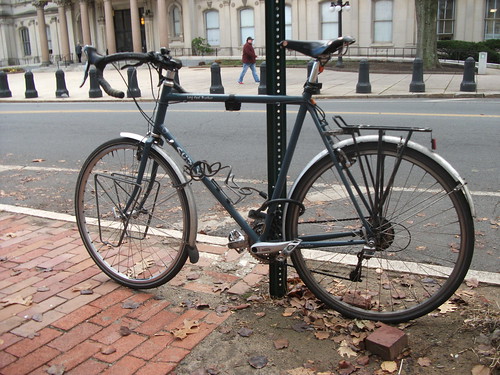
Shaped by 30,000 miles' riding: my Surly Long Haul Trucker
mediates many of my interactions with the world.

The incident made me realise how, even though I still regularly make comically silly mistakes when trying to maintain my bike, I’ve come to know its ways. My attempts to fix faults are growing steadily less disastrous. It also made me think, harder than I have for a while, about quite how intense and symbiotic the relationship between a regular cyclist and his or her main bike can be. My body has gradually shaped this bike – on which I’ve ridden about 30,000 miles over seven years – to fit its needs. I’ve steadily fitted tougher and tougher rear hubs after cheaper ones collapsed under the strain of hauling my tall, heavy body away from traffic lights. The bike, meanwhile, has shaped my body. My bulging leg muscles testify to hundreds of twice-daily climbs over the Brooklyn and Manhattan Bridges. If something on the bike changes - the brakes, say, are tightened - I find myself so used to how they used to be that it takes me some time to adjust my reactions.

My Phil Wood rear hub: a component so expensive one buys it
only after breaking every other brand available.
It’s because of this intense symbiosis, I think, that for many cyclists their main bike excites far greater passion than its status as a possession should suggest. A bike becomes one’s own more and more over time, much as a pair of shoes does. My Surly Long Haul Trucker probably shapes how I interact with the world more than any possession except my spectacles. It’s hardly surprising that, even more than dogs, bikes seem to start taking on an appearance similar to their owners’.

My midtown incident also, however, threw my mind back to the Thursday before Easter, when I encountered a High School student struggling with his bike on the Hudson River Greenway. He asked me to lend him a pump to inflate his obviously punctured rear tyre. Recognising that mere extra pumping wouldn’t get the young man all the way home to Williamsburg, I fixed the puncture for him. But I also felt grateful for the years of advice and training from my father, bike shop staff and fellow cyclists that ensure I’m never similarly forced to rely on the kindness of cycling strangers.

The downside, after all, of the elegant simplicity of a bicycle’s workings is that simple often isn’t self-explanatory. In an era when carmakers are warning customers that they shouldn’t on any account try to repair their vehicles because of the sophistication of their software and electronics, most bikes remain resolutely mechanical. They are still controlled by systems of levers and springs, actions balanced against equal and opposite reactions.
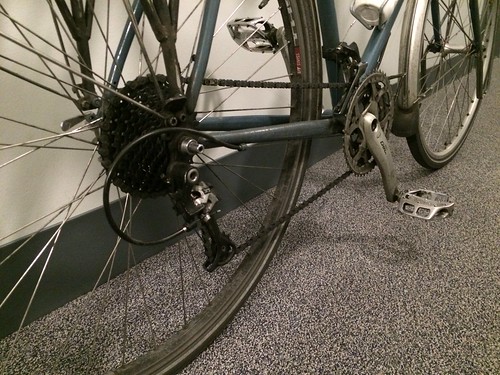
 
My bike's rear mechanism: action and reaction exemplified.
It requires some understanding of derailleur gears to grasp, however, that the cable for the rear sprockets needs to be tighter if the bike isn’t shifting easily onto the easiest gears. When I undertook my roadside repair last Wednesday, I was tensioning the spring in the left calliper and loosening the spring in the right one. I was using my knowledge and experience of how the two sides of the brakes push against each other.

It’s not only worth understanding these systems for purely practical reasons. There’s a poetry to the way a rear mechanism pushes a chain between the sprockets of a derailleur gear that is a powerful testimony to human ingenuity. It’s compelling evidence of how humans learn from their predecessors and make progress that I can now so easily adjust my brakes thanks to simple adjustment mechanisms. That was impossible with the bikes I owned 20 years ago.
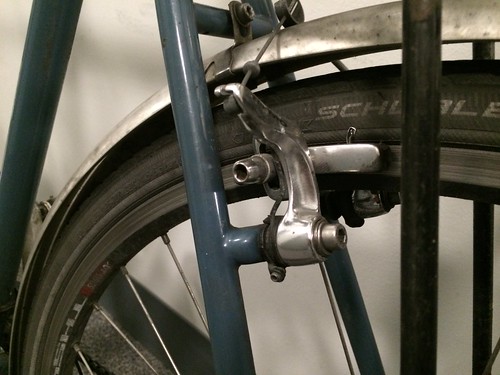
 
My once-troublesome rear brakes: a delicate counterpoise
of springs
The sheer range of different ways of making a bike work also testifies to the dazzling range of different things people seek to do with bikes. I ride a bike with plenty of gears and a solid frame because it fits with the relationship I want between my body and the bike. When I had bikes with harder-to-change gears, I used to get sore knees from pushing on the pedals in a less-than-efficient gear. I shift gears hundreds of times every journey now and my knees suffer no longer. The frame of one old, alloy bike broke under me. My steel frame has withstood the stresses of one crash with a car, another with another bike, huge loads of weekly shopping and transporting, at different times, both my children. I marvel at how smoothly the steel frame copes with corners, removing the sense that I’m wrestling with the bike to get it to turn.

The range of different balances between body and bike came home to me on Saturday night when the Invisible Visible family and I headed the short distance from our apartment to the Red Hook Criterium, a cycling road race near our apartment. The race compels riders to use track bikes – light, brakeless and with fixed wheels – rather than more conventional, multi-geared road bikes. The trade-off was plain. The event teemed with cyclists with leaner, stronger, more efficient bodies than mine, honed to handle the rigours of a far less forgiving bike. We watched awestruck as these hyper-fit riders and their stripped-down machines negotiated the 1.25km circuit, ticking off some laps in less than 90 seconds and swishing by us at well over 60kph.
 
Crit riders warm up: a subtly different balance between body
and bicycle from mine
I’ll never zip round a track like these fit young men. Nor will I ever dance up Alpe d’Huez like Chris Froome, except in my imagination. But there is a similar satisfaction in the relationship between our bodies and the machines. For the Criterium riders, Tour de France participants and me, the bicycle magnifies our bodies’ efforts. For the Criterium riders, it was a question of a carbon frame's coping with the strain both of rapid acceleration and of being slowed down for a corner only through the rider’s resistance against the pedals’ spinning. My bike has to absorb the shock of a hidden pothole then let me skip swiftly away from the next traffic lights while the drivers are still looking at their smartphones.
Riders fly by at the Red Hook Crit: yes, it's entirely different
from my cycling but, yes, their bikes offer similar joys.

Even for me, being on a bike can resemble being in possession of a superpower. On an empty, flat road, it can feel when I slip the chain onto the biggest, fastest chainring as if I’m Mr Scott pushing the button to send the Starship Enterprise into warp drive. A range of new, higher speeds is suddenly at my command and my speed surges. As I labour up steep hills, meanwhile, I reach the lower limits of the lowest gears on my middle chainring. Then I feel a little surge of joy as I switch down to my smallest chainring, pedalling grows easier and nearly any slope is within my reach.

It’s on the offchance that I’ll enjoy such a feeling that I ride to work when I can even on days when the water in my bottle freezes on the way to work – and on days so hot the whole city stinks. Maybe in time the same feeling will inspire the young man I helped to persevere with cycling rather than giving up in frustration. I'd love to think that one day he'd join me among a fairly small minority of New Yorkers - the ones who, faced with rain and a faulty bike, say not, “Let’s take the subway,” but, “Where in my bag is that multi-tool?”

Sunday, 27 April 2014

A stunning view, a midtown ride - and why speed is as much the problem as space

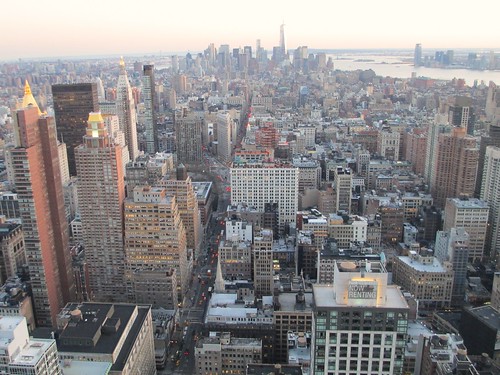
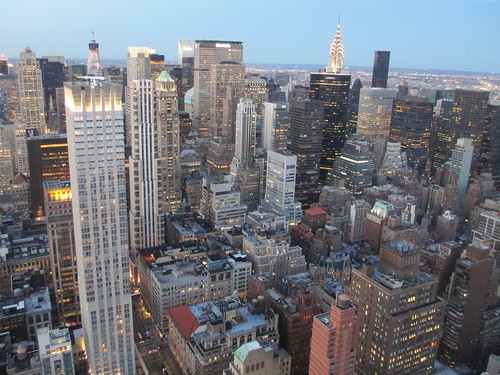
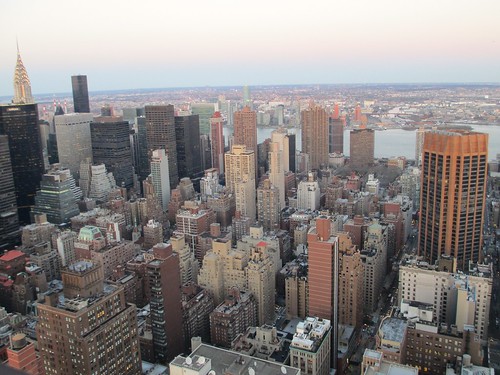
The Wednesday before Easter, thanks to a press event for a company I cover, I had my first chance since moving permanently to New York to go up the Empire State Building. Yet, as I gazed out from the 58th floor, I found myself struck by something other than the extraordinary forest of skyscrapers crowded, like trees straining towards the light, in midtown Manhattan. Looking south, it was clear how the forest canopy seemed to lower around Greenwich Village, SoHo and the Lower East Side into a less dense area of undergrowth or bush. It then rose again at the final, dense clump in the Financial District, teetering on Manhattan’s lower edge.
The Greenwich Village dip, seen from the midtown jungle
Midtown's skyscrapers: the lack of a "cyclists welcome"
sign, I'd suggest, is no coincidence

The view came to my mind the next day when I had to return to midtown for a television appearance at Fox News’ studios on Sixth Avenue. I rode up the Hudson River Greenway as far as 48th street. Then I started pedalling across town into the forest on which I’d been looking down the night before. The deeper I cycled into the mid-skyscraper canyon, the worse conditions became. I was constantly navigating around jammed-up traffic and dodging sites where workers were fixing pipes and cables. I was left wondering if, efficient though they can be, the densest parts of very dense cities such as New York are doomed to be fundamentally problematic places for human-powered transport.

The question’s relevant because many cities around the world are trying to accommodate their expanding population not, as New York City did for much of the 20th century, by sprawling outwards, but by becoming denser. There are calls for London to build new, higher buildings to absorb its growth. There is a similar movement in many parts of North America. It’s easier, so the thinking goes, to serve dense cities with public transport, since more journeys’ starting and end points can be an easy stroll from a station or bus stop. Wouldn’t it be ironic, I thought to myself, if such a movement – intended to make cities more environmentally friendly – made them worse for the bicycle, the most environmentally-friendly transport mode?
 
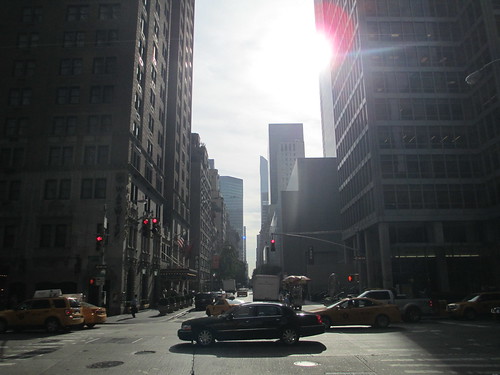
54th St, midtown. Look on this canyon, cyclists, and
at least consider despair.
It’s certainly tempting as one grapples with the reality of riding in midtown Manhattan – as I used to every day before my office moved downtown – to flirt with the idea that it’s a lost cause. The area crams into densities that in many cities would be associated with slums and squalor a mixture of high-end housing and offices teeming with some of the world’s best-paid professionals. No-one has the space or inclination to undertake a vast range of everyday activities but most have the money to pay to have them done. A stream of dry cleaners, express parcel services and food delivery cyclists consequently flows to and from the area’s offices and apartment complexes, giving the area the feel of being some vast apartment hotel crossed with a serviced office.

Since many of the best-off people feel themselves too important or fancy themselves in too much of a hurry to head into the subway, taxis and limousines buzz constantly around the doorways. The business of supplying food for the millions who swarm the area on a weekday would alone be enough to create a substantial traffic jam. The same goes for the business of keeping the people’s water, electricity, gas, sewage, hot water, internet, cable television and other services running smoothly. Almost none of the people engaged in the stressful business of meeting the area’s needs seems willing to take cyclists’ needs into account alongside the multiple other pressures they face. Cycling can be a slow, stressful business of zig-zagging around double-parked delivery vans, slipping past the edges of traffic jams and swerving to avoid the woman who leaps into the cycle lane to hail a taxi.
 
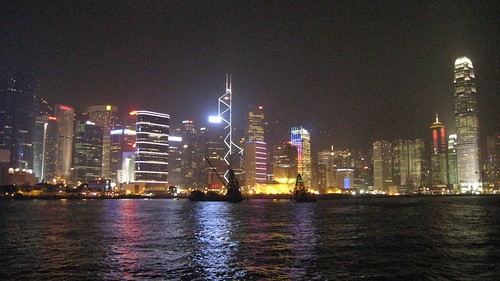
Hong Kong wasn't built specifically to make people feel
optimistic about cycling in midtown Manhattan. But
it serves the purpose very well
The intimidating atmosphere reminds me how I quailed, when it looked as if I might get a job in Hong Kong, at the thought of cycling there. Hong Kong has twice New York’s population density. I started to wonder if it might be London’s lower density – half New York’s level – that makes it generally an easier (if still severely flawed) place to cycle on-street.

Yet an incident later the day I appeared on Fox made me ponder how far space and density really were the problem. I cycled after work to Brooklyn to participate in a Maundy Thursday church service and headed off home afterwards down Garfield Place in Park Slope. I sped down the street, between rows of parked cars, at over 20mph, riding in the middle of the lane for fear a still-faster car would try to pass me. Sure enough, after a couple of blocks I noticed a Jeep Grand Cherokee close behind me, its driver clearly trying to barge me out of the way. I found myself, not for the first time, terrified of being hit from behind if I made a mistake but fearful also that, if I slowed down to pull out of the way, the driver would hit me before I was out of the way.
 
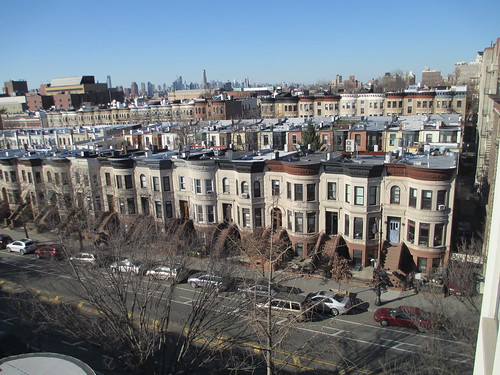
Park Slope: less dense, still speed-plagued
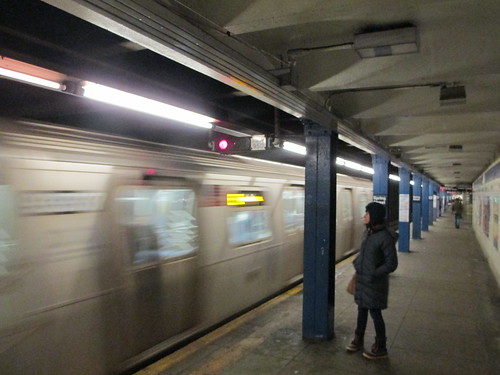
The New York City subway: speed, packaged and hidden away
I realised, instinctively, that the problem was less one of space and more one of speed. I am far happier to have a vehicle pass me on a narrow street at a reasonable speed because the scope for disaster, the room needed to correct a mistake, is so much smaller. I won’t let someone intent on breaking the speed limit on a narrow residential street pass me, because his speed has eaten up the room for error around his vehicle. We discussed some of these issues and a few more – including when he might learn to drive safely since he clearly didn’t know at present – at a red traffic light at Garfield and 5th Avenue.

When I factored speed into midtown conditions, I suddenly saw them in a very different light. The problem wasn’t so much, I realised, that there were so many delivery trucks and other commercial vehicles (although it wouldn’t hurt to switch some of these deliveries to cargo bikes). The problem was that those slow-moving vehicles had to stop every cross-town block to accommodate lines of vehicles sweeping up and down the avenues. I suddenly had a vision of a fast-moving taxi as taking up twice or three times its own road space as one that was stationary. The genius of the New York subway and other urban metro systems struck me. They take the problem of moving people fast – and consequently with lots of space around their vehicles – pack the people into space-efficient vehicles and bury the speed problem below the streets.

Beyond midtown east, out stretches low-rise Queens
Looked at it in that context, it becomes clearer that the real problem in New York lies not in midtown but in the low-rise areas I could see from the Empire State Building, stretching away towards the horizon. In New York and London – and even more so in many other big cities like Los Angeles and Houston – those distant suburbs were built with very little public transport provision. The only realistic way to get about, many residents feel, is to use a motor vehicle. To overcome their distance from the centre, the only way is to drive them fast. To cater to them, cities have built vast, space-eating high-speed roads. A significant part of midtown’s traffic problem is made up of people who drive all the way from those suburbs to work in the city centre.

The sheer unpleasantness of the world that way of living has created came home to me this Saturday as I cycled to meet my family for a day trip to the beach at Coney Island, on the edge of Brooklyn’s low-density sprawl. To cover the last stretch from a harbour-side cycle path to the beach, the marked cycle route heads onto Cropsey Avenue, a terrifying six lanes of suburban automotive culture full of vehicles seeking to drive at 40mph or faster. Far from taking the lane to tame these barrelling lumps of high-speed steel, I found myself letting my fear get the better of me. I cowered - as I once did when cycling in Staten Island - in side streets at each intersection, waited for the herd of charging cars to sweep past. Then I pedalled off after them as fast as I could, hoping to outrun the next charge.At the corner of Cropsey Avenue and Neptune Avenue - a few yards from the Invisible Visible Girl’s school – I shouted at motorists turning fast through a crossing where a man and his daughter were struggling to cross the street.
It's invidious to claim one's city has the worst cycle facility
anywhere. But is there a part of your city's cycle network
quite as grim as Cropsey Avenue?

It remains a stressful and forbidding experience to cycle in the heart of midtown Manhattan and in the densest parts of many other cities worldwide. Although I know space-efficient bicycles have many advantages as a means of urban transport, I don’t know precisely how I’d carve out space on the streets of midtown – or, come to that, the City of London or Hong Kong – to encourage people less hardened than I to cycle.

But, following Saturday’s experience, I feel confident on one point. While W48th St might be chaotic and stressful, it could yet become a healthy, functioning urban space. I’m far less confident the same can be said for Cropsey Avenue.