The Wednesday before Easter, thanks to a press event for a
company I cover, I had my first chance since moving permanently to New York to go up the Empire State
Building Manhattan .
Looking south, it was clear how the forest canopy seemed to lower around
Greenwich Village, SoHo and the Lower East Side
into a less dense area of undergrowth or bush. It then rose again at the final,
dense clump in the Financial District, teetering on Manhattan ’s lower edge.
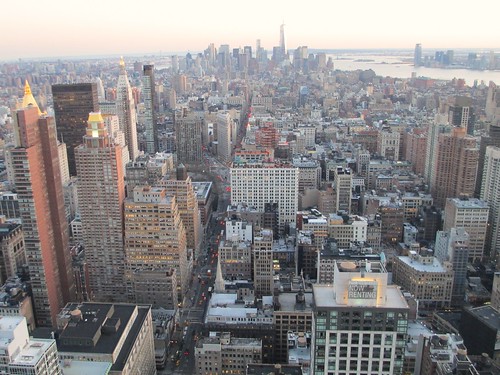 |
| The Greenwich Village dip, seen from the midtown jungle |
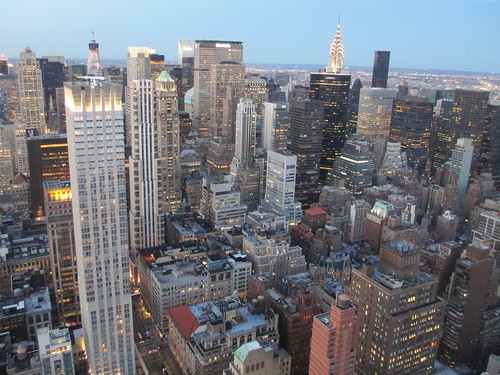 |
| Midtown's skyscrapers: the lack of a "cyclists welcome" sign, I'd suggest, is no coincidence |
The view came to my mind the next day when I had to return
to midtown for a television appearance at Fox News’ studios on Sixth Avenue . I
rode up the Hudson River Greenway as far as 48th street . Then I started pedalling across town into the forest on which I’d been
looking down the night before. The deeper I cycled into the mid-skyscraper
canyon, the worse conditions became. I was constantly navigating around
jammed-up traffic and dodging sites where workers were fixing pipes and cables.
I was left wondering if, efficient though they can be, the densest parts of
very dense cities such as New York
are doomed to be fundamentally problematic places for human-powered transport.
The question’s relevant because many cities around the world
are trying to accommodate their expanding population not, as New York City did for much of the 20th century, by sprawling outwards, but by becoming
denser. There are calls for London
to build new, higher buildings to absorb its growth. There is a similar
movement in many parts of North America . It’s
easier, so the thinking goes, to serve dense cities with public transport,
since more journeys’ starting and end points can be an easy stroll from a
station or bus stop. Wouldn’t it be ironic, I thought to myself, if such a
movement – intended to make cities more environmentally friendly – made them worse for the bicycle, the most environmentally-friendly transport mode?
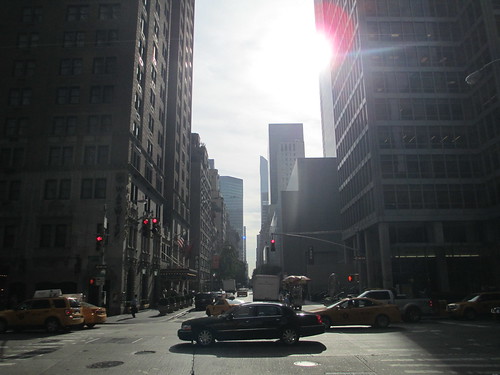 |
| 54th St, midtown. Look on this canyon, cyclists, and at least consider despair. |
It’s certainly tempting as one grapples with the reality of
riding in midtown Manhattan
– as I used to every day before my office moved downtown – to flirt with the
idea that it’s a lost cause. The area crams into densities that in many cities
would be associated with slums and squalor a mixture of high-end housing and offices
teeming with some of the world’s best-paid professionals. No-one has the space
or inclination to undertake a vast range of everyday activities but most have
the money to pay to have them done. A stream of dry cleaners, express parcel
services and food delivery cyclists consequently flows to and from the area’s
offices and apartment complexes, giving the area the feel of being some vast apartment
hotel crossed with a serviced office.
Since many of the best-off people feel themselves too
important or fancy themselves in too much of a hurry to head into the subway,
taxis and limousines buzz constantly around the doorways. The business of supplying
food for the millions who swarm the area on a weekday would alone be enough to
create a substantial traffic jam. The same goes for the business of keeping the
people’s water, electricity, gas, sewage, hot water, internet, cable television
and other services running smoothly. Almost none of the people engaged in the
stressful business of meeting the area’s needs seems willing to take cyclists’
needs into account alongside the multiple other pressures they face. Cycling
can be a slow, stressful business of zig-zagging around double-parked delivery
vans, slipping past the edges of traffic jams and swerving to avoid the woman
who leaps into the cycle lane to hail a taxi.
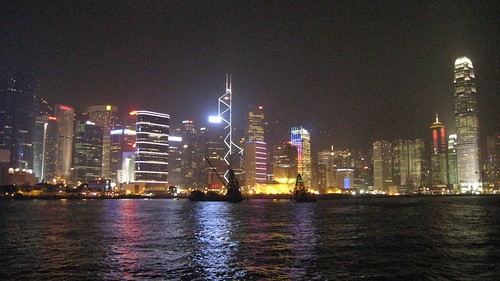 |
| Hong Kong wasn't built specifically to make people feel optimistic about cycling in midtown Manhattan. But it serves the purpose very well |
The intimidating atmosphere reminds me how I quailed, when
it looked as if I might get a job in Hong Kong ,
at the thought of cycling there. Hong Kong has twice New York ’s population density. I started to
wonder if it might be London ’s lower density –
half New York ’s
level – that makes it generally an easier (if still severely flawed) place to
cycle on-street.
Yet an incident later the day I appeared on Fox made me
ponder how far space and density really were the problem. I cycled after work
to Brooklyn to participate in a Maundy
Thursday church service and headed off home afterwards down Garfield Place in Park Slope. I sped down
the street, between rows of parked cars, at over 20mph, riding in the middle of
the lane for fear a still-faster car would try to pass me. Sure enough, after a
couple of blocks I noticed a Jeep Grand Cherokee close behind me, its driver
clearly trying to barge me out of the way. I found myself, not for the first time, terrified of being hit from behind if I made a mistake but fearful also
that, if I slowed down to pull out of the way, the driver would hit me before I was out of the way.
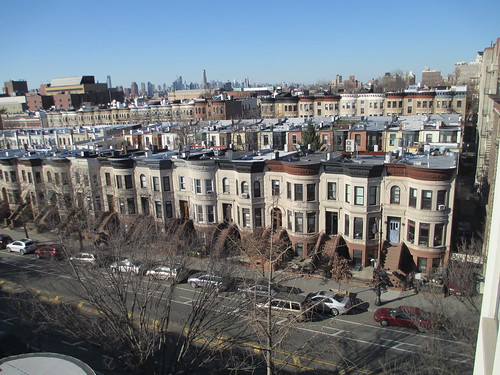 |
| Park Slope: less dense, still speed-plagued |
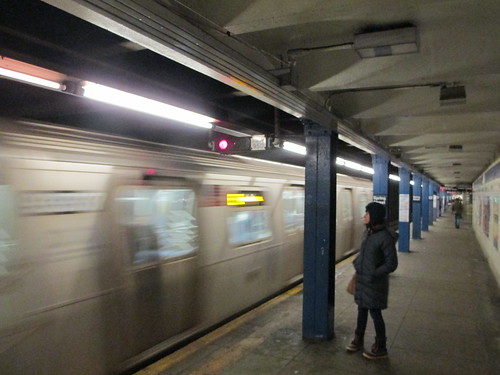 |
| The New York City subway: speed, packaged and hidden away |
When I factored speed into midtown conditions, I suddenly
saw them in a very different light. The problem wasn’t so much, I realised,
that there were so many delivery trucks and other commercial vehicles (although
it wouldn’t hurt to switch some of these deliveries to cargo bikes). The
problem was that those slow-moving vehicles had to stop every cross-town block
to accommodate lines of vehicles sweeping up and down the avenues. I suddenly
had a vision of a fast-moving taxi as taking up twice or three times its own
road space as one that was stationary. The genius of the New York subway and other urban metro systems
struck me. They take the problem of moving people fast – and consequently with
lots of space around their vehicles – pack the people into space-efficient
vehicles and bury the speed problem below the streets.
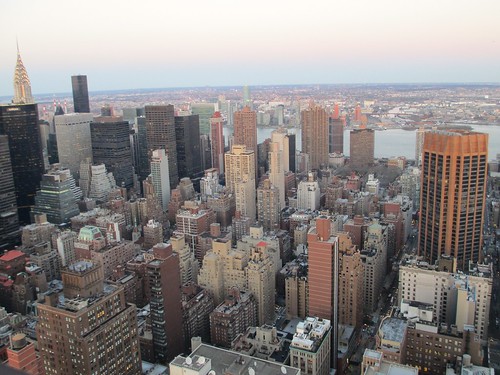 |
| Beyond midtown east, out stretches low-rise Queens |
The sheer unpleasantness of the world that way of living has
created came home to me this Saturday as I cycled to meet my family for a day
trip to the beach at Coney Island, on the edge of Brooklyn ’s
low-density sprawl. To cover the last stretch from a harbour-side cycle path to
the beach, the marked cycle route heads onto Cropsey Avenue , a terrifying six lanes of
suburban automotive culture full of vehicles seeking to drive at 40mph or
faster. Far from taking the lane to tame these barrelling lumps of high-speed
steel, I found myself letting my fear get the better of me. I
cowered - as I once did when cycling in Staten Island - in side streets at each intersection, waited for the herd of charging
cars to sweep past. Then I pedalled off after them as fast as I could, hoping to
outrun the next charge.At the corner of Cropsey Avenue Neptune Avenue -
 |
| It's invidious to claim one's city has the worst cycle facility anywhere. But is there a part of your city's cycle network quite as grim as Cropsey Avenue? |
It remains a stressful and forbidding experience to cycle in
the heart of midtown Manhattan
and in the densest parts of many other cities worldwide. Although I know
space-efficient bicycles have many advantages as a means of urban transport, I
don’t know precisely how I’d carve out space on the streets of midtown – or,
come to that, the City of London or Hong Kong – to encourage people less hardened than I to
cycle.
But, following Saturday’s experience, I feel confident on
one point. While W48th St Cropsey Avenue
