It
was a brief taste of how most of suburban America and Europe lives and it wasn’t, frankly, terribly
pleasant. This past Wednesday, for work reasons, I took my bike and, for only
the second time in my life, travelled by ferry to Staten Island, an island off
the New Jersey shore that historical
accident has made part of New
York City Verrazano Narrows road bridge to Brooklyn ,
it was designed around the private car far more than other parts of the city.
It’s the nearest thing in New
York City
 |
| A shared cycle route marking in St George: much the likeliest way to see a bike on the road in Staten Island |
I
began to have concerns about cycling conditions even before I was properly out
of St George, the borough’s capital. A bus driver drove at me, apparently
astonished that my being ahead of him in traffic meant I thought I should go
first through a pinch point. Later on, I started to wonder if I had put myself
in serious danger. Unable to use the seafront cycle path – still blocked with
sand from Superstorm Sandy – I headed inland along long, straight six-lane
avenues. The 30mph and 35mph speed limits on these roads seemed to be regarded
as minimum permissible speeds. Encountering a cyclist, such drivers simply
drove straight on, at speed, towards the bike, on the apparent assumption the
cyclist would scuttle out of the way.
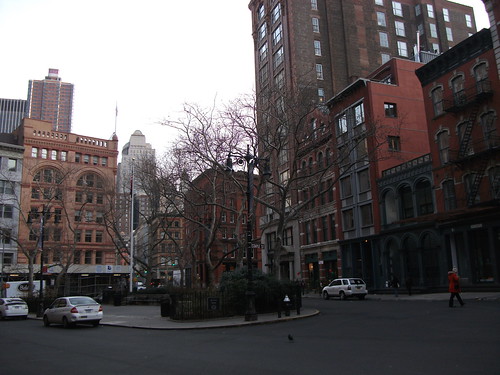 |
| Duane Square, TriBeCa: not specifically cycle-friendly - but not hostile either |
But
I probably shouldn’t have found the conditions surprising. While I have multiple complaints about cycling conditions in brownstone Brooklyn and Manhattan – the places where I currently mostly ride
– and in London Staten
Island mostly impossible. The obvious attractions in such an
environment of the bicycle – which can slip along such streets while cars
remain gnarled in traffic jams – have contributed to recent years’ rapid growth
in inner-city cycling numbers. Better provision is slowly arriving in the wake
of increased cycling.
Conditions
on Staten Island are far more
typical of the places that most rich countries’ inhabitants live. Such places
provide most inhabitants with a house on its own plot of land – but suffer from
the sheer volume of traffic that sprawling, low-density cities generate.
I’ve encountered similar conditions in parts of commuter-belt
Oxfordshire, Cheshire and Scotland
The
natural reaction might be to conclude that cycling is impossible in such
places, to avoid visiting them as far as possible and to leave the bicycle
behind when circumstance forces one to do so. The only alternative is a
wholesale rethink of the car’s role in such societies.
It’s
often said that cycling children are a kind of “canary-in-the-coalmine” of
cycling policy. If you disperse pretty much every danger factor for cyclists in
your city, you’ll find primary school children riding to school. Let even a few
of them creep back and the kids will disappear.
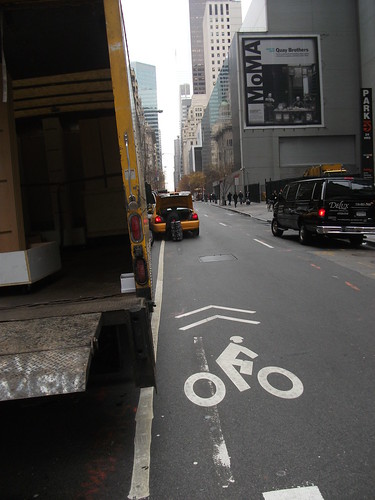 |
| After his Staten Island visit, the Invisible Visible Man will hardly complain in future about scenes such as this in Manhattan. |
By
that standard, I’m closer to being the explosion in the coalmine. I regularly
cycle along fairly busy, high-traffic roads, including fast-moving dual
carriageways in the UK
I
mostly managed in Staten Island to
stick to the principle that a cyclist should boldly take the lane and force
motorists to manoeuvre safely around him. But even I at points hugged closer to
the kerb than normal, darting out into the threatening traffic mainly to get
round obstructions such as parked cars. It felt hard to keep taking the lane on
seeing a line of fast-moving SUVs, three abreast, bearing down on one, giving
no sign whatever of yielding to a cyclist in front of them. I wasn’t confident
I wanted to waste my dying breaths explaining to some over-sized car’s driver
precisely why my road craft should have prevented him from running me over.
So
is there an alternative for cyclists to the appalling conditions that currently
exist in Staten Island and many
other suburban areas? One standard cycling lobby answer is to argue that
entirely separate cyclist provision is needed and that to call for anything
less is counter-productive. Cyclists and such heavy, fast-moving traffic can
never co-exist.
Yet
I left Staten Island doubting that calls for a network of dedicated cycle lanes
on Staten Island would get very far
under current conditions. I saw, as far as I can recall, one other cyclist
during an afternoon and early evening on the island. It’s hard to see that a
democratic society can risk spending heavily to create facilities for a group
– Staten Island utility cyclists –
that might not even emerge in the end. That’s all the more the case at the
moment, when my cycle route took me past large tracts of shoreline land that
remained flooded and empty in the wake of Sandy’s devastation of the island.
Even as a dedicated cyclist, I think finite budgets at the moment are best
spent on ensuring all Staten Island ’s
people again have waterproof, heated houses.
There
are nevertheless compelling reasons beyond encouraging cycling to stop the
cancer of car-dependence from draining the life out of Staten
Island . The wide, uncalmed roads, it was clear, were intimidating
away people other than cyclists. I saw just as few people walking the sidewalks
of the busiest roads as I saw people cycling. The excellent “weekly carnage”feature on Streetsblog, the transport website, features regular stories
of Staten Island ’s elderly and other
vulnerable people crushed by motor vehicles refusing to yield at corners. Many
of those fast-moving vehicles end up ploughing into each other, at a high human
cost. There’s every reason even for someone who’s not a cyclist to support the
installations of road designs that slow drivers down and speed cameras.
Ideally,
the United States would
increase fuel taxes to cover more of the costs cars impose on places such
as Staten Island . A rational system of per-mile charging could calm down the worst of the congestion. Research
suggests that cars might even get where they’re going faster under such a
regime than they do at present.
 |
| Manhattan approaching, from the Staten Island ferry: a welcome sight, from a cyclist's point of view |
A
new approach to cars would, of course, produce a better environment for on-road
cycling too. It’s far from impossible that in Staten
Island calmer, less threatening roads might start to entice
out of their hiding places some of the bikes that must be lying unused in the
borough’s homes. The island might start participating more fully in the cycling
boom that’s taking place, to varying degrees, in New York’s other four
boroughs. That, in turn, might make it easy to justify new cycle-only lanes for
some future reporter who finds himself heading to a distant corner of Staten Island on an assignment.
As
it was, finding dark had descended and contemplating the prospect of a 10½ mile
ride on threatening roads back to the ferry, I took, unusually, the line of
least resistance. Fending off threatening cars, I rode half a mile to the
nearest Staten Island Railway Station and, my bike leaning against my seat,
took in the island’s night-time lights as most of its inhabitants do – from
within the comfort of a metal shell.
