Showing posts with label cars. Show all posts

Friday, 20 March 2015

Barging in TriBeCa, a Top Gear boor - and why I'm proud to be a Roundhead worrywart

It was one morning at the end of January in TriBeCa that I encountered the very personification of motorist arrogance. As I rode down a single block of Reade St that was still mostly clogged with snow, I used the middle of the lane to signal that there was no room to pass me safely. But a block of driving more slowly was unthinkable for a driver who was approaching me from behind in his Lexus SUV. He first leant on his horn to try to bully me out of the way then swerved into the parking lane and passed me close and fast on my right.

“What the hell is wrong with you?” I screamed at him as I, inevitably, caught up with him at the next traffic lights. “There was a bike lane!” he yelled back as though that were some kind of explanation. “It was full of snow,” I screamed back.
A Brooklyn bike lane after one recent snowfall. The angry
Lexus driver of TriBeCa wants me to ride in such lanes
and get myself out of his way.

The driver was one of the scores, possibly hundreds, I’ve encountered over more than two decades of urban cycling whose anger at my presence on the road went far beyond what any actual hold-up or inconvenience at my being on the road might justify. My making a different transport choice seemed to present an existential affront.

The tendency would exist, I’m sure, without Top Gear, the BBC-made show that presents such motorist arrogance as entertaining, clever and part of the natural order of things. But the show, which is syndicated or remade in nearly every country around the world, gives such views far more legitimacy than they would otherwise enjoy. Any number of mind-numbing cable shows and irresponsible adverts feed similar thinking among many US motorists.
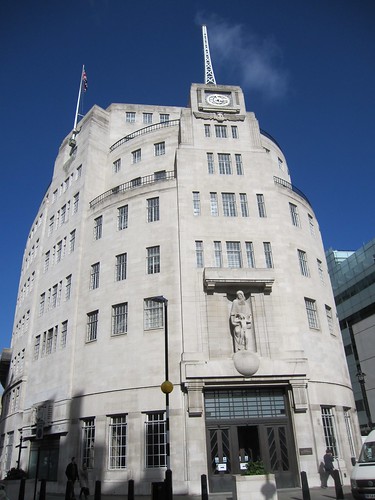
Broadcasting House: who wouldn't make their
point by driving an armoured vehicle here?
I’ve consequently found it depressing how much support Jeremy Clarkson, Top Gear’s star and chief boor, has attracted since he was suspended on March 10 from work on the show after a “fracas” – a British way of saying he apparently punched a producer. A petition demanding his reinstatement – started by Guido Fawkes, a political blog – attracted nearly 1m signatures. It was, tastefully, delivered to the BBC’s Broadcasting House in a tracked armoured vehicle. Clarkson’s suspension seems as much of a threat to some people’s sense of themselves as my cycling in the middle of the road was to the driver of the Lexus SUV.

But a row I had on Facebook with a friend of an old school friend has crystallised in my mind the nature of what’s going on. The role of the motor car appears, for better or worse, to be part of a cultural battle in many industrialised societies.

The Top Gear tendency among motorists is, it seems to me, part of a wider conservative predilection for accepting certain established social facts – including the motor car’s dominant role - as so inevitable that it’s eccentric even to question them. Top Gear seeks to celebrate the joys for those who already have power of exercising it.

 From such a worldview, naturally, people who question the established way of doing things are apt to look like joyless worrywarts. If one can’t see why it’s worth questioning the promotion of high-speed motor vehicles for use in urban environments, it must be frustrating to see people like me poring over statistics and presenting philosophical arguments for change.

The division looks a lot like the classic one that has run through much British politics for centuries and is replicated in many other English-speaking societies. On one side stand care-free conservative bon-vivants, the Cavaliers. On the other are puritanical, uptight progressives, the Roundheads. Society’s overall view of the two sides probably remains much as the two sides in the English Civil War are described in the satirical history 1066 and All That. The Cavaliers are “Wrong but Wromantic,” while the Roundheads are “Right but Repulsive.”
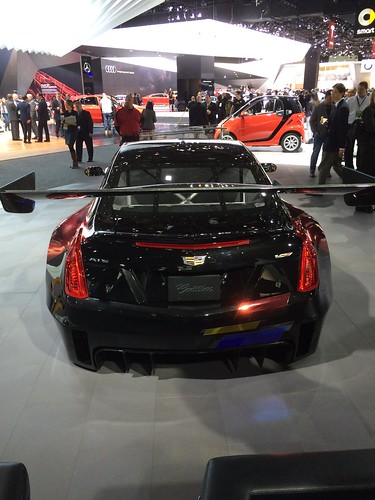
A Cadillac ATS at the Detroit Auto Show:
people like me seem like joyless prudes
if we suggest this maybe isn't an ideal urban car.
I stumbled into the Clarkson discussion by agreeing with an old friend who had commented that Clarkson was “beyond ghastly” in another friend’s post about his suspension. I expressed the hope that the producer – whom Clarkson appears to have hit because a hotel wouldn’t provide him with hot food late at night – had excellent legal representation. I would have left it there had not a third person – whom I don’t personally know – chimed in with a rebuke.

“He is a legend...someone who can laugh at himself and others,” the poster wrote of Clarkson. “Some people have had humour bypass surgery.”

An ironic, amused detachment from events is such a critical attribute for a British man that this was, of course, a serious charge.

So I went on to list some of the many recent controversies surrounding Clarkson and inquire where the joke in them was.  Last year, for example, he was recorded using the word “nigger” – a profoundly offensive racial slur – during taping of Top Gear. In 2011, he denigrated Mexicans as “lazy, feckless, flatulent [and] overweight.” In 2009 he described Gordon Brown, the then UK prime minister who lost an eye in childhood, as a “one-eyed Scottish idiot”.

The jokes are funny only if one presupposes that people’s being different from oneself is inherently funny. They assume, variously, that it’s intrinsically funny to use a racial slur; that some people belong to a different culture from one’s own; that some people have a disability; or that some people are from a less powerful bit of one’s own country. I suggested that Clarkson was indulging in the lazy humour of the school bully, mocking weakness and difference to denigrate them.

My reaction then became part of the joke.

“It is funny, isn’t it – especially the reaction,” the poster replied, with problematic punctuation.

It’s probably easier, however, to recognise the problems with Clarkson’s attitudes if one’s dealing daily with the boorish driving that he and like-minded people, like the worst Daily News and New York Post columnists, endorse. An encomium to the joy of a high-powered vehicle seems less entertaining if one’s just been buzzed by a muscle car with tinted windows on an urban street. Top Gear’s admonishment to cyclists to learn the difference between red and green traffic lights looks less self-evidently side-splitting if one regularly sees motorists speeding at 40mph down residential streets.

The Cavalier driver speeding and jumping lights probably feels free to do so because driving feels to him or her like a private matter. We Roundheads on the outside tend to suck our teeth and worry about how driving on a street means taking part in a complex social transaction. At high speeds one has far less scope to adjust to how other people act - and a far greater chance of harming them.
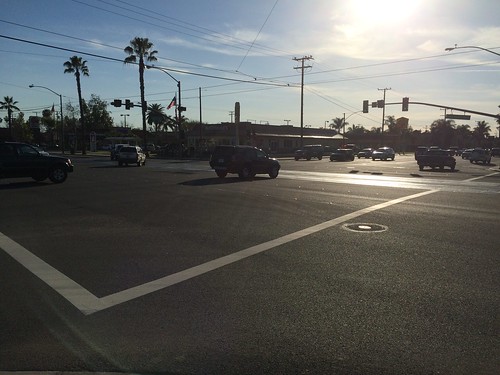
 
A crossroads in Long Beach, California, suggests to me that
car-dominated spaces can have drawbacks - which probably
makes me a joyless worrywart. 
The heavy use of cars in cities presents real moral dilemmas. It’s vital that people who want to think seriously about that aren’t mocked into silence by boors.

Yet I’ve concluded from the Clarkson episode, my Facebook argument about it and countless other expressions of support for inconsiderate driving that there’s an asymmetric battle under way. Advocates for change often earnestly wheel out studies and campaigns as if it were enough to have a better case and better arguments. There are, however, millions of people for whom even the notion of a serious discussion about such matters seems to be beside the point. The first battle has to be against the very assumption that any effort to change or examine the current state of affairs is absurd in itself.

The Clarkson episode is also further proof that what people think and say are closely linked to how they actually act. While Clarkson is often defended as a harmless japester, there has long been a singularly nasty whiff around his behaviour. In January 2014, for example, he tweeted a picture of a cyclist on the narrow backstreets of Chelsea, West London, taking the lane and commented how it was “middle-of-the-road pointmakers like this” who made drivers so angry with cyclists. A person claiming to be the cyclist – who was riding absolutely correctly given the nature of the streets – later claimed that Clarkson forced him off the road by passing when there was insufficient room.

The incident that provoked the latest controversy, meanwhile, apparently involved an angry confrontation. Many accounts suggest that Clarkson called Oisin Tymon, the producer, a “lazy Irish c***” and punched him, splitting his lip. That would suggest a still darker side to Clarkson’s enthusiasm for xenophobic slurs, although he seems to deny either speaking xenophobically or punching the producer.

The most important lesson, finally, may be that large numbers of people are nasty, callous and lack a moral compass. Oisin Tymon appears at the very least to have been badly bullied at work by a far more powerful individual. He may also have been subject to slurs on his ethnicity and an assault that resulted in his going to hospital for his injuries. The response of nearly a million people in the UK to this has been to demand that the perpetrator be allowed unconditionally to return to his job. A significant minority has added to the victim’s suffering by abusing him online. A glance at any online US media report about the death of a cyclist will confirm there’s no shortage of similar scorn for weaker road users on the Atlantic’s western shore.

If that’s what it looks like to be wrong but wromantic in 2015, I’m more willing than ever to accept being repulsive but right.

Update, March 25:
The BBC has decided - using unfortunately mealy-mouthed language - not to renew Jeremy Clarkson's contract. An internal investigation found that he harangued Oisin Tymon for a prolonged period and assaulted him for 30 seconds. Thinking he had lost his job as a result of Clarkson's anger, he drove himself to hospital. The BBC's report and the decision to suspend Clarkson's contract has had the predictable - but depressing - effect of making many of Clarkson's fans furious with Clarkson's victim.

Sunday, 14 April 2013

A broken-down church - and a broken, asymmetric flow of information

I was only a little way into my first ride to work after moving into my apartment in Brooklyn when I started to get into a terrible tangle. Trying to get down Kane Street, in Cobble Hill, I found the road marked closed. After heading past the road cones, I found it was a proper road closure, not the kind where one just wheels the bike on the sidewalk past the obstruction. The closure was absurd, I muttered to myself, as the one-way system pushed my route further and further from the one I’d planned. It was, I reasoned, probably some piece of stupidity on the part of the police, worried about being sued over an unlikely accident near some relatively innocuous building work.
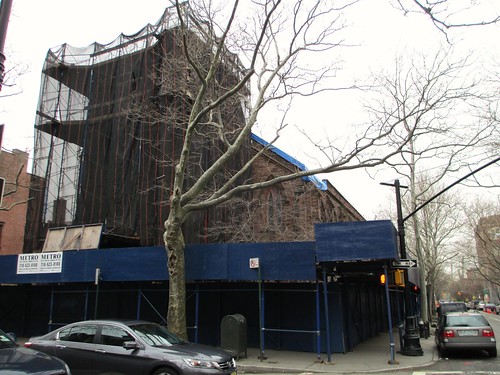
Christ Church, Cobble Hill: source of frustration on
the Invisible Visible Man's commute

I calmed down considerably, however, after finding out via Google why the street was closed. On July 26, while I had been back in Europe, lightning had struck Christ Church, the Episcopal church at the junction of Clinton Street and Kane Street. The spectacular tower – and scaffolding around it – had come crashing down as Richard Schwartz, a pedestrian, was walking underneath. The falling scaffolding had killed him. The building was a serious danger – and hadn’t yet been made safe.

The incident helped to crystallise an idea that had been slopping in fluid form around my mind for a while. I’d never have been irritated about the Kane St closure, I realised, if I’d had better information in the first place. It was, it occurred to me, one of many instances where confusion arises because two different parties – the New York City Department of Transportation and myself, in the Kane Street case – have different understandings of what’s going on on a road. The asymmetric information sharing had at least left me only inwardly irritated, however. The more I thought about it, the more I realised there were times when such information asymmetry probably killed people.

I encountered one potentially serious example the other morning while riding to work. I waited at traffic lights by the start of the Tillary Street segregated bike lane near the Brooklyn Bridge. When the lights changed, I moved off, only to find turning across my path a car heading in the other direction that should have been yielding to me. The driver’s behaviour was entirely wrong, based on his failure to understand what I knew - that the bike lane was as much part of the traffic flow at the intersection as the roads he was using. But, as he moved across my path, he leant out of his window. “Green light!” he yelled at me, self-righteously.

Traffic on W54th street. Those tainted windows don't,
in the Invisible Visible Man's experience, conceal
motorists pondering hard what information they might lack
about other road users' rights
Cycle lanes can give rise to information asymmetry as well. As I approached my office one morning last month, a truck driver opened his door in my path as I made my way up the side of some stalled traffic. He didn’t need to look for cyclists on that side of W54th street, he argued, because there was a bike lane painted down the other. Because of our asymmetric understanding of cyclists’ road rights, he had understood the cycle lane – which I knew to be a refuge for cyclists that didn’t stop me from using the rest of the road – as a kind of prison, to which cyclists should be confined.

Perhaps the most striking and persistent problem of information asymmetry that I’ve come across, however, was in London, where I lived until last August. Most traffic lights at busy intersections in London feature an “advanced stop line” for cyclists – an area where cyclists are meant to wait ahead of the other traffic for the lights to change. Many cyclists value advance stop lines as an idea, since they should, in theory, allow cyclists to get away after lights change, get clipped back into their pedals and get back into a suitable line on the road before the motor traffic catches up. Few motorists, however, seem to have much idea either about the principles of the advanced stop areas or when they should stay out of them. At least one motorist informed me, indignantly, when I complained about his occupying the area that when he’d arrived there had been no cyclists waiting, so he’d simply driven into the bike area.

Advance stop lines were involved in all three of the worst confrontations I had with motorists in London. In one case, a motorist deliberately drove very close to me and then very dangerously overtook me after I remonstrated with him about his driving into the ASL area as I was using it. A bus driver assaulted me (abandoning a bus full of passengers to do so) after I photographed his occupying the ASL area at a particularly dangerous junction. I had to call the police to stave off a threatened assault from another motorist to whom I’d complained about his driving into the ASL area.

Leaving aside the more eye-catching incidents, ASLs were a daily source of tension and frustration. I’d often squeeze past a line of stationary traffic to reach what was meant to be a haven for cyclists – only to fill it full of motorists grumpy at one’s presumption in seeking to get a jump on them at the lights. It’s reasonable, I think, to assume that even a fairly modest publicity campaign might have let at least a little of the fresh air of information into the foetid atmosphere of confrontation surrounding ASLs. In New York, it surely wouldn’t take much of a campaign to educate drivers about the role of bike lanes and the dangers of passing bikes too close to improve driving standards at least a little bit. The New York cycling map, after all, features excellent advice for cyclists on how motorists should give cyclists at least three feet's clearance when passing.

It isn’t, after all, a neutral thing to encourage new cyclists onto a city’s streets and then not tell motorists how to behave around them. Nature seems to abhor an information vacuum just as much as a literal one. In the absence of the pure oxygen of accurate, well-founded information, the information vacuum fills up with the carbon-monoxide-laden air of motorists’ assumptions about cyclists’ rights and responsibilities. It’s perhaps hardly surprising, given that no-one’s telling them otherwise, that so many motorists assume cyclists who ride well outside the door zone away from cars are acting maliciously, rather than entirely sensibly. In New York, it’s still less surprising given how many bike lanes – including most of those I use every day – are painted in precisely the part of the road – next to the parked cars’ doors – that cyclists know to be the most dangerous.

The air has grown still more poisoned because the agency meant to set the limits of acceptable behaviour in most modern societies – the police force – so often seems to have abandoned that role with regard to the road rules. Motorists, after all, like most other people see what they see others doing unmolested and assume it’s acceptable. One telling recent case I spotted involved a police effort to start fining motorists who drove in a bike lane on a narrow street at Twickenham, in South-West London (I’ll give New York cyclists a moment here to come to terms with the idea that, just across the Atlantic, there’s a police force that has, at least once, acted against motorists using a bike lane). A local newspaper quoted Nick Blyth, an officer involved in the enforcement effort, as saying: “Most of the motorists tend to comment when stopped that everyone else does it and they were just following them.”
 
Park right across one of New York City's busiest bike lanes?
Until someone says you shouldn't, you probably will.
It’s hardly surprising, given the New York Police Department’s reluctance to enforce a wide swathe of road rules, that few motorists seem even to understand the harm they cause when double-parking in bike lanes or refusing to yield to a cyclist in a bike lane. Nor, in London, is it terribly surprising that ASL infringements continue at the rate they do when even the Metropolitan Police department charged with processing complaints against motorists from cyclists (normally backed by helmet camera evidence) is currently pleading with leading London cycle bloggers to tell people to send in no more pictures of ASL infringements. They say, to all intents and purposes, they’ve no interest in prosecuting them.

The police’s attitude reflects, in an understated way, the strangeness of the political discourse around cycling. Politicians are eager, when announcing new policies between elections, to borrow cycling’s mantle of greenness and modernity and to encourage its growth. Closer to election time, meanwhile, many seem to revert to a different type – to claiming, like one minister I met, that cyclists were“their own worst enemies” or claiming like Boris Johnson, London’s mayor, that “typical” cyclists had skinny legs and ran red lights. No politician engaged in this delicate dance between pro and anti-cycling positions is likely to back a public information campaign explaining to frustrated motorists why, yes, that cyclist who yelled at you about your dangerous driving actually had an excellent point.

However, until such information is made more widely available and police across the industrialised world are backing up the politicians’ line with proper enforcement, few people will experience the relief I felt at letting go of my frustration over the Kane St closure. Relief is certainly not the emotion that comes naturally to me each morning as I ride along the now-reopened Clinton St towards the Brooklyn Bridge. I am all too often forced into the narrow bike lane, in danger from car doors, as motorists seek to push past me. But, as I reach the Kane St intersection and see Christ Church, still wrecked but now made safe, I still recall at least a little bit of that feeling.

Monday, 11 February 2013

Staten Island and why the Invisible Visible Man is the Opposite of a Canary

It was a brief taste of how most of suburban America and Europe lives and it wasn’t, frankly, terribly pleasant. This past Wednesday, for work reasons, I took my bike and, for only the second time in my life, travelled by ferry to Staten Island, an island off the New Jersey shore that historical accident has made part of New York City. Having mostly developed only in the 1960s after the opening of the Verrazano Narrows road bridge to Brooklyn, it was designed around the private car far more than other parts of the city. It’s the nearest thing in New York City to a chunk of true American suburbia – featureless apart from occasional strip malls and criss-crossed by wide, fast-moving, multi-lane expressways.
A shared cycle route marking in St George: much the likeliest
way to see a bike on the road in Staten Island

I began to have concerns about cycling conditions even before I was properly out of St George, the borough’s capital. A bus driver drove at me, apparently astonished that my being ahead of him in traffic meant I thought I should go first through a pinch point. Later on, I started to wonder if I had put myself in serious danger. Unable to use the seafront cycle path – still blocked with sand from Superstorm Sandy – I headed inland along long, straight six-lane avenues. The 30mph and 35mph speed limits on these roads seemed to be regarded as minimum permissible speeds. Encountering a cyclist, such drivers simply drove straight on, at speed, towards the bike, on the apparent assumption the cyclist would scuttle out of the way.


Duane Square, TriBeCa: not specifically cycle-friendly
- but not hostile either
But I probably shouldn’t have found the conditions surprising. While I have multiple complaints about cycling conditions in brownstone Brooklyn and Manhattan – the places where I currently mostly ride – and in London – where I used to ride – these are actually atypically cycle-friendly environments. Many roads are narrow – inhibiting drivers’ tendency to speed – and the traffic’s sheer volume makes the speeds on Staten Island mostly impossible. The obvious attractions in such an environment of the bicycle – which can slip along such streets while cars remain gnarled in traffic jams – have contributed to recent years’ rapid growth in inner-city cycling numbers. Better provision is slowly arriving in the wake of increased cycling.

Conditions on Staten Island are far more typical of the places that most rich countries’ inhabitants live. Such places provide most inhabitants with a house on its own plot of land – but suffer from the sheer volume of traffic that sprawling, low-density cities generate.  I’ve encountered similar conditions in parts of commuter-belt Oxfordshire, Cheshire and Scotland’s central belt. Cyclists tend not to give much thought to such places for the simple reason that very few cyclists live in them.

The natural reaction might be to conclude that cycling is impossible in such places, to avoid visiting them as far as possible and to leave the bicycle behind when circumstance forces one to do so. The only alternative is a wholesale rethink of the car’s role in such societies.

It’s often said that cycling children are a kind of “canary-in-the-coalmine” of cycling policy. If you disperse pretty much every danger factor for cyclists in your city, you’ll find primary school children riding to school. Let even a few of them creep back and the kids will disappear.

After his Staten Island visit, the Invisible
Visible Man will hardly complain in future
about scenes such as this in Manhattan.
By that standard, I’m closer to being the explosion in the coalmine. I regularly cycle along fairly busy, high-traffic roads, including fast-moving dual carriageways in the UK. If the danger factors somewhere have built up to the point somewhere that they’re intimidating me, it’s a reasonable sign cycling conditions are seriously, dangerously hostile.

I mostly managed in Staten Island to stick to the principle that a cyclist should boldly take the lane and force motorists to manoeuvre safely around him. But even I at points hugged closer to the kerb than normal, darting out into the threatening traffic mainly to get round obstructions such as parked cars. It felt hard to keep taking the lane on seeing a line of fast-moving SUVs, three abreast, bearing down on one, giving no sign whatever of yielding to a cyclist in front of them. I wasn’t confident I wanted to waste my dying breaths explaining to some over-sized car’s driver precisely why my road craft should have prevented him from running me over.

So is there an alternative for cyclists to the appalling conditions that currently exist in Staten Island and many other suburban areas? One standard cycling lobby answer is to argue that entirely separate cyclist provision is needed and that to call for anything less is counter-productive. Cyclists and such heavy, fast-moving traffic can never co-exist.

Yet I left Staten Island doubting that calls for a network of dedicated cycle lanes on Staten Island would get very far under current conditions. I saw, as far as I can recall, one other cyclist during an afternoon and early evening on the island. It’s hard to see that a democratic society can risk spending heavily to create facilities for a group – Staten Island utility cyclists – that might not even emerge in the end. That’s all the more the case at the moment, when my cycle route took me past large tracts of shoreline land that remained flooded and empty in the wake of Sandy’s devastation of the island. Even as a dedicated cyclist, I think finite budgets at the moment are best spent on ensuring all Staten Island’s people again have waterproof, heated houses.

There are nevertheless compelling reasons beyond encouraging cycling to stop the cancer of car-dependence from draining the life out of Staten Island. The wide, uncalmed roads, it was clear, were intimidating away people other than cyclists. I saw just as few people walking the sidewalks of the busiest roads as I saw people cycling. The excellent “weekly carnage”feature on Streetsblog, the transport website, features regular stories of Staten Island’s elderly and other vulnerable people crushed by motor vehicles refusing to yield at corners. Many of those fast-moving vehicles end up ploughing into each other, at a high human cost. There’s every reason even for someone who’s not a cyclist to support the installations of road designs that slow drivers down and speed cameras.

Ideally, the United States would increase fuel taxes to cover more of the costs cars impose on places such as Staten Island. A rational system of per-mile charging could calm down the worst of the congestion. Research suggests that cars might even get where they’re going faster under such a regime than they do at present.
Manhattan approaching, from the Staten Island ferry:
a welcome sight, from a cyclist's point of view

A new approach to cars would, of course, produce a better environment for on-road cycling too. It’s far from impossible that in Staten Island calmer, less threatening roads might start to entice out of their hiding places some of the bikes that must be lying unused in the borough’s homes. The island might start participating more fully in the cycling boom that’s taking place, to varying degrees, in New York’s other four boroughs. That, in turn, might make it easy to justify new cycle-only lanes for some future reporter who finds himself heading to a distant corner of Staten Island on an assignment.

As it was, finding dark had descended and contemplating the prospect of a 10½ mile ride on threatening roads back to the ferry, I took, unusually, the line of least resistance. Fending off threatening cars, I rode half a mile to the nearest Staten Island Railway Station and, my bike leaning against my seat, took in the island’s night-time lights as most of its inhabitants do – from within the comfort of a metal shell.

Saturday, 6 October 2012

Do as you like, motorists - and don't blame us for the deaths


It’s a disturbing scene to encounter on the way to work. Every morning recently that I’ve cycled to the office, I’ve come part way down West 54th Street on a badly-damaged airport shuttle minibus. The passenger doors on one side are mangled; the right-hand front wheelarch obviously took a heavy blow and the front radiator grille is nowhere to be seen. It was, I instantly recognised, the result of a crash with a large vehicle, travelling at high speed, hitting the bus then spinning round to hit it a second time. Some research suggests a Mercedes Benz sped up Sixth Avenue early on September 16 and hit the minibus as it crossed at 50th street. Some witnesses said the driver had been racing another vehicle. He was arrested on suspicion of drunken driving. Not surprisingly, given the vehicle’s condition, four passengers and the bus driver were badly hurt - one had a fractured skull, while others suffered head and neck injuries.
The crushed minibus of W54th street: yet more evidence
that cyclists are the true menace to New Yorkers

Injuries and deaths from traffic accidents like the one involving the minibus are growing more common after years of declines in New York. In the year to June, 291 people died in traffic accidents of various kinds in New York City, up 23 per cent from the previous year. The numbers of pedestrians and cyclists killed rose 11 per cent to 176. The same goes for the UK, from which I've just moved. Statistics released in the last week show 3 per cent more people died in road traffic accidents in the UK in 2011 than in 2010, well above the increase in traffic volumes. Civil servants and politicians in both places profess bemusement at the reversal of fortunes.

But it’s hard to believe the puzzlement is sincere. From a crime point of view, New York City has become a far, far safer place than a couple of decades ago – it's just the city won't use the policies it applied to crime to stamp out bad driving. In the UK, transport officials know that speed and traffic light cameras can sharply reduce road deaths – and have encouraged their removal because drivers don’t like them. The question is how many more minibus passengers and drivers have to be rushed to hospital on both sides of the Atlantic before the various authorities start to do something.

I’m lucky that both my encounters so far with officers of the New York Police Department have been fairly benign. On September 29, when I was riding across the Brooklyn Bridge towards Manhattan, I met a police officer leading thousands of people marching towards Brooklyn for a charity event. It wasn’t safe to cycle, he said, because of the numbers of people. I huffily dismounted and pushed my bike towards City Hall. A few weeks earlier, I’d passed a mounted policeman during my morning ride to work along the Hudson River Greenway. I then dutifully stopped at red traffic lights where a road crosses the path – only for the officer impatiently to tell me to get on with it and keep riding.

A typical Manhattan intersection, making it clear why the police
should prioritise cracking down on cyclists
Other cyclists' experience of the NYPD is very different. Last year, the NYPD issued 50,000 tickets of various kinds – for running red lights and so on – to cyclists, compared with only 25,000 for trucks. The division set up to get trucks to follow the law issued more tickets to cyclists than to trucks. Cyclists – who account for maybe 1 per cent of New York traffic and barely ever kill another road user – received around 5 per cent of all traffic tickets. Cyclists should follow the rules of the road, as should every other road user type. But the NYPD is so keen on ticketing cyclists that even perfectly legal cycling gets the treatment. At the height of the NYPD’s effort to intimidate cyclists last year, the filmmaker Casey Neistat received a ticket for cycling outside the cycle lane – which is simply not an offence.

The NYPD no doubt feels that its crackdown on poor cycling is simply bringing to road safety of the “broken windows” approach that’s generally thought to have helped to bring down other kinds of crime in New York. In the 1990s, Bill Bratton, then the police commissioner, and Rudy Giuliani, then New York’s mayor, told the police to tackle petty, “quality-of-life” pieces of anti-social behaviour, which they'd largely ignored before. Police started arresting vandals and the men who extorted money from motorists by cleaning their car windows at intersections. The approach is generally thought to have played at least some part in making the sitting a significantly less scary place to live. Cyclists certainly seem to be feeling the heat for some of the same reasons vandals and squeegee men started getting arrested. There are stories of community meetings with police where residents' top demand is a crackdown on allegedly scofflaw cyclists.

But it’s hard to imagine that broken windows would have been judged a success if the NYPD had concentrated on the squeegee men at the expense of going after murderers. It’s well documented that NYPD’s current policy for accidents involving cyclists is to investigate only if the cyclist has died or looks like doing so. Even then, the investigations seem to be perfunctory at best. While the fatality figures for the last year don’t give much detail on the nature of the fatal accidents, it’s clear that deaths of car occupants are the ones that are going up sharpest – and it’s essentially impossible that cyclists caused any of them. The city is determinedly not prosecuting motor vehicle crime.

A food delivery cyclist on 6th Avenue:
spreading fear, no doubt, among those he may imminently crush
That view seems in no danger of changing. Amid the alarming reversal in the safety statistics, New York’s latest transport safety crackdown is not on the trucks that I see careering at 50 mph up Sixth Avenue but on food delivery cyclists. I bow to no man in my irritation when I find a vacant-looking man on an electric-assist bike carrying chop suey the wrong way up a bike lane towards me. But, given the numbers of families losing fathers, mothers and children to bad driving, it’s mildly obscene that the focus is on a minor irritant of city life. I would feel even stronger, I imagine, were I, say, a relative of the woman killed in a particularly disturbing incident in late August in the West Village where the truck driver was so oblivious to the woman he hit that he dragged her body in his wheels for two blocks before stopping. The same must hold for the family of the young cyclist killed in an incident on Queens Boulevard on September 25, where the truck seems to have gone straight through a stop line. These are clearly incidents for which no food delivery bike, no matter how poorly ridden, could ever be responsible.

A well worked-out effort to tackle quality of life crime on roads in New York City  - or pretty much any big settlement - would concentrate on prosecuting motorists’ red-light jumping at the most dangerous intersections, failure to yield to pedestrians when required, illegal turning across other vehicles’ paths and excessive speed, especially at the most deadly junctions. Perhaps most importantly, it would try to stop people driving while distracted by their telephones or iPads - an area where prosecutions have fallen sharply even as the habit has become more and more widespread. The strategy, in other words, would seek to catch the kind of person who thinks it’s appropriate to race a Mercedes up Sixth Avenue - and address his behaviour before he ploughs into a minibus. The problem, of course, is that speeding motorists are, by their nature, hard to catch. It can be tough to gather the evidence to prosecute a car driver for dangerous but non-fatal behaviour such as deliberately driving intimidatingly close to a cyclist (a regular event in New York). Police forces everywhere have a predeliction for detecting offences that have a 100 per cent clear-up rate, of which cyclists’ light-jumping is a perfect example. The offence will almost never be reported except by a watching policeman. The offender is easy to catch and unlikely to argue his or her innocence successfully.

The change in tone in the 1990s in policing in New York City – and many other large cities worldwide that followed its lead – resulted from a revolution in thinking. City bosses realised it was no longer acceptable to let crime make parts of the city uninhabitable. The puzzle is why such thinking goes only as far as the kerb, and not onto the roads.

A van yields to pedestrians in mid-town Manhattan:
life would be better if this always happened
The British statistics, meanwhile, take me in my mind back to May 2010 and the day when I and other reporters were ushered into a room in the UK’s Department for Transport to meet Philip Hammond, the then-new UK transport secretary. “We will end the war on motorists,” Hammond told us, a keen glint in his eye no doubt reflecting his personal excitement at gaining greater freedom to drive his sport cars. One peace dividend for the motorists was a cut in funding for speed and traffic light cameras. Local authorities weren’t exactly told to take the things down – but the government did the next best thing. It stopped telling them they had to use some of their central government money for cameras - and cut the funding for road safety spending greatly.

The ensuing changes took me a little under a year later to the village of Nuneham Courtenay, on a stretch of the busy A4047 road just out side Oxford. Residents there had grown desperate enough to offer to pay to have their speed camera restarted. Cars that had been slowing down sharply through the village when there as a speed camera now swept through at 60mph. The same day I visited, Oxfordshire police were reintroducing speed cameras throughout the county after scraping together the money to pay for their operation. Because I knew plenty of places were simply abandoning speed cameras and I'd read research saying they saved 80 lives annually in the UK, I'd known for a long time that the UK's record of improving road safety was likely to be spoilt as it was by the recent statistics.

None of this is to say it's easy to stop future Mercedes bashing into minibuses. There's an urgent need to revise deep-seated attitudes about the priority given to cars and drivers’ rights. The driver who smashed into the minibus might, I suppose, have been a first-time offender whom an effort to target the riskiest drivers would have missed. But there’s a steady, demoralising stream of news at the moment on both sides of the Atlantic – a young musician killed on his bike in Queens, an elderly woman hit on a pedestrian crossings in London, a man hit on a crosswalk in Manhattan. As long as officials put off using speed cameras more and targetting the riskiest motorist behaviour, they're throwing away the chance to slow the flow at least a little.

Tuesday, 24 April 2012

A General Theory of Cycling, Motorists and Money

It was when I witnessed the staff at Brixton Cycles standing worried by a distraught customer that I first appreciated the intense human dramas played out at the bike shop. The woman had just been given some bad news about the cost of fixing her bicycle – or the impossibility of repair. She collapsed into such hysterical sobs that someone scurried off to the back offices to find a chair, sit her down and offer her whatever the bike-shop equivalent of grief counselling is. I’m sure they’d done everything they could.

A Surly Big Dummy outside Brixton Cycles: who knows
what dramas lurk inside the doors?
It was only the messiest of countless collisions I’ve witnessed in bike shops between people’s expectations about the economics of cycling and the reality. Because it costs nothing to jump on a bike in the morning - and people forget that assets require regular maintenance and occasional replacement - many expect it to cost nothing at all. I can’t pretend to be entirely bemused. I open my wallet with something like gay abandon for the bike shop. But I never quite remember that the same money is no longer available to replace trousers worn out by catching on mudguards or shirt collars worn out by over-optimism about my neck’s fatness. I wander round for the most part in the clothing equivalent of the squeaking, buckled-wheel bikes I encounter on the roads – shirt collars frayed, trouser seats nearly worn through.

Yet one doesn’t need to cycle for long in most western countries to encounter someone who thinks cycling should be costing far more. This was roughly the view of the SUV driver who came crowding into the cyclist-only advance stop area at a set of lights one night on south London’s Clapham Road. As I tried to turn right across the oncoming traffic, he should, I pointed out, have been behind me, giving me space. “You don’t pay road tax!” he leant out of his window to shout. It was an only slightly less sophisticated version of the argument that John Griffin, the chairman of Addison Lee, London’s biggest private-hire car company, put forward in a recent issue of his company magazine where he ranted about the danger cyclists posed and their failure to pay road tax. "It is time for us to say to cyclists 'You want to join our gang, get trained and pay up'," the chairman opined.

A beautiful, up-to-date bike: all in a day's work for
the market's invisible hand
Cyclists consequently find themselves in some dark middle ground between the paid-for-but-well-funded city of Motoring and the free-but-clearly-unchargeable village of Disregarded Pedestrianism. Most are paying out far more to the private sector than they might like to keep their bikes on the road – but getting ever-lighter, ever-faster, ever more beautiful bikes in return. They are meanwhile paying, in many people’s view, nothing for use of road networks towards whose uptake most motorised users pay substantial annual taxes. They get in return roads built almost wholly for non-cyclists, and the contempt or antipathy of the police forces meant to keep those roads safe. A powerful headlight is needed to illuminate this road. Who, if anyone, is getting ripped off here? Could there be a better arrangement?

There is certainly an irony about watching the smashing of free-market capitalism’s carbon fibre road bike into liberal cyclists’ custom-built retro roadster at Brixton Cycles, the bike shop that attracts the vast bulk of the Invisible Visible Family’s substantial bike expenditure. The shop avers itself an opponent of normal, capitalistic ways of doing things and is a workers’ cooperative. It is festooned with the paraphenalia of anti-establishment urban culture. I’ve grown so used to them I barely notice them. But, recently, as we left the shop the Invisible Visible Girl stayed, her 10-year-old faced glued to a sign in the window. “Daddy, what’s a Dykes on Bikes ride?” she asked.

The Invisible Visible Man's Surly Long Haul Trucker
He knows he's used this picture before - but suspects
others must enjoy gazing at it just as he does
Yet capitalism’s genius for parting people from their money screams so loud from every corner of the shop that even adverts for biking Lesbians can’t drown it out. I used 15 years ago to reach down to the bike’s down tube to change gears on my early road bikes. When I bought my Surly Long Haul Trucker touring bike in late 2007, I was delighted to find I could change gears between a choice of 24 with a sideways flick of either the brake levers or little switches beside them. Two years later, I found shifters for a mere 24 gears were no longer available. Instead, for much the same price, I was offered seamless shifting between 27 speeds.

When I first brought a road bike from Edinburgh to London in 1997, I had to glue in ineffective Kevlar linings to protect them against puncture risks. Now, thanks to the latest Schwalbe Marathon Plus tyres, punctures are rare, landmark events. My early road bikes’ brakes were neither strong nor easy to service. My Long Haul Trucker boasts easily adjustable brakes that stop me quickly and efficiently from a substantial speed – and that even a mechanical know-nothing such as I can adjust. Twenty years ago, I wrestled with dim lights demanding heavy batteries and apt to stop working suddenly. I now attract complaints from those around me for the dazzling brightness of far smaller, lighter, less energy-hungry lights.

Denmark's Henrik Norby with the Viva Bikes
the market tells him to design
The market’s invisible hand has, in other words, fitted bike manufacturers’ products to cyclists’ real needs as smoothly as a well-lubricated gear cable slips through its cable housing. No mere bureaucrat, for example, could have anticipated the sudden rush away from the order and progress of ever-improving gears into the chaos of gearlessness. But the world has suddenly filled, without breakdowns in supply or vast deliveries of unwanted bikes, the gearless, sometimes brakeless, pared-down machines some of the public seem to want. Cycling advocates have no need to pester the manufacturers to meet their needs. Whatever the market’s shortcomings in, say, providing stable banks or creating just societies, it has responded to cyclists’ changing whims as smoothly as a new chain and rear cassette mesh when bidden by STI shifters like those on my bike.

The transmission between governments and cyclists’ needs works more like the derailleurs on some unloved old mountain bike abandoned outside a town hall. The reactions are either delayed or over-sudden, the outcome unpredictable and everything accompanied by a great deal of squealing.

Rust clogs up the mechanism. The sense that cyclists will never exist in large enough numbers to justify significant spending fouls up many links along the chain. The feeling that cycling is an optional extra sits like great blisters of rust on the rear mechanism.

But undoubtedly the most obstructive bit of rust - two great browny-red agglomerations around the wheels that keep the chain taut - is the feeling that there somehow isn’t a stream of money that justifies spending on cycling. It helps to make the police, largely untroubled by insurance companies’ worries about the cost of cycle accidents, apathetic. It helps to bore local politicians eager to shape dramatic new junctions for cars, rather than dinky bike lanes. The outraged anger of people like John Griffin or the man beside me on Clapham Road makes the politicians scared of being seen to clean off the rust.

The problem takes me on a mental journey to some outbuildings of Oregon State University, in the neat college town of Corvallis. There the university some years ago devised equipment to charge cars for their road use in Oregon by a more rational method than the simple gas tax. A meter, guided by a GPS beacon, would measure the car’s mileage on Oregon’s roads and in the most congested area around Portland. Charges would vary according to the time of day, the car’s carbon emissions and a range of other factors. At fuel stations, an electronic pad would detect the meter, knock the fuel duty charge off the driver’s bill and collect the required road-user charge.

Oregon paid for the apparatus I saw in Corvallis because fuel tax revenue, shrinking as car engines grew more efficient, no longer covered even the state roads' repair costs. Most European countries try to cover the costs of new roads, accidents, pollution, greenhouse gases and congestion as well. But, whatever the approach, introduction of so much clearer and more straightforward a charging system might, I think, have eased even the Angry SUV Driver’s frustration. It would have been clear that he was paying for the damage his SUV did – and that what he paid wasn’t covering everything. Most transport economists even in heavily-taxed Britain think motoring tax receipts fall at least £3bn short of covering all the costs motoring imposes. My taxes are already helping to foot the bill for cars – it’s hard to see I should be charged, as Mr Griffin wants, for using my bike as well.

An Addison Lee cab in traffic: price signals might
keep him in line
But it’s not necessary to wait until everywhere adopts a system like the Oregon experiment – which the state has now, sadly, abandoned – to see the magic of clear, strong price signals working to protect cyclists. Cyclists swarmed on April 23 toAddison Lee’s offices to protest against Mr Griffin’s comments and demand consumers boycott the company. The protest echoed a practice I’ve occasionally adopted when harassed by a particularly aggressive taxi driver. If the driver remains unrepentant after one complaint, I reach for the passenger window, knock on it and shout to the occupant, “no tip!”.

It’s a tactic that’s never well-received and seldom calms down a confrontation. But it’s hard to imagine that, if my knocking on the window prompts a stream of passengers to leave a few more pounds in their purses, there won’t be at least some change. The market’s invisible hand is unlikely immediately to make cars as responsive to cyclists’ needs as bike manufacturers already are. But it could start nudging things imperceptibly towards the right direction.

Wednesday, 21 March 2012

In which our hero picks up cycling policy's hottest potato...

Most evenings, as I head home towards reunion with the Invisible Visible Woman, I pedal, as I’ve noted before, in the footsteps of Roman soldiers along London’s Cycle Superhighway 7. But, on nights of the light, misty rain that are a spring and autumn speciality of London’s weather, something unusual happens. As I and other cyclists swing onto a section of the Cycle Superhighway by Kennington Park, we veer out of the marked, blue-painted part of the road that’s meant to be reserved for us. We all know by now that the marking was done on the cheap with a simple layer of blue gloss paint. In such weather, it becomes scarily slippery. We consequently sit towards the outside of the near-side lane. The sight of the line of bikes, all frightened to use a dangerous facility intended to keep us safe, always leads me to raise at least a mental, mildly amused eyebrow.

Roadworks in the City: guess which transport mode
everyone decided was dispensable
I smile a similarly wry inward smile when cycling along any section of pavement (sidewalk, American readers) that’s been divided between pedestrians and cyclists. The standard UK practice is to mark the separate pedestrians and cyclist sides with ridged tiles (to help vision-impaired people). The ridged tiles on the cyclists’ side are laid parallel to the bike’s wheels, however. Those on the pedestrian side run acrossways. A reasonably cautious cyclist consequently has to veer onto the pedestrian side at the tiles, to avoid the small but real danger the ridges will catch his front wheel. Having narrowly missed crashing after catching my wheel a few times on such a tile, I’m unwilling to take more chances.

My main thought as I negotiate these obstacles (or, more properly, “cycle facilities”) is to wonder whether their designers are even vaguely familiar with a bicycle and its basic physical properties. I think we can dismiss out of hand the idea that they might actually regularly ride a velocipede.

However, there’s a second, more serious thought. If this is the rich world’s idea of cycling infrastructure, why are so many cycling organisations pressing for more of it?

Such a notion pitches me, of course, into a bitter intra-cyclist dispute. It echoes, in a way, the divisions everywhere among oppressed groups seeking greater freedom. Do we seek, like pedalling Malcolm Xs, the segregation of the separate cycle facility, using mainly lanes free of our motor-powered oppressors? Or do we pursue peacefully the dream of integration, winning the right to the respect we deserve on the wider, more diverse society of the road?

It’s worth saying, of course, that I am as open as the next person to enjoying a car-free environment. When visiting my parents-in-law, I cycle to their church in north Wales partly on a tarmac path along an old railway line. On a Sunday morning, with few runners or other cyclists about, it can be one of the purest, most uncomplicated bike-riding experiences available. One of the most enjoyable cycle facilities to use in London is a fully segregated cycle lane along Cable Street in the East End. The absence on most of the route of worries about car behaviour is undoubtedly one of its attractions.

It’s the difference in stress levels using such routes that leads admirable campaigners in many countries to demand better, separate cycle provision. In the UK, it’s currently common for such campaigners to say cycling will remain a niche activity for the eccentric few (such as the Invisible Visible Man) until the country boasts the same kind of network of segregated cycle routes as the mass-cycling Netherlands or Denmark. They look at people like me who think there are chances of forging a basic understanding between road users and shake their heads. Isn’t it sad how determined we are to restrict cycling to ourselves and a few other members of the privileged middle classes?

I have, as it happens, a fundamental distrust of the idea of segregating any groups of people that can’t seem to get along. But I’m worried about the practicality of cutting cyclists off from other traffic too.

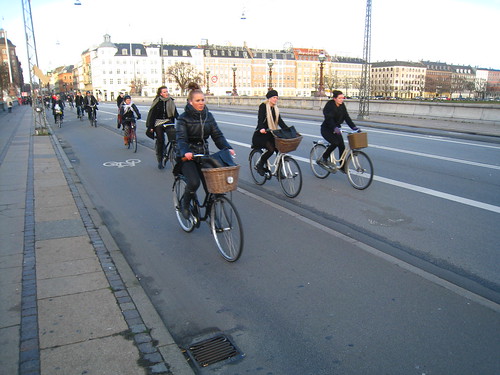
Nørrebrogade: exhibit A in the segregationists' case
It’s certainly hard to feel too sceptical about segregation standing in the morning on Nørrebrogade, in Copenhagen, the street that carries traffic from the west of Copenhagen over a string of lakes into the city centre. I went to look at it in late 2009 and, even towards the end of the rush hour, there were hundreds of bikes streaming down neat, segregated cycle lanes. Niels Tørsløv, the head of Copenhagen’s city traffic department, told me the city timed the traffic lights to fit in with the flow of bikes, rather than cars. One of the major controversies he was tackling was over the number of cargo bikes in the city. He was having to widen the cycle lanes to make it easier to overtake them. Such are the problems of directing traffic in a city where 37 per cent of people get to work, school or college by bike.

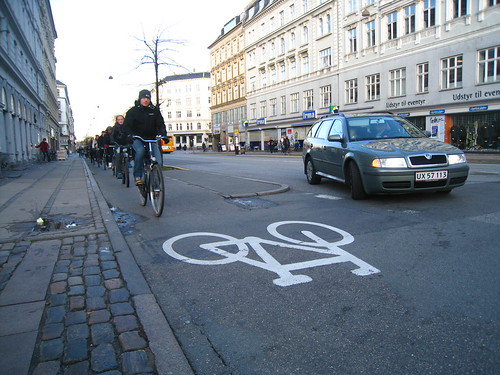
A Copenhagen motorist helpfully illustrates
the Invisible Visible Man's point about side-street conflicts
But, according to Mr Tørsløv, the segregated lanes only rearranged the accidents, putting them at the intersections between roads and cycle paths, rather than at even spaces along the roads. Copenhagen put in the cycle lanes, he said, only because they encouraged people to cycle – cycling numbers rose 10 per cent when a street gained a cycle lane. I happened later the same day to see a motorist knock off a cyclist using a segregated cycle lane.

After that visit, I started to notice, as I sped along Cable Street towards meetings in Canary Wharf, how disproportionately at risk I was from motorists pulling across my path at side streets. I was out of their eye line and difficult to see.

The Invisible Visible Man's hired cruiser bike.
He's not on it - but obviously
drivers saw it like this all the time
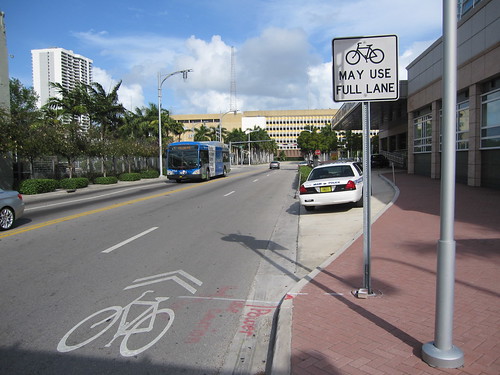
My experiences last week in the US (the reason, dear readers, for the late production of this latest blog post) underlined my worries about segregation. Unable to bear any longer missing my bike languishing across the Atlantic, I hired a cheap cruiser bike and headed across the causeway from Miami Beach into downtown Miami proper. I was encouraged at points to see cycle lanes marked on the road. But then I spotted a sign with a bike picture and the words “may use full lane”. This was a rare piece of permission, I realised. The painted lanes were less a facility than a prison, confining me to the fringes of the roads.

Given the number of motorists I’ve already had tell me in Britain that I shouldn’t be outside some rebranded gutter masquerading as a cycle lane, it made me worry what kind of message a heavy concentration on segregated lanes would send. Certain motorists would quickly come to think of on-road cycling as banned.

A whole lane? The City of Miami, for once, spoils cyclists
I’m consequently positioning myself in the middle of the lane, staring round at any potentially menacing drivers - and pedalling my way into the camp that says cyclists and motor vehicles broadly have to coexist in most city streets. This action will, I know, put me, to some advocates, irrevocably in the Not a Good Person camp. They will look upon me henceforth the way a reactionary newspaper columnist would if he had seen me cycle through a red light and mount a pavement, mouthing obscenities.

Yet I’m reluctant to side firmly with either camp because bike behaviour doesn’t seem to me the most important issue on the roads. Watching politicians’ obvious nervousness when discussing road funding in the UK this week has illustrated how fear of drivers continues to drive attitudes about how roads are used. The same fear holds back police forces from tackling speeding, driving while distracted and the other driver behaviour that puts some cyclists off.  After a driver threatened to assault me recently, the police showed no interest in investigating the driving offence that led to the confrontation. The driver had deliberately pulled his car across the path of a cyclist in, I suspect, full view of a CCTV camera. It would have been a “disproportionate use of police resources” to try to retrieve the film.

There doesn’t even seem to be an appetite for explaining the law. Many drivers, I suspect, don’t actually understand they’re not meant to intrude into cycle-only stop areas or that cyclists are allowed to ride outside cycle lanes. It would take too much courage to embark on a simple public information campaign.

Motorists’ attitudes are certainly not immutable – I’ve referred before to the transformation in views about drink driving in many countries as an example. It’s my guess that, if motorists were behaving better, far fewer people would yearn for the apparent sanctuary of segregated lanes. Meanwhile, if the apathetic planners currently in charge in many western countries set about building new cycle infrastructure, it’s a fair bet it would tend more to keep cyclists out of motorists’ way than to help cyclists.

It's unfortunate, too, if the debate polarises advocates into backing two separate approaches. Some places – the busy roads by the Thames in London, for instance – look perfectly set up for separate cycle lanes. The narrow streets in the City of London look best suited to assertive, on-the-road cycling. Many junctions need redesigning. Others would be fine if the current ignored rules were enforced.

But, for the moment, cyclists’ real needs are so far from policy makers’ minds that they’ve built a “Cycle Superhighway” out of stuff that makes bikes skid. I’d prioritise changing motorists’ and officials’ thinking over pressing the same people to build more of their flawed idea of cycling facilities.

Monday, 13 February 2012

Why no man is an island - even in his car


One day in 2001, I was standing by an intersection in Pristina, the monument to dingy Yugoslav urban design that serves as Kosovo’s capital. A souped-up saloon car squeezed inside a vehicle stopped by a set of traffic lights. Then, the moment the lights showed amber, the saloon car’s wheels screamed. It accelerated forward, then swung round in front of the other vehicle. The driver wanted to get ahead as the two cars turned left. The overtaking driver could easily have lost control of his vehicle and spun off the road; he could have hit the other driver as he swung round – and he moved himself only one place up a line of traffic that was probably just going to join a traffic jam further on.
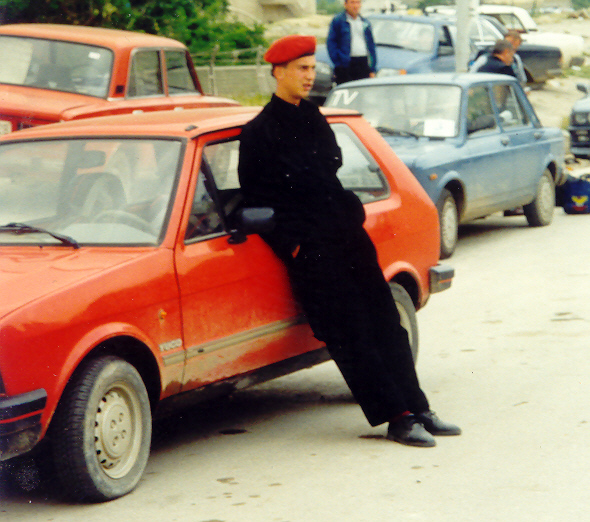
A KLA policeman: tellingly, not looking eager
to tackle Kosovo's traffic culture problem

The following year, I was cycling through the centre of Budapest, then my home city, when a car cut suddenly across my path. Shocked and thinking the driver might simply not have seen me, I slapped a side panel of his car. When the window wound down, the stream of words that issued started “a büdös anyád” (your stinking mother). A general tone thus established, the driver went on to suggest that I shouldn’t be on the road - and that he was well within his rights to act like a homicidal maniac.

The incidents in Pristina and Budapest helped to germinate the seed of an idea that was already planted in my mind. I began increasingly to pay close attention to what light the culture of a country’s roads shed on its wider society. It was illuminating precisely because, to people sitting inside cars, using a road often feels like a purely private enterprise. On busy roads, it is in fact one of the most complex social interactions many human beings undertake.

Budapest: beautiful - but one driver was
misinformed about my mother's personal hygiene
It perhaps wasn’t surprising that Kosovo’s road culture was fairly nihilistic. On a previous visit to Kosovo, shortly after the 1999 war, I had found a farm in western Kosovo whose courtyard was scattered with human ashes and bodies left for the dogs. According to local Albanians, it was the aftermath of a massacre by Serb forces. By the time I saw the bad driving just under two years later, most Kosovo Serbs had left either because of revenge attacks or the expectation of them. The callousness towards others and contempt for the rule of law that had marred Kosovo’s recent history carried straight over, it seemed to me, to how people drove.

Hungary was nothing like as damaged a society as Kosovo – despite the horrors of decades of first right-wing dictatorship and then Communism. But I would regularly report on the miserable living conditions of those who lived in dirty hovels on the edges of towns or run-down bits of Budapest – the country’s gypsies. My experience with the angry motorist – and the boorish tendency of drivers of the most powerful cars on the country’s motorways to drive at speeds that seriously endangered older, slower-moving cars – suggested vulnerable road users attracted similar contempt.

But in Hungary, Kosovo and many other long-misgoverned parts of the world, decades of misrule have discredited both the rule of law and any sense of a wider social good. In such societies, it became heroic to defy even good laws because those imposing them were so distrusted. The negative examples nevertheless suggest something about how road users should conduct themselves in healthier societies. Members of a well-ordered society abide not just by its agreed laws but also by the higher principle that they seek, as far as possible, to respect each other’s interests. They pay particular attention to the interests of the most vulnerable, who are least able to stand up for themselves. They restrain their exercise of their own rights to enhance others’ ability to enjoy theirs.

So we shouldn't be constantly worrying, it seems to me, what others might do to us if we break the rules or behave discourteously. We should all be thinking what our behaviour says about ourselves and our society. If we behave rudely or flout the rules, even if it does no direct harm, we tell those that see us that we are uninterested in their wellbeing. Every time we break road rules, we tell those that see us that we despise the rule of law generally. We’re slowly but surely corroding the bonds that ought to bind us together as a society – and as people who share the limited, precious space our society devotes to roads.

Those who regularly follow the developed world’s controversies over the role of cycling will by now think they know what’s coming. This could easily be the point where I start to bemoan the behaviour of some of my fellow cyclists, shaking my head metaphorically over how those that jump red lights, ride on pavements and so forth besmirch the good name of the rest of us.

My point is, I hope, a bit more subtle. To protect vulnerable road users, it's vital to pay most attention to the vehicles that do most harm. Politicians, police forces and journalists in many countries express outrage at cyclists’ alleged general disrespect for the law. But the less conspicuous law-breaking of motor vehicle drivers – the breaking of speed limits, the driving while distracted by a telephone and the contempt for measures meant to keep cyclists safe – kills thousands of people each year in most developed countries. Many motorists would be surprised how often their fellow motorists even ignore red lights - the failing often, in Britain at least, assumed to be particular to cyclists. I have twice narrowly avoided cars that were simply driving too fast to spot stop lights when I was heading across their paths. The depressing reluctance of many police forces to regard such behaviour as serious and criminal surely leaves vulnerable road users who try to stand up for their rights more exposed.

But there is no point pretending that some cyclists’ behaviour contributes nothing to the malaise. As I argued in a previous blog, cyclists generally harm no-one but themselves if they run red lights, ride on pavements or head the wrong way up a one-way street. Yet motorists or pedestrians seeing such behaviour must surely, to some extent, feel freer to disregard the rules or behave intolerantly themselves. Cyclists have so much potentially to gain from an improvement in road culture that it is surely worth each cyclist’s pondering which way his or her behaviour shifts the delicate balance between tolerance and intolerance on the roads.

It will not solve everything for cyclists to follow the rules. I have previously argued – and still believe – that much anti-cyclist behaviour stems from a simple irritation at cyclists’ choice of an obviously different way of doing things. I have also often been abused for alleged rule breaking when riding (perfectly properly) on on-pavement cycle paths or using one-way streets with a contraflow cycle lane. Some motorists fly into a rage at seeing a cyclist pulling ahead of them into the boxes that are meant to let cyclists leave traffic lights in most British cities ahead of the cars.

But there is a tendency on the part of all road user groups to criticise others for their failure to adhere to the fixed rules of the road – then make up their own minds which rules seriously apply to them. It is a system few people think appropriate with regard to the rules about assault or theft – and one that is no more appropriate about the rules for how people share the roads. Consequently, when I get on board my bike today, I will be looking out for - and trying to obey - traffic lights, one-way street signs and all the other myriad traffic symbols I see about me. It may not directly make my day better. It may not even make me directly safer. But it will reflect my conviction that, because my actions affect a far wider circle of people than myself, I have to respect the only commonly-agreed set of rules that we have.