Most evenings, as I head home towards reunion with the Invisible
Visible Woman, I pedal, as I’ve noted before, in the footsteps of Roman soldiers along London Kennington Park
I smile a similarly wry inward smile when cycling along any
section of pavement (sidewalk, American readers) that’s been divided between
pedestrians and cyclists. The standard UK
Given the number of motorists I’ve already had tell me in
Britain that I shouldn’t be outside some rebranded gutter masquerading as a
cycle lane, it made me worry what kind of message a heavy concentration on
segregated lanes would send. Certain motorists would quickly come to think
of on-road cycling as banned.
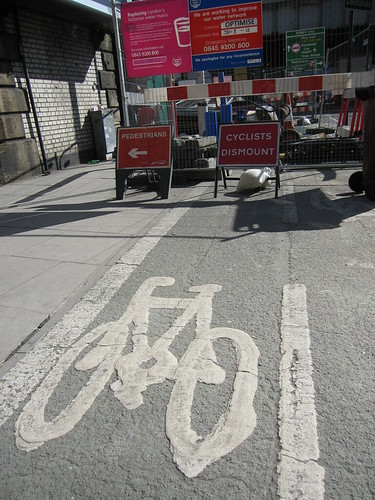 |
| Roadworks in the City: guess which transport mode everyone decided was dispensable |
My main thought as I negotiate these obstacles (or, more
properly, “cycle facilities”) is to wonder whether their designers are even vaguely familiar
with a bicycle and its basic physical properties. I think we can dismiss out of
hand the idea that they might actually regularly ride a velocipede.
However, there’s a second, more serious thought. If this is
the rich world’s idea of cycling infrastructure, why are so many cycling
organisations pressing for more of it?
Such a notion pitches me, of course, into a bitter
intra-cyclist dispute. It echoes, in a way, the divisions everywhere among
oppressed groups seeking greater freedom. Do we seek, like pedalling Malcolm
Xs, the segregation of the separate cycle facility, using mainly lanes free of
our motor-powered oppressors? Or do we pursue peacefully the dream of
integration, winning the right to the respect we deserve on the wider, more
diverse society of the road?
It’s worth saying, of course, that I am as open as the next
person to enjoying a car-free environment. When visiting my parents-in-law, I
cycle to their church in north Wales partly on a tarmac path along an old
railway line. On a Sunday morning, with few runners or other cyclists about, it
can be one of the purest, most uncomplicated bike-riding experiences available.
One of the most enjoyable cycle facilities to use in London is a fully
segregated cycle lane along Cable Street in the East End. The absence on most
of the route of worries about car behaviour is undoubtedly one of its
attractions.
It’s the difference in stress levels using such routes that
leads admirable campaigners in many countries to demand better, separate cycle
provision. In the UK, it’s currently common for such campaigners to say cycling
will remain a niche activity for the eccentric few (such as the Invisible
Visible Man) until the country boasts the same kind of network of segregated
cycle routes as the mass-cycling Netherlands or Denmark. They look at people
like me who think there are chances of forging a basic understanding between
road users and shake their heads. Isn’t it sad how determined we are to restrict cycling to ourselves and a few other members of the privileged
middle classes?
I have, as it happens, a fundamental distrust of the idea of
segregating any groups of people that can’t seem to get along. But I’m worried
about the practicality of cutting cyclists off from other traffic too.
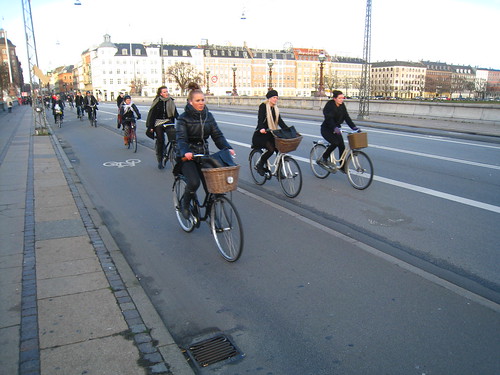 |
| Nørrebrogade: exhibit A in the segregationists' case |
It’s certainly hard to feel too sceptical about segregation
standing in the morning on Nørrebrogade, in Copenhagen, the
street that carries traffic from the west of Copenhagen over a string of lakes
into the city centre. I went to look at it in late 2009 and, even towards the
end of the rush hour, there were hundreds of bikes streaming down neat,
segregated cycle lanes. Niels Tørsløv, the head of Copenhagen’s city traffic department,
told me the city timed the traffic lights to fit in with the flow of bikes, rather than cars. One
of the major controversies he was tackling was over the number of cargo
bikes in the city. He was having to widen the cycle lanes to make it easier to
overtake them. Such are the problems of directing traffic in a city where 37
per cent of people get to work, school or college by bike.
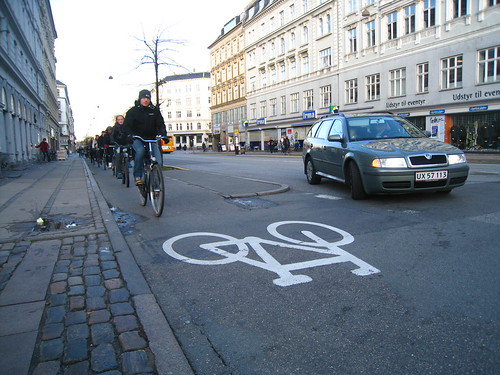 |
| A Copenhagen motorist helpfully illustrates the Invisible Visible Man's point about side-street conflicts |
But, according to Mr Tørsløv, the segregated lanes only
rearranged the accidents, putting them at the intersections between roads and
cycle paths, rather than at even spaces along the roads. Copenhagen put in the cycle
lanes, he said, only because they encouraged people to cycle – cycling numbers
rose 10 per cent when a street gained a cycle lane. I happened later the same
day to see a motorist knock off a cyclist using a segregated cycle lane.
After that visit, I started to notice, as I sped along Cable
Street towards meetings in Canary Wharf, how disproportionately at risk I was from motorists pulling across my path at side streets. I was
out of their eye line and difficult to see.
 |
| The Invisible Visible Man's hired cruiser bike. He's not on it - but obviously drivers saw it like this all the time |
My experiences last week in the US (the reason, dear readers, for the late production of this latest blog post) underlined my worries about segregation. Unable to bear any longer missing my bike languishing across the Atlantic, I hired a cheap cruiser bike
and headed across the causeway from Miami Beach into downtown Miami proper. I
was encouraged at points to see cycle lanes marked on the road. But then I spotted
a sign with a bike picture and the words “may use full lane”. This was a rare
piece of permission, I realised. The painted lanes were less a facility than a
prison, confining me to the fringes of the roads.
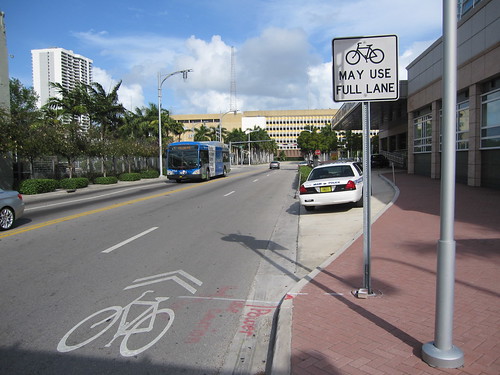 |
| A whole lane? The City of Miami, for once, spoils cyclists |
I’m consequently positioning myself in the middle of the
lane, staring round at any potentially menacing drivers - and pedalling my way into the camp that says cyclists and motor vehicles broadly
have to coexist in most city streets. This action will, I know, put me, to some advocates, irrevocably in the Not a Good Person
camp. They will look upon me henceforth the way a reactionary newspaper columnist would if he had seen me cycle through a red light and mount a pavement, mouthing
obscenities.
Yet I’m reluctant to side firmly with either camp because bike behaviour doesn’t seem
to me the most important issue on the roads. Watching politicians’ obvious
nervousness when discussing road funding in the UK this week has illustrated
how fear of drivers continues to drive attitudes about how roads are used. The
same fear holds back police forces from tackling speeding, driving while
distracted and the other driver behaviour that puts some cyclists off. After a driver threatened to assault me recently,
the police showed no interest in investigating the driving offence that led to
the confrontation. The driver had deliberately pulled his car across the path
of a cyclist in, I suspect, full view of a CCTV camera. It would have been a “disproportionate
use of police resources” to try to retrieve the film.
There doesn’t even seem to be an appetite for explaining the
law. Many drivers, I suspect, don’t actually understand they’re not meant to
intrude into cycle-only stop areas or that cyclists are allowed to ride outside
cycle lanes. It would take too much courage to embark on a simple public information
campaign.
Motorists’ attitudes are certainly not immutable – I’ve
referred before to the transformation in views about drink driving in many countries as an example. It’s my guess that, if motorists were behaving better,
far fewer people would yearn for the apparent sanctuary of segregated lanes. Meanwhile, if the apathetic planners currently in charge in many
western countries set about building new cycle infrastructure, it’s
a fair bet it would tend more to keep cyclists out of motorists’ way than to help cyclists.
It's unfortunate, too, if the debate polarises advocates into backing two separate approaches. Some places – the busy roads by the Thames in
London, for instance – look perfectly set up for separate cycle lanes. The narrow
streets in the City of London look best suited to assertive, on-the-road
cycling. Many junctions need redesigning. Others would be fine if the current ignored rules were enforced.
But, for the moment, cyclists’ real needs are so far from
policy makers’ minds that they’ve built a “Cycle Superhighway” out of stuff
that makes bikes skid. I’d prioritise changing motorists’ and
officials’ thinking over pressing the same people to build more of their flawed idea of cycling facilities.
