Showing posts with label urban cycling. Show all posts

Monday, 9 May 2016

A sobering email, writing about cycling - and why my rational choice brings me joy

It wasn’t the most depressing email I’ve ever received. But it was one of the more disheartening related to this blog. A couple of weeks ago, an old, London-based contact emailed to let me know he was moving to New York. But, while I eagerly agreed to his suggestion we meet up, his second paragraph gave me pause for some gloomy thought.

“I shall not be cycling,” my contact wrote. “I have read enough of your blogs not to tempt fate.”
 
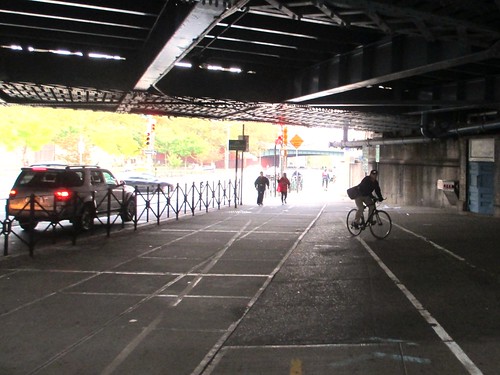
Cyclists literally queue up at the Manhattan Bridge
to tempt fate
The line made me realise my fundamental failure to strike a balance in how I’ve written about cycling. While I would like New York conditions for riding to be far better, I haven’t, I recognise, given nearly enough space to why, amid all my complaining, I continue to ride a bicycle.

My dismay has grown all the greater subsequently as I’ve received repeated reminders that large numbers of people either think it wholly irrational to ride a bicycle in a city or misunderstand the rationale for doing so. Two days after I received the email, Lucy Kellaway, my colleague at the Financial Times, published a column saying she longed to return to cycling after a recent crash while cycle commuting. But she said many readers had assured her the crash should have served as a warning to her to give up. The day before Lucy’s piece, the New York Times published an article of advice for would-be urban cyclists. The Times’ piece dwelt at length on the need to wear a helmet and follow all the road rules but suggested one simply had to trust drivers not to pass one too closely. Most despicably, AMNewYork, a New York news site, on Monday published a piece of unpleasant clickbait listing the "Worst Things about Bicyclists in New York City".

Such criticism of the choice to cycle often seems to me to miss a core point about cycling as an activity. Cyclists, to read many people’s writing about the subject, are helpless subjects of the dangers of the roads, who can do no more to mitigate the risks than wear a plastic helmet. This is essentially the way a cyclist must look to an onlooker driving a motor vehicle.

Yet the arguments in favour of cycling all focus on its nature as an active form of transport. There are significant health benefits to be derived from cycling as a physical activity. It’s also possible to act in ways that, to a limited extent, mitigate the dangers. I’m convinced that, when these points are thrown into the balance, the cost/benefit ratio swings overwhelmingly in favour of cycling. I regret having given a different impression.
 
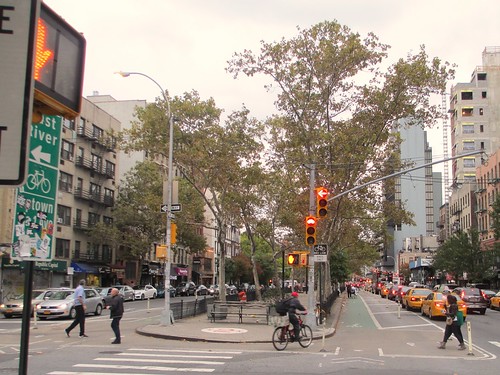
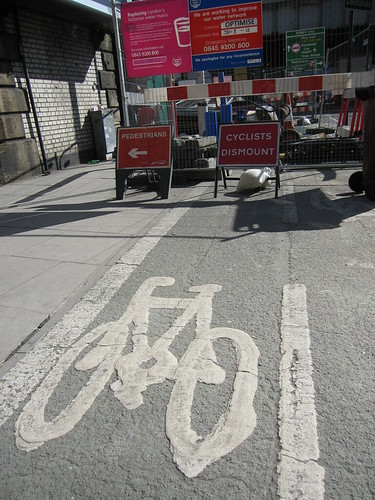
The Broadway bike lane: not a clear signal of cycling's
rationality
It’s perhaps worth asking, however, why it even matters to me that my choice is rational. It’s irrational, after all, to eat and drink as much as I do. It’s almost certainly not sensible to work as hard as I do at a job that’s far less significant than it feels when I’m wrapped up in it. I could simply say – as Lucy’s piece concluded – that a cold-headed assessment of risk doesn’t capture why I cycle. I could say that I ride my bike because of the joy of feeling in step with the city, of the extraordinary things one sees late at night, or because I feel when I'm cycling as if I have a superpower.

I’m not quite prepared to do that, however. It would feel, partly, like a betrayal if, having criticised the irrationality of so many other people’s thinking about transport, I decided it was a matter of personal taste. I’d also risk sounding like the archetypal annoying hipster explaining how he likes a band you “probably won’t have heard of” – “I like cycling in New York – but it’s probably a bit too hardcore for you”.

I want, as I wrote four years ago, to live what Gordon Graham, one of my moral philosophy lecturers at university, called “the rational life”. Someone living a rational life seeks to use reason to decide how to behave. If I didn't think the way I got about was rational, I'd find another way to travel.

Yet there is no doubt that there is at least a superficial case that I'm taking on an unnecessary risk when I cycle. I have, over the course of more than two decades' urban cycling, been twice knocked off by motor vehicles and once by another cyclist. It was only good fortune that none of these crashes involved a serious, long-term injury. There is a small - but not entirely negligible - risk that some day I too will end up, through no fault of my own, crushed under the wheels of a badly-driven truck or sent flying into the air through a taxi driver's inattention.

Make a wise choice, folks: drive a car instead. Oh.
But that fails to capture anything like the whole, complex picture of the risks I'm managing. Heart disease, cancer, stroke and my tendency to put on weight all pose far more serious risks to my life expectancy than the small risk of a fatal crash. Figures years ago from Cycling UK suggested that someone who cycled regularly into middle age – that’s I now, folks – increased his or her life expectancy by an average 24 months. The reduction from crashes was, on average, two months. While the figures for deaths per mile in the US are hard to find, the risk per mile of cycling looks to be just short of twice as high, leaving the benefit: cost ratio still a healthy 7:1.

I am not, either, a helpless victim of those averages. It is certainly true that the vast bulk of crashes between drivers and cyclists are mainly the driver’s fault. But I have, I think, learnt over the years a “well-managed fear”. I let my nervousness about the vehicles around me prompt me towards holding the road when drivers try to bully me out of the way, making clear, understandable movements, rather than sudden, darting ones. I try to communicate clearly with drivers. Such behaviour can guard against the negligence of people who have far less at stake than I. A good knowledge of safe routes and the skills to take up the necessary road space to discourage dangerous passing are far more useful than most of the “safety tips” that the New York Times’ piece gave.
 
Should New York's cycling facilities make it clearer
cycling's a good idea? Guess what I think, based on this picture.
It’s because cycling is a rational choice, meanwhile, that it’s folly for cities to seek to cater to cyclists merely as part of a policy of offering a choice of travel modes. Given that cycling makes personal sense for vast numbers of people, makes excellent use of road space and reduces pollution, it should be incumbent on cities actively to promote cycling. City departments of transportation should ask themselves if few people choose to cycle why their road designs are instead promoting less rational options. The risks of cycling should undoubtedly be less than they are. But better-designed roads would not only reduce those risks but make it far clearer how rational a choice it is to cycle.

Better facilities would make it far easier for citizens to appreciate the true balance of risks they face. All forms of transport entail some form of risk. I was knocked down as a child while crossing a street. I crashed my dad's car off the road during my first driving lesson. I've been caught underground in a subway train during a track fire. Riding a bicycle represents, even under current sub-optimal conditions, a good trade-off between risks and rewards.
The USS Intrepid: a sight I'd have missed in the subway.

Yet I can’t deny that I’m happy to find cycling rational because it’s also a joy. I was acutely aware of that on Friday when I finally met up with my old contact. Leaving the office, I pedalled up Hudson St then out onto the Hudson River Greenway towards midtown. It was a journey my colleagues assumed I wouldn’t do by bike because of the looming threat of rain. My contact assumed I wouldn’t have enjoyed because I’d be battling through traffic. It nevertheless lifted my spirits in a way that a subway trip could never have done and got me there promptly and cheaply in a way a taxi ride could not have. As I zipped along by the water under leaden skies, looking up at the Empire State Building, marvelling at the USS Intrepid and hearing the splash of the water, I reflected on the straightforward pleasure the ride was bringing me. There are few satisfactions greater, I realised, than indulging in an activity that's both rational and brings one immense joy.

Sunday, 20 October 2013

A Film Set, a New Route - and the Joy of Rediscovering Urban Cycling

It’s the kind of intervention in one’s journey home that’s never normally welcome. As I rode my way down Grand St in lower Manhattan around 10.30 in the evening, I found a skinny young man wearing a headset blocking my way. No-one was allowed onto the next block, he said, until the film crew had finished this take. It took only a couple of minutes – although the time felt longer, given that I’d rashly for the time of year put on only a t-shirt on my top half.
 
Grand St in Chinatown: city street, film set or cyclocross
track - it can't settle on a single role
But, despite the inconvenience, I felt a little thrill at being stopped on my way home on Friday. That a film crew was filming on a road on my way home was confirmation that I was, once again, the kind of cyclist whose routes lay along grittily interesting urban streets. For more than a year since moving to New York, I’ve done the majority of my Manhattan cycling on the waterfront greenways, riding often at speed but grappling only in little bites with the serious urban cycling of riding on a street with traffic. Following a move in my employer’s office, I now ride across lower Manhattan from the Manhattan Bridge to Hudson St in SoHo, on city streets for nearly all the distance.

The change has reminded me of some of the sheer pleasures of being an urban cyclist. My riding patterns far more closely resemble those I had in London, where I’d ride mostly along the London Cycle Network of routes along quiet back streets. I’m catching once again little vignettes of city life – I notice, for example, how oddly resigned and depressed the faces of the people waiting each morning for the opening of the Prince Street Apple store are. Pushing a hot dog cart to its place in the morning looks like really hard work.

The contrast between midtown and the relatively relaxed cycling environment in lower Manhattan – where there’s motor traffic, but not on the same scale as further uptown - has also highlighted another truth. Cycling in any place where cars dominate the public space can be pretty dispiriting. I’m missing the last mile of my old work route – where I’d battle my way up 54th street from the Hudson River to my office – not at all. If big cities want to encourage cycling, conditions in such forbidding areas need to be addressed.

The USS Intrepid: just one of the Hudson River landmarks
no longer on the Invisible Visible Man's daily route.
Yet these aren't the reactions I'd expected. For months before the move, I’d been telling anyone who’d listen – and a fair few that wouldn’t – how I was dreading the move. I’d grown used to commuting nine miles each way to and from work, including a four-mile sprint up the Hudson River Greenway along the west side of Manhattan. I was particularly concerned about my waistline. Within a few months of undertaking a daily 18-mile round-trip commute, I was noticing the difference when I stood on the bathroom scales in the morning. I’d dropped a good five or six kilos compared with when I moved in August 2012 from London.

There are certainly sad points about no longer having a daily ride by the Hudson. On my last morning on my old route, I was looking wistfully across at the buildings in New Jersey, glittering in the autumn sun on the river's far bank. I cast a sentimental glance to my right up at the Empire State Building, which I now see only in the distance. I took a picture of the USS Intrepid as I passed it for the last time as a commuter. I was dreading not only the new route’s reduced riding but also the stresses of the new route I’d planned. To the west of the new office – the angle from which I planned to approach – streets buzz with high traffic volumes, pouring into and spewing out of the cross-river Holland Tunnel.
 
The bike route onto the Manhattan Bridge: a quick route
to lower Manhattan streets - and romantically urban to a fault.
But, on my second morning in the new office, it occurred to me that it was worth trying the simplest, straightest route across town to the new site. I sped over the Manhattan Bridge, instead of the Brooklyn Bridge, dropped down into Chinatown and navigated my way across to Prince St. I discovered how the old, muddled-up street plan meant no-one expected to speed across SoHo. More to the point, I arrived with a smile on my face. The route had been chaotic, grimy and a little bit noisy – far more unmistakeably a ride through New York than my former ride on a calm, orderly path up by the Hudson.

I also, I’ll admit, felt a little bit cooler than before. For the last 14 months as I’ve fulminated about this or that aspect of New York’s road culture, I’ve had a sneaking feeling that maybe I wasn’t quite getting it. Nearly two-thirds of my ride to work was car-free and I’d found some of my efforts at on-street riding pretty terrifying. I’d watched on Twitter the discussions between more seasoned New York cyclists of their experience in the lower east side, SoHo, Chelsea and elsewhere in the island’s lower reaches and suspected they were simply cooler, more sophisticated, bolder people than I. Most of them remain, no doubt, cooler and more sophisticated than I – but I have less awe of their willingness to ride on these areas’ streets.

Bike lanes on Allen St at the Rivington St intersection:
a small-time entrepreneur wheeling goods down the bike
lane adds an authentic detail.
It’s certainly not a perfect experience. The journey would be more fun still if more New Yorkers had a better understanding of where the stress in the phrase “bike lanes” is meant to lie. Many seem to hear the term “lanes” and adopt them as the ideal spot to wheel their food truck, haul their suitcase or park their police car. Better protection for many bike lanes would be welcome, as would a reining-in of many vehicles’ speed. I’ve also yet to find an ideal route home. One of those cooler, more experienced cyclists, Joanna Oltman Smith, warned me before the move to avoid Grand St, the most direct route, which extensive sewer works have turned into a cross between a slalom course and a rutted country track. I’ve not yet found a better alternative – and, truth to tell, am enjoying the sense that I might be quietly training for unexpected stardom on the seniors cyclocross circuit.

On the other hand, I now look almost fondly on the elderly Chinese woman I see each morning blocking the Rivington Street bike lane stuffing her bags full of recycling. I marvel at the Beaux Arts magnificence of the Little Singer Building as I cross Broadway. I note how adept the city – like London, my former home – has been at reinventing itself. I see neglected-looking synagogues built for a Jewish community now mainly departed from Chinatown. Factories that once made clothing have been transformed into trendy offices for those of us in the media set. I hear even more of the city's sounds. Next summer, I expect to be still more aware of its smells. I was cycling round New York City on my old route. Now I arrive at the office, a smile on my face, excited at how I've been riding in it.

Tuesday, 24 September 2013

Falling scaffolding, a sidewalk driver and how safe it's your job to be

Unusually early for a Saturday, I cycled off September 14 towards Sheepshead Bay, a distant corner of Brooklyn, to help out with a relief project dealing with the continuing unrepaired damage from last year’s Superstorm Sandy. Running late as ever, I started off at a sprint over a lift bridge near our apartment that takes Brooklyn’s 9th street over the Gowanus Canal and under Smith and 9th street subway station. The subway sits high on a viaduct above.
 
The great 9th Street scaffolding collapse: I can't think how
anyone would have blamed me if I'd got caught up in this.
But I'm sure they'd have found a way.
A couple of hours later, a large truck carrying building materials made the same journey over the bridge as I - but with a crane on its back sitting a little higher than it should have done. The crane caught a piece of corrugated iron on a vast network of scaffolding erected for a renovation project on the subway station. I returned from Sheepshead Bay to find 9th street barred to me and police and fire officers milling around a tangled mess of truck, corrugated iron and other bits of the scaffolding. Had I been riding over the bridge at the same time as the truck, I would have been helpless. Sheets of metal and steel poles would have tumbled on top of me, while the driver, protected by his cab, was unhurt.

Yet, had I found myself crushed under the scaffolding, at least some people, I’ve come to realise, would have blamed me for not looking after myself better. That’s the implication of the response to an appalling incident on September 12 when a motorist in Maspeth, part of the New York borough of Queens, drove onto a sidewalk and hit five children, three of whom are seriously injured. One child, although initially regarded as only slightly hurt, has since died of an asthma flare-up which, the laws of probability suggest, was probably related to the crash.

In the wake of the incident - captured on the disturbing video below - the school’s principal wrote to parents asking them to ensure their children avoided wearing earphones or using mobile devices when walking to school. The suggestion – not borne out by the horrific, disturbing video of the incident – was that the hospitalised children should somehow have avoided the speeding vehicle by paying greater attention.

The letter – which education officials seem to have insisted the principal sent, over his objections – is all the more astounding since it makes no suggestion that parents drive more carefully – and the driver responsible seems to have been dropping his own child at the school.

The education system’s reaction was far from unique. I recently read with dismay the comments under an old news article about the death in 2011 of Johannah Bailey, a cyclist hit by a van driver on Cavendish Road, part of London’s South Circular in Clapham, that I’ve often ridden myself. The van driver, Andrei Dulgher, rounded a bend in the road so fast that he drove over a traffic island before hitting Ms Bailey – on a turning lane in the centre of the road - and sending her body flying high into the air.

One ostensibly sympathetic comment from someone who’d witnessed the horrific incident – which came to my attention when Dulgher was cleared of causing death by dangerous driving – expressed horror at what happened and appealed to all cyclists to “take care” when riding. How cyclists were meant to “take care” around vehicles coming round blind bends at speed in the wrong part of the road was not made clear.

The scaffolding incident and the strange comment on Ms Bailey’s death have prompted me to think hard not only about how other people think vulnerable road users should behave but how I myself think. Where is the line between a crash that the victims clearly couldn’t have avoided – such as that in Maspeth or Johanna Bailey’s killing – and an incident where the victim’s negligence clearly contributed to what happened? Why do so many people place the blame so firmly on the vulnerable? How does that affect my own road behaviour?

The Invisible Visible Man is comfortable with fewer risks
than this helmetless, dark-clothed midtown Manhattan
cyclist. But he still recognises it's the cars that pose the
main risk
I don’t, unfortunately, need to think too hard to imagine the circumstances of a crash for which I’d blame a cyclist. It happened at 1.30am one Saturday a few months ago as I cycled home from a very late night at work. Tired and feeling stressed by the speed and volume of traffic in downtown Brooklyn, I took a rare opportunity when no traffic was on my tail to make a rapid left turn across Boerum Place’s six lanes, into quiet State Street. I’d forgotten that traffic heading the other way along Boerum Place wouldn’t have a red light. Suddenly, an SUV came tearing around the corner from Atlantic Avenue, the next intersection along, and hurtling towards me. I jammed on my brakes and the SUV swerved and also braked. Catastrophe was averted – but I could have had little complaint, despite the road’s confusing layout and the driver’s speed, if the car had hit me. I’d made a stupid – negligent – mistake.

Yet, if the SUV had hit me, it would have been a relatively unusual type of crash. Every survey I’ve read, including a very detailed one from Transport for London, attributes most crashes involving cyclists to a relatively small number of causes – motorists’ failure to look properly, motorists’ failure to judge cyclists’ speed or direction and motorists’ passing cyclists too fast and/or too close. It’s not, in other words, that common for cyclists or other vulnerable road users to take suicidally silly risks or make utterly inept mistakes. The people who are hidden inside steel shells so have least to risk tend to be the biggest risk takers.
 
I ride in such a way as to reduce my risks. I wear – unlike many of my fellow New York cyclists – a high-visibility vest and even a reflective snap bracelet, intended to help drivers to see when I’m signalling left. Convinced that protection for my body’s densest, most sensitive part must do some good, I use a helmet. I also – again, unlike a puzzlingly high proportion of New York cyclists – use lights at night, two at the rear and one at the front. When riding on a cycle lane between a line of halted or slow-moving cars and parked vehicles, I ride slowly, aware that a door could suddenly fly open or a car lurch suddenly into my lane.

Possibly most importantly of all, I try to communicate with drivers. “I’ll be going straight ahead here, OK?” I occasionally say through an open window. “Stop! Wait there!” I’ll tell one who’s turning illegally across my path. “Please stop using your phone,” I’ll tell another. “It’s making you drive badly.”

It’s no coincidence, however, that my efforts are designed either to help me to react in circumstances where I know drivers are likely to be negligent or actually to influence drivers’ behaviour. I concentrate on taking reasonable steps to mitigate the most serious risks. I don’t pretend that, walking on a sidewalk, I could protect myself against an out-of-control SUV hurtling towards me. I don’t believe I – or the poor children so horribly hurt in Maspeth – bear responsibility for crashes where the driver has been negligent and the victim wasn't.

These drivers blocking a crosswalk on W54th street know
who's boss: and it ain't the pesky people on foot
But the reaction to Johannah Bailey’s death perhaps explains why so much thinking on this subject is so woolly. Both the commenter and, perhaps, the jury that acquitted Andrei Dulgher probably thought of themselves mainly as drivers. That seems to create a barrier as impermeable as a car’s body shell between the driver and the complex reality of life outside the car, including its destructive potential. When that destructive power crushes a pedestrian or throws a cyclist 30ft into the air, it can be hard for motorists not to put themselves mainly in the place of the driver, rather than the cyclist or pedestrian. No matter the circumstances, there seems to be a thought that motorists drive of necessity and are a fact of life. Others have made a conscious, eccentric decision to walk or cycle – and can’t complain too much when a motorist’s negligence makes it go wrong.
 
That thinking, it seems to me, lies behind responses like that of the New York Department of Education to the Maspeth tragedy. Many people seem to see cars as the natural, inalienable rights-holders in public places. Cyclists and pedestrians are the parent-in-law house guests – just about tolerated, but only with the poorest of graces. The streets would surely be safer if more people thought of roads as places where multiple types of road users mixed, rather than places where cars drive and others fit around them.

It will, ironically, be when most people think automatically on hearing of incidents like the Maspeth crash, “How negligent of the careless driver” rather than, “How negligent of the walking teenagers” that people will start to hear of far fewer happening.

Wednesday, 21 March 2012

In which our hero picks up cycling policy's hottest potato...

Most evenings, as I head home towards reunion with the Invisible Visible Woman, I pedal, as I’ve noted before, in the footsteps of Roman soldiers along London’s Cycle Superhighway 7. But, on nights of the light, misty rain that are a spring and autumn speciality of London’s weather, something unusual happens. As I and other cyclists swing onto a section of the Cycle Superhighway by Kennington Park, we veer out of the marked, blue-painted part of the road that’s meant to be reserved for us. We all know by now that the marking was done on the cheap with a simple layer of blue gloss paint. In such weather, it becomes scarily slippery. We consequently sit towards the outside of the near-side lane. The sight of the line of bikes, all frightened to use a dangerous facility intended to keep us safe, always leads me to raise at least a mental, mildly amused eyebrow.

Roadworks in the City: guess which transport mode
everyone decided was dispensable
I smile a similarly wry inward smile when cycling along any section of pavement (sidewalk, American readers) that’s been divided between pedestrians and cyclists. The standard UK practice is to mark the separate pedestrians and cyclist sides with ridged tiles (to help vision-impaired people). The ridged tiles on the cyclists’ side are laid parallel to the bike’s wheels, however. Those on the pedestrian side run acrossways. A reasonably cautious cyclist consequently has to veer onto the pedestrian side at the tiles, to avoid the small but real danger the ridges will catch his front wheel. Having narrowly missed crashing after catching my wheel a few times on such a tile, I’m unwilling to take more chances.

My main thought as I negotiate these obstacles (or, more properly, “cycle facilities”) is to wonder whether their designers are even vaguely familiar with a bicycle and its basic physical properties. I think we can dismiss out of hand the idea that they might actually regularly ride a velocipede.

However, there’s a second, more serious thought. If this is the rich world’s idea of cycling infrastructure, why are so many cycling organisations pressing for more of it?

Such a notion pitches me, of course, into a bitter intra-cyclist dispute. It echoes, in a way, the divisions everywhere among oppressed groups seeking greater freedom. Do we seek, like pedalling Malcolm Xs, the segregation of the separate cycle facility, using mainly lanes free of our motor-powered oppressors? Or do we pursue peacefully the dream of integration, winning the right to the respect we deserve on the wider, more diverse society of the road?

It’s worth saying, of course, that I am as open as the next person to enjoying a car-free environment. When visiting my parents-in-law, I cycle to their church in north Wales partly on a tarmac path along an old railway line. On a Sunday morning, with few runners or other cyclists about, it can be one of the purest, most uncomplicated bike-riding experiences available. One of the most enjoyable cycle facilities to use in London is a fully segregated cycle lane along Cable Street in the East End. The absence on most of the route of worries about car behaviour is undoubtedly one of its attractions.

It’s the difference in stress levels using such routes that leads admirable campaigners in many countries to demand better, separate cycle provision. In the UK, it’s currently common for such campaigners to say cycling will remain a niche activity for the eccentric few (such as the Invisible Visible Man) until the country boasts the same kind of network of segregated cycle routes as the mass-cycling Netherlands or Denmark. They look at people like me who think there are chances of forging a basic understanding between road users and shake their heads. Isn’t it sad how determined we are to restrict cycling to ourselves and a few other members of the privileged middle classes?

I have, as it happens, a fundamental distrust of the idea of segregating any groups of people that can’t seem to get along. But I’m worried about the practicality of cutting cyclists off from other traffic too.

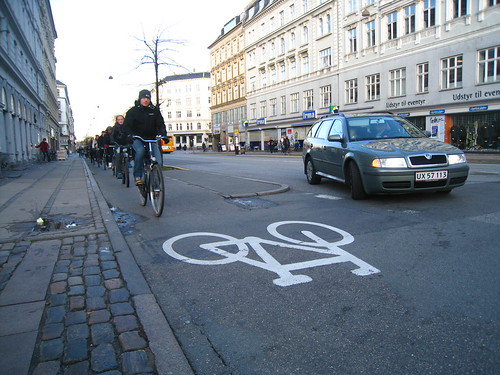
Nørrebrogade: exhibit A in the segregationists' case
It’s certainly hard to feel too sceptical about segregation standing in the morning on Nørrebrogade, in Copenhagen, the street that carries traffic from the west of Copenhagen over a string of lakes into the city centre. I went to look at it in late 2009 and, even towards the end of the rush hour, there were hundreds of bikes streaming down neat, segregated cycle lanes. Niels Tørsløv, the head of Copenhagen’s city traffic department, told me the city timed the traffic lights to fit in with the flow of bikes, rather than cars. One of the major controversies he was tackling was over the number of cargo bikes in the city. He was having to widen the cycle lanes to make it easier to overtake them. Such are the problems of directing traffic in a city where 37 per cent of people get to work, school or college by bike.

A Copenhagen motorist helpfully illustrates
the Invisible Visible Man's point about side-street conflicts
But, according to Mr Tørsløv, the segregated lanes only rearranged the accidents, putting them at the intersections between roads and cycle paths, rather than at even spaces along the roads. Copenhagen put in the cycle lanes, he said, only because they encouraged people to cycle – cycling numbers rose 10 per cent when a street gained a cycle lane. I happened later the same day to see a motorist knock off a cyclist using a segregated cycle lane.

After that visit, I started to notice, as I sped along Cable Street towards meetings in Canary Wharf, how disproportionately at risk I was from motorists pulling across my path at side streets. I was out of their eye line and difficult to see.

The Invisible Visible Man's hired cruiser bike.
He's not on it - but obviously
drivers saw it like this all the time
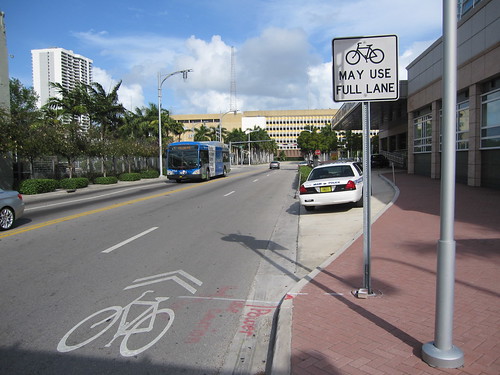
My experiences last week in the US (the reason, dear readers, for the late production of this latest blog post) underlined my worries about segregation. Unable to bear any longer missing my bike languishing across the Atlantic, I hired a cheap cruiser bike and headed across the causeway from Miami Beach into downtown Miami proper. I was encouraged at points to see cycle lanes marked on the road. But then I spotted a sign with a bike picture and the words “may use full lane”. This was a rare piece of permission, I realised. The painted lanes were less a facility than a prison, confining me to the fringes of the roads.

Given the number of motorists I’ve already had tell me in Britain that I shouldn’t be outside some rebranded gutter masquerading as a cycle lane, it made me worry what kind of message a heavy concentration on segregated lanes would send. Certain motorists would quickly come to think of on-road cycling as banned.

A whole lane? The City of Miami, for once, spoils cyclists
I’m consequently positioning myself in the middle of the lane, staring round at any potentially menacing drivers - and pedalling my way into the camp that says cyclists and motor vehicles broadly have to coexist in most city streets. This action will, I know, put me, to some advocates, irrevocably in the Not a Good Person camp. They will look upon me henceforth the way a reactionary newspaper columnist would if he had seen me cycle through a red light and mount a pavement, mouthing obscenities.

Yet I’m reluctant to side firmly with either camp because bike behaviour doesn’t seem to me the most important issue on the roads. Watching politicians’ obvious nervousness when discussing road funding in the UK this week has illustrated how fear of drivers continues to drive attitudes about how roads are used. The same fear holds back police forces from tackling speeding, driving while distracted and the other driver behaviour that puts some cyclists off.  After a driver threatened to assault me recently, the police showed no interest in investigating the driving offence that led to the confrontation. The driver had deliberately pulled his car across the path of a cyclist in, I suspect, full view of a CCTV camera. It would have been a “disproportionate use of police resources” to try to retrieve the film.

There doesn’t even seem to be an appetite for explaining the law. Many drivers, I suspect, don’t actually understand they’re not meant to intrude into cycle-only stop areas or that cyclists are allowed to ride outside cycle lanes. It would take too much courage to embark on a simple public information campaign.

Motorists’ attitudes are certainly not immutable – I’ve referred before to the transformation in views about drink driving in many countries as an example. It’s my guess that, if motorists were behaving better, far fewer people would yearn for the apparent sanctuary of segregated lanes. Meanwhile, if the apathetic planners currently in charge in many western countries set about building new cycle infrastructure, it’s a fair bet it would tend more to keep cyclists out of motorists’ way than to help cyclists.

It's unfortunate, too, if the debate polarises advocates into backing two separate approaches. Some places – the busy roads by the Thames in London, for instance – look perfectly set up for separate cycle lanes. The narrow streets in the City of London look best suited to assertive, on-the-road cycling. Many junctions need redesigning. Others would be fine if the current ignored rules were enforced.

But, for the moment, cyclists’ real needs are so far from policy makers’ minds that they’ve built a “Cycle Superhighway” out of stuff that makes bikes skid. I’d prioritise changing motorists’ and officials’ thinking over pressing the same people to build more of their flawed idea of cycling facilities.

Wednesday, 7 March 2012

It may be fun - but is cycling part of the Good Life?


At the end of most weekdays during my first year of higher education, I would cycle to the central quadrangle of St Andrews University’s ancient buildings, head into a down-at-heel lecture theatre and ponder some of the biggest questions facing humankind. The most eagerly-anticipated Moral Philosophy lectures were by Gordon Graham, the department’s most charismatic lecturer. We teenage students would enter the room to find Dr Graham grasping the podium and peering keenly up at the rows of wooden seats. He brought to mind nothing so much as a hawk eager for some intellectually lazy morsel of first-year thinking to devour.

Praise from Dr Graham for one’s contribution from the floor would leave one feeling a little elevated for days – one enconium boosts my fragile ego 24 years later. Dr Graham’s scorn would leave a discernible chill.

The question is which side Dr Graham, who gave a particularly memorable lecture series on how to live “the Good Life”, would have come down on whether to get around a city by bicycle. The Good Life, Dr Graham eventually concluded, was “the rational life”, where one sought to do good to others, make the most of one’s abilities but also to be effective and rational. One should  reject mere gestures in favour of doing things that genuinely improved the human condition.

A cyclist in London rain: cycling feels part of the Good Life
some days more than others
I’ve dwelt in past posts on the irrationality of other road users’ behaviour towards me, as well as cycling’s capacity to spring sudden, joyful surprises. But are my own actions any more part of a rational life than those of the road-users I criticise? To put it less gracefully, would Dr Graham side with the tooth-suckers – the people who see my high-visibility vest and helmet, suck in their breath through clenched teeth and say, “I think you have to be mad to cycle in London”?

I should say at the outset that I’m not managing to live the rational life. A wholly rational person would drink less than I do, knowing that he was outweighing any health benefits by the damage incurred. A wholly rational person would eat less, weigh probably 20kg less, get more sleep and get less stressed about working in a job that, while it feels like one is writing the first draft of history, is ultimately fairly trivial. That’s even before tackling the subject of my wider belief systems, which I would stoutly defend but many people would criticise.

Nevertheless, it strikes me as more worthwhile to make a stab at living the rational life than merely to do what whim and hunch suggest. It’s consquently worth examining whether an activity that takes up at least an hour most days – more on many – and occupies an irrationally large amount of my waking thinking fits with such an aspiration.

It’s with the tooth-suckers that I most often discuss cycling’s rationality. The conversation generally starts with their saying, “I think you’re very brave” or “I love cycling but I wouldn’t like to try it in London” or just, “Isn’t it very dangerous?” The most depressing instance was the first time I met Geoff Hoon, then UK transport secretary, in his office. “So can you cycle around London?” he asked. I recognised how well pro-cycling initiatives would do under his leadership.

A big truck: the tooth-suckers think
one of these will get me some time
The tooth-suckers are ultimately claiming that any benefits I might gain from cycling are outweighed by a substantial risk that, sooner or later, I’ll find myself beneath the wheels of an articulated lorry. The hopeless dream that my steel-framed bike and vulnerable body could co-exist with trucks taking baked goods to Sainsbury’s will have literally been crushed.

My standard answer is to quote research conducted some years ago by the Cyclists’ Touring Club which showed the average British cyclist who cycled into middle age enjoyed life expectancy enhanced by two years, while risking on average losing only two months through cycling accidents. It’s a 12 to one benefit to cost ratio, I tell people. I even occasionally mention the subtle message of the obituaries page in the Cyclist Touring Clubs’ Cyclist magazine. Stories abound of wiry old devotees of the Sunday club run succumbing eventually only in their 80s or 90s.

Although I might have to hide a receipt for the latest £100 spent on my transmission while doing so, I could also point the tooth-suckers towards the financial advantages of cycling. Even with the amount of damage I seem to do to bike parts, I’m sure I’m spending less than if I commuted by public transport. I impose virtually no costs on others through wear and tear on the public roads.

There are also, of course, the environmental benefits, which many non-cyclists assume are a major factor in many people’s cycling. It is indubitably one of the few forms of transport – amid a motley selection including skateboarding and cross-country skiing – to involve carbon emissions only in the making of the equipment. It’s just unfortunate that one sounds so insufferably pompous talking about it.

The only time I’ve been tempted to raise my superior carbon status was when a woman honked loudly at me after I blew my congested nose’s contents onto a road at traffic lights. It was, I’m sure, not a pretty sight. But there was an irony in being reprimanded over my biodegradable mucus as she merrily pumped out long-lasting greenhouse gases.


While some motorists seem to regard me as a vast, insuperable obstacle in their way, it also seems rational to me to use a vehicle that takes up relatively little of the precious urban space devoted to roads. I'm sometimes tempted to ask motorists frustrated with being stuck behind me whether they'd prefer I was sitting in front of them in a car.

There is, meanwhile, scope for me to manage the safety risks. Although Transport for London research attributes blame for roughly two-thirds of accidents involving cyclists to the motor vehicles involved, there’s still substantial scope for me to cut down my chances of ending up in the road. Failing to look properly, failing to judge another person’s path or speed and being careless or in a hurry were the top three reasons for accidents attributed to cyclists. A careful cyclist can work at avoiding all of those.

Pedestrians: shouldn't they be
wearing helmets?
Yet there remains the objection I heard from one senior figure in my office. He had, he’d told me, been asked, on appointment to his present job, to stop cycling to work. He’d become too important to lose. To my point about cycling’s health benefits, he retorted that he went regularly to the gym. It is clearly true that the CTC’s averages for life expectancies mask very different distributions of the benefits and risks of cycling. Nearly every cyclist gets the extra two years – while the average lifespan lost through accidents represents an unfortunate few, each of whom may lose decades each.

Nevertheless, a check through Great Britain’s accident statistics for 2010 backs up a point I’d already deduced looking around my office. The intersection between colleagues who motorbiked and those to be seen outside with the smokers was striking. These are the real risk-takers - there were, I discovered, 36 cyclist deaths per billion vehicle miles in 2010, against a hair-raising 138 for motorcyclists. Even for pedestrians, the fatality rate per billion miles walked was 37. The only really safe group, I realised, was car occupants, wrapped in their steel shell and suffering only three fatalities for every billion vehicle miles. Each of the 111 cyclist deaths represents a real, avoidable tragedy. There should be far fewer. But I, for one, am prepared to accept the risks of an activity that, despite the appearances, is safer than walking.

Of course, it’s reasonable to ask whether any evidence I could have uncovered would have driven me off my bike. I would certainly be profoundly reluctant to give up the satisfaction of making my way around under my own power, feeling the wind on my face and hands and catching a sense of the city living around me.

But the powerful evidence in favour of cycling does, for me, improve the experience. It feels like the right choice, a rational choice. Then, occasionally, when the wind is in the right direction, the drivers polite and the roads clear, I even sense that I am, indeed, living the Good Life.


Are you making a rational decision to cycle? Are you making an irrational decision not to cycle? Are you making an irrational decision to cycle? You can work out roughly how these questions are working, so please just use the comments box to let us all know your answer.

Tuesday, 28 February 2012

Bikes can be hard to overtake - especially if they're faster than your car

It was one morning in December that I came across the driver who, because I wouldn’t let him overtake me, came close to driving over me instead. I had turned into a short, one-way street near my house when he swung in menacingly close behind. I felt no special worry, however. The road’s speed humps, which slow cars more than they do my bicycle, mean that, even when pulling my son in a trailer, most mornings I pull away from cars behind. I’m far more often stuck behind slower-moving cars in front.

But that was reckoning without this driver’s deep-seated need to overtake. Keeping his foot on the accelerator and the car in a low gear, he maintained his speed, unslackened, over the first speed bump, staying a metre or so behind me. I quickly found myself trapped in an urban cycling version of the film Speed. The road was so narrow, and so clogged with parked cars, that I couldn’t get out of the driver’s path. He was so close, however, that, if I’d slowed down to turn into the few vacant parking spaces, I could easily have gone under his wheels. Just as Keanu Reeves’ character in Speed has to keep a bus travelling at more than 50mph to stop a bomb going off, I had to stay riding fast enough for long enough, without skidding on the slippery speed bumps, that my pursuer wouldn’t hit me. He underlined his point by leaning out of his window to yell abuse.

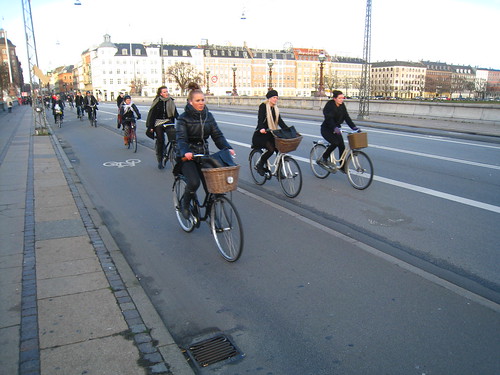
A cyclist on Copenhagen's generously-proportioned
cycle lanes: the Irate Minivan Man of Brixton Hill
might not appreciate this charming Scandinavian city.
It’s one of motorists’ most common complaints about cyclists – along with the perennial (inaccurate) claim that we all ignore red lights – that bikes hold them up and get in their way. But my encounter highlights how some motorists feel something far stronger than a desire to avoid delay. My pursuer put himself close to me only by a deliberate, provocative, highly dangerous effort. It’s not hard to read into his behaviour – and that of quite a few other motorists and pedestrians I’ve encountered – a deeper set of reactions. It’s inherently unlikely, after all, that bicycles – vehicles that take up little road space and form a minority of road vehicles in most developed countries – are a genuinely significant cause of delay. I have certainly heard more cyclists complain about a journey’s being prolonged by the volume of cars than I have motorists complain about the same because of the volume of  bikes.

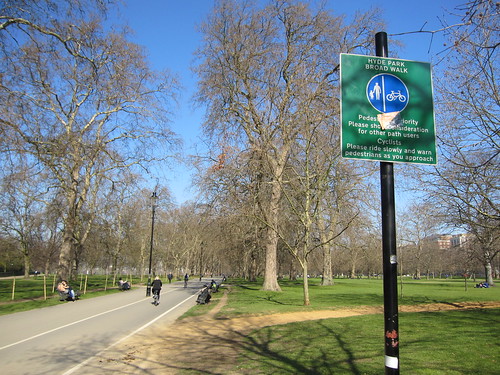
Cyclists, it seems, don't actually have priority on this
cycle path in Hyde Park,according to the sign.
But, well, why would they?
Some people’s existential irritation about sharing the road – or a cycle path - instead takes me back to my meeting with an embittered Protestant 14 years ago in a field outside Portadown, one of Northern Ireland's strongholds of Protestant loyalism to the United Kingdom. The man, who was protesting against the police and army’s blocking of a loyalist parade through a mainly Roman Catholic-Irish Nationalist area, described to me how, as a member of the Protestant majority, he felt downtrodden and oppressed by the Roman Catholic minority. The Catholics, who account for 40 per cent of the population, were getting more and more say in how things were run, he said. The province’s most influential jobs, I pointed out, remained in the hands of Protestants. Catholics remained, on average, poorer. Catholics, I also pointed out, had faced systematic discrimination until the 1970s, excluded from many jobs, from public housing and consequently from voting, which was restricted to householders. He hadn’t known anything about all that, he said. He hadn’t been aware of any problems.

His complaints were similar to ones I've heard from Serbs in Bosnia-Herzegovina about the country’s being controlled by Bosniaks, the country’s Muslims. A colleague once told me with distaste about how a white South African mining executive bitterly suggested to her that, given another life, he’d come back as a black woman. His theory – not, I suspect, based on a thorough investigation of women’s lives in the rough bits of Soweto – was that positive discrimination now made black women’s lives easier than those of white South African men.

All such complaints reflect, it seems to me, the powerful human instinct for those who belong to privileged groups to believe their status a reflection of their own group’s merit. If those privileges are reduced – or extended to another, excluded group – the reaction is often similar. The formerly-downtrodden – whether of a different ethnic group or simply using a different kind of vehicle – are seen as bumptious, difficult, undeserving usurpers.

Which brings me back to the Irate Minivan Driver of Brixton Hill.

 A bike lane on Southwark Bridge: many London motorists
have concluded, the Invisible Visible Man can exclusively reveal,
that the bike pictures in such facilities are a new form of pavement art.
It can hardly, they've decided, be as if cyclists should be given
all this road space.
I can only imagine that my pursuer, if he has been driving around central London for any significant proportion of the last ten years, has felt “his” share of the road shrinking around him. Cyclist numbers have doubled or more on many central London streets, meaning that he will increasingly often have to moderate his behaviour to cope with bicycles. There have been similar increases in other big rich world cities. The issues surrounding cycling are less all-encompassing than the questions that face Northern Irish Catholics or South African blacks. But, in many metropolises, drivers like the Irate Minivan Man feel, it seems to me, a nostalgia similar to that of the man I met in Portadown for the says before a resented, encroaching group started to get ideas above their station.

Even for those drivers I genuinely force to slow down, however, it is rare for a delay to stretch beyond milliseconds into seconds. I have, as I have detailed in a previous blog, been abused by an angry motorist because I had delayed her arrival at the end of a traffic jam. The sheer numbers of motor vehicles – which really do cause congestion – have risen sharply in recent years in many big cities at the same time as cycling numbers. The vehicles, both parked and on the move, have also grown steadily larger, exacerbating their congestion-causing effect. In a rational world, my minivan-driving hunter would have been just as angry with the parked cars, the real reason it was unsafe to let him pass. Any doubts I might have had about motorists' attitude on this matter were dispelled when I read a comment on a (since deleted) post on the excellent Cycling Lawyer blog. The commenter complained about how s/he particularly worried about passing the biggest, fittest cyclists because they tended to outpace his or her car up hills.

Clapham Common: pedestrians can get
just as angry as minivan drivers
Yet an incident a couple of years ago on Clapham Common, a couple of kilometres from where I encountered the Irate Minivan Driver, suggests the real root of some of the resentment. I was cycling across the common, on a designated cycle path, when I encountered a man, with his back to me, pushing a baby buggy. I slowed down and, because he was turned away, rang my bell several times, to no effect. “Don’t worry – I heard you,” he eventually shouted over his shoulder, refusing even to look round. There was a whole common for me to cycle across, he suggested. He wouldn’t get out of my way.

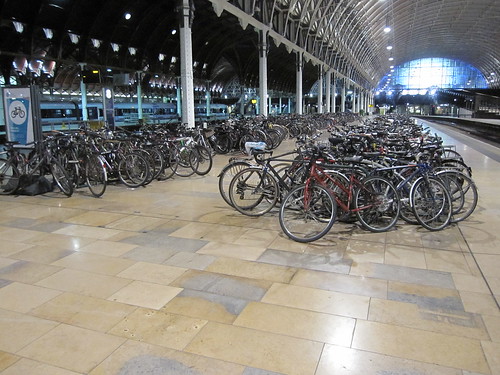
London's Paddington Station: The Invisible Visible Man's bike is in
here somewhere (though, predictably,  not visible). Network Rail,
the station's owners, seem as reluctant as others in London
to give bikes the space they need.
The parallel pedestrian path, nevertheless, was only a couple of metres away. There was only one designated cycle route the way I needed to go. The man seemed as infuriated at the devotion of space to a cycle path as Irate Minivan Man was at my taking up space on the road. It is one of several similar incidents I’ve encountered on paths across the Common.

On a road just by the common, meanwhile, I pulled in one Saturday to the space devoted to bikes at a set of traffic lights. I was pulling the Invisible Visible Boy in a trailer and pulled towards the centre of the road to let the Invisible Visible Woman into the area with the Invisible Visible Girl and her trailer bike. Incensed by my using the space for its designated purpose, a well-spoken, middle-class motorist pulled forward beside me, rolled down his window and said, with an air of deliberate threat: “If you stay at the side of the road, you won't get hit.” When the lights turned green, he accelerated away so fast his tyres squealed. Interestingly, pedestrians generally avoid obstructing the several roads that cut across and spoil the Common the way some feel compelled to do on the cycle paths.

Yet such bizarre, ingrained attitudes aren’t immutable. It was once held axiomatic that very little could be done to reduce drinking and driving – a problem that has been sharply reduced in many countries through consistent, unequivocal public information campaigns. Only a few years ago, prejudice against gays and lesbians went unchallenged. Before that, broad generalisations about blacks or Asians were accepted in polite society.

Such progress looks some way off for cyclists, however. Until it arrives, I’ll have to hope encounters with the likes of Irate Minivan Man end as relatively harmlessly as that one eventually did. After around 150 frantically-pedalled metres, a long break in the cars let me pull over. He accelerated past me and screeched off round a junction. He was, I imagine, frustrated. It requires self-discipline for any group to tolerate ceding territory to another. But nothing I did could have cost him more than a few moments. Had I slipped on one of the speed bumps or otherwise lost my nerve, the consequences of his driving for me could have been many, many times further-reaching.

Wednesday, 22 February 2012

What have the Romans ever done for us? Well, given us Cycle Superhighway 7, for a start


It wasn’t until recently that I discovered why, on a good night, I was able to cycle so fast for a lot of my journey home. I’d previously noticed only that south London boasted a striking number of wide, straight roads that let me, when traffic was light, put my head down, slip into higher gears and cruise at around 30 kilometres an hour. Then I happened in Nikolaus Pevsner’s Buildings of England: South London on a casual reference to Kennington Park Road’s having started as a Roman road. When my bike’s wheels rolled along Cycle Superhighway 7, I realised, they were going where legionaries once marched in plumed helmets between the camps of Londinium and Sussex.

It has been one of the joys of my ten-and-a-half years of cycling in London to have gained a far clearer sense of how the city fits together. When I arrived mole-like at my destination from the underground, I used to peer myopically at each area in isolation from its neighbours. As a cyclist, I no longer feel Covent Garden is cut off from Holborn or Old Street from Bank.

Cycling has also, however, led me to encounter so many ghosts from the city’s past – from its foundation under the Romans to its last hundred years of struggle against adversity - that it feels almost human to me. Londinium, Lundenwic, Lundenburh or London has been knocked down, slaughtered by disease, moved, neglected, shaken by violence, burnt and bombed. But it has consistently struggled back – a stubborn, punch-drunk heavyweight willing himself back into the ring.

The story began in periods of history that archaeologists’ trowels are only slowly unearthing. It has continued up until events that I have witnessed and reported upon. It will continue in all likelihood when I am as forgotten as the millions of others who have come to London to make something of themselves, enjoyed the city’s excitements, cursed its frustrations and died.

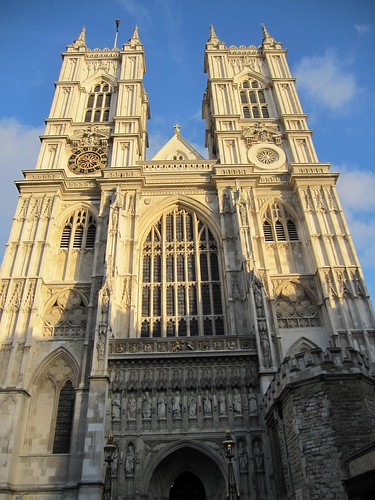
Westminster Abbey: inspires awe, but
not much reverence
It’s probably fitting that I never come across much from a while after the era of London’s Roman founders – they were the dark ages, after all. Nor do I get particularly worked up about the great monuments from just after 1066’s Norman conquest. Westminster Abbey certainly fills me with the intended awe. The oddness of my pedalling past the still-solid, 900-year-old Tower of London – a fortress built amid a still not wholly-tamed England – occasionally strikes me. But it’s the less obvious monument of Charterhouse Square, by Smithfield Market, that gives me the fullest sense of encountering my medieval London forebears.

I often swing to the right near the square when returning to the office from north of the City. It’s one of the tranquil, genteel oases still hiding among the office towers and bustle of the world’s leading international financial district. But the square has properly occupied my attention only since I read, a few months ago, about its role in the Black Death. The site of the square, I discovered, had been a mass grave, filled in 1348 with the bodies of tens of thousands of  Londoners. Half the city’s inhabitants died.

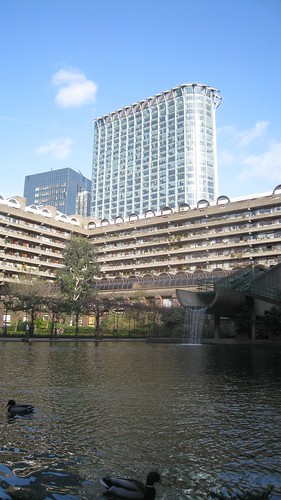
The Barbican:full of Black Death ghosts
trapped, possibly, in the impossible-to-navigate
walkways
I was seized with a mental picture of some prosperous woman, just widowed but feeling the disease’s first symptoms herself, knowing she might have as little as a day to write her will. The story didn’t play out in my mind, however, among the muddy, chaotic streets of plague-ridden, 14th century London but somehow amid the 1970s concrete of the Barbican Centre, just across Aldersgate Street from the plague pit.

The city would heave itself up on the ringside ropes after the Black Death, nevertheless, suck in more newcomers and carry on. The neat Tudor brickwork of the Archbishop of Canterbury’s Lambeth Palace, which I swoop past on my way from home to central London, reminds me of a high point – when England’s new self-confidence first led the country to look far beyond its shores.

Yet the ghosts of the people have more power to surprise my unwary emotions.

St Paul's churchyard:look closely and the New Model Army is
trudging up the hill towards you


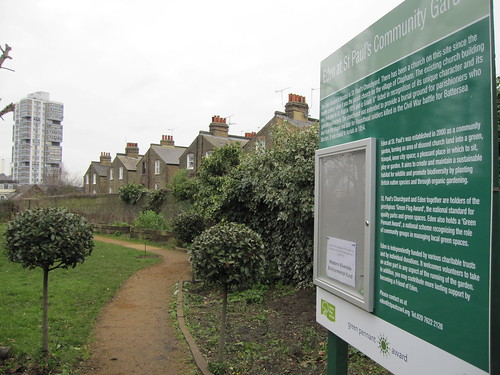
It was outside my son’s nursery that I suddenly found myself amid the English Civil War. I haul him most mornings in a trailer to the nursery, in a Clapham church. I detach the trailer for his nanny to bring home, kiss him goodbye and prepare to head off. Then, as I retrieved my bike one morning, my eye happened on a new notice. It explained how the churchyard had received the area’s plague dead. It had also subsequently expanded to hold the Roundhead dead from the Civil War battle of Battersea marshes.

Battersea Power Station: art deco amid Civil War ghosts
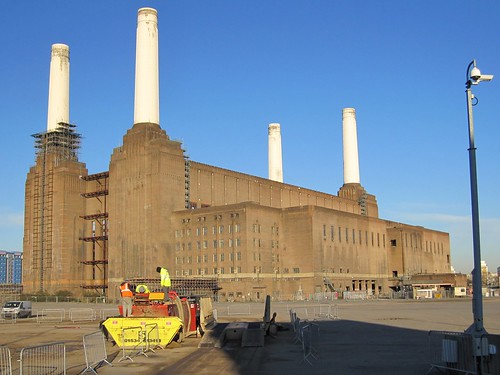
I could see from where I stood modern Battersea, below the hill I sometimes freewheel down en route to Chelsea. The famous power station casts its art deco bulk over the whole area. The Telecom Tower punctuates the skyline. I could nevertheless suddenly sense the parliamentary army’s remnants slogging their way up the hill towards me, their breath hanging in the air over their severe, round helmets, their dead piled in carts behind. This place – the first dry, flat place they reached – would not permit a very dignified burial for the fallen. But it would have to do.

It’s not the only reminder of 17th century tragedy I encounter. A pedal up the steep cobbles of Pudding Lane brings me to the monument to the Great Fire, the destroyer of vast tracts of the city. In 1665, the year before the fire, the bubonic plague for the last time had killed thousands of Londoners en masse.

St Paul's: Sir Christopher Wren gives
possibly the finest two-finger salute in history to fate
However, London not only recovered from those twin catastrophes but showed it with the monumental bulk of St Paul’s Cathedral. I cycle in its shadow to meetings with the City’s bankers and lawyers, marvelling at how my forebears showed such a magnificent two fingers to fate.

Then again, a lot of what I encounter from the next two centuries reeks of audacious confidence. The neat Georgian terraces I cycle between on Kennington Road; the mile after mile of Victorian villas I pass with my family at weekends: they all suggest a robust optimism about the future impossible to imagine feeling now. The wonder is perhaps that it survived so long in a Victorian London occasionally swept by cholera and continually disgraced by some inhabitants’ poverty.

The Cable Street mural commemorates the battle: you have
my permission to think it sentimentalises a complex event.
The buildings constructed after the shock of the first world war puff their chests out far less. A mural that I pass on my way down Cable Street towards Canary Wharf is a reminder of how the clouds started gathering again afterwards. It commemorates how Communists and other anti-fascists in 1936 violently resisted efforts to push through the mainly-Jewish East End a march by fascist blackshirts. I still come across partially unhealed second world war wounds. Whole communities were smashed. In exchange for their ruined houses, they got either the grim, poorly-built postwar housing I often cycle past, or exile to new towns.

Nevertheless, it’s the smallest scars – the points, like the ones on my own street, where one or two post-war houses intrude into a Victorian terrace – that bring home the human drama. As I pedal past such spots, I imagine how  a bomber, full of frightened young men desperate to make it back to Germany, dropped its unused bombs there to escape faster. On their tails would have been young British or Polish or Canadian fighter pilots – just as scared, presumably, but fired up with the need to defend Europe’s last big, free, democratic city. It must have been impossible for the bereaved not to wish that the bomb had fallen somewhere else, on a house not full of their loved ones or their possessions.

Those events are easier to understand, of course, because they remain in living memory. A video showing at the Museum of London includes one woman’s account of how her 12-year-old brother went to buy a drink in the local Woolworth store in New Cross in 1944. He was one of 168 killed when a German V2 rocket hit it. “They didn’t find much of him,” she says, sadly. An older friend has told me how her house was destroyed by a German bomb – and the disorienting sensation of seeing her bedroom exposed to the elements.

But I appreciate the past traumas all the more because of a memory of my own. I was standing in the street by Edgware Road underground station, my bicycle in one hand, peering at a television in a shop window. I had been assuming, as I cycled over there to investigate reports of explosions on the underground, that they were down to some problem with the underground’s power. Immediately I saw a bus had exploded, I knew instantly, in my head and my stomach, what must be going on. Near me dead in the underground station lay seven of my fellow Londoners – a handful of the 52 who would die – and Mohammad Sidique Khan, one of four suicide bombers.

It made me warmer towards London, I think, to cycle round that day and take in the dazed looks on my fellow Londoners’ faces amid the echoing sirens and the beat of the helicopters overhead. London’s tolerance of diversity may be expressed in a cool, arm’s length fashion rather than a fuzzy embrace. But, as more cyclists joined me on the roads in the coming weeks, scared of the underground or facing disruption from line closures, I valued the city’s live-and-let-live tradition all the more for knowing how others hated it.

This isn’t, I hope, to sentimentalise a city that’s probably been hard work since the Romans first spotted a good place to cross the Thames. Londoners rioted murderously against giving Roman Catholics civil rights, backed the blackshirts as well as the resisters at Cable Street and used sometimes to hang signs reading “no dogs, no blacks, no Irish” in boarding house windows. Many of my fellow Londonders, as I’ve argued before on this blog, currently need to revise their attitude towards cyclists.

But, even when the streets teem with the super-efficient bikes of the future, such a big, intense city will never achieve perfection. There were, presumably, rows once between Roman wagoners and charioteers over priority in Londinium’s cramped streets. The first cyclists, I imagine, were abused for scaring the horses.

Yet, if it’s a flawed work in progress, it’s at least a work in progress built by now on the rich experiences of tens of millions of my forebears, people whose traces are there for anyone who pays attention to see. I shall look around, next time I’m the target of some taxi driver’s or white van man’s rage, for such a sign and imagine the person who left it. “Forget it,” he or she will tell me, “the city will long outlive you both.”