It used to be frustrating asking Boris Johnson, London’s mayor until May last year, about transport policy issues. During my first stint as a transport correspondent, from 2003 until 2011, I recall asking him about his determination to remove the western extension of London’s congestion charging zone, to introduce new cycling facilities as mere blue-painted lanes down busy main roads and replace London’s efficient, articulated buses with a lower-capacity, double-deck vehicle loosely based on a much older vehicle. All the concerns were shrugged off, with Johnson’s trademark insouciance.
All those ideas are now recognised, to a greater or lesser degree, as bad ones that either should have been better thought through or not implemented at all. Congestion in west London rose; the painted “superhighways” proved tragically dangerous and the new bus has become an expensive joke that has helped to damage the performance of London’s bus networks. The mayor, meanwhile, went on to be a leading figurehead of the movement calling for the UK to make one of its biggest, most poorly thought-out policy decisions since the second world war when it voted to leave the European Union.
This past week, however, has left me with the impression that far more people approve of the former mayor’s style of policy-making than I had suspected. Since I posted on Monday a blogpost calling for cyclists to face the reality that London’s roads are growing steadily more congested, I’ve faced a series of criticisms. Many of them have focused on my argument that cyclists have to recognise that our aspirations to get further dedicated space for cycling facilities mean we are in competition for scarce road space with other road users, who face growing congestion. Cyclists ought, I argued, to take an interest in the problem and in measures to rein it in. In particular, I was the subject of a blogpost by Andrew Gilligan, who worked as Boris Johnson’s cycling commissioner. He accused me, essentially, of cherry-picking evidence to suit my position and asserted, based on Transport for London’s Journey Time Reliability figures, that congestion wasn’t really getting worse at all.
The various criticisms I’ve faced have fallen into a series of broad groups. Several people argued that there was no real trade-off between cycling and other modes. Others contended that other road-based modes were so much less worthwhile that any trade-off was worth it even if it, say, caused serious inconvenience to people making the 6.5m daily trips by bus in London. Finally, there was a strain of thought that I was mistaken in even my attempt to put cycling in a broader policy context. Cyclists should make the argument for cycling provision and forget about anything else. I’d class all of these criticisms as falling, like Johnson himself, within the Cavalier tradition in British public life - that the depth of one’s convictions and the elan with which one states them are more important than the pettifogging details of the statistics.
However, a report on Thursday from the London Assembly’s transport committee has reinforced my conviction that my cautious approach to public policy - which I’d class as being in the Roundhead tradition - is in the ascendant, in London at least. The report acknowledged the growing congestion crisis and that the recent worsening in conditions reflected a shrinking of the road network’s capacity for multiple reasons. It advocated - as I do - pressing ahead with new, high-quality cycle provision such as the segregated cycle superhighways. However, it also said it was vital to introduce road-pricing - as opposed to a simple congestion charge for entering central London - to relieve the pressure on the roads. I very much hope - although I doubt that the current mayor has the political courage for it - that the assembly members’ recommendation will be followed. I also hope that the debate over the issues can become more constructive than it feels to me after a week that’s marked a fairly miserable fifth anniversary for this blog.
The focus of much of the criticism, however, has been my reference in the last blogpost to a point that ought, in a rational world, to be uncontroversial. This was to point out that central London’s congestion is worsening and that it is likely that the building of wide cycle tracks along some of central London’s key arterial roads - and the addition of some cyclist-only phases at junctions - contributed to this. I made the point not because I disapprove of the cycle tracks’ building - I enthusiastically endorse them - but because of the implications for the future.
Anyone who wants an extension of the existing tracks needs to gain the approval of planning authorities and a mayor’s office already facing substantial pressure because of the road network’s deteriorating performance. There seems to me to be little likelihood that a mere restatement of the now-conventional wisdom that the cycle superhighways are unrelated to traffic delays is going to win over many of the people that need to be persuaded.
In fact, the reason why I didn’t quote Gilligan’s favoured measure of congestion - journey time reliability - is that the average speed figure that I used more accurately captures the nature of this problem. The reliability figure tracks the proportion of vehicles that complete trips in more than five minutes longer than the average time over the previous year. It consequently measures the frequency of severe, one-off disruption. Its use of previous average speeds means it is designed to screen out the kind of gradual, strangling congestion that is steadily choking London.
My central point remains. It must, in my view, be a serious problem if average daytime traffic speeds in the centre of London - a place where motor vehicles are needed to serve a big upsurge in building and infrastructure work, to carry people in buses and to make deliveries - have dropped as low as 7.8 mph.
Members of the London Assembly’s transport committee seem to share many of my concerns. In the foreword to their London Stalling report on congestion in the capital, Caroline Pidgeon, the committee’s chairwoman, wrote that congestion had begun to rise sharply.
“Traffic has slowed down and road users are spending longer stuck in delays,” she wrote. “Buses have become so unreliable that usage has begun to fall, after many years of growth.”
The report went on to list a very Roundhead set of recommendations - ideas based on careful attention to the statistics, rather than the kind of sweeping, grand gesture that used to be the rule under the previous mayor. While I am delighted that the existing superhighways have been built and grateful to Andrew Gilligan for his central role in that achievement, it seems vanishingly unlikely that either Sadiq Khan or the assembly’s transport committee will sign off on a significant extension if it will produce a further worsening of congestion.
It is hard to imagine some of the arguments I’ve heard this week will succeed in swaying the current mayor. It is inherently implausible, for example, that the mayor will allow measures that significantly delay bus passengers to benefit cycling, which currently accounts for just 700,000 daily journeys across the capital. As with nearly every other public policy question, measures to favour cycling are subject to trade-offs with other choices in which policymakers have to balance competing interests in as equitable a way as possible.
But the ultimate question for me doesn’t involve politics, policy arguments or the different personality types of the people involved. It’s that my children since we returned to London from New York in July have become much keener on cycling in central London, thanks to the cycle superhighways. I want to see them extended so that we need do far less jostling with aggressive drivers to reach them.
The Cavaliers had the chutzpah to get the existing facilities built. Perhaps their current strategy - berating the uselessness of everyone concerned, questioning their motives and insisting that no trade-offs are necessary - will succeed again, despite my concerns. But my guess is that the next push will require more of a Roundhead’s recognition of the complexity of the policy challenges and readiness to get to grips with them. I hope that such sober thinking will grow far more widespread than it seems to be at present.
All those ideas are now recognised, to a greater or lesser degree, as bad ones that either should have been better thought through or not implemented at all. Congestion in west London rose; the painted “superhighways” proved tragically dangerous and the new bus has become an expensive joke that has helped to damage the performance of London’s bus networks. The mayor, meanwhile, went on to be a leading figurehead of the movement calling for the UK to make one of its biggest, most poorly thought-out policy decisions since the second world war when it voted to leave the European Union.
 |
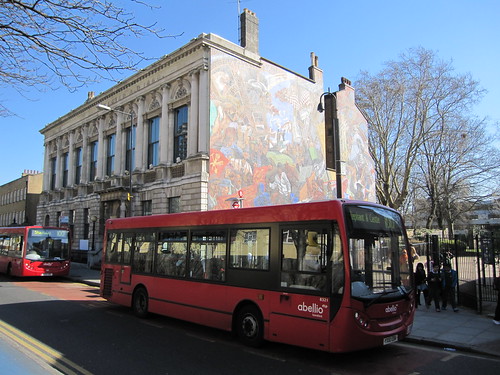
| A Routemaster at the London Transport Museum: nostalgia for the design classic inspired Boris Johnson to commission the New Bus for London, the opposite of a design classic |
This past week, however, has left me with the impression that far more people approve of the former mayor’s style of policy-making than I had suspected. Since I posted on Monday a blogpost calling for cyclists to face the reality that London’s roads are growing steadily more congested, I’ve faced a series of criticisms. Many of them have focused on my argument that cyclists have to recognise that our aspirations to get further dedicated space for cycling facilities mean we are in competition for scarce road space with other road users, who face growing congestion. Cyclists ought, I argued, to take an interest in the problem and in measures to rein it in. In particular, I was the subject of a blogpost by Andrew Gilligan, who worked as Boris Johnson’s cycling commissioner. He accused me, essentially, of cherry-picking evidence to suit my position and asserted, based on Transport for London’s Journey Time Reliability figures, that congestion wasn’t really getting worse at all.
The various criticisms I’ve faced have fallen into a series of broad groups. Several people argued that there was no real trade-off between cycling and other modes. Others contended that other road-based modes were so much less worthwhile that any trade-off was worth it even if it, say, caused serious inconvenience to people making the 6.5m daily trips by bus in London. Finally, there was a strain of thought that I was mistaken in even my attempt to put cycling in a broader policy context. Cyclists should make the argument for cycling provision and forget about anything else. I’d class all of these criticisms as falling, like Johnson himself, within the Cavalier tradition in British public life - that the depth of one’s convictions and the elan with which one states them are more important than the pettifogging details of the statistics.
 |
| A mid-morning traffic queue on Blackfriars Road: road-pricing might fix this. |
The focus of much of the criticism, however, has been my reference in the last blogpost to a point that ought, in a rational world, to be uncontroversial. This was to point out that central London’s congestion is worsening and that it is likely that the building of wide cycle tracks along some of central London’s key arterial roads - and the addition of some cyclist-only phases at junctions - contributed to this. I made the point not because I disapprove of the cycle tracks’ building - I enthusiastically endorse them - but because of the implications for the future.
Anyone who wants an extension of the existing tracks needs to gain the approval of planning authorities and a mayor’s office already facing substantial pressure because of the road network’s deteriorating performance. There seems to me to be little likelihood that a mere restatement of the now-conventional wisdom that the cycle superhighways are unrelated to traffic delays is going to win over many of the people that need to be persuaded.
 |
| Cyclists last week on the north-south Cycle Superhighway: a stirring and encouraging sight - but still, I contend, one that must be affecting the neighbouring motor traffic. |
As I pointed out in the original post, the average speed of traffic in central London has fallen in the most recently-published figures despite a substantial fall in the volume of traffic on the roads, a phenomenon that most observers attribute to a shrinking of the network’s capacity. While it’s true that the network’s capacity started to fall well before the cycle superhighways were built, there’s little serious doubt that the superhighways are contributing to delays for motor vehicles. An update in November on implementation of the schemes said that journey times for motor vehicles southbound alongside the north-south cycle superhighway had returned to pre-construction levels since completion of the project. All other traffic flows alongside the superhighways were longer, however.
The added delays included eastbound journey times alongside the east-west cycle superhighway that were 10 to 15 minutes longer in the evening peak than before the facility was put in. The roads concerned will undoubtedly have been affected by the wider worsening of congestion in the period in question and the changes will no doubt, like all changes to road networks, bed down as drivers adapt their behaviour to cope. But it seems profoundly improbable that the big changes to traffic flows have not contributed to this slowing and it is impossible that this substantial slowing of some journeys has not played a part in the declining average speeds reflected in the statistics.
It was my reference to the superhighways’ effects that prompted Andrew Gilligan’s response. Referring to me by my title in my day job - something I’ve tried to keep scrupulously separate from my free-time blog - he accused me of using figures that were “selective” and that the true indicator of congestion was quite different. At least one person treated this post as definitive proof that I was wrong. “Watch @mragilligan use knowledge and stats to destroy @RKWinvisibleman 's recent argument that cycle lanes are causing London congestion,” wrote @BrixtonHatter on Twitter, linking to Gilligan’s post.
Yet Gilligan’s arguments seem at odds with nearly everyone's experience. His argument that congestion isn’t getting much worse pre-supposes that the ever-slowing movement of London buses and logistics companies’ dwindling productivity are mere fever dreams. Any anecdotal evidence - the fact, for example, that I often now have to pick my way between halted vehicles to buy my lunchtime sandwich, whereas the danger used to be moving ones - is also to be disregarded.
In fact, the reason why I didn’t quote Gilligan’s favoured measure of congestion - journey time reliability - is that the average speed figure that I used more accurately captures the nature of this problem. The reliability figure tracks the proportion of vehicles that complete trips in more than five minutes longer than the average time over the previous year. It consequently measures the frequency of severe, one-off disruption. Its use of previous average speeds means it is designed to screen out the kind of gradual, strangling congestion that is steadily choking London.
 |
| A typical weekday lunchtime on Southwark Bridge: anecdotal evidence that it seems I must disregard. |
Members of the London Assembly’s transport committee seem to share many of my concerns. In the foreword to their London Stalling report on congestion in the capital, Caroline Pidgeon, the committee’s chairwoman, wrote that congestion had begun to rise sharply.
“Traffic has slowed down and road users are spending longer stuck in delays,” she wrote. “Buses have become so unreliable that usage has begun to fall, after many years of growth.”
The report went on to list a very Roundhead set of recommendations - ideas based on careful attention to the statistics, rather than the kind of sweeping, grand gesture that used to be the rule under the previous mayor. While I am delighted that the existing superhighways have been built and grateful to Andrew Gilligan for his central role in that achievement, it seems vanishingly unlikely that either Sadiq Khan or the assembly’s transport committee will sign off on a significant extension if it will produce a further worsening of congestion.
 |
| Ultimate motivation: my son enjoys the east- west cycle superhighway by the Embankment |
It is hard to imagine some of the arguments I’ve heard this week will succeed in swaying the current mayor. It is inherently implausible, for example, that the mayor will allow measures that significantly delay bus passengers to benefit cycling, which currently accounts for just 700,000 daily journeys across the capital. As with nearly every other public policy question, measures to favour cycling are subject to trade-offs with other choices in which policymakers have to balance competing interests in as equitable a way as possible.
But the ultimate question for me doesn’t involve politics, policy arguments or the different personality types of the people involved. It’s that my children since we returned to London from New York in July have become much keener on cycling in central London, thanks to the cycle superhighways. I want to see them extended so that we need do far less jostling with aggressive drivers to reach them.
The Cavaliers had the chutzpah to get the existing facilities built. Perhaps their current strategy - berating the uselessness of everyone concerned, questioning their motives and insisting that no trade-offs are necessary - will succeed again, despite my concerns. But my guess is that the next push will require more of a Roundhead’s recognition of the complexity of the policy challenges and readiness to get to grips with them. I hope that such sober thinking will grow far more widespread than it seems to be at present.