Unusually early for a Saturday, I cycled off September 14 towards
Sheepshead Bay ,
a distant corner of Brooklyn , to help out with
a relief project dealing with the continuing unrepaired damage from last year’s
Superstorm Sandy. Running late as ever, I started off at a sprint over a lift
bridge near our apartment that takes Brooklyn’s 9th street over the Gowanus Canal 9th street
subway station. The subway sits high on a viaduct above.
 |
| The great 9th Street scaffolding collapse: I can't think how anyone would have blamed me if I'd got caught up in this. But I'm sure they'd have found a way. |
A couple of hours later, a large truck carrying building
materials made the same journey over the bridge as I - but with a crane on its
back sitting a little higher than it should have done. The crane caught a piece
of corrugated iron on a vast network of scaffolding erected for a renovation
project on the subway station. I returned from Sheepshead Bay 9th street
barred to me and police and fire officers milling around a tangled mess of
truck, corrugated iron and other bits of the scaffolding. Had I been riding
over the bridge at the same time as the truck, I would have been helpless.
Sheets of metal and steel poles would have tumbled on top of me, while the
driver, protected by his cab, was unhurt.
Yet, had I found myself crushed under the scaffolding, at
least some people, I’ve come to realise, would have blamed me for not looking
after myself better. That’s the implication of the response to an appalling
incident on September 12 when a motorist in Maspeth, part of the New York
borough of Queens, drove onto a sidewalk and hit five children, three of whom
are seriously injured. One child, although initially regarded as only slightly
hurt, has since died of an asthma flare-up which, the laws of probability suggest, was probably related to the crash.
The letter – which education officials seem to have insisted the principal sent, over his objections – is all the more astounding since it
makes no suggestion that parents drive more carefully – and the driver responsible
seems to have been dropping his own child at the school.
The education system’s reaction was far from unique. I
recently read with dismay the comments under an old news article about the
death in 2011 of Johannah Bailey, a cyclist hit by a van driver on Cavendish Road, part of London’s South Circular in Clapham, that I’ve often ridden
myself. The van driver, Andrei Dulgher, rounded a bend in the road so fast that
he drove over a traffic island before hitting Ms Bailey – on a turning lane in
the centre of the road - and sending her body flying high into the air.
One ostensibly sympathetic comment from someone who’d
witnessed the horrific incident – which came to my attention when Dulgher was
cleared of causing death by dangerous driving – expressed horror at what
happened and appealed to all cyclists to “take care” when riding. How cyclists
were meant to “take care” around vehicles coming round blind bends at speed in
the wrong part of the road was not made clear.
The scaffolding incident and the strange comment on Ms
Bailey’s death have prompted me to think hard not only about how other people
think vulnerable road users should behave but how I myself think. Where is the
line between a crash that the victims clearly couldn’t have avoided – such as
that in Maspeth or Johanna Bailey’s killing – and an incident where the
victim’s negligence clearly contributed to what happened? Why do so many people
place the blame so firmly on the vulnerable? How does that affect my own road
behaviour?
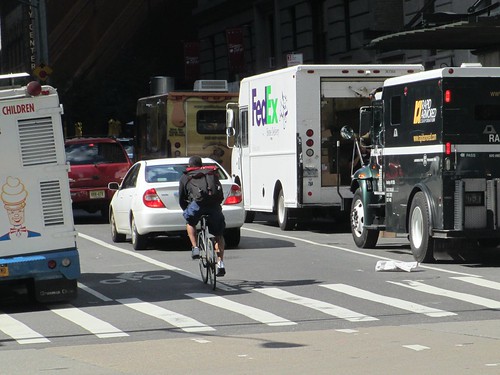 |
| The Invisible Visible Man is comfortable with fewer risks than this helmetless, dark-clothed midtown Manhattan cyclist. But he still recognises it's the cars that pose the main risk |
Yet, if the SUV had hit me, it would have been a relatively
unusual type of crash. Every survey I’ve read, including a very detailed one from Transport for London, attributes most crashes involving
cyclists to a relatively small number of causes – motorists’ failure to look
properly, motorists’ failure to judge cyclists’ speed or direction and
motorists’ passing cyclists too fast and/or too close. It’s not, in other
words, that common for cyclists or other vulnerable road users to take
suicidally silly risks or make utterly inept mistakes. The people who are
hidden inside steel shells so have least to risk tend to be the biggest risk
takers.
I ride in such a way as to reduce my risks. I wear – unlike
many of my fellow New York
cyclists – a high-visibility vest and even a reflective snap bracelet, intended
to help drivers to see when I’m signalling left. Convinced that protection for
my body’s densest, most sensitive part must do some good, I use a helmet. I
also – again, unlike a puzzlingly high proportion of New York cyclists – use lights at night, two
at the rear and one at the front. When riding on a cycle lane between a line of
halted or slow-moving cars and parked vehicles, I ride slowly, aware that a
door could suddenly fly open or a car lurch suddenly into my lane.
Possibly most importantly of all, I try to communicate with
drivers. “I’ll be going straight ahead here, OK?” I occasionally say through an
open window. “Stop! Wait there!” I’ll tell one who’s turning illegally across
my path. “Please stop using your phone,” I’ll tell another. “It’s making you
drive badly.”
It’s no coincidence, however, that my efforts are designed either to help me to react in circumstances where I know
drivers are likely to be negligent or actually to influence drivers’ behaviour.
I concentrate on taking reasonable steps to mitigate the most serious risks. I
don’t pretend that, walking on a sidewalk, I could protect myself against an
out-of-control SUV hurtling towards me. I don’t believe I – or the poor
children so horribly hurt in Maspeth – bear responsibility for crashes
where the driver has been negligent and the victim wasn't.
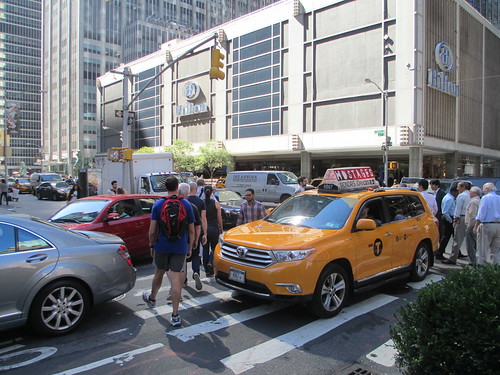 |
| These drivers blocking a crosswalk on W54th street know who's boss: and it ain't the pesky people on foot |
That thinking, it seems to me, lies behind responses like that of the New York Department of Education to the Maspeth tragedy. Many people seem to see cars as the natural, inalienable rights-holders in public places. Cyclists and pedestrians are the parent-in-law house guests –
just about tolerated, but only with the poorest of graces. The streets would
surely be safer if more people thought of roads as places where multiple types
of road users mixed, rather than places where cars drive and others fit around
them.
It will, ironically, be when most people think automatically
on hearing of incidents like the Maspeth crash, “How negligent of the careless driver” rather
than, “How negligent of the walking teenagers” that people will start to hear of far fewer happening.
