Showing posts with label New York City. Show all posts

Monday, 4 July 2016

A tour of tolerant diversity, the horrors of its opposite - and why I'm sorry to say goodbye

I was waiting in line for Salvadorean food, standing next to a black fellow cyclist after the Transportation Alternatives Brooklyn-Queens Tour through New York’s two most diverse boroughs, when the announcement came for a moment of silence. Because we’d been riding our bikes, few of us knew what had happened. “Fifty people?” the rider next to me asked, in a tone of shock. I started trying to work out how one person could possibly have killed so many people.

By the end of June 12, however, I was not only learning far more about the day’s appalling massacre at the Pulse gay nightclub in Orlando, Florida, but on my way to a hotel near the scene to report on it. The job of covering the attack was all the more traumatic because I’d, unusually, remained ignorant for so long of its happening.
Cyclists wait at Citi Field to start the Brooklyn-Queens
Tour. The same parking lot was the scene, later the same day,
of a horrific revelation for many riders

Yet the experience of having ridden my bike through Brooklyn and especially multicultural Queens before heading to Orlando kept informing my thinking over the following two days. The areas where I’d been riding are some of the most diverse in any major western city, with people from countries all over the globe living next to each other in a miracle of tolerant diversity. I couldn’t help but wonder what made the difference between very different people’s ability to live together in areas like Crown Heights – where observant Jews live next to black people from the Caribbean – and the impulse that drove the hate-filled Orlando attacker.

My reactions were all the stronger because I’d undertaken the Brooklyn-Queens Tour as a farewell to New York before I leave the city to return to London on July 6. The looming deadline has made me think harder about why I love the atmosphere of New York City so deeply, despite the chaos – even the corruption - of much of the city’s functioning. I’ve decided that the chaos and its loveability are closely tied up in each other. It’s just unfortunate that the chaos overpowers the loveability on the roads, while it’s mostly the other way round everywhere else.

From the very start of my day’s riding on June 12, I’d been reminded how a cyclist – riding at moderate speeds on surface streets - is uniquely placed to appreciate the intricacy of the stitching that holds together New York’s ethnic patchwork. The morning of the Brooklyn-Queens Tour, I started at my home in traditionally Italian-American Carroll Gardens to ride to Citi Field, the New York Mets’ stadium, 13 miles away, for the start of the event. The trip took me through mainly African-American housing projects near the Brooklyn Bridge, Hasidic Jewish South Williamsburg, heavily Polish Greenpoint then over the Greenpoint Avenue Bridge into areas of Queens that are variously East Asian, South Asian and Hispanic.
 
Diversity Plaza: a twee name for a high ideal
At one point where a particularly large number of seams come together, in Jackson Heights, I rode along a block recently rather tweely renamed “Diversity Plaza”. A nearby block is almost exclusively filled with Tibetan restaurants and grocery stores, while other shops nearby sell saris to local Tamils and a Chinese supermarket supplies the neighbourhood’s Chinese. The area hums to the tune of dozens of different languages.

The boundaries between the different groups’ areas are porous and unclear. The Chinese supermarket in Jackson Heights, for example, stocks some Filipino and Vietnamese food because it recognises that the area’s far less uniform than, say, Manhattan’s Chinatown.

The arrangements are the exact opposite of what I remember seeing when I visited Bosnia in 1995 during its war of independence. As I rode with a bus full of refugees from Tuzla to Split, we kept encountering checkpoints still operating after the brief war between the Bosnian government and Bosnian Croats. The papers of the people on the bus – mostly Bosniaks, as Bosnian Muslims call themselves – all had to be carefully checked to prevent unauthorised crossing of ethnic dividing lines. While the streets of, say, Little Italy were once guarded by men who kept strangers out, there are no barriers for a contemporary New Yorker to wandering around densely-packed areas full of people who look different from him or her.

A bicycle saddle is also an excellent vantage point to see how little obvious planning has gone into forming the city’s ethnic jigsaw puzzle. Old groceries get converted into churches as new groups take over areas that once belonged to another. A grand former synagogue on Pike St in Lower Manhattan is now a mixture of a Buddhist temple, businesses and apartments. The city’s history is that it’s largely when people are able to choose their own patterns of settlement that the process goes most smoothly.
 
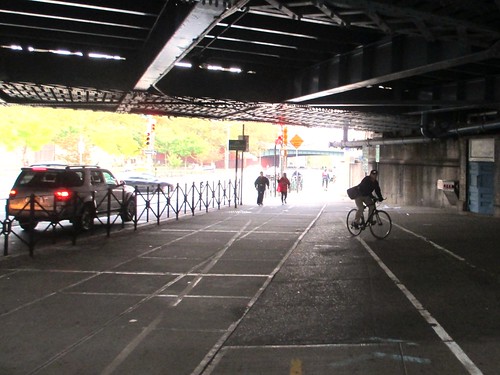
A viaduct on the Brooklyn-Queens Expressway:
Robert Moses' sensitive approach to city planning
on full display
It is certainly no coincidence that the neat mind of Robert Moses – the “master builder” who transformed New York in the mid-20th century – abhorred both diversity and the narrow local streets where it flourishes. In the years after the second world war, he demolished multiple areas that he regarded as slums, replacing them with whiter, duller institutions such as the Lincoln Center or expressway roads. It was obvious at many points along my ride how highways such as Moses’ Brooklyn-Queens Expressway severed once-thriving communities. The city is in many ways only just recovering from his insensitive desire to destroy in the course of building.

Perhaps the truest expression I’ve encountered of New York’s diversity is a scene I encountered on my bicycle while apartment-hunting four years ago. In a tyre shop on Coney Island Avenue in Brooklyn one evening, white-robed men were hunched over drums performing a Sufi Islamic ritual. The ceremony looked imported unchanged from the back streets of the Maghreb. It was being performed in a space intended for another purpose. Yet it was going on not only in full view of the street but on an avenue a mere five blocks from Ocean Parkway, the heart of one of the western world’s most thriving Jewish neighbourhoods.
 
A Jewish couple wait to cross Ocean Parkway - an ethnic
stronghold, yet close to diversity.
During the 40-mile Brooklyn-Queens Tour, the starkest reminder of New York’s remarkable success in building reasonably tolerant diversity was my ride through Crown Heights. The area was the last to feature full-scale inter-racial rioting in New York – in 1991, when a fatal crash involving a driver in a leading rabbi’s entourage and a Guyanan man set off three days’ clashes between black people and observant Jews. Yet, riding through the area on the Sunday morning of the tour, there were the same ambiguities as in other areas about the boundaries separating different groups. I noticed, with a sigh, that the congregation of a large, black Pentecostal church had blocked a stretch of bike lane and sidewalk as they parked for Sunday morning worship. The next moment, I was seeing boys wearing smart white shirts and kippahs heading off to Sunday morning religious classes.

It is, of course, far easier to describe what a peaceful city looks like than to describe why someone like Omar Mateen, the Orlando killer, erupts into hate-filled violence. I got the call asking whether I could go down to Orlando as I approached home at the end of a total of nearly 70 miles’ riding. Within a few hours, I’d made my excuses for a dinner party I’d been looking forward to, taken myself to LaGuardia Airport – near where I’d started my ride at Citi Field – and checked into a suburban Orlando hotel.
 
Reporters near the scene of the Orlando massacre:
feeding an unspeakable horror into the 24-hour news cycle
Starting reporting the next morning, I headed to a family reunion centre near the massacre site and spoke to César Flores, a Guatemalan immigrant whose 26-year-old daughter, Mercedez Marisol Flores, was among the 49 people Mateen killed before he was himself shot. Exactly 24 hours after I’d been riding round Brooklyn and Queens marvelling at their peaceful diversity, I watched Mr Flores hold his phone to show reporters a Facebook picture of his daughter, surrounded with the Pride flag colours. This, it was clear, was the price of  intolerance of diversity.

“She was a very happy girl all the time, a good student, a hard worker,” he said, tearfully. “But she’s gone.”

I began to make the connections between my Sunday experience in New York and my reporting in Orlando on Monday evening, as I attended a vigil for the dead in downtown Orlando. Speaker after speaker pleaded, essentially, for the values that have rescued New York from the low point of the Crown Height riots. They called for gun control – an area where New York is about as strict as the US constitution allows – and for different social groups to safeguard each others’ interests. Muslim speakers defended gay people’s rights, while speakers from gay advocacy groups denounced any potential reprisals against Muslims.
 
The Orlando vigil: a critical reminder of the importance
of "safe spaces"
It was the praise for the role of the Pulse club among Orlando’s gays that finally drove  the point about diversity home. Several speakers described gay clubs as “safe spaces,” vital to giving lesbian, gay, bisexual and transgender people the self-confidence to deal with a sometimes hostile wider world. The remark made me think of the multi-ethnic New York I’d witnessed both during the Brooklyn-Queens Tour - and during all my four years riding in the city - as a complex mix of safe places and meeting points between communities. While it’s unknown precisely what mixture of mental disturbance, islamist radicalism and homophobia drove Omar Mateen, it’s striking that such attackers often seem to come from less cosmopolitan, self-confident places. Greater tolerance should at least play a role in averting future horrors.

Not, of course, that I should sentimentalise New York. During nearly all the sections of the tour that involved riding on roads with cars, I was jostling with drivers for space. The principle that a “safe space” creates an environment for healthy interaction with others extends, I think, to well-designed protected bike lanes, of  which the city still has far too few. The city’s ethnic geography is not entirely a result of happy happenstance. Black people were barred for decades from large areas and economic injustice continues to keep some people in less desirable areas. The New York Police Department continues to do a far less good job than it should do. The police shrug at road safety problems – and it is becoming gradually clearer that police corruption drives many of their decisions about how to manage the roads.
The graduation ceremony at Brooklyn College: a case study
in the value of "defending the hyphen".

But an event on June 21 underlined for me the privileges of having lived and cycled four years amid this bracing, if untidy, experiment. I rode from my office in Manhattan down to Brooklyn College in Flatbush that evening to see my daughter graduate from middle school. For me, a highpoint of the event was a brief address from Eric Adams, Brooklyn’s borough president, in which he told us it was vital to “defend the hyphen”. It was critical, he said, in an era of intolerance to celebrate both the diversity in a Brooklyn full of African-Americans, Puerto Rican-Americans, Russian-Americans and the factors that made them all Americans too. It was a message that was easy to appreciate in a hall packed full of families originally from Asia, the former Soviet Union and South Asia all seeking similar success for their children. But it was all the easier to believe because I’d so recently come face to face with the principle's appalling opposite.

Monday, 14 March 2016

A blizzard-blanketed morning, a Red Hook tragedy - and why road safety is part of tackling racism

On January 24, the day after New York City disappeared under a near-record blanket of snow, I managed to make the mile-long journey to morning worship at my church, All Saints’ Episcopal in Park Slope. But, when I looked round the markedly sparser-than-normal congregation, I recognised something unusual. While around half the faces looking back at me would normally be black or brown, that morning nearly everyone was white.
 
Park Slope the day after the blizzard: the streets weren't
the only thing that got whiter.
The change reflected the city’s demographics. The black – particularly African-Caribbean – families that once lived in Park Slope have been steadily shifted into outer bits of Brooklyn and Queens, with poor public transit. They were marooned at home. Far more of the white, mostly better-off members of the congregation were able to get to worship on foot or on the functioning bits of the subway.

The sudden shift was a particular regret for me that Sunday because I was due after the service to give a talk, together with Transportation Alternatives’ Tom DeVito, on the moral imperatives for making the city’s streets safer. In preparing for the talk, I’d unearthed a trove of material about the disproportionate dangers facing black people and other minorities on streets across the US. Some of the people with the most urgent stake in what I had to say wouldn’t get to hear it.

Yet much of the commentary I’ve seen on the effects of racism on black people’s transport choices focuses on the far narrower issue of black people’s disproportionate chances of being stopped by the police while driving. It’s an important issue – and one of the many reasons why I’m keen for the US to start using more colourblind traffic cameras for roads policing. However, the focus on that issue – and the squeamishness it sometimes induces about tightening up enforcement of road rules – often obscures the pervasive effects of racism on how black people get about, and how safely.

Black people often live in areas with more than their fair share of traffic deaths - but they are disproportionately unlikely to own their own vehicle. They suffer more than other groups from the bad consequences of the US’s auto culture while gaining fewer than others of its benefits. Making cities’ roads safer – and, in particular, making the streets of black people’s neighbourhoods safer – is far more than an environmentally-friendly nice-to-have. It’s an integral part of overcoming centuries of racism in the United States.
 
Hicks and Lorraine Streets in Red Hook: near my house
in distance, but a world away in experience.
It’s not hard, after all, to discover how racism leads to road deaths. On the morning of June 2, 2014, only a short distance from where I live my privileged white existence, Nicholas Soto, a 14-year-old black boy, crossed the street from the Red Hook Houses, a public housing project, to get to his school bus. As he crossed – at an intersection that if the law were properly applied would count as an unmarked crosswalk – the white driver of a BMW that seems to have been comfortably exceeding the speed limit – sent him flying up into the air, killing him.

The Red Hook Houses are among the many drab housing projects built around New York as part of the “slum clearance” programme by Robert Moses, for many decades the city’s most powerful man. Moses’s decision to place the housing in often out-of-the way places – the Red Hook Houses are deeply inconvenient for the subway, particularly because of the barrier formed by Moses’s Brooklyn-QueensExpressway – puts residents at a permanent disadvantage.

The projects were developed, meanwhile, in ways that Jane Jacobs, the pioneering urbanist, convincingly argues serve to make the spaces hostile to residents’ needs. The streets outside such projects lack the bustle they would have had if the houses had opened directly onto them. Drivers consequently tend to treat the roads – including the one where Nicholas was killed – as urban freeways, to be navigated far too fast.
 
The road past the General Grant Houses,
in northern Manhattan, in case you
wondered why more people died on the streets
in such areas.
Yet the residents of such projects – who are overwhelmingly black or from other minority communities – have little choice but to get about such streets under their own power or by public transport. In 2006, Alan Berube of the Brookings Institution and Elizabeth Deakin and Steven Raphael of the University of California Berkeley published research showing that 19 per cent of black households in the US had no access to a car, compared with 7.8 per cent of households as a whole. Even among non-poor black households, 9.9 per cent had no access to a car, compared with 4 per cent for the US as a whole. The figures for New York – which has much the lowest rate of vehicle ownership in the US – must be far higher.

The disparity probably reflects the same reluctance to extend credit to black people that left so many exposed in the first place to Moses’ mass demolitions of rental properties. The results, meanwhile, are unambiguous. Children and adults from well-off families do, tragically, die in well-off areas such as Park Slope or the Upper West Side. But people like Nicholas Soto are over-represented in the death toll.

Research in 2010 by the New York Department of Transportation found that people from minority communities were more likely to be hit while walking or cycling. The effect reflected street designs in areas such as the Red Hook Houses. There were higher crash rates in areas with high proportions of black people. But black people and other minorities were no more likely than other people to suffer crashes in areas away from their homes.

All of this, of course, should prompt some self-reflection. For people like me, it’s a reminder that we should not only think about our own demands for better bike lanes and pedestrian crossings in comfortable, inner parts of our urban areas - but also about the needs of poorer, farther-flung parts of the city. If the street outside the Red Hook Houses had been narrowed by a well-designed bike lane, the BMW driver would almost certainly not have felt able to drive as fast as he did. Nicholas might still be alive.
8th Street in Park Slope: a safer place, statistically speaking,
 for everyone to get about.

Meanwhile, for people who insist that lower speed limits, loss of parking spaces and restrictions on car use represent the smothering of a vital form of freedom, it’s worth asking whose freedom is more important. Why are the critics of change so ready to perpetuate motor cars’ dominance of urban spaces when it so clearly entrenches the privileges of richer, whiter people at poorer, browner people’s expense?

But the issue matters to me on a personal level too. When I arrived at church for worship eight days after the blizzard, I was reminded what had been missing the previous Sunday. I was greeted again in warm accents from all around the Caribbean. There was a sense, which had been dulled the previous week, that I was a member of a community alongside this diverse group of people, even though I know most of them only in passing.

Many of the attitudes that make deaths such as Nicholas’s so common reflect an aversion to treating New York City – or the US as a whole – as a true, integrated society. Some of the failures are to do with failures of road safety policy. New York’s police department often lapses into thinking victims cause most crashes. They blamed Nicholas’s death, for example, on his wearing a hoodie, which they claimed obscured his view. The evidence and common sense show drivers cause most such crashes.
 
All Saints' Church: the place that gives me
a wider sense of community
But it’s also common to hear people suggest that residents of places like the Red Hook Houses could get ahead just as well as anyone if they put their minds to it. It’s an obvious obscenity to believe that people who’ve been systematically prevented over centuries from accumulating capital or getting an education are anywhere close to starting  from the same place as privileged people such as I.

I myself largely ignore the reality of living in a complex, mixed community. Although I lived close to Nicholas Soto, it’s unlikely I’d have ever met him had he  lived. I find myself jumping to lazy assumptions about drivers or people I see on the street, based on ingrained prejudices based on their appearance.

But the Sunday morning after the blizzard and the Sunday following were a reminder that I don’t live entirely in privileged isolation. I smile at, chat with and take communion alongside people whom current policy leaves unjustly exposed to unjustifiable extra risk of traffic death. It’s just as much – if not more - my moral obligation to seek better road conditions for them as it is to seek them for myself.

Monday, 13 July 2015

A driving test, mistaken questions - and why it's too easy to get a New York driving licence

The inspector’s accent was so Old New York it ought to be put in a museum or taped for use in announcements on the subway’s nostalgia trains.

“Turn on da vehicle and, when you’re ready, move off,” he told me.

Sensing that, like a true New Yorker, this employee of the New York State Department of Motor Vehicles was in no mood to wait around, I started the driving school’s ageing Hyundai Elantra, I looked carefully into my mirrors and over my shoulder, signalled and pulled out. I was, finally, taking the road test to get my New York State driving licence (driver’s license, here). It was July 2, four weeks short of 24 years since I last sat a driving test, and, having been breezily confident until the day before, I had woken up acutely nervous about whether I would pass.
20th Avenue, Astoria, Queens: a slice of wide-laned suburbia
that I'll always associate with pre-test nerves

Thanks to those nerves, I had begun as I cycled from home towards the test site to dwell on the vagaries of the licensing process. Vast swathes of the information I’d been given had been focused, it seemed to me, more on making sure I’d be a compliant, cooperative participant in traffic than on making sure I’d pose minimal safety risks to others. There had been lots of mentioning of individual rules. There had been very few efforts to underline the general principle that I should behave safely and considerately.

New York’s drivers, as ever, had acted as I cycled over in ways that heightened my misgivings about the Department of Motor Vehicles’ priorities. I had been overtaken at vastly excessive speed just after crossing the Pulaski Bridge into Queens. Motorists went through red lights for which I’d already stopped. Others had seemed severely distracted. Maybe I was fated not to get along with New York’s culture of driving, I had brooded to myself.

“Make a left here,” the instructor told me, pointing up a hill way from the power station that takes up one side of 20 Avenue in Astoria, the part of Queens where I was taking the test.

I should make it clear, since people have asked, that my deciding to get a New York driving licence doesn’t reflect some Damascene conversion to the cause of driving or a first step towards buying a motor vehicle. I continue largely to dislike driving, which is especially stressful when one’s used to using the streets as a cyclist and aware of how frightening cars can be for other road users.

None of my misgivings, however, negates the fact that it’s occasionally extremely useful to be able to drive, particularly during our annual family summer holiday and on certain work trips. Being a rules-focused, cautious person, I had also grown increasingly nervous about the legal niceties of using my UK licence to drive in the US three years after I moved to New York. After hearing a colleague describe how she’d been fined $800 after she showed a police officer her Brazilian driving licence after several years’ US residence, I had reluctantly decided I could ignore the whole muddly issue no longer.

“I want you to move over here to the right – MOVE OVER HERE TO THE RIGHT – and park behind this vehicle,” the instructor said.
For fans of the blatantly obvious: the Department of Motor
Vehicles' probing questions about alcohol and driving

Even the first step – taking a written, multiple-choice test – had felt like a not-very-subtle form of indoctrination. There had been some straightforward questions about safety rules. It turned out, for example, that only time could counteract the effects of alcohol, not having a cold shower or a coffee. The correct answer on how to proceed when railroad crossing barriers started coming down had been to stop and wait, not to zig-zag round the barriers.

But a fair number of the questions, it seemed to me, had focused on rules that were mainly about keeping the roads moving smoothly. “You are making a left turn from a two-way street into a one-way street,” one question read, before giving four alternatives on which lane one should use after turning.

Worse still had been the relative paucity of questions about driving around pedestrians and managing the complex rules around their right of way. I strongly suspect most New York drivers don’t recognise that there is, legally speaking, an unmarked crosswalk, where pedestrians have right of way over turning vehicles, at even unsignalled intersections. Nothing in the written test would have prompted them to find out about that.
 
How might the victim be to blame for your crashing into
him or her? Some of the DMV's bizarre questions about
cyclists and other vulnerable road users
The most bizarre questions, meanwhile, had been about bicycles. “Motorists should be aware that all bicycles used after dark must have” one question asked before listing as alternatives “reflective handlebar grips,” “front headlight and rear taillight,” “white reflectors on the front and rear fenders” and “brake lights”. “A motorist should know that a bicyclist operating on a roadway must” read another before listing as alternatives “ride on the right side of the road,” “ride on the side of the road facing traffic,” “ride on either side of the road” or “ride on the side of the road with the least traffic”. The correct answer for the side of the road question was that the cyclist should ride on the right – an answer so riven with exceptions under New York City law as to fuel the already considerable misunderstandings between cyclists and motorists.

Given that the test was for a licence to drive a motor vehicle, the only possible explanation for these questions was to give motorists excuses to be frustrated with cyclists. In the several practice tests I tried and the test I actually took, the nearest I encountered to a question asking about safe driving around cyclists was one that asked how a motorist should behave when trying to pass a cyclist. But the correct answer - “exercise extreme caution” – was less close to truly safe behaviour than another answer – “swerve into the opposite lane” – that had been written to appear absurd.

Those and other questions had read as if written by some ill-informed angry motorist eager to get other drivers and cyclists to stay sensibly out of his way, rather than a considered effort to filter out bad drivers. My over-liberal ideas about where cyclists are allowed to ride on the road had cost me one of the 20 points on offer. I had been surprised as I waited afterwards to receive a temporary learner’s permit to hear another test participant berating the staff because he had fallen short of the 14 out of 20 pass mark.

“OK,” the examiner said. “Make a left here.”
 
Everyone hunches over their mobile phones before a five-hour
lesson that ignores their effects on road safety
Much the strangest part of the process had been the compulsory, five-hour classroom lesson I had to take back in May. Just before 10am one Saturday, I had cycled to an unglamorous storefront in Sunset Park, where a rotund man from the Caribbean called Raymond had talked to us, essentially, about how to get through the coming road test. During the road test, he’d told us, it was vital to pause for any pedestrian anywhere near a crosswalk before turning through it. During the road test, he’d gone on, it was vital not to exceed the city’s new 25mph speed limit. During the test, it was important not to swing onto the wrong side of the road while turning a corner. That was a definite fail. These were the unreasonable requirements of the finicky old test, it was strongly implied. Such prissy behaviour wouldn’t be necessary once we were properly licensed drivers.

Raymond had then padded out the time by showing us a series of films, none made more recently than 1997, covering a series of safety themes. Much the worst was a film, dressed up as a corny noir detective thriller, about the mystery of how anti-lock brakes behave in an emergency. Drivers would have to change their old habits to adapt to this new technology, it warned. Another had covered how to drive in adverse weather conditions. “The first question is, ‘What’s the most important thing you can do to improve safety in adverse driving conditions?’” a man in a suit and tie asked. “And the answer is, ‘Slow down’,” answered a woman with curly, 1990s hair, making a downward movement with her hands for emphasis.

The two most effective films had focused on the suffering of bereaved families. One described the death of Nancy McBrien, a US navy officer killed in 1996 on the George Washington Parkway near Washington. She died when two angry drivers jostling with each other crashed, sending one of their vehicles across the parkway’s central reservation and into Cmdr McBrien’s car. The other covered the effects of the behaviour of Bruce Kimball, a former US Olympic diver who in 1989 drove drunk and crashed into a group of teenagers in Florida, killing two and seriously injuring four.

The anti-lock brake video had been especially misdirected. It was warning course participants – most around 20 - of the challenges of adapting to a technology that became near-universal around the time they were born. Even the more effective videos, meanwhile, had been potentially counterproductive. Both had reflected specific moral panics over specific apparent social phenomena – teenage drink-driving and road rage. Yet few drivers who drive aggressively view themselves as acting out of “road rage”. Hardly any drivers who drink too much to drive safely would identify with the hedonistic recklessness of Bruce Kimball.
 
This is the kind of distracted driving I encounter
nearly daily: but there was no time to discuss
it in my five-hour lesson
The behaviour that I see around me on New York’s streets day by day had gone largely unaddressed. There had been no information about distracted driving – even though one student felt compelled to ignore the instructor’s request that we switch off our mobile phones during the class. There was nothing about the dangers to ourselves and others of exceeding the speed limit, except in snowy or icy conditions. There was no effort to stress the obligation to give way when turning to pedestrians crossing the side street. The lesson had been shaped, it seemed to me, by the imperatives of New York’s car-dominated Long Island suburbs or life upstate, rather than the streets of New York City. The day’s sole real utility had been to provide us all with the certificate that allowed us to go on and book our road tests.

As I made the left turn, a man pushing a stroller emerged from behind a parked vehicle, heading towards the crosswalk. I stood hastily on the brakes, only to have him wave me through. I fretted that the incident would cost me my test pass.

The driving instructor had pushed my stress levels up on the morning of the test higher even than they’d been when I’d woken up. I’d arranged for a driving school near the test site in Astoria to give me a short lesson – starting at 7.30am – before the test, due to start at 8.30. Starting driving, I had found the slightest touch on the accelerator sent the vehicle shooting forward. The slightest touch on the brake had brought it shuddering to a halt. As I had grappled with this lurching monster, the driving instructor had worried I was going so slowly – at around 20mph – that I’d be failed. “Go at 25,” she’d kept telling me, referring to the city’s 25mph speed limit, “Definitely not less than 20.”
 
Don't worry; the line will soon clear: would-be drivers
wait in Astoria for their 8.30am driving test appointments
I had begun to worry that my fear over driving down Queens’ narrow, two-way streets, lined with parked cars between which someone could step at any moment, would conflict with the inspectors’ reluctance to approve new drivers who didn’t drive fast enough. Like Raymond, this instructor stressed what I should be doing “for the test” – stopping before the “Stop” line at intersections, sticking to the speed limit but not going too far below it, yielding to every pedestrian at an intersection. The list of potential infractions that would lead to an automatic fail started to grow. I’d fail if I hit the kerb when parallel parking, the instructor told me. I’d fail if my wheels entered a cycle lane as I made a right turn. I’d fail if I drove too slowly. Fail, fail, fail, fail, fail, fail, fail. Who would drive on our family holiday if I failed?

“I want you to turn da vehicle around in a three-point turn,” the inspector said. “Shall I wait for this vehicle coming the other way to pass?” I replied. He grunted in a yes-wait-but-I-don’t-want-this-test lasting-longer-than-six-minutes tone.

We had arrived at the test site with 25 minutes to spare before the test’s 8.30am scheduled start, to find 12 other candidates already waiting in line. Three inspectors had nevertheless worked through the queue so effectively when they arrived at 8.30am that I started my test at 8.59am. Each test was taking an average of seven-and-a-half minutes.

“I want you to pull in at the side of the road here,” the instructor told me, indicating a point across 20 Avenue from where the test had started. “Secure da vehicle.”
One of my least satisfactory personal victories:
the receipt that makes me a licensed
New York State driver.

His head went down into the little notepad and handheld computer in his lap. He jabbed at the computer with a stylus. The momentary silence seemed to stretch on forever.

“You passed da test,” he finally muttered before handing me a receipt showing I’d passed and going on to his next candidate.

But I felt only minimal relief as I headed back to the driving school in the passenger seat. I threw my mind back to the day in 1991 in Glasgow when I’d passed my UK driving test. Apart from the UK test’s being far longer and more demanding – I’d had, for example, to show I could safely make an emergency stop and driven on a wider range of roads – there’d also been a different emphasis. The theory questions I’d been asked after my test in the UK – it was before the UK introduced a full, written test – had focused heavily, for example, on the distance it took to stop a vehicle at different speeds. The UK’s Highway Code of road rules had dealt far more in general principles – such as that one shouldn’t ever execute a manoeuvre that forced another road user to brake unnecessarily – than the emphasis in the New York process on rules and right-of-way.

The differences reflect wider cultural differences. The US – admirably, in many ways – views itself as a nation of laws, operating by adherence to a strict application of the law, with a legal system that tends to look for specific violations of specific statutes before prosecuting someone. The English legal system – which has some points in common with the system in my native Scotland – is more wedded to the principle of common law: that legal precedent and common understanding elucidate what is illegal as much as specific statutes. One country came into being through a dispute over taxation. The other stumbled into existence by such a haphazard process that it still lacks a written constitution.

The New York driving test reflected, I think, the emphasis I see in the city’s often bizarre arguments about road safety rules. The city’s main bus drivers’ union, for example, is still seeking to have its members exempted from a law that makes it a specific offence to strike a pedestrian or cyclist who is proceeding with the right of way. English law treats such obvious wrongdoing on the roads under wider categories – careless driving, dangerous driving, reckless driving. The basic assumptions between the two systems – one putting drivers through a long, difficult test, the other putting drivers through a short, easy one – seem to be fundamentally different. The New York State process - although it is, remarkably, one of the US’s toughest driver licensing regimes – seems to be designed to usher any applicant who doesn’t show him or herself manifestly unfit into driver’s licence ownership. The UK test felt more, well, like a test.
 
The New York Police Department block a bike lane as I
return from my driving test: who couldn't feel pride to
share a licence with such princes of the road?
There remains, for sure, much progress to be made in the UK. Prosecutors are far too ready, for example, to cut charges that should be for causing death by dangerous driving to careless driving. There’s a worrying tendency to attribute contributory negligence to injured cyclists who haven’t, for example, worn a helmet.

But, as I left the driving school to head through the tail end of the rush hour back to the office, it was hard not to contrast the frenzied driving I encountered with the noticeably calmer road behaviour I note when I return to the UK. I was tailgated on narrow streets, jostled by impatient motorists at traffic lights and generally treated with the disrespect that is sadly customary on New York’s streets. The most telling indignity came as I tried to reach the Queens Plaza cycle lane. A police van was parked entirely obstructing it.

Each of these drivers, it occurred to me, had once, presumably, sat in a car with a Department of Motor Vehicles inspector and been told, as I had just been, “you passed”. It was hard not to wish the state took far more care about who got to hear those words and how hard it made for them to hear them.

Sunday, 10 May 2015

A wary pedestrian, getting metaphysical in SoHo - and why I'm a frustrated street communicator

The young man looked at me distrustfully. I gestured to him to head across the pedestrian crossing where I’d stopped my bike for him. He again looked warily to his left, in the direction from which cars tear at high speed down Hoyt Street, in Cobble Hill, in defiance of the area’s 20mph speed limit. Having finally decided that it was safe, he crossed and I was able to resume my journey.
A New York City pedestrian: understandably wary.

The incident on Friday night was one of the clearest illustrations I’ve encountered recently of the difficulty of communicating with other road users. Such communications are often obstructed by noise, by the challenges of communicating with people inside a metal box and by people’s varying expectations about how other road users will behave. The young man I encountered was fearful of my effort to help him cross the road precisely because no-one else stops for that crosswalk, which links shops on Hoyt St to the Gowanus Houses public housing on the other side of the road. My stopping was so out of step with other road users’ behaviour that it must have seemed like some kind of practical joke.

The communication barrier facing cyclists seems particuarly high in cities like New York and London where cars dominate the streetscape. In such big, industrialised cities with only modest cycling levels, few other road users have the inbuilt sense of how cyclists might or should behave that they have with motorists and pedestrians. The scope for severe mutual misunderstanding is significant.

Yet roads remain intensely communal places, where the different users are entirely reliant on each other for safety. Cyclists, drivers and pedestrians all need to decode a complex series of verbal and non-verbal signals to work out each others’ intentions and likely future behaviour. The communication barriers play a big part in ensuring that roads remain such dangerous places. But almost no-one addresses the obstacles that the obvious and growing barriers represent.
Prince St at W Broadway, Manhattan: a venue where I often
have to practise my new communication policy with drivers.

My sensitivity to the challenges of interacting with other road users has been heightened, I suspect, by a change in my own communication policy. In the last few months, I’ve become even more prone than before to using my loud, powerful voice to try to stop drivers from running me over. I do this most often by shouting at drivers trying to cut across my path at intersections, “Stop! Wait there!” While I’m sure that many of those at whom I shout have no desire to behave legally and respect my right of way, most drivers who hear someone shout, “Stop!” loudly in their direction seem to step at least temporarily on the brake pedal.

But I’ve also been struck by the policy’s shortcomings. It regularly leads passersby to shout mockingly at me, rather as though vocal communications in traffic were subject to the same taboos as speaking in a library or an ancient sacred space. People seem to resent clear, unambiguous communication across the cyclist-driver divide.
Pearl St, in Dumbo: good luck communicating
clearly with the driver if one of those cars
starts pulling out in front of your bike.

My shouts also seem to work far less well with drivers who are pulling out of parking spaces into my path. There’s a tendency for drivers creeping slowly into a bike lane while waiting for a suitable gap to pull out to believe their intentions should be clear to those around them. When I shout, “Stop!” at such a driver moving slowly into my path, his or her rejoinder is often to shout, “I saw you!” There’s a failure on the driver’s part to understand that his or her actions communicate the intention to pull out but not that he or she has seen me and is taking care not to hit me.

It’s because I recognise that my actions are my clearest means of communicating with fellow road-users that I seek, by and large, to obey traffic signals. I hope – and I realise it’s a fairly forlorn hope – that the example of my self-discipline will communicate itself to the drivers who pose the real danger. I think there’s a usefulness to having an agreed set of standards for how to act on the roads – albeit a severely flawed one – and to making a point of obeying it.

For the same reason, I try as I cycle around to make obvious, unambiguous movements. When passing a car parked in a bike lane, I don’t squeeze by hoping that other vehicles won’t pass me too close. I swing firmly out into the neighbouring traffic lane, showing following motorists that they shouldn’t overtake. I try to make eye contact with drivers when I can. I signal clearly where I’m going. I use my bell to warn pedestrians when I’m approaching – although, frankly, a follow-up shout of “Watch out in the crosswalk!” to people crossing against the light is generally necessary.
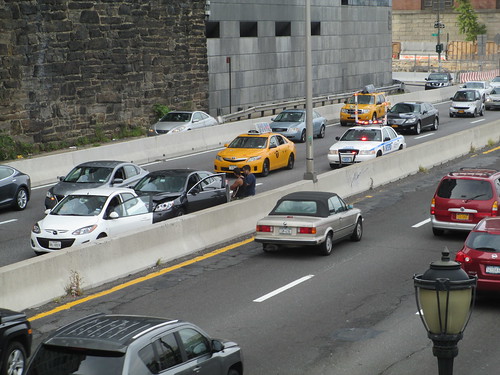
A rear-end shunt on FDR Drive: looked at another way,
it's a failure of two drivers to communicate clearly

Many of these efforts nevertheless run slap-bang into vast barriers. Some of them are cultural. New York drivers seem so used to the idea that they can pass a cyclist in a bike lane with only a tiny space to spare that it barely seems worth trying to communicate with those who do why their behaviour is so dangerous. I ran into similar challenges when I lived in London with drivers who simply didn't seem to realise they shouldn't block advance stop boxes at traffic lights.

The most inescapable fact of on-road communication, meanwhile, is that the modern motor vehicle is designed to shield users from the reality of their being involved in a social interaction. The interior of a motor car looks and feels more like someone’s home than a machine for transporting goods and people. Cadillac last year ran an advertising campaign showing a ring of cymbal-clanging toy monkeys surrounding a Cadillac CTS  expressly to boast how the vehicle’s sound-proofing, glass and even noise-cancelling equipment would silence the reality outside the vehicle. It’s no surprise that people riding in such vehicles might struggle to grasp the complexity of what’s going on in the streets surrounding them – or that they might react angrily to my rapping on the window to point out that they’ve nearly, by their negligence, run me off the road.

Inside that sensation-deprived space, there must be a heightened sense of frustration at the mismatch between the calm sounds of the vehicle’s clear stereo or white noise and the more chaotic pictures coming in through the windows. I’m confident that frustration explains many of the times I have motorists drive fast at me, blaring their horns. This silent, frantically pedalling cyclist must seem like a disorderly intrusion compared with the orderly sound world of the vehicle’s interior.

All of these obstacles play a part in keeping New York's road safety record poor, despite the current mayor's Vision Zero efforts. The position would, needless to say, grow easier if the city built more infrastructure to reduce conflicts, including more of a network of well-designed protected cycle paths.
A driver overtakes a cyclist: one of these people is in a box
sound-proofed to ensure he can ignore the other.

As it stands, people find themselves caught up in conflicts fuelled by misunderstanding - and seized of a powerful impulse to reach through the barriers and explain why they're frustrated. I saw it vividly one recent morning when a woman, wrapped up in her car’s smooth inner world, pulled out of a side street in front of a cyclist careering down Smith St on a single speed. The cyclist jammed on his brakes and landed in a heap. His immediate instinct was to spring to his feet and aim a defiant one-fingered salute towards the rear-view mirror of the motorist. I suspect she never had any inkling of the harm she had done.

I was caught up in a more complicated instance last Thursday when cycling home down Grand St in SoHo. A man in front of me was pushing a baby buggy (stroller, American readers) down the narrow bike lane, one child inside the stroller and another riding on the rear. His only reaction to my bell-ringing was to continue an exaggerated saunter, taking obvious pleasure in blocking my way.

It wasn't the first time I'd come across people deliberately blocking the lane on Grand St to prevent cyclists' using it. I've long since tired of giving people who deliberately obstruct me the tolerance I generally extend to even inattentive pedestrians. My irritation welled up when he turned to me at an intersection and sneered, “But we’ve got wheels. We’re allowed to use it.”
The Smith St bike lane: venue for a memorable
failure of communication

I started calmly, pointing out that it was irresponsible of him to block a busy bike lane and that someone could have hit him. It would have been irresponsible of me to hit him, he replied, so I was the irresponsible one. His deliberate, bullying contempt mixed in with my tiredness after a red-eye flight the night before and my dismay at the emerging British general election results. I felt the urge to communicate quite how deeply he had offended me.

I pointed out – accurately, I think – that he was setting a poor example to his children. I pointed out – again accurately – that his behaviour was making his wife slink away in embarrassment. I finished with a piece of more metaphysical speculation.

“Your soul’s shrivelling inside you because you’re so petty,” I shouted as I rode away.

I should not, clearly, have allowed myself to be provoked. But humans feel the need to connect and communicate with those around them. Far too many street and vehicle designs hinder, rather than work with, humans’ need to talk to each other. It feels like no exaggeration to say that's drying up many cities' souls.

Sunday, 29 March 2015

An unexpected rhythm, a stressful ride to Midtown - and why I feel I'm waltzing with the city

When I’m riding my bike home in the evenings and have come down the long, spiral ramp off the Manhattan Bridge into Brooklyn, I often find myself waiting at a pedestrian crossing nearly right under the bridge’s first girders. Given that the bridge carries four busy subway tracks as well as three roadways, a pedestrian path and a bike path, that means I frequently hear the ear-splitting din of a B, D, N or Q train crossing just above my head.
 
An unexpected source of syncopated rhythm: the bike path
under the Manhattan Bridge's Brooklyn end
But the noise’s effect isn’t what one might imagine. A joint in the tracks means that the wheels produce an exquisitely syncopated rhythm. A-ONE-and-a-two-and-THREE-and-a-four clack the four successive axles as the joins between the cars roll overhead. The rhythm is so compelling that sometimes, when no-one’s looking, I permit myself a little dance with my shoulders.

My jiggling shoulders generally prompt a second thought, however. The sound turns my mind to how cyclists in cities like New York or London or anywhere else where cycling’s an on-road, minority activity, have to attend closely to the rhythm of the city around them. In such an unforgiving environment, it's vital to pick up the cues from the surrounding, constantly-changing city about when and where to cycle fast and confidently and when to exercise maximum caution and restraint.

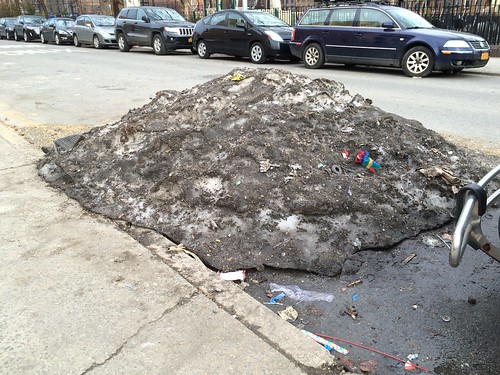
Call it snirt, call it snarbage: we New York City cyclists
have been dodging a lot of snowy, rubbishy mounds like
this in the last few weeks and months.
Many of the patterns I've come to recognise are things that restrict me. During the recent long, bitter winter, for example, I noticed myself learning after each snowfall the distinctive pattern of snow clearance and how it affected each cycle lane and where I positioned myself on the road. An event like last week’s sad gas explosion and fire in the East Village will suddenly paralyse traffic across vast swathes of the city. Light rain after a dry spell makes surfaces particularly treacherous – especially, ironically, those painted with the rather slippery green paint the city uses to mark cycle lanes.

Yet there’s a pleasure, after two-and-a-half years and at least 10,000 miles of New York City cycling, to having learned to recognise – and anticipate – so many of the city’s moods. The sudden surges in traffic in various places; traffic’s unexplained disappearance in others; the surge in grumpiness among drivers in certain conditions: all reflect, I know rationally, a multitude of individual decisions. But they can feel so concerted and sudden that they almost feel like the actions of New York City herself. A cyclist riding through the city has to undertake a kind of dance with her, getting in step and learning how she moves.

I had something of the same feeling about London when I lived there and enjoyed an encyclopaedic knowledge of much of its backstreet network of quiet cycle routes. But New York is a far more mercurial dance partner – hotter in summer, colder in winter, denser, with far more dangerous streets and more prone, it seems to me, to catastrophic mishaps. It feels far harder to learn to get in step with her – and a more satisfying achievement to have learned to do so.

That makes all the more enjoyable those moments of bliss one experiences from time to time riding a bicycle – the moments when the city seems to slip by and it is the other forms of transport that seem momentarily absurd.
 
The kind of weather that's slowing me down particularly
dramatically at present: Fifth Avenue in a light rain shower,
perfect for creating a treacherous surface
There is, nevertheless, a dissenting voice inside my head that wonders how much I’m dressing this phenomenon up. I sometimes wonder if my having got to know the city better simply means I’m growing more fearful. I notice how I’m increasingly stopping to let cars past on the narrowest roads where I know drivers are most aggressive. I’m less often taking the middle of the lane and forcing them to slow down to, say, a 20mph crawl in a 20mph limit. I noticed myself easing off significantly on my speed in some recent rain showers, feeling that the streets, still greasy with the detritus of winter, might be particularly treacherous. I find myself waiting behind motor vehicles as lines of other cyclists slip through narrow gaps between them and parked cars or the kerb.

Perhaps, a voice in my head says, I'm feeling the familiarity of the bullied with the bully. Maybe I’ve let the city’s toughness beat me into mental submission.

The dissenting voice grew particularly loud on March 23 when I had to cycle from home first thing in the morning to a conference right by the south-eastern corner of Central Park. I tried to fall in step with the city. I used my knowledge of the position of the many new potholes that have appeared over the winter to decide when to dodge out of the cycle lane and into the car lanes. I used my experience of the weather to look out for the inevitable ice patches, products of a mixture of the cold and a hundred little thoughtless sloshings out of buckets into the cold street or spillings of drinks.
 
New York's Metropolitan Club: maginficent inside - but
a devil of a place to cycle to.
Already feeling slightly ill before I started, however, I began to feel a little defeated. The corner I was visiting – 5th Avenue and East 60th St – is one of New York’s least accessible by bike for anyone arriving from the south. Having prided myself on finding a viable but unconventional bike route up 1st avenue to 55th street then up Park Avenue to 60th – I found myself dismounting and pushing rather than deal with the gridlock (and yet more ice patches) on Park Avenue.

The experience was a useful reminder that, in an ideal New York City, there would be no real skill to cycling in step with the city’s gyrations. Far more experiences would be like riding along the best sections of the Hudson River Greenway – a chance to travel quickly around New York, put no strain on the city’s environment or infrastructure yet take in the city’s excitement. I was torn between cursing three things: my own cowardice in intimidating conditions, the city’s unwillingness to provide a joined-up cycling network and my own stubborn refusal to give up cycling in the face of these facts.
 
The Queensboro Bridge: where my journey started to go right.
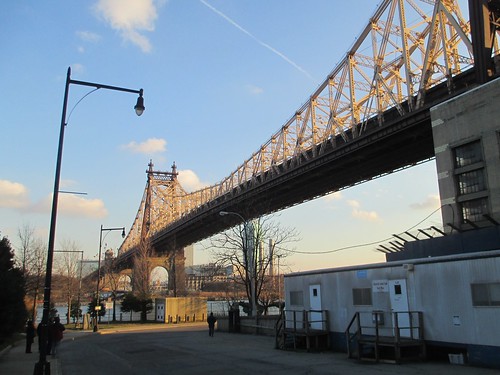
Yet, as I pondered at the end of the day how to get home after my unpromising outbound trip, I realised I was only a few blocks from the Queensboro Bridge and its bike path. I set off and was soon barrelling at nearly 25mph down the bridge into Queens, under the elevated subway tracks then over another bridge into Brooklyn.

I covered the route, though it was long, quickly and efficiently. I took routes through Greenpoint and Park Slope that I’d devised only after many attempts and much trial-and-error. I was able to enjoy the grandeur of the panoramas over the East River and take in the city’s details. I saw the Polish shops in Greenpoint, the Yiddish writing on the buses for Hassidic Jewish schoolchildren in South Williamsburg and the soul food restaurants run by African-Americans in Fort Greene.

I grew briefly frustrated with a cluster of visiting-hour cars outside Methodist Hospital on 6th St in Park Slope but soon slipped past them too and sped, unmolested, down the hill towards home.

It was, in short, the kind of rare, transcendentally enjoyable trip that explains my refusal to give up. It’s the kind of experience I may, if anyone asks me soon if he or she should cycle in the city, recount as evidence for the “yes” side.

But I probably won’t dare articulate my true feeling about how such a near-perfect journey feels. In my head, New York City and I were, for that hour or so, spinning and whirling across the dancefloor in a rare, elegantly-executed and ecstatic waltz.

Sunday, 14 December 2014

A protest march, a German thinker - and how injustice for some is injustice for all

The chanting on the night of December 4 sounded muted heard from my eighth-floor office. But there was no mistaking what was going on. Rushing over to the window, I peered down into Hudson Street and saw the front of a line of hundreds of protesters. The leaders were carrying black placards with slogans picked out in LED lights. “Justice 4 All” and “Black Lives Matter,” they read.

I felt admiration and fellow-feeling for the demonstrators, protesting against the decision of a grand jury in Staten Island, just across New York Harbor from where I was, to bring no charges against the police officer who killed Eric Garner. The officer placed Mr Garner, a black man, in an illegal chokehold in July as he sought to arrest him for selling untaxed cigarettes. The protesters were shouting “I can’t breathe” – the last words that a video of the event captured Mr Garner gasping out 11 times.

Drivers held up by protests over police brutality:
far from determined to uphold the rules themselves.
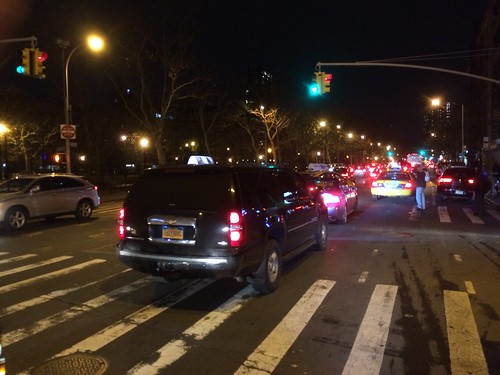
But I faced an immediate problem - how, with protests swarming over much of lower Manhattan, I would get myself and my bicycle home to Brooklyn. I opted for a route somewhat to the north of my normal one and successfully reached the Manhattan Bridge. Yet my biggest challenge turned out not to be the protests but the behaviour they encouraged in drivers. Many expressed their frustration at being delayed by driving into cycle lanes, executing illegal u-turns, honking loudly and otherwise behaving irresponsibly and illegally.

The experience was, it subsequently occurred to me, an excellent encapsulation of the crisis in policing of both the US’s roads and minority – especially black – communities. Far from looking down on the law, the most vulnerable people – the protesters, people who don’t own cars – have high expectations of law enforcement. Fair, undiscriminatory enforcement of society’s agreed rules is their main protection against those who have more power than they - or operate vehicles with greater momentum.

Meanwhile, it’s the people commonly regarded as upholders of society’s order – police officers and those who have taken driving tests and invested in cars – who often seem, consciously or otherwise, to hold those rules in most contempt. Many seem to think themselves responsible or respectable enough not to need to follow the pettifogging details of the rules.
An emblem of the NYPD's style: some officers are prone
to brutality and the department cites shortages of resources
as a reason not to investigate traffic deaths. But even on a cold
winter's evening at present there are four police interceptors
parked on the Brooklyn Bridge to guard against tampering
with the Stars and Stripes on the towers.

The episode brought to mind a famous passage in which Immanuel Kant, the 18th century German philosopher, wrote about how justice’s significance went far beyond any practical effect its execution might have.

Kant expressed his views in relation to the death penalty – and took a position about the morality of capital punishment with which I profoundly disagree. But his take on justice’s significance captures something of why the families of Eric Garner in Staten Island and Michael Brown in Ferguson, Missouri – as well as those of Allison Liao, killed by a driver in Queens, and Cooper Stock, killed by a driver on the Upper West Side – protest so loudly over the system’s failing them.

“Even if a civil society resolved to dissolve itself with the consent of all its members… the last murderer lying in prison ought to be executed before the resolution was carried out,” Kant wrote. “This ought to be done in order that every one may realise the desert of his deeds, and that blood-guiltiness may not remain upon the people.”

The acute problem, however, is not so much that the US – and some other societies worldwide – is failing to prosecute some brutal police officers and many, many negligent or even deliberately violent drivers. It’s that by doing so the authorities send a message to those who follow the rules that they’re mugs. Refraining from violence at risk to yourself, police officer? Why not just grab the suspect round the neck? Ignoring that cellphone call so you don’t endanger other road users, taxi driver? Why? It might be a customer calling to book a long, profitable ride.

Minor lawlessness, certainly - but evidence of a corrosive
contempt for the rules: a private garbage truck blocks the bike
lane, while a delivery truck double parks outside
The challenge is less that the guilty are going unpunished and more that virtue is punished by default.

These ideas started forming in my mind nine days before the December 4 protests, as I took a bike ride on a rare day off work the Tuesday before Thanksgiving. I rode from home in Brooklyn all the way up Manhattan’s 1st Avenue towards The Bronx. Yet it was soon apparent that the relatively new protected bike lane north of 60th Street wasn’t going to live up to its promise. I had to leave the lane repeatedly and pull into fast-moving traffic. Some of the obstructions were because of building work – but most were because cars were illegally parked in the bike lane or improperly turning across my path. More than once, on pulling out of the lane and round the legally-parked cars, I found a third barrier in the form of an illegally double-parked truck.

At one point, I found a huge semi-trailer truck (articulated lorry, British readers) had blocked the bike lane to deliver to a store. I appealed to a nearby traffic police officer to ticket the driver. The driver treated her with contempt and berated me, as a proxy for all other cyclists, for having forced him to park there. A previous cyclist had, apparently, sued after the driver struck him with a trolley while moving goods across the cycle lane from a legal parking place.
It's no illegal chokehold - but the parking outside the 52nd
precinct in The Bronx police station suggested to me something
about its officers' conception of enforcing the law.

It was no surprise when, later in the ride, I had to manoeuvre delicately around police cars parked illegally on the shared sidewalk and bike path outside the NYPD's 52nd precinct in The Bronx.

None of what I experienced went beyond inconvenience and I suffered no real harm. But I was soon feeling humiliated and powerless in the face of the bullying of those who were refusing to follow the rules. I felt angry that so little was being done to ensure a more equitable, fairer outcome.

Given my feelings over this minor injustice, I can only imagine the blind rage that Michael Cheung must feel over the failure to take any serious action against the driver who killed his 90-year-old mother as she crossed a street with the light in New York’s Chinatown in October. It must be indescribably painful for a mother such as Dana Lerner to hear that district attorneys are declining to bring criminal charges against the cab driver who killed her nine-year-old son, Cooper Stock, on the grounds the weather was bad when it happened.

I spoke recently to the daughter of someone killed by a negligent driver while he cycled in Central London. She expressed her rage at the failure of the police there to investigate the crime thoroughly and of prosecutors to bring a prosecution over the case.

It can only be worse still to learn that a relative has died because of illegal behaviour by those meant to uphold the law – and that those responsible will not be held to account. The killings of Eric Garner on Staten Island, Akai Gurley in East New York, Tamir Rice in Cleveland in countless other cases are shocking because they contradict so many of the theoretical principles of life in the US – and anywhere that human rights are held in any regard. A mixture of rage, impotence and grief that must boil inside the victims' relatives at the thought that many of these incidents happened mainly because of their family's skin colour and others' assumptions about people of their race.
 
He agrees with Kant: a demonstrator voices humans' shared
yearning for justice.
Police officers and district attorneys who flout the law or ignore rule-breaking not only disgrace their offices - and sometimes break the law themselves – but breach a fundamental clause in western societies’ social contract. Civil legal authorities centuries ago largely removed from individuals the burden of pursuing those who had criminally wronged them. The promise was that justice would be more fairly, impartially and efficiently dispensed when its pursuit was no longer clouded by issues to do with victims’ personal power, prestige, feelings or wealth.

That principle has been abandoned, it seems, when it comes to many of those killed or injured on the roads or minority community members harmed by police officers. Many prosecutors in the US – and in the UK, I increasingly fear – are ready to pursue only cases where either overwhelming evidence or a plea-bargained guilty plea make a conviction nearly certain. On the rare occasions I cycle through New York’s Foley Square, past the steps that featured at the end of the classic legal drama Twelve Angry Men, I give a rueful smile at how such finely-balanced court cases increasingly seldom come to court.

Despite my misgiving about Kant’s support for the death penalty, it’s hard to escape the conclusion that his feeling about a wider society’s guilt for unpunished crimes captures something about the deep wrong of the Eric Garner and other cases. If this behaviour isn’t regarded as wrong, if wider society imposes no consequences for these kinds of actions, what does it say about the wider society? How far into lawlessness is society prepared to let its roads or its police officers descend?

While the problems of unaccountability spread across the United States and some other developed countries, there are also very specific New York issues. Bill de Blasio stood as mayor on prominent pledges to improve police treatment of black people and to tackle the city’s epidemic of traffic deaths. It’s dispiriting that he appears so weak in face of his police commissioner’s apparent reluctance to act decisively on either.

Yet the outrage I witnessed from my 8th floor window and the growing disquiet over traffic deaths give me at least some hope. The United States might finally be preparing, as Winston Churchill would say, to do the right thing, having exhausted all other options.

Santa-conners in the 2nd Avenue bike lane: our trip would
have been depressing if we'd seen only sights like these.
That hope was boosted this Saturday, December 13, when I took my son Christmas shopping by bicycle in Greenwich Village.

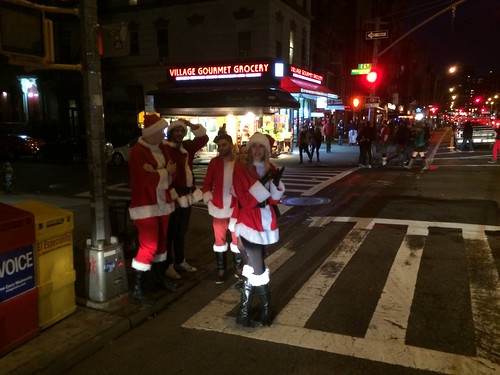
We rode first up 1st Avenue and encountered drunk participants in the gruesome, annual Santacon bar crawl by young fraternity boy-types and like-minded women around the Lower East Side. The partygoers – who had noisily asserted their “right” to pursue their drunken binge in the preceding days – were the epitome, it seemed to me, of privileged refusal to follow generally accepted rules. They wandered over sidewalks, shouted across streets at each other and behaved self-indulgently and short-sightedly.

But, even as I mentally shook my head over them, I heard the first protest chants.

“I can’t breathe!” “Hands up – don’t shoot!”

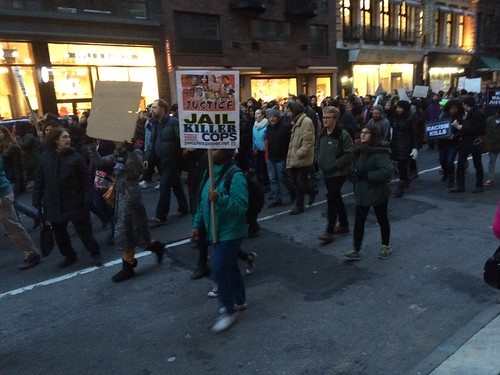
We arrived at the Strand Bookstore on Broadway just as the front of the Millions March NYC protest headed by. Many of the participants were of the same twenty-ish age group as the Santacon participants. But there was an impressive earnestness about them that was entirely absent amid the Santacon foolishness.

There were also far more of them than of the Santacon-ners. We emerged after 20 minutes in the bookshop to find the march still in progress down Broadway. We joined them for a symbolic two blocks, wheeling my bike and the Invisible Visible Boy’s trailer bike.

“How do you spell racist? NYPD!”

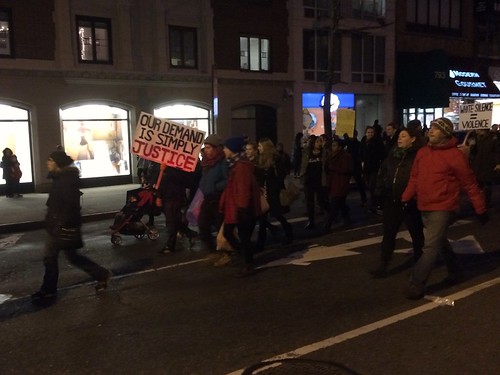
A brief spasm or the start of real change? The Millions March
NYC protest just before I and the Invisible Visible Boy joined.
For those two blocks, it was possible to get caught up in the earnest passion of the crowd, the frustration that so little has changed. My heart sang to see several bicycles among the protesters, symbols of the union of my various political and policy positions.

But I’d have come away less optimistic had I not come away with the sense that others better equipped than I to understand the crisis also thought that, just maybe, these protests might be the harbinger of real change.

As my son and I walked those two blocks, I noticed a tall black man grab the hand of his young son – maybe three or four – and lead him across Broadway through the crowd. He was determined to get him a better view of the event.

“Come on,” he said impatiently, looking down at him. “I want you to see this.”