Showing posts with label Manhattan Bridge. Show all posts

Sunday, 29 March 2015

An unexpected rhythm, a stressful ride to Midtown - and why I feel I'm waltzing with the city

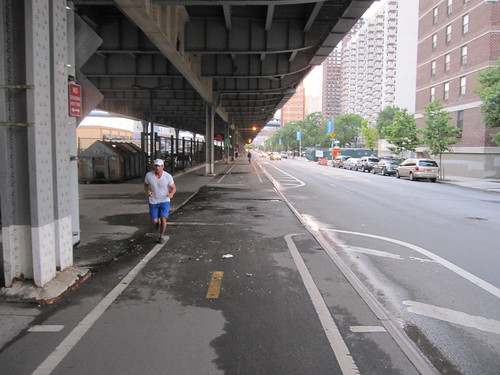
When I’m riding my bike home in the evenings and have come down the long, spiral ramp off the Manhattan Bridge into Brooklyn, I often find myself waiting at a pedestrian crossing nearly right under the bridge’s first girders. Given that the bridge carries four busy subway tracks as well as three roadways, a pedestrian path and a bike path, that means I frequently hear the ear-splitting din of a B, D, N or Q train crossing just above my head.
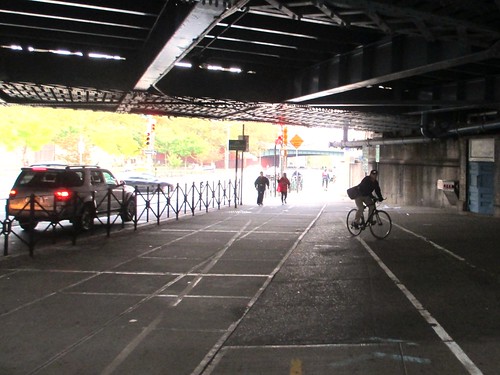
 
An unexpected source of syncopated rhythm: the bike path
under the Manhattan Bridge's Brooklyn end
But the noise’s effect isn’t what one might imagine. A joint in the tracks means that the wheels produce an exquisitely syncopated rhythm. A-ONE-and-a-two-and-THREE-and-a-four clack the four successive axles as the joins between the cars roll overhead. The rhythm is so compelling that sometimes, when no-one’s looking, I permit myself a little dance with my shoulders.

My jiggling shoulders generally prompt a second thought, however. The sound turns my mind to how cyclists in cities like New York or London or anywhere else where cycling’s an on-road, minority activity, have to attend closely to the rhythm of the city around them. In such an unforgiving environment, it's vital to pick up the cues from the surrounding, constantly-changing city about when and where to cycle fast and confidently and when to exercise maximum caution and restraint.
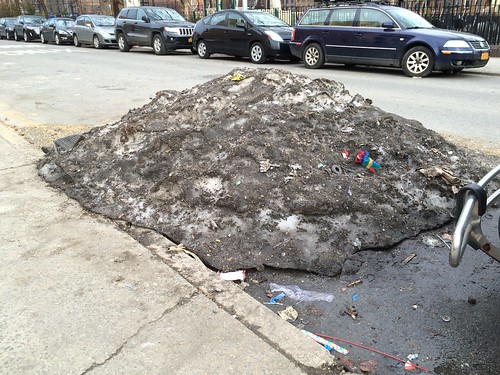
Call it snirt, call it snarbage: we New York City cyclists
have been dodging a lot of snowy, rubbishy mounds like
this in the last few weeks and months.
Many of the patterns I've come to recognise are things that restrict me. During the recent long, bitter winter, for example, I noticed myself learning after each snowfall the distinctive pattern of snow clearance and how it affected each cycle lane and where I positioned myself on the road. An event like last week’s sad gas explosion and fire in the East Village will suddenly paralyse traffic across vast swathes of the city. Light rain after a dry spell makes surfaces particularly treacherous – especially, ironically, those painted with the rather slippery green paint the city uses to mark cycle lanes.

Yet there’s a pleasure, after two-and-a-half years and at least 10,000 miles of New York City cycling, to having learned to recognise – and anticipate – so many of the city’s moods. The sudden surges in traffic in various places; traffic’s unexplained disappearance in others; the surge in grumpiness among drivers in certain conditions: all reflect, I know rationally, a multitude of individual decisions. But they can feel so concerted and sudden that they almost feel like the actions of New York City herself. A cyclist riding through the city has to undertake a kind of dance with her, getting in step and learning how she moves.

I had something of the same feeling about London when I lived there and enjoyed an encyclopaedic knowledge of much of its backstreet network of quiet cycle routes. But New York is a far more mercurial dance partner – hotter in summer, colder in winter, denser, with far more dangerous streets and more prone, it seems to me, to catastrophic mishaps. It feels far harder to learn to get in step with her – and a more satisfying achievement to have learned to do so.

That makes all the more enjoyable those moments of bliss one experiences from time to time riding a bicycle – the moments when the city seems to slip by and it is the other forms of transport that seem momentarily absurd.
 
The kind of weather that's slowing me down particularly
dramatically at present: Fifth Avenue in a light rain shower,
perfect for creating a treacherous surface
There is, nevertheless, a dissenting voice inside my head that wonders how much I’m dressing this phenomenon up. I sometimes wonder if my having got to know the city better simply means I’m growing more fearful. I notice how I’m increasingly stopping to let cars past on the narrowest roads where I know drivers are most aggressive. I’m less often taking the middle of the lane and forcing them to slow down to, say, a 20mph crawl in a 20mph limit. I noticed myself easing off significantly on my speed in some recent rain showers, feeling that the streets, still greasy with the detritus of winter, might be particularly treacherous. I find myself waiting behind motor vehicles as lines of other cyclists slip through narrow gaps between them and parked cars or the kerb.

Perhaps, a voice in my head says, I'm feeling the familiarity of the bullied with the bully. Maybe I’ve let the city’s toughness beat me into mental submission.

The dissenting voice grew particularly loud on March 23 when I had to cycle from home first thing in the morning to a conference right by the south-eastern corner of Central Park. I tried to fall in step with the city. I used my knowledge of the position of the many new potholes that have appeared over the winter to decide when to dodge out of the cycle lane and into the car lanes. I used my experience of the weather to look out for the inevitable ice patches, products of a mixture of the cold and a hundred little thoughtless sloshings out of buckets into the cold street or spillings of drinks.
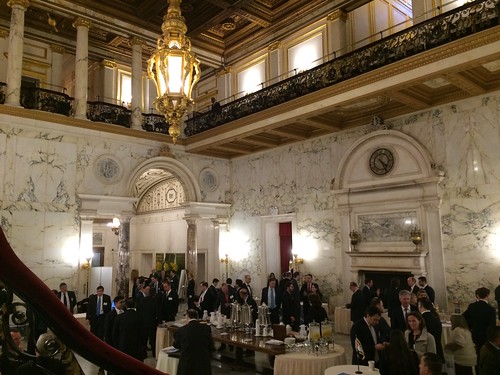
 
New York's Metropolitan Club: maginficent inside - but
a devil of a place to cycle to.
Already feeling slightly ill before I started, however, I began to feel a little defeated. The corner I was visiting 5th Avenue and East 60th St – is one of New York’s least accessible by bike for anyone arriving from the south. Having prided myself on finding a viable but unconventional bike route up 1st avenue to 55th street then up Park Avenue to 60th – I found myself dismounting and pushing rather than deal with the gridlock (and yet more ice patches) on Park Avenue.

The experience was a useful reminder that, in an ideal New York City, there would be no real skill to cycling in step with the city’s gyrations. Far more experiences would be like riding along the best sections of the Hudson River Greenway – a chance to travel quickly around New York, put no strain on the city’s environment or infrastructure yet take in the city’s excitement. I was torn between cursing three things: my own cowardice in intimidating conditions, the city’s unwillingness to provide a joined-up cycling network and my own stubborn refusal to give up cycling in the face of these facts.
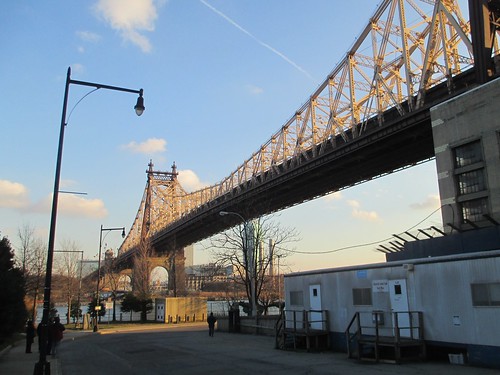
 
The Queensboro Bridge: where my journey started to go right.
Yet, as I pondered at the end of the day how to get home after my unpromising outbound trip, I realised I was only a few blocks from the Queensboro Bridge and its bike path. I set off and was soon barrelling at nearly 25mph down the bridge into Queens, under the elevated subway tracks then over another bridge into Brooklyn.

I covered the route, though it was long, quickly and efficiently. I took routes through Greenpoint and Park Slope that I’d devised only after many attempts and much trial-and-error. I was able to enjoy the grandeur of the panoramas over the East River and take in the city’s details. I saw the Polish shops in Greenpoint, the Yiddish writing on the buses for Hassidic Jewish schoolchildren in South Williamsburg and the soul food restaurants run by African-Americans in Fort Greene.

I grew briefly frustrated with a cluster of visiting-hour cars outside Methodist Hospital on 6th St in Park Slope but soon slipped past them too and sped, unmolested, down the hill towards home.

It was, in short, the kind of rare, transcendentally enjoyable trip that explains my refusal to give up. It’s the kind of experience I may, if anyone asks me soon if he or she should cycle in the city, recount as evidence for the “yes” side.

But I probably won’t dare articulate my true feeling about how such a near-perfect journey feels. In my head, New York City and I were, for that hour or so, spinning and whirling across the dancefloor in a rare, elegantly-executed and ecstatic waltz.

Sunday, 4 May 2014

Brooklyn, a bridge, Manhattan - and the voice every morning in my head

Huh. Morning came around soon. Put bike into road. Swing leg over. Left shoulder? Nothing. Pull out. Brake again. Look right. Goodness that SUV’s coming fast. Swish. Swish. Swish. All gone? Start pedalling. Start pedalling, turn left, into the bike lane. Here we go.

Yeah, I like this first bit on Smith St. Head down. Bit of a slope. Get moving as fast as I can. 16mph. 17mph. Feels like skipping sometimes, pushing down hard each stroke of the pedals.

Here we go. Yup. Here we go.
Oh. Big Toyota SUV poking out from the sidestreet. Wheels? Not moving. Check over shoulder. Signal. Pull out round him. Stern look. What do I think that’s achieving? Driver probably hates me. Maybe just shakes his head.

Traffic backed up to lights. Slip down the bike lane. Car doors? Wheels moving? Doors? Wheels moving? Which way’s this guy gonna turn at these lights? Pull left round him. Stop.

Kind of like what they’ve done with Carroll St subway station. Simple. Modern. Red hand for pedestrians still flashing, flashing. Just red. So look up at lights, look up at lights, green. Go!

Move legs fast, pedal, swing right before the cars catch up. Oops. Car poking into bike lane. Brake. Look over shoulder, pull round it.

There’s the school. I wonder what Alexander’s doing in his class. What’s it like to play out in that little playground?

But yikes. Car turning right in front of me. Brake, signal left to go round turning car. Carroll Gardens festival of dangerous and negligent driving this morning. Funny how they never send me the memo about that. Scary.

But now it’s clear. Pump, pump, pump, pump legs. Slip onto the big chainring. Left shoulder? Clear. Left round that pothole. Car at the sidestreet, creeping forward slowly. Firm finger pointed at him. Eye contact. Ooh – fierce glare, driver. But you stopped, didn’t you?
Spot the gap. Head for it.

Here we go again, though. Huge truck, narrow gap letting me through to the lights. Look up at the driver. Seen me? Seen me? Good. Thumbs up. So off again. Yeah, Mr limo driver, I do need to pull out round this delivery truck. I do and that’s why I’m pulling into the middle of the lane. No, I’m sure you don’t like it.

Oh there’s that guy.

“Hi, Robert. Nice one they’ve laid on for us today.”

“I think it’s something to do with the Pulaski Skyway’s being closed.”

“Yeah, have a nice ride.”
 
Atlantic Avenue in sight. Jails, courts, chaos.
So now Atlantic Avenue.

Yes, Mr Driver: I know you want to turn right. But I’m to your right and I’m going straight on. So hold on a moment. What was that swishing sound? Oh, that cyclist thought that gap was big enough to pass on my right? How many bikes are there at this light now? One, two, three, four, five, six, seven, eight…

Green. Pedal fast, check left shoulder, guy’s not turning through me. How’s bike lane in this busy bit? Oh, guy’s signalling right into car parking. Brake. Check shoulder, signal, move left. Up to next lot of lights. Stop.

Funny seeing the Corrections Department buses. You never see the guys inside. Funny thinking how downtown Brooklyn’s got a jail. Do they look out at me from the windows? High-rise jail. Funny.

Lights green. OK. Tricky bit by where they’re doing this building work. Glad they’ve moved the barriers. Didn’t like it when they had that big bulge out into the traffic. Now this corner. What are these minibuses always stopping in the right lane here? There’s that voice, the automated voice, “The walk sign to cross Smith St is aaawn.” Broad New York accent. Always funny. Read once about the guy whose voice it is. Lives in Staten Island.

Green again.

“STOOOOP!”

Why do drivers have that look of injured innocence when they finally give way and agree not to crush you? It wasn’t a big favour to wave me through, madam. Legal and moral obligation.
 
Smith St at Fulton: a not like from the voice in my head.
Fulton St lights now. Don’t like this crossing. Pedestrians, cars, pedestrians, buses, angry people. Why is everyone so angry all the time? Oh, other bikes. Hi.

“The bridge is coming. Focus on that.”

Green again. Sir, I’m sure your life is not full of people you can defy. But I wish you’d express your sense of powerlessness another way. Your wandering slowly across my path is just frustrating when I have the light.

Cut through bus stop. Could all that grease make me skid? Into bike lane. Lights by that funny tunnel-underpass thing. Red. Stop.

Oh, please, other cyclists. Do not buzz that pedestrian. Please do not.

“Tut, tut.”

Ha, serious condemnation from a British person that, “tut, tut” – if anyone could hear me.

But no-one can and now lights are green. Mr Driver, I am not going to be able to fly over that car in the bike lane so I am sticking my arm out left until I see noticeable braking from you. Slowing down? Good, I’m pulling left and let’s go.

Green light by the college. Everybody’s flying towards Tillary St, fast. Oh, close pass. Better get over to the left somewhere. Signal left, check over shoulder in left-turn lane. Get to front of traffic at Tillary St. Lights red? Stop.

There’s the bridge. I can see the bridge. The bridge is coming; the bridge is coming.

Policewoman over there directing traffic. How does it feel standing there with all the speeding cars, all the people crossing, all the cyclists trying to get to the Brooklyn Bridge or the Manhattan Bridge? Hey, lookie here, Ms Policewoman – look at these cars trying to run down these pedestrians. Interested? Didn’t think so.
 
The bridge is in sight, people. The bridge is in sight.
OK. Green light again and pedal fast. No, Mr turning-across-my-path, you have to yield to me, you have to yield to me, OK. I’ll swerve round you. Fast, fast, fast across this intersection. Cars lined up. Always feeling like they’re just waiting for the chance to run me over.

Now Jay St bike lane again but how are we organising ourselves this morning, fellow cyclists? OK, OK. Let’s do two abreast this bit. Spurt of speed. Pull to front of pack, now upset everyone behind by stopping for these lights.

Never mind. The bridge is coming. Lights green, go. Tricky bit here. Cut across the bridge off-ramp to the  bike lane. How fast is that truck coming down the ramp? Probably OK. In the bike lane, ride down the side of the cars, get to the kerb cut for the bridge bike lane, swing onto the sidewalk, across under the bridge and it’s there: Manhattan Bridge bike path.
 
Manhattan Bridge on-ramp: excitement builds.
Best bit of the ride this, best bit of the ride. Love the spiral on-ramp for a start.

Guy on fixie ahead. Never understand why people ride fixed over the bridge. Pedal, pedal, pedal. Catch up with him. Look into the Brooklyn-bound lane, clear, and bye Mr Fixed Wheel Loser, bye. Get some gears.

Up the slope, up the slope. Subway train climbing the slope too. Scan the passengers. None to wave at. Shoot me when I no longer feel like racing subway trains. Or maybe shoot me when I no longer feel like racing subway trains but check first if I’ve changed my mind with advancing age.

Clunky hybrid rider: feel like I'll pass her, chance that I'll fail.
Bye, Mr Citibike rider. Bye, Ms Pootling Along on a Cutesie Pink Bike.

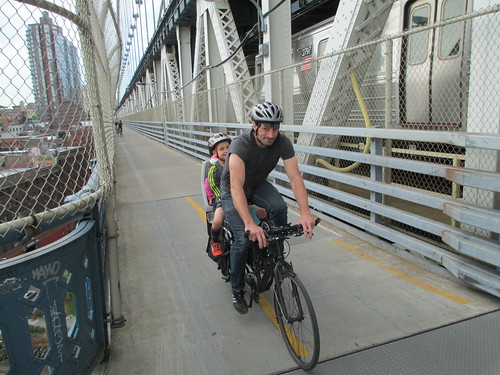
Oh, hi, fixed-wheel rider overtaking me. Yeah, well, I’ve got kind of a heavy bike. Oh, there’s the long-bike commuting-with-kids guy. Kind-of hurts when he overtakes me with his kid sitting on the back. This wind catches my big frame. That’s the problem.

But who cares now? Climbing out over the river. Barge down below. What do they carry? Look out towards the Williamsburg Bridge. Always remember now that bushfire day. City covered in smoke, could barely see the Williamsburg Bridge. Met Doug Gordon that morning. He stopped to take a picture. Can see it OK this morning. Odd-looking bridge.
 
Funny-looking bridge, days you can see it.
Now look for the Empire State Building. There it is. Sun on one side, shade on the other. Middle of midtown, looking fantastic.

Best bit of the ride, this, best bit of the ride.

Past halfway now. Getting faster. 20 on the bike computer. Bye, Mr Citibike rider, bye, Ms Clunky Hybrid. Hello, Chinatown. Not much of a cooking smell today. 22.5mph. Let’s go right over that manhole cover. Love that clanking sound. Now slow for the final curves. Final awkward downhill turn. Brake for the lights in Chinatown. Stop. But whish, whish, whish. Other riders running the lights. Oh my goodness that car is going to hit that guy. No, just missed.

Empire State Building: in Midtown, in the sun.
But now green and off, right.

Feels faster now, after the bridge.

Chinatown Dragon Fighters’ – always like that fire station name. Not sure it makes sense. But like it.

Allen St bike lane left. Oops, cut across that pedestrian slightly. Feel bad about that. Speed up – but delivery man pushing cart in bike lane. Swing round him.

Speed up. Grand St. Fast down bike lane but red light at Delancey.
Crossing Delancey: but not like in the movies.

Crossing Delancey – wasn’t that a film? Yes, it was a film. Not sure what it was about. Tough street to cross, though. Tough. Probably not a film about cyclist safety, though.

But now green, speed up and off up bike lane and then Rivington, left, fast along Rivington until, oh, that old woman’s sorting her recycling in the bike lane again. Round her, then see old synagogue. Places change. Where did that synagogue’s people go? Four-way stop, hard to see, crane neck, nothing to see, then ambulettes in the bike lane. Not even sure what ambulettes are, but they’re always blocking the bike lane here. Stop at lights. Chrystie-Forsyth Park. Robert Moses built the park, yes Robert Moses built this park the year he built lots of parks. He wouldn’t like that I can ride a bike
Allen and Rivington: left and crosstown.
across it but here I go, here I go dodging the pedestrians, here I go across Chrystie St and here I swerve round the forklift truck working in the bike lane and up to Bowery, right, then up to Prince St left, stop at the lights at Mercer St and look around.

Little Italy. Not really Italian any more of course. No Robert de Niros shouting at their wives about the steak’s being overdone. Nice, though. Like this area but don’t like its drivers. Don’t veer into the bike lane, driver, don’t come too close because the bike lane’s closed here and I need to pull left; don’t walk in front of me, pedestrians. Ah, sorry. Light’s changed. On you go.

Final push now. Lafayette, Broadway, crosstown. Feel like I’m making progress. Posh shops. Taxis stopping suddenly, manholes in the bike lane, gratings, feels like cyclocross some days, stand up on the pedals, hands on the brake levers and ready to steer fast round trouble.

But now at 6th avenue, swing round the taxis blocking the bike lane, Charlton St now, zip up the block. Signal left. No, Mr Taxi, you don’t just drive at me like that. Stop at the lights. Left onto Varick, downtown a block, then wait at lights again.
 
Vandam and Varick, SoHo. Nearly there. Nearly there.
Someone from the office.

“Hi, Randi.”

Doesn't hear me.

Then right, down Vandam, pull over to the right and stop, get off, take off the bike computer. Bike onto the sidewalk, walk to the bike entrance, security pass and in. How many other bikes today?

Lock up the bike, grab the panniers, stride out the door.

Eight bikes today? That’s some – but not many.

Never understand it.

Best bit of the day, my bike ride. Best bit of the day.

The post is an edited and abridged transcript of the things the author says to himself and other people during a typical, 40-minute cycle commute from Carroll Gardens, Brooklyn, over the Manhattan Bridge to SoHo, Manhattan.

Monday, 7 April 2014

Miserable subway passengers, a grouchy runner - and a lesson from Bob Dylan

It’s one of those tasks that’s so difficult it’s become a kind of fascination to me. When I ride over the Manhattan Bridge towards work each morning, I’m generally passed, at a gap of just a few feet, by a B or D subway train taking commuters into Manhattan. The passengers stare out the window, blankly, apparently staring straight through those of us labouring up the slope to the bridge’s summit or speeding down from it. The stares are so blank that I’ve taken to waving at individual commuters to see if I can get a reaction.

A subway train passes a cyclist on the Manhattan Bridge:
the subway passengers can't see the cyclist. Fact.
The net result so far, from scores of waves, is one half-smile – and she might just have been reacting to a witty lyric on her iPod. The experience of being in a subway train seems to be so utterly different from the experience of riding a bike that the people on the subway trains can’t react to a human being outside their train on a bike.

Yet the reaction of the subway commuters to cyclists, it’s dawned on me, is only one example of a far more widespread city phenomenon. Big cities are full of people moving around conscious almost solely of their own environment, their own needs and their own sense of right and wrong behaviour. We’re mostly gliding around in little bubbles of our own distinct worlds, over and below each other, avoiding contact as far as possible. But quite a few of the crashes in cities, it strikes me, are cases where, almost literally, two worlds – two contrasting sets of expectations about norms and behaviours and who should give way to whom – collide. This makes it a phenomenon worth noticing and exploring.
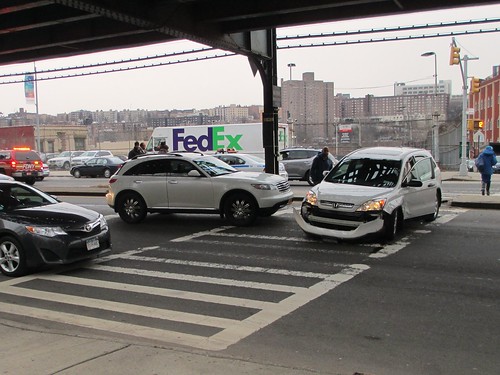
Two cars collide in Northern Manhattan - but so, quite
possibly, do two competing expectations about who
gives way to whom.

The driver I encountered on 55th street in Manhattan 10 days ago illustrates the most obvious form of the problem. I’d spotted that he was driving erratically as he left a parking space near Broadway. He then squeezed past me, dangerously, driving in a parking space, only for me to catch up with him at the traffic lights at 9th avenue. His window was rolled down and he was deep in a conversation on his mobile phone. “Stop talking on your phone!” I shouted at him. “It’s making you drive like an idiot.” He gave me a dirty look and slowly rolled up his heavily-tinted window. I was an unwelcome intrusion from outside the two worlds he was carrying around with him – the world inside his sports utility vehicle and his interaction with his interlocutor in the telephone call. His reaction was to close down his interaction with the place where he was physically present – and where his driving presented a serious danger.

There are multiple ways that people pursue the illusion that their cars are private spaces. They can blast out music so loud that any outside intrusion is inaudible. They can choose to drive a car so large or so fast that it intimidates other road users. They can talk incessantly on the telephone to people outside their immediate confines. People want to drown out the mixture of stress and boredom that comes from sharing a city street with a host of other people with competing claims on the space. Their desire to do so makes the street a little less safe for pedestrians, cyclists – everyone outside their world-in-a-car.

The little bubbles in which people move around also reflect their culture. At my son’s school, it’s mostly the parents with the mild, mid-western accents of hipster incomers that arrive bearing their children on long bikes, tandems and other unlikely bits of cycling apparatus. If I see children spilling out of some huge SUV – there’s a family that arrives daily in a Cadillac Escalade, one of the biggest vehicles on the road – I’m far more likely to hear a traditional Brooklyn accent calling out after them.

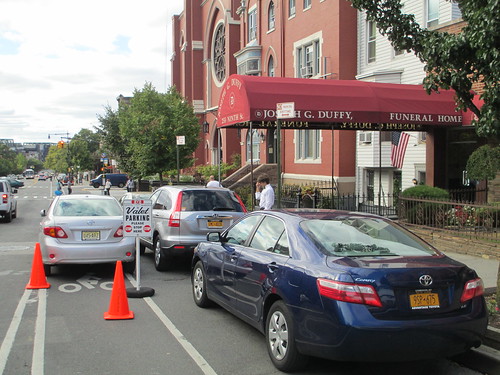
Inhabitants of Duffy Funeral Home's world worry about
where they're going to park. Other users of Park Slope's 9th
St worry where they'll ride their bikes. Here's where those
worlds collide.
The cyclists, I suspect, mainly mix with the other cycling-inclined families and have firm views about the environment, physical fitness and cluttering up the area with cars. The Italian-American SUV drivers come to the school from outlying areas of single-family homes. Many, I suspect, feel that a big car is both a status symbol and a way of keeping one’s loved ones safe. I'm sure they tut-tut quietly at the risks the rest of us are taking.

We maintain our contrasting cultures while sharing the same bits of road partly through the impermeability of a big car’s steel sides. It’s no coincidence in my view that cars that keep the outside world at bay are far more popular than, say, convertibles for city driving.

But it’s not only the motorists that are travelling around in little bubbles of their own worlds. Look on the average city street and nearly everyone is cutting him or herself off from the wider street. Headphones – once limited to discreet earbuds – are now often a large and obvious symbol that the wearer wants to be left alone. Mobile telephone calls and texting take the participant away from his or her immediate surroundings. For many runners, they seem to form an almost indispensable aspect of the experience, providing the rhythm and focus that interaction with the wider world might take away. A pedestrian cursed at me the other day on the Lower East Side for riding, perfectly legally and safely, onto a bike lane across a small city park. It's no coincidence, I think, she was a runner sequestered from reality by her headphones.
A cyclist, runners and motor cars in Park Slope: sure,
they look close together. But they could be worlds apart.

The question, of course, is how far any of this is a bad thing. Would New York City – or any other big city – be a better place if subway commuters were waving to me every morning? Should I expect that runners eschew headphones to try to make their runs as pure an experience as possible of interacting with the city? I’m inclined to say no. When a behaviour is as widespread as this retreat by city dwellers into their private worlds, it suggests a deep need. This is part of how inhabitants of big, densely-packed cities get by without assaulting each other or rioting more often than they currently do.
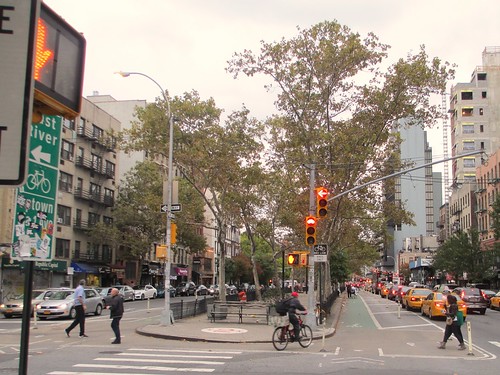
I'm struck, however, that it’s often the people least cut off from the reality of the city around them – cyclists out on the streets, intensely aware of all that’s going on – that are disproportionately involved in campaigns to make the streets safer. It’s a serious safety issue that so many vehicles allow their users to cut themselves off so thoroughly from events outside. It’s hard not to imagine that people with clearer views of pedestrians and cyclists and fewer barriers to hearing street sounds might be less likely to run them over.

I have no immediate policy magic wand to wave to bring about that change of perception.

But an idea came to me the other night as I undertook a late night ride home past the still-buzzing bars and music venues of Bleecker St, the Greenwich Village street where Bob Dylan performed many of his earliest gigs. In Talking World War III Blues, one of the songs from that early era, he describes a dream about being the lone survivor of a third world war. Then he remarks, in the last verse, that many other people seem to have similar dreams.

"Everybody sees themselves/ Walkin' around with no-one else," he says.

Not everybody’s dream can be right, he says.

"I'll let you be in my dreams if I can be in yours," he drawls.

That's the nearest I have to a solution. I'll let you be in my street-world if I can be in yours.

Wednesday, 30 October 2013

A SoHo epiphany, a South London mugging - and the loneliness of the small-hours cyclist

It was around 12.45 in the early hours of last Thursday morning, as I bounced and dodged along the rutted, uneven surface of Grand St, my new route home through SoHo, that I came across an obstacle of the kind one’s apt to encounter at that time of night in a big city. Workmen had closed the street as they moved equipment into and out of the work sites that have been dotted along much of that street for the last year or so. A big sewer underneath is being replaced. I picked up my bike and, eager to get home after a 16-and-a-half hour work day, wheeled it along the sidewalk past the obstruction. Then I got back on, cycled a block and waited for a red light.
 
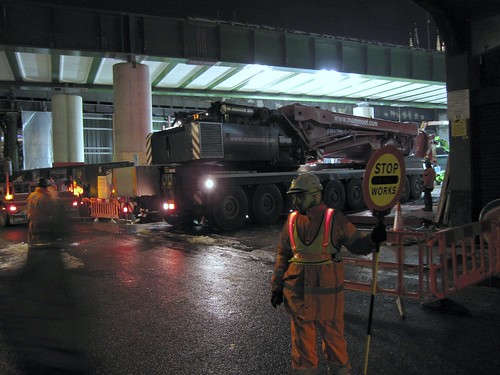
A late-night workman bars my way by London's Southwark
Cathedral: similar to my Grand St experience,
if less poetically picturesque
As I paused, however, I experienced one of those moments on a bike that takes the mind racing off to all kinds of other places. To my left, peering into one of the holes for the sewer, was a safety-helmeted workman. The man, who looked to be of Amerindian descent, looked weather-beaten and sad. I could see his wizened, resigned face in minute detail because of the lights shining up from the work site down in the hole. The expression and unusual lighting gave the picture a timeless feeling. The scene I was witnessing on a New York city street in 2013 could almost as easily have been from some 17th century painting depicting shepherds peering from the dark into a lit stable to adore the newborn Christ.

It was also, it occurred to me, the kind of encounter that’s more common when one’s cycling very late at night or very, very early in the morning – the times when one’s out on one’s bike and most of the rest of the world is asleep. The few people one sees are out for some specific purpose – fixing the streets or transit system, disposing of yesterday’s detritus, delivering the coming day’s food, continuing a celebration that started the previous evening or ensuring public safety. The encounters take on a far more intense flavour than the countless interactions of a bike journey at a more normal time of day. I’ve had things thrown at me at those times of day, helped a mugging victim and come upon a lone woman jogging through an entirely darkened city park.
 
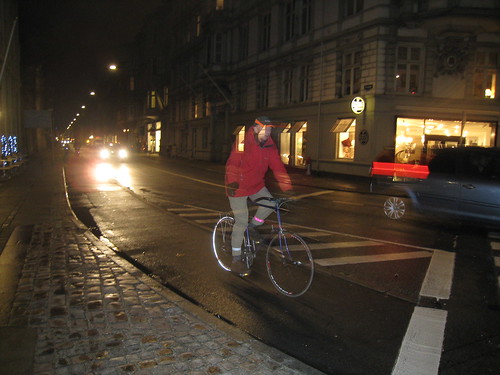
Cycling late at night can feel ghostly quiet. But I've never
felt quite as ethereal as I made this Copenhagen cyclist look.
However, my main memories are of the peculiar euphoria that comes from rushing (as one often can) through a city that’s so calm and devoid of its usual sounds as to seem like an entirely different place.

It’s a form of riding of which I have disproportionate experience. Early in my career, when I worked for The Scotsman in Edinburgh, I had bursts of working as the late-shift reporter. I’d come into the office for 6pm, work until the paper’s final edition was done at 1am then head home by bike through the Scottish capital’s old town. I remember bowling across the Meadows – a rough Edinburgh mixture of Central Park and Boston Common, American readers – on crisp, clear nights, along lines of trees, speeding towards home.
 
A lit-up building by Park Lane: a scene
I'd witness looming across the road at me
as I cycled early morning or late at night
to or from Paddington Station.
When I moved later to London, I often had to catch early-morning trains or flights. Quite the most challenging were the times I had to go to Paris for the day and catch the 5:25am train from St Pancras, eight miles from my house, checking in at 4.55am. I’d dash across town in the early morning quiet, down roads that a few hours later would be prohibitively busy, at a steady 20mph. On arrival, I’d often wonder that I’d dared go as fast as I had, given the load of laptop, washbag and so on often weighing down my panniers, threatening to pitch me into the road if I hit a pothole.

On such journeys, the loudest sound to be heard was often the long rattle as some early morning shopkeeper or underground station manager lifted up his security roller shutter. The rat-a-rat-a-rat-a-rat-a sound would echo off the face of the opposite buildings, disturbing the dawn stillness. There was also sometimes, on side streets, the distinctive hum-and-rattling-bottles of a British electric milk float doing its rounds.

Other than that, there was a strange feeling that this was a world with its mute button on. Police vans or ambulances would often rush by, at speed, but on empty roads only the lights would flash and the engine emit the slightly higher-pitched hurry-hurry-hurry sound that says the driver has his foot firmly to the floor. There would be a gentle “whoosh!” sound as the vehicle passed, then a resumption of the quiet.

But one would also come upon people. One frosty morning in February 2006, I cycled from Brixton to Shepherd’s Bush to give a 6.30am interview at BBC Television Centre. As I rode shortly after 5am through a pitch-black Battersea Park, I was surprised to find I was not alone. There, running along entirely unlit roads, was a woman I took to be London’s most dedicated fitness fanatic.

A couple of years before, cycling home late on a Friday night through Camberwell, South London, I noticed a woman hunched over on the pavement by the roadside shouting, “They got all my money!” Looking down the road, I saw the silhouettes of three young men running away across the street. I talked to her and took her into a neighbouring ambulance station while we waited for the police. The incident – along with the time I heard the smash of a thrown bottle that had just missed me at midnight in a public housing estate – persuaded me to stick mainly to main roads at such times of the night.

The ambulance crews offered the woman tea and very British calming words as she sobbed hysterically about how she was meant to be at a friend’s wedding the next day. It was another scene played out in a mixture of darkness and the warm light from inside the ambulance station. The picture – the ambulance drivers gathered in quiet concern round the seated, weeping victim – had an Old Master timelessness similar to the scene I would much later witness by the hole in Grand St.
 
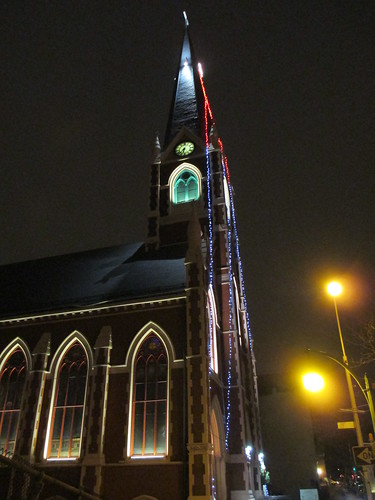
A night-time church spire in Carroll Gardens,
Brooklyn: home - who knows - to depictions
of magical scenes similar to those the
Invisible Visible Man has encountered late
at night on New York's streets
But the level of activity I encountered last week on Grand St – and the fact I was also recently stopped there late at night for a filmshoot – illustrate something rather different about cycling late at night in New York. The subways don’t stop just after midnight as the London Underground does. One’s apt to come upon sudden busy scenes even in the small hours of the morning. A couple of times recently, I've cycled across the Manhattan Bridge at 12.30am and seen below me three lanes of traffic on FDR Drive. How strange, it seems to me, cycling on my own a hundred feet above them, to be stuck as 1am approaches, staring at the rear lights of the car in front.

There are, however, subtle signs in New York when it’s late. One’s more likely to pass a work train rumbling behind a diesel engine along the Manhattan Bridge subway tracks than during the day. The garbage trucks are more likely to be private operators picking up restaurants’ potato peelings and empty bottles than city trucks picking up every house’s refuse.
 
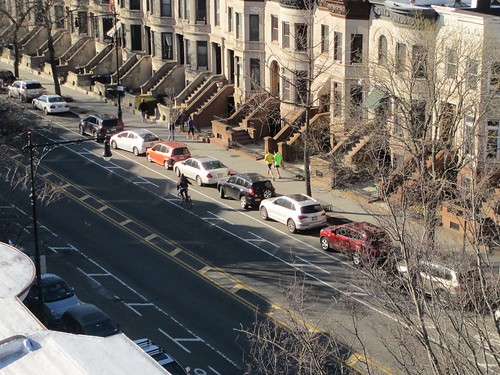
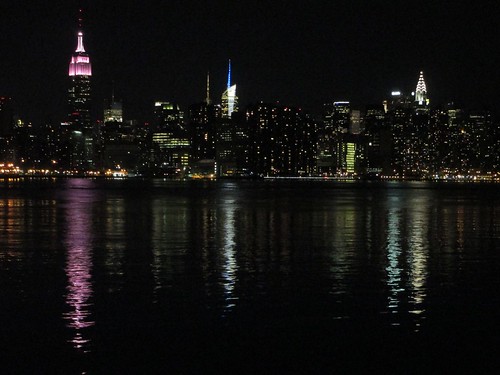
A late-night New York City skyline: fine fingers of Art Deco
elegance from the Empire State and Chrysler buildings.
But there is still a special magic about riding when most people are sleeping, even in the city that itself never does so. I saw one woman striding down Boerum Place in downtown Brooklyn at 11.30pm, holding a small child’s hand and yelling accusations desperately at whoever was on the other end of her cellphone. There was the guy I encountered one night recently so drunk that I feared I’d be obliged to accompany him all the way home.

The most striking moments, however, are the ones where the dark and the shafts of light interact to pick out a startling detail. One’s eye will catch the lights on the Chrysler Building’s spire, fine fingers of art deco elegance pointing into the night sky. Or one will find a man who’s peering into a sewer - but providing for a brief moment a reminder of some of the most sublime moments in western art.

Sunday, 20 October 2013

A Film Set, a New Route - and the Joy of Rediscovering Urban Cycling

It’s the kind of intervention in one’s journey home that’s never normally welcome. As I rode my way down Grand St in lower Manhattan around 10.30 in the evening, I found a skinny young man wearing a headset blocking my way. No-one was allowed onto the next block, he said, until the film crew had finished this take. It took only a couple of minutes – although the time felt longer, given that I’d rashly for the time of year put on only a t-shirt on my top half.
 
Grand St in Chinatown: city street, film set or cyclocross
track - it can't settle on a single role
But, despite the inconvenience, I felt a little thrill at being stopped on my way home on Friday. That a film crew was filming on a road on my way home was confirmation that I was, once again, the kind of cyclist whose routes lay along grittily interesting urban streets. For more than a year since moving to New York, I’ve done the majority of my Manhattan cycling on the waterfront greenways, riding often at speed but grappling only in little bites with the serious urban cycling of riding on a street with traffic. Following a move in my employer’s office, I now ride across lower Manhattan from the Manhattan Bridge to Hudson St in SoHo, on city streets for nearly all the distance.

The change has reminded me of some of the sheer pleasures of being an urban cyclist. My riding patterns far more closely resemble those I had in London, where I’d ride mostly along the London Cycle Network of routes along quiet back streets. I’m catching once again little vignettes of city life – I notice, for example, how oddly resigned and depressed the faces of the people waiting each morning for the opening of the Prince Street Apple store are. Pushing a hot dog cart to its place in the morning looks like really hard work.

The contrast between midtown and the relatively relaxed cycling environment in lower Manhattan – where there’s motor traffic, but not on the same scale as further uptown - has also highlighted another truth. Cycling in any place where cars dominate the public space can be pretty dispiriting. I’m missing the last mile of my old work route – where I’d battle my way up 54th street from the Hudson River to my office – not at all. If big cities want to encourage cycling, conditions in such forbidding areas need to be addressed.

The USS Intrepid: just one of the Hudson River landmarks
no longer on the Invisible Visible Man's daily route.
Yet these aren't the reactions I'd expected. For months before the move, I’d been telling anyone who’d listen – and a fair few that wouldn’t – how I was dreading the move. I’d grown used to commuting nine miles each way to and from work, including a four-mile sprint up the Hudson River Greenway along the west side of Manhattan. I was particularly concerned about my waistline. Within a few months of undertaking a daily 18-mile round-trip commute, I was noticing the difference when I stood on the bathroom scales in the morning. I’d dropped a good five or six kilos compared with when I moved in August 2012 from London.

There are certainly sad points about no longer having a daily ride by the Hudson. On my last morning on my old route, I was looking wistfully across at the buildings in New Jersey, glittering in the autumn sun on the river's far bank. I cast a sentimental glance to my right up at the Empire State Building, which I now see only in the distance. I took a picture of the USS Intrepid as I passed it for the last time as a commuter. I was dreading not only the new route’s reduced riding but also the stresses of the new route I’d planned. To the west of the new office – the angle from which I planned to approach – streets buzz with high traffic volumes, pouring into and spewing out of the cross-river Holland Tunnel.
 
The bike route onto the Manhattan Bridge: a quick route
to lower Manhattan streets - and romantically urban to a fault.
But, on my second morning in the new office, it occurred to me that it was worth trying the simplest, straightest route across town to the new site. I sped over the Manhattan Bridge, instead of the Brooklyn Bridge, dropped down into Chinatown and navigated my way across to Prince St. I discovered how the old, muddled-up street plan meant no-one expected to speed across SoHo. More to the point, I arrived with a smile on my face. The route had been chaotic, grimy and a little bit noisy – far more unmistakeably a ride through New York than my former ride on a calm, orderly path up by the Hudson.

I also, I’ll admit, felt a little bit cooler than before. For the last 14 months as I’ve fulminated about this or that aspect of New York’s road culture, I’ve had a sneaking feeling that maybe I wasn’t quite getting it. Nearly two-thirds of my ride to work was car-free and I’d found some of my efforts at on-street riding pretty terrifying. I’d watched on Twitter the discussions between more seasoned New York cyclists of their experience in the lower east side, SoHo, Chelsea and elsewhere in the island’s lower reaches and suspected they were simply cooler, more sophisticated, bolder people than I. Most of them remain, no doubt, cooler and more sophisticated than I – but I have less awe of their willingness to ride on these areas’ streets.

Bike lanes on Allen St at the Rivington St intersection:
a small-time entrepreneur wheeling goods down the bike
lane adds an authentic detail.
It’s certainly not a perfect experience. The journey would be more fun still if more New Yorkers had a better understanding of where the stress in the phrase “bike lanes” is meant to lie. Many seem to hear the term “lanes” and adopt them as the ideal spot to wheel their food truck, haul their suitcase or park their police car. Better protection for many bike lanes would be welcome, as would a reining-in of many vehicles’ speed. I’ve also yet to find an ideal route home. One of those cooler, more experienced cyclists, Joanna Oltman Smith, warned me before the move to avoid Grand St, the most direct route, which extensive sewer works have turned into a cross between a slalom course and a rutted country track. I’ve not yet found a better alternative – and, truth to tell, am enjoying the sense that I might be quietly training for unexpected stardom on the seniors cyclocross circuit.

On the other hand, I now look almost fondly on the elderly Chinese woman I see each morning blocking the Rivington Street bike lane stuffing her bags full of recycling. I marvel at the Beaux Arts magnificence of the Little Singer Building as I cross Broadway. I note how adept the city – like London, my former home – has been at reinventing itself. I see neglected-looking synagogues built for a Jewish community now mainly departed from Chinatown. Factories that once made clothing have been transformed into trendy offices for those of us in the media set. I hear even more of the city's sounds. Next summer, I expect to be still more aware of its smells. I was cycling round New York City on my old route. Now I arrive at the office, a smile on my face, excited at how I've been riding in it.
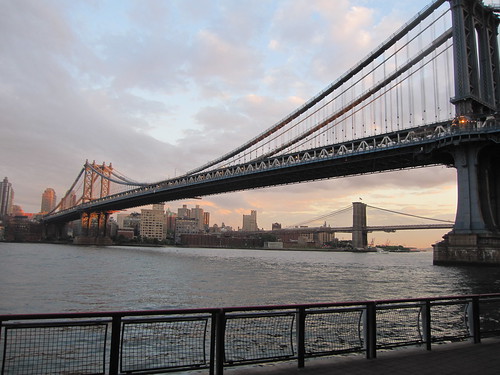
Sunday, 23 June 2013

Hear this: what I heard on the street - and what it says about cycling's merits

It was as inconvenient a time for a work call as I can imagine. I had grabbed my ringing phone from my pocket just as the lights turned green at an intersection on the Invisible Visible Boy’s short route to school. “I can’t talk now,” I shouted before stuffing the phone back into my pocket, leaning heavily down on my pedal and getting myself, my bike, the boy and his trailer bike all safely again into forward motion.

But, once I’d said goodbye to the boy and phoned back my colleague in London, he didn’t immediately want to talk about the matter in hand. Instead, he made me realise how thoroughly I’d taken for granted one of my key sources of information about the world around me as I cycled. I’ve been noticing ever since how many sounds I hear as I ride around – and how richly they add to my experience.

“You didn’t ring off properly,” my colleague told me. “I could hear the sound of the wind – and your son’s giggling.”

I had, I suppose, assumed before my colleague mentioned it that most of the time while riding I wasn’t hearing very much. For much of my journeys both to and from work, I work my way past long lines of waiting cars. No-one’s saying a great deal. Even though it’s New York, people mostly don’t even bother with honking. They just sit there.

Clinton St, Cobble Hill: very nice for people - and even,
the Invisible Visible Man was surprised to hear,
a hit with gentrifying birds
But, the moment I started thinking about it, I recognised how much information my hearing was giving me. The wind whistles in my ears, with anything from a whisper to the full-throated, jet-engine roar of a seriously stormy day. I hear the gentle whir of my bike’s rear hub. There’s the gentle clicking as I change onto an easier gear and sometimes a slight clang as the gear cable loosens and lets the chain slip down to a smaller sprocket. It’s a good sign if I don’t hear very much. Recently, a tiny bit of water crept into one of my pedals and I’ve run out of the grease I need to make it completely quiet again. Every now and again it emits a little squeak, sending my stress levels a little bit upwards.

Much of the time, as I pedal along steadily, songs play in my head, to the rhythm of my breathing and pedalling. For a while now, for reasons I don’t entirely understand, the tune seems to have been Lyle Lovett’s Walk Through the Bottomland – an obscure choice, even to me, but one whose deliberate beat seems to fit with the way I cycle.

The bike’s interaction with the road makes its own sounds. Occasionally, I’ll hit some stray stone on the road and send it flying – thwack! – into a parked car. My mudguard (fender, American readers) gives off a tiny bit of a vibrating sound – a very miniaturised version of an arrow hitting a target – every time my front wheel jars into one of the countless imperfections in the road surface. On the Brooklyn Bridge, there’s the steady clack-clack of the wooden boards on the walkway, as the bike hits each and sets it vibrating against the metal underneath. One night recently, I went over the Queensboro Bridge and enjoyed the sensation of racing down into Queens on a surface made up of jointed concrete slabs – ka-boom-ka-boom-ka-boom-ka-boom, steadily faster as I picked up speed. It’s hard to sort out in my head which of these sounds is audible to the wider world and which is conveyed direct from the road to my skull as the bike judders against the crack in the road or the joint in the concrete.
 
The Manhattan Bridge: a perfect urban cacophony
There are sounds of place elsewhere, too. As I leave my apartment, I hear subway trains growling complainingly around the Culver Viaduct high above my head. Then, the other morning, in another part of Carroll Gardens, I heard what I thought must be a novelty doorbell or strange alarm. No, I eventually concluded, there were actually some birds living happily enough in the trees along Clinton Street that they were singing out to each other one June morning rush hour. In some places, the audio soundtrack actually provides far more of the atmosphere than what one can see. Riding over the Manhattan Bridge yesterday, I noticed how I could hear the sound of wash breaking on the shore down below in Dumbo. Then a subway train rolled out onto the bridge, its clanking echoing off the roadway that runs above the tracks and drowning out the sounds of the motor traffic. As I raced the train over the bridge and gathered speed on the ramp down into Chinatown, I ran over one of the loose inspection covers. “Clunk-clank!” it went as I too sent the sound of my own progress echoing off the roadway’s underside.
 
This is how the bike lanes under the FDR Highway look.
But the Invisible Visible Man hears the sound of the cars
banging over the joints in the road above
My sudden noticing of the birdsong, the sounds of the road and the cacophony on the Manhattan Bridge have all made me feel far more positive about the sounds that surround me as I cycle than I used to. Then, I noticed mainly the sounds of stress. Like most cyclists, I’m constantly listening out for the tone of the engines behind me in traffic, ready to pick out the note of a driver who’s revving his engine, ready to accelerate dangerously. It’s one of the clearest warning signs one can encounter that a driver isn’t going to behave safely.

None of that is to suggest, however, that the most noticeable sounds don't cause me anxiety. The volume of honking gradually rises each morning as I ride towards the Brooklyn Bridge – especially if there’s a garbage truck blocking Clinton Street emitting the strange low-high-low hum of its hydraulic crushing mechanism. The honking reaches a pitch as I struggle my way through TriBeCa. On Friday morning, an angry motorist in a hurry slammed on her brakes when I stopped for a red light where Chambers Street crosses the West Side Highway. She gave me a long, unmistakeably intimidatory blast of her horn for having the temerity to stop her from running the light.

Those aren’t the only worry-inducing sounds. Any encounter with a large, road-hogging SUV has an extra edge when it’s blaring out rap so loud that the whole car vibrates. The motorists with most faith in honking’s efficaciousness seem least ready to move aside for emergency vehicles and I hear their drivers using their sirens to plead their way out of traffic. The mixture of short blasts, honks and steady whines they emit sounds like nothing so much as a pitiful trapped dog. Probably no motorist driving along Boerum Place in downtown Brooklyn the other night was able to hear how desperately the woman traipsing along the street at 11.30pm with a toddler son and luggage was swearing as she pleaded for help or criticised or did whatever she was doing to the person on the other end of her ‘phone call.

But the exposure to the stress is a flipside to the joy of hearing all this sound. It’s a pleasure of cycling round the city that all my senses are in immediate, unfiltered contact with the world around me, rather than being filtered through tinted windows and soundproof doors. I’m experiencing the city far more fully than I would in a car or a subway train.

That came home to me most fully late last summer, when I had not long moved to New York. As I stopped for one of the last sets of lights near my home, an old sedan drew up next to me, its windows rolled down. For a few seconds, I was treated, wholly unexpectedly, to a blast of sublime 1960s jazz, saxophones running riot over a pulsing bass line. I looked over at the driver. We both smiled, surprised to find ourselves sharing a brief transcendent moment of musical appreciation.

Sunday, 2 June 2013

Citibikes, drivers - and the science of moral development

When I first started cycling to work down W54th street in Manhattan, I used to find it puzzling how cars would suddenly come to a complete, but brief, halt half way between 7th and 6th avenues. Then, after a while, I realised what was going on. There was a stop sign intended to protect a crosswalk on the new 6½ Avenue pedestrian path half-way along the block. Cars would carefully come to a complete - but milliseconds long – halt at the sign, to fulfill the legal requirements.

But I quickly recognised a second phenomenon. When I approached the crosswalk, I would stop if I saw pedestrians waiting to cross and let them go.  Most motorists would do the brief halt and drive on regardless, forcing the pedestrians to wait until a break in traffic.

The crosswalk came to symbolise for me the way that many drivers in cities worldwide end up reacting to road rules. They follow what they understand to be the letter of certain laws – in this instance, that cars must stop fully at a stop sign in New York City. But they ignore the wider spirit – that one should not barge past pedestrians trying to cross the road at a designated crossing point. The road environment for pedestrians trying to use 6½ Avenue is little safer as a result of the drivers’ brief stop at the stop sign than if they simply blew through. The sign plays next-to-no role in reducing the horrific annual death toll on New York City’s roads.
 
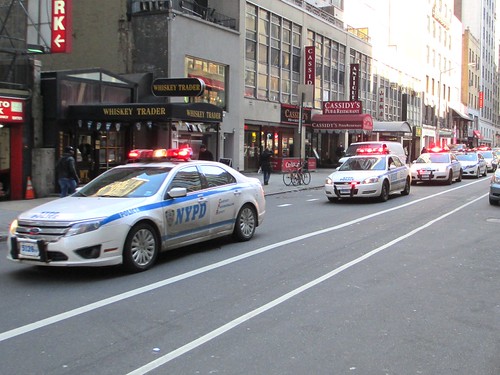
Five New York Police Department cruisers on W55th Street.
A heroic guess: in none of these vehicles is an officer pondering
how to push road users towards Kohlberg's higher stages
of moral development.
The behaviour puts me in mind of the famous work on moral development by Lawrence Kohlberg, a psychologist who classified people’s moral development from the earliest stage – when they merely sought to avoid punishment – to the highest – when they behaved according to an established set of ethical principles. The drivers’ behaviour around the stop sign demonstrates the kind of moral reasoning that, in other fields, one might associate with a toddler seeking to be naughty but get away with it.

The question is how a city – any city, but the most pressing examples for me at present come from New York – can become a place where people interact according to the most advanced stages of moral development. Cities should be striving towards roads where users treat each other out of genuine concern and insight into the other person’s interests.
 
A Citibike stand, by the Brooklyn Waterfront, complete
with neophyte cyclists. Let's hope they're as keen
when they've completed the ride as before
The subject has been particularly on my mind this week because of the launch of New York’s Citibike bike-sharing scheme. It’s clear – from my own observations and from Dmitry Gudkov’s excellent stories and pictures of riders – that many new riders are using bikes for transport for the first time in New York City. It would be a tragedy if, after such a positive start, those new cyclists were to find themselves put off by the near-misses and abuse that other cyclists all too often experience.

The answer, it seems to me, lies in a shift in policing thinking intended, as good parenting should, to push road users gradually towards more considerate use of the road. It is likely unfortunately to prove a long, slow process.

I encountered evidence of the scale of the challenge on my way to work on Friday, as I made my way down E55th street. A car started pulling out into the bike lane as I approached, trying to push into a traffic jam, despite my repeated shouts that he was pulling into my path. When I finally, despite his continued efforts to block me, squeezed past, he shouted after me, sanctimoniously, “Share the road!”

There’s a simple problem underlying these complex issues, however. The NYPD, like probably quite a few police forces worldwide, doesn’t seem to have much of an idea what it’s trying to achieve with its road policing. That’s self-evident looking at most precincts’ traffic ticket statistics. Ticketing focuses heavily on issues like excessively tinted windows that are easy to prove, rather than on offences such as speeding or distracted driving where the behaviour is harder to prove but creates far more danger.

Only basic laziness – and the need to meet some arbitrary monthly target for ticketing – can explain incidents such as the one in April where several policemen - from a force, remember, that claims to have too few resources to investigate crashes properly - stationed themselves late at night on part of the Hudson River Greenway and ticketed and fined cyclists “for their own safety” for the purely technical offence of being in a New York City park (rather than on the far more dangerous roads) after the parks’ official 1am closing time. This and other similar incidents – the truck policing unit that ticketed more cyclists than trucks, for example – suggests the pressure on NYPD traffic cops is to meet quotas for ticket issuing, rather than to make the streets safer.
If such an approach is at work, it would chime with the evidence that’s emerged from the civil case against the NYPD over “stop and frisk” – the NYPD’s insistence on stopping young men to search them for weapons on even the most flimsy evidence. That trial has produced evidence that officers were told to meet targets for monthly stops, rather actually arresting criminals for serious offences. The force is facing legal action because many officers seem to have assumed – and in some cases to have been explicitly told – that the goal was to harass young black and Latino men.
 
Traffic infringements abound on W54th street.
A simple contribution to the police benevolent fund,
however, and no driver need worry.
On traffic policing, meanwhile, another regular sign of attitudes is the proliferation on cars of signs showing support for one or other police organisation or benevolent organisation. The signs clearly reflect an attitude that a traffic ticket is a piece of random bad luck to be made go away, rather than a punishment for a serious offence that could kill or maim another human being. That these signs continue to be so popular suggests they are effective at deterring trouble – and that many police officers agree on road offences’ importance.

It would surely make far more sense for senior police officers’ pay or promotion prospects to depend on measures of desirable outcomes on the roads. Would a precinct commander who knew his pay depended on a 20 per cent fall in road deaths and serious injuries send officers to harass cyclists using an important cycle path simply because it was too late at night? Would he allow his officers to hand out as many or more fines for excessively tinted windows in a month as for the widespread – and deadly – offence of speeding? It’s instead far more likely, I’d suggest, that officers would start to think seriously about policing the crimes that kill and injure large numbers of people every year. It should also help to stop the nonsense that drivers effectively buy immunity from prosecution via donations to police benevolent associations.

I can’t pretend, of course, that such a change would immediately turn every city road user everywhere into a practitioner of the highest, level six stage of moral development under Kohlberg’s principles. Those who have reached level six apply universal moral principles to their interactions with others, seeking to be entirely fair. Most UK police forces concentrate more on the deadliest offences – even if I disagree with many of their attitudes – and drivers in London remain often aggressive and inconsiderate.

But a clearly-signalled change of strategy would surely indicate to drivers that the outcomes of their behaviour – the numbers of pedestrians mowed down in crosswalks, for example – matter. It would shift drivers’ thinking about road policing away from a focus on the grubby transaction – how do I get this officer to ignore my speeding? – towards something a little more positive. What happens if I speed here, hit someone and get treated as other killers would?

The Manhattan Bridge: it is physically impossible, in good
weather, to bowl down the bike lane unobstructed
without a smile on one's face
I recognise such a change remains, sadly, far off in New York, although it may be closer – or may even have arrived – elsewhere.

The scene I encountered in the early hours of Saturday as I rode home makes me wish that were not so.

I had to work late and took a convoluted route home, through Times Square, the Broadway Bike Lane and the east side bike path to the Manhattan Bridge. As I started my climb onto the bridge around 1.30am, I encountered a young couple whizzing the other way on Citibikes, wearing the broad grin that pretty much anyone who’s ever barrelled down that lane unobstructed on a warm summer’s night must have done. A week before, they probably weren’t New York City cyclists. I can only now imagine they’re warmly commending the experience to their friends. It would be sad if a nasty grouch such as E55th street man were to change their minds – and an unspeakable tragedy if something still worse were to befall them.